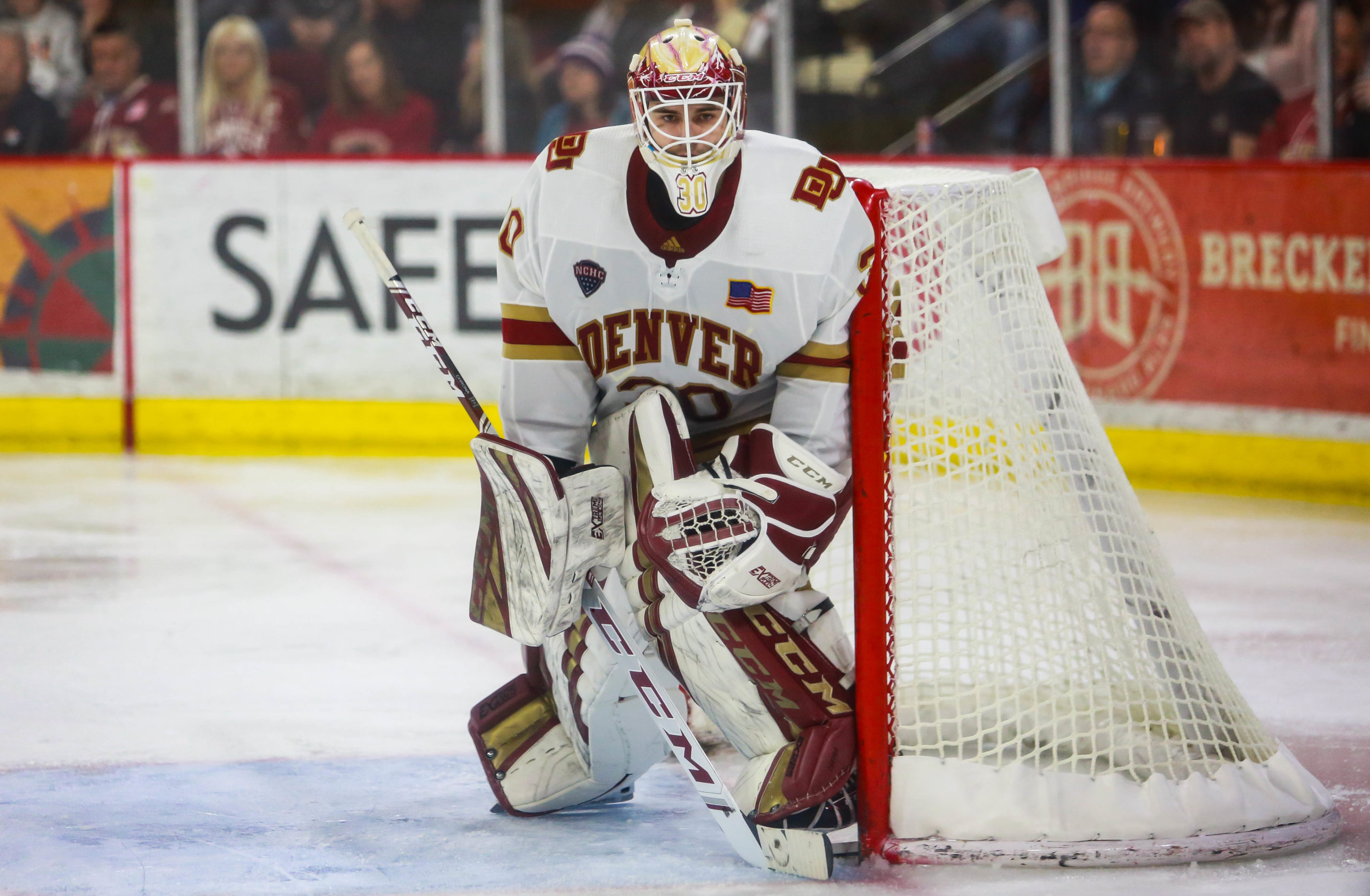
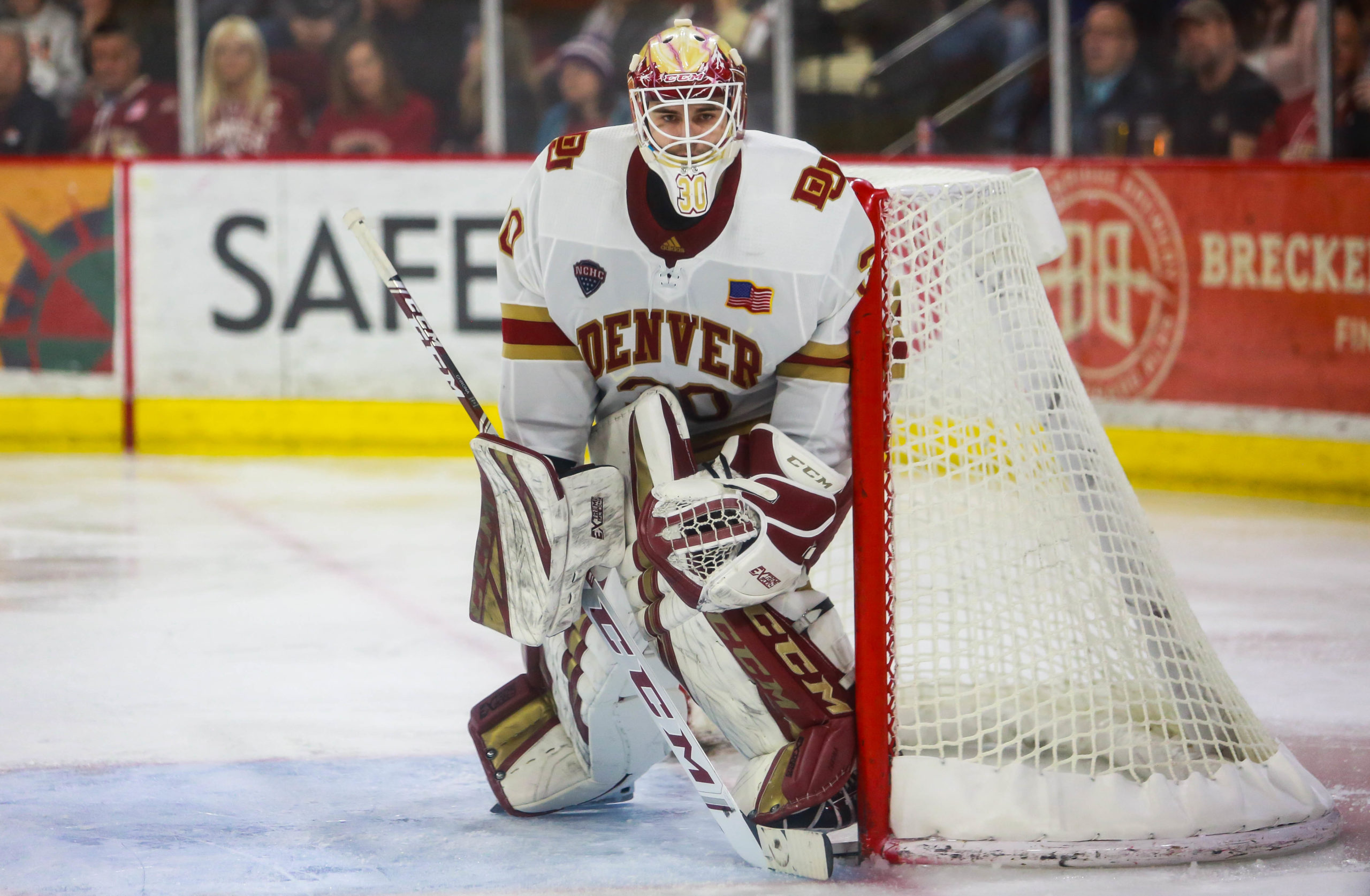
If the DU Pioneers are to repeat as NCAA men’s hockey champions, they’ll have to do it the hard way — again.That ethos will be put to the test once again this week, with many of the same players back from last year’s national title squad. That includes tournament hero Matt Davis between the pipes and Hobey Baker Award finalists forward Jack Devine and defenseman Zeev Buium.The other two national seeds are No. 2 Michigan State (26-6-4) in the Toledo, Ohio, regional and No. 3 Maine (24-7-6) in the Allenton, Pa., regional.“It seems to happen to us a little bit more than everyone else,” Carle said of the tough regional draw after last year’s 2-1 win over Cornell in the regional championship. “… Will we ever let it be an excuse for us? Not a chance. We’ll play anybody, anywhere, anytime.”The Pioneers are aiming to become the first back-to-back national champion since Minnesota Duluth won it all in 2018 and ’19. They could also become the first program to win three national titles in four years since DU did so in 1958, ’60 and ’61.The University of Denver will open the 16-team NCAA Tournament in New England for the third year in a row, it was revealed Sunday afternoon. The Pioneers were placed in the Manchester Northeast Regional, which features No. 1 overall seed Boston College, Providence and Atlantic Hockey champion Bentley.Originally Published: DU is 44-25 in the NCAA Tournament and 15-3 in tourney games since 2017 — a run that includes national titles in 2017, ’22 and ’24. The Pios have reached the Frozen Four five of their last seven NCAA Tournament appearances and 19 times overall.DU lost to Western Michigan in the NCHC Frozen Faceoff championship in double overtime late Saturday night. Western Michigan (30-7-1) ended up getting the No. 4 overall seed as a result but is in a brutal bracket with Minnesota State (27-8-3), Minnesota (25-10-4) and UMass (20-13-5) in Fargo, N.D. And now the Pios are headed to Northeast Regional as an at-large selection.The win over Cornell avenged an NCAA loss the year prior when the Pios were again sent to the Northeast Regional in Manchester as the four-team bracket’s top seed.Want more sports news? Sign up for the Sports Omelette to get all our analysis on Denver’s teams.
The defending national champion Pios (29-11-1) will take on Providence (21-10-5) in the opening round at 3:30 p.m. MDT Friday at SNHU Arena in Manchester, N.H. The winner will play either Boston College (26-7-2) or Bentley (23-14-2) in the regional title game next Sunday at a to-be-announced time.DU entered last year’s tournament as the No. 3 overall seed but was placed in the Northeast Regional in Springfield, Mass. The Pios ended up taking down UMass and Cornell with back-to-back 2-1 wins to advance to the Frozen Four, then beat Boston U and Boston College back-to-back to claim the program’s record 10th national title.
Thriving in the NIL era, Ole Miss turns into an unlikely college football powerhouse
Well, big games are usually built on two things decision making and nerve. In the Sugar Bowl, the Ole Miss Rebels proved stronger in both. The Rebels didn’t need perfection. They needed poise. And in *** game defined by moments, the Rebels making more of the right ones by taking down *** Georgia team built on pressure and precision. Kind of challenged them at halftime and said, you know, look, we, we were up 9 on these guys going in the 4th quarter last time. I said, let’s play 30 minutes of football and I’ll physical them and execute, and, and they responded like they have all year. Uh, it’s *** super tough group. They got *** lot of grit, and they love playing football, and, and then, you know, they’re not tired of it. So just really, really proud of the group and the effort that took place tonight. Well, with Georgia behind them, the Ole Miss Rebels will now move on to face Miami in the Fiesta Bowl up in Arizona, and the Rebels aren’t just advancing, they’re officially announcing themselves as true, legitimate national contenders. Reporting in the Caesars Superdome, Marissa Stubbs, 16, WAPT News.
Thriving in the NIL era, Ole Miss turns into an unlikely college football powerhouse
Updated: 3:32 PM CST Jan 7, 2026
Editorial Standards ⓘ
Mississippi’s football program is thriving in the NCAA’s pay-for-play era. The sixth-seeded Rebels will face No. 10 Miami in the Fiesta Bowl for a spot in the national championship game. It’s the biggest game for Ole Miss in at least 50 years. It’s also the culmination of a massive fundraising effort athletics director Keith Carter and other behind-the-scenes people that’s helped the Rebels gain an upper hand in the NIL era. Carter said he’s confident Ole Miss can maintain its status in the game’s elite, even as bigger schools start to organize their fundraising efforts to match the Rebels.
OXFORD, Miss. —
Mississippi’s football program is thriving in the NCAA’s pay-for-play era.
The sixth-seeded Rebels will face No. 10 Miami in the Fiesta Bowl for a spot in the national championship game.
It’s the biggest game for Ole Miss in at least 50 years. It’s also the culmination of a massive fundraising effort athletics director Keith Carter and other behind-the-scenes people that’s helped the Rebels gain an upper hand in the NIL era.
Carter said he’s confident Ole Miss can maintain its status in the game’s elite, even as bigger schools start to organize their fundraising efforts to match the Rebels.
Washington quarterback Demond Williams Jr.’s announcement Tuesday night that he plans to enter the NCAA transfer portal sent shockwaves through college sports.
Four days earlier, he’d signed a contract to return to Washington, which was set to pay him in the mid-$4 million range and put him near the top the market for college football. Washington continues to pursue legal action, per sources, to enforce the contract.
Williams’ declaration online that he is leaving quickly became a touchstone for a sport and system where there’s already significant skepticism over the viability of signed contracts.
What happens next with Williams will speak volumes about the future of college football and the enforceability of contracts, providing a bellwether for this new era of college sports.
“This is a very bright line,” a high-ranking college official said. “Are we going to respect each other’s contracts? This is a very simple thing. If we can’t protect this, nothing else matters.”
If Williams follows through on his desire to leave Washington — LSU is the presumptive favorite for his services, but others are expected to be involved as well — his case will be a litmus test for the rules of a new era. And it will likely end up in court.
The situation can be boiled down to a simple point that has been a running issue and an embarrassment for college sports: Can contracts be enforced?
“This situation is a product of 2026 football,” a prominent athletic director told ESPN. “Where the story ends, this is one of the big moments in college football — or really, college sports — and what we do next.”
When initially contacted, Demond Williams Sr. — the quarterback’s father — declined to comment.
If Williams attempts to leave for LSU or another school, it is likely to become a bigger saga than former Tennessee quarterback Nico Iamaleava’s jump from Tennessee to UCLA last year.
It’s also a potentially much higher-profile version of the legal fallout — still unresolved — from the departure last fall of Wisconsin defensive back Xavier Lucas to Miami.
Wisconsin sued Miami claiming the school committed tortious interference by knowingly compelling a player to break the terms of his deal with the Badgers.
Williams is a household name in the Big Ten and among college sports fans, as he threw for 3,065 yards and 25 touchdowns this season. He also ran for 611 yards and six touchdowns. Williams was originally committed to coach Lane Kiffin and Ole Miss in 2023 before flipping to Jedd Fisch and Arizona. He followed Fisch to Washington when Fisch took the head coaching job there in 2024.
“This wouldn’t happen in professional sports,” another high-ranking college official said. “Things like this seem to show that people think that they can do anything.”
The college sports world is watching intently. One general manager at a top program told ESPN on Wednesday: “It’s extremely embarrassing the system allows this. There’s no stability at all. How are people sitting around watching everything crumble? What are the leaders doing? What are the commissioners doing? How do we not get everyone in a room and not leave until there’s a solution.”
One veteran head coach added with a chuckle on the lack of oversight: “I don’t even know who we turn complaints in to.”
Washington sources say the university is prepared to pursue all legal avenues to enforce Williams’ contract. The Big Ten has also been engaged on the issue, and the league has been vocal in the past about how crucial it is that “agreed-to obligations be respected, honored and enforced.” Williams used a traditional agency to complete his deal. Sources said there had been outreach for more than two weeks from people outside the agency to schools. The agency that did his deal was blindsided by Williams’ portal entry.
Per sources, one person who has contacted schools about Williams is Cordell Landers, who generally refers to himself as an adviser and loomed as one of the central figures in Iamaleava’s departure from Tennessee. Landers denied to ESPN that he is involved with Williams.
ESPN obtained some details of Williams’ Washington contract Wednesday. There are two items that loom large. The deal includes a buyout to leave that is at the “sole discretion” of Washington. The contract also states that “the institution is not obligated to enter the Student-Athlete into the transfer portal or otherwise assist or facilitate the Student-Athlete’s transfer to another college or university.”
Lucas’ move to Miami shows that the portal is not a necessity for players to move, but it is another complicating factor.
Williams’ case speaks to a larger issue in which contracts around the sport — binding schools to leagues, coaches to schools and players to programs — are largely being ignored.
The situation illuminates the system’s flaws, including not having any single entity in charge of the inter-workings of contracts in a multibillion-dollar business. The Williams contract issue doesn’t fall under the purview of the new College Sports Commission, which handles third-party name, image and likeness deals to meet legal settlement rules, revenue sharing from schools in relation to the cap and roster limits.
The NCAA deals with tampering, which could be at play. Tampering, however, has become so mainstream in college athletics that it’s nearly impossible to enforce. Modern legalities also complicate oversight, as a federal judge’s ruling in Tennessee in February 2024 made the NCAA’s role in enforcing tampering more challenging.
The cries for new rules are even more complicated. The lawsuit that led to that legal ruling was filed Jan. 31, one day after Tennessee chancellor Donde Plowman revealed in a letter to the NCAA that the school’s athletic department was being investigated.
While there are calls for reform, there is inherent resistance whenever rules land on a school’s doorstep.
Suddenly, Williams’ situation has emerged as a flashpoint for a faulty system.
“This is a very important moment in our space,” one high-ranking official said, “about how we’re going to behave.”
Former Michigan quarterback Davis Warren is headed to the ACC next season.
Warren committed to join Stanford on Wednesday after entering the transfer portal, according to ESPN’s Pete Thamel. Warren is expected to have two years of eligibility left, thanks in part to a medical redshirt he’s expected to receive.
Warren spent three seasons with the Wolverines, and was a backup to J.J. McCarthy during their national championship season in 2023. He started for the majority of the 2024 campaign, and threw for 1,199 yards with seven touchdowns and nine interceptions.
Warren, however, tore his right ACL during the ReliaQuest Bowl in 2024. That kept him out for the entirety of last season.
The decision by Washington quarterback Demond Williams Jr. to enter the transfer portal shocked and angered the Huskies because only days earlier the sophomore breakout star had signed a lucrative name, image and likeness deal to remain in Seattle.
Legal action by Washington would be no surprise two weeks after similar events prompted an exchange of lawsuits involving Damon Wilson II, an edge rusher who transferred from Georgia to Missouri in January 2025, days after signing an NIL contract.
With recruiting strategy reduced to shoveling stacks of NIL dollars at players who jump through the transfer portal seemingly at will, it’s no wonder loyalty and etiquette have given way to opportunity and greed.
And it should surprise no one that the implementation of rules might be done by judges, not NCAA officials or conference commissioners.
According to ESPN’s Pete Thamel, Washington is “prepared to pursue all legal avenues to enforce Williams’ signed contract,” and the quarterback’s situation has also “drawn the attention of the Big Ten.” Already, Washington has declined to enter Williams’ name into the portal, citing language in the NIL contract that states the school is not obligated to do so.
It appears Washington wants to play hardball, much the way Georgia is attempting to do with Wilson, whose countersuit against the Bulldogs claims he was one of several players pressured into signing his NIL contract on Dec. 21, 2024. Georgia is seeking $390,000 in damages, pointing to a liquidated damage fee clause in the NIL contract that may or may not hold up in court.
Washington officials suspect that another school contacted Williams after he had signed his Huskies deal, and submitted evidence of tampering to the Big Ten. Tony Petitti, the conference commissioner, happened to be in Seattle on Tuesday for a Celebration of Life service for Washington goalkeeper Mia Hamant, who died on Nov. 6 from an rare form of kidney cancer.
Many Huskies football players and coaches also were in attendance when Williams posted his official announcement about entering the transfer portal on Instagram.
“To post his decision to enter the portal during the service was, at best, the result of horrible advice from his PR team, and at worst, a stunning lack of self-awareness,” wrote Matt Calkins in the Seattle Times.
Williams’ NIL deal with Washington for 2026 was estimated at $4 million, a reasonable number for a quarterback who was among the top 15 nationally in passing efficiency, passing yards and yards per attempt. He attempted to enter the portal with a “do not contact” tag, an indication he has a destination in mind.
A chronology of top quarterback movement in recent days provides circumstantial evidence that Louisiana State and Williams have mutual interest. LSU, of course, has a new coach in Lane Kiffin, and a need at quarterback. Turns out Williams and Kiffin aren’t strangers.
Kiffin’s first target was Brendan Sorsby, who had left Cincinnati, but he committed to Texas Tech. Sam Leavitt of Arizona State is considered the best quarterback left in the portal, and he visited Baton Rouge this week before heading to Tennessee for another visit.
However, Kiffin easily could shift his attention to Williams, a dual-threat signal-caller who while in high school committed to Ole Miss when Kiffin was coach. He eventually signed with Arizona, and when coach Jedd Fisch took the job at Washington, Williams followed him.
Williams blossomed as a sophomore in 2025, passing for 3,065 yards and 25 touchdowns with eight interceptions while adding 611 yards and six touchdowns on the ground.
In his lengthy Instagram post, Williams thanked everyone associated with Washington before revealing the news: “I have to do what is best for me and my future. After much thought and prayer, I will be entering the transfer portal.”
Robert Griffin III reveals why NIL, transfer portal are making college football better appeared first on ClutchPoints. Add ClutchPoints as a Preferred Source by clicking here.
When the NCAA entered this new era, where NIL deals routinely enter into seven figures and seemingly a quarter of the players switch teams in the transfer portal each year, it effectively changed the sport forever.
Advertisement
To many, who loved the legacy, tradition, and homegrown feel of college sports, this has been a major adjustment, but to some, especially those who played the sport themselves, it’s been worth it, as it allows players to make some money for their hard work, where that in the past, that would be afforded only to the universities.
Case and point, Baylor legend-turned-pundit Robert Griffin III, who used some time on Outta Pocket Podcast to celebrate this new era for all of the opportunities it gives players.
“A lot of people say that the transfer portal and NIL have destroyed college football. I actually think it’s made college football better. Because now there’s more parody. It’s harder to be a team that is constantly repeating or constantly playing in the national championship game, playing in the college football semifinals. Ohio State, $35 million roster. Couldn’t get to the semifinal this year,” Griffin III declared.
“So what’s the solution? Well you still have to spend money. So that’s been a lot of money. But now you’ve got to be a better recruiter. Now you got to be a better coach. Because if you’re bringing in 10,12,15, 20, 30 guys through the transfer portal, how do you win? You win because they buy into your culture. And if they don’t buy into your culture and there’s a little bit of slippage or you don’t pay the right guy at wide receiver, or quarterback, man you’ll be down the creek without a paddle now.”
Advertisement
Is Griffin on the money? Does forcing programs to continue investing in their players, outbidding rivals in the transfer portal, and hitting the recruiting trail hard actually make for a better product? Considering Ohio State spent that much NIL money on their roster only to get bumped in the first round of the playoffs, it’s clear they will have to pony up for an even better roster next year, which will benefit the players even more.
Related: Big Ten ADs send ‘unanimous’ support to Washington football amid Demond Williams drama
Related: Gio Lopez leaves North Carolina, Bill Belichick for Wake Forest
Through the first part of Bowl Season, ESPN announced its non-College Football Playoff TV ratings surged. That trend continued through the rest of the bowl games.
Across the 33 non-CFP bowl games that aired on ESPN networks, viewership increased by 13% year-over-year, the network announced. The Citrus Bowl between Michigan and Texas led the charge, just surpassing the Pop-Tarts Bowl for the top spot.
SUBSCRIBE to the On3 NIL and Sports Business Newsletter
All told, 11 bowl games hit at least a five-year high this season, ESPN said. Here are the most-watched non-College Football Playoff bowl games for 2025, based on Nielsen Big Data + Panel data.
Citrus Bowl: Michigan vs. Texas
Date/Time: Dec. 31, 3 p.m. ET Channel: ABC Viewers: 9.1 million
Texas coach Steve Sarkisian predicted the Citrus Bowl would draw strong TV ratings, and it did just that to lead non-College Football Playoff bowl game viewership. An average of 9.1 million viewers tuned in as Arch Manning and the Longhorns defeated Bryce Underwood and Michigan.
Date/Time: Dec. 27, 3:30 p.m. ET Channel: ABC Viewers: 8.7 million
One of the most popular bowl games delivered for ESPN as 8.7 million viewers watched the Pop-Tarts Bowl. BYU held on for a wild victory over Georgia Tech Dec. 27, meaning the Cougars had the chance to partake in one of the sport’s newest traditions: eating the edible mascot.
Pinstripe Bowl: Penn State vs. Clemson
Date/Time: Dec. 27, Noon ET Channel: ABC Viewers: 7.6 million
The Pinstripe Bowl between Penn State and Clemson drew its best viewership on record as 7.6 million people tuned in for the Nittany Lions’ victory over the Tigers. It marked the final game for Terry Smith as Penn State interim head coach, though he is staying on staff under new head coach Matt Campbell.
Gator Bowl: Virginia vs. Missouri
Date/Time: Dec. 27, 7:30 p.m. ET Channel: ABC Viewers: 5.996 million
The Gator Bowl hit 6.0 million viewers on average Dec. 27 – its best figure since 2009. Virginia took down Missouri in that game to secure a 10-win season for the Cavaliers as part of an impressive year under Tony Elliott.
Date/Time: Dec. 30, 5:30 p.m. ET Channel: ESPN Viewers: 5.4 million
At 5.4 million viewers, the Music City Bowl drew its best viewership since 2021 as Illinois took on Tennessee. The Fighting Illini secured another nine-win season under Bret Bielema as they took down the Volunteers, 30-28, on a last-second field goal from David Olano.
Alamo Bowl: USC vs. TCU
Date/Time: Dec. 30, 9 p.m. ET Channel: ESPN Viewers: 4.9 million
In the Alamo Bowl, TCU mounted a comeback late in regulation and eventually forced overtime against USC. The Trojans scored first in the extra period with a field goal, but the Horned Frogs got the victory as Jeremy Payne broke free for a wild game-winning touchdown on 3rd and long.
ReliaQuest Bowl: Iowa vs. Vanderbilt
Date/Time: Dec. 31, Noon ET Channel: ESPN Viewers: 4.6 million
Points were hard to come by in the first half of the ReliaQuest Bowl, but Iowa and Vanderbilt traded blows in the final two quarters. The two teams combined for 44 second-half points, but the Hawkeyes were the ones who came out victorious, 34-27, in front of 4.6 million people on ESPN.
Date/Time: Dec. 26, 4:30 p.m. ET Channel: ESPN Viewers: 4.4 million
At 4.4 million viewers, the Rate Bowl drew its highest numbers since 2011 as Minnesota picked up yet another bowl game victory under P.J. Fleck, taking down New Mexico. It marked the Golden Gophers’ seventh straight bowl win as they finished the year with an 8-5 overall record.
L.A. Bowl: Boise State vs. Washington
Date/Time: Dec. 13, 8 p.m. ET Channel: ABC Viewers: 3.8 million
The L.A. Bowl went out on a high note with a new record-high of 3.8 million viewers tuning in for Washington’s win against Boise State. It marks the final installment of the game, as On3’s Brett McMurphy previously reported, and it drew its highest viewership ever.
Liberty Bowl: Navy vs. Cincinnati
Date/Time: Jan. 2, 4:30 p.m. ET Channel: ESPN Viewers: 3.4 million
One of the final non-College Football Playoff bowl games also rounds out the 10 most-watched matchups. Navy completed an 11-win season with a resounding win over Cincinnati in the Liberty Bowl, which averaged 3.4 million viewers on Jan. 2.
First Responder Bowl:FIU vs. UTSA (Dec. 26, 8 p.m. ET, ESPN) – 3.1 million Las Vegas Bowl: Nebraska vs. Utah (Dec. 31, 3:30 p.m. ET, ESPN) – 3.0 million Texas Bowl: LSU vs. Houston (Dec. 27, 9:15 p.m. ET, ESPN) – 2.9 million Hawaii Bowl: Cal vs. Hawaii (Dec. 24, 8 p.m. ET, ESPN) – 2.7 million Duke’s Mayo Bowl: Wake Forest vs. Mississippi State (Jan. 2, 8 p.m. ET, ESPN) – 2.6 million Military Bowl: Pitt vs. East Carolina (Dec. 27, Noon ET, ESPN) – 2.5 million GameAbove Sports Bowl: Northwestern vs. Central Michigan (Dec. 26, 1 p.m. ET, ESPN) – 2.4 million Holiday Bowl: Arizona vs. SMU (Jan. 2, 8 p.m. ET, FOX) – 2.34 million Celebration Bowl: SC State vs. Prairie View A&M (Dec. 13, Noon ET, ABC) – 2.32 million Sun Bowl: Arizona State vs. Duke (Dec. 31, 2 p.m. ET, CBS) – 2.2 million
Although the non-College Football Playoff bowl games are in the books, the CFP semifinals and national championship are still on the horizon. ESPN has also seen viewership increase throughout this year’s bracket and is hoping to continue that trend the rest of the way.