Esports Charts, a Ukraine-born analytics company that aggregates real-time viewership insights about esports, has won the Esports Innovation Award at the EsportsNext Industry Awards, hosted by the Esports Trade Association (ESTA) in Dallas, USA.
The Esports Innovation Award recognizes an organization or individual that has introduced groundbreaking technology, services, or strategies significantly advancing the esports industry.
Esports Charts was honored for its scalable analytics platform, which provides comprehensive tournament and viewership statistics across more than 25 livestreaming services — helping stakeholders from publishers and teams to fans make smarter, data-driven decisions.
“Winning the Innovation Award from ESTA is an important milestone for us as a leading esports analytics service in the world. Also, we’re especially proud to represent Ukraine-born innovation on an international stage.
From day one, our mission has been to bring clarity and transparency to the world of esports data. And this recognition from the industry is both an honor and a motivation to keep raising the bar.
Thank you to our incredible team and partners, who believed in us from the start. This award is a shared success — and we’re just getting started!”
Artyom Odintsov, co-founder and CEO of Esports Charts.
Founded in 2016, Esports Charts has grown into a key data provider for the global esports ecosystem — powering strategic decisions across media coverage, sponsorship valuation, and fan engagement.
Recently, the company has announced the rebranding of its parent company, ESM.One, to AWERTI, marking a new strategic move for Esports Charts and all the products within the ecosystem.
ROG showcases world-first technologies, next-generation gaming systems, and visionary collaborations that redefine gaming experiences
KEY POINTS
Two decades of gaming leadership: At its Dare to Innovate virtual event, ROG celebrates 20 years of fearless experimentation and bold innovation
Expanding gaming horizons: High-performance gaming innovation from Zephyrus laptops, Crosshair motherboards, Swift OLED monitors and more
Cross-domain collaborations: ROG, Kojima Productions combine signature peripherals and the Flow Z13-KJP
World’s first dual 16″ screen gaming laptop: ROG raises the bar of innovation to a whole new level with the pioneering Zephyrus Duo
LAS VEGAS, Jan. 5, 2026 /PRNewswire/ — ASUS Republic of Gamers (ROG) today announced its Dare to Innovate virtual event at CES 2026, unveiling the next chapter of its vision for gaming performance, design, and culture. The showcase celebrates 20 years of fearless innovation, highlighting breakthrough technologies that empower gamers and creators, while reinforcing ROG’s commitment to redefining gameplay, creation, and competitive performance worldwide.
ROG 20th Year Anniversary
A wide range of next-generation technologies across ROG’s gaming ecosystem is on display, including laptops, desktops, motherboards, and peripherals ― all engineered with world-first features and advanced capabilities that elevate performance and immersion.
On this 20-year milestone, ROG reflects on a legacy defined by bold concepts, pioneering engineering, and an unwavering dedication to its global community. From the groundbreaking Crosshair motherboard in 2006 to today’s cutting-edge gaming platforms, every milestone embodies the spirit of For Those Who Dare, a commitment to challenging conventions and redefining what gaming hardware can achieve.
Continuing this legacy, the ROG Lab embodies the heart of ROG’s experimental spirit, transforming ideas into tangible breakthroughs. This year’s showcase unveiled engineering advancements from the Lab, combining performance, thermal mastery, and user-focused design to elevate how gamers play, create, and connect.
ROG also extends its influence beyond technology into culture through global co-branding partnerships that merge gaming with music, fashion, art, and entertainment. Collaborations with creators and iconic franchises, including Kojima Productions, empower players to co-create within a growing, cross-domain ecosystem, reinforcing ROG’s role in shaping gaming identity and community worldwide.
ROG remains committed to pioneering the future of gaming, transforming daring visions into experiences that inspire every player to push beyond boundaries. Attendees at CES 2026 in Las Vegas can explore the latest ROG creations firsthand at The Venetian Expo, Level 3, San Polo #3403, from January 5 to 8, 2026.
ROG Zephyrus laptops: immersive, AI-powered, and ultraportable
Designed for those who need performance on the go, the Zephyrus line-up delivers all-day power and stunning visuals in a sleek, ultraportable chassis. With smart AI features and efficient cooling, it keeps creators and gamers productive and immersed wherever they are.
ROG Zephyrus G14 and G16
This generation’s ROG Zephyrus G14 (GU405/GA403) and ROG Zephyrus G16 (GU606) redefine what compact performance can deliver, featuring next-gen processing power and a new HDR-class display that delivers higher brightness and visual depth for gamers who want more capabilities in the same sleek footprint.
The Zephyrus G14 (GU405) and G16 (GU606) feature Intel® Core™ Ultra Series 3 processors, delivering flexible performance and up to 50 TOPS of NPU power for local AI tasks and in-game AI workflows. The G14 GU405 supports up to an NVIDIA® GeForce RTX™ 5080 Laptop GPU, and the G16 GU606 up to GeForce RTX 5090, with NVIDIA Blackwell architecture, DLSS 4, and Frame Generation. Max GPU TGP has been increased by up to 23% in manual mode, from 120W to 130W on the G14 and 130W to 160W on the G16.
With 50 TOPS of NPU performance and Copilot+, these laptops bring AI-powered acceleration directly to the device for gaming, creating, and multitasking — without relying on the cloud. ROG Intelligent Cooling keeps both models quiet and efficient under load, with a redesigned bottom panel, optimized exhaust vents, and liquid metal on the CPU.
In terms of display, they now feature a new 1100-nit Nebula HDR display with Nebula HDR engine tuning, delivering richer highlights, deeper contrast, and more lifelike HDR visuals, while providing 100% DCI-P3 coverage and Delta E < 1 color accuracy for cinema-grade quality. Extended battery life ensures productivity throughout the day. The laptop also adds a full-size SD card reader for easy media transfer. Powerful as it is, the G14 features a CNC-milled aluminum chassis with a redesigned Slash lighting and glass-mirror finish, combining performance, portability, and style.
ROG Zephyrus Duo 16
The dual-screen ROG Zephyrus Duo 16 (GX651) takes versatility to the next level. Its dual 3K ROG Nebula HDR OLED touchscreens run at 120Hz with a 0.2ms response time, providing smooth, tear-free visuals while supporting multitasking for gaming, streaming, or creative workflows, and the main panel supports NVIDIA G-SYNC®. Powered by the latest Intel processor and up to an NVIDIA GeForce RTX 5090 Laptop GPU, it handles demanding games, content creation, and AI workloads with ease. ROG Zephyrus Duo enable five operating modes to suit any scenario, while ROG Intelligent Cooling — featuring a vapor chamber, dual fans, and a dedicated graphite sheet — all combine together to provide the best possible performance, providing ultimate flexibility for work, play, and creation.
ROG x Kojima Productions: a visionary gaming collaboration
ROG has partnered with Kojima Productions to merge high-performance gaming technology with visionary storytelling and artistry. The collaboration celebrates creativity, exploration, and immersive experiences, bringing gamers, creators, and dreamers a collection of devices and peripherals that are as functional as they are collectible.
The ROG Flow Z13-KJP stands at the center of this collaboration, merging two decades of ROG’s gaming innovation with Kojima Productions’ visionary storytelling. Designed to reflect and reimagine the studio’s core values, the device draws deep inspiration from its iconic mascot, Ludens. It is a flexible 2-in-1 powerhouse that transforms into a gaming console, a creator tablet, a workstation, or an ultraportable laptop. Powered by the AMD Ryzen AI Max+ 395 processor with Radeon™ 8060S graphics and a 50 TOPS NPU, it delivers desktop-class performance and on-device AI acceleration in a tablet-sized form factor. Its 13.4-inch 2.5K Nebula HDR touchscreen with a 180Hz refresh rate and a 100% DCI-P3 color gamut offers cinematic visuals and ultra-responsive motion, while the detachable keyboard and slim chassis make play and creation possible anywhere. Designed by Yoji Shinkawa, the chassis blends art and engineering into a collectible piece, enhanced with exclusive Kojima Productions packaging, custom Armoury Crate themes, and Ludens-inspired wallpapers.
Complementing the Flow Z13-KJP are specially crafted peripherals. The ROG Delta II-KJP headset delivers lifelike audio with 50mm titanium-plated drivers, clear communication with a 10mm super-wideband microphone, DualFlow Audio for seamless dual-device connectivity, ROG SpeedNova wireless technology and up to 100 hours of battery life. The ROG Keris II Origin-KJP mouse offers lightweight 63-gram ergonomics, three-zone RGB lighting, a 42,000dpi ROG AimPoint Pro optical sensor, and SpeedNova wireless technology for precise, lag-free gameplay. Finally, the ROG Scabbard II XXL-KJP mouse pad, featuring a hand-drawn Ludens motif by Yoji Shinkawa, combines collector-worthy design with water-, oil-, and dust-repellent durability.
Together, the Flow Z13-KJP and Kojima Productions peripherals deliver a fully integrated gaming ecosystem that merges performance, creativity, and artistry — turning every gaming session into an immersive, co-creative experience.
ROG G1000: a gaming desktop with holographic innovation
The ROG G1000 redefines what a gaming desktop can be, combining extreme performance with show-stopping innovation. At its core, the built-in AniMe Holo fan is the world’s first holographic fan system in a prebuilt gaming PC that can project customizable holographic visuals, transforming the environment into a medium of personal expression. The AniMe Holo module is housed in an independent chamber that incorporates the hinge-door design, ensuring airflow does not interfere with the main components’ thermal path and helping reduce overall system noise by limiting vibration from the Holo system. The ROG Thermal Atrium, dedicated for CPU cooling, channels fresh air through 420 mm AIO liquid cooler with three fans and isolated airflow paths, ensuring critical components remain cool and stable during extended gaming sessions. Equipped with up to the ROG Astral GeForce RTX 5090 / 5080, ROG Strix GeForce RTX 5070 Ti, or AMD Radeon 9070XT GPUs, up to 128GB DDR5 memory, and up to a 2TB PCIe® 4.0 SSD, the G1000 is tuned and ready for peak performance from day one. The 104L ATX ultra tower chassis enhances airflow, accommodates larger cooling hardware, and supports easy maintenance, while the Fan Key provides instant one-touch thermal boost. Customization is extensive with Armoury Crate and Aura Sync, letting users control RGB lighting across GPU, cooling fans, water-cooling blocks, and the AniMe Holo, delivering a system that is as visually striking as it is powerful. With every unit validated for stability and backed by comprehensive ROG service, the G1000 gives gamers and creators the confidence to push limits without compromise.
Specifications:
ROG Zephyrus G14
SKU
GU405A
Model name
ROG Zephyrus G14
Operating System
Windows 11 Pro
Display
14″ 16:10 3K ROG Nebula HDR OLED Panel, 1100 nits peak brightness, 120Hz/0.2ms, 100% DCI-P3, Delta E < 1 and VESA HDR TrueBlack 1000
Republic of Gamers (ROG) is an ASUS sub-brand dedicated to creating the world’s best gaming hardware and software. Formed in 2006, ROG offers a complete line of innovative products known for performance and quality, including motherboards, graphics cards, system components, laptops, desktops, monitors, smartphones, audio equipment, routers, peripherals, and accessories. ROG participates in and sponsors major international gaming events. ROG gear has been used to set hundreds of overclocking records and it continues to be the preferred choice of gamers and enthusiasts around the world. To become one of those who dare, learn more about ROG at http://rog.asus.com.
(PRNewsfoto/ASUS Computer International)
Cision
View original content to download multimedia:https://www.prnewswire.com/news-releases/asus-republic-of-gamers-presents-next-gen-gaming-innovations-commemorates-20-years-of-gaming-excellence-at-ces-2026-302652995.html
Digital gaming continues to evolve at a remarkable pace, and much of that momentum is coming from technologies that sit beneath the surface. Blockchain may not dominate headlines the way big releases or subscription shifts do, yet it increasingly shapes how players pay, own, and move digital assets across ecosystems. Developers are watching these shifts closely because the expectations forming today often become industry standards tomorrow.
Players have grown used to seamless digital transactions, whether they’re purchasing cosmetic packs or moving funds between entertainment platforms. That comfort is now extending to crypto‑enabled services, particularly in areas where fast settlement and transparent transfers matter. Some entertainment categories, including platforms such as Ethereum online casinos, illustrate how blockchain-based payments are becoming a practical alternative rather than a novelty. These examples help frame how gamers might come to expect the same kind of fluidity in mainstream titles. And as more players experiment with varied digital payment rails, studios are paying attention to how these habits could influence in‑game systems.
The Rise of Blockchain-Backed Payment Options Across Modern Gaming Platforms
Studios exploring blockchain payments aren’t necessarily chasing hype; they’re reacting to a widening ecosystem. The Web3 gaming sector was valued at $25.63 billion last year and is projected to surge to $124.74 billion by 2032. That long‑term growth outlook signals that payment experimentation in gaming isn’t slowing down.
The appeal for developers is straightforward: blockchains can handle microtransactions, cross‑platform rewards, and user‑to‑user transfers with fewer intermediaries. For players, the value comes from speed and clarity, especially when moving funds between platforms that don’t traditionally “talk” to one another. That combination of utility and consistency adds weight to the idea that blockchain payments could soon feel as ordinary as digital wallets did a decade ago.
Developers Are Leveraging Crypto Infrastructure for In-Game Economies
Ownership has become a defining issue in modern gaming, especially as digital libraries expand and cross‑platform play becomes the norm. Some teams are experimenting with blockchain-based IDs, tokens, or asset registries to give players a stronger sense of permanence. Ubisoft’s blockchain‑integrated releases from last year hinted at how publishers might use distributed ledgers for identity systems rather than speculative assets, making the technology more functional than flashy.
Market momentum supports this approach. Data from CoinLaw places the global blockchain gaming market at $21.6 billion in 2025, reflecting how many players are engaging with tokenized assets and decentralized economies. That figure underscores how digital ownership has become more than a niche experiment.
When implemented with care, crypto infrastructure can support predictable, player‑friendly marketplaces where items maintain consistent histories and transparent value. This matters because it could reduce fraud, stabilize in‑game trading, and help teams build cohesive economies that last across sequels or updates. The challenge lies in making the tech invisible enough that players benefit without needing to think about consensus models or wallet mechanics.
Where Crypto Entertainment Fits In: From Streaming Integrations to Emerging Models Like Ethereum Casinos
Crypto-enabled entertainment doesn’t exist in isolation; it’s increasingly brushing up against mainstream gaming habits. Streamers have already experimented with token-gated communities, blockchain reward drops, and audience‑driven item giveaways. These integrations quietly shift expectations around what digital ownership should look like, especially when viewers can carry items or achievements into other community spaces.
Platforms using crypto payments, including models similar to those found on the Ethereum casino side of the entertainment industry, show how frictionless transfers and transparent balances appeal to users who want quick access without traditional payment delays. For game studios, these behaviors serve as a test case for what players may expect from in‑game marketplaces or cross‑title inventories.
What’s more, these experiments hint at a broader trend: entertainment platforms are blending, and payment systems are blending with them. The line between playing, watching, and collecting is thinning, and blockchain often sits in the background, enabling that shift.
What These Shifts Signal for the Future of Player Experience and Industry Standards
If the current trajectory continues, the next wave of digital gaming could revolve around portability and permanence. Players increasingly expect items, progress, and identity markers to travel with them, even as they jump between devices, subscription models, or entirely different worlds. Blockchain’s role here won’t always be visible, but it will be foundational.
Studios face a balancing act. They need to incorporate emerging tech without overwhelming players with complexity or triggering backlash tied to past Web3 missteps. Yet the appetite for secure, consistent, and interoperable systems is growing. Developers who meet that demand—quietly, thoughtfully, and with a focus on player value—could set the tone for the next decade of game design.
In practice, that means treating blockchain not as a selling point but as supporting infrastructure. Successful implementations will feel intuitive, not experimental, and they’ll prioritize long‑term reliability over hype. As more publishers adopt these tools to streamline payments, protect assets, and enhance cross‑platform continuity, blockchain’s influence on gaming will likely move from occasional talking point to everyday expectation.
With the gaming community set to converge on Barcelona, Voltage is addressing the industry’s most pressing payment challenges head-on.
Attendees at ICE can visit stand 4L52 for a firsthand look at how Lightning Network technology enables instant, near-zero-fee deposits and withdrawals, eliminating chargebacks and unlocking new revenue streams.
The company’s platform empowers online casinos, sports betting, and social gaming operators to move value instantly and globally, bypassing the high costs and slow settlement times of traditional financial rails.
“Our platform is built to solve the real-world challenges of high fees and slow withdrawals that directly impact player experience and operator margins,” said Graham Krizek, CEO of Voltage. “At our booth, we are demonstrating that Lightning Network transactions are not just theoretical, but are a practical, scalable tool for increasing retention and profitability, available right now.”
At ICE, the Voltage team will conduct consultations showcasing how operators can:
Increase margins with Lightning’s minimal transaction fees.
Eliminate chargeback risks with Bitcoin’s irreversible transactions.
Enable instant coin packs and rewards for seamless player engagement.
Access global markets without intermediaries or currency barriers.
Voltage’s enterprise-grade infrastructure allows iGaming companies to integrate Bitcoin and stablecoin payments without the complexity of building it themselves, providing a seamless experience for both the operator and the player.
Operators, developers, and media attending ICE Barcelona 2025 are encouraged to visit the Voltage team to get hands on and discuss how to integrate instant payments into their platforms.
Fast Track, the leading CRM technology provider for the iGaming industry, today announced that Greco, the gameplay risk management company acquired in February 2025, has now transitioned to become a core Fast Track product.
Following a successful period operating as a standalone business, Greco is now scaling fully under the Fast Track product umbrella. This marks a strategic step in expanding Fast Trackʼs platform beyond engagement execution into value-led optimisation, with a specific focus on helping operators scale bonus strategies with greater precision and control.
Founded in 2021 as a joint venture with Fast Track, Greco introduced a new approach to gameplay risk modelling through its proprietary Gameplay Risk Engine (Greco). The technology enables iGaming operators to model theoretical player value, detect behavioural anomalies and make smarter, data-driven decisions around bonus allocation and gameplay exposure.
As part of Fast Track, Greco becomes a foundational component alongside Fast Trackʼs real-time CRM, AI-driven gamification and natural language products.
“This has always been about building something bigger than the sum of its parts,” said Simon Lidzén, CEO and co-founder of Fast Track. “Greco adds a powerful new dimension to our platform.
“By bringing it fully under Fast Track, we can help operators scale their bonus strategies with the same sophistication they apply to CRM strategies – backed by real-time data, intelligence and world-class execution.”
As Greco becomes a core Fast Track product, it will be delivered with the same world-class service, reliability and pace of innovation that Fast Track customers expect. The offering will be complemented by an expanded service layer designed to help operators optimise and scale both CRM strategies and bonus strategies, working from one central system.
Grecoʼs co-founders, Ozric Vondervelden and Ed Dickerson, remain actively involved as the technology and team transition into Fast Trackʼs broader product organisation.
With this move, Fast Track continues to evolve its platform to support iGaming operators in digitalising operations, delivering true 1:1 experiences and shifting from promotion execution to scalable, value-driven player engagement.
Meet Fast Track at ICE
Fast Track will showcase the new Greco-powered product in action at ICE Barcelona, from 19-21 January. Operators are invited to visit the Fast Track stand to see how gameplay, risk, intelligence and CRM orchestration come together to scale smarter bonus strategies.
HKC Corporation’s participation in CES 2026 centers on presenting a diversified portfolio of display technologies through its three distinct brands. Each model targets a specific segment of the high-performance monitor market.
HKC Corporation’s showcase is anchored by the introduction of several flagship products. The HKC M10 Ultra is promoted as the first monitor to utilize an RGB MiniLED backlight system for enhanced color and brightness control. It would appeal to professional graphic designers, video editors, and game developers. The KOORUI S4941XO is a large-format OLED screen with a high refresh rate aimed at immersive simulation gaming. Finally, the ANTGAMER ANT275PQ Ultra stands as an LCD monitor with an exceptionally high refresh rate for competitive esports.
Collectively, HKC Corporation’s display products demonstrate the company’s technical focus on advancements in panel construction, backlight engineering, and integrated image processing software.
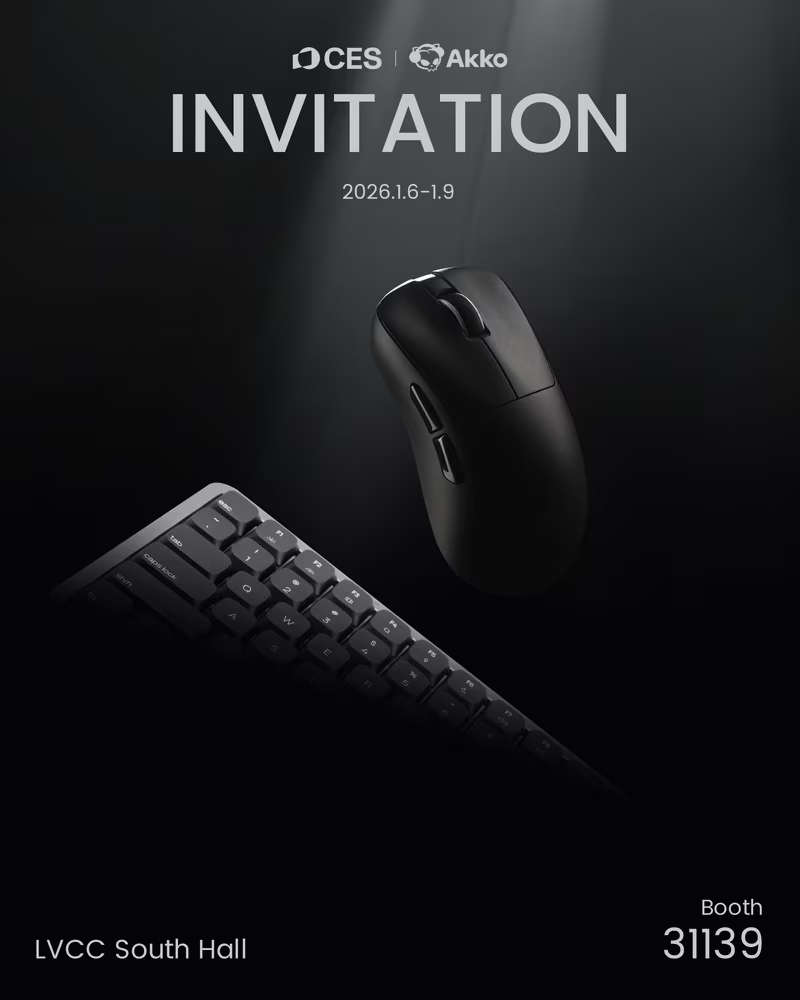
The brand Akko is revealing a significant innovation in gaming peripherals at the 2026 Consumer Electronics Show in Las Vegas. This new ecosystem expands beyond Akko’s traditional keyboard focus to include a full suite of high-performance computer mice.
At CES 2026, Akko calls attention to three distinct series — the Nest, the Dash, and the Framer. The brand highlights the Dash as its “most advanced mouse to date.” This computer peripheral weighs just 39 grams and boasts the PixArt 3950 sensor for ro-grade precision and stability. Nest, on the other hand, is a right-hand ergonomic style, while the Framer is for entry-level gaming.
In addition to the high-performance computer mice, Akko is also highlighting new keyboards — including the aluminum rapid assembly magnetic-switch keyboard MOD007v5 HE and the Year of the Snake Keyboard — as well as the M1 V5 TMR technology by Akko’s sister brand MonsGeek.







 Studios exploring blockchain payments aren’t necessarily chasing hype; they’re reacting to a widening ecosystem. The Web3 gaming sector was valued at $25.63 billion last year and is
  Crypto-enabled entertainment doesn’t exist in isolation; it’s increasingly brushing up against mainstream gaming habits. Streamers have already experimented with token-gated communities, blockchain reward drops, and audience‑driven item giveaways. These integrations quietly shift expectations around what digital ownership should look like, especially when viewers can carry items or achievements into other community spaces.