
Technology
Esports Management Platforms Market Size

Report Overview
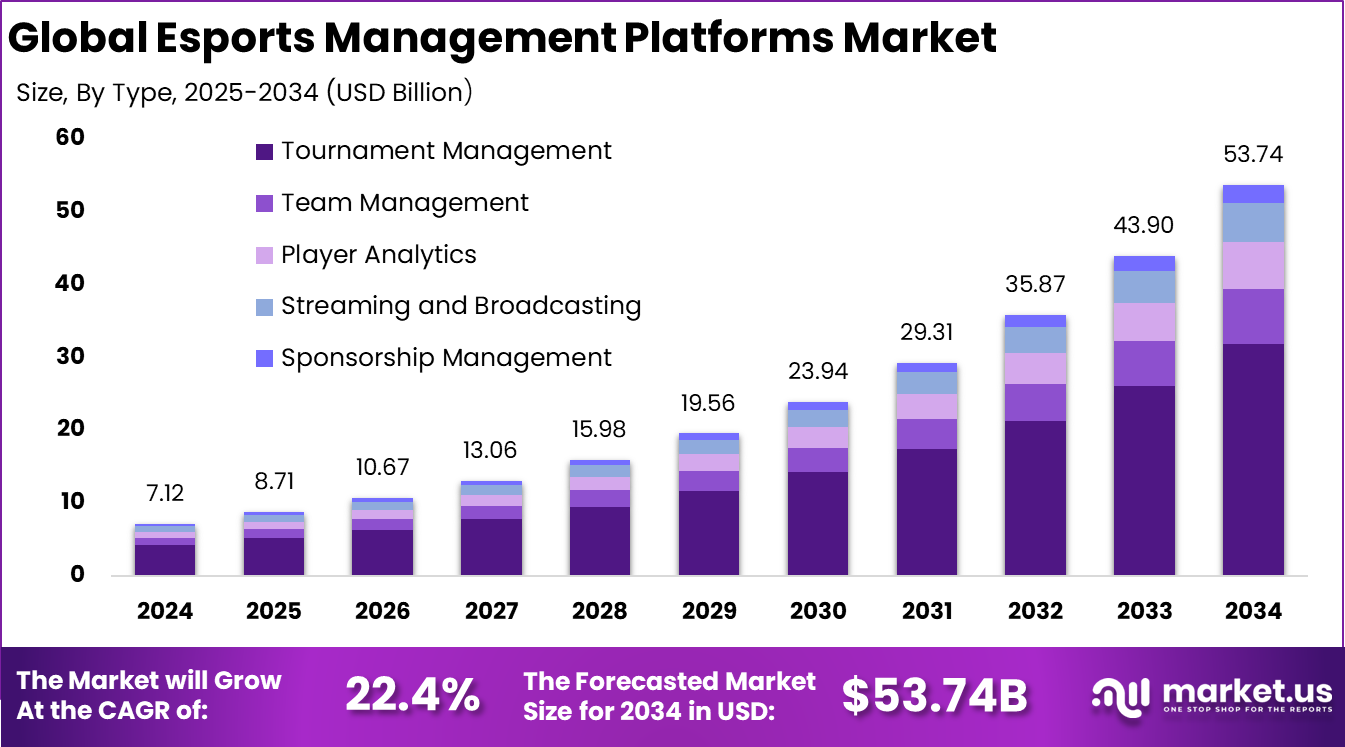
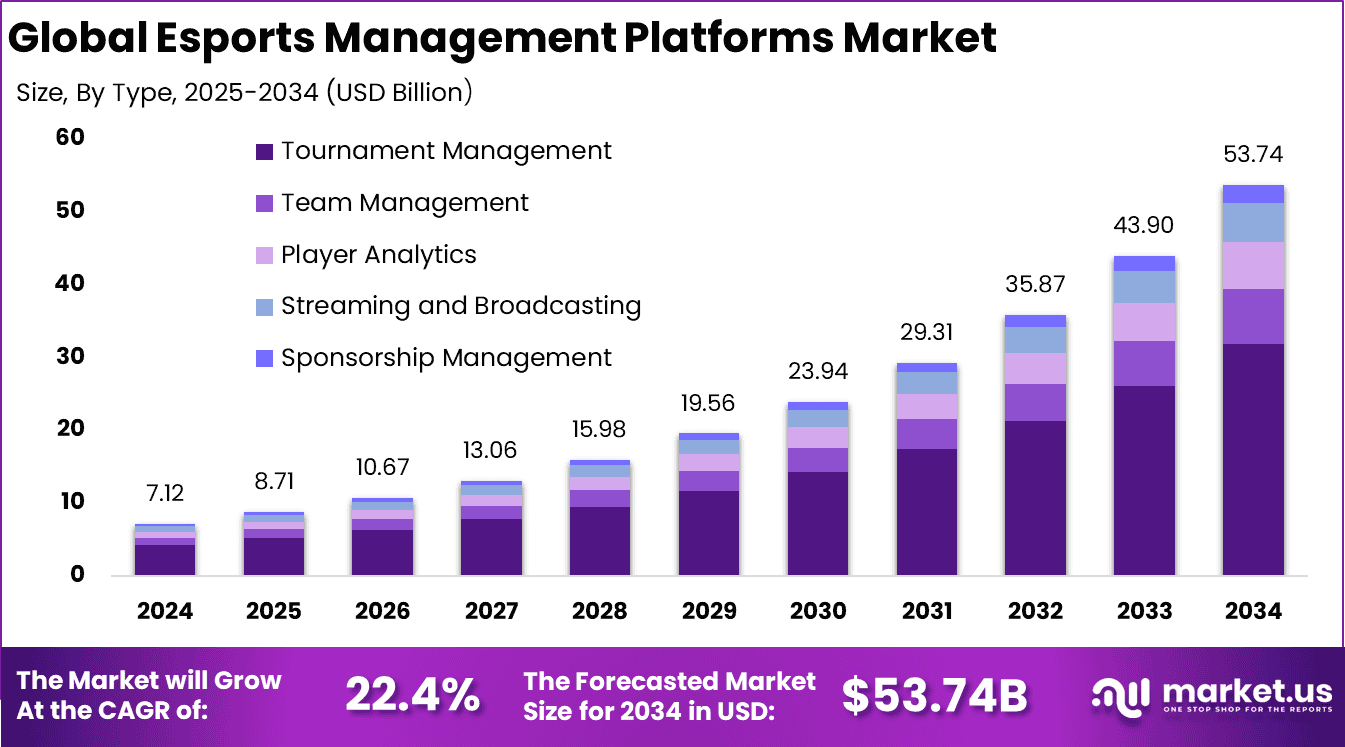
The Global Esports Management Platforms Market size is expected to be worth around USD 53.74 billion by 2034, from USD 7.12 billion in 2024, growing at a CAGR of 22.4% during the forecast period from 2025 to 2034. In 2024, North America held a dominant market position, capturing more than a 39.5% share, holding USD 2.81 billion in revenue.
The esports management platforms market has expanded as teams, tournament organisers and gaming communities adopt digital tools to streamline competitive operations. Growth reflects the rising professionalisation of esports, the need for structured workflows and the increasing number of tournaments hosted across regions. These platforms now support team coordination, event scheduling, analytics, player management and content distribution for both amateur and professional ecosystems.
One major factor driving the adoption of esports management platforms is the increasing professionalization of esports as a global industry. The growth in live tournaments and large-scale competitions demands efficient scheduling and robust management tools. Additionally, younger demographics’ growing interest in competitive gaming and the integration of AI and data analytics for player performance and fan engagement are boosting platform demand.
The market for Esports Management Platforms is driven by the increasing adoption of cloud-based solutions that offer flexibility and scalability to esports teams and event organizers. These platforms enable smooth management of tournaments, player data, and live streaming integration, making esports events more efficient and engaging. The growing popularity of esports globally and the need for organized, user-friendly management tools further boost demand.
For instance, in September 2025, Colab Platforms launched a dedicated esports division and went live with their official esports website. This strategic move aimed to tap into India’s growing esports market, positioning the company to capitalize on the booming competitive gaming sector that is expected to become an Olympic discipline by 2027. The platform focuses on managing esports tournaments, athlete engagement, and enhancing user experience, aligning with India’s expanding digital sports ecosystem.
Key Takeaway
- In 2024, the tournament management segment maintained the leading position in the Global Esports Management Platforms Market by accounting for a 59.4% share.
- In 2024, the esports teams and players segment secured a dominant 61.8% share, reflecting its strong influence within the Global Esports Management Platforms Market.
- In 2024, the cloud based segment captured a commanding 63.5% share, reinforcing its role as the preferred deployment model in the Global Esports Management Platforms Market.
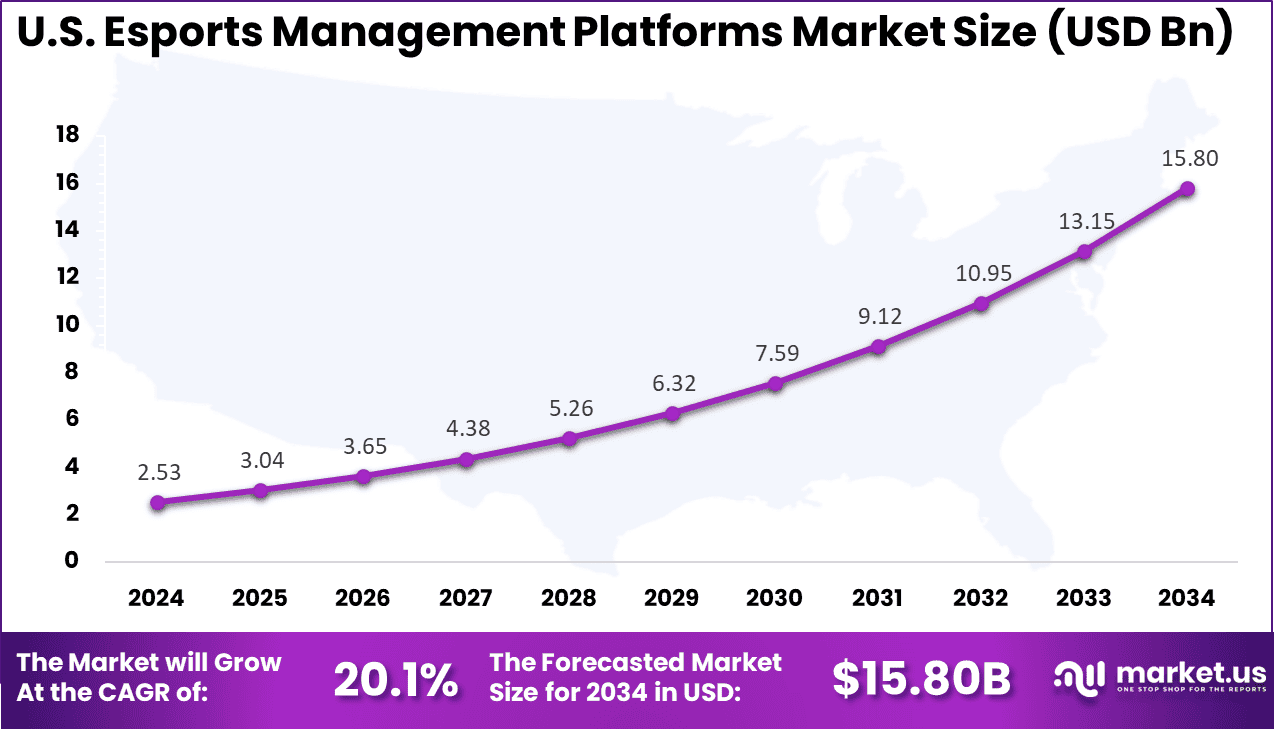
- The U.S. Esports Management Platforms Market reached USD 2.53 Billion in 2024, supported by a steady 20.1% CAGR.
- In 2024, North America dominated the Global Esports Management Platforms Market with a regional share of 39.5%, highlighting strong adoption across the region.
Role of Generative AI
Generative AI plays a growing role in esports management by providing deep analytics and personalized insights that help teams refine strategies and training. It can analyze vast amounts of historical and real-time player data to give actionable feedback, assisting coaches and players in improving performance.
For example, generative AI can generate customized training exercises and predict game outcomes based on current conditions, adding a data-driven edge to competitive play. Studies show generative AI enhances decision-making in real time, boosting team effectiveness and fan engagement through interactive features like AI commentators.
In addition, generative AI supports tournament organizers by optimizing bracket structures and audience experiences with real-time content generation and localized game distributions. It also enhances marketing by creating tailored promotional content targeted at esports fans. By 2025, the adoption of generative AI tools in esports is expected to grow substantially, with AI-powered analytics becoming a standard feature in many management platforms, reflecting the shifting technological landscape of esports.
U.S. Market Size
The market for Esports Management Platforms within the U.S. is growing tremendously and is currently valued at USD 2.53 billion, the market has a projected CAGR of 20.1%. This strong growth is driven by the increasing popularity of esports, rising investments in competitive gaming, and the expanding presence of professional teams and tournaments.
Advances in cloud technology and real-time event management tools are making platforms more accessible and efficient. Additionally, a growing fan base and sponsorship opportunities are fueling the demand for sophisticated management solutions that support seamless event organization and player performance tracking.
For instance, in May 2025, ggLeap, a U.S.-based esports venue management platform, continued to enhance its cloud-based software with features like player engagement, payment acceptance, and user management, supporting a growing number of esports businesses with scalable and efficient venue operations.
In 2024, North America held a dominant market position in the Global Esports Management Platforms Market, capturing more than a 39.5% share, holding USD 2.81 billion in revenue. This leadership stems from the region’s strong esports culture, advanced digital infrastructure, and early adoption of innovative technologies.
The presence of major professional esports leagues and teams fuels demand for sophisticated management tools. Additionally, substantial investments from sponsors, advertisers, and streaming services support market growth. North America’s well-established ecosystem continues to drive product innovation and widespread platform adoption, reinforcing its dominant market position.
For instance, in December 2024, ESL FACEIT Group announced the ESL Impact Circuit 2025, the premier all-women Counter-Strike 2 esports circuit, supported by a total financial contribution of $1 million to promote women’s esports programs, highlighting North America’s leadership in fostering inclusive esports tournaments and ecosystem growth.
Type Analysis
In 2024, The Tournament Management segment held a dominant market position, capturing a 59.4% share of the Global Esports Management Platforms Market. This segment remains essential as it provides the core functionality needed to organize, schedule, and manage esports competitions.
Platforms in this segment focus on automating brackets, registrations, and match schedules, making it easier for organizers to handle growing numbers of participants and complex event formats. The rise of online and hybrid tournaments has increased demand for efficient, scalable tournament management tools that enhance user experience and engagement.
As esports events grow in scale and diversity, tournament management platforms have also evolved to support real-time updates, live streaming integration, and audience interaction features. This segment benefits from technological advancements such as AI-based matchmaking and detailed analytics, which improve matchmaking fairness and event success metrics.
For Instance, in October 2025, Battlefy Inc. raised $1.3 million from US investors to enhance its esports management platform offerings. Battlefy focuses on delivering customizable and scalable tournament solutions for professional gaming, catering to a wide variety of esports events worldwide.
End-User Analysis
In 2024, the Esports Teams/Players segment held a dominant market position, capturing a 61.8% share of the Global Esports Management Platforms Market. This reflects the growing professionalism and competitive rigor within the industry, where teams require sophisticated tools to manage rosters, training schedules, performance data, and sponsorship obligations.
Platforms targeted toward teams focus on analytics, communication, and coordination features that help optimize player performance and team strategy. This segment’s growth is propelled by the increasing number of professional and semi-professional players who rely on these platforms to gain a competitive edge.
Esports teams are also key drivers of adoption for new features such as integrated social media, fan engagement tools, and real-time performance tracking. Platforms catering to teams prioritize flexibility and depth of insights, supporting both individual player development and team management.
For instance, in November 2025, ESL FACEIT Group opened a new regional headquarters in Riyadh, Saudi Arabia, to serve as a flagship esports venue and talent development hub. This move targets the growing demand for esports team and player support, emphasizing nurturing local talent and expanding professional opportunities.

Deployment Model Analysis
In 2024, The Cloud-based segment held a dominant market position, capturing a 63.5% share of the Global Esports Management Platforms Market. Cloud platforms enable real-time data synchronization, remote accessibility, and seamless updates without the need for extensive on-premise infrastructure. This deployment model lowers entry barriers for smaller teams and tournament organizers, offering cost-effective, flexible access to powerful tools.
The cloud approach also supports rapid scaling during peak esports event seasons and facilitates global tournaments by ensuring smooth cross-border connectivity. Security, uptime, and integration capabilities are key priorities for cloud-based solutions, which continue to evolve with innovations in cloud computing technology. Cloud deployment remains the preferred choice for many market players valuing agility and operational simplicity.
For Instance, in January 2025, Versus Programming Network (VPN) secured a multi-million Series B2 funding round led by Morgan Stanley Private Equity Asia to expand its cloud-based esports event production and content infrastructure, focusing on scalable and accessible solutions for global esports tournaments.
Investment and Business Benefits
Investment opportunities lie in funding developers that offer advanced real-time analytics, AI integration, and user-friendly interfaces. Cloud infrastructure providers supporting esports scalability are attractive prospects, along with startups creating fan engagement or sponsorship analytics platforms.
The growth of mobile esports invites investment in mobile-optimized tools and platforms. There are also emerging chances in niche markets, including virtual reality experiences, AI performance tools, and sustainable esports solutions that focus on eco-friendly practices. These platforms bring multiple benefits, such as streamlined event management, improved team coordination, and enhanced sponsor-brand relationships through detailed engagement metrics.
They reduce errors and delays during tournaments, raising fan satisfaction and retention. Data insights support strategic planning for rosters and marketing campaigns. Moreover, automation of payment, contract, and licensing processes decreases administrative costs while boosting revenue collection efficiency.
Emerging Trends
A key emerging trend is the integration of AI for live performance tracking and strategy refinement, which allows teams to adapt gameplay instantaneously. There is also growing emphasis on precision software tailored to specific game genres such as battle royale or multiplayer online battle arenas. This trend is helping teams and organizers manage gameplay with tools designed specifically for the nuances of each format.
Another trend is the focus on fan engagement, where immersive technologies like augmented and virtual reality are becoming more common to make tournaments more interactive for viewers. Blockchain technology adoption is increasing for better transparency in player contracts and prize distribution.
Sustainability is also becoming a consideration, with some platforms introducing eco-friendly practices. These shifts show that esports management platforms are evolving rapidly to meet the needs of a dynamic industry with expanding global audiences. The continuous development of mobile esports and betting platforms further fuels innovation in management software.
Growth Factors
The rising popularity of esports among younger demographics is a strong driver behind demand for sophisticated management platforms. Increased professionalization of esports, including team development and expanded sponsorships, also supports this market’s growth.
The integration of advanced analytics and AI technologies in these software solutions is key, allowing users to make data-driven decisions on player performance and tournament logistics. Greater connectivity through smartphones and high-speed internet improves accessibility, especially in emerging markets, widening audience reach and boosting platform adoption.
Additionally, regulations clarifying esports betting and gaming activities create safer environments that attract more users. Cooperation between gaming companies and investors encourages ongoing innovation and expansion, further driving the market forward.
Key Market Segments
By Type
- Tournament Management
- Team Management
- Player Analytics
- Streaming and Broadcasting
- Sponsorship Management
By End-User
- Tournament Organizers
- Esports Teams/Players
By Deployment Model
Regional Analysis and Coverage
- North America
- Europe
- Germany
- France
- The UK
- Spain
- Italy
- Russia
- Netherlands
- Rest of Europe
- Asia Pacific
- China
- Japan
- South Korea
- India
- Australia
- Singapore
- Thailand
- Vietnam
- Rest of Latin America
- Latin America
- Brazil
- Mexico
- Rest of Latin America
- Middle East & Africa
- South Africa
- Saudi Arabia
- UAE
- Rest of MEA
Drivers
Growing Adoption of Cloud-Based Platforms
The rising adoption of cloud-based esports management platforms is a key driver for market growth. Cloud solutions offer flexibility and performance benefits, enabling teams and tournament organizers to scale operations rapidly without investing heavily in hardware. This democratizes access for smaller and grassroots esports events, increasing overall platform usage.
Organizations benefit from seamless integration with streaming and analytics tools, making event management more efficient and engaging for participants and viewers. Many esports organizations now prefer cloud deployments as they ensure smooth tournament operations and real-time performance tracking.
For instance, in August 2025, Battleroom Gaming continues to enhance its game show and team-building experiences in esports. Its emphasis on providing engaging team play events fuels demand for management software to organize and track participation. This drives growth by pushing the usage of integrated platforms that offer seamless event management for both casual and competitive players.
Restraint
Regulatory and Cybersecurity Concerns
One major restraint in the esports management platforms market is regulatory uncertainty and cybersecurity risks. Different regions have varying legal requirements for data privacy, disrupting smooth cross-border operations. Platforms must comply with strict regulations such as GDPR in Europe or similar laws elsewhere, which make data handling complex and costly for providers and users alike.
Cybersecurity concerns also loom large as esports management software handles sensitive player and financial data. Threats like data breaches or unauthorized access could deter adoption and increase compliance costs. These issues slow down market growth as organizations seek trusted, compliant solutions that safeguard user information.
For instance, in October 2025, ESL FACEIT Group announced layoffs and internal restructuring to form a more sustainable structure. This reflects cost pressures and operational challenges threatening revenue growth and investment capacity. Such financial and organizational stresses in leading companies restrict broader market expansion due to uncertainty and retrenchment in service development.
Opportunities
Integration of Emerging Technologies
The integration of new technologies such as artificial intelligence, blockchain, and 5G offers considerable opportunity for market expansion. AI can enhance player performance analytics and matchmaking, improving team strategies and fan experience. Blockchain enables secure asset management and transparent transactions in esports ecosystems, increasing trust and opening new monetization channels.
Faster 5G networks enable low-latency gaming and smoother live-streaming, which further enhances the viewer and player experience. Opportunities also lie in developing virtual and augmented reality features that make competitions more immersive. These innovations could attract new users and sponsors, supporting sustained market growth.
For instance, in October 2024, Challengermode raised approximately $2.53 million in funding to expand beyond esports and develop offerings for AAA game developers. Their move to integrate in-game technology and build partnerships with publishers shows the potential to unlock new revenue streams. This opportunity lies in converging esports with mainstream gaming, increasing platform adoption, and innovation.
Challenges
Market Fragmentation and Interoperability
A significant challenge for esports management platforms is the fragmentation of software solutions and the lack of interoperability. Many platforms offer specialized tools that do not easily integrate, creating operational difficulties for teams and event organizers that use multiple systems.
This fragmentation can lead to inefficiencies and higher costs as users juggle incompatible software. Providers face pressure to adopt open architectures and modular designs that allow easier connection with third-party tools, but developing such cohesive ecosystems requires time and resources. Failure to address this could limit market adoption and slow growth.
For instance, in January 2025, VSPN secured a ‘multi-million’ series B2 funding round to grow its overseas business and esports content matrix. Despite expansion efforts, the company faces complexity in scaling globally while adhering to diverse regulatory environments and competing with localized platforms. Managing cross-border operations and technological integration poses a challenge in maintaining consistent service quality and compliance.
Key Players Analysis
The market is shaped by platforms that support tournament operations and player engagement. Battleroom Gaming and Senet focus on venue and center management, offering tools that streamline workflows. ggLeap and Versus Programming Network improve user tracking and automation for esports centers. Battlefy and FACEIT strengthen competitive ecosystems with matchmaking, event hosting, and community tools that support global participation.
Toornament and Challengermode provide flexible league and tournament management solutions. Their platforms help organizers manage brackets, track performance, and support multi-game formats. Esports One adds value with analytics and match insights. TV by Theta Labs enhances viewer engagement through decentralized streaming and token-based rewards, creating stronger audience interaction.
The market shows steady progress as key players invest in automation, analytics, and cloud delivery. Partnerships with venues, gaming brands, and content platforms expand platform adoption. AI-enabled tools, stronger security, and enhanced fan-engagement functions improve user experience. The presence of established and emerging vendors supports innovation and broad accessibility across regions.
Top Key Players in the Market
- Battleroom Gaming
- Senet (Vindex)
- ggLeap (Oomba, Inc.)
- Versus Programming Network (VPN)
- Battlefy Inc.
- FACEIT (Owned by ESL Gaming)
- Toornament (Webedia Group)
- Challengermode AB
- Esports One, Inc.
- TV (Theta Labs)
- Others
Recent Developments
- In February 2024, Battlefy Inc. launched an AI-powered tournament prediction and analysis tool. This innovation helps organizers optimize bracket structures and seeding based on the performance data of players and teams from past competitions. This move highlights Battlefy’s focus on leveraging AI to improve tournament efficiency and experience.
- In November 2024, after Toornament’s parent company, Oxent, was acquired by Webedia, Toornament is accelerating its development globally. This acquisition provides stronger media and gaming reach across multiple countries, helping Toornament remain a major player by offering a free platform for tournament organizers and participants.
Report Scope

Technology
Games of the Future Abu Dhabi 2025 Rewrites the Playbook for Sports with Phygital Innovation
Published on
December 25, 2025
By: Tuhin Sarkar

The Games of the Future Abu Dhabi 2025 have closed an unforgettable chapter in the evolution of phygital sports. Hosted under the patronage of His Highness Sheikh Mohamed bin Zayed Al Nahyan, President of the UAE, the event marked an unparalleled fusion of physical and digital competition. Over six action-packed days, Abu Dhabi hosted more than 850 participants from 60+ countries, with fierce battles across 11 disciplines including Phygital Football, Phygital Basketball, esports, Phygital Fighting, drone racing, and VR gaming.
Games of the Future Abu Dhabi 2025 was not just a sporting event; it was a vision of the future. It set a global standard for what sports can look like in the digital age, where technology and human skill come together to create immersive and multi-dimensional experiences. The competition showed the world that the future of sports isn’t confined to a physical arena, but seamlessly integrates both the physical and digital.
The Champions of Tomorrow: Phygital Sports Takes Centre Stage
The Games of the Future Abu Dhabi 2025 featured 11 disciplines that blended traditional sports with futuristic technologies, including Phygital Football, Phygital Basketball, esports, Phygital Fighting, and Phygital Shooter. These unique formats tested competitors in both the physical and digital realms. For example, Phygital Football powered by ADNOC saw the México Quetzales – Armadillos FC clinch the Phygital Football title, defeating Troncos FC 2-4 in a thrilling final that captivated crowds throughout the week. Likewise, in Phygital Basketball, the LIGA PRO TEAM triumphed in a 29-23 victory over Moscowsky.
Other high-stakes competitions included Phygital Fighting.FATAL FURY: City of the Wolves, where Kuznya dominated, winning all four of their matches. Meanwhile, xGoat emerged victorious in the Phygital Shooter.CS 2 final, overcoming Dontsu Esports 2-0 in an intense digital shootout.
In the drone racing category, Drone Racing One wowed spectators by completing 50 laps of a challenging circuit, showcasing the high-tech thrill of phygital racing.
A Digital Revolution: The Rise of VR Gaming and Esports
Beyond traditional sports, Games of the Future Abu Dhabi 2025 brought esports and VR gaming into the spotlight. The esports events featured top teams and intense matches across a variety of games, including MOBA Mobile.MLBB and MOBA PC.Dota 2. In a thrilling final, ONIC defeated Aurora Gaming in the Mobile.MLBB championship, while teamWin overcame Vikings 2-0 in Dota 2.
The Battle Royale tournament, featuring Fortnite, saw Kami + Swizzy crush their opponents ZYRO + RAPID in the final. In VR gaming, the HADO competition proved to be one of the most exciting events, where Team Rock claimed the victory.
The digital revolution didn’t stop there—Phygital Dancing.Just Dance was an engaging crowd favorite, with Ivan “myakekcya” Vlasov taking home the crown. These events proved that esports and VR gaming are no longer just niche interests but are now integral parts of mainstream competition.
The Future is Phygital: Tech and Sport in Perfect Harmony
Games of the Future Abu Dhabi 2025 perfectly illustrated how technology and sports are converging to form an entirely new ecosystem. With events such as Phygital Football, Phygital Basketball, and drone racing, the Games were a showcase of the groundbreaking possibilities that arise when sports embrace digital innovations. Technology was not merely an accessory at this event—it was the cornerstone upon which the competitions were built.
With immersive experiences that brought together digital avatars, VR environments, and physical action, the event revealed a new way of experiencing and consuming sports. It also showcased how athletes and fans alike can now engage with sports in ways that were unimaginable just a decade ago.
Abu Dhabi Leads the Way: A Global Hub for Next-Generation Sports
As the host city, Abu Dhabi solidified its position as a global leader in the future of sports. This landmark event wasn’t just about showcasing phygital sports, but also about demonstrating the UAE’s commitment to innovation and technology. The event was a triumph of vision, execution, and global collaboration, bringing together athletes, clubs, and partners from around the world.
In his remarks, Saif Al Noaimi, CEO of Ethara, remarked on the complexity of delivering an event on such a grand scale: “Delivering an event of this scale and complexity required close coordination across multiple disciplines, venues, and partners. The Games of the Future Abu Dhabi 2025 showcased competitive excellence, but also operational innovation and audience engagement at the highest level.”
Similarly, Nis Hatt, CEO of Phygital International, praised the event’s impact: “What we saw over six days was not just competition, but the emergence of a global ecosystem where sport, esports, technology, and innovation coexist on one stage. Abu Dhabi set a new benchmark for scale, delivery, and ambition.”
A Glimpse into the Future: The Global Impact of Phygital Sports
The success of Games of the Future Abu Dhabi 2025 is not just about the event itself. It signals a transformative shift in how we view and experience sports in the 21st century. By embracing phygital sports, the UAE is not just shaping the future of competition, but also setting the stage for the next generation of athletes, fans, and sports industries.
The Phygital Sports Summit, which took place during the event, provided a platform for discussing the future of sports, technology, and innovation. The summit brought together industry leaders, athletes, and tech visionaries to discuss the convergence of physical and digital realms. The dialogue held here will help define the future trajectory of phygital sports and shape the policies that govern it.
Looking Ahead: The Future of Phygital Sports is Now
The Games of the Future Abu Dhabi 2025 wasn’t just a flash in the pan; it was a statement. The event demonstrated how sports and technology can work in harmony, paving the way for the next generation of competition. As Abu Dhabi continues to innovate and lead the way in phygital sports, the rest of the world is watching closely, eager to follow in the footsteps of this global hub for next-generation sports and entertainment.
As Stephane Timpano, CEO of ASPIRE, pointed out, “The success of this edition shows what is possible when vision, technology, and execution align.” The Games of the Future Abu Dhabi 2025 will undoubtedly serve as a springboard for even bigger, more ambitious events in the years to come, setting a new standard for what’s possible in the world of sports.

Technology
The Games of the Future Abu Dhabi 2025 Closes Landmark Edition, Setting New Benchmark for Phygital Sports


GOTF 1

Concludes GOTF.2

Concludes GOTF .3
ABU DHABI, UNITED ARAB EMIRATES, December 25, 2025 /EINPresswire.com/ — The Games of the Future Abu Dhabi 2025 powered by ADNOC concluded on Tuesday after six days of elite competition, innovation, and global participation, marking a milestone moment in the evolution of phygital sports.
Held under the patronage of His Highness Sheikh Mohamed bin Zayed Al Nahyan, President of the UAE, the landmark event brought together more than 850 participants from over 60 countries and featured 11 disciplines, spanning Phygital Football, Phygital Basketball, esports, Phygital Fighting, Phygital Shooter, Phygital drone racing, and VR Game.HADO. Across arenas, stages, and digital battlegrounds, the event showcased how technology and sport are converging to shape the future of competition.
During the globally-watched event, champions were crowned in each discipline, delivering their own defining moments and reinforcing the unique multi-sport identity of the Games of the Future.
Phygital Football powered by ADNOC and Phygital Basketball.3on3 FreeStyle brought to you by M42 both drew vocal crowds throughout the week, with MÉXICO QUETZALES – ARMADILLOS FC taking the Phygital Football title in a thrilling 2-4 final win over Troncos FC, and LIGA PRO TEAM secured the Phygital Basketball title with a 29-23 victory over Moscowsky. Meanwhile, in Phygital Fighting.FATAL FURY: City of the Wolves, Kuznya finished top of the leaderboard after winning all four of their fights, dominating both on the digital stage and in the octagon, and xGoat won the Phygital Shooter.CS 2 final, beating Dontsu Esports 2-0 in the digital world to avoid the need for a deciding round of physical laser tag.
Tasting glory in the esports-focused disciplines, ONIC won the MOBA Mobile.MLBB final against Aurora Gaming, while the aptly-named teamWin beat Vikings 2-0 in the championship game of MOBA PC.Dota 2, and Kami + Swizzy conquered ZYRO + RAPID in the final of the Battle Royale.Featuring Fortnite. In the Phygital Drone Racing presented by InsuranceMarket.ae, which tasked clubs to complete 50 laps of a testing circuit filled with loops, hoops, and straights, Drone Racing One proved fastest on the final day ahead of Team BDS.
A pair of events taking place in the Atrium at ADNEC Centre drew plenty of attention as Ivan “myakekcya” Vlasov triumphed in the Phygital Dancing.Just Dance final, while Team Rock took the title in VR-game.HADO. Lastly, in Battle of Robots, proving itself one of the most spectacular disciplines of the week, Fierce Roc’s menacing Deep Sea Shark machine annihilated Team Cobalt’s Cobalt in a spectacularly destructive finale.
In parallel with the competitive program, the event week also featured an eye-catching and engaging Opening Ceremony and the inaugural Phygital Sports Summit, reinforcing Abu Dhabi’s position as a global hub for next-generation sport, innovation, and immersive entertainment.
Saif Al Noaimi, CEO of Ethara, reflected on intricacy of the Games: “Delivering an event of this scale and complexity required close coordination across multiple disciplines, venues, and partners. The Games of the Future Abu Dhabi 2025 showcased competitive excellence, but also operational innovation and audience engagement at the highest level. We are proud to have played a role in bringing this landmark event to life and in supporting its growth on the global stage.”
Nis Hatt, CEO of Phygital International, said: “The Games of the Future Abu Dhabi 2025 demonstrated how far this movement has come in a short space of time. What we saw over six days was not just competition, but the emergence of a global ecosystem where sport, esports, technology, and innovation coexist on one stage. Abu Dhabi set a new benchmark for scale, delivery, and ambition, and this edition has reinforced the Games of the Future as a defining platform for next-generation competition worldwide.”
Stephane Timpano, CEO of ASPIRE, added: “Hosting the Games of the Future in Abu Dhabi reflects the UAE’s commitment to shaping the future of sport and innovation. This event brought together athletes, clubs, partners, and audiences from around the world. The success of this edition shows what is possible when vision, technology, and execution align, and it positions Abu Dhabi firmly at the forefront of emerging sport formats.”
The Games of the Future Abu Dhabi 2025 is organized by ASPIRE, the Local Delivery Authority, in collaboration with Ethara, the Event Delivery Partner, and Phygital International, the Global Rights Holder. The event is supported by key partners, including Abu Dhabi Sports Council, ADNOC, EDGE, M42, Solutions+, The Galleria, Abu Dhabi Gaming, du Infra, InsuranceMarket.ae, Ministry of Sports, Advanced Technology Research Council, and ADNEC Group.
Deepra Ahluwalia
Action Global Communications
+971 56 477 0995
email us here
Legal Disclaimer:
EIN Presswire provides this news content “as is” without warranty of any kind. We do not accept any responsibility or liability
for the accuracy, content, images, videos, licenses, completeness, legality, or reliability of the information contained in this
article. If you have any complaints or copyright issues related to this article, kindly contact the author above.

The Samsung Odyssey 3D G90XH gaming monitor features a 165Hz refresh rate that can be boosted to 330Hz in Dual Mode. The monitor is slated to arrive in 2026 and is expected to be a hit amongst avid gamers.
The Tandem WOLED technology will offer fast response time, high refresh rates, low motion blur, dual modes, enriched color depths and more. The Tandem OLED technology will allow screens to blend more seamlessly into everyday spaces thanks to its natural performance.
The latest LG Display OLED technology comes as part of the company’s rebranding of its screen technology to help usher in a new age for the brand.
Technology
Abu Dhabi to Showcase Its Esports and Motorsports Excellence: Gran Turismo World Series 2026 Kicks Off in the UAE
Published on
December 22, 2025

In a historic first for the Middle East, Abu Dhabi, the vibrant capital of the United Arab Emirates, will host the opening event of the Gran Turismo World Series 2026 on March 28, 2026. This prestigious event will take place at the Space42 Arena, showcasing Abu Dhabi’s growing influence in esports and motorsports. As the world’s most exciting digital racing series kicks off its new season in the heart of the UAE, the city’s status as a global hub for innovation, entertainment, and technology is further solidified.
This announcement was made during the Gran Turismo World Series 2025 Finals held in Fukuoka, Japan, by S.E. Saeed Al Fazari, the Executive Director of Strategic Affairs at the Department of Culture and Tourism – Abu Dhabi (DCT Abu Dhabi), and Kazunori Yamauchi, the producer of the Gran Turismo series. Their collaboration highlights Abu Dhabi’s readiness to host an event that will attract millions of esports fans and motorsport enthusiasts from around the world.
Abu Dhabi: The Perfect Location for the Gran Turismo World Series 2026
Abu Dhabi, already known for its world-class motorsport events such as the Formula 1 Abu Dhabi Grand Prix, is now expanding its footprint in the esports industry by welcoming the Gran Turismo World Series. This high-profile event, which brings together the best virtual drivers from around the globe, will elevate the UAE’s presence in the digital gaming and motorsport communities.
The Gran Turismo World Series: A Global Racing Championship
The Gran Turismo World Series is an annual competition that aims to crown the best Gran Turismo player in the world. The competition begins with online qualifiers, where players from across the globe compete to earn their spots in the live events. The series then moves to major international venues, where the top drivers from each region meet to race for the title. The 2026 series opener in Abu Dhabi will mark a monumental step in the history of the event, as it’s the first time the series has taken place in the Middle East.
Yas Marina Circuit in Gran Turismo 7: A Digital Tribute to Abu Dhabi’s Motorsports Legacy
Adding to the excitement, the Yas Marina Circuit, one of the most iconic motorsport venues in the world, will be featured in Gran Turismo 7. This addition allows players to virtually race on the very track that has hosted the Formula 1 Grand Prix since 2009. With this integration, Gran Turismo 7 connects real-world motorsports with virtual racing, offering players the chance to experience the thrill of Yas Marina from the comfort of their homes.
Key Highlights of the Gran Turismo World Series 2026 in Abu Dhabi
- Event Date: March 28, 2026
- Venue: Space42 Arena, Abu Dhabi, UAE
- Region’s First: This marks the first time the Gran Turismo World Series will take place in the Middle East.
- Key Features: The event will showcase the best virtual drivers, live competitions, and interactive experiences for fans.
- Inclusion of Yas Marina Circuit: The iconic Yas Marina Circuit will be featured in Gran Turismo 7, bringing a unique virtual motorsports experience to players globally.
Abu Dhabi’s Growing Role in Esports and Digital Innovation
Abu Dhabi has rapidly become a global leader in the esports sector, thanks to its investments in cutting-edge technology, entertainment infrastructure, and strategic partnerships. The opening of the Gran Turismo World Series 2026 marks a milestone in Abu Dhabi’s growing presence in the world of competitive gaming and motorsports. The event also supports the UAE’s Vision 2021, which aims to position the country as a leader in innovation, technology, and global partnerships.
The Role of Abu Dhabi Gaming
The event is organized by Abu Dhabi Gaming, an initiative led by the Department of Culture and Tourism – Abu Dhabi. Abu Dhabi Gaming is dedicated to transforming the emirate into a world-class esports and gaming hub, attracting global talent, investors, and partnerships that will help develop and expand the gaming ecosystem. With Gran Turismo World Series 2026, Abu Dhabi continues to build on its reputation as a city that hosts world-class events and provides a platform for esports growth.
Abu Dhabi’s Vision for Esports and Motorsports
S.E. Saeed Al Fazari expressed the importance of this event for both Abu Dhabi and the Middle East. He stated, “Hosting the opening of the Gran Turismo World Series is a moment of pride for Abu Dhabi and the entire MENA region, reflecting our ambition to be a destination with limitless possibilities. This marks a significant step for our esports and motorsport sectors, bringing the world’s elite competitors to the emirate and showcasing Abu Dhabi’s proven capacity to deliver world-class experiences in these fields.”
The Gran Turismo World Series 2026 will also contribute to Abu Dhabi’s broader vision of becoming a global center for innovation, entertainment, gaming, and motorsports. The emirate continues to offer a safe, future-ready environment for businesses, investors, and talent, providing opportunities for growth in emerging industries such as esports.
Kazunori Yamauchi on the Middle East’s Growing Impact on Esports
Kazunori Yamauchi, the producer of the Gran Turismo series, also expressed excitement about this landmark event. He said, “We are excited that Abu Dhabi will host the opening of the Gran Turismo World Series in March 2026, marking the first time the event will be held in the Middle East. This is a historic milestone for our championship and a testament to the region’s growing presence in esports and motorsports worldwide. We are also thrilled that the Yas Marina Circuit is now available in Gran Turismo 7, offering players an authentic experience of one of the world’s most remarkable motorsport venues.”
The Road Ahead: Esports and Abu Dhabi’s Future in the Digital Age
The Gran Turismo World Series will continue to evolve, and Abu Dhabi’s role in the esports and digital gaming industry will only continue to grow. Events like this serve as catalysts for the city’s vision to become a global leader in the sectors of esports, technology, and digital innovation. For Abu Dhabi, hosting the Gran Turismo World Series 2026 is just the beginning of its journey to build an esports ecosystem that connects global talents with world-class facilities.
How to Attend the Gran Turismo World Series 2026 in Abu Dhabi
Tickets for the Gran Turismo World Series 2026 opening event in Abu Dhabi will be available through Ticketmaster at website. Fans from around the world can look forward to witnessing this exciting event live, making it a must-attend for all esports and motorsports enthusiasts.



Playstation Market
The global PlayStation Market continues to be a cornerstone of the interactive entertainment industry, driven by technological innovation, immersive gameplay, and a rapidly expanding gaming ecosystem. Valued at USD 34.12 billion in 2025, the market is projected to reach USD 54.12 billion by 2035, growing at a steady CAGR of 4.72% between 2024 and 2035. This sustained expansion reflects the increasing popularity of console gaming, digital distribution, and evolving consumer engagement models across the world.
With 2024 as the base year and historical data spanning 2019 to 2024, the market outlook for 2025-2035 highlights long-term stability supported by loyal user bases and continuous innovation. The PlayStation brand has evolved beyond hardware into a comprehensive entertainment platform, integrating online services, exclusive titles, cloud gaming, and virtual reality experiences that redefine modern gaming.
The competitive landscape of the PlayStation Market is highly dynamic and innovation-driven. Sony Interactive Entertainment (JP) remains the dominant force with its PlayStation console ecosystem, while competitors and partners such as Microsoft Corporation (US), Nintendo Co., Ltd. (JP), Electronic Arts Inc. (US), Activision Blizzard, Inc. (US), Take-Two Interactive Software, Inc. (US), Ubisoft Entertainment S.A. (FR), and Bandai Namco Entertainment Inc. (JP) play critical roles in shaping content, technology, and user engagement. These companies compete through exclusive titles, cross-platform compatibility, subscription services, and cutting-edge gaming engines.
“Access Full Report Now” – Gain Comprehensive Insights into the Market with Our Detailed Research Report
https://www.marketresearchfuture.com/reports/playstation-market-22446
One of the most influential growth drivers in the PlayStation Market is the continuous advancement of gaming technology. High-performance consoles, ultra-realistic graphics, faster load times, and enhanced processing capabilities have significantly elevated user experiences. Additionally, the growing popularity of online multiplayer gaming and esports has further strengthened platform engagement, particularly among younger demographics.
Market segmentation reveals a diverse and evolving ecosystem. The market is segmented by platform, game genre, revenue source, age group, gaming style, and region, enabling companies to tailor offerings to specific consumer segments. Action-adventure, role-playing, and sports games continue to dominate demand, while digital downloads, in-game purchases, and subscription-based services generate a growing share of overall revenue.
“Free Sample Copy” – Access A Complimentary Copy of Our Report to Explore Its Content and Insights
https://www.marketresearchfuture.com/sample_request/22446
A key market opportunity lies in the integration of virtual reality (VR) to enhance player immersion. PlayStation VR technologies are reshaping how users interact with games, offering deeper engagement and new gameplay formats. As VR hardware becomes more affordable and content libraries expand, adoption rates are expected to rise, opening new revenue streams and redefining console gaming experiences.
Geographically, the PlayStation Market spans North America, Europe, Asia-Pacific (APAC), South America, and the Middle East & Africa (MEA). North America remains a leading market due to strong console adoption, high disposable income, and a well-established gaming culture. Europe follows closely, supported by a robust player base and strong presence of global publishers. APAC, particularly Japan, South Korea, and emerging Southeast Asian markets, continues to demonstrate rapid growth driven by technological advancements and a digitally native population.
The market is also influenced by shifting consumer preferences toward digital ecosystems. Physical game sales are increasingly replaced by digital downloads, cloud gaming services, and subscription models. This transition not only enhances convenience but also allows companies to maintain continuous engagement with users through regular updates, downloadable content (DLC), and live-service games.
“Proceed To Buy” – Move Forward with Your Purchase and Gain Instant Access to the Complete Report
https://www.marketresearchfuture.com/checkout?currency=one_user-USD&report_id=22446
Intensifying competition remains a defining market dynamic. Companies are investing heavily in exclusive franchises, strategic acquisitions, and cross-platform compatibility to maintain competitive advantage. Strategic partnerships with game developers and technology providers are also playing a crucial role in expanding content libraries and enhancing user retention.
Another critical trend shaping the market is the growing emphasis on social and community-driven gaming. Features such as live streaming, social sharing, and interactive online communities have transformed gaming into a social experience. This evolution has strengthened brand loyalty and expanded PlayStation’s reach beyond traditional gaming audiences.
The report provides comprehensive coverage, including revenue forecasts, growth drivers, competitive analysis, and emerging trends, offering valuable insights for stakeholders across the gaming ecosystem. As segmentation analysis deepens, opportunities continue to emerge across age groups, gaming styles, and monetization models.
Looking ahead, the PlayStation Market is well-positioned for sustained growth through 2035, supported by innovation, immersive technologies, and evolving consumer expectations. As gaming continues to converge with entertainment, social interaction, and digital lifestyles, PlayStation remains a key force shaping the future of global interactive entertainment.
Discover More Research Reports on Consumer and Retail By Market Research Future:
Residential Food Waste Disposer Market Size, Share, Growth | Report, 2035 – https://www.marketresearchfuture.com/reports/residential-food-waste-disposer-market-37125
Residential Hob Market Size, Trends, Analysis By 2035 – https://www.marketresearchfuture.com/reports/residential-hob-market-37057
Residential Induction Cooktop Market Size, Trends, Growth, 2035 – https://www.marketresearchfuture.com/reports/residential-induction-cooktop-market-41404
Residential Outdoor Gas Fire Pit Market Size, Growth, 2035 – https://www.marketresearchfuture.com/reports/residential-outdoor-gas-fire-pit-market-37242
Residential Outdoor Storage Product Market Size, Share, Outlook, Demand – https://www.marketresearchfuture.com/reports/residential-outdoor-storage-product-market-34934
Contact us:
Market Research Future (part of Wantstats Research and Media Private Limited),
99 Hudson Street,5Th Floor, New York, New York 10013, United States of America
Contact Number:
+1 (855) 661-4441 (US)
+44 1720 412 167 (UK)
+91 2269738890 (APAC)
Email: info@marketresearchfuture.com
About Market Research Future:
At Market Research Future (MRFR), we enable our customers to unravel the complexity of various industries through our Cooked Research Report (CRR), Half-Cooked Research Reports (HCRR), Raw Research Reports (3R), Continuous-Feed Research (CFR), and Market Research & Consulting Services.
MRFR team have supreme objective to provide the optimum quality market research and intelligence services to our clients. Our market research studies by products, services, technologies, applications, end users, and market players for global, regional, and country level market segments, enable our clients to see more, know more, and do more, which help to answer all their most important questions.
This release was published on openPR.

Young residents support Cheer Club | News, Sports, Jobs

Hendrick Motorsports Icon Delivers Powerful Christmas Reminder As NASCAR Still Reels From Greg Biffle Loss

Sarasota Sun Devils 14U Football Team Flourishes on National Stage

Palm Beach 7A-5A girls volleyball first team, second team, honorable mention and coach of the year

Kick Off the Cold: Winter Soccer Events | Communities

A youth art contest for the FIFA World Cup 2026™

Volleyball Player of the Year: Millbrook’s Aaliyah Green | Winchester Star

City of Fillmore Youth Basketball Underway

Volleyball Coach of the Year: James Wood’s Adrienne Patrick | Winchester Star

KohR Motorsports to run Greg Biffle tribute livery in IMSA Michelin Pilot Challenge at Daytona

IHRA is Brining Memphis International Raceway Back From the Dead! – Drag Bike News

TOYOTA GAZOO Racing to Release New GR Brand Video “WILD ROAD” on January 1 | PRESS RELEASE

No easy fix for what ails college football, but it’s still fun

Broward 4A-1A girls volleyball first team, second team, honorable mention and coach of the year

Alexandria Area Youth for Christ moves into new building and will be adding a new program in January – Alexandria Echo Press

Fargo girl, 13, dies after collapsing during school basketball game – Grand Forks Herald

SoundGear Named Entitlement Sponsor of Spears CARS Tour Southwest Opener

Jo Shimoda Undergoes Back Surgery

Redemption Means First Pro Stock World Championship for Dallas Glenn

Bowl Projections: ESPN predicts 12-team College Football Playoff bracket, full bowl slate after Week 14

Black Bear Revises Recording Policies After Rulebook Language Surfaces via Lever

Robert “Bobby” Lewis Hardin, 56

Donny Schatz finds new home for 2026, inks full-time deal with CJB Motorsports – InForum

How this startup (and a KC sports icon) turned young players into card-carrying legends overnight

How Donald Trump became FIFA’s ‘soccer president’ long before World Cup draw

Men’s and Women’s Track and Field Release 2026 Indoor Schedule with Opener Slated for December 6 at Home

David Blitzer, Harris Blitzer Sports & Entertainment

Indiana’s rapid ascent and its impact across college football
Wisconsin volleyball sweeps Minnesota with ease in ranked rivalry win

Michael Jordan’s fight against NASCAR heads to court, could shake up motorsports






-
 Motorsports2 weeks ago
SoundGear Named Entitlement Sponsor of Spears CARS Tour Southwest Opener
-
 Motorsports2 weeks ago
Donny Schatz finds new home for 2026, inks full-time deal with CJB Motorsports – InForum
-
 Rec Sports3 weeks ago
David Blitzer, Harris Blitzer Sports & Entertainment
-

 Motorsports3 weeks ago
JR Motorsports Confirms Death Of NASCAR Veteran Michael Annett At Age 39
-
Sports3 weeks ago
Elliot and Thuotte Highlight Men’s Indoor Track and Field Season Opener
-
Sports3 weeks ago
West Fargo volleyball coach Kelsey Titus resigns after four seasons – InForum
-

 Motorsports2 weeks ago
Rick Ware Racing switching to Chevrolet for 2026
-

 NIL2 weeks ago
DeSantis Talks College Football, Calls for Reforms to NIL and Transfer Portal · The Floridian
-

 NIL3 weeks ago
Colleges ponying up in support of football coaches, programs
-

 Sports3 weeks ago
Temple Begins Indoor Track & Field Season at UPenn This Weekend