From Ambition to Action: Fit4Green Releases Resources for Sustainable Sport Events Co-Created with Youth
We proved that with the right framework, youth can co-create green(er) sports events that are fun, active, and environmentally responsible, bridging the gap between ambition and reality.”
— Andrej Pisl, EUSA Director Projects and Policy
LJUBLJANA, SLOVENIA, November 28, 2025 /EINPresswire.com/ — Following 18 months of intensive co-creation, testing, and research, the Fit for Green (Fit4Green) consortium is proud to announce the release of a comprehensive suite of resources designed to help organisations turn grassroots sport into a driver for environmental sustainability – especially when youth is engaged in planning and execution.
Co-funded by the European Union, Fit4Green has successfully demonstrated that when young people are given the tools to co-create, sport events can become powerful platforms for behavioural change. The project consortium now invites sport federations, educational institutions, and youth organisations to access its legacy tools: the Fit4Green Manual in Action and the Impact Assessment Report.
The centrepiece of the release is the Fit4Green Manual in Action. Moving beyond abstract theory, this practical guide offers a “6-Step Journey” for organisers – taking them from the initial spark of inspiration through to co-creation, prototyping, implementation, and reflection.
The accompanying Impact Assessment Report provides evidence base for this approach. During its pilot phase in Austria, Latvia, and Slovenia, the project exceeded expectations: • High Engagement: Engaging 244 young people in co-creation workshops and over 1,100 participants in green campus events. • Behavioural Shift: Post-project surveys revealed that the belief that sport events should be sustainable saw the largest increase among participants, shifting from a preference to an expected standard. • Practical Innovation: The project successfully tested zero-waste runs, upcycling equipment workshops, and nature-based activity challenges.
To ensure the legacy of the project extends across Europe, the consortium has made the following resources publicly available for free download: 1. The Fit4Green Manual in Action: A step-by-step “concept catalogue” featuring infographics, real-life case studies, and scalable templates for organising green sport events mainly targeting youth. 2. The Impact Assessment Report: A deep dive into the project’s methodology (including the GreenComp framework), offering data-backed insights on how sport fosters sustainability competences.
Fit4Green is a project co-funded by the European Union, coordinated by the EUSA Institute (Slovenia) in partnership with Holztechnikum Kuchl (Austria), Innovationsmanufaktur (Germany), the Latvian University Sport Federation (Latvia), the National Youth Sport Association NYSA (Sweden), and the University of Ljubljana (Slovenia). The project ran from June 2024 to November 2025 with the mission to use sport as a catalyst for environmental awareness and youth inclusion.
Organisations, educators, sport professionals and other interested public can read more about the project and download the resources at: https://fit4green.eusa.eu
Disclaimer: Funded by the European Union. Views and opinions expressed are however those of the author(s) only and do not necessarily reflect those of the European Union or the European Education and Culture Executive Agency (EACEA). Neither the European Union nor EACEA can be held responsible for them.
EUSA Office European University Sports Association email us here Visit us on social media: LinkedIn Instagram Facebook YouTube X Other
Legal Disclaimer:
EIN Presswire provides this news content “as is” without warranty of any kind. We do not accept any responsibility or liability
for the accuracy, content, images, videos, licenses, completeness, legality, or reliability of the information contained in this
article. If you have any complaints or copyright issues related to this article, kindly contact the author above.
Team Alaska 14U celebrates a big goal against the Colorado Thunderbirds on Nov. 11, 2025. (Photo by Team Alaska)
Traditionally, youth hockey players ages 14 to 18 have been permitted to participate in games and practices for both their local high school and Team Alaska, the state’s lone AAA tier competitive league program.
After receiving feedback from a majority of players’ parents, Team Alaska program director and 18U head coach Matt Thompson and fellow coaches at other age levels decided that their players wouldn’t be permitted to play both this year.
“When you’re reviewing things, you’re trying to look at what is the bigger voice and what do people want: How did our teams do? Did we have success? Were there issues here? And then we ask all the coaches,” Thompson said.
The high school and comp teams share the goal of developing young Alaska hockey players, but the decision has put a strain on their relationship. Many high school coaches disagree with the either/or approach. Generally, high school teams acquiesce to regular absences by some of their top players during the regular seasonto allow them to compete at both levels.
“You’re taking kids away from the game they love and they’ll never get these years back,” West High head coach Rob Larkey said.
Every year, the coaches of each youth program from 14U to 18U are allowed to decide whether to allow players to take part in both the high school and competitive league seasons.
Last year only the 14U team, which consists of mostly high school freshmen and middle schoolers, and 18U, which includes high school juniors and seniors, permitted their players to do both.
At the end of every season, Thompson sends surveys to parents and legal guardians of players so they can provide feedback on how the program can improve and voice concerns anonymously.
Thompson said after last season, they sent out 60 surveys, and only a few voiced appreciation for dual participation. Many more came back expressing frustrations about a lack of commitment from the team as a whole.
By late summer, the Team Alaska coaches had decided to stop allowing dual participation.
“This isn’t just a decision on me, it’s a decision by the program collectively,” Thompson said. “I backed those coaches, and they asked me to send an email out at the end of August just to reaffirm that we were doing that because there were a lot of people asking questions to those coaches.”
After sending the email, he said he didn’t receive any correspondence from concerned parents or coaches about the decision aside from Kevin Fitzgerald, an assistant coach at West High School.
Thompson and 18U coach William Wrenn met with the coaches from West in June, but the meeting turned sour on the topic of dual participation, which led to some friction between the two parties.
In early October, Fitzgerald, himself a former comp coach, sent a lengthy letter to hockey families outlining his criticisms of the decision. It included a number of responses to issues raised in the meeting as well as reasons players should consider high school hockey as opposed to club hockey.
“That was the only school that we heard from,” Thompson said. “One school that had an opinion on something. A school that I went to and played for sent out a letter that stirred up the pot a little bit.”
Forcing a decision
There was a point earlier in the year when it was unclear whether there would even be a 2025-26 high school hockey season. It was one of three high school sports on the chopping block during the Anchorage School District’s budget discussions in the face of a large budget deficit.
During the summer, when the season was still up in the air, Larkey said Team Alaska asked West players who play for both teams about their plans for the upcoming winter. The players couldn’t give a concrete answer because nothing had been finalized at the time.
Since the sport was ultimately spared from cuts, Larkey believes it’s unfair to make players and their families choose between the two.
“You’re forcing the kids that love the game and want to play the game to make a choice on that,” Larkey said.
In doing so, he thinks that Team Alaska has put more pressure on itself to perform better if they’re going to have players who play only for them year-round.
“Where are you going to measure yourself?” Larkey asked. “You should be getting out of regions and going to nationals. If not, then where are you at and how many of your players are going on (to play at the next level)?”
South goalie Jaeger Huelskoetter tries to make a stop during a scrum in front of the net during a game between the Wolverines and Chugiak on Tuesday, Nov. 11, 2025 at the Harry J. McDonald Memorial Center in Eagle River. (Chris Bieri / ADN)
Chugiak head coach Rodney Wild believes kids are being forced to make a choice between the two, and in most cases, it’s not theirs to make.
“I don’t buy the reasoning as to why,” he said. “They’re doing it because they believe it’s in the kids’ best interest, I truly believe that. They’re not doing it to hurt the kids or put the kids at a disadvantage. They truly believe that what they’re doing is best for their players. I just don’t agree with it.”
Often, it’s the parents who are making the final decisions on behalf of their student-athletes. In many cases, players want to play for their high school teams as well.
South High lost between 10 and 15 players to the decision, but that hasn’t stopped them from opening the season on a high note as the lone undefeated team in the Cook Inlet Conference.
“South gets hammered the most with those Team Alaska guys but it’s OK,” Wolverines head coach Daniel Ramsey said. “We’ve had some JV kids come up, we’re in our fourth season now so our seniors are big on this team. That’s who our first line is, all seniors.”
High school hockey benefits
The high school coaches at West, Chugiak and South referenced the type of overwhelming support that comes with playing at that level. There are often big crowds featuring friends, family, faculty, alumni and the community at large. In travel hockey, teams typically play in front of scarce audiences predominantly made up of parents.
“I coached comp hockey too, and all you do is go to the arenas and moms and dads are the only ones in the arenas,” Larkey said. “There’s no cheerleaders in the crowd leading chants or a band being played. It’s a different excitement.”
The rivalry games between Chugiak and neighboring Eagle River average around 1,000 fans filling the stands and lining the rink at the Harry J. McDonald Memorial Center, providing an atmosphere that is “absolutely raucous,” said Wild.
Maggie Price, 11, center on the red carpet, dropped the puck before the Partner’s Club Superhero Hockey Game between West High and Chugiak High at the Harry J. McDonald Memorial Center in Eagle River on Thursday, Jan. 16, 2025. West High senior defenseman Chase Thompson, left, and Chugiak High senior forward Blake Yawit, right, faced-off during the ceremonial puck drop. (Bill Roth / ADN) Fans celebrats a West High goal during the Eagles’ 6-1 victory over the West Valley Wolfpack in the opening round of the Alaska Division I Boys hockey tournament at the Menard Center in Wasilla on Thursday, Feb. 8, 2024. (Bill Roth / ADN)
“I feel like the kids are being forced to sacrifice an experience that they will not be able to replicate after they’re done playing (youth) hockey,” Wild said. “They’re robbing these kids of an opportunity, and they’ll tell you that there’s nothing like playing high school hockey.”
Many youth hockey players won’t get a chance to play in front of a packed arena outside of high school unless they play for a good junior hockey team in a passionate community.
“I think it’s really cool being able to play for your high school because you get to represent your school and represent the hockey team,” South sophomore forward David Berg said. “You really get to put out for your school and your fans.”
West wasn’t hit as hard as some of the other teams when it came to the volume of players they lost to Team Alaska’s decision. Larkey said five players are forgoing the high school season to commit to Team Alaska.
“We don’t want kids to throw their Team Alaska away either,” he said. “We don’t want to interrupt them as well.”
Possible resolutions
Youth hockey is the rare sport in the state in which the high school season overlaps with the competitive league season.
According to Thompson, the Team Alaska program director, the conflicting schedules are the most detrimental to Team Alaska at the time when the team needs to be at its best and sharpest, around the time of the high school regional tournament.
Thompson said he’s spent the past four years trying to work with the Alaska School Activities Association on a possible resolution.
“Before I was event program director, I was meeting with them to see how we can make this work because I get that high school hockey more than anything is the experience,” Thompson said. “The way that the schedules are built up for high school and our comp, it doesn’t set either of us up for success.”
Team Alaska 18U goalie Keagon O’Bryan celebrates a 3-2 shootout victory over the Wasatch Renegades on Oct. 18, 2025. (Photo provided by Team Alaska)
His proposals to ASAA over the years when there has been dual participation included moving up the dates of the high school postseason or changing the start of the regular season to earlier in October.
“That would give us more wiggle room for our teams to prepare for the regional tournament and hopefully punch a ticket to nationals,” Thompson said. “Unfortunately, ASAA doesn’t want to separate the big schools from the small schools, and the difficulty there is that the smaller programs practice outside, so their season is surrounded by the temperatures to have outdoor ice.”
To develop a possible resolution for future dual participation, Thompson wants to work with ASAA to ensure a pathway that is beneficial for all parties.
“It wasn’t an easy decision. It is not one that is set in stone that no matter what moving forward, that’s what we’re doing,” he said. “It all comes down to that I think there’s a way for this to work for both, and I think that adjusting the (high school) season even by a couple weeks would change a lot of things.”
Finding success
All six Alaskans currently on the Anchorage Wolverines junior hockey team have come through the Team Alaska pipeline, which Thompson believes is a direct reflection of how the program sets its athletes up for success.
“These kids who are aspiring to play for the Wolverines one day or for any of our other junior programs in the state or any program that is outside the country, they’re (on a) stepping stone by playing at (our) level,” he said.
Thompson regrets that his players won’t get to have the same types of experiences as those who opt to play at the high school level, but knows that the sacrifices they make now have the potential to pay major dividends later.
“A lot of these players are asking for more of a challenge and unfortunately, in high-level athletics in high school, college or junior hockey, there is sacrifice,” he said. “Anybody that’s gone through it understands that. Unfortunately, you can’t have everything.”
Team Alaska 18U players get instructions at the board during a practice on Oct. 26, 2025 (Photo provided by Team Alaska)
Thompson and Team Alaska compiled a list of youth hockey players with birth years of 1975 until present day who have left the state to pursue higher levels of competition, and the number of those who leave each year has grown.
In 1992, there were only a handful, and that number stayed low through 2005. But there have been double-digit departures in 19 of the last 20 years. The most in a year during that span was 43 in 2019, and departures remained in the double digits during the COVID-19 pandemic with 11 in 2020.
“Our goal is to keep these kids at home,” Thompson said. “When you’re sitting there and thinking that Team Alaska hasn’t won anything, our goal is to keep some of these best kids here.”
Larkey, the West High coach, pointed to a large number of players who have participated in high school and have gone on to bigger things in hockey as well. Among them is Boston Bruins goalie Jeremy Swayman, who played at South High and the AAA Alaska Junior Aces before moving up in competition.
Thompson said the fact that Team Alaska has been able to consistently contend for region titles despite not having the top local talent is tangible proof of their growth as a program. They’re seeing sustained success and better results this year on their travel teams with no dual participation, he said.
“We’re clearly doing something that people appreciate because they want to be a part of it and they’re staying in it,” Thompson said. “That is probably more rewarding than anything. Seeing kids staying in Alaska and staying in the program to represent Alaska.”
What began as California’s first drone soccer team has made breakthroughs in the sport to become the gold standard of academic and competitive success in Long Beach within just three years of its founding.
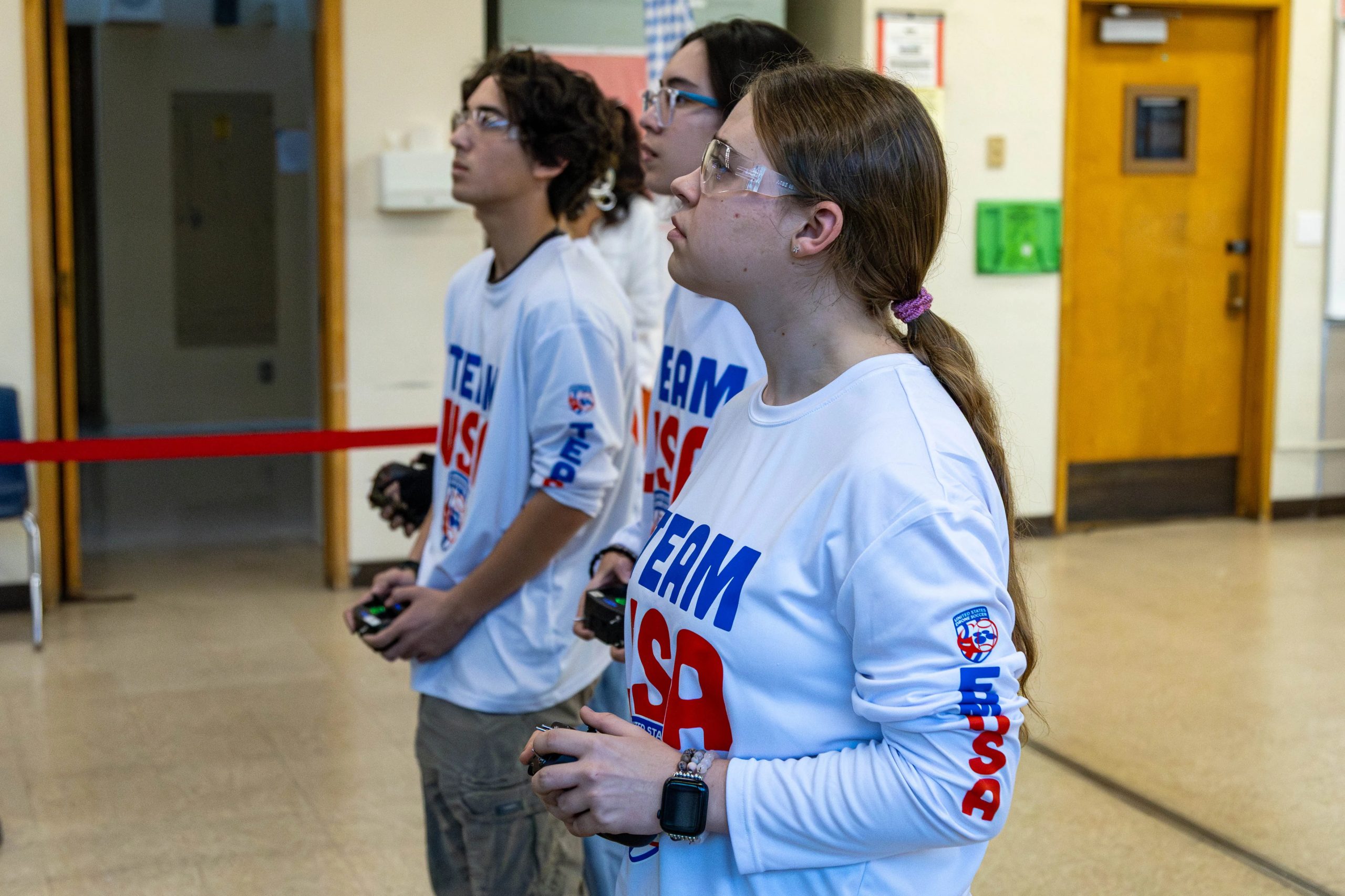
The SATO Academy of Mathematics and Science Drone soccer team represented the United States during the 2025 Fédération Aéronautique Internationale (FAI) World Drone Soccer Championships in China from Nov. 15-18, where the team placed fourth in the 40 centimeter section and fifth in 20 centimeter matches.
“It’s honestly mindblowing because I didn’t think we were gonna get that far,” said Kira Black, president of the SATO Drone Soccer Club and the team’s goalie.
SATO Drone Soccer head coach Albert Gallo founded the program after he heard about the U.S. Drone Soccer League and subsequently pitched the idea to the principal, who “absolutely loved it,” he said. Gallo then began pitching the program to kids he taught in his engineering class during the 2022 school year, and it has grown ever since.
Drone soccer consists of four defenders and one designated attacker (the drone with red stripes). The attacker’s goal is to go straight through the goal ring to score points for their team. (Samuel Chacko | Signal Tribune)
Drone soccer is a five-on-five sport where the aim of the game is to score as many goals as you can by driving a “striker drone” completely through the opponents goal. Two members of each team are designated as the “striker” and “goalie” as the match is broken up into three, three-minute sets. The team who scores the most goals wins each set, and whoever wins two sets wins the match.
The SATO Drone Soccer program is broken up into two senior-led official teams they send to tournaments, “Mushu” and “Dragon Fire.” The two separate groups of seniors have been on the team since its inception at SATO. The school also has a separate club for students to join recreationally.
“I told them [the professional players from Mushu and Dragon Fire] from the beginning that, ‘you guys are the pioneers of this sport,’ we’re rewriting playbooks [and] we’re writing strategies.”
– SATO drone soccer coach and team founder Albert Gallo
SATO’s drone soccer team has been dominating the U.S. drone soccer sphere since its inception.
Since starting the program in 2022, they’ve placed first in the U.S. Drone Soccer Championships in 2023 and 2025, and earned a second-place finish in 2024. Multiple members of the program have received recognition from the United States Drone Soccer Association.
Most recently, team Mushu won the U.S. Drone Soccer Championship on May 3, 2025 and had the opportunity to represent the U.S. National Team in China.
The SATO Drone Soccer Club talks with one another just before being dismissed at their 7 p.m. practice on Dec. 9, 2025. (Samuel Chacko | Signal Tribune)
“I’m extremely proud of our students and our pilots, I couldn’t have done it [without] my wife helping me, the principal of the school helping, the district helping us finance the equipment. Seeing all that growth is very satisfying,” Gallo said.
Drone Soccer originated in South Korea in 2016 from the research team in CAMTIC Institute of Technology, but the first tournament in the U.S. started in April 2021 in Colorado, with the United States Drone Soccer Association formally launching near the end of 2021.
SATO’s Drone Soccer program has helped students apply the skills they learn in STEM classes as well as build their communication and teamwork skills.
“I’ve made a bunch of new friends just by being in the club, I’ve been more social, I’ve been a better communicator,” Black said.
As their success has catapulted them into a Long Beach sports powerhouse, the team’s goals have shifted from just having fun to placing first in every single tournament they enter.
Kira Black, senior and president of the SATO Drone Soccer Club, talks with the team on Dec. 9, 2025 as they draw up different types of formations during their last practice. (Samuel Chacko | Signal Tribune)
SATO’s program has also helped influence other schools across the United States. According to the U.S. Drone Soccer Association, U.S. Drone Soccer has reached 300+ schools and organizations, serving 5,000+ students in 38 states.
The team has also been instrumental in getting other drone soccer teams in Long Beach started, allowing the Millikan High School drone soccer team to practice at SATO and loaning them drones to use.
Albert and his wife, Andrea Gallo, are co-founders of California Drone Sports, which holds camps, coaching clinics and helps fundraise for schools with the goal of continuing to expand, promote and support drone soccer programs throughout California.
Even with all of the success as one of the pioneers of drone soccer in California, the team faces challenges on the horizon.
Twelve seniors from the official teams will soon be graduating from SATO, which means more than half the program is leaving. Gallo’s main goal is restructuring the team while maintaining their competitiveness, he said.
SATO Drone Soccer Club head coach and team founder Albert Gallo poses with the team’s awards, trophies and a signed team USA shirt on Dec. 9, 2025 in Long Beach. (Samuel Chacko | Signal Tribune)
“I’m gonna miss these kids the most because there’s 12 of them,” Gallo said. “[To] see them go on to do great things is gratifying, but it’s also the knowledge base that is leaving.”
The other challenge is finding money to get students to international tournaments. During the tournament in China, donations from the Long Beach Airport and Supervisor Janice Hahn were divided between hotel rooms and equipment, while the students’ parents paid for the flights to China.
“I heard there’s a tournament coming up in April in France and I would love to take a team, but where do we find the money? You could probably find money for hotels and food but who’s gonna pay for the flights?” Gallo said.
Gallo said they’re hoping to have an invitational on Jan. 31 and host a regional competition on March 21.
“I would love to fill the stands with more fans and more people wanting to come,” he said. “[The March 21 event] would be great just for people to come out and watch and see what drone soccer is about.”
For more information about their program and events, follow SATO’s Drone Soccer Club on Instagram.
Samuel Chacko
Photojournalist
Samuel Chacko is an award-winning photojournalist from Long Beach, California. Samuel currently works as a freelance journalist for multiple publications and he is a class of 2025 Cal State Long Beach graduate. Samuel loves watching sports (the Ravens and the Yankees) and taking photos. Check out more of Samuel’s work here: https://samuelchacko.com/
“His sudden passing will be felt deeply by all who knew him.” That’s what the East Alton Police Department posted on social media, Friday, following the death of Officer Jack Stalcup on Christmas Day.
The 69-year-old Stalcup had served in various capacities with EAPD since his retirement as a South Roxana police officer. He served 32 years there.
East Alton Police say Stalcup also worked with parks and recreation to coordinate youth sports and volunteered with village events.
Visitation is from four until seven Tuesday afternoon at Mark’s Mortuary in Wood River. The funeral service will be on Wednesday at eleven.
A friend sent me a photo of Mt. Holly in Michigan. Funny thing is, that’s where I first learned how to ski with my brother and my parents. I wore two pair of heavy socks and a pair of red rubber boots. My feet froze and I don’t remember having fun. Just being cold.
Mt. Holly opened in 1956, I was 8 years old and my brother was 10. My parents were in their early 40s. I’ve always thought that they were brave to begin a sport like skiing in their 40s.
But in Michigan, you either huddle by a fire or get out and enjoy the snow. My family enjoyed the snow.
I remember wearing an old pair of my mom’s ice skates. They weren’t figure skates just plain white skates. I always thought that if I had had figure skates I could have been a contender. But no, I ended up skating on my ankles with absolutely no support. I was the worst skater in the neighborhood.
Skiing was about the same. My brother got a pair of Head skis, great ones available at the time, and I skied on a pair of wooden skis until I was 16. It was after my brother died that I inherited his skis. At 6 feet 3 inches, his skis weren’t for me at 5 feet 7 inches. They completely ruined my skiing. But that’s what I got.
It’s my belief that if your children are going to participate in a sport, they should have the tools/equipment to do so, even though it’s not always easy as equipment is expensive.
Maybe my parents knew I was clumsy. But then they must have known that I persevered for decades in skiing, even after a ski accident that caused a spinal injury. Not in skating though as I never skated on a pair of descent skates.
Renting equipment helps while learning to ski.
My friend Mabel said, “Being one of the parents in the stands for wrestling competitions was like watching paint dry because it would take forever with only two wrestlers wrestling at a time. It was boring and I’d take a book. If my son didn’t make it to the next level, I’d have to stay, for it was a team sport, even for the parents as it wasn’t good sportsmanship to dip out. Rah, rah, rah.”
One friend told me they were dirt poor when she was a kid, and she tried soccer but wasn’t good at it. But she found her love for horses through her dad, a horse trader, so she rode horses and still does.
MoneyFit had great tips on how to budget for youth sports.
Rather than buying all the equipment at one time, get the most important gear, i.e. helmets and cleats for football and skates and helmets for hockey.
Many sports stores have used gear. As with clothing, kids outgrow equipment so it’s a good idea to check with sport stores in your area for items. Also, teams have gear-swaps. If your child is moving up an age bracket, there are others also moving up and leaving their equipment for a child behind them.
Comments on Reddit say that Rec Leagues are much more affordable than competitive sports travel/clubs. Rec Leagues also provide great coaching and skill building for players.
Several comments said the players’ parents should look at helping the team with coaching and other volunteering, plus consider working at events to raise funds for the team to offset the cost of their child/children’s sports.
I have three great grandsons and I’m sure (knock wood) their parents are planning wisely as all three are playing sports.
What’s a girl to do?…guess it’s time to start a “sports fund.”
127 Sports Intensity (FBC) will host their annual boys & girls Basketball Jamborees at Fairfield High School, in January. Girls divisions are set for Saturday, January 24th, with the boys divisions on Saturday, the 31st. Mike Schmidt, at Fairfield High, is looking for girls & boys who’d like to participate & play in the Basketball Jamborees. Please contact Athletic Director Mike Schmidt, at Fairfield High School, at www.fairfieldeagles.com, & then get set to JAMBOREE! Go Eagles!!
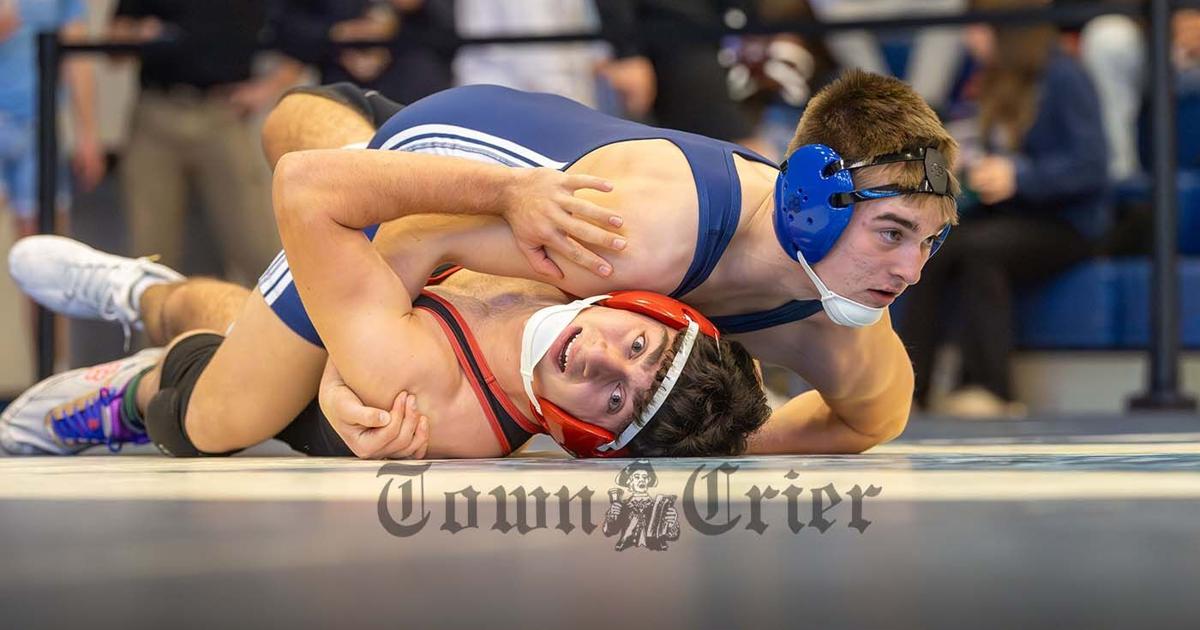
The Wilmington High wrestling team hosted its annual Sons of Italy tournament last weekend.
Before the Sons event, Wilmington competed at the Wakefield tournament.
In Wakefield, both Mason Kwiatkowski (157 pounds) and Jonathan Panatta (heavyweight) placed sixth. Samuel Beaudoin (106) and Joshua Lopez (140) picked up some good wins also.
Last year, Wilmington finished 3-12 overall in dual meets, but return plenty of experience with captains Kwiatkowski and junior Theo Bryson leading the way.
Other top returners include senior heavyweight Jonathan Panatta, junior Adam Saied at 165 and sophomores Domenic Bonanno, Ronan O’Shea, Beaudoin, Rafael Hernandez, Joshua Lopez and Colby O’Brien.
Newcomers include sophomore Gabriel Andrade and freshman Jordan Wedge.
“We have a great group of second-year wrestlers that we are confident will make an impact on the team’s performance,” said WHS coach Kevin Riley. “Samuel Beaudoin, Joshua Lopez and Colby O’Brien all picked up some quality wins at the varsity level and we are excited to witness their continued progress. Adam Saied and our junior captain Theo Bryson are now upperclassmen. They are both looking to rebound from a previously shortened season due to injury. We are excited for their return. Our heavyweight, Jonathan Panatta is looking to build upon a great junior year picking up several quality wins including success at the Lowell Holiday Tournament. Our senior captain, Mason Kwiatkowski is focused on making his final year his best yet. He produced a lot of quality wins for the team last year and they look forward to his leadership for the 2025-2026 season. We welcome David Watson to our coaching staff.
Coach Watson brings a vast amount of wrestling experience and family pedigree to the table and we are fortunate to have him. We are also fortunate to have former standout wrestling alums Evan Walsh and Ken Adams back as assistants. Both Coach Walsh and Adams bring college level experience to the table which is invaluable.”
Gymnasts ready
The Wilmington High gymnastics team is ready for a solid season.
The Wildcats will be led by seniors Sienna Brickman, Maddie Plurad and Lexie Masters this season.
Juniors on the team include Jordan Haering and Isabelle Maiella while sophomores are Emma Callahan, Martina Andreeva and Lindsay Fontana.
Freshmen on the squad consist of Emmy Rada, Kelli Tkachuk, Isaure Pretot, Janice Ryou, Grace Call and Lily O’Connor.
Three eighth graders will compete with the Wildcats including Gia Slusher, Teagan Sullivan and Liora Dashevsky.
“We hope to have a great season,” said WHS coach Kristen Hannon. “We have our returning captains Lexie and Maddy, who are entering their senior season. Along with our other senior Sienna returning, we have our new junior captain Emma returning; as well as our other juniors Jordan, Isabelle and sophomores Martina and Lindsay. We have the potential to use a variety of our talented kids in the all-around or at least to fill in the gaps where needed on other events. We hope to keep up the success and momentum we have had from this past season, while building for the future.”
Swimmers optimistic
The Wilmington High swim team is partnering with North Reading this winter with coach Jim Boyle as the head coach.
The squad was 1-5 last season, but is looking forward to improving this year.
Senior Ella Dong and junior Cole Falk are the team captains while other returning letter winners for the Wildcats include senior Vijay Cudia, senior Declan Savage, senior Jon Mehr, senior Gabby Latson, junior Cooper O’Shea, junior Kyle Griffin, junior Angelia Vo, sophomore Stella Michaud and freshman Emily Falk.
Promising newcomers are freshmen Alita Nguansiri, Ruby Davidson and Molly Bagtaz along with eighth grader Vasili Listapod.
“Our goal is to continue growing the team while becoming increasingly competitive within the Cape Ann League,” Boyle said. “We have several swimmers with the potential to qualify for Sectionals and States, led by junior Cole Falk, who aims to build on his top-five finishes in the 200 freestyle and 100 butterfly at last year’s state championships.
Girls hockey drops opener
The Wilmington Girls Hockey is starting in a new co-op opportunity with Wakefield this season.
The team will be led by senior captain, Vivien Savoie, who was the squad’s leading goal scorer last season.
Also returning are goalie, Emma Allard, forwards Dani Chillemi and Olivia Raposa and on defense, Emma Ebert.
Freshmen Kelsie Morrow and Riley Lopes are exciting new additions as well as sophomore Rita Bishop, who is coming off of being out with an injury last year.
Woburn beat Wakefield/Wilmington last Saturday evening, at Stoneham Arena, 3-0.
Allard had 29 saves on the day.
“Yes, she (Allard) was tough to beat, last year (with Stoneham/Wilmington), and we put a lot of shots on her,” said Woburn coach Steve Kennedy. “I would have liked to have seen more offensive production, but they (Warrior Cats) were a good team.”
Wilmington/Wakefield’s best chance came from Savoie as she had a last-second breakaway in the middle stanza.