OUR GRANT OPPORTUNITIES: Youth Today’s grant listings are carefully curated for our subscribers working in youth-related industries. Subscribers will find local, regional, state and national grant opportunities.
“The Bridgestone Americas Trust Fund seeks public schools pursuing funding to start adaptive sports programs or increase access to adaptive sports and equipment for children and youth. Bridgestone is offering eight $25,000 “mobility” grants to organizations that can establish new athletic programming for students with disabilities. Organizations must articulate a clear plan to provide access to new athletic programs for students with disabilities in one or more public schools for students grades K-12.”
Funder: Bridgestone Americas Trust Fund Eligibility: “Public schools serving students grades K-12, including city, township, or county public schools. Independent school districts may be considered. Must have nonprofit 501(c)(3) status with the IRS.” Amount: $25,000 Contact:Link →
>>> CLICK HERE to see all of Youth Today’s GRANT LISTINGS
For most of the world, soccer is the most accessible sport imaginable. The pillar of many communities, all it takes to play is a bit of space and something to kick.
In the United States, though, soccer is anything but accessible.
“When the cost for my son’s club team started (pushing) $2,000 because of all the expenses, my husband said, ‘We’re out,’” said Di Anderson, a loan officer in Phoenix. “He wasn’t even a teenager yet.”
Many in the youth soccer universe have echoed Anderson’s frustrations.
“There was a line that people used to use a lot: ‘For soccer around the rest of the world, you need a ball. For soccer in America, you need a uniform, you need referees and you need a scoreboard,’” said Washington Post reporter Les Carpenter, who has covered the issue of exclusivity in youth soccer extensively. “There is a lot of truth to that.”
Forget accessible. Soccer isn’t even affordable here.
“The soccer scene is an incredible amount of money and time commitment,” said Jon Solomon, community impact director at the Aspen Institute Sports & Society Program. “You are paying for your league fees or the team fees. You are paying tournament fees. Sometimes, there is additional money that you are paying to go play at these tournaments.
“You are paying for the travel, whether it is flights or driving and gas. Hotel stays and food, too. Don’t forget about equipment and uniforms.”
The bucket of costs parents must take on for their kids to play soccer in the United States is overflowing.
Even as excitement builds for the men’s FIFA World Cup 2026 coming to North America, U.S. youth organizations are seeing a decline in enrollment. Participation in soccer for ages 6-12 dropped 5.5% from 2013 to 2023, according to a study by the Sports & Fitness Industry Association. Soccer is typically the sport kids play first, the study revealed, but also the one whose participation rate declines the fastest, often because of expense.
Overlooked costs speak to both the accessibility and the costliness of playing soccer here, in part because of field access. The process of obtaining permits is “very, very extravagant,” said Carpenter, who initially believed “parks were parks, and you just go play ball in the park. I didn’t realize there was a permitting procedure.”
Fields are increasingly hard to come by in the U.S., and leagues are taking extreme measures to secure them.
“I was told that there is a league in suburban Maryland that actually employs someone to do nothing but find fields,” Carpenter said.
Money, money, money
The glut of youth soccer costs are on the rise, and at an alarming rate.
In 2024, the families of youth soccer players spent $910 annually, up from $537 in 2019, according to an Aspen Institute’s Project Play survey published in March.
This “pay-to-play” model that U.S. soccer has adopted cannot be traced to a single cause. Some speculate it is the result of the sport finding its footing here later than elsewhere in the world, forcing organizers to build infrastructure while unfamiliar with soccer’s inner workings.
They leaned on existing league structures for other sports in the United States, which were not designed to allow soccer to flourish.
“Soccer trailed the other sports here in terms of organization,” Carpenter said. “There was a boom in the 1970s, and these leagues would start up, but they were very rudimentary and mimicked Little League for baseball or youth basketball leagues. Soccer here didn’t try to evolve organically like it did around the rest of the world.
“When soccer evolved in the 1970s and these leagues started, it became, ‘How do we do soccer? Well, we start a league.’ This was because there was no other way that anyone knew how to do it or how to find players. It started so differently here than anywhere else.”
Soccer adopting more rigid, structured leagues makes for a more costly experience for parents. Unfortunately, capitalization does not spare youth sports.
“Youth soccer is a highly commercialized industry,” Solomon said. “There are a lot of entities and people who are making money in this industry.”
Though the motivations behind a structured, pay-to-play model for youth soccer, as opposed to one that is more organic and serves to better the local community like the ones many other countries have opted are unclear, the result is obvious: The underserved and the marginalized within American society suffer the most from a youth soccer system where increased parental income levels are seemingly a prerequisite for participation.
“Covering this was really eye-opening,” Carpenter said. “Not only a disparity, but it was almost as if there were two separate worlds. There was a soccer world played by immigrant kids or kids from lower-income families that never saw the light of day, and, no matter how wonderful their leagues or their games might be, they were never going to be a part of the bigger system.”
By leaning into higher costs to turn youth soccer into a revenue machine, few paths allow many kids to even enter the space.
Exposure to sports at a young age is essential for future participation. For kids who are interested in playing youth soccer but are excluded for reasons out of their control that stem from being unable to pay the costs associated with it, or not having a league near them and facing transportation issues, this early exclusion can often be a death knell to their prospects in the sport.
A lack of inclusion at a young age can foster feelings of insecurity about one’s ability to play, which can prevent later adoption of soccer, understandably so.
“Once you get to that middle school age, if you don’t have the training, you don’t want to be embarrassed,” Solomon said. “You don’t feel like you can play. We have this ‘up-or-out’ model in the U.S. when it comes to youth sports, meaning you’re either continuing to move up competitive levels, or oftentimes you are out of sports because you don’t have the money.”
While it is fair to point to the idea that soccer is a priority in other countries in a way it is not here, and this impacts the general attitude toward what families should have to pay to participate, clubs in most other countries, particularly in Europe, will often work with families who struggle to pay for the costs of youth soccer.
Rather than being priced out, families can receive a lifeline through a club that provides financial or transportation assistance.
The Messi journey
The most famous instance of this is now-Inter Miami forward Lionel Messi and the circumstances surrounding his decision to leave his native Argentina at 13 to join Spanish giant FC Barcelona. Diminutive in stature, Messi was diagnosed with a hormone deficiency as a child and was prescribed daily growth hormone injections that cost around $1,000 a month.
His family was unable to afford these costs, and Newell’s Old Boys, his club at the time in Argentina, initially covered the payments but later reneged on this agreement. River Plate, a massive club in Argentina, were offered the opportunity to poach Messi but declined, citing its inability to cover the injections due to the state of the Argentine economy at the time.
If this had happened to the Messi family in the U.S. he might have been priced out of the sport as a child, which is hard to imagine given his place in the game now. Because it happened in a part of the world where youth soccer is not primarily seen as a way to make money, he was not.
Barcelona stepped in and agreed to pay for Messi’s treatments, thus securing his services.
While Messi’s case is perhaps extreme, families from other countries are often not left to choose between clubs, where selecting one option over another will have financial ramifications that may later lead them away from the sport.
Take Charlie Dennis. The British forward for USL Championship club Phoenix Rising FC came up through the academy system at Southampton FC, an English soccer club currently in the EFL Championship, the second tier of the soccer pyramid.
England favors club academy systems, which have a very different attitude toward the costs a family will incur for their child to play.
“We didn’t pay anything,” Dennis said. “We didn’t have to pay anything. Anything at all.”
Costs that U.S. parents have been forced to accept as part and parcel to their child playing organized soccer were covered by Southampton.
“They would give us training uniforms and travel outfits,” Dennis said. “If we had an away game, there was a team bus to use. The facilities at Southampton were really good. You’d never be asked to pay a penny, really.”
Having now been exposed to the American approach to soccer, Dennis can point to the different priorities between the two countries. England is more focused on casting a wider net to find the best players, regardless of socioeconomic status, while the U.S. prioritizes profits.
“Use Wayne Rooney as an example,” Dennis said. “He had a lower-class upbringing in Liverpool. For people like that who are struggling for money, they would not be able to get those opportunities they got in England (in the United States). (British Academies) definitely give everyone a look, and look at a bigger pool of players.”
Granted, the situations were very different, but the youth soccer journeys of Messi and Dennis paint a clear picture: Youth soccer elsewhere steps in to help families make ends meet for their children’s athletic future.
Looking for a fix
Youth soccer’s inaccessibility to so many in the United States does not mean some aren’t trying to correct the problem.
When Amir Lowery, who played youth soccer in Washington, D.C. before playing for various MLS and USL clubs during his professional career, returned to the D.C. area in 2013 to coach following retirement, he knew something was wrong.
“I started coaching, and immediately I could see, and I knew that it was not an accurate representation of the demographics of D.C.,” Lowery said. “It was predominantly white, upper-middle-class. Not only was there no racial diversity, but the socioeconomic diversity of the team was nonexistent.”
Lowery also recognized that, even for those kids from different backgrounds or economic standings who did find a way into the “pay-to-play” system, they still had to make sacrifices and face stressors that many of their teammates did not.
The system was not catered to them or serving them. Instead, they were sacrificing in order to participate, often to their detriment.
“An equitable platform did not exist in the form of having these kids and those families integrated into the ‘pay-to-play’ system because they had to leave their communities,” Lowery said. “They were not in welcoming, safe places. They were often the only or one of the only minorities and definitely one of the only players from a different socioeconomic background.
“Those factors, and the environment the kids were in, took too much of a mental and emotional toll on the kids to make it worth it.”
Lowery himself had seen that youth soccer did not have to create what he describes as a “transactional environment” and could be a place that brings people together and props up the collective.
“I come from a middle-class family, and there was a lot of diversity in programs and teams that I grew up playing for,” Lowery said. “White, Black, Latino and otherwise. My experience was one of people helping each other out, working together collectively and giving each other rides at times. Solving problems and navigating situations as a group to make sure the team and kids were having the best experience.”
Recognizing the role that soccer can play in a community when harbored correctly, Lowery was not going to stand idly by and let these issues in the youth soccer system go unchallenged.
“I know that soccer is a powerful vehicle for development, for character building, for upward mobility, and I am a living example of that,” Lowery said. “I knew that the environment I was in, the entire structure, would benefit from having more diversity, socioeconomic and racial, and that that would create a better platform for kids to understand different cultures and backgrounds and be more tolerant.”
Open Goal Project
In 2015, Lowery and Simon Landau co-founded Open Goal Project, a free-to-play soccer program operating in the Washington, D.C. area.
Open Goal Project brought everything for its soccer program in-house, curtailing the risk of costs being shoved onto parents later. They planned the league so that it was within walking distance of public transport in the D.C. area, in a bid to make the programs as accessible as possible.
The decision to effectively create a union between the Open Goal Project and public transportation is one that draws praise from those invested in solving this issue.
“They are bringing club soccer, which is typically in more affluent communities, directly to these underserved kids, and that is one model that I think works,” Solomon said.
Lowery is not only hoping to change the cost structure of youth soccer with Open Goal Project. He is challenging the values of traditional youth soccer leagues and teams, which he believes have strayed so far from the things youth sports should prioritize.
“We have gone away from a set of values that promote youth development and building leaders who will impact their communities in positive ways,” Lowery said. “Talent development has become the ideal, and what clubs are selling. For our organization, character development precedes talent development. We focus on blending those two things with a holistic approach.”
To provide free leagues, Open Goal Project scours any and every potential avenue for funding, an undertaking Lowery acknowledges, matter-of-factly, takes “a tremendous amount of time and energy and sacrifice.”
“We piece together a lot of things for our funding,” Lowery said. “We apply for a lot of grants. We get grants from the city government and government-adjacent entities here locally. We get grants from family foundations and corporate entities. We try to go after sponsors in the local communities here. Our families run some fundraisers. We cultivate a lot of individual donors and sell merchandise.
“We do pretty much everything possible to amplify our brand and drive resources towards our community.”
In the years since its inception, Open Goal Project’s imprint on the D.C. community is already evident in a number of ways.
Over 20 participants have progressed through the program and played soccer collegiately at various levels, said Lowery, who was quick to stress that an Open Goal Project participant playing at the Division I level is “no more impactful” than another playing for a community college.
Success classified as collegiate soccer participation is tangible and easy to point to. For Lowery and Open Goal Project, success can also be more abstract.
“We have taken players who would have otherwise had no opportunity to play at a high level, and helped them integrate into either the pay-to-play system or our own system,” Lowery said. “We have wrapped support and guidance and mentorship and positive coaching around those kids.”
The ripple effects of Open Goal Project participants attending college are long-reaching and likely to span generations.
“We have helped a lot of kids become the first person in their families to go to college,” Lowery said. “They are first-generation college students and college graduates. We have helped those families and those players change the trajectories of their families by giving them soccer.”
Lowery and his fellow Open Goal Project leaders are not the only ones working on this issue.
MLS jumps in
In 2023, Major League Soccer introduced MLS GO, a soccer program that was “designed to increase participation and access for boys and girls outside of the existing soccer ecosystem.” Namely, they want to provide kids with a “fun, affordable, local soccer experience.”
In Vallejo, California, Ryan Sarna already had the Coach Sarna League, a nonprofit program that provided flag football leagues to local youth at a lower cost, up and running.
This program was founded for the same reasons the Open Goal Project exists: Kids want to play sports, and more affordable option to make this feasible are needed.
The kids in the flag football leagues expressed an interest in a soccer league, and Sarna seized the opportunity presented by MLS GO with both hands.
Where league fees for other youth soccer leagues in the area can range from $500 to $1,000, Sarna’s MLS GO program in Vallejo costs $125 per session, a figure inclusive of uniform costs and registration fees.
There is also room for fluctuation in the cost, depending on any given family’s financial situation. Like Open Goal Project, this league exists to work with families who want their kids involved in soccer, rather than dismissing those who cannot pay.
“If a family can’t pay, they will let me know,” Sarna said. “If they are willing to coach, we will give them a full scholarship, so they won’t pay anything. If they want to volunteer, we will give them a scholarship, and they won’t pay anything. If they can’t do either, they fill out a form, and I ask if they can pay half. If they can’t pay half, we figure something out.”
Since its inception, Sarna’s MLS GO program has awarded nearly $18,000 in scholarships to families to ensure their children can participate.
No one-size-fits-all solution exists for the problems facing youth soccer. It will require more people like Lowery and Sarna who understand what will be asked of them and are willing to take this issue on at the community level.
And they insist people should not be deterred by the challenges this issue presents
“It does not matter how small or large the impact is that someone can make,” Lowery said. “There are ways to affect this issue in small ways.
“Maybe they start how we started, by helping players who can’t afford league fees. Maybe it is a community organization that offers soccer and people with expertise in it. Maybe it is someone with a license and expertise who gets involved and donates their time. It doesn’t have to be viewed as ‘We need a club, and we need scale and we need to impact hundreds or thousands of kids.’ It can be done in a smaller way, and still be important.”
As the United States prepares to co-host the men’s FIFA World Cup 2026, many are hoping the federation can capture the increased interest in the sport and use it to pursue what they believe is the most critical goal: fielding a men’s team that can actually compete in the World Cup.
Should that be the focus? For the next generation of Americans who want to follow in the footsteps of the world’s soccer stars who will soon be welcomed to the U.S., the rising cost of youth soccer makes that dream a moot point.
All eyes will be on the American soccer system this summer, and it could be the catalyst for sweeping change.
“I think we are in desperate need of some sort of awakening from people within U.S. soccer to do something about this,” Lowery said. “It can’t just be folks like myself operating on the ground level.
“We need people in decision-making roles and leadership roles to take action, and that is one thing that has been sorely missed.”
This article first appeared on Cronkite News and is republished here under a Creative Commons Attribution-NoDerivatives 4.0 International License.
A technical rescue team was able to extract the man from Camelback Mountain after sunrise Wednesday morning.
The Tonto National Forest has temporarily closed the lower Salt River area to most horses and pack animals after an equine virus was detected. The closure could last through March.
El Capitan, a team that has made the Arizona 1A playoffs each of the last four years, had its season cut short because of a recent measles outbreak in Mohave County, one of the largest outbreaks in the country. Throughout the season, several players contracted the virus, ultimately forcing seven game cancellations, including El Capitan’s coveted matchup with their crosstown foes.
Their three countries are jointly hosting next summer’s FIFA men’s soccer tournament.
Mexican President Claudia Sheinbaum says trade will be the main topic between the two world leaders during a “brief” meeting at the 2026 FIFA World Cup draw.
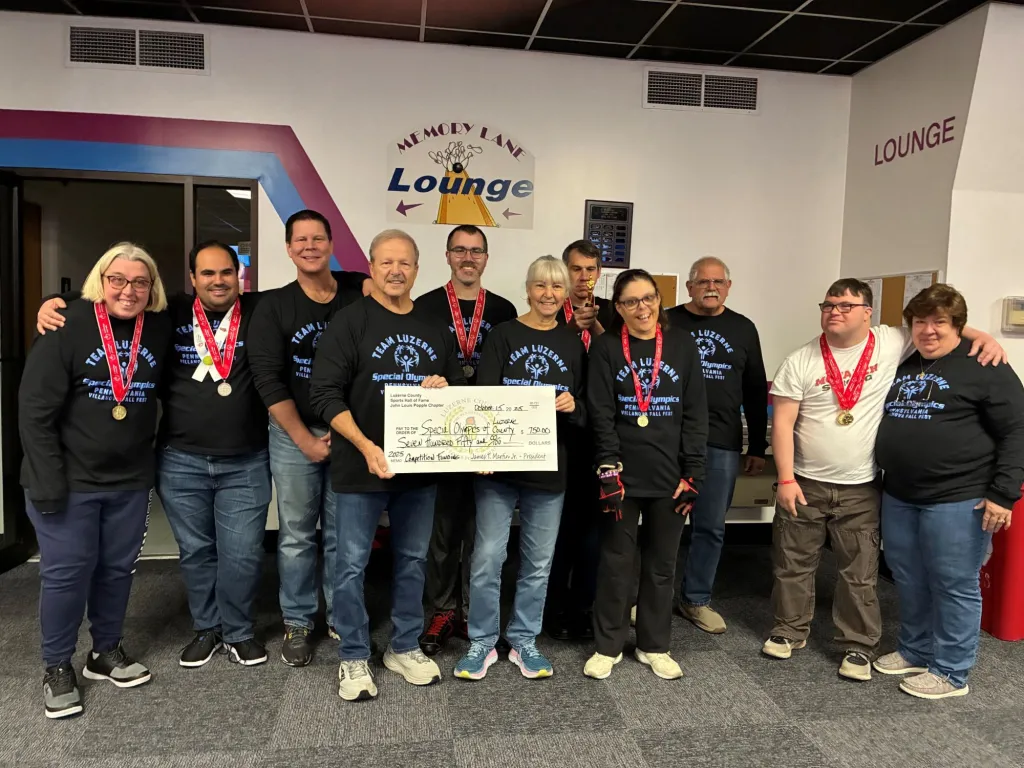
From left, are Randy Proctor, LCSHOF; Doug Miller, executive director of the GWVA-YMCA, and Jim Martin, LCSHOF president. (SUBMITTED)
The Luzerne County Sports Hall of Fame is completing its 2025 campaign contributions to non-profit organizations within Luzerne County. Two recent distributions have been designated to Special Olympics of Luzerne County and to GWVA-YMCA to provide necessary support in 2025. Funding to Special Olympics was directed to purchase Team SOLC competition shirts and to help with travel expenses for their recent event at Villanova University. The YMCA donation was used in support of Bernie’s Run and to purchase five youth basketball clinic memberships. Funding for allocations was generated from the Luzerne County Sports Hall of Fame Cares program.
Thanks to a pair of recent judicial appointments, the Third Circuit Court of Appeals has quickly become one of the most potentially consequential battlegrounds for Second Amendment litigation.
President Donald Trump nominated and the Senate confirmed two judges to fill vacancies on the court earlier this year. That gave the appellate court overseeing Delaware, New Jersey, and Pennsylvania an 8-6 Republican-appointed majority. The new balance created a tantalizing prospect for gun-rights advocates: an appeals court overseeing states with some of the strictest gun laws in existence that may skew toward an expansive view of the Second Amendment.
The rebalanced court has wasted little time making its presence felt in pending Second Amendment cases, particularly through grants of en banc review.
On Thursday, the circuit announced that it was granting full court review of Koons v. Platkin, a case challenging New Jersey’s sweeping gun-carry restrictions adopted in response to the Supreme Court’s New York State Rifle & Pistol Association v. Bruen decision.
Back in September, a three-judge panel composed of two Democratic appointees and one Republican appointee largely sided with New Jersey officials in upholding broad swaths of the state’s law. The majority OKed the state’s ban on licensed gun carry in zoos, parks, beaches, playgrounds, recreational facilities, libraries, museums, places that serve alcohol, entertainment facilities, healthcare facilities, casinos, public transit, youth sports events, and within 100 feet of public gatherings. It also approved the law’s requirement that carry permit applicants provide four separate character references before receiving a permit.
“Throughout our Nation’s history, the People have time and time again opted to limit the use of firearms at specific venues set aside for civic purposes, namely, governmental and democratic functions, and public places akin to the fairs and markets of old,” Judge Cheryl Ann Krause wrote for the majority. “We have done our best to distill the principles of our Nation’s tradition of firearm regulation from the available historical record, and what we have found convinces us that New Jersey’s law, at least in part, continues that tradition.”
That decision has now been vacated in light of the en banc grant, and the full panel of Third Circuit judges will rehear the case on February 11. And it won’t be the only Second Amendment case they’ll be rehearing that day.
The court similarly granted en banc review in Williams v. Attorney General, a case challenging the federal lifetime gun ban for convicted felons as applied to a particular non-violent misdemeanant. In November 2023, a US District Judge ruled that the Second Amendment prevents the government from permanently disarming a Pennsylvania man convicted of a repeat DUI offense under a state law carrying a penalty of up to five years in jail.
“[T]he Court finds that the Government has not carried its burden in proving that the United States’ tradition of firearm regulation supports stripping an individual of their right to possess a firearm because they had previously driven while intoxicated,” Judge John Younge wrote. “The application of Section 922(g)(1) to Plaintiff, therefore, constitutes a violation of his Second Amendment rights, and the Court finds that Plaintiff is entitled to the requested relief.”
A three-judge panel of the Third Circuit was reviewing that decision and heard oral arguments in the case in July. However, before it could issue a decision, the full court decided to take the case up sua sponte, something it had already shown a willingness to do on an even more hot-button Second Amendment subject just a few weeks prior.
In August, the full Third Circuit Court of Appeals decided sua sponte to take a consolidated group of lawsuits challenging New Jersey’s “assault weapon” and “large capacity” magazine bans en banc less than two months after a three-judge panel comprised of two Democratic appointees and one Republican appointee heard oral arguments in the case. The recomposed 8-6 court reheard oral arguments in that challenge in October and could issue a final decision at any time.
The trend in the new Third Circuit points toward a newfound enthusiasm for gun-rights challenges.
En banc hearings are rare. According to one study, appeals courts grant less than one percent of requests for en banc rehearings. Yet in a span of about four months, the Third Circuit has granted en banc review of three separate Second Amendment cases, twice doing so on its own accord.
And while the outcomes of its eventual rulings in these cases aren’t guaranteed, the procedural context of the specific cases it’s chosen to wade into suggests a favorable decision for gun owners is more likely than not.
Gun-rights advocates have long been searching for a way to entice the Supreme Court to take up bigger-ticket Second Amendment issues like assault weapon bans, magazine limits, and gun-carry restrictions. With an eager Third Circuit set to begin churning out potentially circuit-splitting decisions on those very issues, they just may have found one.
The All-Russian rugby competition among students is used not only to identify the strongest but also to help integrate sportsmen into the society.
Top student teams from the districts
The Student Rugby League competition took place at the Yessentuki Arena stadium from November 30 to December 5. Six teams from Moscow, Tatarstan, Dagestan, Volgograd Oblast, Krasnodar Krai, and Krasnoyarsk Krai participated in the event. All teams won their respective regional competitions.
But not only amateurs participated in the tournament. There were also some experienced athletes: silver medalists of the Russian championship, as well as players who have contracts with professional clubs.
Rugby teams had to play group stage matches, followed by playoffs: the four best ones played in the semifinals, where the finalists were determined. The game format was 15×15 with 25 for each half.
Sports student events as a bridge between a school and a career
A competition was held to make rugby more popular. The progress is now getting noticeable. In five years, the number of rugby players in Russia has doubled—80,000 people compared to 40,000 in 2020, said Emil Aslanov, president of the Student Rugby League.
He noted that this sport originated in universities. At the same time, rugby helps high school graduates, who have been accepted into universities, to stay involved in sports until they figure out their career paths.
Student sports are an important bridge that ensures the transition from school to amateur or professional sports. It is a platform where you can fulfill your potential and not be afraid of being left with nothing.
— said Emil Aslanov.
So, for the first time, in 2025 the organizers decided to add an educational module to the competition. It was developed with the support of the Ministry of Education and Science of the Russian Federation. Educational events are held between tournaments. Students engage in conversation with speakers and discover options for employment in various fields.
Particular attention is devoted to the opportunities in the sports sector. Players also attend lectures on different topics: artificial intelligence in sports, anti-doping, psychology, sports management, and modern trends in training.
We do not view our league solely as a platform for competitions. The educational and developmental components are just as important to us. We want to help players after they finish their sports careers. We know not everyone will become a professional athlete, and that is not our goal. But we must help young people socialize—this is just as important as their physical development.
— explained Emil Aslanov.
Long-term path
On the final day, December 5, the fate of the student championship was decided by a match between teams from Krasnoyarsk and from Moscow, which the latter one won by 23:17.
The winners and best players of the tournament received their trophies at the awards ceremony. Delighted with their success, the athletes gave interviews—it won’t be long before some of them head off to compete in professional tournaments.
Emil Aslanov, in turn, thanked the student teams for participating in the competition. He announced that educational programs and social support for students are planned to be further developed in the upcoming years.
It’s the holiday season, and you are throwing a festive party to celebrate the occasion. As the evening winds down, Cousin Ralph, who had a bit too much eggnog, misses the last step and slides down the driveway on the ice. Always looking for a payday, Ralph sues you for injuries, pain and suffering — and for serving him that last toddy.
Your homeowners’ liability policy may cover up to $300,000, but Ralph saw a billboard ad for an attorney wielding a hammer who believes the case is worth half a million. What happens if he prevails?
The answer in many cases is: You pay. A plaintiff who receives a legal award in excess of your insurance limits may generally go after your other assets. Today, $300,000 in coverage may not be enough. That is where a supplemental insurance product called an umbrella policy becomes invaluable.
Umbrella coverage is an additional policy laid on top of your other coverage that can pick up the difference if you experience a liability loss that is greater than your standard limits. This type of supplemental coverage is cheap for the protection it offers, starting at around $200 per year for $1 million in additional protection, and anyone with significant property or financial assets should have it.
The concept of liability insurance in the U.S. began in the late 19th century to address potential hazards faced by employers. Policies were narrowly tailored to cover specific risks like fire, work accidents, vehicle crashes and maritime incidents. As the magnitude of losses increased, a secondary market developed to tack on additional protection, known as excess liability coverage, also covering narrowly defined risks.
The first generalized add-on policy to cover multiple exposures above the standard coverage was written by Lloyd’s of London and sold to Gulf Oil in 1949. Originally called “broad form third-party excess liability” coverage, this unwieldy moniker was quickly changed to the more efficient and descriptive “umbrella” insurance. U.S. companies began offering umbrella policies to wealthier individual households around 1959, and ultimately the industry developed a standardized contract in 1997 that made supplemental coverage widely available to a broader customer base.
Some risks that homeowners face are fairly obvious, like a fall down the stairs by a visitor (or even by an Amazon porch pirate) on your property. Policies can also extend beyond the limits of coverage on your vehicles and are especially important if there are young drivers in the house. Other types of vehicles can also be included or added, like boats or RVs, although you must verify with your agent that the specific policy covers additional vehicles.
Household workers like babysitters, landscapers, contractors and housekeepers can also pose a risk when they are on your property if their company does not carry its own liability coverage.
Other risks may not be so obvious until you face one of them. Volunteering with nonprofit organizations can present liability risks if the organization does not carry its own insurance. For instance, around 2 million emergency room visits occur each year due to youth sports injuries. Coaches can be held responsible for failing to supervise properly or providing adequate instruction, and accusations of improper behavior are not unheard of. Adults who take part in potentially dangerous physical activities like hunting or skiing may be liable if they injure another party.
Do you own a dog? Fido could be just one mail carrier away from costing you your home. According to State Farm, $1.5 billion in liability claims were filed last year alleging injuries from dog bites. Do your kids have a trampoline in the back yard? Better cover it with an umbrella. Got a pool? Imagine the possibilities.
If you happen to be a social media troll, you may think you are safe. Think again. If you are found guilty of defamation including libel or slander, you can be sued. Same goes for harassment or cyberstalking, as well as invasion of privacy (exposing personal information). Damages are admittedly difficult to prove, but in any event, you would likely need to engage counsel.
And if you are a renter, you may still be exposed to substantial liability for damage and injuries that occur within your home. Renter’s policies typically cover up to $100,000 in liability. A fire caused by leaving a burner unattended could easily cost you more than that if you are found negligent.
Umbrella policies typically pay expenses that exceed your regular limits including bodily injury, damage to another person’s property, legal expenses in litigation and liability arising from personal behavior against another. They do not provide protection from criminal acts or intentional damage.
Given their relatively low cost and the peace of mind they provide, umbrella policies should be considered by pretty much anyone who owns more stuff that their various individual policies may not fully cover. Some insurance companies may not sell an umbrella policy to you unless you carry other coverage with them, but by all means shop around. Ask your agent for a recommendation. There are also many carriers who offer excellent coverage online. You should investigate the financial strength and claims history of any potential insurer, starting with AM Best. You can also check customer reviews (as you would with a new toaster from Walmart).
Litigation is a way of life in modern society. and the cost of being underinsured could be catastrophic in a worst case scenario. A modest investment in an umbrella policy can put your mind at ease and let you enjoy the party, even if Ralph is in his cups again.
Christopher A. Hopkins, CFA, is a co-founder of Apogee Wealth Partners in Chattanooga.
Demons girls still looking for first win this year
Durango’s Jaelyn Alston drives to the basket and attempts a 5-foot jumper against Aztec’s Alisia Valerio (21) and Grace Villarrial-Owens (4) in the first quarter of the Marv Sanders Invitational second round play on Friday at Scorpion Auxiliary Gym. (Curtis Ray Benally/Special to the Tri-City Record)
Curtis Ray Benally
The Durango High School basketball teams headed south for some great competition in Farmington at the Marv Sanders Invitational to mixed success.
Durango’s boys split their first two games, while the girls continued their streak of close losses to open the season.
Here’s how each team did in their first two games of the tournament:
Navajo Prep girls hold off Durango rally for 34-31 win in first round
The Navajo Prep girls basketball team led by as many as eight points in the third quarter before holding off a late rally, topping Durango 34-31 in an opening-round game of the Marv Sanders Memorial Girls Basketball Tournament on Thursday at Farmington High.
The win advanced the Eagles (2-1) into a second-round winner’s bracket match Friday against Volcano Vista, who routed Aztec in a first round game by a score of 55-21.
Senior Kameron Dale led the way with 10 points for Navajo Prep, and junior Leilani Wood had a strong outing, scoring all six of her points in the second quarter. Navajo Prep has now won two straight games.
The two-time defending Class 3A state champions took advantage of poor Durango shooting in the first half; the Demons converted only four of 14 field goal attempts before halftime.
The Eagles’ defense forced seven turnovers in the second half, even as the Demons closed the gap in the fourth quarter to tie the game at 31-31 with 3:30 remaining.
Led by Claire Goodwin’s game-high 15 points, Durango had several chances to claim the lead in the final minutes but missed a pair of jump shots and then resorted to fouling to stop the clock. Durango committed eight personal fouls in the fourth quarter, four of which sent Navajo Prep to the free-throw line.
Dale connected on a pair of free throws with 19.3 seconds left to seal the victory for the Eagles. Durango had a chance to tie the game on the final possession, but Navajo Prep junior Nataya Serrano intercepted a cross-court pass just before the final buzzer sounded.
Durango (0-3) looked to win its first game of the Sanders Invitational when it faced Aztec in a consolation-round clash Friday at 11 a.m.
Durango boys surge past Window Rock 52-41 in opening round
Durango held off a Window Rock push in the second half and advanced to the second round with a 52-41 win Thursday inside Scorpion Arena.
The Demons (1-1) leaned again on junior standout Kingston Kerlin, who poured in 29 points. Senior Jaylen Brown led the Fighting Scouts (3-4) with 15.
Both squads opened cold. Durango hit only one of nine shots yet stayed in front through strong free-throw shooting, knocking down six of eight. The Demons’ pressure forced stops, and they closed the quarter ahead 11-7.
Window Rock kept charging after the break, trading baskets until they pulled within 33-31 — the tightest margin of the contest. Durango’s pace then swung the game. The Demons found lanes, beat defenders downcourt, and went on a 7-0 run for a 44-35 lead entering the fourth.
Kerlin controlled the finish, grabbing his own miss for a putback and directing a patient offense that chewed clock. Durango closed strong, sealing the 52-41 victory.
“Everybody knows [Kerlin] on this side of the track, especially on the Western Slope and New Mexico-Colorado border, so everybody’s going to be looking for him,” Durango head coach Alan Batiste said. “So, it’s just going to be another guy that has to step up. We have to have someone help him out.”
Aztec girls edge Durango in consolation game
Senior Jazzlyn Gomez scored 15 points to lead the Aztec High School girls basketball team to a 31-26 win over Durango in another second-round consolation game at the tournament.
The win, coming after a tough loss to Volcano Vista in the opening round, improves the Tigers’ record to 3-1. Aztec will face Newcomb on Saturday at 12:45 p.m.
Both teams struggled offensively. The game featured a number of turnovers in the opening half, and the Tigers were held to only three points in the opening quarter.
Aztec trailed 14-13 at halftime but found more success shooting the ball in the third. Gomez connected on a 3-pointer and made a pair of free throws, while Camila Dominguez also helped put the Tigers’ offense in a better rhythm.
Gomez hit another 3-pointer to give the Tigers the lead in the third quarter, then Khloe Schmidt extended that advantage to 20-16. The Durango Demons (0-4) rallied and reclaimed the lead after Jaelyn Alston connected on back-to-back possessions.
As the third quarter was ending, Gomez put the Tigers back in front, converting a free throw attempt after driving to the lane and drawing a foul.
“She’s been so special to this team, and she really shouldered a load for us today,” Aztec head coach Bill McLaughlin said of Gomez.
The game was sealed midway through the final quarter with Aztec leading 26-23. Schmidt grabbed a turnover in the backcourt and sank a 3-pointer to lift Aztec’s lead to 29-23.
“That was really the shot of the game,” McLaughlin said. “[Durango] was starting to press a bit, and she came up with that shot that gave us a little separation.”
Durango (0-4) wrapped up its bracket play Saturday against Shiprock at 11 a.m.
Farmington boys dominate Durango in second round
Farmington senior Sataurus Griego pulls up and attempts a 6-foot jumper against Durango’s Jude Alderton in the first quarter of the Marv Sanders Memorial Invitational semifinal game on Friday at Scorpion Arena. (Curtis Ray Benally/Special to the Tri-City Record)
Curtis Ray Benally
In the other semifinal, Farmington dominated the boards and capitalized on clean execution to cruise to a commanding 68-38 win over Durango.
The Scorpions (6-1) pulled away with a 21-point fourth quarter. Senior Sataurus Griego finished with 11 points, while classmate Donathan Tracy added nine with smooth moves under the basket.
The Demons (1-2) were sparked by 11 early points from senior King Kerlin and sophomore Taj Batiste, who stepped in as a key scorer in the second half.
Farmington took a 21-13 lead at the end of the opening frame, helped by a triple from senior Conner Neff and a basket from Griego.
Tracy began flashing his moves and footwork in the second quarter, providing a boost as the Scorpions’ offense stalled briefly.
“When (Tracy) is driving down to the basket, he’s just so crafty down there and they think they’ve got him,” said Farmington head coach Larry Don-Chitty. “I thought he was sort of our saving grace in the first half.”
Farmington led 36-24 at the break and held a 47-33 lead after three quarters, despite posting its lowest scoring quarter of the night with 11 points.
The Scorpions opened the final quarter strong on defense, forcing a five-second inbound violation. Neff fed Isaac Dinning for a score, and senior Derrick Jaramillo Jr. added six fast-break points, powering the 21-point fourth quarter and sealing the 68-38 victory.
“I’m so pleased with (Jaramillo),” Chitty said. “When he comes in, he plays so hard every time. It’s cool that he can come off the bench like that and be ready to go.”