
NIL
House v. NCAA settlement complicated — and still not settled | University Times


By SUSAN JONES
If you’ve been paying attention to the business of college athletics, you probably know that big changes have been happening — and more are on the way.
“The impacts are going to be real, that’s for sure, and in many ways, it’ll be unrecognizable, even though a lot of people just have their eyes closed or their blinders on,” said Mike Epitropoulos, a Pitt sociology professor and chair of the University Senate’s Athletics & Recreation committee.
For those who haven’t paid attention, the key phrases are “House settlement” and “Name, Image and Likeness (NIL).”
The money involved in the proposed House settlement could have lasting impacts not just on college sports, but also on colleges themselves.
Pitt recently said in a statement: “The University of Pittsburgh is extremely proud of its rich and robust tradition of athletic excellence, and we are committed to building upon that legacy by implementing the provisions of House vs. NCAA settlement, should it be approved by Judge Wilken. We believe the proposed settlement provides clarity and a path forward as the University and its student-athletes take the next steps forward together in this new era of college athletics.”
What is the House settlement?
The first thing to know is the House vs. NCAA case is not settled, yet. U.S. Judge Claudia Wilken was initially scheduled to rule on the final settlement in early April, but she had several questions, particularly about roster limits (more about that later).
The case stems from a 2020 lawsuit by Arizona State swimmer Grant House and women’s college basketball player Sedona Prince, along with two separate suits by other college athletes, which were combined into one case. The suits argued that the NCAA and the top-tier conferences — including the ACC, which Pitt belongs to; Big Ten, Big 12, Pac-12 and SEC — violated antitrust law by collectively agreeing to not provide benefits and compensation to student-athletes, and denying student-athletes the opportunity to profit from use of their name, image and likeness.
Over the past several years, many states — including Pennsylvania since 2021 — have allowed third parties to pay student-athletes in NIL deals, but universities were still prohibited from paying students directly.
After many years of discussions, a preliminary settlement was reached last October. The key details of the plan include:
Back pay: The settlement includes $2.78 billion in back pay for athletes who competed between 2016-24 and were either fully or partially shut out from NIL payments. The money will be paid over 10 years — 60% by the NCAA from its reserves and 40% from the schools. Most of the schools’ part of the settlement will come from revenue they would have received from the NCAA for events like the March Madness basketball tournament.
Still in question is how the back pay will be divided among all Division I athletes. Some estimates say that up to 95% will go to football and men’s and women’s basketball players. A specific distribution plan, designed by the plaintiffs, will determine individual back pay amounts.
Revenue sharing: Under the 10-year deal, schools will be able to pay students directly for NIL rights, up to a cap of 22% of their annual revenue from things like media rights, ticket sales and sponsorships, which currently average about $23 million per school.
NIL deals: Student-athletes can still negotiate external NIL deals under the settlement, but would have to report any third-party NIL compensation greater than $600. And there would be increased scrutiny on these deals.
Roster limits vs. scholarships
The big stumbling block now delaying Judge Wilken’s final approval of the settlement is the provision that does away with athletics scholarship limits and instead institutes roster limits for each sport.
For instance, the initial proposal would limit football to 105 players, instead of the 85 scholarship players now permitted. In 2023, Pitt had 110 players on its football team, with 25 not on scholarship. This limit would essentially eliminate “walk-on” players.
Some schools have already made some roster cuts in anticipation of the House ruling being implemented in July, although Pitt has not. Pitt football coach Pat Narduzzi told the Post-Gazette that his understanding is the 105 number doesn’t need to be met until classes officially start, so he has some time to decide.
Ohio State Athletic Director Ross Bjork told the school’s Board of Trustees last year, according to the Columbus Dispatch, that roster limits could mean a reduction of about 150 student-athletes out of a total of 1,100 a year, and that some sports would become more like club sports. Shortly after his comments, Ohio State eliminated scholarships for the men’s gymnastics program.
Attorneys submitted a compromise proposal last week that would allow, but not require, colleges to grandfather in players who would have been or who already had been cut because of the roster limits and let them play for as long as their NCAA eligibility lasts.
During that time, those players would not count against the roster limits. That includes athletes who were “certified for practice or competition” during this current academic year season, prior to April 7; or any new recruit who was assured a spot on the team roster for 2025-26.
Those who objected to the original roster limits had until May 13 to reply. Lawyers representing athletes who lost their roster spots called the proposed solution insufficient.
Where will the money come from?
Pitt Athletics reported $69.1 million in revenue for fiscal year 2023-24, according to the most recent Stairs Report required by the state, and expenses of $108.5 million — leaving a nearly $40 million deficit. If Pitt had paid student-athletes up to the 22% cap that year, it would have added another $15 million to the deficit.
And even more profitable programs are questioning how they will come up with the money. The Associated Press quoted Alabama Athletic Director Greg Byrne, who told Congress “Those are resources and revenues that don’t exist.”
Sheila Vélez Martinez, the University’s faculty athletics representative and professor of asylum refugee and immigration law in the School of Law, said an analysis by the Knight Commission shows that around 2% of the budget for Power Four conferences’ athletic departments — which include the ACC — comes from institutional funds. The rest is mostly media rights and donations, business deals with sponsors, sponsorships and ticket sales.
One Pitt alumnus, attorney J. Byron Fleck, has tried to get the Board of Trustees to vote on a resolution that would prohibit any part of student tuition and fees or appropriations from the state from being used to pay players under the revenue-sharing proposal in the House settlement.
So far, he hasn’t had any luck in getting the trustees to take up the matter.
More issues in the future
If all the issues involved in the House settlement weren’t enough, other potential problems may lie ahead.
“What we see today, it’s not what we’re going to have by the end of the decade,” said Sheila Vélez Martinez, the University’s faculty athletics representative and professor of asylum refugee and immigration law in the School of Law. “There’s too much at stake for too many people.”
No matter what Judge Wilken eventually rules, there’s likely to be more lawsuits regarding issues about how the back pay money is divided or over students losing roster spots or teams being cut.
Congress also might pass legislation that allows student-athletes to collectively bargain, but then not be considered employees, Vélez Martinez said, which will add an extra level of complexity for athletic departments. There also might be a move for the power conferences to break away from the NCAA.
“Athletics directors right now are kind of CEOs in that they’re just going to try to generate business so they can support the needs of the department,” she said, “because that money is not coming from the institutions.”
The impact from the House settlement is likely to ripple through universities, Epitropoulos said. “I’ve seen concern about … faculty unions striking because ‘You won’t give us $1,000 raise, but all of a sudden the budget for sports is going to go up.’”
But Epitropoulos said polls show that athletics are still important in recruiting not only athletes, but other students and faculty. “Even faculty who might hate sports, many of them say, ‘Yeah, I like being around a university with a vibe that has all the swag around and the big game coming in this weekend, and all the alumni coming in.”
Student-athletes are “ambassadors for all that we do,” Vélez Martinez said. “They’re not only ambassadors for athletics, but they’re ambassadors for Pitt, and that is important. So I want to be able to preserve that.”
Susan Jones is editor of the University Times. Reach her at suejones@pitt.edu or 724-244-4042.
Have a story idea or news to share? Share it with the University Times.
Follow the University Times on Twitter and Facebook.


Brendan Sorsby, a redshirt junior who split his first two years at Indiana before transferring to Cincinnati in 2024, posted an efficient, productive 2025 season.
In 12 games, he threw for 2,800 passing yards with 27 passing touchdowns and five interceptions, plus 580 rushing yards and nine rushing scores, making him among the more complete dual-threat QBs in the country.
Unfortunately for the Bearcats, he informed Cincinnati of his intent to enter the NCAA transfer portal on Monday and is also awaiting an NFL draft grade while he gauges options.
Brendan Sorsby’s public NIL profile ranks him among the higher-valued transfer assets nationally, with a reported valuation of around $2.4 million, ranking 12th among all NCAA athletes in 2025.
As college football’s winter transfer market quickens, Tennessee has now been connected to Sorsby, according to reporting by On3’s Pete Nakos.

The link arrives as the Vols’ quarterback picture for 2026 grows murky, creating a plausible landing spot for a veteran signal-caller.
Tennessee starter Joey Aguilar closed the 2025 regular slate with 3,444 passing yards, 24 TDs, and 11 INTs, but the depth chart behind him has thinned.
Backup Jake Merklinger has reportedly told staff he plans to enter the portal, and the only experienced alternatives are true freshmen and early enrollees such as George MacIntyre and incoming five-star signee Faizon Brandon.
That combination leaves Tennessee weighing whether to chase an established transfer or roll with youth.
Several other programs, including Big Ten and Big 12 teams, have also been linked to Sorsby, notably Indiana, Oregon, Penn State, and Texas Tech.
Sorsby’s decision will likely hinge on three factors: NFL feedback on his draft prospects, immediate playing opportunity, and a clear path to a starting role.
Tennessee checks two of those boxes: potential playing time if depth erodes and a high-usage offense, though competition from programs willing to offer larger NIL guarantees remains a factor.
Expect conversations and movement to heat up with the portal opening on January 2, 2025.
Read More at College Football HQ
- Top 5 transfer portal landing spots for Missouri quarterback Beau Pribula
- $64 million college football coach emerges as prime candidate to replace Sherrone Moore at Michigan
- $45 million college football head coach reportedly offers Lane Kiffin unexpected role
- $3.7 million college football head coach named clear candidate for Michigan vacancy
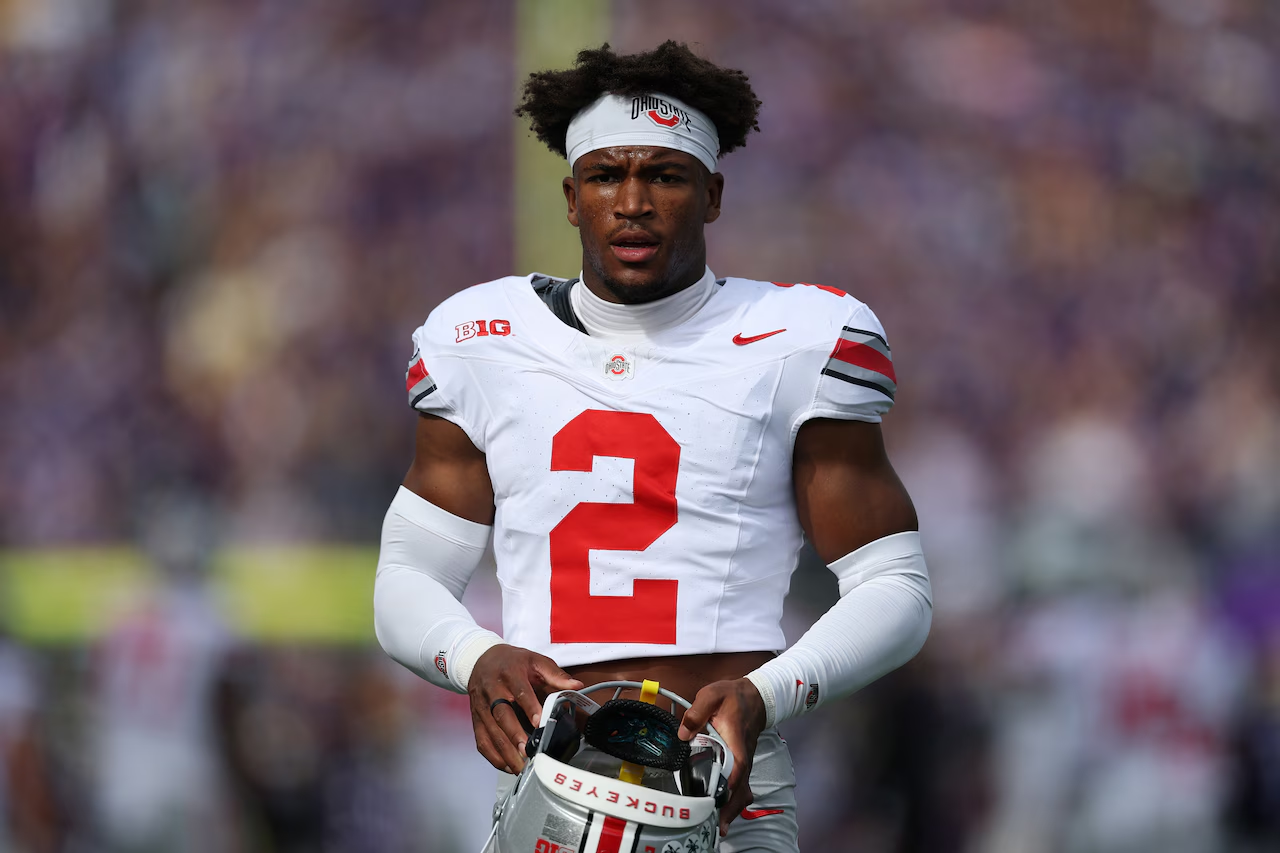
COLUMBUS, Ohio — Receiver Jeremiah Smith, safety Caleb Downs and defensive tackle Kayden McDonald have earned first-team All-American honors from all five major publications this postseason, officially making them unanimous selections.
In doing so, the collection of stars helped Ohio State football set a record.
The Buckeyes now have a college-football best 42 unanimous All-Americans in program history.
Alabama, which entered the season with a record 41 unanimous selections, had none. Notre Dame, which was tied with OSU at 39 coming into the season, had two (Jeremiyah Love, Leonard Moore).
This is the first time Ohio State has ever had three unanimous selections in the same year.
| Five major All-American publications |
|---|
| Walter Camp Football Foundation |
| Associated Press |
| American Football Coaches Association |
| Sporting News |
| Football Writers Association of America |
Downs is the first defensive player in program history to earn multiple unanimous All-American honors.
He’s in his second campaign at OSU after transferring from Alabama. Along with his All-American honors, Downs won the Lott IMPACT Trophy and Jim Thorpe Award this year.
Smith is also in his second season with the Buckeyes after arriving as one of the most highly-touted recruits in program history. He’s lived up to the hype, highlighted by his 80 receptions for 1,086 yards and 11 touchdowns this season.
McDonald has been a fixture in the middle of Ohio State’s defensive line, collecting 57 tackles, three sacks and two forced fumbles. He’s anchored a unit allowing only 84.46 rushing yards per game.
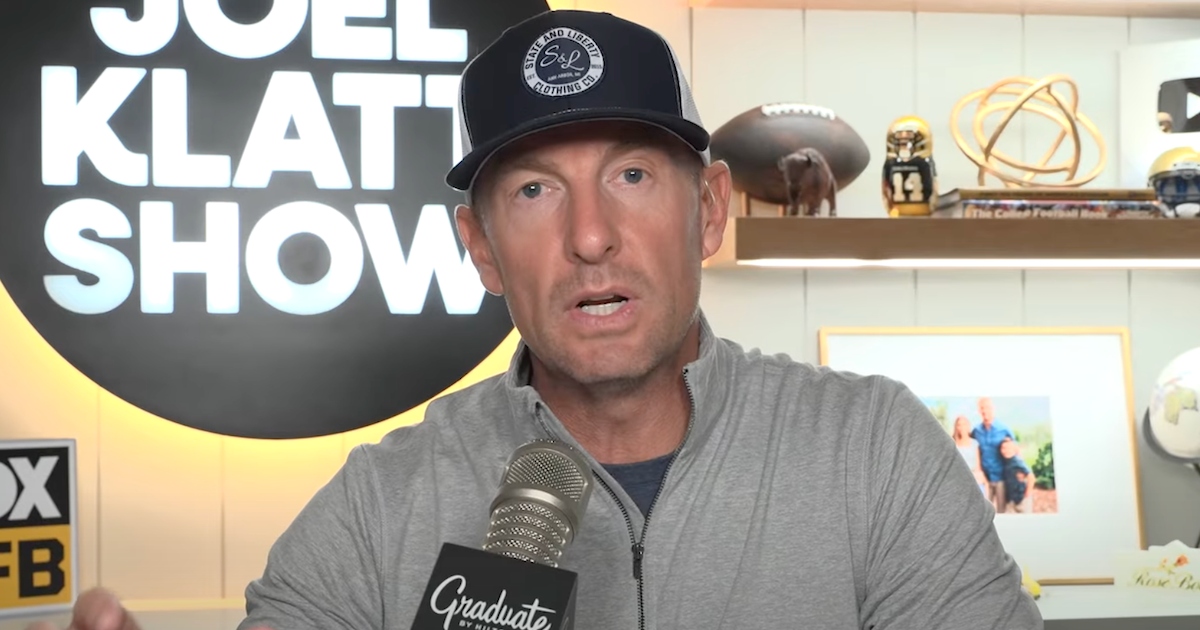
FOX Sports analyst Joel Klatt drew instant scrutiny this week when he made the claim that the only reason the Group of Five was in the College Football Playoff was the threat of litigation. He also suggested, in a parallel vein, that the NCAA basketball tournament isn’t an effective way to crown a champion in the sport.
He railed against Cinderellas a bit and just generally came off seeming a touch antagonistic toward both college basketball and the G5. On Thursday, he apologized for his delivery.
“I had an interesting take. It was a bad take. It was a terrible take,” Joel Klatt said on The Joel Klatt Show. “I have this take about the NCAA Tournament that is a bad take. And it’s a hot take. But it’s what I believe about the NCAA Tournament.
“Now, to be fair, what I said on their show on Monday morning early was sloppy and worded wrong. So it was kind of like I landed the plane but it was in a corn field and so like we had to hit the eject and the plane didn’t crash necessarily. Here’s the deal: I did not articulate what I wanted to articulate.”
He later spent a few minutes on his podcast further outlining his thoughts on Thursday morning. But has his stance really changed?
“Here’s the take: The NCAA basketball tournament, if the objective was to crown the best basketball team of the college basketball season, then it’s a bad format,” Klatt said. “And because of that, then it’s not fair, is what I said. And I said it is a joke and it’s the dumbest, and that’s obviously going to grab headlines. That’s stupid of me to use those terms.
“But the structure of the NCAA basketball tournament, its objective is entertainment, it’s meant to be a gauntlet. So the point is the best college basketball team for the year doesn’t always win the NCAA basketball tournament. That tournament is set up to just crown its own champion. It’s a made-for-TV, entertainment event. And it’s great. And by the way, I do love the NCAA basketball tournament. But if you’re asking me if it’s structured properly to crown the best team of the season, then the answer is no.”
Klatt would admit his opinion is unpopular. But he was unflinching in defending the heart of his point, even if not his delivery of the initial comments.
“Now… it’s a hot take. It’s a bad take,” Klatt said. “Not everyone’s going to share that with me, because everyone loves the entertainment value of Cinderellas in the NCAA basketball tournament. But there’s the thing, if you’re actually honest with yourself, you love the Cinderellas early, but late, you want to see the best teams playing against each other. You want to see incredible regional finals. You want to see Kentucky and Duke with (Christian) Laettner hitting it at the buzzer. Why? Because that’s greatness. So I root for good teams to become the participants late in the tournament.”
Here’s where the argument starts to come back around to the Group of Five and the College Football Playoff a little more. The links that were perhaps missing or not well-enough established in Joel Klatt’s initial go-round were filled in.
“In college football, ours is much more selective. We have 12 teams of 130-whatever in college football,” Klatt said. “So once we’re down to 12, well, now we don’t really want Cinderellas. And I will maintain that opinion. You can disagree and more power to you.”
As for the NCAA basketball tournament, perhaps it was just a case of Joel Klatt conflating two ideas and two different opinions that didn’t need to intersect. Maybe.
Still, the analyst stuck to his guns on his overall points. Especially with the G5 in the playoff.
“The way I said it on Monday morning was so dumb. Dumb take,” Klatt said. “And I prefaced it by saying it’s like the hottest of all takes. There’s 68 teams in the NCAA basketball tournament. So yeah, people love the Cinderellas, but you want the great teams playing late. That makes it awesome in the Final Four and the regional finals. And I’m saying we’re already at that point in college football.”
So what should the Group of Five do if they’re no longer welcome in the playoff? Well, Klatt suggested an alternative. It’s likely to be controversial. But it’s not something totally out of the realm of possibility, either.
“By the way, I’m not a Group of Five hater,” Klatt said. “I think it would be better for the Group of Five if they played their own championship, so that we could celebrate them. Focus on them. More teams could be involved, more fanbases could be involved. That would be awesome. I think that would be great for everyone. Not having to go up to Autzen and face one of the best five teams in the country. That’s impossible for JMU. … I will just say I think it would be better if they played their own playoff.”

BATON ROUGE, La. – Marshall Faulk continues to assemble a staff with deep Power Four ties, as the HBCU program at Southern University prepares to hire Ben Miles, the son of former LSU head coach Les Miles, as tight ends coach and recruiting coordinator.
The move was first reported by Matt Zenitz of CBSSports and represents another notable addition to Faulk’s growing staff in Baton Rouge. For Miles, the hire marks a return to Louisiana and a new chapter inside Black college football.
Ben Miles arrives at Southern after serving as a graduate assistant at Florida State, where he gained experience working within one of college football’s most resource-rich environments. Before joining the Seminoles, Miles worked on staff at Texas A&M, adding further exposure to high-level recruiting operations and player development.
Now, he brings that experience to an HBCU setting under one of the most recognizable figures in football.
A Baton Rouge Return
The hire carries added symbolism because of Miles’ family ties. His father, Les Miles, spent more than a decade as head coach at LSU, leading the Tigers to a national championship in 2007 and becoming one of the most recognizable figures in the program’s history.
While Ben Miles is carving out his own coaching path, his return to Baton Rouge places him back in a city deeply connected to his football roots. This time, however, the setting is Southern University, where Faulk is working to elevate the Jaguars’ profile nationally.
Recruiting Emphasis
In addition to coaching tight ends, Miles is expected to serve as Southern’s recruiting coordinator. That role aligns with Faulk’s stated emphasis on expanding Southern’s reach in modern recruiting landscapes shaped by NIL, facilities, and national visibility.
Athletics Director Roman Banks has been clear that Southern must compete differently in today’s college football environment. Adding staff members with Power Five experience supports that goal and enhances Southern’s credibility with prospects and families.
Miles’ background at Florida State and Texas A&M provides insight into recruiting operations at the highest level. That knowledge could prove valuable as Southern seeks to attract and retain talent in an increasingly competitive space.
Staff For Marshall Faulk Takes Shape
Since being introduced as head coach, Marshall Faulk has leaned heavily on relationships, trust, and experience while building his staff. The additions of Todd Lyght and now Ben Miles reflect a blend of NFL pedigree, Power Five exposure, and long-term developmental focus.
Southern is not simply filling roles. The Jaguars are assembling a staff designed to teach, recruit, and compete with purpose.
As Faulk’s first season approaches, each hire adds another layer to what is becoming one of the most closely watched coaching transitions in the HBCU football landscape.
The post Marshall Faulk adds Les Miles’ son to football staff appeared first on HBCU Gameday.
HBCU Gameday
This story was originally published December 18, 2025 at 2:25 PM.

During his time at Texas, Michael Taaffe built an impressive social media following with more than 80,000 followers across Instagram and X. That platform is important in the NIL era – but Taaffe took a “different” approach.
Taaffe didn’t ink many high-profile deals during his time at Texas. He was part of Sonic’s activation along with some Longhorns teammates and Texas A&M players, and he joined Seat Geek’s initiative ahead of last year’s College Football Playoff.
SUBSCRIBE to the On3 NIL and Sports Business Newsletter
Instead, Taaffe’s focus remained on the big picture, which included his efforts with Texas Against Fentanyl. That’s why he wasn’t necessarily active in the NIL space with deals.
“I think NIL, for me, has been a little bit different because there’s opportunities that I have taken to get a little cash in the wallet, in the pocket,” Taaffe told On3 via Zoom on behalf of Allstate. “But I think, would you much rather have this little success? This little financial success that at the end of the day, when you have to go buy a house, when you have to get a car, when you have to pay rent, this little success isn’t going to matter in the long-term? Or, would you rather have success and significance to the University of Texas that will last 100 years? I chose that route.”
Taaffe focused on giving back throughout his time at Texas. His efforts in substance abuse prevention helped him win the Wuerrfel Trophy, the premier award for community service. He helped raise nearly $60,000 for Texas Against Fentanyl through a fundraiser, which he said helped cover the organization’s yearly budget.
Taaffe’s efforts went beyond substance abuse awareness, though. He also helped raise more than $100,000 for the Texas Flood Relief Foundation after the flooding at Camp Mystic earlier this year and has visited the Dell Children’s Hospital to distribute food.
But while other athletes star in ads or promote different products through NIL, Michael Taaffe wanted the ability to have a platform to make a difference. He understands why his peers have a different approach, though. It just didn’t fit with his goals.
“I don’t fault anybody for the routes they take,” Taaffe said. “But I just knew that I believe being significant is way more important than being successful.”
NIL
Michael Wilbon claims Kalen DeBoer will leave Alabama for Michigan with loss in College Football Playoff opener

The College Football Playoff gets underway Friday night as Alabama heads to Norman to take on Oklahoma. But to ESPN’s Michael Wilbon, there’s even more at stake for Crimson Tide coach Kalen DeBoer.
DeBoer’s name has been the subject of rumors throughout the offseason in the coaching carousel. Most recently, he received questions about the opening at Michigan following Sherrone Moore’s firing for cause, though he made it clear he intends to be at Alabama in 2026.
However, Wilbon didn’t sound as convinced. He predicted Alabama would not only lose to Oklahoma on Friday night, but DeBoer would also be on a flight to Ann Arbor to take the Michigan job afterward.
“Let me tell you about … two schools that could be in the coaching carousel after [Friday night],” Wilbon said Thursday on Pardon The Interruption. “Because when Alabama loses to Oklahoma – let me say it again, when Alabama loses to Oklahoma – the coach of Alabama, half the people in the state will want to run him out. And he’ll be on the carousel – oh, wait, that’s a G5 being flown to Ann Arbor, Mich., where he has said, ‘Oh, no. I ain’t got no interest in that.’ He’ll have interest [Friday night].
“And then, Alabama will be in the coaching carousel because they’ll be looking for a coach. … The Alabama coach is going to have a job-on-the-line situation in 24 hours and then, headed to Michigan once he loses. And then, Alabama’s looking. Then, what are you going to say?”
During a press conference this week ahead of the College Football Playoff opener, Kalen DeBoer was directly asked if he intended to be Alabama’s head coach next season. He responded, “Yes.”
Earlier in that press conference, DeBoer received a question about the rumors surrounding him. He again spoke highly of his tenure at Alabama so far and made it clear he’s happy in Tuscaloosa.
“A lot of the same things I said before, a couple weeks ago, when asked really the same question, just feel completely supported,” DeBoer said. “My family loves living here. Just all the things that we continue to build on, love the progress. Haven’t talked with anyone, no plans of talking with anyone. So just, I think that’s a lot of what I said a couple weeks ago, and continues to be the same thing.
“Feel strong about it. And our guys, if there’s been any distraction, I haven’t seen it, haven’t felt it. I’m really proud of the way they’ve handled whatever noise is out there. And again, we probably all season long, have dealt with enough noise to where it wouldn’t surprise me on how they handle this.”

2025 DI women’s volleyball championship: Bracket, schedule, scores

Badgers season ends in five-set thriller

Major SEC program emerges as candidate for $2.4 million college football quarterback

Assistant Coach-Women’s Volleyball in Tulsa, OK for Oral Roberts University

Badgers news: Final Four Game Thread vs. No. 1 Kentucky Wildcats

Brightspeed invests $580,000 in STEM and esports, supporting North Carolina schools and programs — EdTech Innovation Hub

Ohio State football has set a new record with its unanimous All-American selections

Assistant Women’s Volleyball Coach in Cleveland, TN for Lee University

Reaction To The Loss Of NASCAR Driver Greg Biffle, His Wife-Cristina, Daughter-Emma, Son-Ryder, Friend-Craig And Pilots-Dennis and Jack

Joel Klatt admits his viral NCAA Tournament stance ‘was a terrible take’

Wilson aiming for Olympic heights following graduation

Pitt Falls In National Semifinal

TOYOTA GAZOO Racing Announces 2026 Motorsport Program | Corporate | Global Newsroom

The 2025 Bowerman Finalists and Watch List for men’s and women’s NCAA track and field

Marshall Faulk adds Les Miles’ son to football staff

First Tee Winter Registration is open

Fargo girl, 13, dies after collapsing during school basketball game – Grand Forks Herald

CPG Brands Like Allegra Are Betting on F1 for the First Time

F1 Las Vegas: Verstappen win, Norris and Piastri DQ tighten 2025 title fight

Volleyball Recaps – November 18

Sycamores unveil 2026 track and field schedule

Two Pro Volleyball Leagues Serve Up Plans for Minnesota Teams

Utah State Announces 2025-26 Indoor Track & Field Schedule

SoundGear Named Entitlement Sponsor of Spears CARS Tour Southwest Opener

Jo Shimoda Undergoes Back Surgery

Redemption Means First Pro Stock World Championship for Dallas Glenn

Texas volleyball vs Kentucky game score: Live SEC tournament updates

Bowl Projections: ESPN predicts 12-team College Football Playoff bracket, full bowl slate after Week 14

How this startup (and a KC sports icon) turned young players into card-carrying legends overnight

Robert “Bobby” Lewis Hardin, 56






-
 Motorsports1 week ago
SoundGear Named Entitlement Sponsor of Spears CARS Tour Southwest Opener
-
 Motorsports3 weeks ago
Jo Shimoda Undergoes Back Surgery
-
 NIL3 weeks ago
Bowl Projections: ESPN predicts 12-team College Football Playoff bracket, full bowl slate after Week 14
-
 Rec Sports3 weeks ago
Robert “Bobby” Lewis Hardin, 56
-
Sports3 weeks ago
Wisconsin volleyball sweeps Minnesota with ease in ranked rivalry win
-

 Motorsports1 week ago
Donny Schatz finds new home for 2026, inks full-time deal with CJB Motorsports – InForum
-

 Motorsports3 weeks ago
Increased Purses, 19 Different Tracks Highlight 2026 Great Lakes Super Sprints Schedule – Speedway Digest
-

 Rec Sports2 weeks ago
How Donald Trump became FIFA’s ‘soccer president’ long before World Cup draw
-

 Motorsports3 weeks ago
Michael Jordan’s fight against NASCAR heads to court, could shake up motorsports
-

 Rec Sports2 weeks ago
Black Bear Revises Recording Policies After Rulebook Language Surfaces via Lever