
Sports
How Does SGAI Differ From SSAI and CSAI for Live Streaming Monetization?


As the buzz around server-guided ad insertion (SGAI) grows in the adtech and streaming worlds, what sets it apart from the more familiar server-side ad insertion (SSAI) and client-side ad insertion (CSAI), and what specifically can it do that SSAI and CSAI can’t, particularly for live sports streams without period ad breaks?
IAB Tech Lab’s Katie Stroud, Paramount’s Jarred Wilichinsky, RealEyes Media’s David Hassoun, and Google’s Sourya Roy debate the differences and the potential of SGAI to enhance ad experiences in this clip from a panel at May’s Streaming Media Connect.
Join conference chair Andy Beach and other streaming media experts in person Oct. 6–8 in Santa Monica, CA, for more thought leadership, actionable insights, and lively debate at Streaming Media 2025.
Explaining the Differences
Streaming Media Contributing Editor and Reality Software Consultant Nadine Krefetz opens the discussion as panel moderator by asking IAB Tech Lab Senior Product Manager of Ad Experiences Katie Stroud, “Katie, can you sum up what some of the options are in terms of the actual ad experience for server-guided ad insertion, like L-bars?
Stroud explains the differences among SSAI, CSAI, and SGAI by noting that SSAI is “all stitched and delivered to the player in one streaming experience.” CSAI allows for inserting ads at any place, she says, but with SGAI, “you’re pulling the content, you’re pulling the instructions for the ad, putting them together in the player.” What SGAI enables that is new is the ability to use ad formats like squeeze-backs, L-bars, nonlinear, and overlays. “You can’t really stitch those into the streaming content. So if you give that to the player to control, you can get a little bit more creative,” Stroud explains, adding that she’s currently looking deeply into SGAI and its considerations because of the process of trying to standardize those kinds of ads.
Other Viewpoints
Paramount SVP of Global Digital Ad Operations Jarred Wilichinsky counters that SSAI does offer the flexibility of dynamic ad placement—squeeze-backs, PIPs (picture-in-picture ads), L-bars, etc.—at the user level. “I think it’s when you’re dealing with multiple systems—that’s where the flexibility is important,” he asserts. Wilichinsky knows of people using SSAI who transmit live and implement squeeze-backs. “So it is doable. [I]t becomes a control conversation,” he says.
Founder of RealEyes Media and SVTA Advertising Working Group Co-Chair David Hassoun builds on Wilichinsky’s point by emphasizing that cost and scale play a role in the debate, especially for dynamic ad insertion (DAI) tailored to individual users: “That’s still something that needs to be considered.”
The Latency Conversation Is Key
Google Senior Product Manager Sourya Roy notes that SGAI simplifies the implementation of new ad experiences, reducing latency and interoperability issues compared to server-side methods. He shares that at Google, “we had tried to do a lot of these new experiences when we were doing server-side, and when we started to do those on scale, … you had latency at high cost.” He continues, “But as Jarred mentioned with [SGAI], it’s two separate systems and it just works so much better when you have two separate systems coming together and working.”
Hassoun agrees, calling Roy’s point about latency key. He explains that “as we keep on pushing more towards low latency, low latency, low latency, having a system that doesn’t have to do the full manifest rewrites and so forth is one less hop—one less processing step—that we can take to help us maintain and control the latency aspect of our streams while still offering [inserted] ads.”
Stroud concludes with appreciation for her fellow panelists’ expansion on her discussion points. “I meant you have to do things a little differently” with SSAI and CSAI, she says. “But if all of that was standardized and the player can manage that ad experience, I think it becomes easier.”

Related Articles

What Is Driving the Surge in WNBA Viewership and Fan Engagement?
2023 was the breakthrough year for women’s basketball, with the explosion of viewer interest in the national championship game featuring Caitlin Clark and Angel Reese, and that growth has carried over to the WNBA since the two stars went pro, according NBA Global Media Insights Team Leader Michelle Auguste. But a number of other factors are driving the exponential surge in fan engagement throughout the WNBA and in other women’s sports, say Auguste, Team Whistle President Joe Caporoso, and Hub Entertainment Research Joe Giegengack in this clip from Streaming Media Connect 2025.
10 Jun 2025

Why Ad Tech Is Becoming Smarter Than Ad Buying
SGAI is an ad-insertion technique that combines the advantages of CSAI and SSAI. This approach allows for more targeted ads and better technical delivery. It’s part of an industrywide effort to standardize the ad-insertion process in which the server and client video player share the responsibility of ad insertion.
02 Dec 2024

Server-Side vs. Client-Side Ad Insertion: Which Side Are You On?
There are two broad categories of CTV ad insertion: Server-side (SSAI) and Content-side. We’ve had the SSAI vs. CSAI debate many times before, with SSAI often coming out on top in recent years, but the uptick in FAST viewing is changing the conversation for many stakeholders in the current media landscape. Effective ad delivery is far from a one-side-fits-all proposition these days.
09 Aug 2023

Scale Matters: How to Deliver Five-Nines Streams to Global Live Audiences
Any streaming workflow is only as strong as its weakest (or least-tested) link. The more massive the stream, unfortunately, the larger the opportunity and the smaller the margin for error. So, what do the experts say about the architectural demands and challenges of maintaining five-nines uptime and broadcast quality when the stakes are too high to let either suffer? And what solutions do they recommend?
19 May 2023












Lancaster, PA (December 6, 2025) – The DeSales University men’s track & field team opened the 2025-26 indoor T&F season competing at the Diplomat Open at Franklin & Marshall College on Friday.
The Bulldogs posted 10 MAC qualfying times/marks in the meet.
Among the qualifying times were junior Bryce Guthier taking second in the 400-meters with a time of 52.08. It is the fifth fastest time in indoor history. Senior Davis Trump also qualified in the 5K with a time of 16:20.32.
In the field events, DSU posted eight qualfying marks. Junior Weston Simak qualified for the MAC Championships in both the long jump (6.52m) and triple jump (13.72m). His triple jump mark was the second best in team history. First-year Luke Heimann also qualfied in the triple jump (11.86m).
Junior Jonathan Castronovo took home first place in the long jump with a mark of 6.58m, the second best long jump in team history.
First-year John Amoretti qualified in the shot put (12.33m), seniors Jonathan Eudja and Giovanni Wellington qualified in the weight throw with marks of 14.85m and 14.23m. First-year Ryan Rodriguez also quallified in the weight throw (11.89m).
The Bulldogs won’t return to action till the New Year at the Blue and Grey Invitational on Jan. 17th.
RESULTS
ITHACA, N.Y. –
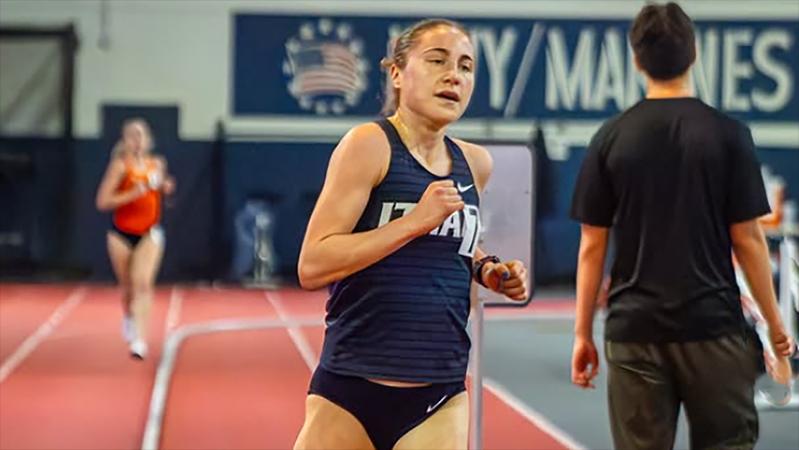
The Ithaca College women’s track & field team opened its 2025-26 season over the weekend as the Bombers made the short trip across town to compete in the Greg Page Relays hosted by Cornell University on December 5-6.
Lola Gitlin posted a time of 10:25.57 in the 3000-meter run to finish third overall.
Rachel Larson was a fourth place finisher with a time of 8.58 seconds in the 60-meter hurdles. That time is currently No. 1 in Division III after the opening weekend of the season.
Aynisha McQuillar took fifth in the 200-meter dash in a time of 26.61 seconds. McQuillar also ran in the 60-meter dash and posted the 11th fastest time in DIII during the prelim with a performance of 7.78 seconds.
Lyla Powers was fifth in the 500-meter dash with a time of 1:21.75.
Lily Seyfert claimed fifth in the shot put with a heave of 12.78 meters, which is currently ninth in the nation.
Bree Boyle and Erin Eastwood each cleared 3.54 meters in the pole vault, which is tied for 11th on the Division III performance list.
Alexis Brown turned in a leap of 11.02 meters in the triple jump for the 17th best mark in the country.
Ithaca is off for the remainder of 2025 and will return to Cornell on January 10 for the Southern Tier Invitational.
RESULTS
ITHACA, N.Y. –
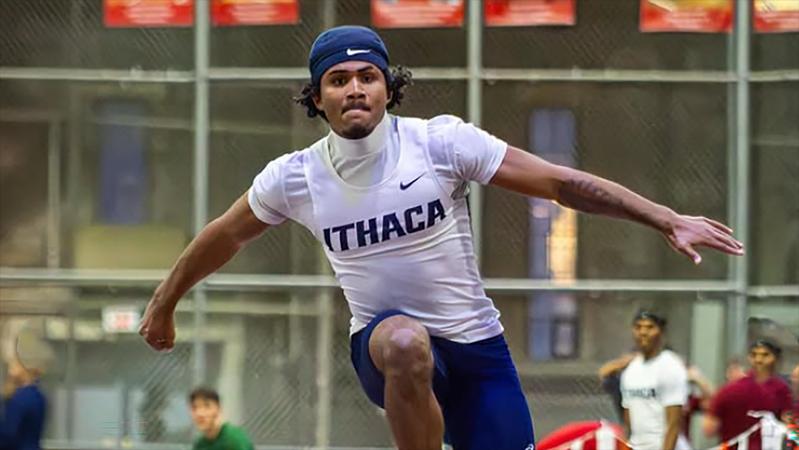
The Ithaca College men’s track & field team opened its 2025-26 season over the weekend as the Bombers made the short trip across town to compete in the Greg Page Relays hosted by Cornell University on December 5-6.
Anik Vossschulte claimed third in the 200-meter dash in a time of 23.32 seconds, while Jacob Antilety was seventh at 23.71 seconds.
Matt Lokshin posted a time of 8.65 seconds in the 60-meter hurdles to place third in the event. Aidan Irwin took fourth in the high jump with a mark of 1.70 meters.
Quinten Lewis posted a mark of 13.73 meters in the triple jump to place fourth and Sebastien-Oliver Lacrete was sixth at 12.68 meters, while Evan Cherry secured fifth in the long jump with a leap of 6.84 meters.
IC’s 4×400-meter relay team of Damian Simmonds, Griffin Lupes, Noah McKibben and George Nilson placed sixth in 3:34.49.
Luke Ellor finished sixth in the shot put with a mark of 14.40 meters.
Three Bombers finished within the top eight in the 500-meter dash as Brad Kellogg was sixth in 1:09.73, Peter Tysiak followed in seventh with 1:10.74 and Matthew DeJulio was next at 1:11.59.
Kaiden Chandler and Luke Ferrer posted times of 4:41.29 and 4:53.44 in the mile to finish in seventh and eighth.
Raf Campanile was seventh in the pole vault with a clearance of 4.25 meters.
Ithaca is off for the remainder of 2025 and will return to Cornell on January 10 for the Southern Tier Invitational.

UTICA, N.Y. – The Hamilton College Continentals competed against 13 teams at the non-team scoring 2025 Utica University Track & Field Holiday Classic inside the Todd & Jenn Hutton Sports and Recreation Center on Saturday, Dec. 6.
The meet was the first of the 2025-26 season for the Hamilton women, who will be back at Utica for the Pioneers’ Winter Opener on Friday, Jan. 16 after taking a break for finals and the winter holiday.
The Continentals qualified for the 2026 All-Atlantic Region Track & Field Conference Indoor Championships in four different events and finished first in three events.
Emily Pogozelski ’26 won the 3,000-meter run by over 20 seconds with a regional-qualifying time of 10:27.93. Mackenzie Loudon ’29, who was competing in her first collegiate meet, took first place and qualified for regionals in the triple jump.
Loudon was also part of Hamilton’s winning 4×200-meter relay with Tatiana McCray ’28, Ava Chiappinelli ’29 and Marley Meyers ’28. Their performance was more than five seconds faster than the regional-qualifying time.
McCray ran a regional-qualifying 7.96 seconds and finished in second place in the 60-meter dash final. Chiappinelli also qualified for regionals in her first collegiate meet and finished right behind McCray with a time of 7.99 seconds.
TOP PERFORMANCES
300-Meter Dash (17 Runners)
4. Marley Meyers ’28, 43.08
7. Hannah Turner ’26, 43.91
60-Meter Dash (35 Runners)
2. Tatiana McCray ’28, 7.96 (PR, AARTFC)
3. Ava Chiappinelli ’29, 7.99 (AARTFC)
600-Meter Dash (16 Runners)
5. Aisha Kandji ’29, 1:47.31
4×200 Meter Relay (9 Teams)
1. McCray ’28, Mackenzie Loudon ’29, Chiappinelli ’29, Meyers ’28 (1:46.42, AARTFC)
3000-Meter Run (19 Runners)
1. Emily Pogozelski ’26, 10:27.93 (PR, AARTFC)
Triple Jump (15 Athletes)
1. Loudon, 11.29 meters (37 feet, 0.5 inches; AARTFC)
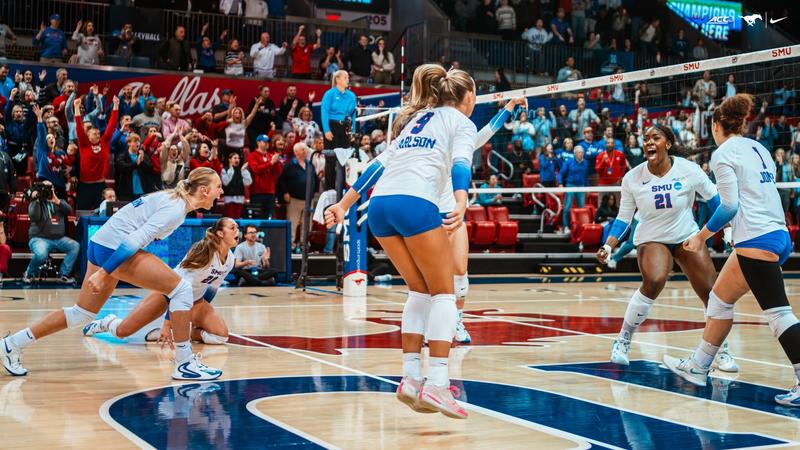
DALLAS (SMU) – For the first time in program history, SMU volleyball is headed to the Sweet Sixteen after sweeping Florida (16-12) in the Round of 32 on Saturday with set scores of 25-11, 25-21, 26-24.
With the win, SMU won its 27th match of the season, tying the program record for single-season wins. It also gave coach Sam Erger her 100th victory at SMU and in her Division I head coaching career.
Averi Carlson dished out 38 assists, the most in a three-setter for the senior setter this season. Carlson led the Mustangs to a .370 hitting percentage in the win. Kennedi Rogers went for 14 kills, hitting .440, with four digs and three blocks. Malaya Jones closely trailed Rogers with 13 kills, eight digs and seven blocks, tying her career high.
SMU out-blocked the Gators 15-4, spearheaded by a career-high nine blocks from freshman Maggie Croft. The Mustangs’ blocking efforts helped hold the Gators to a .156 hitting percentage for the match.
MATCH NOTES
- With 13 kills against Florida, Jones (503) is now the second player in SMU Volleyball history to reach 500 kills in a season. She joins Rachel Giubilato, who notched 568 kills in 2006.
- Averi Carlson (1,341) moved to third in the rally scoring era and sixth all-time for single-season assists at SMU.
- Jones reached the double-digit kill mark for the 26th time this season and for the ninth straight match.
- Rogers recorded double-digit kills for the sixth time this season.
- It marked Schilling’s 22nd time in double-figures this season and her fifth straight.
- With six blocks against the Gators, Anyanwu draws within 14 of breaking the program record for most blocks in a season. (188 by Janelle Giordano in 2015)
- SMU had double-digit blocks (15) for the 17th time this season and for the second straight match.
- SMU has won 20 of its last 21 matches and its 12th straight.
- The Mustangs end the 2025 season with 15 wins at Moody Coliseum, tying the program record for most in a season.
- The win marks the Mustangs’ 15th sweep, 11th at home this season.
HOW IT HAPPENED:
SMU controlled the first set from start to finish in all phases of the game. SMU hit .483 with no errors on 29 swings in the first, while holding Florida to a .000 hitting percentage. Rogers put in five kills to lead the Mustangs, who got point production from six different players to help propel them to a 25-11 set one victory. SMU commanded the net with a 5-0 advantage in blocks.
Down four (16-12) in the second frame, SMU responded with five straight points on a run that included two aces from Madison Scheer. After trading points, SMU went on a 4-0 run to pull away in the frame. The Mustangs went on to win the frame 25-21.
Tied 20-20 entering the red zone of the third set, SMU got the first two points on an ace from Carlson and a block from the freshman tandem of Rogers and Croft. Despite a 3-1 run by Florida that put the Gators at set point first, the Mustangs responded with three straight to close the match, ending the frame with their sixth block of the set to win 26-24.
SMU LEADERS:
SMU Kills Leader: Kennedi Rogers (14)
SMU Assists Leader: Averi Carlson (38)
SMU Digs Leader: Jordyn Schilling (11)
SMU Blocks Leader: Maggie Croft (9)
SMU Ace Leader: Madison Scheer (2)
SMU Points Leader: Malaya Jones (17.5)
Up Next: SMU will get a rematch with No. 3 seed Purdue in the NCAA Regional Semifinal on Thursday evening in Pittsburgh, Pa.
Sports
Trans volleyball player Blaire Fleming hits back at claim about female teammate’s eating disorder
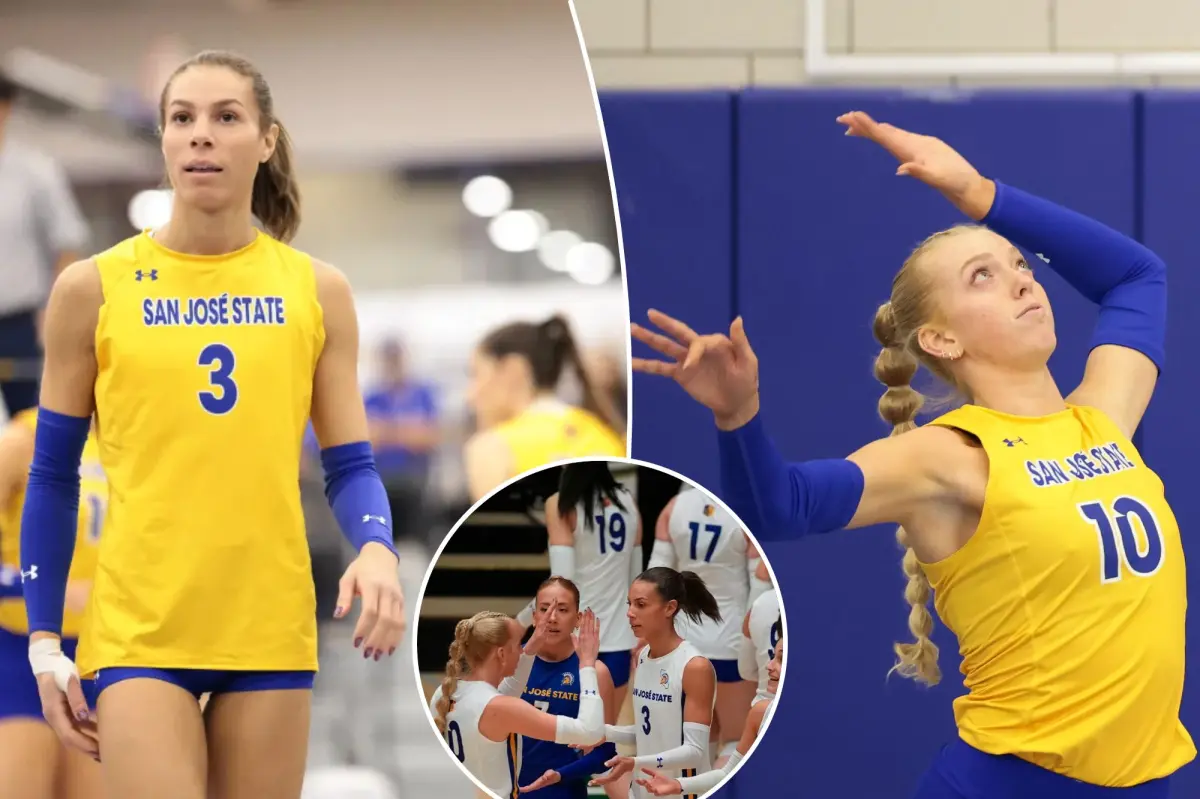
Transgender college volleyball player Blaire Fleming has hit back at claims that she triggered her teammate’s eating disorder due to emotional distress — and said that she doesn’t “feel bad for her.”
Fleming, 23, was at the center of a scandal last year involving Brooke Slusser, who filed multiple lawsuits against her San Jose State University (SJSU) teammate after discovering that she was transgender.
Slusser alleged that the panic and stress from that period of her life led her to develop an eating disorder, leading to anorexia so severe that her menstrual cycle stopped for nine months.
The pair had previously shared hotel rooms and changing spaces for a whole season in 2023 before Slusser said she found out that Fleming, who is biologically male but reportedly started medically transitioning at 14, was trans.
“From the stress and how anxious I was every single day, I just wasn’t eating really at all,” Slusser told Fox News Digital last week.
“I went from around 160 to 128 [lbs] in that one semester. It definitely isn’t healthy for someone of my size to be that weight, and I ended up losing my menstrual cycle for nine months. So it was definitely severe,” she said.
Slusser later dropped her classes in the final semester this past spring, citing constant in-person harassment by students who opposed her stance.
Fleming has since responded, claiming that Slusser’s eating disorder dated back for as long as she knew her, prior to her learning that she was trans.
“She’s been anorexic and struggled with food since I’ve known her aka since 2023. She literally would weigh herself 2-3x a day and keep track of it on her whiteboard in her room,” Fleming told Fox News Digital on Sunday.
“So I really don’t care or feel bad for her. And she didn’t drop her classes, she failed out, hope that helps!” Fleming said.
Slusser has now come back and disputed Fleming’s allegations.
“These statements are just not true. I have always lived a very healthy lifestyle. Before these events took place I was very disciplined in fueling myself for athletics and [kept] track to make sure I was where I need to be to be the best athlete,” Slusser told Fox News Digital.
“It wasn’t until all the craziness started that my healthy lifestyle turned very unhealthy into not eating the amount I should,” Slusser said.
“As for school, I decided to stay home after fall 2024 to better myself and heal. So no, I did not return to San Jose and enroll myself in more courses at an institution that didn’t have my best interest,” she added.
Slusser alleged that she was never told Fleming’s birth sex and said the two regularly shared hotel rooms on away trips, according to her lawsuits filed against the NCAA and Mountain West Conference.
Fleming allegedly requested to be roomed with Slusser, a request she said was granted by team leadership, according to lawsuits.
Slusser said that the 6ft1 Fleming confessed to being transgender during a conversation over ice cream with another teammate in April 2024.
In September 2024, Slusser joined swimmer Riley Gaines’ lawsuit against the NCAA.
At the same time, SJSU’s volleyball team saw a series of forfeits by opposing teams, with police protection regularly assigned.
The US Department of Education is currently investigating SJSU for potential Title IX violations.

Mill Creek Activity Center to increase gymnastics space to help meet demand

New Mexico and Minnesota Selected to Play in 2025 Rate Bowl on December 26 at 2:30 p.m.

UGA suing former Bulldog, Missouri DE for transfer damages

IU football is No. 1 seed in College Football Playoff, headed to the Rose Bowl – The Daily Hoosier

Men’s T&F Opens Season at Diplomat Open

Max Verstappen’s wife has child with F1 driver he replaced – Motorsport – Sports

Miami Selected to College Football Playoff – University of Miami Athletics

Women’s Track & Field Turns in Multiple High Marks to Begin Season at Cornell

Brad Keselowski glad Michael Annett ‘no longer suffering’ after death – Motorsport – Sports

Men’s Track & Field Opens Indoor Season at Cornell Greg Page Relays

Verstappen expected to win race, Norris title

Alonso hints at ‘favorites’ as Max hunts allies

Revised plan for Good Life District Aquatics Center appears to meet city’s needs

Forget Kiffin — NIL is the real villain here

BangShift.com Pro 10.5 Racing Action From The DI Winter Series Snowbird Nationals At Bradenton Motorsports Park In Florida

First Tee Winter Registration is open

Fargo girl, 13, dies after collapsing during school basketball game – Grand Forks Herald

CPG Brands Like Allegra Are Betting on F1 for the First Time

Volleyball Recaps – November 18

F1 Las Vegas: Verstappen win, Norris and Piastri DQ tighten 2025 title fight

Two Pro Volleyball Leagues Serve Up Plans for Minnesota Teams

Utah State Announces 2025-26 Indoor Track & Field Schedule

Sycamores unveil 2026 track and field schedule

Redemption Means First Pro Stock World Championship for Dallas Glenn

Bowl Projections: ESPN predicts 12-team College Football Playoff bracket, full bowl slate after Week 14

Texas volleyball vs Kentucky game score: Live SEC tournament updates

How this startup (and a KC sports icon) turned young players into card-carrying legends overnight

Indiana’s rapid ascent and its impact across college football

Pohlman admits ‘there might be some spats’ as he pushes to get Kyle Busch winning again

Robert “Bobby” Lewis Hardin, 56

 Why a rising mid-major power with an NCAA Tournament team opted out of revenue-sharing — and advertised it
 NBA Legend Michael Jordan to Join NBC Sports as Special Contributor
 Falcons mailbag
 Portal Update – Basketball and Gymnastics Take Hits
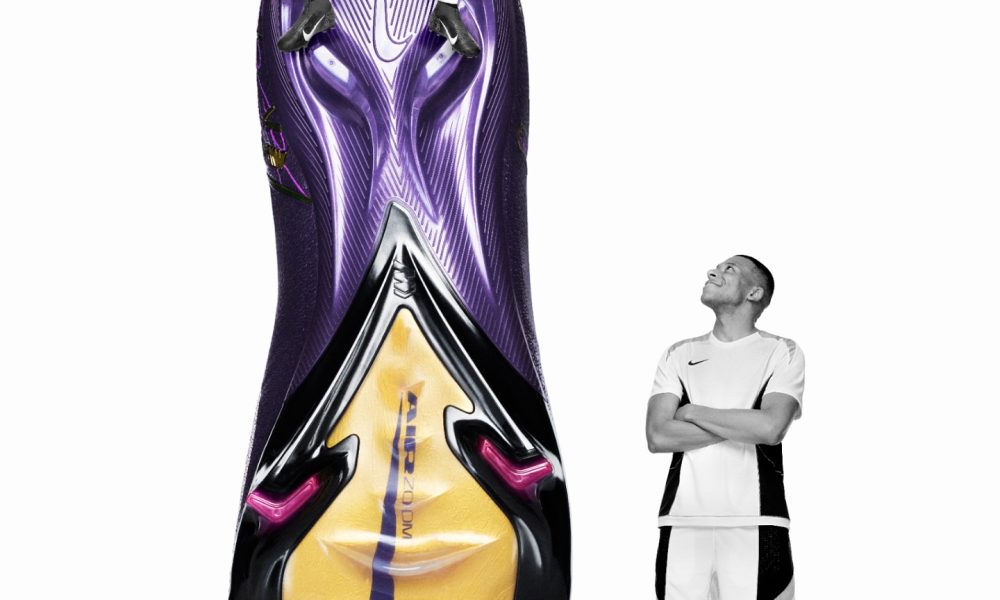 has always dreamed in Mercurial. Now his initials are on the boots.
The new Kyl…
has always dreamed in Mercurial. Now his initials are on the boots.
The new Kyl…
-
 Rec Sports2 weeks ago
First Tee Winter Registration is open
-
 Rec Sports2 weeks ago
Fargo girl, 13, dies after collapsing during school basketball game – Grand Forks Herald
-
 Motorsports2 weeks ago
CPG Brands Like Allegra Are Betting on F1 for the First Time
-
 Sports3 weeks ago
Volleyball Recaps – November 18
-
 Motorsports2 weeks ago
F1 Las Vegas: Verstappen win, Norris and Piastri DQ tighten 2025 title fight
-
 Sports2 weeks ago
Two Pro Volleyball Leagues Serve Up Plans for Minnesota Teams
-
 Sports2 weeks ago
Utah State Announces 2025-26 Indoor Track & Field Schedule
-
 Sports2 weeks ago
Sycamores unveil 2026 track and field schedule
-
 Motorsports1 week ago
Redemption Means First Pro Stock World Championship for Dallas Glenn
-
 NIL1 week ago
Bowl Projections: ESPN predicts 12-team College Football Playoff bracket, full bowl slate after Week 14