
NIL
How Vols football recruits negotiate NIL pay

- Colleges can now pay athletes directly for the use of their name, image, and likeness (NIL).
- Tennessee football recruits negotiate their NIL pay with the university’s NIL operations office.
- New rules dictate when schools can offer NIL money. And players can’t be paid until they enroll and arrive on campus.
Tennessee football recruits will sign scholarship agreements with the Vols and then ink their NIL revenue-sharing contracts with the university during the early signing day, which begins Dec. 3.
It’s a new phase of the NIL era. Since July 1, colleges have been allowed to pay athletes directly for use of their name, image and likeness. And recruits in this 2026 class will be the first to sign under the new rules.
UT granted Knox News an exclusive behind-the-scenes look into its new NIL operations office, which negotiates and manages pay for student-athletes.
It provides eye-opening insight into a prospect’s experience these days, from mulling lucrative offers during recruitment to getting their first paycheck as a college player.
With that in mind, let’s tackle the biggest questions of this new system from the perspective of a Tennessee football recruit.

When do we talk money during my recruitment?
As a 2026 signee, you’ve already done that. It can happen at different points in the recruiting process, probably ramping up in the summer before your senior year. Your official visit to UT’s campus provided a perfect time to sit down and talk dollar figures.
But those are just informal talks. A university can’t make a written offer of direct school-to-player pay until Aug. 1. And even then, the recruit can’t sign the offer sheet, so it’s just a step in the process toward signing day.
Those rules are put in place by the College Sports Commission, an independent regulatory body established by the power conferences to oversee new revenue-sharing and NIL rules.
So do I find out my pay during recruiting visit?
Yes, or at least an opening offer. For some players, that’s a first and final offer. For others, it’s the first step in a long negotiation. Just like a job, your talent and the competition for your services determines your leverage.
A few players may only get a scholarship, and they can play their way into NIL money once they prove themselves on the field.
Again, you’re not going to sign anything during your recruiting visit, so don’t feel overwhelmed. You can sign a contract as early as signing day in December.
Who do I meet with about my pay from Tennessee?
During the recruiting visit, you’ll meet with JB Bowling, UT’s executive associate athletics director for NIL operations, and Will Watkins, associate athletics director for NIL operations. They’ll make the initial offer of how much money UT plans to pay you directly.
Other UT staffers may also be there to answer your questions about UT promotional content or academic resources that can help you manage your money.
Your family is welcomed and encouraged to attend. In some instances, the UT coach who’s recruiting you may also sit in the meeting, but only if you want them there.
If you have an agent, they negotiate on your behalf via phone call after you leave the meeting.
Who negotiates with Tennessee for my pay?
You or your family are allowed to do that. But most players prefer to have legal representation to avoid uncomfortable negotiations.
For moderately paid and highly paid players, an agent makes sense, especially if earning third-party NIL money is a possibility. But keep in mind that they get a percentage of your earnings.
For lower paid players, an attorney can do the job. They’re just dotting I’s and crossing T’s on a standard contract, and they often only charge a flat fee.
UT can call the agent or attorney before the meeting with the initial offer so you’re already aware of it. But they’ll always get a call after the meeting.
Does Josh Heupel determine my pay?
Not exactly. Athletics director Danny White decides how much money each sport gets to pay players under a revenue sharing salary cap. For UT and most SEC schools, that’s about $13.5 million for football.
As head coach, Josh Heupel gets the final say on player pay. But that doesn’t mean every decision on every player ultimately reaches his desk.
UT football has staff members that strategize and manage the payroll, including director of internal and advance scouting Billy High. He’s the closest to a general manager that UT has.
Plus, most SEC schools follow a version of the NFL payroll model, which generally allots money by position.
Can I get third-party NIL plus Tennessee pay?
Yes. UT will help you get that if you want. Its new NIL operations office has staff tasked with seeking out and connecting you to third-party NIL opportunities.
Some players want every NIL deal they can get. Some players don’t want any, especially if it requires a social media presence. Your agent or an NIL collective may also help land those third-party NIL deals.
Is that third-party NIL money part of my Tennessee offer?
No. Under the College Sports Commission rules, schools can’t guarantee third-party NIL money. They can only guarantee the revenue share money they pay you directly.
Granted, some schools are still promising third-party NIL money that isn’t under their purview. That’s against the rules, so ask them to put it in writing and watch the deal fade away.
That being said, schools can tell you about third-party NIL opportunities that their athletes typically get. But they can’t guarantee them. Once you’re enrolled, UT and its partners can help you explore additional NIL deals.
When can I sign a contract with Tennessee?
You can sign a contract for direct school-to-player pay when you sign your scholarship agreement during the early signing period Dec. 3-5.
But you’re not required to sign it immediately. Negotiations can actually extend beyond your enrollment, either over the dollar figure or other terms in the contract. But you won’t get paid until you’re under contract.
What do I have to do to get paid by Tennessee?
Nothing extra. You’re not required to make special appearances or do any additional work on behalf of UT. Just focus on academics and football.
UT is paying you a share of its revenue as an NIL royalty for the use of your name, image and likeness. Your image will appear on the UT website, posters, promotional videos, social media and other things.
However, third-party NIL deals will require you to make public appearances, create social media posts or appear in commercials to endorse products or services. Those are separate from UT’s revenue sharing contracts.
When do I get paid by Tennessee?
UT encourages monthly payments to help athletes learn to follow a budget. But your payment schedule is negotiable. Some players want a lump sum up front. If so, UT may push more money to the back end of the contract to balance the terms. Some players want to be paid quarterly. UT works with each athlete to meet their preferences.
How do I get paid by Tennessee?
It’ll come to you via direct deposit. UT uses Ramp, a financial technology company that specializes in expense management and bill-payment software. UT’s NIL office monitors those payments to ensure they’re accurate and on time.
Do I get help budgeting and investing my money?
Yes. UT has a mandatory course for freshmen and newcomers on financial literacy, budgeting, saving and taxes. You can also opt into advanced courses on financial planning and investing. Financial institutions and experts visit campus for group sessions or 1-on-1 confidential meetings with athletes for financial advising.
Since 2021, UT athletics has partnered with NIL-focused firm Altius Sports Partners and the Haslam College of Business to create curriculum for athletes in the NIL era. UT makes this part of its recruiting pitch, emphasizing that it wants athletes to make the most of their money.
Will my third-party NIL deal be automatically approved?
If it’s under $600, yes. But all other NIL deals must be approved by the clearinghouse called NIL Go. You can submit your deal to the clearinghouse or designate someone to do it like your agent or parent. But a UT employee cannot submit your third-party NIL deal into the clearinghouse database.
Again, third-party NIL deals are separate from your revenue money paid by UT.
Do I get a one-year contract from Tennessee?
That’s the standard for most players in this phase of the NIL era. Highly-touted quarterbacks sometimes get multi-year deals. But the length of the contract is negotiable depending on the player.
If I transfer after the season, what happens to my contract?
It just ends, as well as your payments. Some schools may seek damages for money already paid, but that’s not UT’s primary approach. You can get a new contract at your new school. UT will retain the money it was going to pay you in your second semester.
Of course, every situation is different. There could be clauses in your contract that apply if you transfer before the deal ends, but that’s not the standard.
Other schools may seek damages when players under contract jump into the portal. That’ll be something to monitor when the portal opens Jan. 2.
Adam Sparks is the Tennessee football beat reporter. Emailadam.sparks@knoxnews.com. X, formerly known as Twitter@AdamSparks. Support strong local journalism by subscribing at knoxnews.com/subscribe.
Get the latest news and insight on SEC football by subscribing to the SEC Unfiltered newsletter, delivered straight to your inbox.

-

Max Olson
LUBBOCK, Texas — In December 2021, Jacob Rodriguez felt lost.
The young quarterback had just ended his freshman season at Virginia. Coach Bronco Mendenhall had unexpectedly stepped down. Rodriguez decided to transfer but had minimal tape as a college passer and few options. He had a creeping doubt, too, that maybe it was time to give up his quarterback dreams.
Texas Tech was willing to take a chance on him under two conditions: It didn’t have a scholarship available, and it didn’t need a QB. If Rodriguez wanted to come home to Texas and play for new coach Joey McGuire, he would have to learn to play linebacker.
Rodriguez took out a student loan to pay for school. He couldn’t find an apartment when he arrived in January 2022 and moved in with his older brother at the University Pointe apartments. He slept on the floor of his brother’s bedroom, on a foam queen mattress topper folded in half for a little more cushion.
He started sixth on the linebacker depth chart. He lifted weights twice a day to bulk up and watched film to figure out a position he had never played in high school. Back then, Rodriguez wasn’t envisioning someday becoming the All-America performer he is today.
“My biggest concern was not really trying to get a scholarship,” he said. “I was just trying to make the team. I’m fighting to survive.”
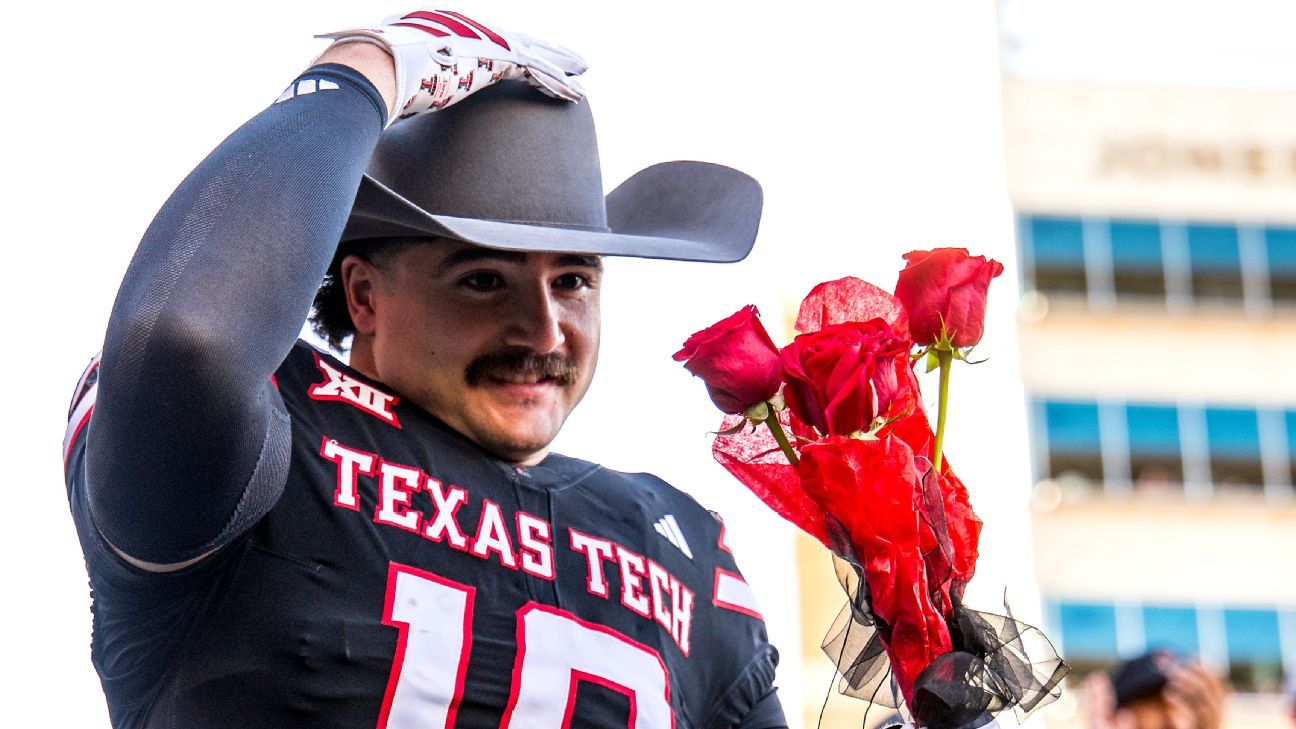
Four years later, Rodriguez is the Big 12 Defensive Player of the Year and the best linebacker in college football. His No. 4 Red Raiders are about to play for a Big 12 championship. Then, they’ll advance to the College Football Playoff. Surreal doesn’t even begin to describe it.
The mustachioed, cowboy hat-wearing captain married to a U.S. Army Black Hawk helicopter pilot is enjoying a historic senior season and experiencing a new level of fame this fall as Texas Tech pushes him for Heisman Trophy consideration. No other college defender over the past 20 years has put up the stats he has with more than 100 tackles, seven forced fumbles and four interceptions.
And Rodriguez is ready for more as the Red Raiders prepare for the program’s first Big 12 title game against No. 11 BYU on Saturday (noon ET, ABC).
“Man, it’s such a great story,” McGuire said. “In the age of all this money, which is great — I mean, I’m all for it, obviously — this is one of those great stories for college football.”
Rodriguez always had his believers as a record-setting quarterback coming out of Wichita Falls, Texas, but Heisman good? No, even those who know him best say this is getting ridiculous and see it as pure proof of his determination. If Rodriguez could tell his 19-year-old self where he’d be standing today after his humble beginnings?
“That was a long time ago,” Rodriguez said with a smile. “But I’m very proud of that. I think it’s something that I’ll hang my hat on for a long time.
“There’s nowhere else I’d rather be than here, doing what we’re doing.”
HIS CHILDHOOD DREAM was to become the starting quarterback of the Minnesota Vikings.
“Oh yeah, you betcha,” his brother Joshua Rodriguez said with a chuckle.
Jacob Rodriguez was born in Hastings, Minnesota, the youngest of five siblings in a family that competed in everything, from croquet to UNO to holiday pancake decorating. Joe and Ann Rodriguez signed up Jacob and his twin brothers Joshua and Jeremiah for wrestling at a young age because “we were breaking everything,” Joshua said.
Jacob got started at age 3 and won two youth state championships by the time he was 7, pinning every opponent he faced during his second title run.
“That’s one reason why he’s so good at tackling: all those single-leg and double-leg takedowns,” Joshua said.
When the family moved to Wichita Falls in 2010, the boys were eager to start playing tackle football. The twins would play linebacker at Rider High School. Jacob, a four-sport athlete, played varsity as a sophomore and went on to break school records with more than 10,000 career total yards and 106 touchdowns.
“He was the guy, the talk of the town,” Rider teammate Jed Castles said. “He was signing autographs when we went out to restaurants.”
Rider coach Marc Bindel occasionally let his star quarterback play safety, but Rodriguez was a QB first and foremost with a playing style that evoked Tim Tebow comparisons.
“We always called him Captain America,” Bindel said.
Rodriguez was an ESPN 300 recruit, but recruiters were split on his college projection: Should he play offense or defense? Then-Kansas State offensive coordinator Collin Klein gave him his first FBS offer in 2019 and saw his potential as an athletic quarterback.
But others saw something else. In a game against Canyon Randall during his junior year, Rodriguez made a fourth-and-1 play on defense they still talk about to this day. He burst through the line, grabbed the running back by his legs, lifted him in the air and slammed him on his back for the stop.
Bindel had a coach on his staff send the clip to then-Texas Tech defensive coordinator Keith Patterson. The next day, the Red Raiders offered Rodriguez a scholarship as a linebacker. Baylor would end up doing the same after McGuire became its outside linebackers coach in 2020. Rodriguez ultimately received more offers for defense than offense.
But Mendenhall and his Virginia coaches made Rodriguez a priority — and convinced him he could be their next Taysom Hill. His plans to fly out for a spring break official visit were canceled by COVID-19. Rodriguez still committed and enrolled without ever visiting campus.
“I think we all knew his best chance to make it big was going to be on defense,” Bindel said, “but in his heart, he wanted to play quarterback. And why would you not want to try to play quarterback in college?”
Virginia had an established starter in Brennan Armstrong, who broke single-season school records in 2021. But the Cavaliers also had a way to get Rodriguez on the field as a freshman. He agreed to back up Keytaon Thompson at their FBP (football player) position, a hybrid role in Robert Anae’s offense that could entail pretty much anything.
Rodriguez wore No. 98 and Thompson, a former quarterback at Mississippi State, wore No. 99. They lined up at slot receiver, outside receiver, tight end, running back or behind center. They would motion all over the field before the snap and throw blocks, run routes or take handoffs. It was intentional chaos, aimed at confusing opposing defenses.
“It was pure creativity,” Thompson said. “A lot of the stuff [Anae] came up with, I don’t even think he knew it would work. If it looked good, we’d go with it.”
It was an awful lot of running, so much so that Rodriguez said he went from 215 pounds to 185 during the season. He played 169 snaps but only four at quarterback. The rookie didn’t expect to become a Swiss Army knife on offense, but he embraced it.
“I was having a blast,” Rodriguez said. “I was just happy to be on the field.”
All these years later, Rodriguez believes he would’ve finished his college career at Virginia if Mendenhall hadn’t surprised everyone by resigning that December after a 6-6 season. Thompson called it a “totally unexpected curveball.”
“I loved it there and loved the people there,” Rodriguez said. “But I kind of went there to play for him.”
He made the 1,300-mile trek home to Wichita Falls, unsure what his future might hold. And his phone wasn’t ringing.
“There wasn’t a whole lot of buzz,” Bindel said.
TEXAS TECH ASSOCIATE head coach Kenny Perry excitedly called Bindel the morning after Red Raiders’ first spring practice in 2022.
“Jacob Rodriguez is a bad motherf—er,” Perry told him.
The high school coach’s reply?
“Yep, and he’s playing for free right now…”
After leaving Virginia, Rodriguez had asked a few people to reach out to McGuire on his behalf in the hopes he could join the Red Raiders. Two Rider teammates, Castles and E’Maurion “Dooda” Banks, played for Texas Tech. One of his former youth coaches, Dudley McAfee, is a Tech grad and knew McGuire well. All three vouched for Rodriguez to the new head coach.
“Dooda was like, ‘Coach, if we can get this guy on our team, we need to get him,'” McGuire said.
McGuire vowed he would put Rodriguez on scholarship as soon as one became available. These were the early days of NIL before collectives helped take care of walk-ons. Tech could provide him two meals a day, but he would need to take out a student loan to cover his classes and books.
“It was kind of one of those deals where, well, I got to go somewhere,” Rodriguez said.
More importantly, Rodriguez had to accept his future was on defense. Texas Tech already had three starter-caliber quarterbacks in future second-round pick Tyler Shough, Behren Morton and Donovan Smith.
Bindel has no doubt Rodriguez could’ve made it as a tough dual-threat QB such as Georgia Tech’s Haynes King had he found the right opportunity. Rodriguez doesn’t fault other coaches for missing on him during his month in the portal, especially given his role with the Cavaliers.
“I really didn’t have any quarterback film,” he said. “I just had a whole bunch of other stuff.”
Ann Rodriguez suspects if he hadn’t gone to Virginia to play quarterback, he would’ve regretted never trying. He had received plenty of advice that linebacker was his best path to the NFL. It still wasn’t easy to give up his childhood dream.
“There were a lot of tears shed and a real thought process about it,” his mother said. “It took a lot of him really looking inward and deciding, ‘You know what? I’m going to do whatever it takes.'”
It was Joshua’s idea for Jacob to move in and save money. The brothers lived in a four-bedroom apartment with three random roommates they initially didn’t know. The bedroom was certainly tight quarters — the brothers had to share a bathroom and closet — and Jacob would sleep near the foot of Joshua’s bed. Eventually, they squeezed in a twin-sized mattress for him.
“To be honest, I wouldn’t even know if those guys would be able to say, ‘Yeah, I lived with Jacob Rodriguez,'” Joshua said. “He was never there. He’d go to workouts at 5 a.m. and was gone before they woke up. He’d come back at 9 p.m. after classes and film.”
Rodriguez said he’d go in for the 8 a.m. lifting session and come back at 2 p.m. for another while working to get back to 220 pounds for spring practice. His offensive knowledge helped, but learning to play his new position was a completely different challenge. Former Texas Tech inside linebackers coach Josh Bookbinder said Rodriguez had all the right traits coming out of high school to be a great linebacker — he just hadn’t played the position.
The hardest part early on was the physicality of Texas Tech practices. Quarterbacks never get touched in these settings. Rodriguez had to get the hang of hitting and getting hit day after day. “I’m like, ‘Dude, how can I sustain this?'” he said. If he were to queue up his 2022 practice film today, Rodriguez expects it would probably look “awful.” He barely had a clue.
“The one thing he showed really early was his effort was nonnegotiable,” Bookbinder said. “He may not have known exactly what he was doing at linebacker, but he was running his ass to the ball.”
Texas Tech coaches loved the potential they saw in the spring of 2022. When McGuire called Rodriguez into his office before August preseason camp, the linebacker genuinely didn’t know why. The head coach asked him to call his parents and let them know he was on scholarship.
“There was a lot to learn, but Jacob is a football dude,” McGuire said. “He was raw, but he picked up stuff so fast because he’s really intelligent. Football makes sense to him.”
All the little details — his footwork, hand use, the angles he took in tackling, how he struck ball carriers — came with reps and time as he graduated from playing on instincts to processing and better understanding formations, sets and situations. After playing backup snaps as a sophomore, Rodriguez’s development accelerated throughout his second offseason in Lubbock to earning a starting job entering 2023, but a foot injury sustained in the season opener sidelined him for most of the season.
“It’s like you had all the ingredients on the counter,” said Bookbinder, who’s now coaching at TCU. “You just had to mix them up and let it cook for a little bit.”
The Jacob Rodriguez who returned in 2024 was finally ready to put it all together with an All-Big 12 season, finishing second among all Power 4 defenders with 127 tackles. And the one who returned for his senior year in 2025?
“He’s the best player in college football,” Perry said.
SESI VAILAHI TOOK the handoff and ran up the middle. Rodriguez met the Oklahoma State running back in the hole and stood him up. But this wasn’t your typical tackle for loss.
Vailahi staggered backward, attempting to break free. Except the veteran linebacker wasn’t going for a takedown. No, he was thinking theft. Rodriguez ripped the football right out of Vailahi’s grip and ran the other way for a 69-yard touchdown.
Literally took it away and took it to the house.
Best defender in the country.
📺 @ESPNU | https://t.co/G56N3v07Kv https://t.co/SKua435dYH pic.twitter.com/1FGuLyRaEt
— Texas Tech Football (@TexasTechFB) October 25, 2025
He has been filling up the Heisman highlight reel week after week. Like the two Kansas State fumbles he punched out. The one-handed interception at Utah. The pick he deflected to himself against BYU, or the screen pass he jumped in front of against UCF.
“Every time you look up, he’s at the ball,” Morton said. “The way he can cause and flip momentum in a game, there’s not another player in the country who can do that.”
Rodriguez has created seven turnovers by himself. His FBS-leading seven forced fumbles are more than 53 teams have all season, including Georgia, Ole Miss and Notre Dame, and he’s four away from breaking Khalil Mack’s FBS career record of 16.
McGuire has plenty of respect for Indiana’s Fernando Mendoza, Vanderbilt’s Diego Pavia and Ohio State’s Julian Sayin, the trio of quarterbacks currently leading the Heisman race with one week to go. But he’s not going to relent in campaigning for Rodriguez.
“The thing for me is there’s nobody at the quarterback position that is having a year that we haven’t seen before,” McGuire said. “He’s having a year at the linebacker position that we haven’t seen.”
For comparison: Notre Dame linebacker Manti Te’o finished with 113 tackles and seven interceptions but zero forced fumbles during his Heisman runner-up season in 2012. Te’o was the unquestioned top player on the No. 1 team in the country.
Rodriguez points to Texas Tech pass rusher David Bailey, their projected first-round pick with 12.5 sacks, as the best player they’ve got. His answers in news conferences offer praise toward teammates and coaches. But among his peers, there’s no question.
“This is a talented football team,” Morton said, “and it’s led by Jacob.”
McGuire shook up Texas Tech’s defense after an 8-5 finish in 2024. He brought in defensive coordinator Shiel Wood from Houston, splurged in the portal with a rebuilt defensive line that cost more than $7 million and inked arguably the top transfer class in the country.
Rodriguez considered going pro at the end of last season and went through senior day ceremonies before the home finale. But he put his trust in McGuire and watched as his coach and general manager James Blanchard assembled the kind of roster that could finally compete for a Big 12 championship.
“You could tell as soon as we put pads on for spring ball: Hey, we’re going to be a special group,” Rodriguez said. “I’ve never had this much fun playing football ever.”
Texas Tech’s determined efforts to make Rodriguez a Heisman finalist took a creative turn two weeks ago. Ahead of its home finale against UCF, McGuire texted Joe Rodriguez to break the news: Offensive coordinator Mack Leftwich was working on a Wildcat package to utilize Jacob at quarterback.
“I said, ‘Coach, that’s so freaking awesome,'” his dad said. “I’ve been pushing that for four years. I told him, ‘Be careful, because you’re going to let that beast out.'”
Joe did not warn his wife that this was in the works. Jacob’s wife, Emma, was the one who told her inside Jones AT&T Stadium, a few plays before the moment arrived in the first quarter. She asked her to try to stay calm. Texas Tech running back Cameron Dickey said he got goosebumps when he overheard Leftwich ask, “Is J-Rod ready?”
“He goes out there,” Ann said, “and we both immediately started crying.”
The home crowd got so loud that Rodriguez worried he might mess up the snap cadence. But his offensive line paved a wide-open lane for an easy 2-yard score. He got to go in and do it again Saturday at West Virginia.
Linebacker Jacob Rodriguez with his FIRST CAREER OFFENSIVE TD for @TexasTechFB ‼️
And he hit the Heisman as his celebration 👀 pic.twitter.com/zzOWSXR1Qr
— FOX College Football (@CFBONFOX) November 15, 2025
“Just like old times, man,” said Thompson, his former Virginia teammate.
It was all so cathartic for those who know Rodriguez best, who watched how relentlessly he worked to turn into the linebacker he is today and know what he gave up getting here. The dream had to change along the way, but he wouldn’t change a thing now.
“We couldn’t have dreamt this up,” Ann Rodriguez said.
FAYETTEVILLE, Ark. — Ryan Silverfield had a second stop to make Thursday after his first press conference since being hired as Arkansas football coach.
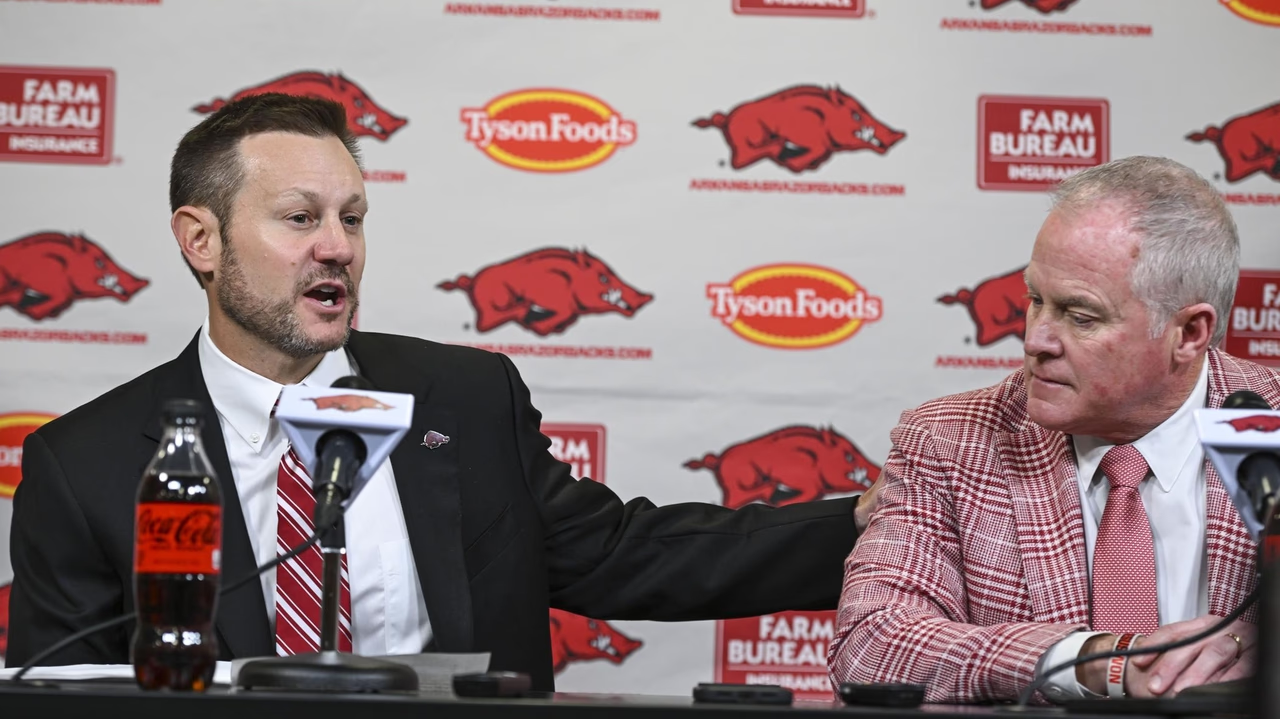
He had to face the people he needs to win over, the ones the Razorbacks need to increase their spending so they can compete with the SEC’s power programs.
Silverfield signed a five-year, $33.5 million deal to take over in Arkansas earlier in the week. He had coached Memphis since the 2020 season, plus a single game with the Tigers as interim head coach in 2019. Memphis qualified for a bowl in every season with Silverfield at the helm and peaked in 2024 with an 11-2 record. The Tigers hold an 8-4 record ahead of a likely bowl game.
Those kinds of results at Arkansas would be a boon. The Razorbacks’ season concluded Saturday with a loss to Missouri. That ended a 2-10 season with an 0-8 record in the Southeastern Conference, the third season in the last seven Arkansas finished with those marks.
“This program is built on pride, resilience and toughness, and it’s time to bring it all back,” Silverfield said at the press conference. “Being all in together, we will rebuild it, we will earn it, and we will make this state proud.”
Finances were one of the biggest points in both the press conference and the public introduction a few hours later. Arkansas athletic director Hunter Yurachek has made a point for the last year that the Razorbacks need more contributions for NIL funds in order to compete at a higher level in the SEC. The first audible announcement over the loudspeaker before Silverfield took the dais was one asking for money.
NIL war chests are tight-lipped secrets across college football. But Arkansas’ football attendance, which equates to revenue earned, ranks fifth from the bottom in the SEC. Both Silverfield and Yurachek said finances were a key topic during the interview and contract negotiations.

Arkansas’s new head football coach Ryan Silverfield speaks to reporters during an NCAA college football press conference, Thursday, Dec. 4, 2025, in Fayetteville, Ark. Credit: AP/Hank Layton
“I think it’s our competitive advantage not to give details of what that is, other than to tell you that it is a significant investment in all aspects of our football program that will move us to the top half of spending in all of those categories I mentioned in the Southeastern Conference,” Yurachek said. “I don’t believe we need to be at the top of spending. We need to be somewhere where we’re really competitive and Ryan and I are on the same page with where we are.”
Quarterback KJ Jackson and defensive end Quincy Rhoads Jr. both joined the press conference and announced they would return to the team in 2026. Jackson, a rising sophomore, took over as Arkansas’ starting quarterback for the final game of the season and is largely considered the future of the position. Rhoads finished in a tie for fifth in the SEC in sacks (8) and second in the league in tackles for-loss (17 1/2).
Silverfield told fans he doesn’t think a rebuild will take long.
“It’s not one of those things where we’re sitting here saying, ‘Hey, you know, Hunter, I need three years to rebuild this,’” Silverfield said. “No. We can start rebuilding the culture the moment we step down.”
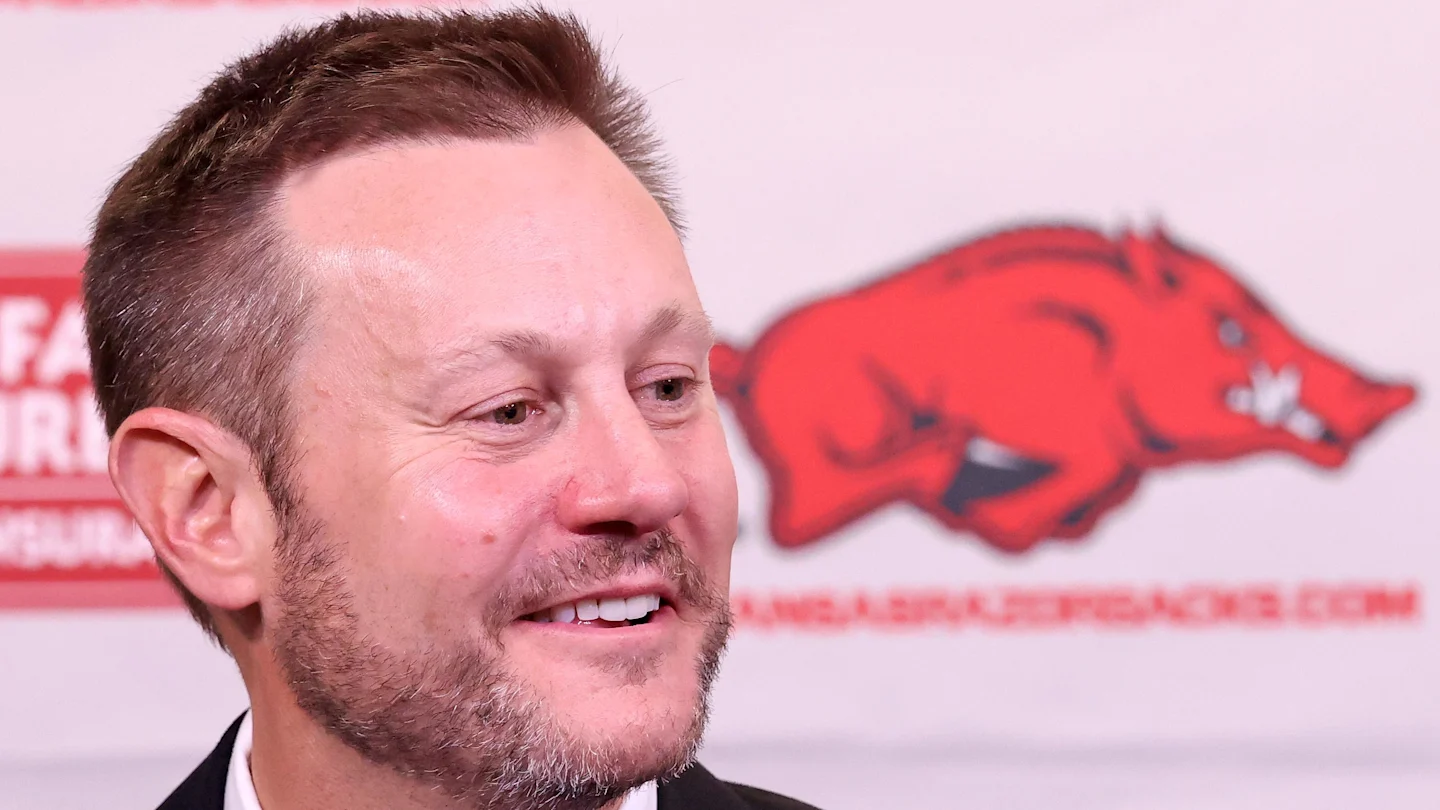
Just days into his tenure as head coach, Ryan Silverfield has already made a major impression, on more than just the Razorbacks’ players and fans. According to Arkansas Athletics Director Hunter Yurachek, a donor committed to a seven-figure donation to the football program after spending just five minutes with Silverfield in a club box at the Hogs’ basketball game last night.
“This new commitment is the first step in the process of building a championship program at Arkansas,” Yurachek said.
A Sign of Confidence in Ryan Silverfield’s Rebuild
The donation is more than a symbolic gesture. For a football program that has struggled to compete financially with other SEC powerhouses, seven figures provides critical resources. From recruiting and coaching staff salaries to roster development and facility improvements, Silverfield now has tangible backing to begin implementing his vision immediately.
That such a commitment came in less than a week on the job highlights the clarity and passion Silverfield brings to the role. During his introductory press conference, he emphasized finances as a central pillar of his plan, noting that rebuilding Arkansas football will be a swift process.
““It’s not one of those things where we’re sitting here saying, ‘Hey, you know, Hunter, I need three years to rebuild this,’” Silverfield said. “No. We can start rebuilding the culture the moment we step down.””
Ryan Silverfield
Back in September, after the dismissal of former head coach Sam Pittman following six seasons, Yurachek acknowledged that Arkansas didn’t have the funding necessary to compete with the majority of SEC programs. Attendance revenue ranked near the bottom of the conference, and NIL war chests remained limited, hindering recruiting and player development.
Yurachek, however, was optimistic that a new hire could change that. Silverfield’s arrival, and the immediate donor confidence, has confirmed that progress is underway.
““Finances were a key part of both the interview and contract negotiations,” Yurachek said. “It’s clear Ryan has a vision for how to rebuild this program, and he’s already inspiring donors to step up.””
Hunter Yurachek
For players, it signals that the program has momentum and ambition, which can be a powerful motivator on and off the field. Additionally, immediate financial support allows Silverfield to act quickly without waiting years to implement changes, a rare advantage in college football.
A New Era in Fayetteville
Silverfield’s first week has sent a clear message: Arkansas football is ready to change. With donor confidence, administrative support, and a clear vision, the Razorbacks are positioning themselves for a rapid turnaround after years of struggles.
““We’re not going to wait to start this rebuild,” Silverfield said. “The culture begins today, and we have the resources and the plan to make it happen.””
Ryan Silverfield
For fans and recruits alike, the combination of strong leadership and newfound financial backing signals that Arkansas football is entering a new era, one aimed at competing at the very top of the SEC and soon.
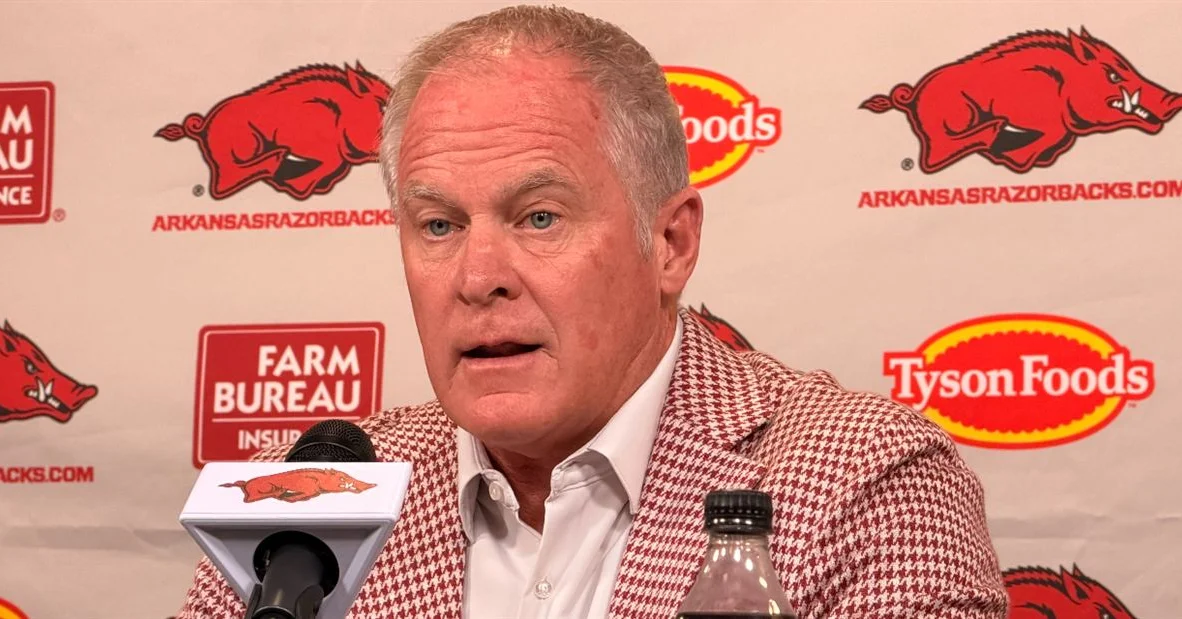
Arkansas vice chancellor and director of athletics Hunter Yurachek formally introduced Ryan Silverfield as the 35th coach in the football program’s history on Thursday afternoon to assembled media in the Broyles Center. As part of the hour-long introductory press conference, Yurachek answered a plethora of questions regarding the financial support surrounding the football program.
Back in September, following the Sam Pittman’s dismissal after six seasons as coach, Yurachek admitted that the football program didn’t have the necessary funding to compete with the majority of SEC programs in football. At the time, he seemed optimistic that would change in lock-step with a new coaching hire.
As part of his opening statement on Thursday, Yurachek revealed the funding has indeed improved. The goal is to build a championship program at Arkansas and, as Yurachek put it, this new commitment was the first step in the process of accomplishing that goal.
“The top-down alignment of a new financial commitment from our Board of Trustees, the University, the department of athletics and so many generous donors that have taken place over the last several weeks was the first step to us being all in on this goal,” Yurachek said. “This financial commitment will push us to the top half in key SEC items such as our assistant coaches pool, our strength and conditioning staff, our support staff pool and our talent acquisition through revenue sharing and legitimate NIL.”
Yurachek was peppered with questions regarding this ‘new financial commitment’ but wouldn’t divulge any specifics on the budget or amount of newly committed funds, citing a competitive advantage as the reason not to. He did, however, say the investment was “significant.”
“I think it’s our competitive advantage not to give details of what that is other than to tell you that it is a significant investment in all aspects of our football program,” Yurachek said. “That will move us to the top half of spending in all of those categories I mentioned in the Southeastern Conference.
“I don’t believe we need to be at the top of spending, we need to be somewhere where we’re really competitive and Ryan and I are on the same page with where we are. It allows him to go out and hire the assistant coaches that he believes he needs to hire to build a championship program and to invest in our revenue sharing and legitimate NIL to make sure that we acquire the best talent for our roster.
“I want to make sure that we have a competitive advantage. I think once you put your financials out there and tell other schools what you’re doing, that allows them the opportunity to come meet you where you are or exceed where you’re at.”
While the financial commitment is improved according to Yurachek, he also revealed they’re still not to the level they want to be from a fundraising standpoint. He explained that the program is off to a good start with the last few months, but they still haven’t accomplished their goal.
“We’re not to the finish line, but I will tell you from a fundraising standpoint, we’re off to a great start,” Yurachek said. “With the athletic department is going to commit is significant and that’s how we’re going to reallocate some of the dollars that we have. The board is going to make a commitment to our football program as well, and all of that is significant. I don’t want to tie down a specific dollar amount to any of that, because I don’t want to limit what we can do
a couple of different revenue sources that we’re looking through, both through our foundation and through the athletic department, and then just how we reallocate money that we’re currently spending within our department, whether that’s from a salary standpoint, an operational standpoint, but we feel like we can do some things differently to be more efficient, that we can reallocate more dollars to our football program.
Yurachek explained that some of the financial commitment from the athletic department will come from reallocation of what they’re currently spending. He mentioned salaries, operations and that there are other ways they can be more efficient which helps push more money toward football.
When asked how fans will be able to notice the new financial commitment behind the football program, Yurachek pointed to Silverfield’s recruiting and staff additions among other things.
“It will come when he announces some of the people on his staff, that will be the first piece,” Yurachek said. “Then when you see how our roster comes together after the transfer portal officially opens in January, you see we’ve got a couple of young men in here (Quincy Rhodes and KJ Jackson) that are coming back. That’s a part of the financial commitment that we’ve made into our football program, to be able to retain those high-caliber, very talented young men.”
It’s not just Yurachek and his staff helping get Arkansas football in better financial shape. Silverfield himself has hit the ground running in that department and has made a difference in just a matter of days. Yurachek shared a story of the new Razorbacks head coach leaving quite the impression on one donor at Thursday’s basketball game.
“Let me touch on his fundraising prowess,” Yurachek said of Silverfield. “He doesn’t even know this yet. He was in the courtside club last night, and he was doing what he does in building relationships with donors. Right off the bat, he walked away from one donor, the donor came up to me and committed to a seven figure gift to a football program, just with a brief five minute encounter.”

FAYETTEVILLE, Ark. (AP) — Ryan Silverfield had a second stop to make Thursday after his first press conference since being hired as Arkansas football coach.
He had to face the people he needs to win over, the ones the Razorbacks need to increase their spending so they can compete with the SEC’s power programs.
Silverfield signed a five-year, $33.5 million deal to take over in Arkansas earlier in the week. He had coached Memphis since the 2020 season, plus a single game with the Tigers as interim head coach in 2019. Memphis qualified for a bowl in every season with Silverfield at the helm and peaked in 2024 with an 11-2 record. The Tigers hold an 8-4 record ahead of a likely bowl game.
Those kinds of results at Arkansas would be a boon. The Razorbacks’ season concluded Saturday with a loss to Missouri. That ended a 2-10 season with an 0-8 record in the Southeastern Conference, the third season in the last seven Arkansas finished with those marks.
“This program is built on pride, resilience and toughness, and it’s time to bring it all back,” Silverfield said at the press conference. “Being all in together, we will rebuild it, we will earn it, and we will make this state proud.”
Finances were one of the biggest points in both the press conference and the public introduction a few hours later. Arkansas athletic director Hunter Yurachek has made a point for the last year that the Razorbacks need more contributions for NIL funds in order to compete at a higher level in the SEC. The first audible announcement over the loudspeaker before Silverfield took the dais was one asking for money.
NIL war chests are tight-lipped secrets across college football. But Arkansas’ football attendance, which equates to revenue earned, ranks fifth from the bottom in the SEC. Both Silverfield and Yurachek said finances were a key topic during the interview and contract negotiations.
“I think it’s our competitive advantage not to give details of what that is, other than to tell you that it is a significant investment in all aspects of our football program that will move us to the top half of spending in all of those categories I mentioned in the Southeastern Conference,” Yurachek said. “I don’t believe we need to be at the top of spending. We need to be somewhere where we’re really competitive and Ryan and I are on the same page with where we are.”
Quarterback KJ Jackson and defensive end Quincy Rhoads Jr. both joined the press conference and announced they would return to the team in 2026. Jackson, a rising sophomore, took over as Arkansas’ starting quarterback for the final game of the season and is largely considered the future of the position. Rhoads finished in a tie for fifth in the SEC in sacks (8) and second in the league in tackles for-loss (17 1/2).
Silverfield told fans he doesn’t think a rebuild will take long.
“It’s not one of those things where we’re sitting here saying, ‘Hey, you know, Hunter, I need three years to rebuild this,’” Silverfield said. “No. We can start rebuilding the culture the moment we step down.”
___
Get poll alerts and updates on the AP Top 25 throughout the season. Sign up here and here (AP News mobile app). AP college football: https://apnews.com/hub/ap-top-25-college-football-poll and https://apnews.com/hub/college-football
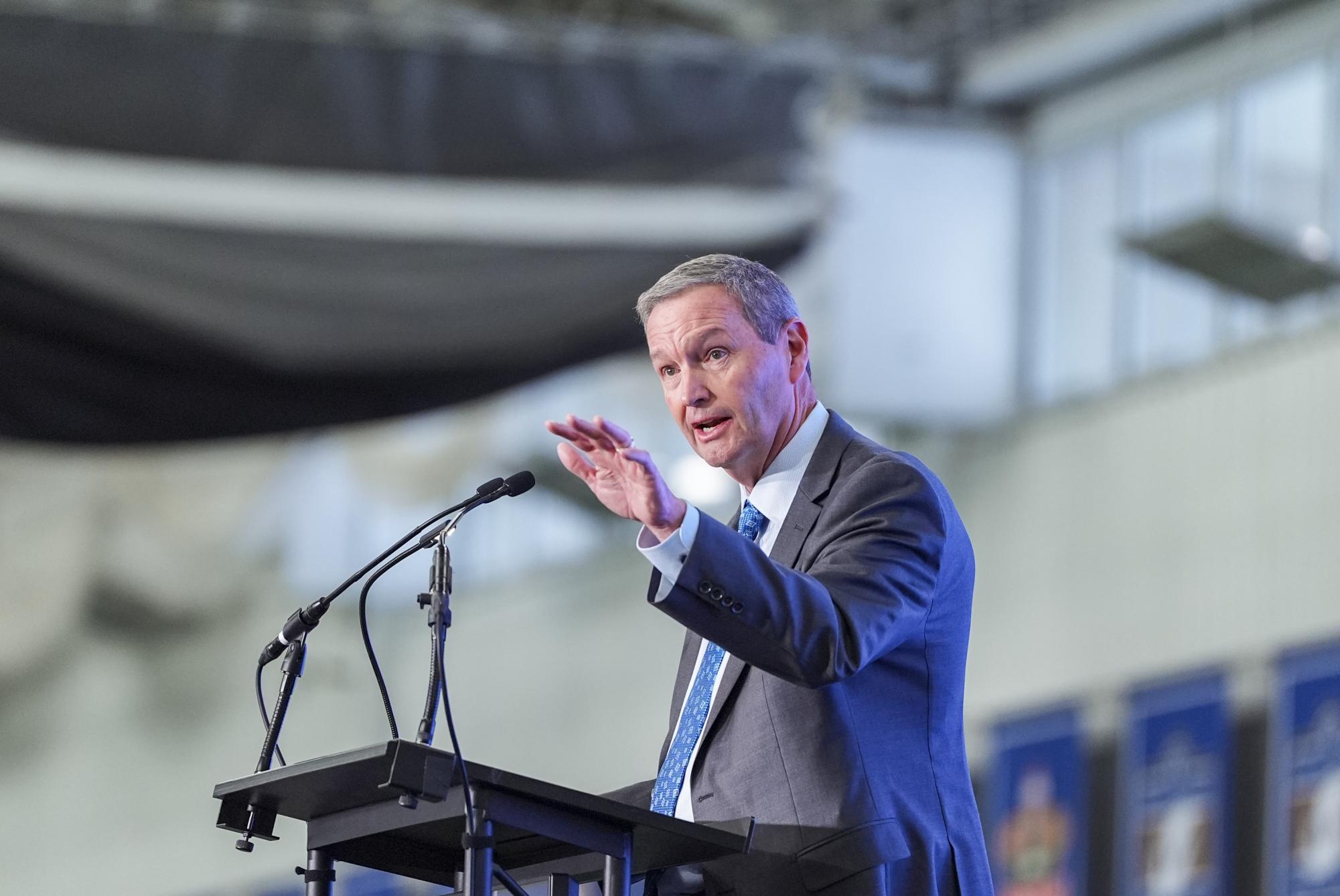
A new era of Kentucky football was celebrated yesterday as Will Stein was introduced as head coach and spoke to fans along with media for the first time.
As expected, NIL came up in this conference as it is the talking point of college sports all around the country.
The new head coach was the first to confirm that Kentucky is where it needs to be to compete for the players it wants under the new leadership.
“Yeah, of course, of course,” Stein said. “Mitch [Barnhart], Mark [Hill] laid out a great plan. Feel like we’re right there to be successful right away.”
To help navigate this process, it is believed that Pat Biondo will be joining the staff as a general manager.
The role has started to become more integrated into the sport in this rising world of NIL in order to have experts at the forefront of this process for recruiting and roster-building purposes.
Barnhart spoke with media after the introductory press conference and doubled-down on Stein’s take about NIL for the program in a fired response.
“We’re confident in what we’re doing and people ask that question 19 different ways, from all the stuff that’s been going on, and it’s exhausting. You know, enough, enough about have we got enough? We’ve got enough, and we’re working at it just like everyone else is working at it We’re no different,” Barnhart exclaimed. “They’ve got Learfield, we’ve got JMI, they’ve got Learfield, they’ve got playflight. So this notion that we don’t have enough is ridiculous. We’ve got enough.”
Another avenue that has caused several debates on NIL is the salary cap that limited the amount schools could directly share to athletes at $20.5 million.
This was meant to limit the amount schools could give players and sounds good in principle, but like most things when it comes to NIL, did not work that way.
A lot of schools have used deals outside the school that has inflated the money within college football programs well above the limit.
Some schools have even incorporated and expanded athletic departments into agency to secure the deals for these players that bend the rules just a bit.
Another major issue is that schools are making NIL promises part of recruitment for high schools players and transfers.
Within the given timeframe, there is nothing wrong with this, but since NIL, teams have been known to reach out to players when they are not allowed to.
This tampering expedited the process for getting Stein to Lexington to become the Wildcats next head coach.
“Make no mistake about it, we can talk about tampering, we can talk about no doing this, no doing that, they’re flat calling players all over the place, and there’s player movement everywhere,” Barnhart said. “So let’s not kid ourselves, so, yeah, to protect our roster, to protect our program, to protect recruiting, we had to move fast.”
However, while others might be not playing the rules and finding workarounds, that is not going to happen at Kentucky.
“We’ve got to resource it the right way. We got to assess talent the right way. We got to acquire it the right way. We’ve got to make sure we’re within the boundaries and the rules,” Barnhart said. “We’re not going to break the rules. That’s flat out. We’re not doing that alright, we will do it the right way. We don’t need to, we don’t need to do that. We’re good enough at what we do. We’ve got good people.”
With National Signing Day over and the transfer portal opening in January, it will not take long to see just how well Stein and Kentucky can compete with the rest of the SEC to recruit talent in this NIL era.

No. 3 Badgers stifle Panthers to kick off postseason action

Jacob Rodriguez’s college football journey: From QB to LB to Heisman?

EGT Digital Receives Industry Impact Award at BEGE Awards 2025

New Arkansas coach Ryan Silverfield says it won’t take long to rebuild the program

Arkansas football receives seven-figure NIL boost

Hunter Yurachek dishes on ‘new financial commitments’ for Arkansas football

Volleyball Closes Season Against No. 1 Kentucky in NCAA Tournament

Gaming Computers Market Growth Trajectory Strengthens with

New Arkansas coach Ryan Silverfield says it won’t take long to rebuild the program

Demon Deacons Open Season at Liberty Kickoff

Metaverse in Gaming Market to Surge at 27.62% CAGR, Anticipated

Mitch Barnhart emphatically affirms Kentucky football’s NIL status – Kentucky Kernel

Lopes unveil 2025-26 indoor slate

Men’s and Women’s Track and Field 2026 Season Preview

Mustangs Open Track and Field Season This Weekend

First Tee Winter Registration is open

Fargo girl, 13, dies after collapsing during school basketball game – Grand Forks Herald

CPG Brands Like Allegra Are Betting on F1 for the First Time

Volleyball Recaps – November 18

F1 Las Vegas: Verstappen win, Norris and Piastri DQ tighten 2025 title fight

Two Pro Volleyball Leagues Serve Up Plans for Minnesota Teams

Utah State Announces 2025-26 Indoor Track & Field Schedule

Sycamores unveil 2026 track and field schedule

Texas volleyball vs Kentucky game score: Live SEC tournament updates

Bowl Projections: ESPN predicts 12-team College Football Playoff bracket, full bowl slate after Week 14

Redemption Means First Pro Stock World Championship for Dallas Glenn

Pohlman admits ‘there might be some spats’ as he pushes to get Kyle Busch winning again

Indiana’s rapid ascent and its impact across college football

Troy Football Need to Know; Gameday at The Vet — Georgia State Game

How this startup (and a KC sports icon) turned young players into card-carrying legends overnight

 Why a rising mid-major power with an NCAA Tournament team opted out of revenue-sharing — and advertised it
 NBA Legend Michael Jordan to Join NBC Sports as Special Contributor
 Falcons mailbag
 Portal Update – Basketball and Gymnastics Take Hits
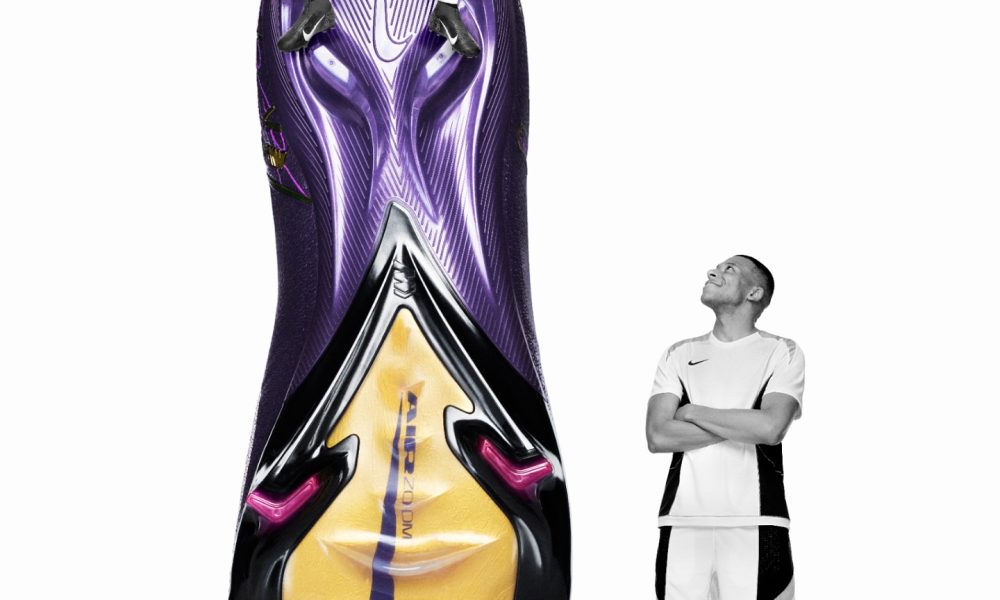 has always dreamed in Mercurial. Now his initials are on the boots.
The new Kyl…
has always dreamed in Mercurial. Now his initials are on the boots.
The new Kyl…
-
 Rec Sports2 weeks ago
First Tee Winter Registration is open
-
 Rec Sports1 week ago
Fargo girl, 13, dies after collapsing during school basketball game – Grand Forks Herald
-
 Motorsports1 week ago
CPG Brands Like Allegra Are Betting on F1 for the First Time
-
 Sports2 weeks ago
Volleyball Recaps – November 18
-
 Motorsports2 weeks ago
F1 Las Vegas: Verstappen win, Norris and Piastri DQ tighten 2025 title fight
-
 Sports1 week ago
Two Pro Volleyball Leagues Serve Up Plans for Minnesota Teams
-
 Sports1 week ago
Utah State Announces 2025-26 Indoor Track & Field Schedule
-
 Sports1 week ago
Sycamores unveil 2026 track and field schedule
-
 Sports1 week ago
Texas volleyball vs Kentucky game score: Live SEC tournament updates
-
 NIL4 days ago
Bowl Projections: ESPN predicts 12-team College Football Playoff bracket, full bowl slate after Week 14