(Bloomberg) — Lei Jun, founder and chairman of Xiaomi Corp., the only tech company to have successfully diversified into carmaking, couldn’t resist.
Speaking at a triumphant launch event in Beijing late last month for Xiaomi’s second electric vehicle, a long-anticipated SUV, Lei pointedly mentioned Apple Inc., which spent a decade and $10 billion trying to make a car before giving up last year.
“Since Apple stopped developing its car, we’ve given special care to Apple users,” he said, noting that owners of the American giant’s iPhones would be able to seamlessly sync their devices to Xiaomi’s vehicles.
The not-so-subtle dig was followed by a flex: Xiaomi then said it had received more than 289,000 orders for its new sport utility vehicle within an hour of its announcement, more than its first EV, a sedan launched in March 2024.
Xiaomi succeeding where Apple failed has burnished Lei’s reputation, made his company one of the most valuable in China and shaken up both the tech and automobile industries.
The collapse of Apple’s moonshot car program has only underscored the effectiveness of Xiaomi’s grounded approach, which took inspiration from proven designs from Tesla Inc. and Porsche Automobil Holding SE while staying true to the affordable ethos that’s made it a cult brand for Gen Z consumers.
Crucially, it also launched into the most fertile EV ecosystem in the world — China. With state subsidies, existing charging infrastructure and a ready made supply chain, Xiaomi had a structural tailwind Apple lacked.
Xiaomi declined to comment for this story.
Lei and Xiaomi’s “charisma, brand recognition and ecosystem cannot be underestimated,” Yale Zhang, the managing director of Shanghai-based consultancy Automotive Foresight, said. “It’s a big influence on young consumers who have filled their homes with Xiaomi products. When it comes time to buy an EV, they naturally think of Xiaomi.”
But building cars is a far more complex, capital intensive challenge than making phones or rice cookers. It requires mastering safety regulations, global logistics and production at scale, all while competing against legacy automakers with long histories and large model lineups. Any international expansion will also require navigating complex geopolitical landscapes. As one of the first tech giants to actually manufacture a car, Xiaomi is in uncharted territory.
Apple’s Failings
Apple’s car project, internally dubbed Project Titan, failed in large part because it wasn’t just an EV — it was at one point an attempt to leapfrog the auto industry with a fully autonomous, Level 5 self-driving machine. Its goals were lofty and the direction constantly shifting, the result being over a decade of effort with nothing to show.
Lei, 55, was comparatively stingy with time and resources and staked his personal reputation on the endeavor, claiming that making cars would be his “last entrepreneurial project.”
Xiaomi’s public narrative is that Lei and his team learned by visiting multiple Chinese automakers, including Zhejiang Geely Holding Group Co. and Great Wall Motor Co., and talked to more than 200 industry experts in some 80 meetings.
The reality is also that he used Xiaomi’s reputation as an innovative consumer behemoth to get close to China’s large carmakers and pick off their top talent. Geely and its billionaire founder Li Shufu welcomed Lei to the automaker’s research institute in Ningbo in the months leading up to Xiaomi’s announcement that it would enter the car business to discuss topics, including potential collaboration.
It’s Geely lore that Lei added the WeChat contacts of many staff at the institute, including then-director Hu Zhengnan. Hu later joined Shunwei Capital Partners, the investment firm co-founded by Lei.
Recruitment Tactics
Xiaomi headhunters also courted Geely staff intensely, according to people familiar with the matter. While it’s common for talent to move between companies in the same industry, it was unusual to see this level of aggressiveness around recruitment, the people said, asking not to be identified discussing information that’s private. Geely didn’t respond to a request for comment.
Hu, known for his love of the German luxury marque Porsche, was one of the team members credited as being instrumental to developing Xiaomi’s EV business, Lei said at the SU7 launch in 2024. Lei added that Hu left his previous employer after his contract ended.
Other executives who joined Xiaomi came from companies including BAIC Motor Corp., BMW AG, SAIC-GM-Wuling Automobile Co. — the General Motors Co. joint venture with SAIC Motor Corp. and Wuling Motors Holdings Ltd. — and auto supplier Magna Steyr LLC.
Besides assembling top Chinese automaking talent, Lei made a prescient bet on investing in a self-controlled supply chain — insulating Xiaomi’s operation from manufacturing vagaries. This came from painful lessons learned in Xiaomi’s early smartphone-producing days, when external suppliers would cut off components unpredictably.
In 2016, some members of Xiaomi’s supply chain team displeased Samsung Electronics Co. representatives and the South Korean firm threatened to halt supply of its industry-leading AMOLED screens.
To mend the fractured relationship, Lei flew to Shenzhen to meet with Samsung’s China head at the time. The pair drank five bottles of red wine during their dinner meeting, according to a Xiaomi company biography, and Lei also made multiple trips to Samsung’s headquarters in South Korea to apologize and negotiate the resumption of supply. Representatives from Samsung declined to comment.
After Xiaomi went into the carmaking business, it invested into almost all parts of the EV supply chain, from batteries and chips to air suspension and sensors. It pumped more than $1.6 billion via Shunwei or other Xiaomi-led funds into over 100 supply chain companies between 2021 and 2024, according to data compiled by Chinese analytics firm Zhangtongshe and Bloomberg.
The components from some of the companies that Xiaomi invested in have ended up in its cars, such as lidars from Hesai Technology Co. and onboard chargers and voltage converters from Zhejiang EV-Tech Co.
With the 10 billion yuan ($1.4 billion) it committed to the first phase of its EV venture, Xiaomi also built its own factory, rather than going down the contract manufacturing route that some Chinese makers, including Nio Inc. and Xpeng Inc., did when they started out.
“Among tech companies that now build electric vehicles, those who previously had hardware products seem to be more successful than those who only had software products or information services,” said Paul Gong, UBS Group AG’s head of China autos research.
Copycat Allegations
Despite its early success, there are many who argue Xiaomi’s one hit car is copied from elsewhere — and that a sole successful vehicle does not a successful auto producer make. Lei’s aggressive approach has also raised hackles in China’s car industry.
Yu Jingmin, vice president of SAIC’s passenger car division, reportedly described Xiaomi’s approach as “shameless” in a critique of the SU7 resembling Porsche. The SU7 has been colloquially dubbed “Porsche Mi” by netizens. SAIC didn’t respond to questions about Yu’s remarks.
Xiaomi’s design team, led by former BMW designer Li Tianyuan, has defended the SU7’s aesthetics, emphasizing that the choices were driven by aerodynamic efficiency and performance benchmarks.
In late March, there was another setback after a fatal accident involving the SU7. The car had its advanced driver assistance technology turned on before the crash, which afterward led to authorities reining in the promotion and deployment of the technology.
The usually vocal Lei kept a low profile on social media for more than a month post the March accident. He returned to more active engagement in May with a missive that said this period of time was the most difficult in his career.
Fortunately for Xiaomi, its consumer base is sticky. Known as “Mi Fans,” the loyal customers have played a pivotal role in the company’s rise. Xiaomi cultivated this fandom early on by prioritizing user feedback and the grassroots allegiance has helped it build strong brand equity, especially in China. The SU7 has remained a top selling model even after the accident in March.
Indeed, dealers have reported that nearly 50% of customers plump for the SU7 without comparing it to other brands. “A significant number of older consumers are buying the SU7 for their children, indicating that the model has built trust among more conservative buyers thanks to its safety and quality,” said Rosalie Chen, a senior analyst from investment research firm Third Bridge.
Small Scale
Xiaomi has set a delivery target of 350,000 units in 2025, up from its previous goal of 300,000, buoyed by demand for the newly launched YU7 and a ramp up in production. The starting prices for the SU7 sedan, at 215,900 yuan ($30,100), and its SUV, at 253,500 yuan, make them competitive alternatives to models like Tesla’s Model 3 and Model Y.
The EVs are also showing financial promise. Xiaomi posted record revenue for the first quarter this year, driven by car and smartphone sales. Its EV division is expected to turn profitable in the second half of 2025, Lei said in an investor meeting in June.
But even if the popularity of Xiaomi’s EVs can spring beyond the company’s devoted base, production is still on a much more boutique scale. China’s top car brand, BYD Co., sold around 4.3 million EVs and hybrids last year, many overseas, while Tesla moved about 1.78 million vehicles globally. Toyota Motor Corp., the world’s No. 1 automaker, sold some 10.8 million vehicles and boasts a lineup of approximately 70 different models.
Lei doesn’t seem to be prioritizing the mass market of below $20,000 yet, which drives significant volume and is where BYD dominates, Automotive Foresight’s Zhang said.
Without a lineup in that segment, Xiaomi cars will remain niche purchases for middle to higher-income consumers and Xiaomi may face the same risks as Tesla, which is seeing its sales slump exacerbated by a narrow consumer base and limited models.
Nonetheless, Lei seems buoyed by Xiaomi’s early wins and is now looking at global expansion. Xiaomi will consider selling cars outside China from 2027, he said last week.
Success or otherwise, the European Union, the US and Turkey have all slapped tariffs on Chinese EVs, but Xiaomi wants to set up a R&D center in Munich and may test sales starting in European markets such as Germany, Spain and France when the time is right, Chinese media 36Kr reported in April.
“Xiaomi is a latecomer to the auto industry,” Lei admitted on Weibo in June. But, he said, in a market driven by technology and innovation and the rising global influence of China’s EV culture, “there are always opportunities for latecomers.”
–With assistance from Vlad Savov, Mark Gurman, Drake Bennett and Jessica Sui.
More stories like this are available on bloomberg.com
Pune, India – December 15, 2025 – Exactitude Consultancy, a global leader in market research and intelligence, today announced the publication of its Gaming Headset Market Report, delivering a detailed analysis of industry trends, segmentation, competitive landscape, and growth forecast through 2034. This report equips manufacturers, gaming peripheral brands, distributors, investors, and technology stakeholders with actionable insights into the evolving gaming audio accessory ecosystem.
Download Full PDF Sample Copy of Market Report @ https://exactitudeconsultancy.com/request-sample/70022
Market Overview
The global gaming headset market was valued at approximately USD 3.6 billion in 2024 and is projected to grow at a CAGR of 7.1 % over the forecast period (2025-2034), reaching an estimated USD 7 billion by 2034. Growth is driven by rising eSports participation, immersive gaming demand, and technological advancements in audio features.
Key Growth Drivers & Trends
• eSports & Online Gaming Boom: Global expansion of competitive gaming amplifies demand for high performance headsets that offer superior positional audio and communication clarity.
• Technological Innovation: Enhanced features such as noise cancellation, surround sound, wireless connectivity, and spatial audio are increasingly integrated, improving player immersion and comfort.
• Streaming & Content Creation: Growth in gaming streaming and content production influences headset demand, as creators seek high quality audio capture and playback.
• Casual & Mobile Gamers: A broadening gamer base – especially casual players – continues to drive headset adoption for both competitive play and entertainment.
Market Segmentation
The report segments the gaming headset market by:
• Product Type: Wired and wireless gaming headsets. Wired remains significant due to low latency, while wireless is rising with improved battery tech and convenience.
• Application: Gaming, music, virtual reality (VR), and streaming usage.
• End User: Casual gamers, professional gamers, and eSports athletes.
• Technology: Surround sound, noise cancellation, RGB lighting, built in microphones – key immersive and functional features driving differentiation.
• Distribution Channel: Online retail, offline retail stores, and direct manufacturer sales.
Explore Full Report here: https://exactitudeconsultancy.com/reports/70022/gaming-headset-market
Regional Insights
• North America remains the largest regional market, accounting for about 40 % of global revenue, buoyed by a strong gaming culture and high accessory spend.
• Asia Pacific is a dynamic growth region with an ~10 % CAGR, driven by expanding middle class gaming populations and significant eSports adoption in China, Japan, and SEA.
• Europe shows solid growth supported by widespread console and PC gaming infrastructure.
• Latin America and Middle East & Africa are among the fastest growing emerging regions with projected double digit regional CAGRs by 2034.
Competitive Landscape
The gaming headset market is highly competitive with both established brands and specialized gaming audio companies. Key players include:
• Logitech
• Razer
• Corsair
• SteelSeries
• HyperX
• ASUS
• Turtle Beach
• Sennheiser
• JBL
• Creative Labs
These companies continually innovate with features such as spatial audio, advanced noise suppression, enhanced wireless protocols, and ergonomic design to meet diverse gamer preferences.
Market Challenges
Challenges facing the market include price competition and saturation in certain product tiers, as well as evolving platform compatibility requirements across PC, console, mobile, and VR devices.
Strategic Importance
Gaming headsets have become essential peripherals for modern gaming ecosystems, influencing play experience, communication, and competitive performance. As the gaming sector – including casual, competitive, and VR gaming – continues to expand, high fidelity audio gear remains a key differentiator for brands and consumers alike.
This report is also available in the following languages : Japanese (ゲーミングヘッドセット市場), Korean (게이밍 헤드셋 시장), Chinese (游戏耳机市场), French (marché des casques de jeu), German (Markt für Gaming-Headsets), and Italian (Mercato delle cuffie da gioco), etc.
Request for a sample of this research report at (Use Corporate Mail ID for Quick Response) @ https://exactitudeconsultancy.com/request-sample/70022
Exactitude Consultancy is a market research & consulting services firm which helps its client to address their most pressing strategic and business challenges. Our market research helps clients to address critical business challenges and also helps make optimized business decisions with our fact-based research insights, market intelligence, and accurate data.
Games including Rocket League, Marvel Rivals, Super Smash Bros, Mario Kart 8, and others.
FLINT, Mich. (WJRT) – The University of Michigan-Flint’s College of Innovation & Technology joined forces with the Michigan High School Esports Federation to host the fall 2025 state finals event.
More than 120 teams and 350 players from over 70 schools across the state participated in the event on Saturday.
Eleven champions were crowned in games such as Rocket League, Marvel Rivals, Super Smash Bros, and Mario Kart 8.
“It’s amazing. It’s my first time in a tournament or anything,” said Corunna esports player Jackson Donley.
“Especially in person, and the atmosphere is just amazing. You can tell it’s tense, especially when the matches are so close,” Donley said.
Corunna Middle School secured first place in the middle school division of the Team Super Smash Bros competition.
Davison High School claimed first place in the high school division.
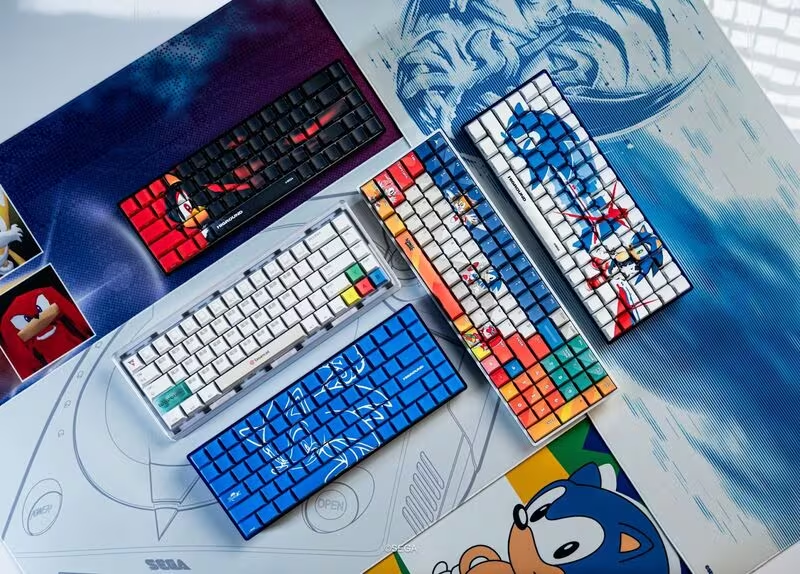
The Sonic the Hedgehog collection, a renewed collaboration between lifestyle gaming peripheral brand Higround and SEGA, highlights a design concept that merges retro nostalgia with modern performance engineering. Drawing from the cultural legacy of Sonic the Hedgehog and the visual language of the Dreamcast era, the collection introduces peripherals that blend archival aesthetics with contemporary functionality. This release also expands Higround’s product range “through updated 75% and 96% keyboard layouts and the introduction of a Hall Effect model, each referencing the theme of Sonic’s characteristic speed.”
The ‘Summit 65+,’ presented in a Dreamcast-inspired design, features a CNC aluminum case, stainless steel back plate, and Higround’s ‘Dampening Plus’ five-layer system for a stable, quiet typing experience. The ‘Basecamp 65HE,’ influenced by the Radical Highway level, debuts Hall Effect technology for increased precision. Additional offerings—including the Classic Sonic–themed ‘Basecamp 96+,’ two ‘Basecamp 75+’ versions inspired by Escape from the City and Sonic CD, a Sonic CD keycap set, and four coordinated XL mousepads—further unify the collection’s nostalgic yet contemporary character.
The Competitive Spirit That Powers Both Sports and Startups
Miami sports fans know that greatness comes from more than talent alone. Whether it’s the Heat grinding through a tight fourth quarter or the Dolphins executing a perfectly timed offensive scheme, winning requires discipline, fast thinking, and an unshakeable competitive spirit. Interestingly, these same qualities power the tech and startup world, where entrepreneurs make split-second decisions that can define the future of an entire business.
In both arenas, success belongs to those who can read momentum, adapt under pressure, and turn small opportunities into game-changing wins. That overlap is why so many sports-minded individuals naturally thrive in the world of business, innovation, and technology.
Why Analytics in Sports Fuel Smarter Business Thinking
Today’s sports landscape is driven by analytics—shot charts, win probability graphs, EPA metrics, and possession efficiency numbers are all part of modern fan knowledge. This analytical mindset doesn’t stop at the arena. Tech entrepreneurs, founders, and investors rely on the same data-driven thinking to navigate product decisions, market shifts, and competition.
This crossover is why the startup world attracts problem solvers shaped by sports culture. And platforms in the entertainment-tech space—such asFoxy gold casino—reflect this growing connection between digital innovation, predictive thinking, and user engagement.
Understanding Momentum: A Shared Advantage for Founders and Athletes
Momentum is everything. In sports, a single run, turnover, or three-pointer can change the energy in seconds. In business, momentum might be a viral post, a successful beta launch, or hitting a major funding milestone. Leaders in both fields understand how to recognize momentum and capitalize on it.
This parallels perfectly:
Athletes ride hot streaks.
Founders capitalize on traction.
Sports teams adjust mid-play.
Startups pivot product strategy just as quickly.
The ability to shift gears on the fly is one of the most important skills in sports and tech alike.
Building a Winning Strategy: What Startups Can Learn From Miami Sports
1. Scouting and Research Matter
Sports teams invest heavily in scouting reports and film studies. They evaluate:
Opponent strengths
Player tendencies
Lineup matchups
Efficiency ratings
Startups mirror this with market research, user interviews, competitive analysis, and data modeling. Knowing the landscape allows founders to execute smarter, faster, and with more confidence.
2. Team Culture Determines Long-Term Success
The Miami Heat built the “Heat Culture,” known for discipline, conditioning, and accountability. Startups adopting similar cultural principles see major benefits:
Clear leadership and communication
Defined expectations
Continuous improvement
Resilience under pressure
A strong culture is often the difference between a startup that scales—and one that collapses.
3. Adaptability Separates Winners From the Rest
Sports demand constant adjustments: defensive rotations, halftime strategies, and clutch-time decisions. Startups face equally rapid shifts:
Market changes
New competitors
Shifting user demand
Technological breakthroughs
Founders who adapt quickly, without losing their vision, stay competitive.
Table: Business Lessons Inspired by Miami’s Sports Playbook
Miami Sports Principle
Startup Application
Tech/Innovation Impact
Heat Culture
Strong internal systems
Higher productivity & retention
Film study & analytics
Market and user research
Better decision-making
In-game adjustments
Product pivots
Faster adaptation to trends
Team chemistry
Cross-functional collaboration
Smoother product scaling
Game-winning mentality
Resilient leadership
Strong long-term growth
How Miami’s Fast-Paced Environment Fuels Innovation
South Florida’s sports scene is known for energy, excitement, and bold plays. Coincidentally, Miami’s startup scene mirrors that same intensity. The city has quickly become a hub for fintech, AI, gaming, and digital entertainment. Entrepreneurs here are used to speed—speed of execution, iteration, and scaling.
A few reasons Miami is thriving in the innovation sector:
Diverse global talent
High investor interest
Strong tech community backing
Growing digital entertainment market
Crossover influence from sports and media
Miami is one of the few cities where sports culture and startup culture genuinely feed each other.
Technology Is Changing the Game—On the Field and in the Office
Technology has reshaped sports with player-tracking systems, real-time analytics, and dynamic stat models. Meanwhile, tech startups use automation, AI-driven insights, and SaaS platforms to accelerate growth. Both industries depend on innovation to stay ahead.
Today’s fans and founders alike have access to tools such as:
Predictive analytics
Machine learning insights
Automated reporting dashboards
Real-time performance tracking
Competitive intelligence platforms
This shared tech ecosystem keeps both sports teams and startups laser-focused on performance.
The Role of Mindset: What Makes Sports Fans Natural Innovators
Sports fans understand pressure. They analyze plays, debate strategies, track performance trends, and anticipate outcomes. These instincts make them naturally suited for entrepreneurship and tech leadership.
Key mindset overlaps include:
Confidence under pressure
Long-term thinking
Understanding risk and reward
Embracing competition
Continuous improvement
Sports create thinkers who thrive in fast-paced, unpredictable environments—the exact conditions startups face daily.
Why the Connection Between Sports and Startups Keeps Growing
Sports influence is everywhere—from data modeling to team culture to leadership strategy. At the same time, tech continues to elevate sports through analytics, digital enhancements, and real-time engagement tools. The crossover strengthens every year, especially in vibrant markets like Miami.
As both industries push forward, one thing remains true: the mindset that wins games is the same mindset that builds the next big company. Athletes, analysts, fans, and founders all share a core advantage—a competitive drive, sharpened by strategy, that fuels consistent growth.
Lakeview Academy in Gainesville recently unveiled its newly renovated Innovation and Technology Wing.
The learning environment is designed to inspire creativity, collaboration, and hands-on problem-solving.
“The expanded robotics and esports facilities give our students room to imagine bigger and build bolder,” Technology Director Mikhail Lovell, said. “With advanced tools like industrial laser cutters and high-performance 3D printers, they can design and create with a level of precision and freedom that we couldn’t offer before. This renovation strengthens the programs our students already love while opening the door to new opportunities for innovation, growth, and achievement.”
School officials said the renovation was made possible through Lakeview donors and community partners who share in the school’s mission to cultivate curiosity, excellence, and forward-thinking leadership.
“This renovation represents more than just new facilities,” John Simpson, Head of School at Lakeview Academy, said. “It is an investment in our students’ future and a reflection of Lakeview’s vision to provide a learning environment that mirrors the innovation and collaboration found in today’s leading industries.”
The Game Awards 2025 concluded on December 11 in Los Angeles, celebrating a standout year in gaming. The ceremony unveiled the full All Winners List across major categories, including Game of the Year, Best Art Direction, Best Narrative, and more. Fans tuned in worldwide to see whether Clair Obscur Expedition 33, Death Stranding 2 On the Beach, or Donkey Kong Bananza would claim top honors.
This year delivered an unusually competitive field. Nearly every major genre saw multiple critically acclaimed releases. The All Winners List highlights how diverse the gaming landscape has become, rewarding innovation, storytelling, performance, and design. Below is the complete breakdown of winners as confirmed during the live show.
Full All Winners List for The Game Awards 2025
The Game Awards recognized excellence across more than 30 categories. The All Winners List below reflects the official results announced during the broadcast. These selections were made through a combination of jury voting and fan participation. Trusted outlets such as Reuters and AP covered the event throughout the week, citing its global impact on the entertainment industry.
The ceremony featured wins for established franchises, emerging studios, and standout indie titles. Clair Obscur Expedition 33 dominated several major categories, cementing its status as one of the year’s most influential releases. Death Stranding 2 On the Beach and Hollow Knight Silksong also secured notable wins across art, music, and direction.
The winners list includes categories such as:
Game of the Year
Player’s Voice
Best Game Direction
Best Adaptation
Best Narrative
Best Art Direction
Best Score and Music
Best Audio Design
Best Performance
Innovation in Accessibility
Games for Impact
Best Ongoing Game
Best Community Support
Best Independent Game
Best Debut Indie Game
Best Mobile Game
Best VR/AR Game
Best Action Game
Best Action/Adventure Game
Best RPG
Best Fighting Game
Best Family Game
Best Sim/Strategy Game
Best Sports/Racing Game
Best Multiplayer Game
Most Anticipated Game
Content Creator of the Year
Best Esports Game
Best Esports Athlete
Best Esports Team
Each winner reflects the shifting trends of interactive entertainment. Publishers invested heavily in cinematic storytelling, AI-driven mechanics, and world-building. Indie studios saw renewed recognition, demonstrating how smaller teams continue to push creative boundaries.
How the 2025 All Winners List Shapes the Industry
The impact of the All Winners List extends far beyond the ceremony. Industry analysts note that Game Awards recognition often boosts sales, renews franchise momentum, and influences publisher strategies for the following year. Reuters reported that award-winning titles typically experience a significant rise in global downloads after the show’s conclusion.
For indie creators, nominations and wins can accelerate distribution partnerships and platform support. For major studios, standout wins in categories such as Game Direction or Narrative reinforce creative leadership and help guide long-term development pipelines.
The All Winners List also redirects attention toward emerging technologies showcased in nominated titles. VR advancements, accessibility innovations, and audio engineering breakthroughs from this year’s winners are expected to shape next-generation game design approaches.
The Game Awards 2025 All Winners List underscores how far the medium has evolved. It highlights a year defined by risk-taking, creativity, and boundary-pushing design. Fans now look ahead to 2026 as studios aim to build on the momentum created by this remarkable lineup of winners.
FYI (keeping you in the loop)-
Q1: What is included in The Game Awards 2025 All Winners List?
The list includes winners across more than 30 categories, covering major genres and industry achievements. Categories range from Game of the Year to Best Esports Team.
Q2: Which game won the most awards in 2025?
Clair Obscur Expedition 33 earned multiple major category wins, reflecting strong critical and fan support.
Q3: Why is The Game Awards All Winners List important?
The list influences sales trends, industry recognition, and future project investment decisions. It sets expectations for upcoming releases.
Q4: How are winners selected for The Game Awards?
A combined jury and public voting system determines winners. Both professional critics and global players contribute.
Q5: Does winning an award impact game development studios?
Recognition often leads to increased funding, hiring, and platform visibility. It can also validate creative direction for future titles.
iNews covers the latest and most impactful stories across
entertainment,
business,
sports,
politics, and
technology,
from AI breakthroughs to major global developments. Stay updated with the trends shaping our world. For news tips, editorial feedback, or professional inquiries, please email us at [email protected].
Get the latest news and Breaking News first by following us on
Google News, Twitter,
Facebook,
Telegram , and subscribe to our YouTube channel.