
Rec Sports
If all youth athletes grow, why don’t they all hurt?


Every youth athlete goes through periods of rapid growth — but not all of them experience pain or injury along the way. So, what separates the athletes who stay healthy from those who get sidelined?
Growth itself isn’t the issue. The real challenge lies in how the body adapts to increases in size, speed and overall physical stress. During growth spurts, bones often lengthen faster than muscles and tendons can keep up. This mismatch can affect coordination, control and overall movement quality. Without adequate relative strength, movement competency and physical capacity, young athletes are more vulnerable to overuse injuries such as Osgood-Schlatter’s, Sever’s disease and even stress fractures.
At Rehab 2 Perform, we focus on bridging the gap between rehabilitation and sports performance with a proactive, development-based physical therapy approach. Our rehab program includes age-appropriate movement assessments, targeted strength training and education for both athletes and their parents. We don’t simply help young athletes rehab and recover; we help them build resilience, confidence and the physical foundation needed for long-term success.
By moving beyond the traditional “rest and wait” approach—or ignoring pain altogether—we empower young athletes to understand their bodies, address their weaknesses and take ownership of their development. Growth doesn’t have to equal growing pains. With the right environment, coaching and training principles, athletes can grow stronger, move better and stay on the field.
At Rehab 2 Perform, we believe the true measure of success isn’t just returning to play—it’s creating durability and longevity in sport and in life.

Dr. Josh Funk, DPT
Rehab 2 Perform
About the Author
Dr. Josh Funk, DPT, is the Founder and CEO of Rehab 2 Perform, a leading performance-based physical therapy company with 14 locations across the Washington, D.C., Maryland and Virginia region. A former collegiate and pro lacrosse player, Dr. Funk specializes in bridging the gap between rehab and performance for athletes of all levels.
Awards & Honors
Individual:
- EY Entrepreneur of the Year Finalist (Mid-Atlantic) 2024, 2025
- APTA Peer2Peer Honoree
- Goldman Sachs 10,000 Small Businesses Graduate
- Daily Record VIP 40 Under 40
Rehab 2 Perform:
- Inc. 5000 Fastest Growing Company (2020–2025)
- U.S. Chamber CO-100 Growth Accelerator Honoree
- WebPT Innovator of the Year 2022

Rec Sports
Oregon’s Kenyon Sadiq thrives during challenging journey from small-town Idaho to tight end stardom

EUGENE – Oregon Ducks tight end Kenyon Sadiq has a big decision to make.
NFL Draft? Or one more year at Oregon?
“I really haven’t decided yet,” the junior said. “There are some things that I’d like to accomplish.”
One is winning a national championship, and Sadiq and the No. 5 Ducks are two wins away from that goal. They face No. 1 Indiana in the Peach Bowl on Friday night in Atlanta.
Shining on such a stage has driven Sadiq to this point. He began focusing on college football when his late grandfather first put a ball in his hands as a child.
Sadiq’s will to succeed was forged by a sometimes-tough upbringing as one of three children raised by a single mother in Idaho, where he encountered racism.
Living in three different cities, even more homes, and watching his mother struggle, while creating an environment where he and his two siblings could thrive, has inspired him.
“The adversity that my family kind of faced just in different phases of life, there’s definitely pieces my sister and my brother, we all take from our mom and use in our lives,” he said.
Music and laughter
Sadiq is one of three children born to Heather Pledger, a former track & field athlete at Pocatello High School. She dabbled in modeling and acting before becoming a mother, which changed her career path.
The relationship with Pledger’s children’s father ended, leaving her to raise three kids alone while in her early 20s.
“I’ve never really talked to him or nothing,” Sadiq, 20, said.
The family, which includes older sister Daisha, now 22, and younger brother Mikhi, 19, spent most of their childhood living in Pledger’s hometown of McCammon. The town of fewer than 1,000 people is located in Eastern Idaho.

They also spent time living in Pocatello, 20 minutes north, and in Idaho Falls, another 40 minutes north. Where they lived usually depended on where Pledger could find work.
Money was tight. Pledger sometimes worked three jobs and long shifts to make ends meet without financial help from her children’s father. Pledger was determined to create a happy home where her children could flourish.
“She always wanted us to do what made us happy,” Sadiq said.
Pledger’s work ethic inspired her children.
“I knew because she was working so hard, I had to work so hard,” Daisha said. “And I think Kenyon did the same thing.”
Sadiq was a cut-up, often making people laugh. Daisha recalls her brother being “super-outdoorsy.”
“He’d always drag me outside and make me dig in the dirt,” she said with a laugh.
Their homes were filled with music and laughter to mask the struggle.
“I did my best to try to protect them from our situation,” Pledger said.
A video on Pledger’s Instagram page shows Sadiq, still in his football pants following a middle school practice, turning on the kitchen faucet only to receive a surprise.
“I rigged it so it would shoot him in the face,” Pledger said. “They used to do that stuff to me all of the time.”
A grandfather’s influence
While living in McCammon, the group often stayed with Pledger’s parents. Her father, Terry Pledger, is responsible for first placing a football in his grandson’s hands.
A law enforcement officer with a large presence in the community, Terry Pledger played a significant role in Sadiq’s life. He taught his grandson how to fish, enjoy outdoor activities and other important lessons that helped shape Sadiq.

“He was kind of just like a father figure in my life,” Sadiq said. “Having a single-parent household, he kind of showed me how to really do everything. And he taught me the core morals of a man. What it means to help your community out.”
Terry Pledger, a three-sport athlete at Pocatello High, won a basketball state championship in 1969. He was an offensive tackle, and may have played college football if not for injuries. Instead, Pledger entered the workforce.
Football became the go-to activity between Sadiq and his grandfather. Pledger’s love for football was evident to Sadiq.
Pledger emphasized toughness.
“He’d say, ‘Be the hammer, not the nail,’ and things like that,” Sadiq said with a smile.
Grandfather would pay his grandson money for each touchdown he scored until it became too expensive. Sadiq was that good.
Heather Pledger was grateful for the role her father played in Sadiq’s life and for all the work he did with him on his football skills.
“It was their thing because his dad wasn’t involved,” Pledger said. “So, my dad was the role model to him. He coached him up a lot.”
Terry Pledger’s law enforcement background helped keep Sadiq in line.
“Kenyon was too scared to get into trouble,” Heather said with a laugh.
Sadiq excelled in any sport he tried. But football came naturally to him. He hit a growth spurt in middle school. Suddenly, Sadiq was even bigger and faster than those around him.
“I started thinking, ‘Wow, I’m pretty good at this,’” he said.
He soon realized that football could take him places.
Extreme focus
Skyline High School football coach Scott Berger first had his eye on Sadiq’s talents while he played in the Idaho Falls youth sports system. Sadiq’s family returned to McCammon in fifth grade when his grandmother, Alaina Pledger, was diagnosed with breast cancer.

In the years that followed, Berger heard from assistant coaches about how much Sadiq was growing and improving as a player across all sports.
When his grandmother’s cancer went into remission, Heather moved her family back to Idaho Falls. It was a better fit. She believed attending Skyline High would help her children’s dreams; Daisha had dreams of attending an elite college and Kenyon wanted to play football at a bigger program.
Pledger also believed her mixed-race children would be more accepted in Idaho Falls.
“They had to grow up fast out here,” Pledger said. “He dealt with a lot of racism out here, to be honest.”
Pledger recalled a freshman basketball game at Marsh Valley High School where the opposing crowd began chanting: “Go back to the cotton fields.”
“And they didn’t stop the game,” Pledger said.
But Sadiq persevered. He was 6-foot-2 as a sophomore, and his athletic skills had blossomed.
“When he showed up, it was a good day,” Berger said with a laugh.
The pandemic was part of Sadiq’s high school experience, but he was undeterred. After the pandemic, Sadiq continued homeschooling to have more time for workouts.
“He was so determined to get a scholarship,” Pledger said.
Sadiq got up early, made himself breakfast and did schoolwork through ISucceed Virtual Schools, an online program based in Boise. He then went to the gym where he worked out with adults. Then he’d return home, have a protein shake and lunch, do schoolwork then head to football practice.
“He was very dedicated,” Pledger said. “More so than most kids.”
Sadiq dived deeply into exercise science and nutrition. He would instruct his mom on what foods, supplements and vitamins he needed. He studied workout plans and exercises that were best for him.
Sadiq reached the point where he would design workout plans for guys at the gym and his high school friends.
“He was self-guided, the way that he built his body,” Pledger said.
Impressing recruiters
Berger, a Skyline coach for 36 years, said Sadiq is “by far” the best football player he has ever coached.
Skyline has won five state titles in 10 years, three with Sadiq, who also played defensive end.
On offense, Sadiq dominated.
“There’s times these DBs would turn and run away from him,” Berger said.

As a junior, Sadiq was named 4A All-Idaho Player of the Year after catching 78 passes for 1,162 yards and 19 touchdowns in 2021.
But few college offers came his way. Sadiq began working out with RARE Academy in Boise. It helped get his name out.
After Sadiq performed well at a track meet, football recruiters from Iowa State and Washington State called Berger to ask about the uber-athletic tight end.
Sadiq began participating in camps in the region against high-end competition. It became clear Sadiq belonged.
Soon, offers came in from Michigan, Vanderbilt, Kansas, BYU and Oregon.
“Oregon had always been a school that I loved,” Sadiq said.
Later, Texas, Washington and Colorado made offers.
Outside influences were strong. But his mother encouraged Sadiq to stifle the noise and settle on the best place for him in all aspects of his life.
The next day, Sadiq walked down the stairs of their home with a big smile on his face.
“Mom, I want to go to Oregon,” he said.
“I cried because I knew that’s what he truly wanted,” Pledger said.
After making the decision, Sadiq made a declaration to Berger.
“He told me, ‘Coach, I’m going to get you another state championship,’” Berger said with a laugh.
Sadiq delivered. He was again named 4A player of the year after catching 62 catches for 1,303 yards and 18 touchdowns. He graduated early and enrolled at Oregon in winter 2023.
“You’d like to have a whole team of Kenyon Sadiqs,” Berger said.
Oregon bound
Sadiq caught five passes for 24 yards as an Oregon freshman and scored his only touchdown in a Fiesta Bowl victory over Liberty.
Watching from Idaho was his excited grandfather.
A few weeks later, Terry Pledger unexpectedly died at age 74 without having watched Sadiq play in person at Oregon.
“It was a tragic situation,” Heather Pledger said.

Sadiq was a backup again last season, but opened eyes across the country by scoring two touchdowns in UO’s win over Penn State in the Big Ten Championship game.
Statistically, Sadiq hasn’t had quite the production this season that many projected in August. He enters the Peach Bowl with 46 receptions for 531 yards and eight touchdowns, the latter is a Ducks record for tight ends.
“You can’t be mad at the end of the day when your team is doing well,” Sadiq said.
Sadiq has one year of college eligibility remaining, though he is projected by many mock NFL draft pundits as a first-round selection.
Whenever his football career ends, Sadiq plans to be involved in real estate. He’s already made investments in properties.
“I’ve taken a big interest in real estate,” he said.
He is on schedule to earn his degree in General Social Sciences this summer. But that could be delayed should he enter the 2026 NFL draft.
After his football career, Sadiq sees himself continuing to spend a lot of time outdoors. Fishing. Hiking. Doing things he did with his grandfather.
“Just getting out and clearing your mind,” Sadiq said.
Heather Pledger is nearing the finish line of raising three children.
Kenyon is a step away from the NFL. Daisha will graduate this spring from New York University, where she attended on an academic scholarship, and plans to pursue a Ph.D. in criminology.
Mikhi recently graduated from ISucceed.
“He’s my tech guy,” Pledger said. “He can fix and build computers.”
The journey for the quartet was challenging, but rewarding.
“I have no regrets about my life and the beings that I brought into this world because I know they are going to make it better in whatever they do,” Pledger said.
No. 1 Indiana (14-0) vs. No. 5 Oregon (13-1)
- When: Friday, January 9
- Time: 4:30 p.m. PT
- Where: Mercedes-Benz Stadium, Atlanta
- TV: ESPN and ABC
- Stream: You can watch this game on DIRECTV (free trial) or with Sling (a Sling day pass to watch this game and more is just $4.99). Streaming broadcasts for this game will be available on these streaming services locally in Oregon and Washington, but may not be available outside of the Pacific Northwest, depending on your location.

House Bill 103, known as the Youth Athlete Protection Act, proposes new statewide requirements for youth sports organizations and local governments in Alabama. The bill mandates that all coaches, including volunteers, undergo criminal background checks and complete annual mandatory reporter training. Additionally, organizations must adopt a youth athlete protection policy outlining clear rules for coach behavior, one-on-one interactions, communication with athletes, and reporting suspected abuse.
Rep. Leigh Hulsey, the bill’s sponsor, explained the motivation behind the legislation. “This bill came about after several families in my district reached out to me with concerns about youth athletics and the need for stronger safeguards. There have been situations involving families that raised serious concerns. At the end of the day, I believe we will never be wrong when we take steps to protect children,” Hulsey said.
The bill requires youth sports organizations and local governments to certify compliance with the state annually or face prohibition from offering youth sports programs. Hulsey emphasized the bill’s preventative nature, stating, “I believe this bill can be very effective, especially in preventing individuals with a criminal history involving inappropriate behavior with minors from being placed in positions of trust with our children. It’s a common sense step that prioritizes safety while supporting youth sports in our communities.”
The legislation, which takes effect Oct. 1, 2026, does not apply to K-12 schools or informal pick-up sports but covers most organized youth leagues across the state. The Department of Human Resources (DHR) will oversee compliance, develop a model Youth Athlete Protection Policy by Jan. 1, 2027, and provide mandatory reporter training for coaches. Noncompliant organizations must suspend operations until compliance is verified.
This bill would authorize DHR to rely on national resources, such as the U.S. Center for SafeSport, when developing the model policy.
Below is Rep. Hulsey’s full statement in response to questions from ABC 33/40:
This bill came about after several families in my district reached out to me with concerns about youth athletics and the need for stronger safeguards. While I can’t speak to whether athletic abuse is a widespread issue across the entire state, I do know there have been situations involving families that raised serious concerns. At the end of the day, I believe we will never be wrong when we take steps to protect children.
This legislation wasn’t prompted by any organization or group, but as a result of conversations with parents and a belief that reasonable protections should be in place everywhere. The bill simply ensures that adults who are coaching children in youth athletic programs are able to pass a background check. I am sure many municipalities already do this, so in many cases it likely won’t change current practices, but it helps create consistency across the state.
BE THE FIRST TO COMMENT
I believe this bill can be very effective, especially in preventing individuals with a criminal history involving inappropriate behavior with minors from being placed in positions of trust with our children. It’s a common sense step that prioritizes safety while supporting youth sports in our communities.

Portola Coach Brian Barham talks to his team during a timeout. (Photo courtesy Brady Kim).
Portola’s girls basketball team, coming off the most successful season in the eight-year history of the program, is having another memorable year under Coach Brian Barham.
Portola, which is in the competitive Pacific Coast League, which also includes Sage Hill and Rosary Academy, is off to a 13-6 overall start and looking for a solid run in the CIF post-season playoffs again.
“Last year, we ended our season in the semifinals round of the state tournament,” Barham said. “This season, we return three starters off that team. As always, we’re the smallest squad on the floor every night. Knowing this, we have stuck with our space and pace system.
“Speed wise, this is a special group to watch. We’re averaging just over 70 shots per game. Our squad has learned the more the balls move, the better we look.”
Portola was 19-16 overall last year and 6-2 in league play.
Three seniors have led the way for the Bulldogs, who are ranked 12th in Orange County.
“Maddison Nguyen remains one of the faster guards in Orange County while averaging 13 points per game,” Barham said. “Her speed and ability to compromise a defense creates so many opportunities for her teammates.”
Another top player is senior Kara Niho is closing in on 1,000 career points.
“If she hits it, she will be the fifth player in our program’s history to achieve the milestone,” Barham said.
Another senior, Amelia Booth “took her game to the next level,” Barham said.
Booth is averaging 11 points, 14 rebounds and and four steals a game.
“She is the emotional driving force for our team. In the fall, Amelia committed to Saddleback College where she will join her former teammate, Nina Saiki (Portola 2025),” Barham said.
Barham said he knows there will be challenges in the league.
“This season, we will have our hands full during PCL league play,” he said. “The league runs through Sage Hill, who are still the Yankees. We have three private schools in the league, so it will be an uphill battle every night. On the bright side, the tough competition helps preparation wise for a possible CIF run.”
Barham said he has been proud of the way the team has approached games.
“We often tell the players, ‘the way you play the game will be the way you live your life, so don’t be boring.’ We want our players to be dynamic on and off the court. As a coach, it’s very rewarding to watch this undersized group never punk out. I am proud of their fighting spirit.
“I would love to see this group have a special ending. However, our fate is in the hands of the basketball gods. As always, we will whatever we deserve.”
Portola opened league play Tuesday losing to Rosary Academy 56-52. The Bulldogs were scheduled to play Sage Hill Friday night and also have a non-league game Saturday at home vs. Westiminster.
—Tim Burt, OC Sports Zone; timburt@ocsportszone.com
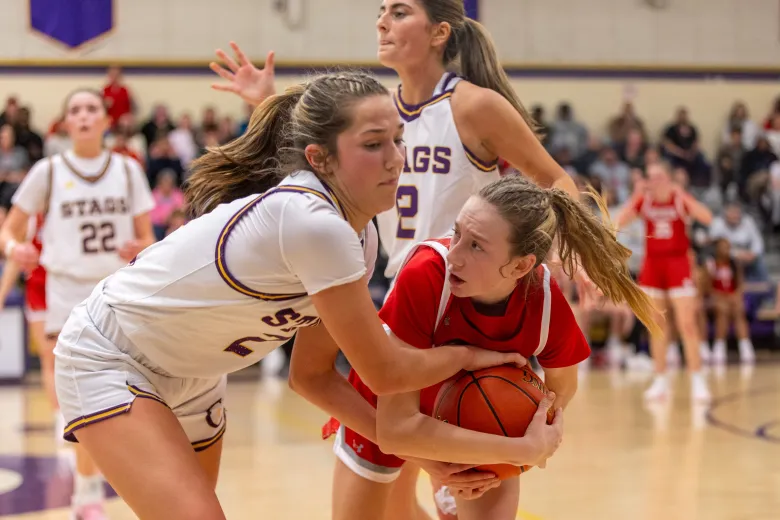
Meghan Henry lives in Portland.
Youth sports has long been lauded as one way to instill a sense of belonging, responsibility, patience and accountability in young people. Sports, particularly team sports, pushes youth to think beyond the “me” and toward the “we.”
“Sportsmanship is as important as winning,” we say. We should be good humans as we strive to be good athletes. In the last few weeks, I have had the misfortune of witnessing behavior very out of line with these tenets.
My daughter plays basketball on the eighth grade team of King Middle School in Portland. The team is composed of four (maybe five) players who have played this game before. The other 11 players have never played. Not only is most of the team new, the coaches are also new. They are dedicated King staff filling an unexpected gap, have no experience coaching and limited basketball experience in general.
But the players and coaches are learning, they are showing up, they are trying their best, they are helping each other out on the court — often to understand the basic rules of the game.
As you may have guessed, the King team is not in the middle of a winning season. We have lost every game, often by a pretty good margin. During most of these games, the other teams exhibit behavior you’d expect. The coaches pull the best players after the first half, they don’t press or try too hard to steal the ball from kids obviously still learning to control the ball, they don’t shoot three-pointer after three-pointer. Basic sportsmanship.
In two of our recent home games, however, we have had teams come in missing that bit of sportsmanship that the other teams exhibited. Windham won the game 73 to our 6. Falmouth won 64 to our 19. During both of these games, the coaches kept their best players in, they stole the ball constantly, they smirked.
Windham celebrated when they hit 67 points (6-7!) while King still had just 6 points. And they continued to score. Their coaches encouraged this. They laughed. They argued with the refs. Falmouth did the same. During the last two minutes of the Falmouth game, the coaches and the players were engaging in “operation 6-7” and had all the players shooting three-pointers for the last few minutes just so they could laugh. The King players kept up their efforts. They did not give up and Falmouth was denied that extra bit of mocking celebration, thank goodness.
You cannot ignore the underlying context that shines a harsher light on this. Windham and Falmouth are both well-resourced schools. King is not. Our gym has a court that is smaller than regulation, and we do not have bleachers. The King staff line up metal chairs along the wall before each game. When you sit, your toes can touch the sideline.
Many of the King players are in families here (legally) to seek asylum from countries to which they cannot return. The current environment adds a level of stress to all families in our community, and especially those who live in fear of having their parents taken during school drop-offs. For these and other reasons, few King parents can attend the games.
However, the political climate and socioeconomic disparities are not the responsibility of the student athlete to fully understand. It should be the responsibility of the coaches to help them understand. What are we teaching our youth when we allow players to engage with the world this way?
Each team could have won handily and handled it with grace. They chose not to. These players are watching and learning how to behave on the court. This is not a “participation trophy” argument. The better teams should win and, in an evenly matched game, the better players should play more than the players still learning.
Please do not confuse a plea for sportsmanship with anything other than that. These teams took on the role of every antagonist in an underdog sports movie. During this holiday season, I hope that these coaches and others who have lost sight of the real goal of youth sports reflect on whether they are focusing enough on helping student athletes be good humans as they become — no doubt — exceptional athletes.
Rec Sports
Dead dogs, dead cat discovered at Bedford Twp property amidst animal neglect investigation

BEDFORD TOWNSHIP, Mich. — In an update related to the dozens of animals found at a Bedford Township property Wednesday, the Battle Creek Police Department (BCPD) announced Friday that some dead animals were also found on the property.
Several dogs and one cat were found dead in addition to the 29 dogs, 15 cats, and two horses that had been removed from the Woodside Drive property that day, according to BCPD.
Police said the residence was operating as animal rescue but received a tip that raised concerns about animal care.
The dogs and cats are now in the care of the Calhoun County Animal Shelter and partner facilities, where staff are continuing medical and behavioral evaluations.
Shelter Executive Director Jackie Martens told News Channel 3 on Thursday many of the dogs are showing positive signs, but not all animals were up to date on rabies vaccinations.
Records for the cats have not yet been provided, meaning the shelter may need to re-vaccinate and spay or neuter them as a precaution.
Veterinarians are continuing medical evaluations. The horses were taken to a secure location that officials are not disclosing due to the ongoing investigation.
BE THE FIRST TO COMMENT
The owner was not home when authorities searched the property and no arrests have been made, according to BCPD. As detectives continue to investigate, the department said they will likely submit the case to the Calhoun County Prosecutor’s Office for review of potential criminal charges.
Rec Sports
Supreme Court to Hear Cases on Trans Youth Sports Bans as Advocates Warn of Mental Health Harm

As the U.S. Supreme Court prepares to hear two high-profile cases involving transgender student athletes, LGBTQ+ advocates are urging the justices to consider not only constitutional questions, but the real-world consequences facing trans youth across the country.
On Jan. 13, the court will hear oral arguments in West Virginia v. B.P.J. and Little v. Hecox, cases that challenge state laws barring transgender girls from participating on school sports teams that align with their gender identity. While the cases focus on athletics, advocates say the broader implications reach far beyond the playing field.
What’s at Stake for Trans Youth
The challenged laws in West Virginia and Idaho are part of a growing wave of state-level restrictions that target transgender participation in school sports. Supporters of the bans often frame them as necessary for fairness or safety. Critics argue they rely on assumptions rather than evidence and impose blanket exclusions that fail to account for differences in age, sport, or level of competition.
The Trevor Project, the nation’s leading suicide prevention organization for LGBTQ+ young people, has taken a firm stance against the bans. In a statement released ahead of the hearings, CEO Jaymes Black urged the Supreme Court to reject what he described as discriminatory policies.
“Like all young people in this country, transgender youth deserve the opportunity to play sports at school, if they want to,” Black said, emphasizing that exclusion sends a damaging message about belonging.
Mental Health Impacts Backed by Data
The Trevor Project points to a growing body of research linking anti-transgender legislation to negative mental health outcomes. According to the organization, transgender and nonbinary youth living in states where restrictive laws were enacted reported up to a 72% increase in suicide attempts compared to peers in states without such policies.
Their 2024 U.S. National Survey on the Mental Health of LGBTQ+ Young People found that 46% of transgender and nonbinary respondents seriously considered suicide in the past year. Political debates and legislation were cited as a major source of distress, with 90% of LGBTQ+ youth saying recent politics harmed their well-being.
Sports participation, meanwhile, appears to have protective effects. LGBTQ+ youth who reported playing sports showed nearly 20% lower rates of depressive symptoms than those who did not. Still, fewer than one in three LGBTQ+ young people participate in athletics, often citing discrimination or fear of mistreatment as barriers.
Beyond Fairness Arguments
Black also criticized the laws for applying broad restrictions without nuance. “These one-size-fits-all bans treat every sport, age group, and level of competition the same,” he said, adding that they are rooted in misinformation rather than evidence.
While acknowledging the need for thoughtful discussion around safety and competition, Black drew a clear line between regulation and exclusion. “Banning an entire group of young people from any participation whatsoever is discrimination, plain and simple,” he said.
Polling from The Trevor Project suggests the emotional toll is immediate. Among transgender and nonbinary youth surveyed, debates around sports bans triggered feelings of anger, sadness, stress, and fear, underscoring how public discourse alone can impact mental health.
Looking Ahead
The Supreme Court’s decisions in these cases could shape how states approach transgender inclusion in schools for years to come. Regardless of the outcome, The Trevor Project says its mission remains unchanged.
“No matter what they decide,” Black said, “we will continue fighting for a world where transgender and nonbinary youth feel safe, seen, and accepted exactly as they are.”

CSUN Improves to 2-0 After Holding Off Harvard in Four Sets

2026 Season Opens in a Five-Set Thriller

NCAA Denies Ole Miss QB Trinidad Chambliss a 6th Year of Eligibility

Men’s Volleyball Sweeps St. Thomas Aquinas to Begin 2026 Campaign

Men’s Volleyball Falls In Season Opener At #3 Long Beach State

Men’s Volleyball Drops Rematch With Loyola Chicago In Four Sets

Oregon’s Kenyon Sadiq thrives during challenging journey from small-town Idaho to tight end stardom

Youth Athlete Protection Act aims to safeguard young athletes in Alabama

College enforcement group voices ‘serious concerns’ with spiraling transfer portal – Las Vegas Sun News

Portola girls basketball team aiming for another memorable CIF post-season run –

What are we teaching Maine’s young athletes?

From Clemson Clinics to Friday Night Lights

Hoosiers Close Day One From Rod McCravy
College enforcement group voices ‘serious concerns’ with spiraling transfer portal

Track & Field Opens Strong at Day One of Rod McCravy Memorial – Ole Miss Athletics

#11 Volleyball Practices, Then Meets Media Prior to #2 Kentucky Match

Stempien to seek opening for Branch County Circuit Court Judge | WTVB | 1590 AM · 95.5 FM

Ross Brawn to receive Autosport Gold Medal Award at 2026 Autosport Awards, Honouring a Lifetime Shaping Modern F1

Maine wraps up Fall Semester with a win in Black Bear Invitational

Nascar legal saga ends as 23XI, Front Row secure settlement

Princeton Area Community Foundation awards more than $1.3 million to 40 local nonprofits ⋆ Princeton, NJ local news %

Downtown Athletic Club of Hawaiʻi gives $300K to Boost the ’Bows NIL fund

Sunoco to sponsor No. 8 Ganassi Honda IndyCar in multi-year deal
NASCAR, 23XI Racing, Front Row Motorsports announce settlement of US monopoly suit | MLex

WNBA’s Caitlin Clark, Angel Reese and Paige Bueckers in NC, making debut for national team at USA camp at Duke

Hope College Tops MIAA Commissioner’s Cup Fall Update

Nike Signs 10 LSU Athletes to NIL deals

Badgers news: Wisconsin lands 2nd commitment from transfer portal

Three Clarkson Volleyball Players Named to CSC Academic All-District List

Five Youth Sports Trends We’re Watching in 2026





-
 Sports3 weeks ago
Badgers news: Wisconsin lands 2nd commitment from transfer portal
-
 Rec Sports1 week ago
Five Youth Sports Trends We’re Watching in 2026
-

 Sports3 weeks ago
Is women’s volleyball the SEC’s next big sport? How Kentucky, Texas A&M broke through
-
 Sports2 weeks ago
Kentucky VB adds an All-American honorable mention, loses Brooke Bultema to portal
-

 Rec Sports3 weeks ago
NBA, Global Basketball Community Unite for World Basketball Day Celebration
-

 Motorsports3 weeks ago
Dr. Patrick Staropoli Lands Full-Time O’Reilly Ride with Big Machine Racing
-

 Motorsports3 weeks ago
BigRock Motorsports Retains Its Championship Title At ISRL Season 2 Grand Finale In Calicut
-

 Motorsports3 weeks ago
NASCAR, IndyCar, and F1 Share These Race Days in 2026
-
 Sports2 weeks ago
Colorado volleyball poised to repeat success
-

 Sports2 weeks ago
Texas A&M volleyball’s sweep of Kentucky attracts record viewership