
NIL
In College Sports’ Billion-Dollar Arms Race, Philly Schools Are Being Left Behind

Longform
Villanova, Temple, and others face a harsh new reality: Without deep pockets, even winning might not be enough.
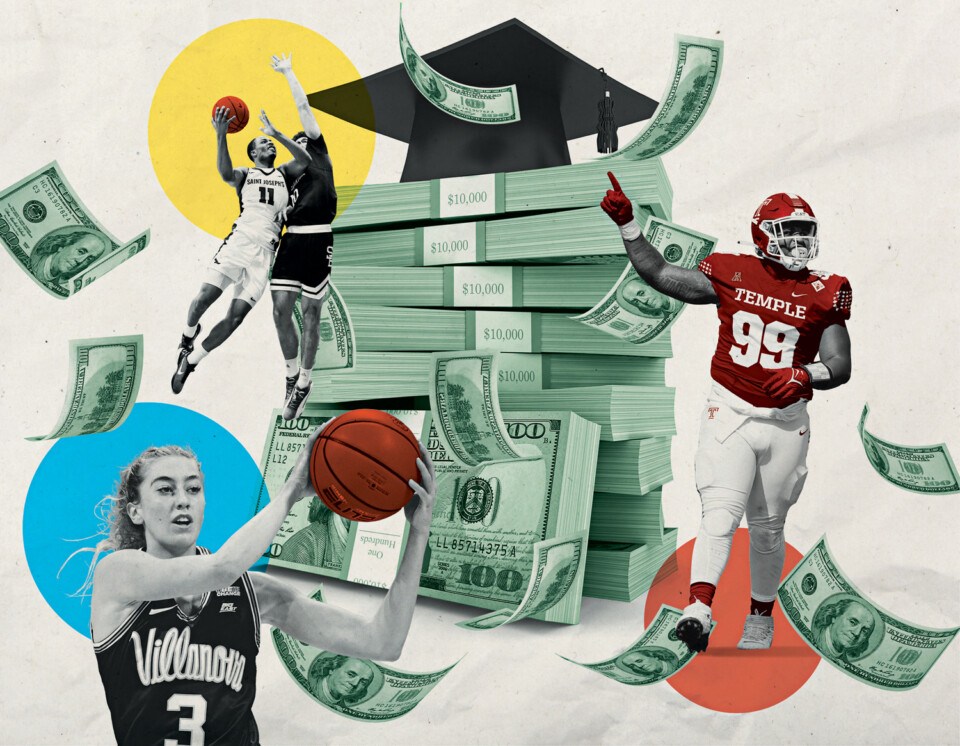
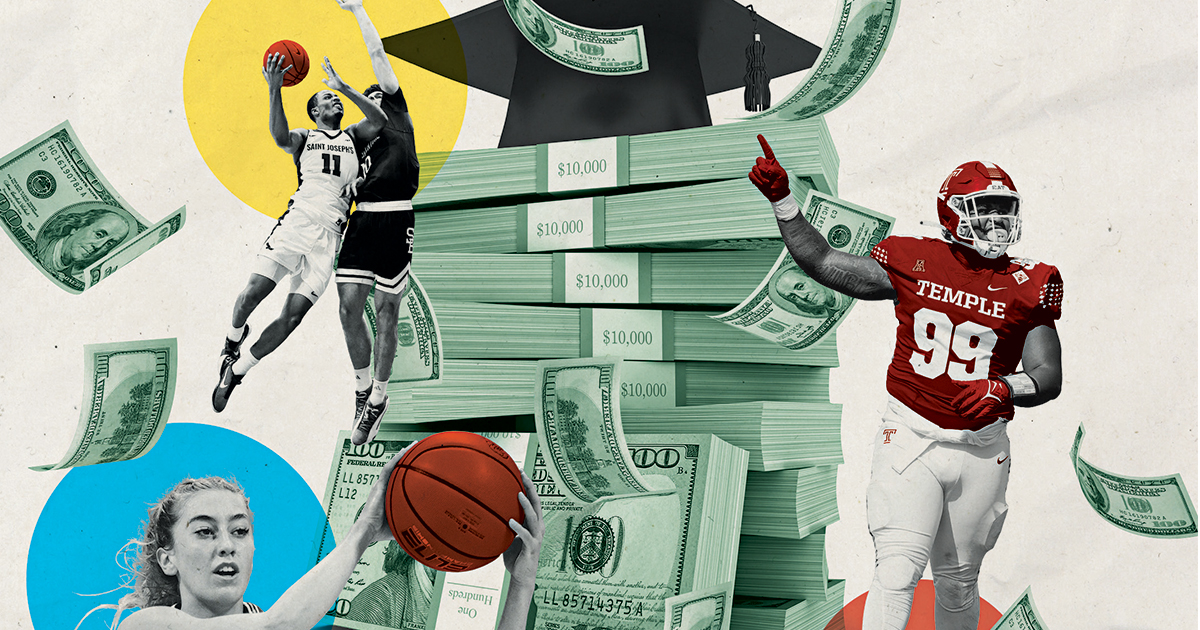
Big financial changes have come to college sports, and Philadelphia schools are being left in the dust. / Photo-illustration by Leticia R. Albano; photographs via Getty Images
Villanova athletic director Eric Roedl is not wearing a green tie this early May morning as an homage to his former employer, the University of Oregon. Even though he might not have intended it this way, it’s more of a symbol of the current money-driven college sports climate.
Roedl became AD in January. Two months later he fired men’s basketball coach Kyle Neptune, and two weeks after that replaced him with Maryland’s Kevin Willard. More important, however, than filling the most visible athletic role on Villanova’s campus is that he has worked to raise the money necessary to fund the payment of Nova’s basketball players, the result of a landmark revenue-sharing settlement forged after the NCAA, the governing body of college sports, lost a $2.8 billion lawsuit about allowing athletes to profit from their names, images, and likenesses.
It’s a wonder, then, that Roedl isn’t dressed entirely in green.
Roedl wants to make sure his men’s and women’s basketball programs are positioned to compete nationally, and that’s going to take a lot of cash. With some athletes receiving millions in guarantees from schools (Brigham Young reportedly will pay freshman hoops player AJ Dybantsa $7 million), Roedl might need a telethon to raise enough money to help the Wildcats. It’s going to be even more difficult for the rest of the City Six colleges — Drexel, La Salle, Penn, St. Joseph’s, and Temple — to reach that level.
As part of the revenue-sharing settlement, schools will be allowed to compensate their athletes up to $20.5 million annually across all sports. Colleges in the so-called Power Four conferences — Big Ten, Southeastern, Atlantic Coast, and Big 12 — have the resources to do that, thanks to media rights deals tied to their strong football programs. Just about everybody else is way behind them. And the Power Four conferences want even more money, which translates to on-field success and off-field power.
“As a summary to all of this, the color is green,” says former Temple and La Salle AD Bill Bradshaw, who now advises schools and coaches. “That’s the only thing that matters. When all is said and done, those who have the cash and the football TV money are the ones who will survive.”
•
Temple is the only City Six school that plays in the Football Bowl Subdivision (FBS), the highest level. But it is part of the American Athletic Conference, a non–Power Four confederation. Temple took in $9.7 million in revenue from the conference last year. By comparison, Big Ten members will receive up to $75 million in media rights each this year. Schools will also earn money from NCAA football and basketball tournaments, as well as conference championships. The Big East Conference, of which Villanova is one of 11 members, is slated to receive about $80 million in media rights this year, per sports business journalist John Ourand. La Salle and St. Joe’s of the Atlantic 10 receive less than that. Drexel’s and Penn’s conference payouts are negligible. Drexel’s entire conference, the Coastal Athletic Association, signed a four-year, $10 million deal in 2023. That’s loose change for Power Four schools.
According to the U.S. Department of Education, Temple’s 2024 athletic budget was $70 million; Villanova spent $61 million. Meanwhile, Ohio State shelled out $262 million, and Alabama’s budget was $243 million. It’s hardly a fair fight.
“The NIL settlement is the last nail in the coffin,” says Temple professor Michael Leeds, who studies the economics of sports. “We’re going to have haves and have-nots.”
The NCAA basketball tournament is a perfect example, one especially important to local schools. If the powerhouse conferences limit — or eliminate — access to it for mid-major and smaller schools, like most of the City Six, in the name of funneling the tourney’s payouts ($2 million for reaching the tournament, $2 million per win) to their members, local schools could leave Division I. Tournament access for all 365 Division I programs, says Drexel AD Maisha Kelly, is “the thing tethering schools together.”
The NCAA has always had problems, but it was functioning and had a good balance between winning and academics. It feels now that the conversation is exclusively about money. That upsets me. I’m sorry, but it does.” — Temple University president John Fry
The doomsday scenario involves the Power Four schools breaking away from the NCAA and forming a superconference of 70 to 80 teams. That would end Division I and drive almost all the top athletes to big schools. For now, local colleges are trying to raise enough money to appeal to good players so they can win and stay relevant. “I would say it’s 90 percent money and 10 percent the school,” Willard says of recruiting these days.
Local teams’ recent struggles don’t help. No City Six school has played in the NCAA men’s basketball tournament in three years, after a 46-year run during which at least one school participated. Even Villanova, which won national titles in 2016 and 2018 and reached the Final Four in 2022, has floundered recently. Temple’s football team hasn’t won more than three games in a season since 2019.
There has been success. The St. Joe’s field hockey team reached the NCAA championship game last fall. Penn’s women’s lacrosse team has been a perennial NCAA tournament participant over the past decade-plus, and Drexel’s men’s rowing team has been ranked in the top 20 for 10 years. Nova’s women’s hoops team reached the Sweet 16 in 2023, and the school’s track squads have excelled for more than 50 years.
In today’s college sports world, though, those achievements don’t bring money or power. Football and, to a lesser extent, men’s basketball do. The NCAA has piddling influence on FBS football and a dwindling impact on other sports, thanks to its losses in court. That has created a climate of urgency for Philadelphia-area colleges. If they can’t find the money to compete, or the big boys keep changing the rules to give themselves more power, local college sports could become little more than sweaty extracurricular activities.
“The NCAA has always had problems, but it was functioning and had a good balance between winning and academics,” says Temple president John Fry. “It feels now that the conversation is exclusively about money. That upsets me. I’m sorry, but it does.”
•
To see how we got here, we first have to look back.
For decades, schools could provide a scholarship — tuition, room, and board — to Division I college athletes, who received nothing to cover discretionary expenses. The term student-athlete was coined by the NCAA in the 1950s to prevent players from being considered employees so they couldn’t claim workmen’s compensation benefits if injured. They had no input and certainly no share of the revenue.
The NCAA controlled everything about college sports, including TV rights. In 1981, Oklahoma and Georgia sued the NCAA on behalf of the College Football Association, which included 61 big-time gridiron schools, about 30 of which had signed a TV deal with NBC — without NCAA approval. The schools won the right to negotiate their own contracts and pushed the NCAA out of the big-time business of college football.
“Since that suit, there has been a steady move by the big schools to amass more wealth and concentrate more wealth in a small group of schools,” says Leeds, the economics professor.
It took more than 30 years for athletes to get some freedom. In 2014, former UCLA men’s basketball player Ed O’Bannon successfully sued the NCAA, claiming it had conspired to prevent athletes from profiting from the use of their likenesses in video games and on TV broadcasts. The verdict allowed athletes to earn up to $5,000 per year in additional compensation through use of their names, images, and likenesses (NIL).
It’s very much a Moneyball situation. You have to look at your resources and decide what you’re willing to do to keep players.” — Temple’s head football coach K.C. Keeler
Five years later, California became the first state to allow athletes to earn as much as possible from NIL deals. Other state legislatures followed, and in 2021, the NCAA — against its will — permitted universal NIL deals. Last year, the NCAA settled a class action suit with plaintiffs Grant House, an Arizona State swimmer, and then–Oregon basketball player Sedona Prince on behalf of more than 10,000 athletes for compensation from 2016 forward because NCAA rules limiting athlete compensation constituted a restraint of trade. The House settlement includes provisions for revenue sharing of $20.5 million per school annually, but athletes are still not school employees. The number will go up each year, while the $2.8 billion paid to former athletes will come from smaller payouts for NCAA Tournament participants over the next 10 years.
In 2018, the NCAA instituted the transfer portal to formalize the process by which athletes switch schools, but transfers had to sit out a year. Three years later, the NCAA allowed one free transfer that didn’t include that penalty. Then, in 2024, the courts forced the NCAA to allow unlimited athlete transfers without sitting out. That created an annual marketplace for talent, with high-revenue football schools able to lure the best players in all sports.
“Schools in the big conferences more and more will decide what they’re doing on their own,” says Jeffrey Kessler, a partner at New York–based Winston & Strawn and the co-lead counsel for plaintiffs in the House lawsuit. “They want more and more autonomy, especially with the College Football Playoff.”
That’s not good news for Temple, which is trying to rebuild its gridiron fortunes.
•
When Temple hired Al Golden in 2006, it had posted 15 straight losing seasons and had lousy attendance. Golden established a foundation that would lead to six bowl appearances over the next nine seasons. In 2015, ESPN’s College GameDay program came to Philadelphia ahead of Temple’s game against Notre Dame at sold-out Lincoln Financial Field.
Just a few years later, the program bottomed out.
On December 1st, K.C. Keeler took over as Temple head coach, inheriting a program that has had five straight losing seasons and attendance woes. Since his hiring, Keeler has persuaded the university to increase monthly room-and-board stipends for players and to improve the training table fare. He’s also spruced up Temple’s football facility.
That’s helpful, but the Owls are lagging in the most important part of college athletics. Keeler must also afford recruits, develop them into contributors, and keep them from transferring for bigger paydays. “Almost every player we lost in recruiting, we got outbid,” Keeler says of this offseason. Every Tuesday, Keeler calls alumni and asks them to help Temple compensate its players. That means increased donations. “It’s very much a Moneyball situation,” he says. “You have to look at your resources and decide what you’re willing to do to keep players.”
Power Four schools are expected to devote up to 75 percent of their $20.5 million total to football. In contrast, Temple’s conference, the AAC, is mandating that members spend at least $10 million across all sports over the next three years — total. Keeler will offer all players some money — “We tell them, ‘You’re not going to get much at Temple, but we can make your life more comfortable,’” he says — and the chance to play.
Senior defensive tackle Demerick Morris transferred to Oklahoma State after Temple fired former head coach Stan Drayton in November. Morris went through winter workouts in Stillwater but didn’t “feel welcome” there, he says. He contacted Keeler and asked to return to Temple.
Morris admits Oklahoma State offered him more money than he’ll get at Temple. But he will likely play more for the Owls.
“When I went to Oklahoma State, the money was cool, but it wasn’t a good fit, especially position-wise,” Morris says. “I was third or fourth on the depth chart. I was getting money, but I didn’t want to waste my last year.”
Morris’s story is encouraging, but Temple still could become something of a developmental program for bigger schools.
“It’s likely we’ll bring people in who won’t be with us the whole four years,” Temple athletic director Arthur Johnson admits.
Former Temple assistant Gabe Infante thinks the Owls can be successful if the school’s administration shows “an investment in the program and that it’s an important part of the institution.” Fry insists it is. Although while president at Drexel he wrote a 2016 piece in the Wall Street Journal titled “We’re Glad We Say No to College Football,” he understands the sport’s value at Temple. “We are committed to the program, committed to K.C., and committed to the long term,” he says.
Fry has told the board and alumni groups that to be competitive in this changing landscape, they need to support athletics, particularly football, at higher levels: “I don’t think Temple has done enough asking,” he says.
Other City Six schools are certainly asking — and also getting creative.
•
In late April, the St. Joseph’s athletic department hosted a symposium titled “Navigating Our New Normal: Settlement Implementation and a Future Focus.” The symposium, which was created by SJU athletic director Jill Bodensteiner, brought together more than 40 mid-major schools from across the country that do not have big-time football (if they have it at all) to brainstorm.
Afterward, on a questionnaire provided to the 111 participants, the most popular comment was “Can we do this every year?”
“When we go to professional conferences, our voices get drowned out,” Bodensteiner says. “Big schools are discussing how to share $20 million with athletes. The discussion doesn’t include us.”
Mid-major schools don’t have the budgets to attract and retain top players, so they have limited sway in the administration of college athletics. And the influence they do have could dwindle. On May 7th, Ross Dellenger of Yahoo Sports reported that big schools presented a structure to the NCAA that would weight the 67 Power Four members’ votes to between 51 and 65 percent of the 365-school total.
“The bigger risk [than money] is if somehow the governance model changes, and the Power Four schools say, ‘We don’t want you in the club anymore,’” Bodensteiner says. “In that instance, access to championships goes away.”
In 2024-25, smaller schools won NCAA titles in men’s lacrosse (Cornell), men’s ice hockey (Western Michigan), and men’s soccer (Vermont). But those sports don’t bring influence. Football does. And basketball helps schools gain recognition: Champions of all Division I conferences gain automatic bids to the tourney, an important consideration for non–Power Four schools.
“Basketball and the NCAA Tournament in its current structure are what’s holding everything together,” La Salle athletic director Ashwin Puri says. And in order to stay relevant in that sport, teams need to raise money to build competitive rosters.
“When donors see me coming, they say, ‘Oh, shoot, he doesn’t want a $10 cup of coffee.’ It’s $20,000 or $200,000,” says new La Salle men’s basketball coach Darris Nichols.
Villanova’s Willard estimates that gathering donations is “80 percent of the job,” an unthinkable percentage even just 10 years ago. Sports that aren’t top priorities are often on their own. Nova football coach Mark Ferrante, whose team competes in the Football Championship Subdivision, one step below the FBS, doesn’t expect to get any revenue-sharing dollars from the school, which has just introduced the Villanova Athletics Strategic Excellence Fund (which allows alumni and fans to donate directly to the school’s revenue-sharing efforts) to support primarily men’s and women’s hoops. “I’m going to go out and try to fundraise,” Ferrante says.
Perhaps St. Joe’s could devote enhanced resources to its outstanding field hockey program to make it a perennial power and become known nationally for that, but for now that isn’t a consideration. Besides, it could take away resources from basketball. “Let’s see how the market plays out before we think about that,” Bodensteiner says.
The climate is fostering creativity. Bodensteiner says St. Joe’s might give out only 12 of the allotted 15 men’s and women’s basketball scholarships and convert the extra $80,000 per scholarship to revenue sharing. St. Joe’s will play in the Players Eras Festival men’s basketball tournament the next two years, which promises each school $1 million in NIL money.
I haven’t spoken to one person who can give me an idea about what things will look like in five years.” — John Fry
Increased cash flow could help smaller schools keep players from transferring to bigger ones for more money. But bigger schools are looking for experienced help. In February, St. John’s men’s basketball coach Rick Pitino said he wouldn’t recruit a five-star high school prospect because “I don’t think you can win, and win big, with high school kids.” La Salle has one player returning from last year’s 14-person men’s basketball roster, in part due to coach Fran Dunphy’s retirement. This offseason, Drexel’s top four men’s basketball scorers left for bigger paydays.
“We will not opt in to spend at high levels,” Drexel athletic director Kelly says. “We’ve stayed closely aware of how our peers in the [Coastal Athletic Association] are doing things and will be good stewards of the university’s resources.”
At Temple, last year’s second-leading men’s basketball scorer, Zion Stanford, moved on to Villanova. St. Joe’s top scorer, Xzayvier Brown, is now at Oklahoma. Players at every level are looking to improve their situations, and schools are struggling to maintain continuity. “Everybody is trying to figure it out,” Temple head men’s coach Adam Fisher says.
Ivy League schools don’t offer athletic scholarships, so Penn certainly won’t be sharing revenues with players. “We have to do the best we can with the resources we have,” says new men’s basketball coach Fran McCaffery. That makes the Quakers vulnerable to losing players. After the past three seasons, a trio of top players — Jordan Dingle (St. John’s), Tyler Perkins (Villanova), and Sam Brown (Davidson) — transferred to schools that could compensate them. Last December, standout Penn running back Malachi Hosley moved to Georgia Tech, where he will receive money.
“You have to constantly adjust as a football program, athletic department, and league,” Quakers coach Ray Priore says. “How do you change and put your best foot forward?”
McCaffery returned to his alma mater after 15 seasons at Iowa and aims to revive a program that has played in just one NCAA tourney since 2008. Part of that is finding some NIL opportunities (allowed by Ivy League rules). McCaffery says he’s “talked to more billionaires in my first few months at Penn than I did my entire time at Iowa,” in an attempt to find companies to connect with his players. That makes sense to Penn professor Karen Weaver, an authority on the role of sports in higher ed. “Every school thinks it’s one rich donor away from success,” she says. McCaffery understands the challenges he faces: “This is, without a doubt, the most dramatic change [of my career], and it could be the most frustrating and create the most opportunity for you to say, ‘It can’t be done.’ I’m going to work with my staff and the players and get them ready. I’m going to coach them up and compete. That’s why I do this.”
Some players have a different motivation.
•
When former Penn guard Sam Brown wanted to practice shooting after he announced he was transferring to Davidson, he would sneak into the Palestra late at night, hoping he wouldn’t get booted by security for his move. The son of former Sixers coach Brett Brown scored more points during Ivy League games last year than any other player and decided to consider transfer options after the Quakers fired head coach Steve Donahue, who had recruited Brown.
Brown seriously considered 15 suitors (including St. Joe’s), a group he narrowed to three — Davidson, Notre Dame, and returning to Penn. He will get paid to play at Davidson, but Brown insists he didn’t make the decision based on money. He wants to improve enough to play pro ball, in the U.S. or abroad. Davidson has had success turning players into pros, Brown says, a factor in his decision.
Athletes’ Ink agent Doug Young was an assistant at Lower Merion High while Brown was there and helped Brown through the portal process. He says Brown could have made more money if he’d wanted. Temple’s Morris says some players “are asking for millions,” and Keeler says there are agents guiding clients to the most money, regardless of fit.
“Some families prioritize the best dollar amount,” Young says. “I can say all day to them that it may not be the best fit.”
Just about every player has an agent, including many high school recruits. There is no denying that the players are profiting. “Some mid-major kids are going to make more during their college careers than they will playing professionally in Europe,” Young says. And there are still NIL opportunities available that allow players to represent companies, make personal appearances, and promote products, all while being compensated.
Cody Wilcoxson, an associate at law firm Blank Rome in Philadelphia, has worked over the past five years to connect schools and athletes with NIL deals.
“Athletes are becoming parts of advertising campaigns for universities and for some of their business partners and sponsors,” Wilcoxson says. “If a school is playing a big neutral-site basketball game, it may ask a football player to promote it on their social media.”
Opendorse, a Lincoln, Nebraska–based company, provides NIL guidance for schools and a marketplace for athletes to earn endorsements. Julian Valentin, Opendorse’s senior vice president of college services and marketing, says, “There are no better influencers for young people than athletes,” especially female athletes.
But Christy Hedgpeth, president of Playfly Sports Properties, a Berwyn-based firm that negotiates multimedia rights, sponsorships, and NIL opportunities for 30 colleges nationwide, including Villanova, says the NIL climate must be regulated and that college-affiliated collectives that put together NIL deals should be controlled.
If nothing’s done, I don’t think this is sustainable.” — Villanova men’s basketball coach Kevin Willard
“What a collective would do is have an athlete do a clinic for the Boys and Girls Club, a service-oriented activity, or go to a children’s hospital,” Hedgpeth says. “It’s noble, but the athletes were being paid at above fair market value. It was very clear [the NIL model] was being abused.”
As part of the settlement, athletes must report every NIL deal above $600, and they will be subject to audit by Deloitte. According to Yahoo’s Dellenger, a Deloitte official told ACC coaches and ADs in May that “70 percent of past deals from booster collectives would have been denied” under the new model. But schools will keep making NIL connections.
“Schools want to be known as destinations that create an environment that generates NIL interest,” Hedgpeth says. “Schools want to see as much NIL activity for student-athletes as possible. It’s a differentiator.”
And it’s something Villanova is counting on for its basketball team.
•
In March, when Willard was leading Maryland to the NCAA Tournament Sweet 16, he told the media he believed basketball wasn’t being funded properly. Villanova’s basketball-first mentality influenced his decision to change jobs.
“From the first day I stepped on campus, everybody was talking about how to make this a championship program,” Willard says. “At a football school, from the minute the spring game ends, everybody talks about how to sell tickets for football.”
Villanova has won three national titles and has high expectations. The school failed to reach the NCAA Tournament during Kyle Neptune’s three years, and Willard was hired to revive the program. To do that, he needs money to attract top players and NIL deals to augment those payments. As a school without an FBS football team, Villanova is able to devote the bulk of its revenue-sharing resources to men’s (primarily) and women’s hoops. Some of those resources will come from its new Strategic Excellence Fund. (St. Joseph’s has recently established a Basketball Excellence Fund to help finance its hoops aspirations as well.)
It helps that Nova is part of the Big East Conference, which boasts four of the last nine NCAA basketball champions. Only one member — Connecticut — plays FBS football. UConn won this year’s women’s title and has hung 11 other banners. Nova’s women reached the Sweet 16 in 2023. “The Big East as an entity will not be left behind by the Power Four,” predicts former St. Joseph’s men’s coach and current TV analyst Phil Martelli. True, but nothing is guaranteed.
“The biggest factor there is going to be continued investment,” Nova AD Roedl says. “The various universities in the Big East are highly committed to success in men’s and women’s basketball, and that’s going to continue.”
That commitment is a big reason Duke Brennan chose to transfer from Grand Canyon University to the Main Line for the 2025-’26 season. The six-foot-10 forward, part of a core eight-person transfer class, describes himself as a “hard hat, lunch pail guy.” “If you think of blue-blood programs, Villanova is a blue blood,” he says. “I consider them on a par with Duke, North Carolina, Kentucky, and Connecticut.”
Brennan likes Villanova’s blue blood — and green cash. He says his monetary deal wasn’t an “overarching” reason for choosing the school, but it was big.
“All of us players are thinking about our futures, and of course, financial stability is important,” he says. “I wouldn’t say it’s 90 percent of my focus, but I want to be able to put things away for my future.”
Villanova’s money won’t all go to the men’s hoops team. Roedl says the school must “figure out how to resource” its 24 athletic programs. That includes the women’s basketball squad, which is a Big East stalwart. After the 2023-’24 season, leading scorer Lucy Olsen transferred to Iowa for a larger NIL payment and a chance to play in the Big Ten Conference.
Playfly can help that commitment by connecting Nova players with brands and can create “premium” opportunities that generate funds. “We could do an event like a bourbon tasting at a coach’s house and charge a thousand dollars a person,” Hedgpeth says.
Fans may want to drink single-barrel whiskey at Willard’s home, but not all of them like the current climate of players being compensated and being able to transfer freely. Nova must guard against supporters losing interest because of yearly roster turnover and substantial payouts to athletes. The school needs to educate fans on what some of the new realities are, Roedl says.
Unfortunately, some of those lessons will be incomplete.
•
Good luck finding someone who knows what’s going to happen next.
“I haven’t spoken to one person who can give me an idea about what things will look like in five years,” Temple’s Fry says. He’s not talking to the wrong people. Everyone is confused.
One thing we know is that the Power Four schools will keep trying to get as much control of the revenue streams as possible. The College Sports Commission they created will continue to represent their interests. And that’s bad news for everybody else.
The expected expansion of the College Football Playoff from 12 to 16 teams? More money for the big schools. The predicted growth of the NCAA basketball tournament field? More spots for the power conferences. The revenue-sharing cap will increase every year, based on Power Four schools’ annual revenues. As media rights deals expire in the coming years, the Power Four will try to expand their ranks with desirable schools from everywhere else to get bigger contracts.
The City Six will move valiantly forward with creative revenue-generating strategies, but they could become glorified junior colleges, with players staying on campus a year or two before searching for better opportunities. The smaller schools are particularly vulnerable to the Power Four, which have largely emasculated the NCAA.
“If nothing’s done, I don’t think this is sustainable,” Willard says about NCAA — or perhaps federal — legislation.
Even Villanova, which is banking on the Big East’s continued relevance, might only have the best seat at the kids table, especially if Connecticut moves to the Big 12, which was discussed last year. Being a basketball-centric conference in a football world doesn’t provide complete security.
For now, fans should enjoy their favorite colleges’ opportunities to compete for championships and hope the big boys don’t decide to take everything for themselves. But change will continue. And it’s unlikely things will get better for local schools.
So get out those checkbooks and help the cause. Who knows how much longer you have?
“Schools had better understand this and adapt to it, or they’ll get run over,” Willard says.
Published as “Varsity Blues” in the August 2025 issue of Philadelphia magazine.

Tennessee safety Boo Carter has committed to Colorado out of the NCAA transfer portal, On3 has learned. Carter had a bit of a rocky relationship with the Volunteers, ultimately departing the program before the 2025 campaign had finished.
In two seasons at Tennessee, Carter recorded 63 tackles. He also notched two sacks, three forced fumbles, an interception and three passes defended.
Carter earned numerous SEC-related honors stemming from the 2024 season. He was a 2024 SEC All-Freshman team selection. He was also a 2025 preseason All-SEC third-team selection by the league’s coaches.
Boo Carter was arguably his most productive in terms of getting his hands on the ball in 2025. He logged 25 tackles, a sack, three forced fumbles and three passes defended this season.
But Carter didn’t stick around for the full season at Tennessee. He did not play in the team’s 42-9 win over New Mexico State in November. That absence was conspicuous.
Coach Josh Heupel expressed some disappointment in Boo Carter after the game. He shed a little light on the situation.
“At the end of the day, there’s a standard you’ve gotta meet to be in that locker room,” Heupel said. “So he was not out on the field with us. That will be my last response to anything related to that for right now.”
Boo Carter also missed several days with the team in July and went into call camp with questions about his availability. But he was able to work his way back into the good graces of the staff.
Ultimately, things didn’t end up working out at Tennessee. Shortly after that New Mexico State game, it was reported that Carter was splitting with the program.
“No, not regretful,” Heupel said. “At the end of the day, it’s our job as coaches to try to mold these guys, and that’s a part of the commitment that you make, you know, in the recruiting process and when they decide to come. You know, sometimes it works, sometimes it doesn’t. And, you know, at the end of the day, we’re moving forward.”
Prior to enrolling at Tennessee, Boo Carter was ranked as a four-star prospect and the No. 111 overall recruit in the nation, according to the Rivals Industry Rankings. He also checked in as the No. 3 athlete in the class and the No. 3 overall player from the state of Tennessee, hailing from Chattanooga (TN) Bradley Central.
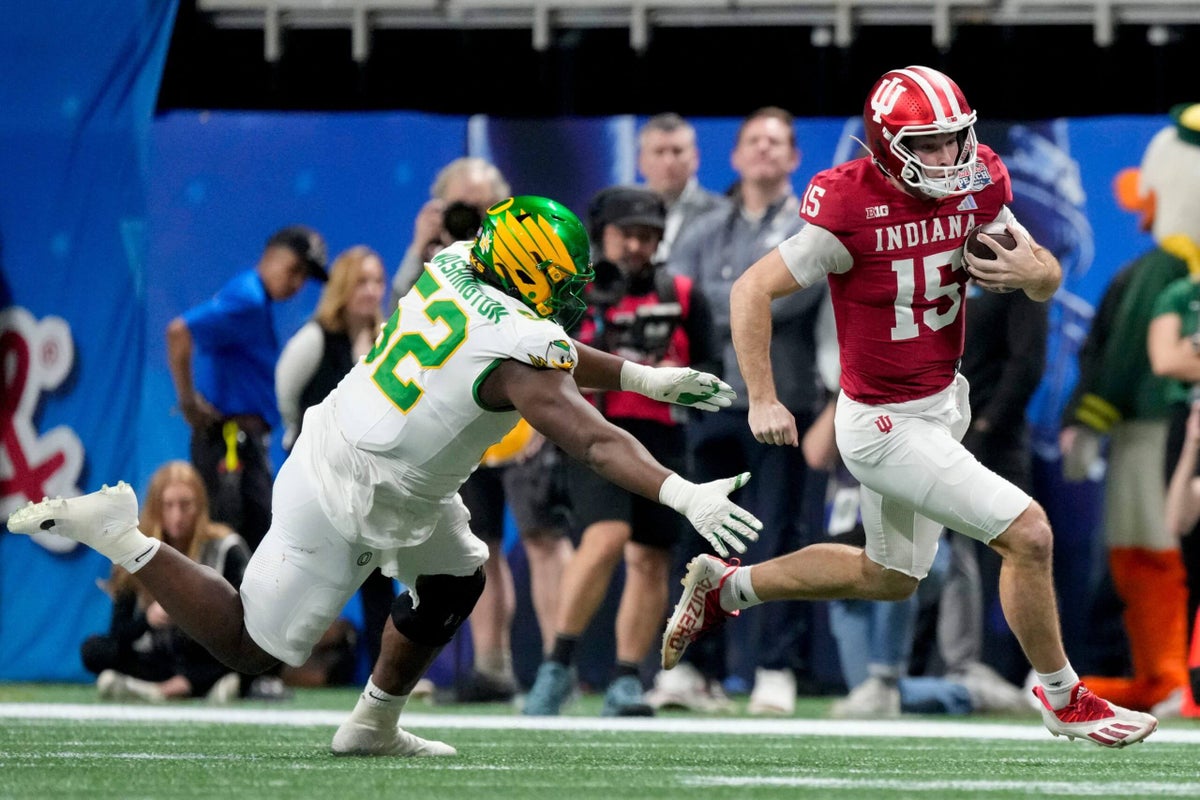
Indiana football is everything right now, representing at once the enhancement of the college football product on the field and the unsustainable reality off it.
No, Indiana didn’t do anything wrong — that we know of, anyway, though I’m sure other coaches would like to investigate Curt Cignetti and his players for spyware or cyborg blood or something. But as we wrap up a week that had the absolute best and worst of the sport clawing at each other for top billing, the Hoosiers should know they’ve made it so much harder for so many people.
Not that they should care. Go destroy Miami after people spend the week talking themselves back into why you can’t really be this good, then celebrate a national championship that would represent one of the most unforeseen, inexplicable, glorious stories in American sports history.
Indiana, even while making Friday night more boring than we wanted with a 56-22 semifinal thrashing of Oregon, is the prevailing example of why college football is in a great place as a product.
Transfer portal. Contracts. No loyalty. Whatever. Inject this stuff into MY VEINS!!!!!
— Dari Nowkhah (@ESPNDari) January 9, 2026
Never has there been more hope for so many. Membership in the exclusive club of heritage and built-in advantages is no longer required. A tallying of the recruiting stars next to names on a roster no longer produces a long and accurate list of programs with no shot of winning it all.
The landscape is always changing, never boring. Vanderbilt, Texas Tech, Ole Miss and Arizona State are among Indiana’s party-crashing undercards. The College Football Playoff is compelling. The games aren’t all thrillers, but enough of them are.
I would, though, like us to get through one of those good games without half of college sports media crowing on some app: “OH THAT’S WEIRD, I THOUGHT COLLEGE FOOTBALL WAS BROKEN.”
Because we all know darn well that, in ways, it is. Or maybe fractured sounds less dramatic. Chaotic. Problematic? Whatever makes you feel less bad. In the same week we’re enjoying the CFP semifinals, including an Ole Miss-Miami classic, we’ve got the former coach of Ole Miss keeping assistant coaches from attending the ball like he’s Cinderella’s stepmother.
We’ve got that same coach, LSU’s Lane Kiffin, courting one quarterback (Arizona State transfer Sam Leavitt) at a basketball game while another (Washington’s Demond Williams Jr.) announces he’s in the portal, apparently with the idea of joining Kiffin, except he had already signed to stay on with Washington. Except we have contracts in college sports that seek to sort of bind, while being careful not to make the person being paid sound as if he or she is being paid to play. Even though that’s exactly what’s happening.
So it’s the latest but far from the last “contract dispute,” this one finishing with Williams deciding to return to Washington. And hey, look, here comes the College Sports Commission promising to start cracking down on these predictable workarounds to pay enough to land top players in a market that is rising.
Which, at best, means an example made of a program or two, and in no way means any chance for the CSC to get its arms around things. Men and women with gavels and long, black robes will continue seeing to that. Lawmakers aren’t changing it.
Collective bargaining, in some form, is the only answer, and more and more people in the industry are coming around on that. The painful, inevitable journey continues. Hopefully, the past week serves as a bit of a jolt. I talked to an administrator who has been in that camp for a while and believes the athletic director and president levels are getting there.
But that will have unintended consequences, too. Go back and read what a lot of us were writing about name, image and likeness rights 10 or 15 years ago. I don’t recall anyone coming close to predicting all that has come with it.
And I must wonder how, with a cap of some sort in place while athletes get a bigger chunk of the revenue overall, the boosters at Ohio State, Alabama and Georgia are going to feel about officially being like everyone else, about parity as league design — about the caddies getting full-time access to the pool and golf course.
Which brings us to the thing I hear the most from folks in college sports in terms of long-term concerns. And this is where Indiana re-enters the discussion, in three words: return on investment. Indiana AD Scott Dolson has made what must be considered, two years later, one of the great hires in modern college football history. As hyperbolic as that may sound.
And for as much as this should be seen as an outlier that will spawn books and documentaries, it only serves to intensify the pressure elsewhere. All your resources, all that time, and you couldn’t figure this out, Penn State? Steve Sarkisian and Arch Manning can’t match this James Madison dude and Fernando Mendoza? Wasn’t USC the program with the great quarterback developer and offensive designer?
Those programs are at least having some success. All of them are begging the millionaires and billionaires who have helped build a facility or throw some nice cars at recruits of the past to sustain competitive payrolls. The TV money is good, but check the expenses. Colleague Seth Emerson wrote about “donor fatigue” in 2024 and, spoiler alert: No one has gotten any rest.
The wealthy folks who pay NFL players are called owners, and their investments are being multiplied many times over. The wealthy folks who pay college players get names on buildings, seats on the team plane and games of catch between the star quarterback and their grandkids. NFL owners lose, fire people, draft high and continue to profit; college boosters increasingly feel like they’re setting large piles of money on fire.
Which is why private equity looks as inevitable as collective bargaining. This is more than just a slight hairline fracture that will heal on its own.
I hope you can enjoy the college football right now. The product is soaring. Also, I hope anyone who cares about it understands that it can plummet without improved leadership that values common sense, the greater good of the industry and all of its employees.
If you’re an Indiana fan, soak in these experiences that are Cignetti-driven but still possible only because of NIL and the transfer portal. And plan to stay for a while. Cignetti never looks like he’s satisfied, and Mark Cuban is looking awfully happy right now.
I for sure have been concerned about all the players abandoning the ship, but what if they were talked to about not doing their jobs. What if they were given the option of either putting in the work or finding a new home. Could we have been wrong in some cases thinking the player was looking for more $ rather than putting the work in. Some players, as you know, don’t live up to their billing. OSU is one of the premier colleges for education and sports. I think when the players were recruited out of HS, they jumped at the chance to be a Buckeye. Now, the players see how difficult it is to live up to the expectations that is required to be a Buckeye. This is just a different take on what we have witnessed so far with the transfer portal. I what to find out how 11W members feel about this.

OK, time’s up. After 30 or so years, it’s time to end the Idiots’ Picnic, time to go home, time to remove the rehearsed-then-parroted nonsense from sports telecasts.
First one that must go is transfer portal. That’s a crock. Those are, in fact, mostly NIL price-tagged signings of college athletes without academic credentials. They are free agents, too many without the ability to read or write functional English.
In 2012, Ohio State QB Cardale Jones presaged the NIL scene when he tweeted, “Why should we have to go to class if we came here to play FOOTBALL, we ain’t come to play SCHOOL, classes are POINTLESS.”
That sad, shameful and nationally ridiculed message is now the daily reality!

And then there were two. The 2026 college football season has led to this: No. 1 Indiana and No. 10 Miami will meet in the College Football Playoff National Championship Game to decide the best team in the country.
In most years, the Hurricanes would be seen as an overwhelming favorite against Indiana. But Miami has gone on an underdog run of its own after making the playoff as the last at-large team.
Indiana, meanwhile, has bowled over opposing teams en route to a 15-0 record. The Hoosiers are 2025’s hegemon and it appears as if they aren’t going away anytime soon.
They handled their semifinal game against Oregon with ease, downing the Ducks 56-22. Miami, meanwhile, triumphed over Ole Miss in a 31-27 thriller that ranks as one of the best postseason games of the CFP era.
Those semifinal games, of course, provided plenty of material to overreact to as the 2025 season nears its conclusion.
Indiana is the best team of the CFP era
Yes, better than 2019 LSU. The Hoosiers may not have as much elite NFL talent — though quarterback Fernando Mendoza is a shoe-in to go first overall in the 2026 draft — and the offense isn’t quite as explosive, but they are a more complete team.
Indiana’s +473 point differential ranks first among schools in the playoff era (hat tip to my CBS Sports colleague Tom Fornelli). The Hoosiers have bludgeoned opposing teams by an average of 31.5 points per contest. Their last three wins against blue bloods Ohio State and Alabama and new blood Oregon have come by a combined score of 107-35.
Curt Cignetti’s squad has won all but one of its games against ranked opponents by at least 10 points. And Indiana is doing this in the Big Ten, one of the nation’s premier conferences.
The Hoosiers are also on the precipice of becoming the first college football program to ever go 16-0. Of course, they have the benefit of playing in the expanded playoff years, but an undefeated season in the modern era of college football, when parity is at an all-time high thanks to NIL, seems like an accomplishment that won’t be easily repeated.
After all, only four NFL teams have ever completed undefeated seasons and it only happened once after the league went to a 16-game schedule.
Indiana vs. Miami: Early preview, odds, picks as Hoosiers will meet Hurricanes in CFP National Championship
Chip Patterson

Miami’s discipline issues will doom it against Indiana
Miami was, somehow, able to overcome itself in the Fiesta Bowl against Ole Miss. The Hurricanes committed 10 penalties for a total of 74 yards, including a targeting foul that resulted in the ejection of cornerback Xavier Lucas. They dropped four potential interceptions.
Those fouls allowed Ole Miss to hang around and even take the lead at certain points. Ultimately, the Rebels made a few crucial mistakes of their own — and were pitiful on third down — which allowed the Hurricanes to outlast Ole Miss.
That won’t do against the well-oiled Indiana machine. The Hoosiers rank third nationally with just 3.57 penalties per game. They’re smart, they’re disciplined and — as was seen with D’Angelo Ponds’ pick six to open Indiana’s semifinal win over Oregon — they will pounce all over any mistakes the opponent makes.
Ultimately, discipline will make the difference in a battle between two teams that stack up fairly well otherwise.
Oregon is in trouble
You’ve certainly heard of a clutch gene if you’re a fan of sports. Oregon coach Dan Lanning has the opposite.
In their last three playoff games against Power Four opponents, the Ducks have been outscored 97-66. That includes a 23-0 romp against Big 12 champion Texas Tech this season.
Talent isn’t the issue with Oregon. The Phil Knight money certainly helps, but the Ducks have always recruited at a high clip. Coach Dan Lanning has done a good job at the high school level and in the portal.
But there’s plenty of reason to be concerned about the path that Oregon is walking with Lanning, especially given the recent postseason results. This will be a big offseason for him.
The Ducks are set to lose both of their bright young coordinators. Will Stein is headed to coach Kentucky while Tosh Lupoi will lead former Pac-12 foe California.
It is a good sign for a program’s health when assistants get head coaching jobs, and it’s a testament to what Lanning has built at the young age of 39. The next few months will be a huge test of his ability to keep the ship steady.
Ole Miss is bigger than Lane Kiffin
It was time to stop talking about Kiffin’s move to LSU once the playoff began, but the two will always be intrinsically linked given the time that Kiffin had in Oxford and the messy nature in which he departed. While Kiffin deserves his flowers for elevating the standard at Ole Miss, it’s clear that the Rebels have outgrown the need for him.
His departure didn’t do the program any favors or anything like that. Pete Golding has shown, in short order, that he can at least maintain the level of success that Kiffin established — if not exceed it. Golding, after all, has more playoff wins than Kiffin at this point, and he’s only been a head coach for three games.
Kiffin was certainly hoping that he’d be able to drag some of Ole Miss’ top stars with him, but his decision instead galvanized the Rebels. Top running back Kewan Lacy, top linebacker Suntarine Perkins and edge rusher Princewill Umanmielen, along with a bevy of other key players, have already committed to returning.
On top of that, Ole Miss is off to an incredible start in the transfer portal. The Rebels currently sit seventh in 247Sports’ Team Transfer Rankings. They’re one of just two schools in the top 10 with less than 10 commits thus far and their average prospect grade of 89.22 is first among top-15 transfer classes.
Four of Ole Miss’ nine transfer additions hold at least a four-star ranking. That includes LSU transfer Carius Curne, the No. 1 offensive tackle in the transfer portal, who spurned Kiffin for the Rebels.

Tickets for the Indiana-Miami College Football Playoff national championship game are available, but they come with a hefty price tag. After Indiana’s win over…
MIAMI GARDENS, Fla.(AP) — The good news: There are tickets out there for the Indiana-Miami matchup in the College Football Playoff national championship game.
The bad news: They’ll cost you. A lot. A whole lot.
In the moments after Indiana finished rolling past Oregon on Friday to win the Peach Bowl 56-22, clinching a spot in the CFP title game on Jan. 19 against Miami — on Miami’s home field, no less — ticket prices for the matchup soared.
The cheapest tickets available entering Friday on the secondary markets were around $2,800. After Friday’s game, those in-the-door prices soared to around $3,800 — and that was for seats in the final rows of the upper deck of Hard Rock Stadium.
By Saturday afternoon, TicketData — which tracks activity across a number of sites — said the lowest get-in price was just under $3,600 per ticket, including fees.
Some seats available on sites like StubHub, TickPick and Ticketmaster were offered for more than $10,000 on Saturday. Numbers like those will fluctuate considerably in the coming days, but it’s already clear that this matchup will be a pricey one. It’s a perfect formula for wild demand: Miami playing a home game and seeking its sixth national title (albeit as the “visiting” team, technically) against an Indiana team on this stage for the first time.
“To see Miami galvanizing like it is right now, it’s awesome,” Hurricanes coach Mario Cristobal said Friday after he and his team arrived home from Thursday night’s win in the Fiesta Bowl over Mississippi. “And we need everybody in that stadium going absolutely bananas.”
Miami sold more than 500,000 tickets this season for its eight home regular-season games, the most in program history. And Indiana fans showed once again in the Peach Bowl that they’ll travel to support their Hoosiers; the stadium in Atlanta was overwhelmingly crimson, swallowing up whatever Oregon green was in the crowd.
“There’s nothing like having a home semifinal game,” Indiana coach Curt Cignetti said in the on-field celebration on Friday night. “There are no fans like Indiana Hoosier fans.”
Not everyone at the game will have to pay the big, big, big prices. Indiana and Miami both receive an allotment of tickets that they can sell — at face value — to season-ticket holders, donors, students and others.
And it appeared Saturday, based on what was showing online, that most of the early sales were for tickets on the “visitor” sideline — because that’s where Miami will be for the game. The CFP predetermined that the Fiesta Bowl winner would be the road team and the Peach Bowl winner would be the home team, meaning Indiana will be on the sideline that the Hurricanes typically occupy.
Get poll alerts and updates on the AP Top 25 throughout the season. Sign up here. AP college football: https://apnews.com/hub/ap-top-25-college-football-poll and https://apnews.com/hub/college-football

Tennessee safety Boo Carter commits to Colorado out of NCAA transfer portal

Long Beach State vs. McKendree, Men’s Volleyball – The562.org

Is college football broken, or the best it’s ever been? Yes

No. 3 Long Beach State Sweeps McKendree to Close Opening Weekend – The562.org

Beach Earn Back-to-Back Home Wins with Sweep of McKendree

CSUN Concludes Asics Invitational With 3-0 Sweep Over Kentucky State

What if Not NIL but Hit the Road Jack
Bailey Sinish named Gatorade Player of the Year
Pride Men’s Track and Field Takes on Wesleyan Winter Invitational
2025 Providence Journall All-State Girls Volleyball Team
Track and Field Opens 2026 Calendar year at Wesleyan Winter Invitational

Nowak Paces Jaspers; Men’s Volleyball Opens Program at Penn State

Hadziahmetovic, Hale and Marshall Among Ball State Leaders at Badgers Midwest Invite

Sports broadcasting’s parroting problem is bordering on the shameful

Damis, Bolaske Post Top 40 Division III Marks as Indoor Track Gets Back in Action

Stempien to seek opening for Branch County Circuit Court Judge | WTVB | 1590 AM · 95.5 FM

#11 Volleyball Practices, Then Meets Media Prior to #2 Kentucky Match

Ross Brawn to receive Autosport Gold Medal Award at 2026 Autosport Awards, Honouring a Lifetime Shaping Modern F1

Maine wraps up Fall Semester with a win in Black Bear Invitational

Princeton Area Community Foundation awards more than $1.3 million to 40 local nonprofits ⋆ Princeton, NJ local news %

Nascar legal saga ends as 23XI, Front Row secure settlement

Downtown Athletic Club of Hawaiʻi gives $300K to Boost the ’Bows NIL fund

Sunoco to sponsor No. 8 Ganassi Honda IndyCar in multi-year deal

WNBA’s Caitlin Clark, Angel Reese and Paige Bueckers in NC, making debut for national team at USA camp at Duke

Badgers news: Wisconsin lands 2nd commitment from transfer portal

Nike Signs 10 LSU Athletes to NIL deals

Three Clarkson Volleyball Players Named to CSC Academic All-District List

Five Youth Sports Trends We’re Watching in 2026

Beach Volleyball Unveils 2026 Spring Schedule – University of South Carolina Athletics

Kentucky AD explains NIL, JMI partnership and cap rules





-
 Sports3 weeks ago
Badgers news: Wisconsin lands 2nd commitment from transfer portal
-
 Rec Sports1 week ago
Five Youth Sports Trends We’re Watching in 2026
-
 Sports2 weeks ago
Kentucky VB adds an All-American honorable mention, loses Brooke Bultema to portal
-

 Motorsports3 weeks ago
Dr. Patrick Staropoli Lands Full-Time O’Reilly Ride with Big Machine Racing
-

 Motorsports2 weeks ago
BangShift.com IHRA Acquires Historic Memphis Motorsports Park In Millington Tennessee. Big Race Weekend’s Planned For 2026!
-
NIL2 weeks ago
Fifty years after IU’s undefeated champs … a Rose Bowl
-
 Sports2 weeks ago
2025 Volleyball Player of the Year: Witherow makes big impact on Central program | Nvdaily
-
 Sports2 weeks ago
H.S. INDOOR TRACK & FIELD: GLOW region athletes face off at Nazareth University | Sports
-
 Sports2 weeks ago
Colorado volleyball poised to repeat success
-

 Sports2 weeks ago
Texas A&M volleyball’s sweep of Kentucky attracts record viewership