The Linden boys basketball players formed a handshake line after the hotly contested game, same as they had hundreds of times in the past.
In an instant, a sacred sports tradition exploded into shocking violence.
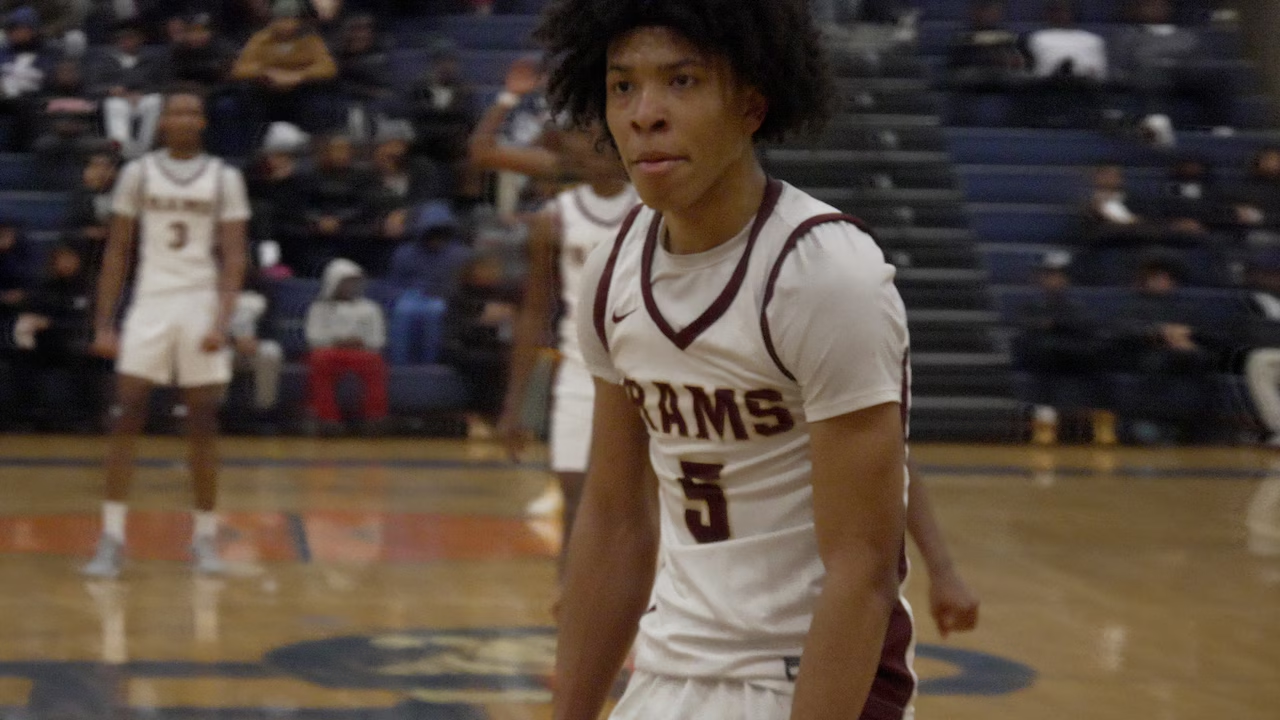
As the Plainfield and Linden high players prepared to shake hands, Linden junior Shakim Bibby was sucker punched in the face by an unknown assailant. The blow knocked Bibby unconscious and sent him crashing to the ground, where he was kicked, stomped and left with a concussion and broken bone in his face.
The shocking melee from 2018 made national news and resulted in a lawsuit by Bibby that was eventually dismissed after a years-long battle in the Union County courts.
But it was after that disturbing incident that legendary former Linden coach Phil Colicchio came to a controversial conclusion that more coaches are calling for as violence continues escalating on ball fields and courts across New Jersey:
He wanted to put an end to the post-game handshake line.
“There’s no reason they need to shake hands,” said Colicchio, now the coach at Elizabeth High. “Teams are uptight, teams are emotional — that’s when things are going to be said. Pushes come to shoves, shoves become punches and then it’s all-out fights.”
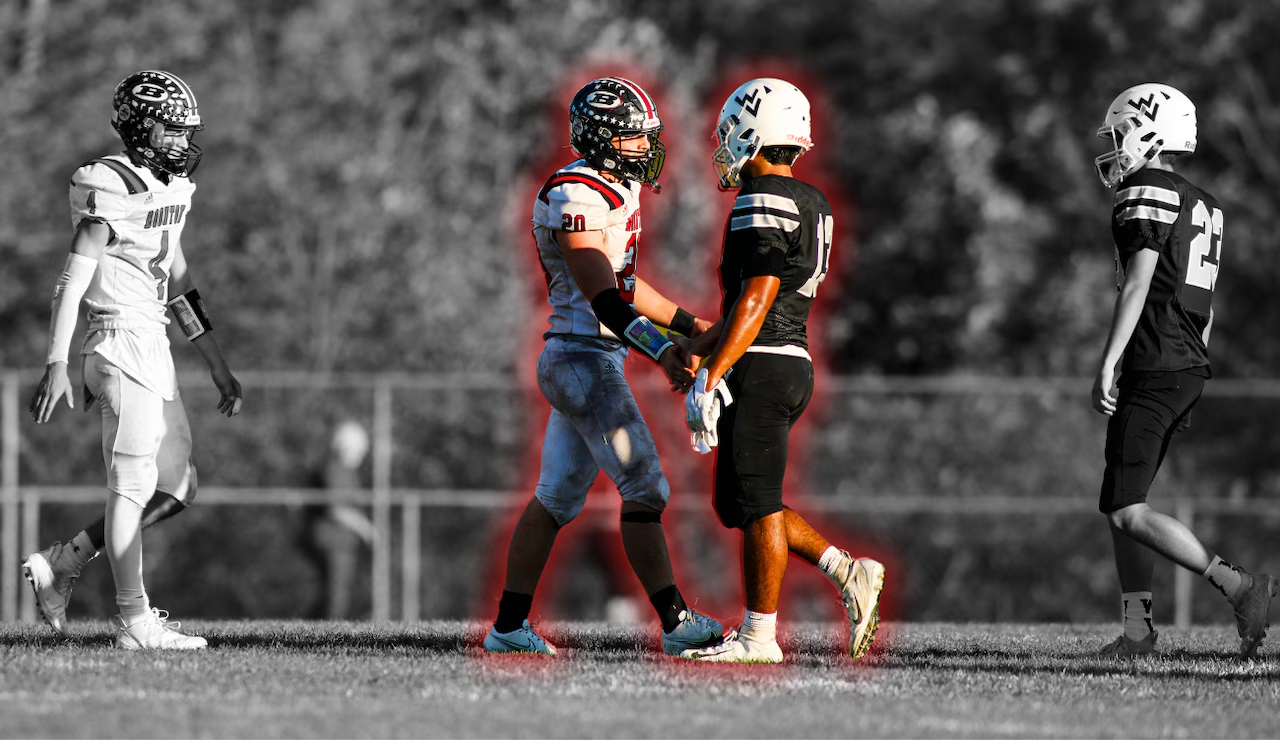
Colicchio’s opinion may rankle sportsmanship purists and traditionalists who believe the post-game handshake line is a baseline for youth and high school sports. But the idea of nixing the tradition is gaining traction as outbursts of violence continue to occur in the handshake line, when tense, high-strung players come together moments after play ends.
Just last month, a wild brawl erupted between St. Benedict’s Prep and St. Peter’s Prep, two of the state’s top high school soccer powerhouses, after punches and shoves were exchanged in the post-game handshake line. As the fracas unfolded, one of New Jersey’s top-ranked players charged after a photographer who was taking pictures of the melee and grabbed his throat, leading to a two-game suspension.
In St. Louis last month, football players from a Missouri high school were reportedly pepper sprayed by police after a fight broke out during the handshake line.
And even in the NFL, a pair of melees ignited at the conclusion of games this season. Following an Oct. 12 loss to Kansas City, Detroit safety Brian Branch refused to shake the hand of Chiefs quarterback Patrick Mahomes and slapped wide receiver Juju Smith-Schuster. Last Sunday, Buffalo’s Dion Dawkins and Jacksonville’s A’Shawn Robinson nearly came to blows after jawing during handshakes.
The recent incidents have prompted some in high school sports circles to seriously question whether post-game handshake lines should continue. Those proponents include St. Peter’s Prep athletic director Rich Hansen, a former legendary football coach who witnessed the melee with St. Benedict’s.
Hansen believes players should display sportsmanship by shaking hands before games — not after.
“We’ve all been in these altercations,” Hansen said after the brawl between his school and St. Benedict’s. “I’d rather see pre-game shakes.”
It’s a tradition in youth sports for teams to show good sportsmanship, lining up and shaking hands after games. New Jersey’s governing body for high school sports, the New Jersey State Interscholastic Athletic Association, even mandates it as part of its annual coaches handbook.
“The NJSIAA strongly believes that the handshake at the end of every interscholastic contest is an important part of sportsmanship,” the mandate reads. “The NJSIAA’s stance is that it highlights a critical lesson for student-athletes and coaches while demonstrating respect and integrity regardless of the outcome. Walking away from the handshake due to a tough loss sends the wrong message, suggesting that poor sportsmanship is acceptable in the face of defeat.”
It’s an idyllic take, but one that Colicchio believes isn’t practical amid the chaos on playing fields throughout New Jersey.
“I say we go back to the way it was during Covid, when nobody was allowed to shake hands after games,” Colicchio said. “Fighting was non-existent after the game.”
After loosing 7-3 Mid-Atlantic Champion Mid-Island Little League All Star 12s players high five with Southeast Region Champion Peachtree City American Little League players Thursday August 23, 2018 at Howard J. Lamade Stadium in Williamsport, Pa. in the Little League World Series. (Staten Island Advance/Bill Lyons) Staten Island AdvanceStaten Island Advance
A timeless tradition
Anyone who has ever played Little League baseball understands that shaking hands with opposing players afterward is part of the post-game procedure. All other youth sports operate in similar fashion, coaches said.
The post-game pep talk from coaches and free hot dogs at the snack stand can wait. There’s always the matter of shaking hands or fist-bumping opponents while repeating, “Good game,” a dozen or so times.
“For me, I played in some of the hardest-fought college football games back at Rutgers and always made it a point to shake hands with the opposing team, even though it was never a requirement,” said former Scarlet Knights linebacker Kevin Malast, who now coaches his son’s Pop Warner football team in Toms River. “I get a little emotional seeing the kids on my team shaking hands with their opponents, especially after tough losses.”
According to Little League International, no mandate exists requiring teams shake hands following games. But reports indicate the practice started after Little League World Series games in the late 1940s.
These days, none of the four major professional sports conclude with formal handshake lines. Typically, a final play happens and some athletes embrace while others head to the locker room. In the NBA, some players simply wave to each other as they leave the court.
The closest to an official handshake line in the professional ranks happens in the NHL. Opposing players typically form lines, skate ahead and shake hands after hotly contested playoff matchups.
“For me, the thing that comes to mind is just respect,” Devils captain Nico Hischier told NJ Advance Media. “It’s kind of a war out there, especially playoff hockey, and you might even still be pissed at your opponents but if you can put all that aside and respect the game and respect your opponent it shows character in yourself.”
New Jersey Devils center Nico Hischier (13) looks on during the second period of an NHL hockey game against the Philadelphia Flyers, Saturday, Jan. 18, 2025, in Newark, N.J. (AP Photo/Noah K. Murray)AP
Brenden Dillon echoed that sentiment inside the Devils locker room following a practice earlier this month. The 15th-year defenseman remembered playing for the San Jose Sharks in the Western Conference finals in 2016, when he fought Carl Gunnarsson late in a Game 4 loss. His team rallied to win the series and afterward he shook hands with the St. Louis Blues’ defenseman — just days after they traded punches.
“I personally have fought some of my best friends in the game,” Dillon said. “I like to play the game hard. I like to play the game on the edge. But once it’s over, you can be a good person and represent yourself and your team with good sportsmanship.”
There’s no hard and fast rule in the college ranks mandating players shake hands after games. Like the NFL, college football games routinely end with head coaches shaking hands while some players pay respect to opponents before heading to the locker room.
“It’s a cultural thing that’s bigger than just that single incident of shaking hands after a game,” Rutgers coach Greg Schiano said. “To me, you pay your respect to your opponent and then you get inside. You don’t need to gloat if you win and you don’t need to put on a show that you’re so sad. Let’s do the things we’re supposed to do and let’s get into the locker room.”
While handshake lines typically form in front of the scorer’s table at the conclusion of most college basketball games, post-game skirmishes have erupted as a result because of player interactions in recent years.
In 2022, the handshake line at the end of Rutgers’ upset of Michigan was interrupted by a scuffle, with multiple teammates and a staffer needing to drag Michigan’s Moussa Diabate back to the visiting locker room.
In 2024, a massive brawl broke out following Texas A&M-Commerce’s win at Incarnate Word as teams started shaking hands, resulting in a “girl’’ in the crowd getting hurt and a team manager to be bloodied, according to reports.
Even coaches have failed to contain their emotions. In 2022, former Michigan coach Juwan Howard swung at Wisconsin assistant Joe Krabbenhoft during a scuffle in the handshake line, and locally Seton Hall coach Shaheen Holloway threw Wagner coach Donald Copeland’s hand away and started jawing at him following a 2023 matchup.
The chaos caused legendary college basketball coach Rick Pitino to order his team to abstain from post-game handshakes at one point during the 2024-25 season.
“We almost had a fight during the Bryant game in the handshake line and coaches had to get in the middle,” the St. John’s coach wrote on social media. “The fighting nonsense has to stop!”
Hunterdon Central catcher Brandon Padre (8) leads the handshake line after the Red Devils defeated Immaculata on Thursday, April 18, 2019.Handshake line
Rethinking the handshake line
In a memo last year, the National Federation of State High School Associations, the national governing body for scholastic sports, issued a statement to its thousands of member schools suggesting that security personnel be stationed “in close proximity to the handshake line.”
It’s a warning that administrators and coaches are taking seriously, according to coaches and athletic officials.
Jim DeSarno, the former long-time football coach at Westfield and current athletic director, said when he used to coach, he’d be at the front of the handshake line, paying respects to the opposing team’s coaches and players following games.
Now?
“You need to make sure that our site managers are really monitoring the end of the game because it’s so important,’’ DeSarno said. “Everyone around high school sports nowadays has a story about something happening or almost happening after games.”
And while he’s heard some coaches and athletic officials pushing for the eliminating handshake lines, DeSarno said he favors keeping it in some form.
“Sportsmanship is something worth fighting for,” he said.
St. John Vianney athletics director Brian Chapman agreed with the sentiment, but said every game is different.
“Coaches need to have some feel with what’s going on in the game, how heated or chippy the game was, especially in hotly contested rivalry games,’’ Chapman said. “I don’t think every game needs to end with a handshake line. But anyone who values sportsmanship should be able to pay respects after a game, and I hope the handshake line doesn’t go away.’’
After several post-game altercations have prompted investigations by the NJSIAA, the organization acknowledged it’s heard criticism of the handshake line. But spokesperson Mike Cherenson said it is not currently considering changes to its policy.
“Sportsmanship is central to education-based athletics,” Cherenson said. “After competition, players should look opponents in the eye, shake hands, and show respect for each other and for the game. Walking away from that lesson solves nothing.”
That means the onus on quelling disorderly behavior post-game remains on coaches and schools.
West Orange’s Darnell Grant and Wall Township’s Ed Gurrieri are just some of the state’s high school football coaches who said they discuss their handshake line operations before games with players and coaches.
“There should be a level of respect for the game and civility that we as adults should be teaching our kids,’’ Grant said. “I know things have happen that shouldn’t, but abolishing the handshake line would seemingly be a temporary ease. We need to work a little harder, every coach, AD, mom and dad,to instill in our kids to have the right perspective for the game.’’
As commissioner of the New Jersey Football Coaches Association, East Orange’s John Jacob said his organization’s policy is to mirror the NJSIAA’s in ensuring the handshake line remains part of the post-game festivities.
Even as incidents and fights continue to pile up.
“I understand there have been instances where coaches feel it’s not in their best interests to have their teams interact after the game,” Jacobs said. “As a coach, you want to tell your players to let go of those emotions, look at your competitor and shake their hand.
“I understand that’s easier said than done,” Jacobs continued. “But I think ultimately that’s what we all want.”
If you purchase a product or register for an account through a link on our site, we may receive compensation. By using this site, you consent to our User Agreement and agree that your clicks, interactions, and personal information may be collected, recorded, and/or stored by us and social media and other third-party partners in accordance with our Privacy Policy.
Time Out Sports Bar has announced it will also cease operations at its current location, with its final day of business set for Sunday, Jan. 4, 2026. Notices posted at the bar invite the community to attend a “last day of business” event that day, with all bartenders scheduled to be on site from 3 p.m. until close.
According to the notice, customers who have funds remaining on the bar’s sweepstakes machines will be given a two-week window to cash out. Management stated that specific times for cash-out availability will be posted.
Time Out Sports Bar also indicated plans to relocate and said information about its new location will be shared on the business’s Facebook page.
The building housing both Margaritas and Time Out Sports Bar has been sold to a new owner. As of publication, the identity of the buyer and any future plans for the property have not been publicly disclosed.
However, according to filings with the Texas Department of Licensing and Regulation, a new Denny’s restaurant will occupy one of two lease spaces attached to a new convenience store development called Q-Mart, which is set to be located at 10280 W. Hwy. 29–is the same address as Margaritas.
Plans for the Q-Mart include an 11,766-square-foot main building, two fuel canopies, and a second lease space that remains open for a future tenant. The privately funded project carries an estimated construction cost of $3 million. Work is expected to begin in March 2026, with completion anticipated by February 2027.
A commercial demolition permit for Margaritas’ playground, covered wood deck and canopies was approved in December 2025 to occur Jan. 5.
Follow The Independent for more information on this developing story.
GARFIELD HEIGHTS, Ohio — Akron Garfield and Euclid stole the show Sunday during the NEO Youth Elite Christmas Classic at Garfield Heights High School with their double-overtime thriller.
It took two buzzer-beaters by the Rams’ Rayshawn Hamilton and Monty Thompson Jr. in both overtimes to lift Garfield to a 73-71 win against Euclid. Afterward, they were greeted in the locker room by the hosts from Garfield Heights ahead of the Bulldogs’ game with Glenville.
Both share the name, Garfield, and both are in Division III for OHSAA postseason play.
They could meet in March, but both put on shows Sunday during the five-game showcase. Here are the standout performances to go with the highlights in this post:
Mekhi Asberry, Euclid
Had Akron Garfield not hit so many clutch shots, it would have been Asberry’s shooting that lifted Euclid (5-3).
The Panthers’ sophomore guard scored 19 points and knocked down five 3-pointers in their double-overtime loss. He played off junior guard Tyree Williamson and 6-foot-8 forward Kye Owens, who scored 18 points with 10 rebounds.
Dereon Barber, Richmond Heights
His older brother, De’Erick, is Ohio’s all-time leader in assists after starting four years at Richmond Heights. Now a sophomore, Dereon follows in his footsteps as the Spartans’ starting point guard on a new-look team for first-year coach Mel Burke Jr.
The younger Barber controlled the tempo early in Richmond Heights’ 74-56 win against Orange to start Sunday’s showcase. He finished with 21 points and three assists, including two to senior guard Khyell Moreland, who scored 20 points and hit four 3-pointers. The Spartans (5-5) returned to .500 and bounced back from a seven-point loss last week to defending Division III state champion Louisville.
Rayshawn Hamilton, Akron Garfield
Hamilton’s 27 points carried the Rams for much of their thriller vs. Euclid. The 6-4 guard also grabbed nine rebounds, as Garfield outmuscled a lengthier Euclid team.
Chris Hill, Lutheran East
Lutheran East beat Warrensville Heights at its own game with a tenacious defense and quick passing offense. Hill led the Falcons (6-0) in both of those aspects for their 60-38 win, as he dished out seven assists with three steals and 11 points.
Marcus Johnson, Garfield Heights
Mr. Basketball is out to keep his crown this season, and Sunday’s 40-point effort is another addition to the resume. The Bulldogs’ standout guard and South Carolina commit knocked down seven 3-pointers in a 74-70 win against Glenville. Three of those 3s came in the fourth quarter, as the Bulldogs (4-4) built a 15-point lead.
Johnson scored 17 points in the fourth quarter.
Aaron Lewis, Orange
A freshman guard, Lewis came off the bench to score 22 points in the Lions’ loss to Richmond Heights. He is the nephew of Trey Lewis, who starred at Garfield Heights before a professional career that now has him playing overseas and most notably a run with the Utah Jazz.
Greg Price, Hawken
Hawken (8-1) held off Rhodes’ rally, as four of its starting five led the way. Price earned MVP honors from the Hawks’ 87-80 win, as he scored 24 points and made repeated trips to the free-throw line down the stretch. He also dished out five assists.
Sophomore guard Ice Taylor scored a game-high 25 points, while Daron Hill added 12 and Charlie Mallett had 10, but Price set the tone early and took responsibility for his team’s turnovers that led the Rams back into it.
Hawken is playing back-to-back games against Cleveland Senate League teams and has a rematch from last season’s Division IV state semifinals coming Sunday against Glenville at Euclid for the Scholastic Play By Play Classic.
Gio Ramos, Glenville
Ramos is a newcomer for the Tarblooders, who made it to last season’s Division IV state finals. The junior steps into the big forward spot for a Glenville team that graduated leading scorer Xavier Vickerstaff and played a role similar to him against the Bulldogs with 14 points and 16 rebounds.
Monty Thompson Jr., Akron Garfield
Thompson, a junior guard who came off the bench for coach McNeal Thompson III, is quickly developing a reputation as a clutch shooter.
He made some big shots this summer at the Midwest Live showcase in Sandusky and continued Sunday in one of the Rams’ biggest tests to date. Thompson scored 17 points, including a buzzer-beating 3-pointer to end the third quarter and his baseline jumper to beat Euclid in the second overtime.
Dylan Zeigler, Lutheran East
The sophomore guard, who has big offers including Ohio State, led the Falcons with 20 points in their revenge game against Warrensville Heights after the Tigers beat them last year at this showcase.
After arriving in Fayetteville, it doesn’t take long to realize that sports are woven into the city’s DNA. From Razorback game days to the cyclists on our trails to families filling fields and courts across the region, this is a community that moves.
And that movement represents far more than recreation. It is one of the strongest economic opportunities ahead of us.
Sports tourism has grown into one of the most powerful, reliable economic engines in the country. According to the Sports Events & Tourism Association, spectator sports tourism generated $47.1 billion in direct spending last year, supporting more than 665,000 jobs nationwide. Youth and amateur sports, everything from tournaments to camps to regional competitions, contributed even more, with $52.2 billion in travel-related spending. These visitors stay in hotels, eat in local restaurants, shop in stores, and explore outdoor assets, leaving a meaningful mark on local economies.
In Arkansas, that story is magnified. Outdoor recreation alone contributed $7.3 billion to the statewide economy in 2023, supporting more than 68,000 jobs. And tourism reached $17.4 billion in economic impact in 2024, with Northwest Arkansas playing a major role in that growth.
Ryan Hauck
At a time when leisure and business travel have softened nationally, sports-related travel has continued to rise, providing a level of stability and resilience that communities increasingly depend on. When communities like Fayetteville lean into their strengths — outdoor recreation, hospitality, accessibility and local culture — the returns are significant.
Fayetteville is uniquely positioned to lead the state and region in this space. We’re home to a thriving SEC city, incredible year-round weather, world-class outdoor recreation, a variety of indoor sporting facilities, and a welcoming culture that makes competitors and travelers feel instantly at home.
Our community has also invested intentionally in the infrastructure that makes sports tourism possible. Centennial Park is a perfect example. Purpose-built to host world-class cycling events, it has already welcomed the 2022 UCI Cyclocross World Championships and will host the USA Cycling Cyclocross National Championships this December, and again next year. These events don’t just bring athletes. They bring national attention, media coverage, and significant economic impact for our hotels and hospitality businesses.
And that momentum extends well beyond cycling. In the past year, organizations such as the Women’s Football League, Athletes Unlimited Softball League, and the Marshall Islands Soccer Federation have approached us about hosting events in Fayetteville. Their interest reinforces what the sports community already knows: Our city is emerging as a national-caliber sports destination.
But the value of sports tourism extends beyond visitor spending. It strengthens identity and builds civic pride. It brings families together. It activates public spaces and showcases the best of who we are. In my previous role in Cody, Wyo., I saw firsthand how powerful it can be when a community rallies around its strengths and invites the world to experience them. In Fayetteville, that same opportunity is in front of us, and we are already leaning in.
The path is clear: We need to continue investing strategically. That means purpose-built sports facilities and deeper partnerships across the region. If we continue investing with intention, collaborating across sectors, and telling our story with clarity and authenticity, Fayetteville can set the standard for what a modern, movement-driven destination looks like.
The momentum is already here. Our job now is to harness it and to make sure the world knows exactly why Fayetteville is a place worth traveling to, competing in, and coming back to again and again.
Editor’s note: Ryan Hauck is CEO of Experience Fayetteville, the city’s tourism marketing agency. The opinions expressed are those of the author.
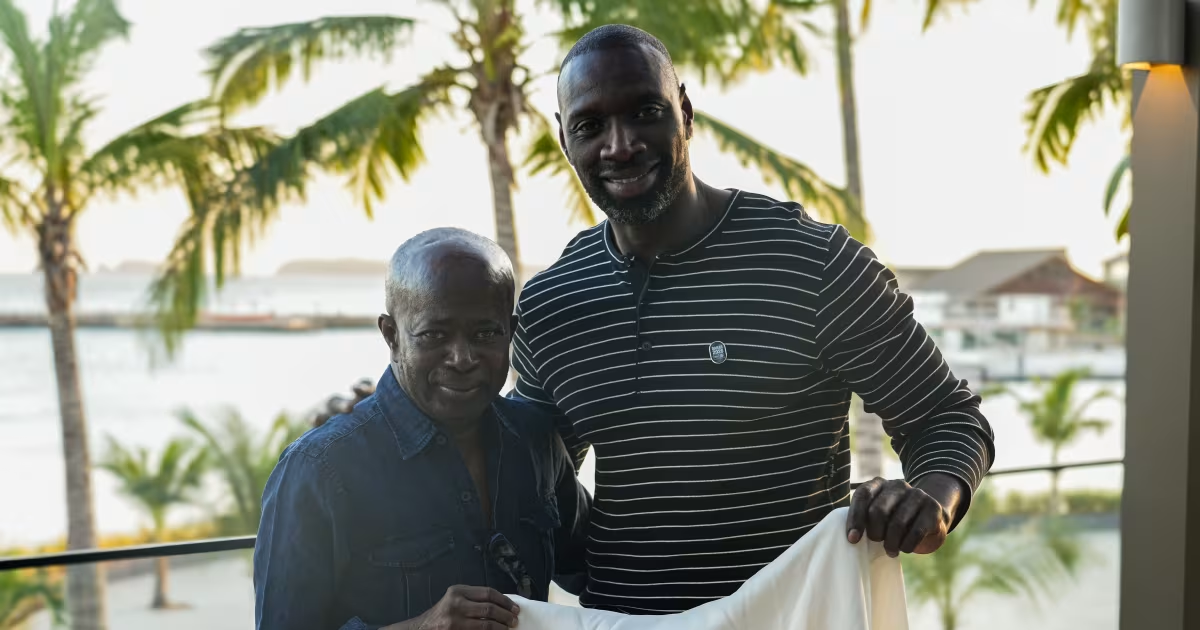
Omar Sy is one of those personalities who brings people together.
At 47, the internationally acclaimed actor is stepping into a new role – one firmly rooted in real life.
Already the star of productions that have left a lasting mark on audiences worldwide, Sy will now become one of the faces of the Youth Olympic Games (YOG) Dakar 2026, the first Olympic event to be staged on African soil.
Known for his roles in hit films, the actor first established himself as one of the most popular figures in French-language cinema with The Intouchables in 2011. His global profile grew even further thanks to the Netflix series Lupin, which helped expand his audience well beyond Europe.
His appointment as an ambassador for Dakar 2026 YOG on Monday, 29 December, marks another step in his growing international influence. He shared his feelings upon the announcement of this new role.
“I am proud and honoured to be an ambassador for the Youth Olympic Games that will take place in 2026 in Senegal. These Games represent values that are close to my heart: sharing, solidarity, pushing beyond one’s limits, and intercultural encounters,” he said.
He also underlined the symbolic significance of the event: “Seeing the youth of Senegal and the entire world shine together on the land of Teranga is a powerful symbol of unity and hope.”
Born in France to a father from Senegal, Sy maintains a close personal connection with the country.
This bond has influenced some of his artistic choices, as reflected in his roles in Yao (2018) and Father & Soldier (Tirailleurs, 2022). In January 2025, he was also received by President Bassirou Diomaye Faye, further highlighting his commitment to Senegal and its youth.
DICKINSON — It’s no secret that hockey is a huge part of my life. I’d even say it is my life.
When I was interviewing for this job at The Dickinson Press in 2024, the editorial staff said that they’ve never had someone with a lengthy track record of covering hockey. From that conversation, I knew I would have a big role once the puck dropped.
When I returned to Dickinson from Thanksgiving that year, I was told that I was going to be getting a hockey show. I was stoked.
It took me some time to come up with a name. I even bounced around some name ideas with my mom. Let’s just say some of her suggestions weren’t ideal.
Once I settled on The Breakaway, I slated for it to start at the beginning of 2025. The first episode I did featured Kyndall Peterson and Sarah Menge taking on each other in a faceoff competition. I’ll never forget seeing one of the first comments on the video — “this is amazing!”
But this show is more than about me sharing my immense passion for hockey with the Dickinson community. It’s about showing off what these athletes are capable of on the ice. This year I plan on expanding the show beyond the on-ice skills.
I want to get to know them on a personal level and find out more about their hockey background. One of the biggest things I especially want to do this year is get more involved in the hockey community. Those ideas are currently in the works and you’ll have to stay tuned to find out more.
I hope everyone has enjoyed The Breakaway since this started and I can’t wait to see what this season holds.
See you on screen – and on the ice!
Jacob Cheris covers a variety of high school and college sports. A graduate of Penn State University’s class of 2023, with a degree in broadcast journalism, he covered Penn State Men’s Hockey for three years. Jacob also covers Big Ten Hockey for College Hockey News.
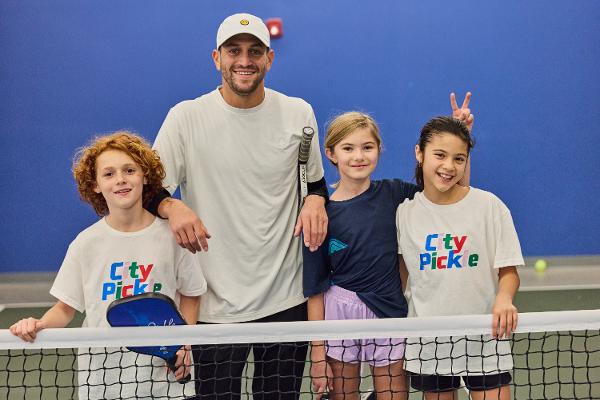
CityPickle Kids: Youth Academy Launching Winter 2026, CityPickle is debuting NYC’s first leveled, 12-week junior pickleball program for ages 8–13. Pickleball has emerged as a leader in youth sports, with more than 240 collegiate clubs nationwide (and even varsity programs!). Families are increasingly seeking structured, skill-building opportunities for their children.
CityPickle’s Youth Academy meets that demand with a thoughtfully designed curriculum created by Head of Coaching Josh Gartman, mirroring the rigor and progression of elite junior tennis programs. Players advance through three levels — Competitor, Challenger, and Champion — with coach evaluations at the start and end of each season. The invite-only Champion tier includes tweens and teens with serious talent (and yes, they can already beat most adults).