NIL
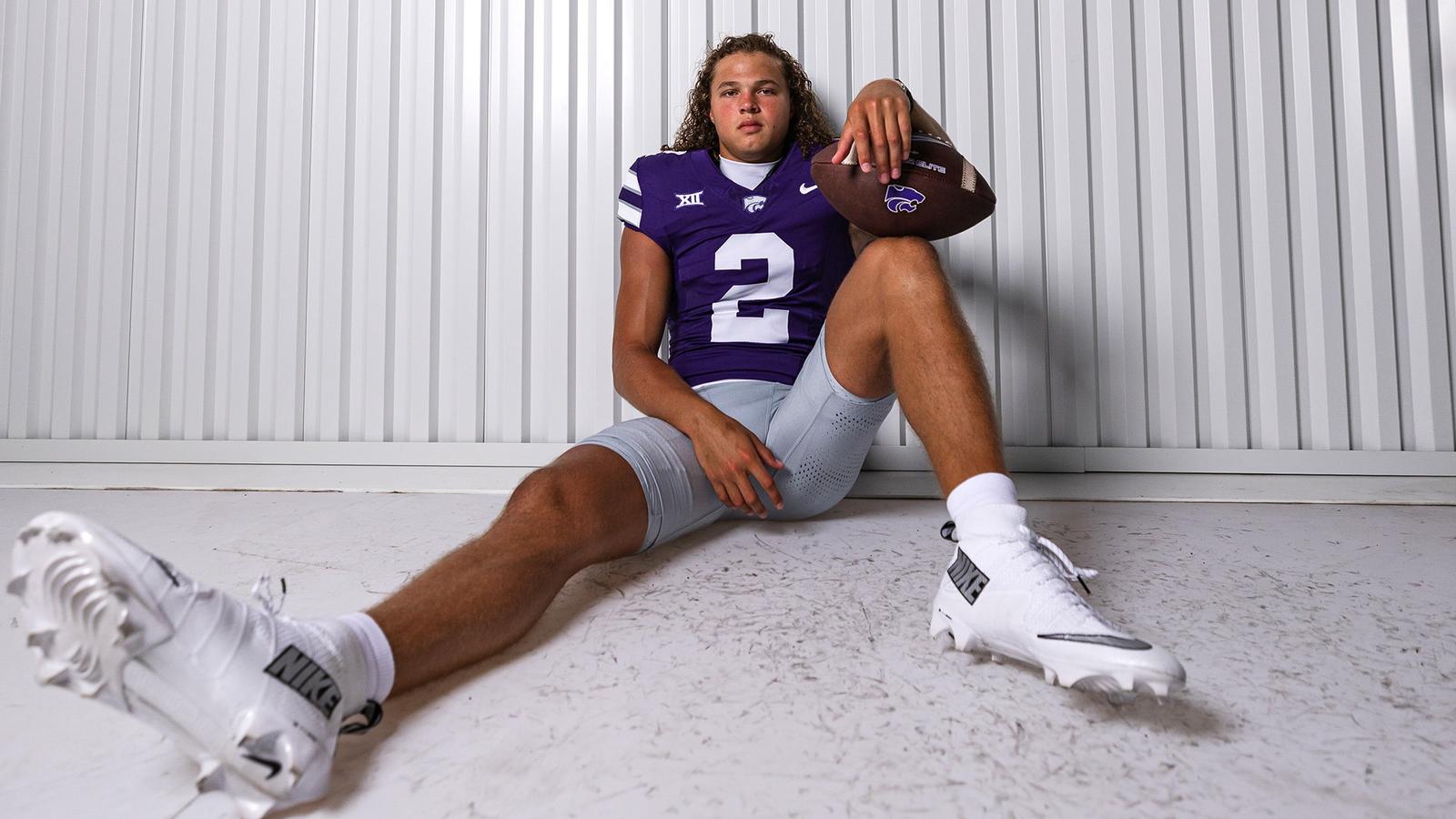
Johnson Enters 2025 ‘Super Comfortable and Super Confident’
He sits in his lavender suit at a long table with a black tablecloth and in front of a large digital display bearing the Powercat logo and with the end of Big 12 Football Media Days nearing an end at the Ford Center in Frisco, Texas — an eight-hour affair that can test the vocal chords — and Avery Johnson still sits and politely and methodically answers every question tossed his way.
Then somebody lobs him a question about No. 20 K-State facing No. 21 Iowa State in the Aer Lingus College Football Classic on August 23 in Dublin, Ireland.
Johnson unhesitatingly and emphatically knocks it out of the park.
“It’s definitely extra motivation for us knowing we’ve lost to Iowa State the last two years,” he says. “They beat us to end the regular season last year and left a bad taste in our mouth. It definitely doesn’t sit well with me and the rest of our team.
“We’re going to prepare our hardest and go out there and get the win.”
True. K-State suffered a 29-21 loss at Iowa State last season. Johnson completed 12-of-28 passes for 220 yards with touchdown passes of 28 and 65 yards to Jayce Brown and a 7-yard scoring toss to Garrett Oakley. K-State also suffered a 42-35 loss to Iowa State on Senior Day in Manhattan in 2023. Will Howard went 24-of-48 for 288 yards with one touchdown and one interception in that contest.
Matt Wells, K-State’s associate head coach, quarterbacks coach and first-year offensive coordinator, got a vibe from Johnson the first time they met prior to last season, and that vibe has perhaps become more pronounced during the offseason as Johnson, the face of K-State football, stares down his second year as a full-time starter.
“He’s a dog. He’s a competitor. And he has that mindset that he’s the best one out of 22 players on the field at that time,” Wells says. “That’s something you either have it, or you don’t. That’s a special trait that Avery has. He’s a winner.”

K-State is one of only five Power 4 teams to win at least nine games each of the last three seasons with at least one conference championship in that timeframe, joining Alabama, Clemson, Georgia and Oregon.
Johnson, a Wichita native who a year ago guided K-State to a 9-4 record, including a 44-41 win over Rutgers in the Rate Bowl, would like to help keep K-State shining among the best in college football.
Meanwhile, the 6-foot-3 Johnson, who is on the 2025 Maxwell Award Davey O’Brien Award watch lists, says that he will play above 200 pounds for the first time this season while maintaining his 23-mile-per-hour speed, has a chance to prove himself among the best signal-callers in the nation.
Last season, Johnson completed 58.3% of his passes for 2,712 yards and a school-record 25 touchdowns while adding 605 rushing yards and seven touchdowns on 113 carries. He finished fourth in school history in pass attempts (372), fifth in completions (217) and passing yards (2,712), sixth in total offensive yards (3,317) and sixth in touchdown responsibility (32).
He was on fire with three passing touchdowns and two rushing scores against Oklahoma State, becoming the first Wildcat to hit those marks against a conference opponent since Collin Klein at West Virginia in 2012. It was only the 30th time since 1996 a player had at least three passing touchdowns and two rushing touchdowns against an AP Top 25 team, earning him Manning Award Star of the Week and Davey O’Brien Award Great 8 honors.

He finished as one of five players in the nation — and one of three from a Power 4 school — to record 2,700 passing yards and 600 rushing yards last season.
CBS ranks Johnson as the fourth-best quarterback in the Big 12 heading to the 2025 season, contending that “Johnson finished with a school-record 25 touchdown passes and yet it didn’t feel like he met the high expectations many set for him as a first-year starter.”
CBS adds: “When he’s on, the Wildcats are a conference frontrunner.”
It wasn’t too long ago that ESPN college football senior writer Pete Thamel on the College Gameday Podcast called Johnson “electric,” adding, “He’s going to be the face of the sport in the upcoming years. He’s got like (NFL quarterback) Anthony Richardson electricity, like he’s rare, man.”
Last week, ESPN listed Johnson as the “most important player in the Big 12 race.” It adds: “If he phases out some of the errors and maximizes the big plays, K-State’s ceiling is higher than 10 wins.”
At the moment, one of the most electric — and likely among the fastest — signal-callers in college football stands center stage in the team theater room at the Vanier Family Football Complex after training camp on Thursday.
Johnson has seen the film. Boy, has he seen the film. Wells says not a day goes by that Johnson isn’t in his office. They talk football. They watch football. Often, they watch football and talk football at the same time as the hours slowly burn away. Both coach and pupil are fiery. They’re like-minded. They look at each other and know what the other is thinking. It’s that kind of bond that they’ve formed through two years of growth. Every offensive play is dissected. Every drop back and every rush analyzed. Virtually nothing goes untouched in Wells’ office.
“I put the weight of the world on my shoulders (in 2024),” Johnson explains to reporters on Thursday. “If I missed a throw, I wanted to get it all back on the next throw. If we got down, I wanted to score a 14-point touchdown. A lot of times, I’d try to be this player I wasn’t and try to fit the narrative of, ‘Oh, he needs to be a passer and doesn’t need to run as much.’ Really, it’s about being myself.
“If the defense gives up run opportunities, I need to make the defense pay and run the ball, and if they give up passing opportunities, I need to be a pocket passer and play to my strengths more. I need to really do what I can do best, which is lead and go out and win football games.”

Which is what Johnson has strived to do all along.
One day, in particular, comes to mind. Johnson sported a tan-and-black Nike hoodie, black sweatpants, black socks and black slides as he stood inside the team theater at the Vanier Family Football Complex. It was February 2, 2022 — 43 days after he signed his letter-of-intent with the Wildcats. One of the highest-rated players ever to sign with K-State — he was the Kansas Gatorade Player of the Year, the No. 1-rated dual-threat passer by Rivals and the 41st-rated overall player by 247Sports — he exuded confidence, yet was not brash; he spoke, but is not boastful; he smiled, but not too big; and he fit the part of a charismatic leader.
As for Johnson’s goals while at K-State?
“A lot of winning,” he said. “I have personal goals, but to be honest, the team goals mean more to me than any personal goals, whether that’s winning the Big 12 or playing for a national championship. I just like to play football, and I like to win football games.”
That competitiveness? That drive?
It came early.
There was always something different about Avery. When he was 2 years old, he memorized the uniform numbers of his older brother’s little league baseball team. Kids played in the dirt. Avery studied how players swung the bat. When Avery was 3, his basketball and t-ball coaches politely asked his parents if Avery could play up a level. He outraced his older brother’s fifth-grade football team in 40-yard dashes. Mark Johnson tried to put Avery, his youngest child, into competitive situations and exercise his brain. Avery memorized 120 offensive plays. He read defenses, audibled out of plays, found the exact right one, then took care of the rest.
He was in the third grade.
“He beat them every single time,” Mark says.
In the eighth grade, Avery wowed Maize High School varsity football head coach Gary Guzman, who saw the boy in the No. 2 jersey race past the competition for the first time. And he could throw. Boy, could he throw. The possibilities were endless.
“He was just so athletic at that age,” Guzman says. “He has been forever, I guess.”
Avery played on the Maize High School freshman football team on Mondays and played on the varsity team on Fridays. He was an unstoppable force for the freshman squad while serving as backup quarterback to a senior on the varsity team. Oh, he played. He played in every varsity game his freshman year. He threw for more than 500 yards — “pretty good for a freshman part-timer,” Guzman says — while honing his throwing mechanics and learning the offensive system. He had a silky-smooth delivery and put zip on the ball, finding receivers across the field. Guzman inserted Avery into multiple situations, regardless of opponent or score. Didn’t matter. When he took the field, one thing stood out among his many attributes: His leadership. The juniors and seniors responded to him. The Maize High fans cheered for him.
“We had no problem putting him in there at any point during the game,” Guzman says. “I mean, he could get it done. He did great things as a freshman and just kept getting better every year.
“He had long runs. At any point in the game, he’d hurt you. You give him enough time, and he was going to hurt you with the pass. It was no surprise when he threw the ball back across his body right on the money. He had a lot of velocity on the football.”

As a sophomore, Avery threw for 2,109 yards and 25 touchdowns and just three interceptions while rushing for 10 scores on the ground. He earned first team all-state honors after throwing for 2,549 yards and 20 touchdowns while rushing for 1,080 yards and 22 touchdowns as a junior. As a senior, he threw for 2,768 yards and 29 touchdowns and three interceptions while rushing for 817 yards and 15 touchdowns in leading Maize to a 12-1 record. He was named Kansas Gatorade Player of the Year. He was selected to play in the All-American Bowl. He played in the 2023 Under Armour Next All-America Game. He was also named a finalist for the Elite 11 quarterback competition.
It all built Johnson into the 20-year-old fearless playmaker who lights up scoreboards across the Big 12 Conference — and who plans to see the end zone at the 47,000-capacity Aviva Stadium in Dublin in just 12 days.
What we might see in the first college football game of the 2025 season is a more refined Avery Johnson, the fruits of his labor on full display as he opens a new chapter to a tale that hasn’t yet reached the really good part.
Deep balls downfield? Better believe he’s worked on it.
“It’s about just being able to have that pocket presence and being able to find the checkdown,” Johnson says. “It doesn’t always need to be a 100-yard bomb and force things into tight windows. It’s just being able to create completions when the shots aren’t there. Then whenever we do get big-shot opportunities or I can throw a 1-on-1 jump ball, I can give my guys a chance.”

As for the biggest improvement Johnson looks to make his junior season?
“Really, just not as many turnovers,” he says. “Just trying to do too much at times caused some unnecessary turnovers. What we say in the quarterback room is sometimes tips will happen, might get a ball through your guy’s hands and might get tipped for an interception, and that’s the cost of doing business. At the quarterback position, if you throw it enough times, things just don’t always shape up your way.
“Last year, I had some unnecessary picks where I tried to force things and threw things right to defenders. I want to eliminate that from my game and be a lot more — still aggressive, I don’t want to say conservative — but safer with that football. You have to win the turnover battle and that ball means everything.”
In his two seasons, Johnson not only has captured the attention of opposing coaches and fans, but his skillset and will to win has left an impression on players across the nation.
Take Jaron Tibbs, for example. After two seasons at Purdue, Tibbs suddenly found himself “chopping it up” with Johnson after dinner on his official visit to Manhattan in the second week of last December. The 20-year-old Tibbs, a 6-foot-3, 210-pound junior wide receiver from Indianapolis, Indiana, possesses an idea frame, and his athleticism coupled with deft route running in traffic and speed on the post makes the sure-handed pass catcher a virtual threat across the field. He signed with K-State thinking one thing: Me and Johnson can win some games.
“Honestly, it’s exciting because when you have Avery Johnson back there who you know can extend plays with his legs and get the ball deep sitting back in the pocket, it makes it easier because you know you have more time to really run your route to the fullest,” Tibbs says. “When a play is broken, you’re never really not an option, and the play is never dead.”

Jerand Bradley, who originally played for Wells when he was head coach at Texas Tech, spotted Johnson’s talent long ago, as well. A 6-foot-5, 217-pounder with 4.5 speed and a pair of sticky hands that caught long balls out of the Texas skies, Bradley has taken his talents to Manhattan as well for his senior season.
“I like how the offense is so versatile,” Bradley says. “I like everything about the offense from Avery Johnson to the weapons we have. I remember the first time I saw Avery play when I was at Texas Tech, and he scored five touchdowns. Every time I see him, he’s doing something crazy on the field. Man, I just love watching him play.”
Tibbs and Bradley seem ideal complements to junior Jayce Brown, who curiously isn’t regarded nationally as one of the top receiving threats in the Big 12, but he’s poetry in motion when he teams up with Johnson, his roommate. Brown has 18 starts over a span of two seasons, owns a career 17.0-yard average per reception, which ranks fifth in the FBS among active players. Last season, Brown tied for fourth in the FBS with seven catches of at least 40 yards and eighth with four receptions of at least 50 yards. He also posted 25 receptions of at least 20 yards, which equated to 53.2% or his total catches.
“Jayce is my guy, that’s my dog,” Johnson says. “We spend a lot of time together outside the facility. Our chemistry gels. When we step onto the field, I’m able to talk to him as a brother and understand where I want him to be on different plays. It just makes us a more dangerous duo whenever we do step on the field.”

In all honesty, there are weapons galore at Johnson’s disposal. He has the deepest and most talented group of tight ends in the country, including true freshman Linkon Cure, the No. 1-rated tight end in the Class of 2025 and highest-rated signee in K-State history. He has one of the most electric players in running back Dylan Edwards, his childhood football teammate. He’ll play behind a bruising offensive line that has shown nothing but good things in training camp. Reserves aren’t really reserves in this K-State offense, rather they’re “game changers.”
“I’m super comfortable and super confident,” Johnson says to reporters on Thursday. “I can only go as far as the people around me, and I understand that. We have so much talent at offensive line, wide receiver, running backs and tight ends, you name it. Those guys make my job so easy. I’ll continue to say that because we have talented skill players, and the guys up front are going to protect my butt all year.
“I’m just thankful to be in the position I’m in. I wouldn’t want it any other way.”
And exactly what position is Johnson in heading into 2025? He enters his second full year as starting quarterback in an offense guided by Wells, who the Associated Press calls “one of the game’s top offensive minds,” and a part of a winning program led by seventh-year head coach Chris Klieman. He’s had a chance to digest the entirety of the 2024 season and build from the 2024 season and look to the 2025 season and walks into a locker room in training camp surrounded by some new and exciting faces eager to help Johnson and the Wildcats go places this fall.

First stop: Dublin, where K-State has a chance to become the first team to win a game in the 2025 college football season.
So here we are, back at Big 12 Football Media Days in Frisco, Texas, and Johnson sits in his lavender suit at a long table with a black tablecloth and in front of a large digital display bearing the Powercat logo. The questions from reporters keep rolling in. Then someone asks him what is probably on everybody’s mind as he and the Wildcats embark upon this journey.
What should everyone know about this K-State team in 2025?
Johnson pauses.
“We’re a team ready to prove to the world,” he says, “that we’re the best team in the Big 12.”

NIL
Inside Ole Miss’ landmark NIL victories after Lane Kiffin’s exit
Moments after Ole Miss’ thrilling Sugar Bowl win over Georgia, the first person Walker Jones found on the field was newly minted Rebels hero Lucas Carneiro.
Carneiro had just hit the game-winning 47-yard field goal to send Ole Miss to a national semifinal and one win away from the national championship game.
When Carneiro saw Jones, the executive director of the Grove Collective, a big smile broke across his face amidst the exuberant on-field celebration.
“I’ll call you tomorrow,” Carneiro said with a grin.
“You better,” Jones replied.
“I’ve never been so happy to get that call the next day,” Jones told CBS Sports this week.
Keeping a star kicker has been just one piece of the puzzle for Ole Miss, but in many ways, it has been representative of what the last couple of weeks for the Rebels. It’s been a wild run of success, concern over possible tampering and poaching off the field and a concerted effort to do everything possible to keep the momentum.
It’s hard to find a program that has handled the uniquely challenging circumstances better than Ole Miss.
Consider what Ole Miss head coach Pete Golding, athletic director Keith Carter and others have had to deal with in recent weeks. All the drama around whether the coaches following Lane Kiffin to LSU would be allowed to finish the playoff run. A narrative that it was just a matter of time before Ole Miss’ top players fled Oxford to join Kiffin at LSU. All of this while preparing for a Thursday semifinal against Miami and navigating an especially wild and active transfer portal.
And yet, Ole Miss has re-signed quarterback Trinidad Chambliss (pending waiver), running back Kewan Lacy, Carneiro and other key contributors.
“None of these guys left,” Matt Bowers, a prominent Ole Miss booster who owns 14 car dealerships, told CBS Sports. “We don’t have to guess what that means. You can say whatever you want if you’re LSU. You can say, ‘Well, they overspent.’ OK, tell yourself that. The truth may be harder to accept.”
That’s a credit to a talented, sleep-deprived group. Everyone from Golding and his staff to Jones and his team at the Grove Collective — along with newly added president of football Austin Thomas, assistant general manager Kelvin Bolden and senior associate athletic director for cap management Matt McLaughlin — has helped keep the train on the tracks.
“We’re in a really good place,” Carter told CBS Sports. “The brand is really strong. Clearly, we’re proving that we can win at a high level and make deep runs in the playoffs. So why would these guys want to leave? I think that’s what we have to continue to build here in Oxford.”
Invest in Golding
Carter’s big bet on Golding to replace Kiffin has already paid major dividends. In many ways, it was both a bold and practical decision to elevate the likable defensive coordinator and entrust a first-time head coach with navigating an unprecedented situation.
What Carter and others around the program understood was that Golding had forged real connections with players, boosters and other key figures. He had long been a top recruiter for a reason. If Ole Miss wanted to keep its roster intact for a playoff run, Golding may have been the only choice.
The way Golding handled the aftermath of Kiffin’s exit has been about as close to ideal as anyone could have hoped. And while this story is not about Lane Kiffin, there is no question he has had an impact, intentional or not, on what is happening in Oxford.
Doubling down
The manner in which Kiffin left Ole Miss for LSU, and the hurt feelings it stirred among fans, has energized the base. There is a sense of resolve to prove the program can sustain its success in a post-Kiffin world, that the self-appointed “Portal King” was not the lone driver of Ole Miss’ success in the NIL and transfer portal era.
As Jones joked, “It’s amazing what a common enemy will do.”
“I think they knew this was a rallying point,” Jones said. “Our people kind of love us against the world, little Ole Miss can’t compete, little Ole Miss was built just by happenstance. They wanted, along with us, to show everybody this is built to last and we’re bigger than any one man or any one variable.
“We’ve got a lot of resources in place, commitment in place from our administration to our coaches to our collective, and that has aligned our fanbase. They know what to do.”
The money has come pouring in. Carter said Ole Miss athletics has already set a record for annual giving just six months into the fiscal year. After Ole Miss’ home playoff win over Tulane, 30-40 people joined the Vaught Society, which comes with a $25,000 commitment.
“It’s been a perfect storm in a really good way,” Carter said. “Our fans are more galvanized at this moment than maybe they’ve ever been.”
Said Bowers, a key financial contributor: “These people have money, and they’re motivated. In the name, image and likeness era, we’re one of the most successful programs in the country. That’s a fact.”
Everything Ole Miss is doing at this moment works toward sustainability. Beyond retaining top talent, Golding and his staff have been aggressively adding it. The Rebels currently have the nation’s No. 6 transfer class, headlined by Florida defensive lineman Micai Boireau, LSU offensive lineman Carius Curne and Auburn defensive back Jay Crawford. If Chambliss’ waiver isn’t approved, it’s a good bet Ole Miss will add an impact transfer quarterback, too.
With the new additions, there’s a world in which Ole Miss could be even better next season. After all, this was supposed to be the rebuilding year after losing top talent such as Jaxson Dart and Walter Nolen off last year’s team. If Chambliss is eligible for another year — and that is a big if right now — there may not be a better one-two offensive punch in the country than he and Lacy.
At minimum, Ole Miss fans will get to watch the two stars suit up for at least one more game on Thursday in Arizona. A win would add another chapter in what’s already been a remarkable and historic season for the Rebels. One more win and Ole Miss is playing for a national championship without the man who started the season as its head coach. Two more wins and Golding and this special group of Rebels will go down as legends.
Through all the outside noise and wild circumstances, Ole Miss football has never been in a better place. And everyone associated with the program is putting in the hard work to keep it going.
“They’ve got a taste of this,” Carter said, “and they want to hold onto it.”
NIL
Thriving in the NIL era, Ole Miss turns into an unlikely college football powerhouse
Mississippi’s football program is thriving in the NCAA’s pay-for-play era. The sixth-seeded Rebels will face No. 10 Miami in the Fiesta Bowl for a spot in the…
Keith Carter had a premium vantage point at the Sugar Bowl for arguably the biggest moment in Mississippi’s college football history, standing directly behind the goalposts as Lucas Carneiro’s 47-yard field goal split the uprights.
The Ole Miss athletic director scooped up the football and tucked it under both arms, hugging it tight like a fullback as he ran through the end zone in jubilation.
The 49-year-old Carter — who played basketball for the Rebels in the late 1990s — didn’t play a snap in Ole Miss’ 39-34 victory over Georgia in the College Football Playoff quarterfinals. But in some ways, he might be the most important person for a football program that hasn’t acheived this much success since the early 1960s.
He is also the man working to keep Ole Miss on top.
“We want to go win the whole thing this year, obviously,” Carter said. “But our hope is to be right back here next year and be a program that’s an every-year CFP contender with a chance to win national championships.”
Such talk would have sounded crazy less than a decade ago when Ole Miss was mostly an afterthought in the SEC, dealing with the fallout of an NCAA investigation into rules violations and a messy breakup with then-coach Hugh Freeze.
But as the No. 6 seed Rebels prepare to face No. 10 Miami in the Fiesta Bowl on Thursday with a spot in the national championship game on the line, it doesn’t feel nearly as far-fetched.
Thanks to a group of behind-the-scenes people that includes Carter and Walker Jones — who leads the Ole Miss NIL collective — the Rebels have thrived in the pay-for-play era, building a fundraising behemoth that’s given them resources to build a roster that includes quarterback Trinidad Chambliss, running back Kewan Lacy and a defense stacked with NFL-caliber talent.
Chambliss recently committed to return to the Rebels next season pending NCAA approval. He said Ole Miss has all of the resources it needs to compete at the highest level.
“I feel like college football’s changed throughout the years,” Chambliss said. “NIL changed that. The transfer portal changed that. The college football playoff changed that. I feel like Ole Miss, being in the SEC, the best conference in the nation, you’re going to get guys. You’re going to get good guys and coaches want to coach there. Ole Miss has done a good job transitioning with how college football is transitioning itself.”
Jones played football for the Rebels in the 1990s before a business career that included more than a decade with Under Armour. He came back to Ole Miss in 2022 to lead The Grove Collective, which is the athletic department’s fundraising arm.
Carter and Jones have known each other since their days playing Ole Miss sports and that connection was crucial.
“I always talk about the trust Keith had in me to come back in this capacity during a very confusing and complex time,” Jones said. “That probably wasn’t easy. I credit our history together and the experience of being student-athletes together.”
The Rebels were quick to adapt to the NIL era under coach Lane Kiffin, who iprovided the recruiting. Carter and Jones provided the money and a juggernaut was born.
Now Kiffin is gone — headed to LSU after an awkward breakup — but the money remains. Jones has cultivated a group of roughly 7,000 donors in The Grove Collective who range from millionaries to college students. It’s all impressive for a school that has a large following, but not the same kind of massive alumni base of schools like Ohio State or Texas.
“We may not have a T. Boone Pickens or a Phil Knight,” Carter said, referring to the well-heeled donors for Oklahoma State and Oregon. “But when you put us all together collectively, pull the rope in the same direction and people give not only what they can, but maybe even a little above what they should, we’ve been able to be really good.”
Ole Miss’ staying power has been evident over the past 12 months after last year’s disappointing ending to the season. The Rebels spent a boatload of money in 2024 for a roster that included quarterback Jaxson Dart, but they went 9-3 in the regular season and didn’t make the playoff.
Jones and Carter weren’t deterred and the donations kept pouring into the program. One year later, they’re exactly where they want to be. Even losing Kiffin hasn’t stopped the momentum; Carter quickly promoted Pete Golding and the Rebels keep chugging along.
“You’ve seen this before in sports,” Carter said. “There’s a team with all the expectations and you fall a little short. Then the very next year, you look up, and there’s a team that’s maybe not as heralded or doesn’t have as much preseason hype. But the pieces fit perfectly, the locker room is right, all these intangible things happen and it’s the best team in school history.”
It’s all new territory for an Ole Miss program that hasn’t been a powerhouse since the 1950s and ’60s, back before integration. The Rebels claim three national championships in football, though none since 1962.
There were a few good moments in the ensuing decades: Eli Manning was the team’s quarterback during a few heady years in the early 2000s, the Rebels won the Cotton Bowl in 2008 and Freeze had it rolling for a few years in the mid-2010s before NCAA troubles arose.
All those flashes of national relavance faded quickly.
Now because of Carter, Jones and a whole lot of cash, this version of Ole Miss might stick around for a while. Carter is soaking in the moment.
“It’s not just for me,” Carter said. “I’m the one who gets recognized and is the one out in front, but there are so many people who deserve this. I’m so happy for our fans, the ones who have been through some ups and downs.”
Get poll alerts and updates on the AP Top 25 throughout the season. Sign up here. AP college football: https://apnews.com/hub/ap-top-25-college-football-poll and https://apnews.com/hub/college-football
NIL
Expert College Football Betting Locks for 2025 Playoff Semifinal Games
At long last, only four teams remain. And if we’re being completely honest, it’s not the four teams we saw coming.
Either Ole Miss or Miami will play in the national championship, which is a welcome change of pace given how many college football regulars have competed for a title over the past decade.
On the other side of the bracket, Indiana and Oregon will play in a rematch absolutely no one will be angry about. The Hoosiers won the first matchup on the road, and they’re favored once again. But this is different in every way.
With the pleasantries out of the way, let’s get right to it. Enjoy every remaining college football game while you can.
Fiesta Bowl: Miami (-3.5) vs. Ole Miss

Let’s begin with some praise for both programs, as they created brilliance and drama in a postseason round that needed plenty of both.
With the other games taking on the form of blowouts, Miami pulled one of the biggest upsets in CFP history, and Ole Miss, without its former head coach, did something awfully similar.
This isn’t the semifinal we saw coming, but it’s one we will gladly embrace. And we’re going to be embracing Miami to move forward.
Oh, we’ve doubted this team. We’ve also doubted the head coach. In fairness, Miami has given us reason to doubt over the past few seasons, losing games against teams it shouldn’t lose games against.
None of that matters at this exact moment. The Hurricanes have gone on the road to beat Texas A&M and overwhelmed mighty Ohio State, coming together at the right time.
“Overwhelmed” is indeed the word to use, especially when you see just how well Miami has played in the trenches. The Hurricanes averaged more than four yards per carry against the Buckeyes, one of the nation’s elite run defenses. But the defensive line, which has been the dominant force in both playoff games to date, is where this pick takes form.
Oh, it will have its work cut out for it against Ole Miss. Quarterback Trinidad Chambliss was absolutely sensational against Georgia, and he’ll be slippery once again. Even with his wideouts and targets dropping balls, Chambliss found a way.
Still, this feels like a different challenge. The Miami defense isn’t just good up front. The Hurricanes are also sensational on the back end. And the ability to run the ball behind a dominant offensive line creates a unique challenge for Ole Miss.
Speaking of challenges, the Ole Miss staff is likely to undergo more changes, with assistants poised to leave for LSU to work under Lane Kiffin. That’s a significant disruption given how little time these teams have to prepare.
Look for Miami to dominate time of possession, kill clock and torment Chambliss just enough. With that in mind, we’re also leaning toward the under, leaning on a Miami defense that should once again be the star of the show.
Peach Bowl: Oregon (+4) vs. Indiana

Don’t assume the second coming of this delightful matchup will go like the first game did, but let’s take inventory on what we saw months ago.
Indiana went to Eugene and won 30-20, though neither offense was particularly sharp. Both quarterbacks—Oregon’s Dante Moore and Indiana’s Fernando Mendoza, perhaps the first two QBs taken in next year’s draft—combined to throw three interceptions. Mendoza, the eventual Heisman winner, threw a pick-six.
The defenses ruled, and they likely will again. These two teams combined to allow just three points last round. Oregon shut out Texas Tech, forcing four turnovers in the process.
Indiana limited Alabama to 193 yards and three points, dominating the Crimson Tide in a way we haven’t seen in many, many years. The Hoosiers limited Alabama to 23 yards rushing on 17 carries, and the defense sacked Ty Simpson three times.
Now, this total sits in the mid-40s, which feels about right. This game features a wealth of offensive firepower, although both defenses have the ability to be elite.
As for location, this one seems somewhat relevant.
While the Peach Bowl will be a neutral site, don’t be surprised if the crowd is more Indiana-heavy. It’s not an easy trip from Eugene. It’s even harder for those considering making a trip to the national championship in Miami a week later, if they get that far.
Despite the first outcome and the long travel, this feels like a field-goal game. Even the first matchup, which was ultimately decided by 10 points, was tight throughout.
Indiana has been absolutely sensational, and there is no reason to believe that will stop here. Oregon, however, just played one of the best defenses in the country, found success and still left a lot of points out there. That experience should help plenty.
Since the line was posted, it has moved slightly in Indiana’s favor. Given how sensational this team played against Alabama, this should come as no surprise.
Still, it feels a tad high. Oregon is more than capable of pulling off the upset, and the Ducks should find success on both sides of the field.
Close game. Fabulous game. Enjoy this one regardless of what side you land on.
NIL
How much LSU football offered transfer portal QB Brendan Sorsby
Jan. 7, 2026, 11:51 a.m. CT
BATON ROUGE — Cincinnati transfer quarterback Brendan Sorsby was at the top of every school’s list that needed a quarterback, and LSU football was included in that.
New LSU coach Lane Kiffin and his program was one of the fortunate two to get Sorsby on campus for a visit, which he did this past weekend. It was then LSU made its Name, Image, Likeness marketing and revenue sharing deal to him which was upwards of $4.5 million altogether, Yahoo! Sports reported Wednesday.
Sorsby signed a contract with Texas Tech, the other school he visited this past weekend, that is believed to be at least $5 million total, according to the report.
The 11-page deal from LSU was made through the university’s multimedia rights partner, Playfly Sports Properties detailed how the compensation was Sorsby was going to be structured during his one year with the football program. For Sorsby, $3.5 million was going to be handled by NILSU MAX, an independent entity formed in affiliation by Playfly and LSU athletics while “likely at least $1 million” would’ve come from LSU’s revenue sharing cap money.
If NILSU MAX couldn’t fulfill the guaranteed amount of $3.5 million to Sorsby, it was contractually obligated to come up with the money using his name, image and likeness on promotional materials as well as organizing a “limited amount” of autograph signings and appearance, per the contract.
There were also incentives tied to the proposed deal to Sorsby which included a $500,000 bonus should he win the Heisman Trophy and $200,000 for winning the Maxwell Award, which is presented annually to college football’s top player. Quarterback Joe Burrow is the most recent LSU player to win the award back in 2019.
What’s interesting about LSU’s proposed deal to Sorsby is how does it fly with programs supposedly operating under a revenue-sharing pool, which is marked at $20.5 million?
The College Sports Commission, the industry’s new enforcement agency, and NIL Go signs off on third-party contract for student-athletes, determining if the deals have a “valid business purpose” and that they do not exceed an established “range of compensation.”
But the agency was only started this past June. So it’s unclear if NIL GO would have approved the deal or not as there’s very little precedent at this time.
Kiffin and LSU are still in the market for a quarterback out of transfer portal. Arizona State transfer signal caller Sam Leavitt was on campus for a visit the last two days and LSU has reported interest in Washington quarterback Demond Williams.
It’s unknown what proposed deals to those quarterbacks would look like — likely not as high as LSU’s offer to Sorsby as he was the top player in the transfer portal at his position. But the one guarantee if the offer would be competitive.
Cory Diaz covers the LSU Tigers for The Daily Advertiser as part of the USA TODAY Network. Follow his Tigers coverage on Twitter: @ByCoryDiaz. Got questions regarding LSU athletics? Send them to Cory Diaz at bdiaz@gannett.com.
NIL
Two Crazy Ideas to ‘Fix’ College Football
Does college football need fixing? That could be argued.
It’s inarguable that there are broken aspects to the sport (see the calendar), but at the same time, the sport is gobbling up as much money as it ever has.
As I reflect on the last year, I’ve come up with two whacky ways I think college football could improve on some of its issues. I stayed away from the calendar and the portal because everyone at this point knows something has to give there.
1. NIL-Incentive-Based Preseason Bowl Games
I’m typing this out with a quad box on my TV that features three bowl games (this was written on Dec. 31), so just know if the bowl system doesn’t innovate, I’ll still be here for it.
With that said, there is no denying that the bowl season has been losing its luster over the past decade or so. So, let’s try to find a way to spruce things up. My suggestion (which I don’t think is necessarily original): move them to the next preseason.
That may sound all sorts of backward, but is it more backward than a team having to turn down a bowl because they don’t have enough players to field a team? Is it more backward than a handful of teams going into bowl season with cobbled together coaching staffs because their coach left for another job?
Here’s my idea: Based off conference finishes, teams will be slotted into bowl games to start the next season. Using the Texas Bowl as an example, say it hosts the third-place finisher in the Big 12 and the fifth-place finisher in the SEC (would’ve provided a Utah vs. Texas matchup based on this season’s results). Then, the Texas Bowl’s sponsor would have to pony up some money (how much, I have no idea) for some NIL during next season’s games.
You could argue that the roster that makes the bowl should get the NIL, which I won’t put up much of a fight arguing about, but it going to the next season’s roster would benefit the program going into the offseason. Coaches would be able to recruit the portal with, “Oh, and we’re in the X Bowl, which pays out X.” Maybe it would also be enough to keep some of the players undecided about hopping in the portal to stay in a spot.
It’s a reward to the program for having a good season that they now have the extra recruiting tool and a reward for players in that they get paid. AND it provides The College Football Playoff committee more potentially relevant interconference data points come the end of the year. It’s a win-win-win, as far as I’m concerned.
Things that would need to be figured out:
For one, a lot of teams already have nonconference games scheduled way in advance, so you’d have to deconstruct some of those deals.
Secondly, teams ineligible for a bowl would have a relatively quick turnaround to get a game scheduled. But basically every other college sport puts schedules together much quicker than football, so I think you’d be able to work around that.
2. Region-Based Promotion, Relegation
From a fun idea that could somewhat realistically be implemented smoothly to something that is bat-poop crazy that the powers that be would never agree to.
This prompt is sort of two in one, as it would take conferences realigning (again) plus the implementation of a European soccer-esque promotion-relegation system.
Starting with the conferences, nothing makes sense anymore. USC is in the same conference as Rutgers, despite the two schools having about a 40-hour drive between them. Cal and Miami share a conference despite having about a 45-hour drive between them.
I say the conferences should come together (already not going to happen) and divide schools up based on geography. Not just the Power Five, either. The American Conference hosts UTSA (San Antonio, Texas) and Army (West Point, New York). Conference USA has New Mexico State and Delaware. Those leagues don’t have the TV revenue to afford such travel expenses as easily.
So, the Power Five returns (welcome back, Pac-12!), and each of those league’s get paired with a Group of Five conference. The winner of the Group of Five conference and the last-place team in the Power Conference would switch leagues (or potentially play a winner-take-all postseason game?). Base media rights payouts would be uniform across the P5 leagues (again, never going to happen) and in the G5.
Let’s say it’s Pac-12/Mountain West, Big 12/American, Big Ten/MAC, SEC/Sun Belt and ACC/Conference USA.
I still think the college football regular season means a lot, but this would only add to that for literally every team. There’s even intrigue for teams having bad seasons. A late November game between two teams that are 2-9 might be must-see TV.
Aside from helping with travel costs for schools and fans, the regionality of things would also bring back some rivalries and create others.
Take the state of Texas, for example. There are six Group of Five programs in the Lone Star State, and those six schools are in three difference conferences. Rice (Houston, Texas) shares a conference with Temple (Philadelphia, Pennsylvania) but not with Sam Houston (Huntsville, Texas). I imagine a lot of players on those G5 Texas teams know one another and would probably very much like to prove that their college team is better than someone they grew up playing in high school. Same for regular students. Say Joe and Bob grew up as friends in Dallas. One went down to Texas State for college and the other went to North Texas. That game has a new level of care to it for bragging rights over your buddy.
Things that would need to be figured out:
Money means this idea is dead on arrival. Schools in the Big Ten or SEC right now would have no interest in sharing their portion of the pie, even if it was for the betterment of the sport. Could you imagine one of those Big Ten teams who woke up on third base despite basically never being relevant in football agreeing to a system that could have them relegated to the MAC? No way. College Football Playoff payouts to the league would have to be big with the regionality of things. The more teams that league gets in, the more money that league gets to divvy among its schools.
Promotion-relegation also isn’t as smooth an idea in college sports as it is professional sports because of A, the transfer portal, and B, eligibility. If a Group of Five team was good enough to win its league, the difference in P5 media rights money and G5 media rights money would need to be enough for the G5 team to retain at least portions of its roster rather than the whole thing getting blown up, forcing an underfunded team into a stronger league while having to replace a large chunk of the roster. But even if that money is enough for rising G5 schools to retain their rosters, what if that G5 school was filled with seniors?
Then would anyone belong to any conference anymore? Or is it sort of like the NFL but rather than AFC and NFC its Big 12, SEC, etc.?
It’s messy, there is no doubt, but if somehow the whole system was reset, I think this system would be a ton of fun.
NIL
Indiana football gets big Mark Cuban NIL donation as transfer portal heats up

Indiana’s ascendence to the top of the college football world is nothing short of stunning, as Curt Cignetti arrived in Bloomington and immediately turned into a contender. Cignetti’s displays a powerful ability to get buy-in from all levels of the program, from players to the administration to boosters, tapping into Indiana’s alumni base to get the Hoosiers closer to the nation’s top programs in spending.
Among the alumni that Cignetti convinced to invest in the program is billionaire Mark Cuban. The investor and now-minority owner in the Dallas Mavericks has plenty of cash on hand after selling the majority stake in the Mavs, and after never giving to his alma mater’s athletics department previously, Cuban made back-to-back major donations to help the Hoosiers compete in the portal.
Cuban confirmed he sent in another donation prior to the opening of the transfer portal on Jan. 2, telling Front Office Sports he “already committed for this portal.” While he wouldn’t confirm how much he gave, he did hint that it was a bigger gift than last year — “Let’s just say they are happier this year than last year.”
That investment from Cuban and others has already paid major dividends for the Indiana program. After a playoff berth in 2024, the Hoosiers improved even further in 2025, landing the No. 1 overall seed in the College Football Playoff after an undefeated season and winning the Big Ten championship. They’re now the favorites to win it all and will look to punch their ticket to their first national title game in a rematch with No. 5 Oregon on Friday night in the Peach Bowl.
The transfer portal played a huge role in Indiana’s success, as Cignetti brought much of his James Madison team with him in addition to a number of key players via the portal — most notably Heisman Trophy winning quarterback Fernando Mendoza.
While the on-field focus remains the Ducks, the Hoosiers are aggressive once again in the portal for 2026. Indiana’s put together another big portal haul, ranking fourth in 247Sports’ transfer portal class rankings, putting Cuban’s money to good use by landing nine commits. The headliners so far are TCU quarterback Josh Hoover and Michigan State wide receiver Nick Marsh, as they look to reload at key positions on offense to stay on top of the Big Ten.
-
Rec Sports3 weeks agoPrinceton Area Community Foundation awards more than $1.3 million to 40 local nonprofits ⋆ Princeton, NJ local news %
-
Sports2 weeks agoBadgers news: Wisconsin lands 2nd commitment from transfer portal
-
Rec Sports5 days agoFive Youth Sports Trends We’re Watching in 2026
-
Sports3 weeks agoBadgers news: Final Four Game Thread vs. No. 1 Kentucky Wildcats
-
Sports2 weeks agoIs women’s volleyball the SEC’s next big sport? How Kentucky, Texas A&M broke through
-
Rec Sports2 weeks agoNBA, Global Basketball Community Unite for World Basketball Day Celebration
-
Rec Sports3 weeks agoRefugee-Focused Youth Sport Initiatives : Moving for Change
-
Sports2 weeks agoKentucky VB adds an All-American honorable mention, loses Brooke Bultema to portal
-
Rec Sports3 weeks agoYouth Sports Business in 2025: The Year the Industry Grew Up
-
Rec Sports3 weeks ago
Inside the NWSL’s first combine: Can the league create a more robust pathway for American talent development?