NIL
Josh Heird on NCAA’s revenue-sharing model

UofL is investing its $20.5M in football, men’s basketball, women’s basketball, volleyball and baseball.

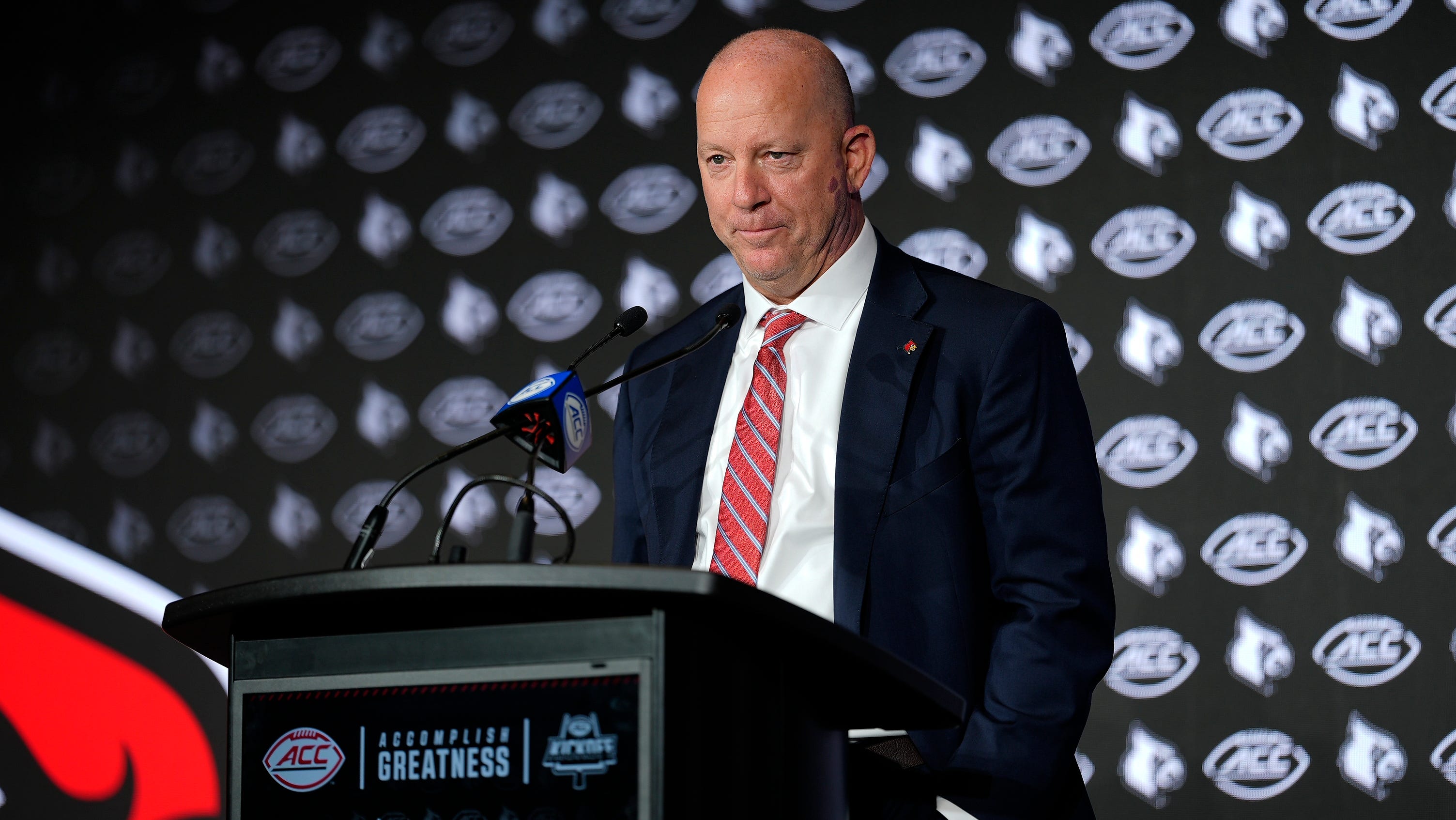


The C.L. Brown Show with U of L’s Jeff Brohm, Miller Moss, Chris Bell
The C.L. Brown Show hosts Louisville football coach Jeff Brohm, quarterback Miller Moss and receiver Chris Bell recorded on location at ACC Kickoff.
- Louisville athletics director Josh Heird told The Courier Journal Louisville is investing in the following programs: football, men’s basketball, women’s basketball, volleyball and baseball.
- Athletes from UofL’s other 18 sports will not receive any revenue-sharing money.
Welcome to the revenue-sharing era of college sports.
Judge Claudia Wilken approved the House vs. NCAA settlement in June, allowing schools to pay athletes directly starting July 1 with a per-institution cap of $20.5 million. That cap is set to increase annually by 4%. While opting in was ultimately optional, all current members of the traditional “Power Conferences” (ACC, Big Ten, Big 12, Pac-12 and SEC) did, according to a list published by the College Sports Commission — a new entity overseeing compliance with rules around revenue sharing, name, image and likeness (NIL) deals and roster limits established by the settlement.
Louisville athletics director Josh Heird sat down with The Courier Journal to discuss U of L’s approach to this new system. When asked how the department is dividing its $20.5 million budget among 23 varsity sports in 2025-26, Heird said Louisville is investing in the following programs: football, men’s basketball, women’s basketball, volleyball and baseball. Athletes from U of L’s other 18 sports will not receive any revenue-sharing money.
Heird did not answer how much of the $20.5 million is going into each sport, but he did say he approached each allocation with “ranges,” as opposed to rigid numbers. No coach feels like their program got a big enough slice, but that’s to be expected. From Heird’s perspective, it’s about what’s best for the athletics department as a whole. When football, men’s basketball and now women’s basketball — with the advent of an NCAA Tournament prize fund — succeed, that means more resources for Louisville athletics as a whole.
“It was more like, let’s try to, for lack of better terms, look at this as one team,” Heird said. “… If there’s an opportunity from another coach that says, ‘Hey, could we do something here from a rev-share standpoint,’ (we’re) willing to have that conversation. But for all intents and purposes, it’s those five programs.”
During a University of Louisville Athletics Association budget workshop meeting in May, Heird shared that implementing the terms of the House settlement would have about a $22 million impact on U of L’s budget. There’s the $20.5 million cap, $450,000 in additional operating costs and $1 million in reduced revenue from the NCAA as part of the $2.8 billion in backpay due to athletes who could not profit off their NIL between 2016-Sept. 15, 2024.
Louisville is in a relatively unique position.
Every school has to balance the checkbook by feeding its money-making sports more than the ones that don’t generate revenue. And for most schools that have shared their budgetary breakdown, that means dumping 75% into football, 15% into men’s basketball, 5% into women’s basketball and 5% to everybody else.
That’s what Georgia is doing. And Texas. Texas Tech decided on 74% for football, 17-18% for men’s basketball, 2% on women’s basketball, 1.9% on baseball and the rest on other sports.
Louisville, though, is a basketball town. More so than Athens, Georgia, or any Texas town, where football is king. U of L is in a class with Duke, Kansas, Kentucky and North Carolina (though that one is a little more complicated now that eight-time Super Bowl winning Bill Belichick is head football coach). In those communities, gridiron gains are greatly appreciated and undoubtedly profitable but don’t carry the same cultural weight as NCAA Tournament triumphs.
So Heird and his staff have to navigate a world where Louisville football is on the rise, eyeing ACC championships, College Football Playoff berths and all the extra cash that comes with each achievement; where men’s basketball is poised, in the eyes of some, to make its long awaited return to the Final Four; where women’s basketball is a consistent NCAA Tournament player; oh, and where volleyball and baseball are competing for national championships.
So how does one reckon with all of that?
“It’s a challenge,” Heird said. “… There’s always been some push and pull there relative to investment, but there’s more now. But if football and basketball for us aren’t successful, then everybody’s resources are going to get reduced. I think that’s what you’re really trying to reconcile. How do we make sure that we can provide the most resources to all of our programs?”
When considering how to allocate the inaugural revenue-sharing budget, Heird and his team weighed three main factors:
- Return on investment: Football, men’s basketball and women’s basketball are relevant here. In addition to cash flow opportunities from CFP appearances, the ACC’s new revenue-sharing model will distribute 40% of TV money evenly among the league’s 14 most longstanding members — which includes Louisville. The other 60% will be distributed based on football and men’s basketball ratings from the past five years. Men’s and women’s basketball also offer units for participation in the NCAA Tournament. Lots of opportunities to recoup costs and help fund Louisville’s other 20 sports.
- External impact of success, or good PR: A trip to the Men’s College World Series or a spot in the women’s volleyball national championship doesn’t equate to big paydays, but it does shine a positive light on U of L athletics. More so than a top-25 team finish at the NCAA outdoor track & field championship, as both Louisville’s men’s and women’s squads achieved this summer. Cardinals baseball saw a 27% year-over-year increase in social media impressions from 2024 (when the team didn’t make the NCAA Tournament) to 2025 (when U of L played four games in the MCWS), according to Learfield. The 2024 volleyball national championship between Louisville and Penn State drew 1.3 million viewers, peaking at 1.9 million, according to ESPN. Viewership and visibility are key.
- Coaching staffs with a proven track records: Last year, Jeff Brohm became the first Louisville football coach to win 19 games over two seasons since 2014. Pat Kelsey led the men’s basketball program to one of college basketball’s largest ever single-year turnarounds in 2024-25. Jeff Walz took the women’s basketball team back to the NCAA Tournament for the 16th time in 18 years. Dan McDonnell brought baseball back to Omaha for the first time since 2019. New volleyball head coach Dan Meske served as Dani Busboom Kelly’s associate head coach from 2017-2024, leading the Cards to two national championship appearances and three Final Fours.
“We try to base it on like, ‘Hey, what’s best for us?’ Right? As opposed to playing the comparison game of, ‘Well, I heard this school is giving X, or this school is giving Y.'”
Louisville, and other universities across the country, can use “true NIL deals” to work above the $20.5 million cap. Heird said he’s spent a lot of his time lately re-educating donors. They got accustomed to the old system, where pay-for-play payments reached athletes via collectives. But with the CSC-monitored clearinghouse NILGo, to which deals exceeding $600 have to be submitted and approved, those type of payments won’t fly.
“I talked to a group of donors last week,” Heird said, “and I just told them, ‘Look, guys, I wake up and there’s days that I’m not 100% sure what’s going on. This is my every day, right? Like, I get paid to follow all this and make sure we know what’s going on. You guys are fans, right? And so you know probably a 10th of what’s going on.'”
Rather than scrambling to keep up with ever-changing rules and regulations, federal legislation proposed by Congress and executive orders from the White House, Heird advises his donors to stick to authentic NIL agreements. What companies or corporations are interested in paying one or more athletes to promote a business or product? At this current juncture, those types of agreements feel the safest.
On the CSC and new system as a whole, Heird said:
“Do I think it’s gone as expected? Yes, as long as you expected that there was gonna be bumps in the road. And if anybody thought this was gonna be seamless, then joke’s on them. At the end of the day, as you’re trying to make the biggest adjustments that an industry has ever seen, if you don’t have this expectation that it’s going to be a little rocky, then you’re going to be disappointed.
“… We got a long way to go. And it’s not going to be six months from now. This is going to be a slow process, but hopefully in two or three years, it’s like, ‘Hey, we really have a good understanding of how college athletics is going to operate in the future.”
Reach college sports enterprise reporter Payton Titus at ptitus@gannett.com, and follow her on X @petitus25.