Henrik Haapalainen, Jelle Hoste, and Lazar Ðukić (from left) at the starting line of the 2024 CrossFit Games.
Michael Halpin


The sun was just beginning to rise on Marine Creek Lake in Fort Worth, Texas, and Lazar Ðukić was feeling confident.
A 28-year-old from Serbia, Ðukić was known in the CrossFit community for his easygoing attitude — a relentless optimism that showed up as a beaming smile, the first thing many people noticed about him. This morning Ðukić had good reason for his air of self-assurance beyond his usual upbeat nature. He was about to embark on a 3.5-mile run followed by an 800-meter swim — the first event of the 2024 CrossFit Games — and as a former water polo player who’d been a strong swimmer since the age of seven, he knew he was the front-runner in the men’s field.
“Somebody asked me what CrossFit is to me,” Ðukić had said in a video posted to his Instagram the day before the race. “It’s the only thing I’m good at,” he kidded. “This year, for me, the goal is podium — and to stay there for multiple years.”
David Shorunke, a former CrossFit Games athlete and coach of the athlete Emma Tall, saw Ðukić stretching and warming up by the finish line shortly before the race was set to start. Ðukić asked him if he could have a swig of water from his water bottle — already warm before dawn, the Texan heat was beginning to creep into the 90s. Still, Ðukić told Shorunke, he felt good: He had a solid plan. He knew what he was doing.
“Knowing how good he is,” Shorunke tells me later, “I was expecting him to win the event.”
As soon as the air horn blew to mark the start of the race, Ðukić tore off, leading the group for the run and during the bulk of the swim. On the television broadcast, in aerial shots and footage from the shoreline, it was clear to see Ðukić cruising through the lake toward the finish, well ahead of his competitors.
But after reaching the homestretch, he suddenly seemed to disappear, and he never appeared on the shore. Viewers were baffled: One moment he was visible, and the next he was nowhere to be seen.
Shorunke was at the finish line waiting for Tall to come ashore when Anja Pantović, Ðukić’s girlfriend, approached in a state of distress. (Pantović could not be reached for comment.) She didn’t know where Ðukić was, she told Shorunke, breaking into tears: She never saw him get out of the water. Shorunke reassured her that Ðukić was probably already at the athlete recovery area, that he was a strong swimmer and was almost certainly fine. But privately, he had his doubts.
“He should be out of the water now,” he remembered thinking. “That’s when I knew something wasn’t right.”
DESPITE ITS INTENSITY, CROSSFIT, as an exercise regime, has never been particularly dangerous — a 2013 study in the Journal of Strength and Conditioning Research found that CrossFit’s injury rate is 3.1 per thousand hours of exercise, which is about on par with weightlifting or triathlon training, two sports that are not considered unusually high-risk. But there are risks inherent in high-level athletic competitions, and competitive environments can drive athletes to perform not just at but beyond their capacity. Deaths occur even in seemingly benign settings where too much is demanded of the body: as recently as this past May, two college football players died on the same weekend during two separate marathon races, one of heatstroke and one of cardiac arrest.
The CrossFit workout methodology was developed by Greg Glassman, a former gymnast and personal trainer, in Santa Cruz, California, in the mid-1990s. It exploded in popularity in the late 2000s, in large part because its foundation — hour-long group sessions involving “constantly varied, high-intensity functional movements,” in Glassman’s original description — was accessible, effective, and infinitely scalable, meaning that anybody from any background could walk into a CrossFit class and get fitter. “The needs of Olympians and the needs of our grandparents differ by degree, not kind,” Glassman was famous for announcing, and CrossFit was meant to be a workout program for both. A typical hour-long CrossFit class might include some rowing, a few barbell squats, and a circuit of pull-ups and burpees, all of it scalable for different skill levels and focused on proper technique.
But outside of the gym, the methodology is represented by the CrossFit Games, the competition the company has hosted annually for nearly 20 years: Looking to crown “the fittest on earth,” this is the CrossFit of bare chests and rippling muscles, of barbells flying through the air. Originally conceived as a way to demonstrate the program’s efficacy by putting its strongest athletes to the test, the Games represent the tip of the CrossFit spear. Its several dozen competitors are the super elite, taking on the highest expression of the fitness regime enjoyed by hundreds of thousands of people at what a source close to the company says is more than 11,000-affiliated CrossFit gyms around the world.
The Games season begins each February with the CrossFit Open, an online qualifier open to anyone that at its 2018 peak attracted nearly half a million registrants. The top performers move on to in-person regional, quarterfinals, and semifinal events throughout the spring, and the best of the best punch their tickets to the Games in August. In the early days of the sport, weekend warriors vied for bragging rights and a modest cash prize, but over the past decade the Games have matured into a professional sport, with hundreds worldwide training as CrossFit athletes full time. And though the audience for the training regimen still leans heavily American, it’s taken off abroad, finding hot spots in Iceland, Australia, the Balkans, and beyond.
The company has long had a somewhat fraught relationship with the Games. The complex, multistage competition is incredibly expensive, owing to its gargantuan scale and high production values — in 2017, according to internal documents reviewed by Rolling Stone, more than 50 cents of every dollar the company earned was spent on the Games, while earning back only 25 cents — and while its broadcasts on ESPN are a kind of promotional tool, the expense is still difficult to justify, especially as the brand’s growth stalled out after the Covid lockdowns, when the fitness industry at large ground to a halt. (A source close to the company strongly denies the figures from the internal documents and says they are inaccurate.) The number of CrossFit gyms globally are down almost 30 percent from their high-water mark in the late 2010s, and its reputation took a serious hit in 2020, when Glassman was mired in accusations of racism and sexual misconduct, leading him to sell the company to the private equity firm Berkshire Partners. (Glassman has repeatedly denied the accusations.)
The 2024 Games were an important opportunity to justify the competition’s ongoing importance to the CrossFit brand and to put on a compelling show. I had flown to Fort Worth to cover the event for The New York Times, and in the lead-up, the organizers had expressed their enthusiasm for what they hoped would be a landmark edition. Dave Castro, a former Navy SEAL who had programmed the Games since their inception, had big plans for the event going in. “I’m doing a lot of things to help create buzz, create discussion, create awareness, create excitement, and sometimes to create controversy,” Castro told me in an interview a few weeks before the event. “I have no issue with controversy.… We’re going to lean into it, actually. And it’s going to be something that everybody is talking about because of that.”
He couldn’t have known it at the time, but the 2024 Games would prove to be the most controversial of his career.
SHORTLY BEFORE DAWN ON THE MORNING of Aug. 8 in Fort Worth, where the Games were being held for the first time, the 78 men and women competing in the 2024 CrossFit Games peeled off their shirts and jogged back and forth around the rugged, lopsided lot that was their designated warmup area near Marine Creek Lake.
At 6:35 a.m., just under a half-hour before the race was to begin, Castro called athletes to the shoreline to announce a change. The day prior, during an event briefing, Castro had outlined the race course on a whiteboard, marking dots to chart where buoys would be placed along the lake. Castro explained that these buoys were to be kept to the athletes’ left, and that straying from this course would result in a penalty. Now, he was revising the rule. The buoys would still be there, but the athletes just had to make it from the boat ramp to the finish line, and they could swim on either side of the buoys. They can be seen swimming far from the buoys in the video, and they say they weren’t penalized for it.
Castro had sprung these sorts of last-minute changes on athletes often enough that some had come to anticipate them. “We’re used to that,” Emma Tall tells me. She’d scouted the lake earlier to find something on the opposite shore, like a big tree, that she could use to orient herself, just on the off chance that the buoys never materialized as promised. “You prepare for that to happen,” she says. “I don’t trust it.” The buoys had offered some security, in the form of some much needed visual orientation. Without being oriented by them, the athletes would be spread out more haphazardly across the span of the lake. (A source close to the company says staff always know about the details of the competition well in advance and plan for them. On rare occasions, changes are made based on discoveries during rehearsals or due to weather.)
The athletes had been given brightly colored swim caps as a safety precaution, and they were required to keep them on at all times. Pat Vellner, an athlete from Canada, later asked whether they would be penalized if they lost their cap on the run. If you lose it, no big deal, he remembers being told — which as far as many of the athletes were concerned meant they didn’t have to wear the caps at all. Half a kilometer into the race, “you’re seeing caps all over the trail,” Vellner recalls. “Within 100 meters, I took mine off, because my head was fucking boiling.”
Henrik Haapalainen, Jelle Hoste, and Lazar Ðukić (from left) at the starting line of the 2024 CrossFit Games.
Michael Halpin
It was 7:20 when the first athletes kicked off their shoes and trotted down the Ten Mile Bridge boat ramp to begin a grueling 800-meter swim. They were looking forward to some relief from the sweltering air of the Trinity Trail, which during their 3.5-mile sprint had already reached a balmy 93 degrees. Instead, it felt like they were diving into a jacuzzi. “It’s such a weird thing to get in the water and not have it be refreshing — for the water to feel hotter than it felt outside,” one of the athletes tells me.
Several volunteers were on the water on stand-up paddleboards. Some were medics and wore red shirts; others were judges, there to keep athletes on course, and wore blue. Before the race, Games staff had divided the judges into two groups, with half assigned to the race on land and half on water. According to the reporter Mike Halpin of the CrossFit blog Known and Knowable, who conversed with some of the volunteers on-site, they were never asked whether they had experience on the water, and neither the judges nor the medics were given whistles or floatation devices for use in emergencies. (Other athletes confirmed they didn’t see flotation devices, and they weren’t visible in video of the race. A source close to the company says the safety personnel on the water had specific water-rescue experience.)
Athletes were required to use goggles that had been provided by a sponsor, and as they hit the water, many athletes found that the goggles were immediately fogging up. At the same time, the sun was peaking over the horizon directly into their line of sight, making it all but impossible to see. “It was pure white-out,” Vellner says. “You couldn’t see anything.”
It was too much for Elisa Fuliano, an Italian athlete, who started to have a panic attack. Hot, tired, and disoriented, with her heart rate spiking out of control, she felt terrified, like she was on the verge of drowning. Arms bumped her as others swam past, and she did her best to follow their general direction. It was her impression based on past events that if she asked for help, she would be disqualified — not only from the race, but from the entire weekend of competition. But she was desperate enough to accept the consequences.
“At that moment, I just wanted to be out of the water,” she says. “But when I looked around, no one was there. I saw nobody.”
She managed to struggle, one slow breaststroke at a time, to the other side of the lake. She was no longer thinking about the competition. She was thinking about her family — about surviving.
It was only as she approached the finish line, 18 minutes later, that Fuliano finally saw a medic in a red shirt standing on a paddleboard. She couldn’t believe it: Where were the rest of them? As she dragged herself out of the lake, she was grateful to be alive. “I love sport, but that seemed like war, not a workout,” she says. “It was about having to survive. That was not the CrossFit that I like.”
AT 7:38 A.M., TWO MINUTES AFTER BELGIUM’S Jelle Hoste crossed the finish line to take first place, Brian Friend, an analyst and commentator who reports on CrossFit, sent a text to a colleague about the race. “I was wrong,” he wrote. “Lazar died lol.”
What he meant was that Ðukić seemed to have given up his comfortable lead, and that their initial speculation — that Ðukić had slowed to a crawl over the swim’s final stretch to conserve energy and coast to a win — was wrong. The guy was clearly struggling. Any second now he would surely be limping across the finish line to secure second.
Ðukić was born in Novi Sad and raised in Temerin, in the Serbian province of Vojvodina. He first discovered CrossFit while training to be a lifeguard in the United States, when a roommate introduced him to “Murph,” a legendarily hard CrossFit workout involving push-ups, pull-ups, and air squats while wearing a weighted military vest. Ðukić was hooked right away, and when he returned to Serbia, “immediately my goal was to qualify for the Games,” he said in a video interview about a month before the Games.
He and his younger brother, Luka, trained together regularly, and Ðukić’s preternatural talent for the methodology, combined with his natural tenacity, made him a rising star: In 2017, he was the top-ranked CrossFit athlete in all of Serbia, where the sport has seen steady growth, and in 2021, he ranked in the top 10 of the CrossFit Games in his rookie year.
Swimming isn’t typically part of day-to-day CrossFit — few, if any, CrossFit gyms have swimming pools on site — but swim events are a staple of Castro’s Games programming. Many of the top Games athletes struggle inordinately with these events, but Ðukić’s background in water polo has always given him a natural advantage there, which is why so many spectators had him pegged to win the race.
Over the next two minutes, a number of other racers emerged from the water: Brent Fikowski, Tia-Clair Toomey-Orr, Roman Khrennikov, Ricky Garard. But as Friend could not help but notice — with increasing alarm — still no Ðukić. “Dude,” he texted in follow-up. “Is he even OK?”
Around 7:40 a.m., there was a flurry of action around the shore. Jessica Smith, a spectator, told CrossFit blog the Morning Chalk-Up that she thought she saw someone struggle in the water, and she started screaming: “He’s drowning!” She tried to hail two volunteers on paddleboards — one a medic, the other a judge. She urged her boyfriend, a former Marine, to jump into the water to help, but as soon as one of the paddleboarders saw him enter the lake, he was reprimanded and directed to return to shore.
Another spectator, Shanna Medeiros — mother of two-time Games winner Justin Medeiros — told the Morning Chalk-Up after the race that she was “99.9 percent sure” she saw someone drowning near the boat ramp. She says she’d also tried, and failed, to get the attention of CrossFit Games staff, until a volunteer told her that “all male athletes are accounted for” and not to worry.
At 7:41 a.m., announcer Larry Moss made a call over the loudspeaker reporting that “Ðukić, Lazar” was “heading towards that finish line.”
Friend felt a momentary wave of relief — until he looked at the finish line and saw that it was in fact Luka Ðukić, Lazar’s younger brother, who was exiting the water and had been misidentified by Moss, who quickly corrected himself.
The Fort Worth Fire Department responding on Marine Creek Lake, Aug. 8, 2024.
GDA/AP Images
Ðukić and his brother Luka had long been inseparable. Three years younger than Ðukić, Luka was a longtime soccer player who nearly went pro before an injury to his fibula sidelined him indefinitely. The two would always wrestle and fight as kids, though Ðukić “was so much stronger than me, so I didn’t have much chance back then,” Luka said in an interview shortly before the Games. It was during Luka’s recovery from his soccer injury that Ðukić suggested he give CrossFit a try. He became obsessed, too.
The brothers trained side by side at their garage gym in Serbia, although as Luka pointed out, they didn’t do the same program: They worked with different coaches, giving their work together a playfully competitive edge. This was the second time that the brothers would be competing at the Games together. When Ðukić won a European semifinal event earlier in the year, thereby qualifying for the Games, he used the spotlight to beam about Luka: “This doesn’t mean as much as my brother qualifying and us going back together,” he told the crowd in Lyon, France, last May. “To me, that’s the biggest impression of this weekend — us going back together, us preparing for the Games together.”
Of the two, Ðukić was the stronger athlete, particularly in swimming. So when Friend heard the announcement and saw Luka coming out of the water, his heart sank. “Knowing the two of them, Luka’s never beating Lazar on that workout,” he says. “That was the first time I was genuinely concerned for his life.” (Luka declined to comment for this story.)
As the athletes gathered in the recovery area nearly an hour after the start time, cooling down in ice baths, Luka and Pantovic hurried from person to person, asking whether anyone had seen Ðukić. No one had. Some thought maybe he had retreated to the parking lot after a disappointing performance. Others heard rumors — no one knew where they began — that he’d swum off course and had been found on a different shore. CrossFit staff only seemed to add to the sense of confusion. Shorunke remembers a staffer telling Luka that the team had eyes on Ðukić, and that his chip timer passed the finish line.
They didn’t, and it had not. Yet Castro himself told Luka, around this time, not to worry: “We’ve found him,” he said. Shorunke, who overheard these remarks, was mystified by the air of certainty. They were insisting they had found the man. “But they hadn’t,” he says. “They hadn’t found him.”
Castro said in a statement to Rolling Stone, “Lazar’s passing was a profoundly tragic moment for our community and for me personally. My own reflections on that time and the findings of the third-party investigation are now informing how we operate as an organization today and beyond. I have always taken the well-being and success of our athletes seriously, and we have made significant changes to improve safety protocols across the board. My focus is now on delivering the best of CrossFit to the 2025 Games and my hope is that the entire CrossFit community can come together to move forward.”
At the lake, Shorunke was struck by how disorganized the response seemed. “I can’t see them talk to each other, but I can see what’s happening, I can see them running around like headless chickens, and I can twice hear people say they’ve found him when they haven’t,” he says.
As it neared 8 a.m., and as it was becoming painfully clear that Lazar had not actually been located, organizers placed a call to emergency services, according to the police call record, while medics and judges on paddleboards searched along the shore. Shorunke and some others jumped into the water near where Ðukić was last seen, hopelessly peering into the 40-foot depths for any trace of him, as concerned spectators huddled around the lake, watching with mounting unease. “All I could think about was that he must have swam to shore somewhere else, because it feels absolutely impossible that he has drowned, it doesn’t enter your mind as a reality,” Tall says. But the more time passed, the more undeniable the truth became. “You know most likely what has happened, but you just can’t believe it.”
Another group of athletes, competing in teams and meant to start their heat at 8 o’clock, were dismissed from the starting line and told that their race had been postponed. Although no one knew anything for sure, social media was already alight with speculation; local police were on-site asking questions, and shortly after 8:00, rescue boats were spotted on the water, as a team of divers prepared to search for a body around the floor of the lake. Those still there could tell that the news was bad.
In the warmup area, there was a section set aside for storage. By 8:10 a.m., it was nearly empty, as most athletes had already cleared out.
Only one bag remained. It was Ðukić’s.
Lazar Ðukić is pictured on his Instagram account. He died during last summer’s CrossFit Games.
GDA/AP Images
THE INAUGURAL EDITION OF THE CROSSFIT Games was held on Castro’s family ranch in Aromas, California, but within just a few years, the competition ditched its backyard-barbecue feel for something more extravagant, held in sports stadiums and costing many millions of dollars, bankrolled by the company’s growth, which was accelerating as CrossFit gyms cropped up all over the world. As the competition expanded, so too seemed Castro’s ambition to go bigger and bolder.
Dr. Adam Schulte, a former medic at the Games, took a dim view of how CrossFit approached athlete safety. “They do not treat athletes the way that other organizations treat their athletes,” he says. “They’re expendable. They’re disposable.”
Schulte points to the 2015 CrossFit Games, at the StubHub Center in Carson, California, where he witnessed firsthand competitors taking on “Murph,” a brutal 40-minute gauntlet involving pull-ups, push-ups, and two miles of running while wearing a military-style weighted vest in extreme heat: Several athletes suffered from heatstroke requiring medical attention, while 18-year-old Maddy Myers was hospitalized with rhabdomyolysis, a potentially life-threatening condition involving the rapid breakdown of muscle tissue due to overexertion. After the event, Schulte went public with his concerns about what he thought was a failure to prepare for extreme heat conditions and indifference to medical precautions.
Water events had been a problem before. During a run-swim-run event at the 2017 Games, 57-year-old athlete Will Powell was rescued by a fellow competitor after he struggled in the water and nearly drowned, while former Games champion Mat Fraser once struggled with an open-water event and feared for his life, according to his former coach Chris Hinshaw.
“The ethos of the CrossFit Games has always been ‘How far can we push people?’” says Alyssa Royse, a former CrossFit gym owner who has been outspoken about the company in the past. “It isn’t always a test of strength. Sometimes it’s just a test of fealty — or stupidity.”
THE COMPETITION FLOOR AT DICKIES ARENA the afternoon after the race was eerily silent.
It was a little after 4 p.m., and several hundred athletes, coaches, and staff members from CrossFit’s head office were assembled in the center of the cavernous stadium, waiting to hear Dave Castro, in his customary cap and tight-fitting T-shirt, address the crowd. Nothing had been made official, but nearly everyone had seen the local news reports: Lazar Ðukić had been declared dead, his body discovered by divers and extricated from the lake shortly after 10 a.m., in what the Tarrant County Medical Examiner’s office later deemed an accidental drowning. They were waiting now to hear what CrossFit intended to do in response.
Castro entered and strode into the middle of the room. He started to speak, then stopped, as if thinking better of it; he stood there, silently, for a long time. No one moved.
Finally, he made his brief announcement. He told the athletes that they would be continuing with the CrossFit Games. The athletes recall him acknowledging the tragedy, then adding abruptly, “We have the family’s blessing to carry on. Any questions?”
The room was stunned. Nobody seemed to know what to say. Castro, a former Navy SEAL, was not exactly renowned for his emotional depth — “My wife says I’m a sociopath,” he once joked in a behind-the-scenes Games video. But this seemed insensitive even for him.
It was Kara Saunders, who had competed in the Games 11 times, who at last spoke up. “That’s it?” she remembers saying. “Someone just died, and you come out here and we just go on with the CrossFit Games? We just pretend that nothing happened?”
“No, no, no, I’m not pretending nothing happened,” Castro quickly insisted. But he’d spoken to the family, he explained. And the family wanted them to go on with the Games.
At that, Laura Horvath, 2023’s Games champion, walked out of the room. Several other athletes followed. Those who remained erupted in debate — some felt the Games should continue as normal, while others thought it should be canceled entirely. Many argued that the Games should play out as a kind of exhibition in Ðukić’s honor, with the prize money — more than $3 million — split among the athletes and the Ðukić family.
The athletes were divided. Some, especially those who knew Ðukić, were appalled by the idea of carrying on as normal, and some withdrew as soon as it became clear that the Games were continuing. Many athletes were visibly distraught, weeping and barely able to keep it together. A few others seemed to shrug off the episode — callously, it seemed to some of those present. “I don’t see what the big deal is,” one athlete complained. “Yeah,” another agreed. “People die every day.”
Castro reiterated that he’d spoken to Luka, Ðukić’s brother, and that Luka was in favor of moving ahead: “He said that this is what Lazar would want, to go on,” Castro insisted. For one conflicted athlete, this was the most compelling reason to continue competing. “We’re like, ‘Alright, I think this is weird, it still doesn’t feel right, but this is his brother,’” Saunders remembered concluding. Eventually, Castro sent out a survey to athletes by email, and soon reported that the majority was in favor of moving ahead with the Games, too.
Late that night, Brian Friend was at his hotel room, unable to sleep. Around 3 a.m., he sent a message to Luka, offering his condolences. Luka instantly started a video call. He had something to clear up.
According to Friend, Luka explained that Castro showed up to his hotel room that afternoon with Nicole Carroll, CrossFit’s chief brand officer. Luka had just learned that his brother’s body had been recovered from the bottom of the lake, and he was still sitting in his wet swimsuit, trying to absorb the shock. In Luka’s account to Friend, Friend recalls, Castro told Luka that they wished to continue with the Games as a tribute to his brother.
Luka equivocated. He wasn’t thinking clearly, he said, and he was not in the state of mind to make such a big decision. “I don’t fucking care,” he told Castro. “Do whatever you want.” He told Castro that this shouldn’t be up to him.
Castro replied that it wasn’t up to him anyway. After the Games, Luka described this incident on his Instagram account, objecting to Castro’s version of events. Castro apologized on his own Instagram account shortly thereafter. “I should never have said that the decision to continue the CrossFit Games in August was ‘blessed’ by their family,” he wrote. “I’ve never been in a situation like that before and I absolutely made a mistake.”
The CrossFit Games started back up on Friday afternoon, a little more than 24 hours after Ðukić drowned.
WHEN I SPOKE TO DON FAUL, CrossFit’s CEO, later that weekend, he told me that the company had already initiated a third-party investigation, and he emphasized the importance of having “to ask questions about what happened here” and to make changes based on what came to light. “Our intent has been to be transparent about that,” he told me, “and we will continue to be.”
But in the months that followed Ðukić’s death, it became apparent that no answers would be forthcoming. When, this past November, the third-party investigation came to a close, CrossFit announced that “the results of the investigation have been reported to our Board of Directors,” but that it was “not publishing a full report based on privacy and legal considerations.” CrossFit instituted a number of changes in response to the investigation, including the creation of a new safety board and the suspension of all open-water swimming events.
In a statement to Rolling Stone about Ðukić’s death, CrossFit said: “CrossFit has been fundamentally transformed by Lazar’s tragic passing and we reject the criticism that we did not take this tragedy seriously — our actions prove otherwise. CrossFit has since delivered on every one of its safety commitments and is continuing to make further operational changes. These commitments include hiring a new Head of Safety, establishing a Safety Advisory Board and community-nominated CrossFit Athlete Council, suspending all open water swim events for the foreseeable future, with more safety improvements to come in advance of the 2025 Games. As an organization, we are choosing to focus on delivering a safe and successful CrossFit Games for our athletes and the broader CrossFit community going forward.”
The athlete council, an independent group of representatives from the professional CrossFit community, was created to liaise with CrossFit’s leadership in order to facilitate communication and address any ongoing concerns. Taylor Self, a member of the council, tells me that one of the council’s first demands to CrossFit was to show them the results of the investigation so that they could help make recommendations for athlete safety. CrossFit declined. “We didn’t get the investigation,” Self says. “They said they’re going to continue to follow their legal counsel which was to not release the results to the public.”
“The ongoing criticisms from CrossFit’s detractors about not disclosing the extensive details of this tragic death does not serve our community in any constructive way,” a representative for CrossFit says in a statement. “The CrossFit organization has been heads down making changes to support the safety of our athletes at future CrossFit Games. We believe the more important takeaway is that this investigation drove action and that CrossFit is implementing changes. “
CrossFit’s founder Greg Glassman recently said to me, “What needs to be done now from the mothership’s perspective, or the perspective of truly caring about people, is figure out what happened so that we can prevent it from happening again.” No longer involved in CrossFit’s operation, Glassman’s been observing from afar, and he hasn’t been impressed with how the incident has been handled. “The fact that the whole thing is sealed up, the idea that they hired someone to investigate the thing and then for the sake of the family are keeping the results hidden — I call bullshit.”
The continuation of the status quo was too much for some people. In the wake of the tragedy, many of the sport’s top athletes announced they wouldn’t be competing in this year’s CrossFit Games, including Vellner, Fikowski, and Chandler Smith. “I felt that they were responsible, that this accident was preventable, and I was doing the same thing I’d always done, which was just carrying water for them in some way by going out and competing,” Smith tells me. “I need to accept that this is never going to change.”
Amateurs have followed suit. The CrossFit Open, CrossFit’s annual global competition, saw a more than 30 percent reduction in registrations in 2025, according to data available on the official CrossFit Games app. More than 12 percent of CrossFit gyms worldwide have canceled their affiliations or closed down entirely over the past year, likely in part as a result of an increase in affiliate fees implemented at the beginning of 2024. In March, the company’s owners, Berkshire Partners, announced that the brand was for sale, explaining only that it was “now time to seek out a new owner for our next phase of growth.”
For Chris Hinshaw, who is now coach of CrossFit Games athlete Jeff Adler, you don’t need an investigation to tell you that “Lake Day” was badly planned. “That was very eye-opening to me,” he says. “You put more people on the water.… You make sure there are personal flotation devices. You make sure they’re swimming on one side of the buoys. You make sure they have their own goggles … these things. Because of where I’ve been as a swimmer, in open water and triathlons, where you know how events are done, it was shocking to me what I saw.”
“Everybody just wants to be like, ‘Well, he drowned, and we missed him in the two split seconds that happened,’” says Known and Knowable’s Halpin, who covered the accident extensively and compiled a thorough timeline of the race. “No. The whole thing wasn’t officiated very well. And in that process, this happened.”
This was the first time in the nearly 20-year history of the Games that an athlete had died, but for some, such an accident was in some ways inevitable. “This is the culmination of 10,000 bad decisions,” Friend says. “It’s not a one-off thing.”
In May, I traveled to Montpellier, France, for the French Throwdown, a CrossFit-sanctioned competition that serves as one of several semifinal events for qualification to the 2025 CrossFit Games. During the final event of the weekend, one of the competitors, Mirjam von Rohr of Switzerland, collapsed on the competition floor while working out, apparently having overexerted herself. Her right arm twitching, it was instantly clear that something was very wrong — and within moments, medics swarmed the floor treat her, and soon carried her away on a stretcher.
Von Rohr made a quick recovery, no doubt thanks in part to the swift response of the medical team.
On the morning after Ðukić’s death, the remaining athletes gathered at the arena for a brief tribute to him. Competitors and volunteers were marched out onto the floor in black shirts, stood in silence for a few moments, and then withdrew, as a short slideshow looped on the jumbotron.
Luka seemed to speak for everyone when he posted a photo of the tribute on Instagram later that day. He wrote, “No tribute will ever give you back to me.”
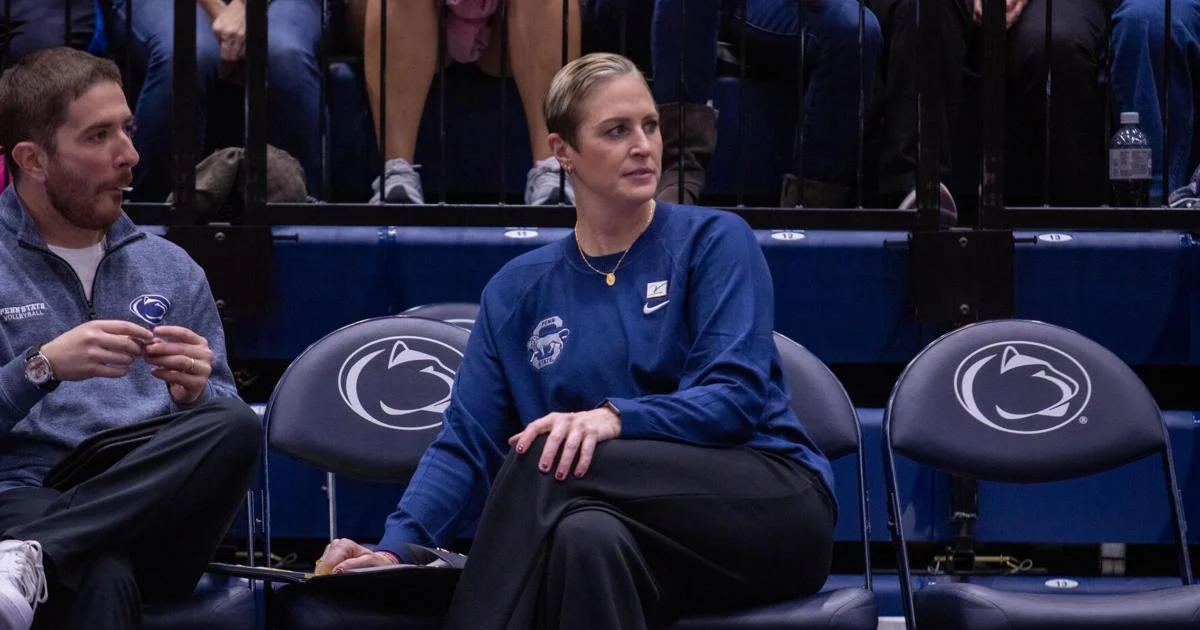
Penn State landed its second commitment in the transfer portal of the day.
The Nittany Lions earned a commitment from outside hitter Whitney Lauenstein.
Lauenstein was previously at Texas and Nebraska before transferring to her third school, Penn State.
Lauenstein adds depth to the right side and outside, which is already pretty deep for the blue and white.
The Waverly, Nebraska, native had her best season in 2022 with the Cornhuskers, totaling 297 kills, with 2.78 kills per set and a .238 hitting percentage. She added 28 aces as a premier server, which could be a major part of her role with the Nittany Lions.
She’ll make her way to Happy Valley as a graduate transfer with one year of eligibility.
MORE VOLLEYBALL COVERAGE
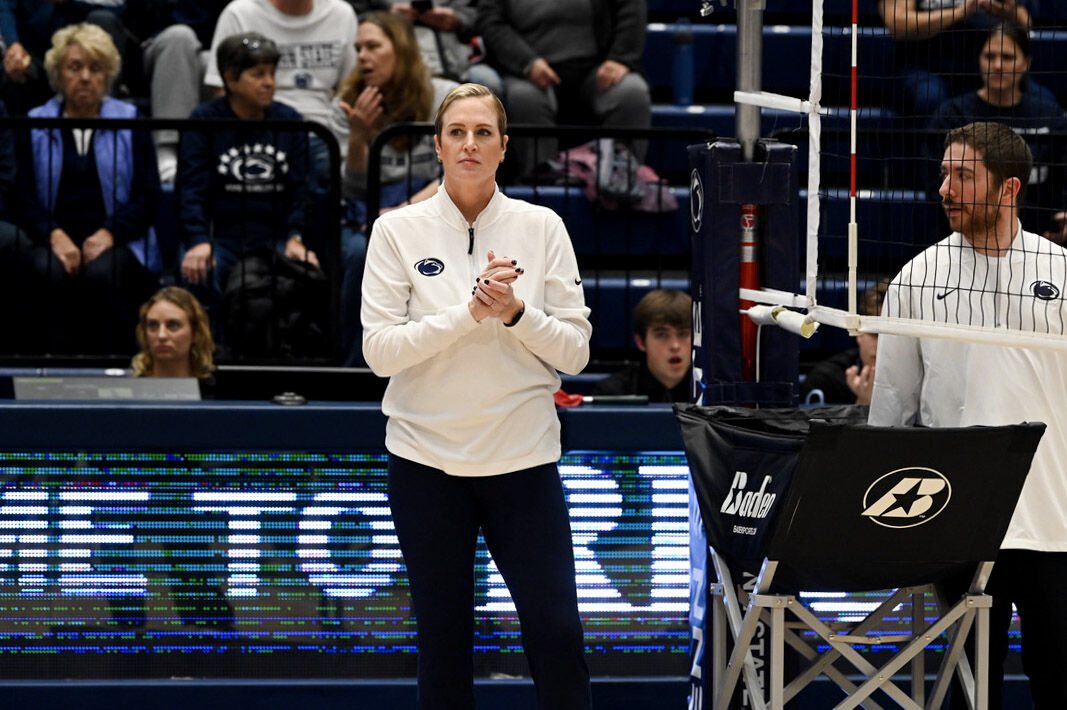
Penn State earned another commitment from the transfer portal.

Texas outside hitter Whitney Lauenstein announced her commitment to Penn State women’s volleyball out of the transfer portal on Wednesday. Lauenstein posted her decision to transfer to Happy Valley on her Instagram.
As a redshirt senior this past season, Lauenstein logged 33 kills, 11 digs, and 14 total blocks across 20 sets for the Longhorns.
Lauenstein began her NCAA journey with two seasons at Nebraska. As a sophomore, she led the Cornhuskers in total points, earning AVCA All-Region Team and Academic All-Big Ten honors.
After the 2022 season, the Waverly, Nebraska, native stepped away from the team to focus on her family. Lauenstein then transferred to Texas in December of 2023, where she spent the last two seasons.
Lauenstein now joins setter Alexis Stucky and middle blocker Ryla Jones as transfer players who have committed to the Nittany Lions this cycle.
Please choose an option below.
OR

Updated Dec. 24, 2025, 10:22 a.m. CT
A Marquette volleyball All-American is joining the national champions.
The Golden Eagles’ Natalie Ring announced on social media on Dec. 23 that she will use her final season of NCAA eligibility at Texas A&M.
Ring, a former Madison Edgewood High School standout, was a third-team All-American this season. She ranked 25th in the nation in kills with 497. Ring has 754 kills in her career.
“We are excited to add Natalie to our Aggie family here in Aggieland,” Texas A&M coach Jamie Morrison said in a statement. “She brings a wealth of experience as a well-rounded outside hitter and is a relentless competitor who consistently raised her level against the best competition.”
Ring helped lead the Golden Eagles to the second round of the NCAA tournament under first-year coach Tom Mendoza. MU lost in five sets to host Louisville.
Texas A&M went on a magical run to the national title as a No. 3 seed, beating three of the tournament’s No. 1 seeds, culminating in a sweep of Kentucky in the title game.
Ring is the second key player to leave MU’s team. Freshman setter Isabela Haggard announced a transfer to Baylor after recording 997 assists and 257 digs.
Mendoza has added Ball State’s Carson Tyler, the Mid-American Conference player of the year who will have two seasons of eligibility. She registered 506 kills, which was 18th in the country.
Updated Dec. 24, 2025, 12:56 p.m. ET
Pitt volleyball’s fifth consecutive trip to the NCAA Tournament national semifinals ended with another heartbreak following an upset loss to the eventual champions, the Texas A&M Aggies. But the Panthers have reloaded for next season with one of the biggest names in the transfer portal.
The Panthers announced the signing of former Penn State setter Izzy Starck on Tuesday, pairing the 2024 AVCA National Freshman of the Year with Olivia Babcock, the two-time AVCA National Player of the Year.
“I’m so excited I cannot wait for next season to start,” Babcock wrote on Instagram. “WOOOOHHOOOO.”
Starck had a breakout freshman campaign at Penn State, recording 1,483 assists (10.89 per set), 342 digs, 112 kills and 99 blocks. The Big Ten Freshman of the Year led the Nittany Lions to a 35-2 overall record under head coach Katie Schumacher-Cawley and the program’s eighth national championship.
The 6-foot-1 setter appeared in four games for Penn State before stepping away for the season to prioritize her mental health. Starck said her hiatus wasn’t a “goodbye forever,” but her time at Penn State officially came to an end when she entered the transfer portal earlier this month.
“I am very excited to announce that I will be entering the transfer portal this December. I look forward to finding a new home where I can grow in the next chapter of my career,” said Starck, who has three years of eligibility remaining after redshirting her sophomore season. “I am beyond grateful for the endless support I’ve received over the past months.”
Starck joins a championship contender looking to finally get over the national semifinal hump. Pitt advanced to the 2025 NCAA volleyball Final Four for the fifth consecutive year, but the No. 1 seed Panthers were swept 29-27, 25-21, 25-20 by No. 3 seed Texas A&M. It marked the first time Pitt had been swept all year and the Panthers’ fifth straight time falling short of a national championship berth.
Pitt is in search of its first national championship appearance and first national title.
The USA TODAY app gets you to the heart of the news — fast. Download for award-winning coverage, crosswords, audio storytelling, the eNewspaper and more.
Dec. 24, 2025, 10:30 a.m. CT
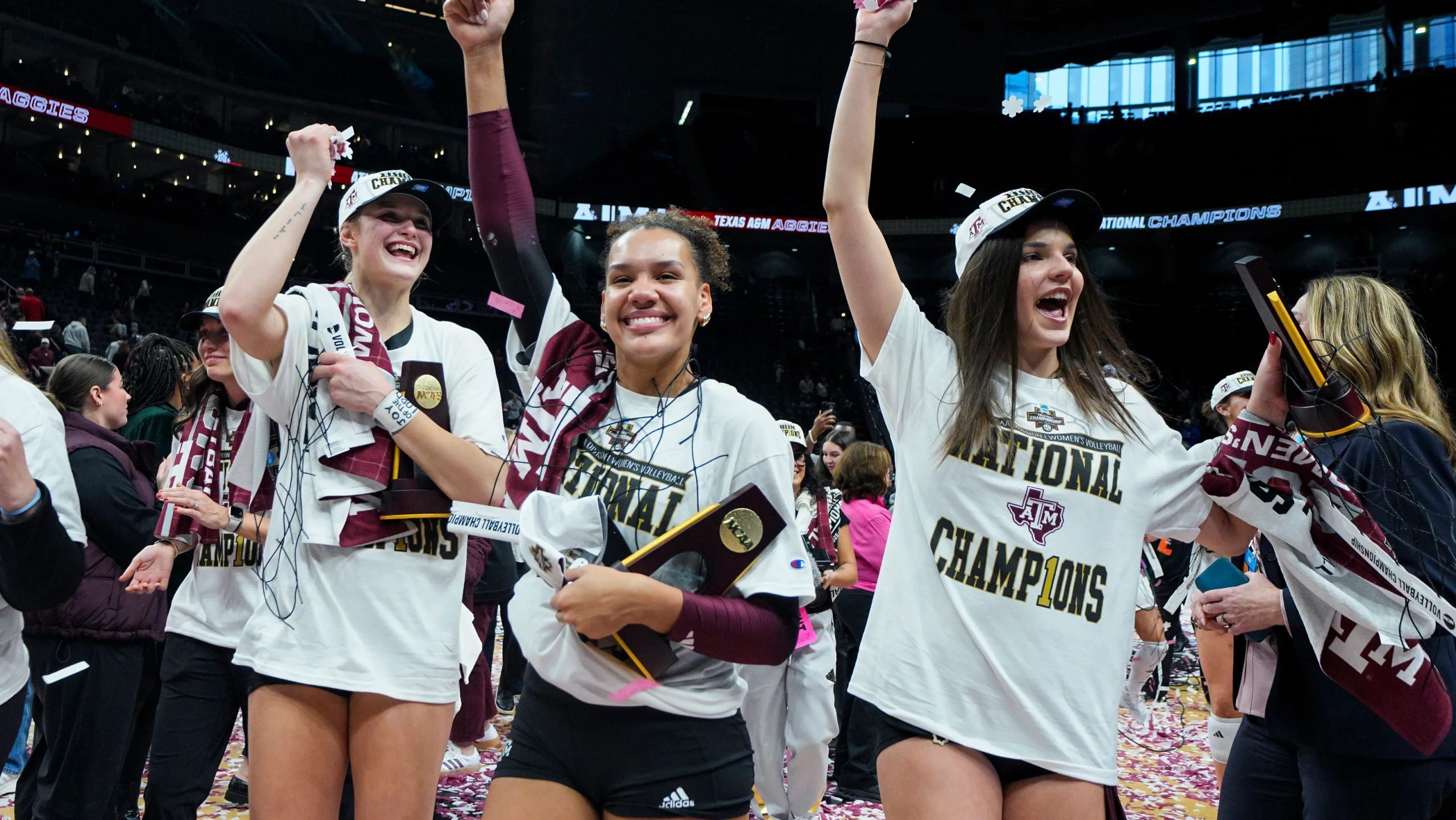
Texas A&M’s first-ever NCAA Championship win over the Kentucky Wildcats on Sunday was one of the most-watched title games in college volleyball history.
The 2025 campaign has featured many first-time achievements for Jamie Morrison’s squad in just his third year as head coach in Bryan-College Station, Texas, including a victory in the No. 2-most-watched NCAA title game ever. Texas A&M’s match against Kentucky attracted a peak of 1.7 million viewers, as part of the most-consumed NCAA Women’s Volleyball Tournament in the history of the sport.
The Aggies have much to be proud of following their historic run on the court this season. Still, the Maroon and White faithful have also played their own crucial roles in supporting the program as it ventured to some of the most hostile road environments in volleyball. One of those rowdy atmospheres occurred in the Lincoln Regional, where Morrison’s squad dethroned No. 1 seed Nebraska in an instant classic that advanced the Aggies to their first-ever appearance in the Final Four.
Texas A&M’s outstanding season, capped off by a sweep of the Wildcats in the NCAA Championship, played a massive role in etching their name into the viewership history books.
The wheels never stop turning, however. Morrison went straight to work and immediately made a splash in the transfer portal by landing commitments from Ohio State middle blocker Kaia Castle and Marquette outside hitter Natalie Ring. While it hasn’t even been one week since Texas A&M brought the national title to College Station, Morrison and company are already turning their heads to focus on building another stacked roster eager to make more history in 2026.
That approach to recruiting and rebuilding is a massive reason for the Aggies’ recent success on the court under Morrison’s watchful eye. The talented athletes like Logan Lednicky, Ifenna Cos-Okpalla and the NCAA MVP Kyndal Stowers have molded this winning culture, which the stars of the future in the Maroon and White will look to build upon and surpass moving forward.
Contact/Follow us @AggiesWire on X (formerly Twitter) and like our page on Facebook to follow ongoing coverage of Texas A&M news, notes and opinions. Follow Dylan on X: @dylanmflippo.



SoundGear Named Entitlement Sponsor of Spears CARS Tour Southwest Opener

Donny Schatz finds new home for 2026, inks full-time deal with CJB Motorsports – InForum

How Donald Trump became FIFA’s ‘soccer president’ long before World Cup draw


David Blitzer, Harris Blitzer Sports & Entertainment

JR Motorsports Confirms Death Of NASCAR Veteran Michael Annett At Age 39
Elliot and Thuotte Highlight Men’s Indoor Track and Field Season Opener
West Fargo volleyball coach Kelsey Titus resigns after four seasons – InForum


Rick Ware Racing switching to Chevrolet for 2026


DeSantis Talks College Football, Calls for Reforms to NIL and Transfer Portal · The Floridian

#11 Volleyball Practices, Then Meets Media Prior to #2 Kentucky Match