
Rec Sports
Longtime Midland sports official dies


MIDLAND, Texas (KOSA) – A longtime West Texas sports official known for his dedication to youth athletics has died.
According to a post by Midland – Northern Little League, Dal Watson, a well-known figure in West Texas athletics and a longtime supporter of youth and high school sports in Midland, has passed away.
Watson was a respected official who served as a football and basketball referee and an umpire for baseball.
Over the years, he became a familiar and trusted presence on fields and courts across the Permian Basin.
He played football at Odessa Permian High School and later at Texas Tech University before turning his lifelong passion for sports into decades of service to the community.
Watson was deeply involved in Northern Little League and was a key figure in the Midland Junior Baseball Association, helping grow the game for young athletes throughout the region.
Known for his ability to connect with players of all ages, Watson earned widespread respect not only as an official but also as a mentor and friend.
“We lost more than just an official — we lost a role model,” said one colleague.
Details about memorial services were not immediately available.
Watson is survived by his family, who ask for privacy during this time.


Copyright 2025 KOSA. All rights reserved.

Continue Reading

The US Supreme Court will hear two challenges to state laws restricting transgender participation in youth sports, marking the justices’ first return to transgender rights since last year’s decision in United States v. Skrmetti.
The court in Skrmetti upheld a Tennessee ban on gender-affirming care for minors, but declined to answer whether transgender individuals constitute a quasi-suspect class deserving of higher judicial scrutiny.
Transgender Rights Under Trump: Policy Battles and Legal Fights
The youth sports cases could give the court’s conservative majority an opportunity to answer that question and grant states wider discretion in imposing transgender-related regulations.
At issue in the cases being argued Tuesday is whether states may categorically bar transgender girls from competing on girls’ sports teams based on biological sex — and whether such policies should be reviewed deferentially, as the court held in Skrmetti, or subjected to heightened judicial review.
“What’s happening in Skrmetti, and what might happen here, is just saying, no, this isn’t sex discrimination at all even if the government is using sex,” said Yale Law School professor Douglas NeJaime. “And that is a real narrowing of decades of sex equality law.”
Skrmetti represented a setback for transgender rights, five years after the landmark victory in Bostock v. Clayton County for nationwide workplace protections for LGBTQ+ individuals under Title VII of the Civil Rights Act of 1964.
Prior to Skrmetti, lower courts had been able to interpret Bostock broadly, Nejaime said. But last year’s decision limited Bostock’s reach, and the cases now before the court could result in further retrenchment on sex discrimination issues by the court.
“I hope that the court will see the stakes are really about sex equality,” said Kate Redburn, professor and director of Columbia Law School’s Center for Gender and Sexuality Law.
Joshua Block, senior counsel with the ACLU’s LGBTQ & HIV Project who will argue on behalf of one of the transgender respondents, acknowledged the loss in Skrmetti made the job of defending transgender rights harder.
“Look, we’re not hiding the ball in acknowledging that we have an uphill battle here,” Block said.
But, he said, critics misunderstood why that case got to the high court in the first place.
“There is, I think, this false narrative that people only defending the rights of trans folks have been trying to propel the issue both in the courts and in the court of public opinion, and I think the opposite is true,” Block said. “Why were these laws passed in the first place? They were passed to roll back the rights of transgender people. And I think it’s been a wildly successful strategy.”
Wider Stakes
Block said it was a “surprise” the justices moved so quickly to take up the transgender girls sports cases just weeks after resolving Skrmetti on narrow grounds.
“Five of the justices in Skrmetti were unwilling to sign on to a broader decision,” Block said. “I think the question is, are they going to take the same approach here or not?”
NeJaime said there’s reason to think the court might not.
“You had three justices on the record in Skrmetti saying no suspect class for trans people,” he said. “You might have some justices like Chief Justice Roberts or Justice Kavanaugh that maybe aren’t ready to completely go there.”
Redburn said the conservative justices seemed eager for a second shot at the constitutional questions they dodged in Skrmetti. But, Redburn said, even a narrow ruling could encourage legislatures to justify discriminatory laws as grounded in biology rather than stereotypes.
“The fear here is that the court is going to authorize states to legislate in discriminatory ways against trans people, but also against women in general, based on biological differences,” Redburn said.
The cases being argued Tuesday arise from challenges to laws in West Virginia and Idaho. In West Virginia, the Fourth Circuit ruled the state’s “Save Women’s Sports Act” likely violates Title IX’s ban on sex discrimination. In Idaho, the Ninth Circuit blocked enforcement of the nation’s first categorical ban on transgender women and girls in female sports, a law that also allows sex-verification challenges.
The Trump administration has urged the court to side with West Virginia and Idaho, as has the conservative legal group Alliance Defending Freedom, which is assisting the states.
John Bursch, senior counsel and vice president of appellate advocacy at ADF, said the ACLU’s attempt to moot the Idaho case shows they fear the majority may take a broader approach than it did in Skrmetti.
“Just based on their briefing, I expect the primary approach will be duck-and-cover,” Bursch said.
The cases fit within a wider slate of litigation in which ADF has argued for expanded state authority and limits on the reach of transgender rights, including in disputes involving religious employers and parental objections.
Bursch said the court’s June decision signals growing judicial support for those arguments.
“I think the Skrmetti case really puts a lot of wind in our sails,” Bursch said.
West Virginia Attorney General JB McCuskey said victory would be a holding that the legislature acted constitutionally — a decision, he said, that would allow other states to pass similar legislation modeled on West Virginia’s. The state’s arguments don’t seek to move any of the court’s analyses “beyond the athletic playing fields of this country,” he said.
A decision upholding the laws would immediately be felt in the more than two dozen states that already restrict transgender participation in youth sports. But it could also encourage the Trump administration to pursue litigation against other, largely Democrat-led states in an attempt to enforce the president’s February executive order on restricting transgender participation in women’s sports, according to Tres Cleveland, co-chair of the higher education practice group at Thompson Coburn.
“Other than immigration enforcement, this issue is the cornerstone of what the president ran on,” Cleveland said. “What he will do with this decision and how far the administration will go in feeling vindicated is yet to be seen.”
The cases are Little v. Hecox, U.S., No. 24-38 and West Virginia v. B.P.J., U.S., No. 24-43, set for argument on 1/13/26.

The Winter Olympics are approaching and it’s not just the Olympians who are warming up this time of the year.
ALBUQUERQUE, N.M. — When you think of living in the desert, winter sports may not be the first thing that comes to mind – but it does for some kids in New Mexico.
“I love that you get pucks and it’s competitive. My dream is to be the Chicago Blackhawks’ Stanley Cup-winning goalie,” goalie Kieran Abhay said.
Abhay and his teammates on the New Mexico Warriors youth hockey team are all excited for the Winter Olympics, which start Feb. 6. Seeing pieces of themselves on the biggest athletic stage inspires them and others to keep playing.
“It sparks interest in the locker room about all, ‘My team is going to be your team and my players are better than yours,’ and it’s just it’s awesome to watch,” head coach Tom Terrel said.
It also reminds people in New Mexico that we have our own professional teams.
“I think more families are going to think, ‘Wow, we actually have hockey in Albuquerque,’ and once we kind of hammer that down, they’re going to roll over here and out to Rio Rancho,” said Kyle McKenzie, head coach of the New Mexico Ice Wolves.
Since the Ice Wolves have first calling New Mexico home in 2019, McKenzie said more and more people have been coming in, including families.
“We expect in a couple of years to double the size of everything on this side. Right now, we’re at about 110 kids. We hope to be at 300,” Terrel said.
The hockey hype is growing and impacting our local rinks, like The Mac in Rio Rancho, where the Warriors, Scorpions and now the University of New Mexico Lobos all play.
“It’s honestly brought in more business for the youth programs, just seeing these guys and then interacting with them on a daily basis, seeing them going to the locker room, seeing how they approach the game,” MAC employee Wayne McNatt said.
Hockey’s most recent expansion was the New Mexico Goatheads, which announced its name recently.
MORE:


Jill Schramm/MDN
Gene Yeater holds his Mentor of the Year award from Minot’s Companions for Children Friday, Jan. 9.
Gene Yeater’s positivity and willingness to go above and beyond caught the attention of Minot’s Companions for Children recently.
The Minot Air Force Base firefighter was named the organization’s Mentor of the Year for his mentorship of a middle school youth and his overall support for mentoring in the community.
“Gene is definitely someone who has supported us at our events. He brings mentoring to those events as well, and just kind of represents us as a whole for what we do,” said Kat Howard, community outreach manager at Companions for Children. “He’s very, very involved. And I think it just speaks for his care and mentoring by seeing how he shows up for his mentee. He plans a lot of different fun activities and keeps it engaging for his mentee, too. Those are just highlights that we look for when it comes to this award, just showing an above-and-beyond type of attitude toward mentoring.”
Yeater said the award was unexpected. He didn’t know he was in consideration for the annual honor until the organization handed him the award.
Yeater began volunteering with Companions for Children in November 2023. While working on his master’s degree, he took nonprofit leadership class in which he studied the leadership structure of Companions for Children. His interest in studying the organization came from his own positive experience as a young mentee with the Big Brothers program in California.
Upon completing his master’s, he signed up to volunteer with Companions for Children.
Yeater and his mentee share interests in a number of activities, including video games and sports. They engage in about three outings a month.
“We hang out. We play video games together. We go to the park. We’ll go to the arcade. We’ll watch movies together,” Yeater said. “We’ll spend a lot of time at the park, playing baseball, football. I have a whole bag full of sports equipment we’ll bring with us.”
Companions for Children also hosts a group event about once a month, such as an upcoming scavenger hunt, which Yeater and his mentee take part in.
Yeater has three children of his own, including one who is the same age as his mentee. He said it’s been helpful for him to see the similarities in what the two middle-school youth are going through as he helps them brainstorm solutions to problems they face.
Yeater said his relationship with his mentee has grown close over the past two years. They’ve become good friends who can talk about almost anything, he said. He would encourage others to consider becoming mentors for the opportunity to experience the satisfaction he has known.
“Part of it is getting to see the mentee grow and become a better person,” Yeater said. “I’ve seen him become a lot more confident.”
Minot’s Companions for Children has about 250 mentors across its five programs, Howard said. Some programs are school-based, such as Lunch Pals or Pen Pals. Another program is expected to begin soon that will be geared toward middle school girls.
Companions for Children will begin recruiting this week for an internship program through a partnership with Minot High’s Magic City Campus. Businesses willing to open their doors to high school seniors are invited to get involved. The fall semester each year features the World of Work Program, in which business people come into the classroom to engage with Minot High students.
But the largest program and the one in greatest need of additional mentors is the community-based program, in which Yeater participates. Men, in particular, are needed as mentors, Howard said. Mentees range in age from 6-18.
Companions for Children hosts a Mentor Mingle event each year to recognize the work of its volunteers. Mentors are encouraged to bring along a friend or family member who is interested in learning about possibly volunteering, Howard said. This year’s event will be May 7.
However, Howard added, “We are always recruiting for community-based (volunteers) at any time of the year.”
Yeater considers mentoring to be a valuable investment of time for anyone who enjoys being around children and youth.
“Getting to see your influence on the kids, I think, is probably the biggest benefit of it,” he said, “and getting to know that you’re really making a difference.”
January is National Mentoring Month
This month is National Mentoring Month, a designation that has been in place since 2002.
According to the nonprofit MENTOR, the organization and the Harvard T.H. School of Public Health launched National Mentoring Month to amplify, encourage and strengthen mentorship for young people. The goals of National Mentoring Month are to raise awareness of mentoring, recruit mentors and recruit organizations to engage their constituents in mentoring.
Within National Mentoring Month this year are: I am a Mentor Day, Jan. 6; International Mentoring Day, Jan. 17; Martin Luther King Jr. National Day of Service, Jan. 19; and Thank Your Mentor Day, Jan. 28.
– MDN STAFF
Rec Sports
What Kevin Young, Alex Jensen said about each other’s programs after their first BYU-Utah matchup – Deseret News
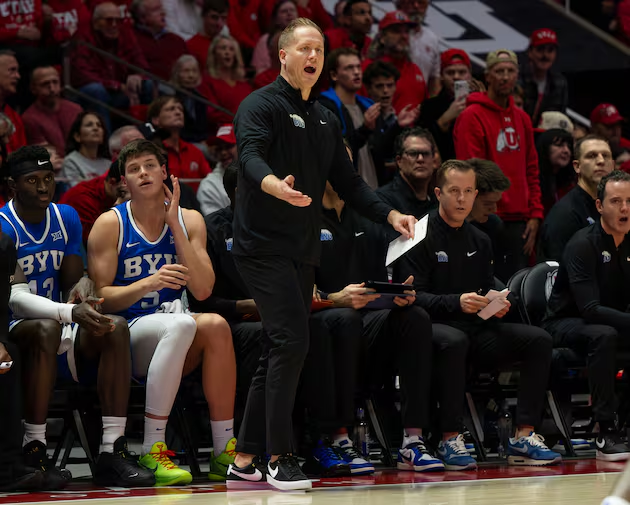
If things go according to plan, Saturday’s game between the BYU and Utah men’s basketball programs will be the first of many pitting Cougars coach Kevin Young against Utes coach Alex Jensen.
Young and Jensen have some similarities in their journeys toward becoming the head coach at their respective schools: they both have G League head coaching experience and they both spent more than a decade in the NBA as assistant coaches before landing in their current roles.
Young has one year of experience on Jensen in his current job — he is in his second year as BYU’s head coach, while Jensen is in his first season coaching his alma mater.
That familiarity with each other has fostered a healthy respect between the two coaches. On Saturday, Young’s No. 9 BYU team got the best of Jensen’s Utes, as the Cougars held off Utah, 89-84.
BYU (15-1, 3-0 Big 12) relied on its Big 3 — Robert Wright III, AJ Dybantsa and Richie Saunders — to carry the load.
Wright scored 23 points and added six assists, Saunders logged a double-double with 24 points and 14 rebounds, along with three assists, and the freshman sensation Dybantsa contributed across the board with 20 points, six rebounds, four assists, one block and a steal.
BYU led for more than 31 minutes against its rival, and the Cougars never trailed in the second half, though Utah climbed within one at one point.
“It’s hard to give up 89 points and win, right? And if you look at all the good teams in college that win, (they) are the teams that defend and rebound,” Jensen said, about two factors that prevented Utah from pulling the upset.
He was then complimentary about the program Young is building in Provo.
“BYU has done a great job. Kevin does a good job. It’s hard to have those guys be together. They’ve done a great job as an institution, and (BYU athletic director) Brian (Santiago), giving the resources to the program,” Jensen said. “Just like (Utah’s recent loss to No. 1) Arizona, it’s a great lesson for us to learn from. They play well together.”
Utah (8-8, 0-3 Big 12), for its part, had arguably its best overall effort of the season, perhaps only bested by a one-point win over Ole Miss during nonconference play.
Terrence Brown (25 points, five assists, three rebounds, two blocks) and Don McHenry (21 points, two rebounds, two assists, one steal) led a spirited Utah attack Saturday, while James Okonkwo’s energy and results — 13 rebounds, 4 points and two assists — helped the Utes keep pace in front of an electric crowd.
“I’ve known Alex for a long time,” Young said. “We’ve coached against each other (a) long time ago in the G League. We sort of broke into the NBA around the same time, and when I was with the Suns, he was with the Jazz.
“We had a ton of battles, so I’m very familiar with him. He’s a good person, but you still want to beat him in a game like that.”
BYU’s coach, too, was complimentary about the organization and work that Jensen has already put into revitalizing the Runnin’ Utes program.
“He’s smart, man. He’s a smart coach, and he’s just figuring it all out, all the idiosyncrasies. He joked before the game — in the NBA, you do the anthem and the coaches wave and you play the game; in college, before the game, you walk the line, shake, and he’s still trying to figure out if we’re supposed to do this,” Young said.
“He’s still figuring everything out, but he’s a smart guy, and (Utah basketball general manager) Wes Wilcox, too. They’re smart. They have a lot of experience, and this will be some fun games over the years between our groups.”

Jan. 12, 2026, 4:04 a.m. ET
- Texas Rangers player Wyatt Langford hosted his second annual baseball camp for over 100 kids in Newberry, Florida.
- Langford, a Trenton native and former Florida Gators star, aims to provide local youth with the mentorship he lacked growing up.
- Former UF teammates joined Langford as coaches, and about half the campers were from the surrounding tri-county area.
- Langford, a 2023 World Series champion, still lives in the area during the offseason and is seen as a role model by young players.
It’s rare for kids to agree on anything, especially a desire to wake up early on a Saturday.
Yet, over 100 kids from around the Gainesville-area willingly braved tiredness and the odd January heat to drive to Newberry.
Why? Because a local superhero offered his tips on how these 8-14 year olds can reach the big leagues.
Trenton native and Florida baseball legend Wyatt Langford hosted his second annual baseball camp at Champions Park in Newberry — three months before his third season with the Texas Rangers begins.
Despite his new big city digs with the 2023 World Series champions, Langford remains committed to the area. He still lives in Trenton in the offseason with his wife Hallie. A college softball player, Hallie will play her final season with North Florida. She’ll visit Gainesville on Tuesday, February 17.

It’s his love for the area that pushed Langford to begin the camp. He said that when he grew up in Trenton, youth baseball camps weren’t popular, despite the proximity to UF.
“There wasn’t a lot of people you can look up,” Langford said. “People who could tell you what to do and what not to do.”
The lack of resources didn’t hurt Langford much, who won two state championships in Gilchrist County. That led to a scholarship from Florida. He became of the Gators best offensive player in program history and a College World Series finalist in 2023.
The campers benefited from Langford’s connections as his former UF teammates Colby Halter, Blake Purnell and Ryan Slater served as coaches. The camp was run by the Florida Hardballers, the travel baseball team Langford played for.
About half the kids came from the tri-county area of Levy, Dixie and Gilchrist Counties. This pleased Langford even more.
“We’re lucky enough to be role models to them, so it’s our duty to be good role models and show them a little something that gives them hope and ambition to continue practicing,” Langford said.
![Florida's utility Wyatt Langford (36) celebrates his home run in the bottom of the first inning against the Miami Hurricanes, Friday, March 3, 2023, at Condron Family Baseball Park in Gainesville, Florida. The Gators beat the Hurricanes 10-4 in Game 1. [Cyndi Chambers/ Gainesville Sun] 2023
Gator Baseball March 3 2023 Condron Family Ballpark Miami Hurricanes](https://www.gainesville.com/gcdn/authoring/images/smg/2025/02/14/SGAT/78591442007-7-102875.jpeg?width=660&height=637&fit=crop&format=pjpg&auto=webp)
Calling himself a role model isn’t far enough. For the kids at the camp, he’s a superhero.
Mason Depaola, a 12-year-old, called Langford a superhero and an inspiration to him.
“If you’re playing with better guys, they’ll push you, and if you see guys in the majors, you can strive to be like that,” Depaola said. “That’ll make you the best player.”
The Rangers 2026 season begins on March 26 at the Philadelphia Phillies. Texas will visit the Tampa Bay Rays July 28-30, the Atlanta Braves July 17-19 and the Miami Marlins June 22-24.
Noah Ram covers Florida Gators athletics and Gainesville-area high school sports for The Gainesville Sun, GatorSports.com and the USA TODAY Network. Contact him at nram@gannett.com. Follow him on X @Noah_ram1. Read his coverage of the Gators’ national championship basketball season in “CHOMP-IONS!” — a hardcover coffee-table collector’s book from The Sun. Details at Florida.ChampsBook.com

WASHINGTON — Becky Pepper-Jackson finished third in the discus throw in West Virginia last year though she was in just her first year of high school. Now a 15-year-old sophomore, Pepper-Jackson is aware that her upcoming season could be her last.
West Virginia has banned transgender girls like Pepper-Jackson from competing in girls and women’s sports, and is among the more than two dozen states with similar laws. Though the West Virginia law has been blocked by lower courts, the outcome could be different at the conservative-dominated Supreme Court, which has allowed multiple restrictions on transgender people to be enforced in the past year.
The justices are hearing arguments Tuesday in two cases over whether the sports bans violate the Constitution or the landmark federal law known as Title IX that prohibits sex discrimination in education. The second case comes from Idaho, where college student Lindsay Hecox challenged that state’s law.
Decisions are expected by early summer.
President Donald Trump’s Republican administration has targeted transgender Americans from the first day of his second term, including ousting transgender people from the military and declaring that gender is immutable and determined at birth.


Heather Jackson, left, and Becky Pepper-Jackson pose for a photograph outside of the U.S. Supreme Court on Sunday in Washington.
COPYRIGHT 2025 THE ASSOCIATED PRESS. ALL RIGHTS RESERVED. THIS MATERIAL MAY NOT BE PUBLISHED, BROADCAST, REWRITTEN OR REDISTRIBUTED.
Pepper-Jackson has become the face of the nationwide battle over the participation of transgender girls in athletics that has played out at both the state and federal levels as Republicans have leveraged the issue as a fight for athletic fairness for women and girls.
“I think it’s something that needs to be done,” Pepper-Jackson said in an interview with The Associated Press that was conducted over Zoom. “It’s something I’m here to do because … this is important to me. I know it’s important to other people. So, like, I’m here for it.”
She sat alongside her mother, Heather Jackson, on a sofa in their home just outside Bridgeport, a rural West Virginia community about 40 miles southwest of Morgantown, to talk about a legal fight that began when she was a middle schooler who finished near the back of the pack in cross-country races.
Pepper-Jackson has grown into a competitive discus and shot put thrower. In addition to the bronze medal in the discus, she finished eighth among shot putters.
She attributes her success to hard work, practicing at school and in her backyard, and lifting weights. Pepper-Jackson has been taking puberty-blocking medication and has publicly identified as a girl since she was in the third grade, though the Supreme Court’s decision in June upholding state bans on gender-affirming medical treatment for minors has forced her to go out of state for care.
Her very improvement as an athlete has been cited as a reason she should not be allowed to compete against girls.
“There are immutable physical and biological characteristic differences between men and women that make men bigger, stronger, and faster than women. And if we allow biological males to play sports against biological females, those differences will erode the ability and the places for women in these sports which we have fought so hard for over the last 50 years,” West Virginia’s attorney general, JB McCuskey, said in an AP interview. McCuskey said he is not aware of any other transgender athlete in the state who has competed or is trying to compete in girls or women’s sports.
Despite the small numbers of transgender athletes, the issue has taken on outsize importance. The NCAA and the U.S. Olympic and Paralympic Committees banned transgender women from women’s sports after Trump signed an executive order aimed at barring their participation.


Protestors hold signs during a rally on March 9, 2023, at the state capitol in Charleston, West Virginia.
COPYRIGHT 2025 THE ASSOCIATED PRESS. ALL RIGHTS RESERVED. THIS MATERIAL MAY NOT BE PUBLISHED, BROADCAST, REWRITTEN OR REDISTRIBUTED.
The public generally is supportive of the limits. An Associated Press-NORC Center for Public Affairs Research poll conducted in October 2025 found that about 6 in 10 U.S. adults “strongly” or “somewhat” favored requiring transgender children and teenagers to only compete on sports teams that match the sex they were assigned at birth, not the gender they identify with, while about 2 in 10 were “strongly” or “somewhat” opposed and about one-quarter did not have an opinion.
About 2.1 million adults, or 0.8%, and 724,000 people age 13 to 17, or 3.3%, identify as transgender in the U.S., according to the Williams Institute at the UCLA School of Law.
Those allied with the administration on the issue paint it in broader terms than just sports, pointing to state laws, Trump administration policies and court rulings against transgender people.
“I think there are cultural, political, legal headwinds all supporting this notion that it’s just a lie that a man can be a woman,” said John Bursch, a lawyer with the conservative Christian law firm Alliance Defending Freedom that has led the legal campaign against transgender people. “And if we want a society that respects women and girls, then we need to come to terms with that truth. And the sooner that we do that, the better it will be for women everywhere, whether that be in high school sports teams, high school locker rooms and showers, abused women’s shelters, women’s prisons.”
But Heather Jackson offered different terms to describe the effort to keep her daughter off West Virginia’s playing fields.
“Hatred. It’s nothing but hatred,” she said. “This community is the community du jour. We have a long history of isolating marginalized parts of the community.”
Pepper-Jackson has seen some of the uglier side of the debate on display, including when a competitor wore a T-shirt at the championship meet that said, “Men Don’t Belong in Women’s Sports.”
“I wish these people would educate themselves. Just so they would know that I’m just there to have a good time. That’s it. But it just, it hurts sometimes, like, it gets to me sometimes, but I try to brush it off,” she said.
One schoolmate, identified as A.C. in court papers, said Pepper-Jackson has herself used graphic language in sexually bullying her teammates.
Asked whether she said any of what is alleged, Pepper-Jackson said, “I did not. And the school ruled that there was no evidence to prove that it was true.”
The legal fight will turn on whether the Constitution’s equal protection clause or the Title IX anti-discrimination law protects transgender people.
The court ruled in 2020 that workplace discrimination against transgender people is sex discrimination, but refused to extend the logic of that decision to the case over health care for transgender minors.
The court has been deluged by dueling legal briefs from Republican- and Democratic-led states, members of Congress, athletes, doctors, scientists and scholars.
The outcome also could influence separate legal efforts seeking to bar transgender athletes in states that have continued to allow them to compete.
If Pepper-Jackson is forced to stop competing, she said she will still be able to lift weights and continue playing trumpet in the school concert and jazz bands.
“It will hurt a lot, and I know it will, but that’s what I’ll have to do,” she said.
The new playbook: Why personalized coaching is taking over youth sports
The new playbook: Why personalized coaching is taking over youth sports


In the past, finding a private sports coach often meant word-of-mouth referrals, expensive training facilities, and time-consuming scheduling. But as technology continues to reshape the way we work, learn, and connect, the world of youth sports training is getting its own upgrade.
Just as Airbnb revolutionized travel and Uber reimagined transportation, new digital platforms are now decentralizing the $20 billion youth sports industry, giving families more direct access to qualified coaches—and providing former athletes with flexible, gig-style income opportunities after their playing careers end. It’s the era of on-demand coaching.

Training on Your Terms


This model, often referred to as the “platformization” of sports training, is catching on fast. Rather than committing to year-round training fees or expensive academies, families can now access high-quality coaching one session at a time—often from athletes who’ve competed at the highest levels. Proprietary data from Athletes Untapped, an on-demand coaching platform, shows a threefold increase in the number of youth training sessions booked online between 2018 and 2024. The spike reflects a growing comfort with using digital tools to find and schedule specialized coaching, echoing consumer trends seen in fitness, tutoring, and other service sectors.
Much of this growth has been driven by parents seeking personalized, flexible training options that fit into increasingly busy family schedules. Rather than enrolling in seasonal or year-round programs, families are opting to book single sessions based on their child’s needs and availability—often working directly with former collegiate or professional athletes in their local area.
A Win-Win Era for Sports

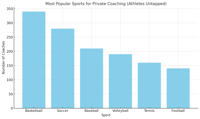
Former athletes get a meaningful, flexible path forward. And the game itself? It gets to live on in new and evolving forms.
Further analysis of platform data reveals which sports are driving the most interest in private coaching. Basketball, soccer, baseball, and volleyball rank as the most-booked disciplines on Athletes Untapped, consistent with broader youth sports participation trends in the U.S.
That data shows some of the most popular sports for youth training—including basketball, soccer, and baseball. But the bigger takeaway? The way we think about skill-building is changing. Kids want coaches they connect with. Parents want transparency and trust. And both want access—without the red tape.
Whether you’re a parent looking for flexible training options or an ex-athlete figuring out your next chapter, the message is clear: Coaching, like almost everything else, is going on-demand.
This story was produced by Athletes Untapped and reviewed and distributed by Stacker.
COPYRIGHT 2025 THE ASSOCIATED PRESS. ALL RIGHTS RESERVED. THIS MATERIAL MAY NOT BE PUBLISHED, BROADCAST, REWRITTEN OR REDISTRIBUTED.

Sports2 minutes ago
What to know about the 2026 NCAA Convention

Rec Sports6 minutes ago
Justices Reenter Transgender Rights Debate With Student Athletes

NIL10 minutes ago
Ty Simpson’s NFL Future Isn’t Locked In, And the NIL Numbers Are Getting Wild

Rec Sports14 minutes ago
Winter sports heat up in New Mexico

NIL1 hour ago
So what are schools spending money on now?
Sports2 hours ago
Week Ahead: Monday, Jan. 12 to Sunday, Jan. 18
Sports2 hours ago
VOTE for the 2025 Las Cruces Sun-News Female Athlete of the Year

Sports2 hours ago
UNC Bears volleyball’s busy offseason

NIL2 hours ago
College Football’s Expanded Playoff Works. Its Rhythm Doesn’t.

Sports2 hours ago
WSU volleyball signs Audrey Hollis out of the transfer portal – The Daily Evergreen

Motorsports2 hours ago
Dunne’s Decision to Leave McLaren Explained
Sports2 hours ago
Lubbock-Cooper Liberty Campbell Beeler is top area volleyball player
Sports3 hours ago
Here is the 2025 Lubbock Avalanche-Journal volleyball Super Team

NIL3 hours ago
Demond Williams Jr. stays at Washington: Did revenue share contract work as intended?

Sports3 hours ago
ETBU beach volleyball team serves Honduras communities on mission trip

Rec Sports4 weeks ago
Stempien to seek opening for Branch County Circuit Court Judge | WTVB | 1590 AM · 95.5 FM

Sports4 weeks ago
Maine wraps up Fall Semester with a win in Black Bear Invitational

Motorsports4 weeks ago
Ross Brawn to receive Autosport Gold Medal Award at 2026 Autosport Awards, Honouring a Lifetime Shaping Modern F1

NIL4 weeks ago
Downtown Athletic Club of Hawaiʻi gives $300K to Boost the ’Bows NIL fund

Rec Sports3 weeks ago
Princeton Area Community Foundation awards more than $1.3 million to 40 local nonprofits ⋆ Princeton, NJ local news %

Sports3 weeks ago
Badgers news: Wisconsin lands 2nd commitment from transfer portal

Rec Sports1 week ago
Five Youth Sports Trends We’re Watching in 2026

Sports4 weeks ago
Beach Volleyball Unveils 2026 Spring Schedule – University of South Carolina Athletics

NIL4 weeks ago
Nike Signs 10 LSU Athletes to NIL deals

Sports4 weeks ago
Three Clarkson Volleyball Players Named to CSC Academic All-District List

NIL4 weeks ago
Kentucky AD explains NIL, JMI partnership and cap rules

Sports3 weeks ago
Badgers news: Final Four Game Thread vs. No. 1 Kentucky Wildcats

Sports3 weeks ago
Kentucky VB adds an All-American honorable mention, loses Brooke Bultema to portal

Sports4 weeks ago
Central’s Meyer earns weekly USTFCCCA national honor

Motorsports4 weeks ago
PRI Show revs through Indy, sets tone for 2026 racing season

 NBA Legend Michael Jordan to Join NBC Sports as Special Contributor
 Why a rising mid-major power with an NCAA Tournament team opted out of revenue-sharing — and advertised it
 Trackhouse to pair Chastain with McSwain
 Volleyball Falls to SEMO – Tennessee State University
 Kennewick School Board backs changes to gender inclusion in sports | News
-
 Sports3 weeks ago
Badgers news: Wisconsin lands 2nd commitment from transfer portal
-
 Rec Sports1 week ago
Five Youth Sports Trends We’re Watching in 2026
-
 Sports3 weeks ago
Kentucky VB adds an All-American honorable mention, loses Brooke Bultema to portal
-

 Motorsports3 weeks ago
Dr. Patrick Staropoli Lands Full-Time O’Reilly Ride with Big Machine Racing
-

 Motorsports2 weeks ago
BangShift.com IHRA Acquires Historic Memphis Motorsports Park In Millington Tennessee. Big Race Weekend’s Planned For 2026!
-
NIL2 weeks ago
Fifty years after IU’s undefeated champs … a Rose Bowl
-

 Sports2 weeks ago
H.S. INDOOR TRACK & FIELD: GLOW region athletes face off at Nazareth University | Sports
-
 Sports3 weeks ago
Colorado volleyball poised to repeat success
-

 Sports3 weeks ago
2025 Volleyball Player of the Year: Witherow makes big impact on Central program | Nvdaily
-

 Motorsports3 weeks ago
NJ Motorsports Park Announces 2026 Event Schedule