
Sports
MLB Commissioner puts expansion on fast track with public push for 32 teams


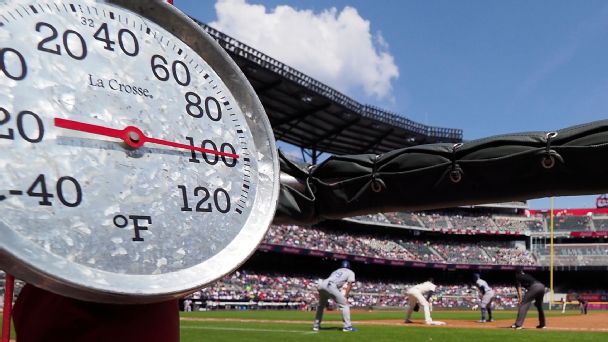

CLEVELAND, Ohio — Commissioner Rob Manfred just tipped his hand about Major League Baseball’s future, and Cleveland Baseball Talk Podcast hosts Joe Noga and Paul Hoynes wasted no time dissecting what it means for the sport – and potentially the Guardians.
During MLB’s Little League Classic on Sunday, Manfred voluntarily broached two topics that could fundamentally reshape the baseball landscape: expansion and realignment. This wasn’t a case of a commissioner being pressed into revealing plans; he deliberately brought them up, signaling they’re front and center on his agenda.
“Those sort of go hand in hand,” Noga explained. “In baseball, Manfred wants to get to 32 teams. I think the ideal number, as the NFL has shown, is 32 teams.”
The potential expansion locations are taking shape, with Nashville and Portland leading the pack of contenders. Other possibilities include Montreal (returning baseball to a city that lost the Expos), Puerto Rico, and Salt Lake City. Each presents its own unique market opportunity and challenges.
However, Hoynes raised an immediate red flag about MLB’s expansion ambitions – timing and existing franchise instability.
“It’s interesting. With expansion, you have to do it carefully. You have to be careful expanding the talent pool. We’ve seen it happen before, and I know Manfred, this has been a big thing for him. He wants to expand before his tenure as commissioner ends,” Hoynes cautioned.
The elephant in the room: two current MLB franchises are essentially homeless. The Athletics are in limbo between Oakland and Las Vegas (currently playing in Sacramento), while the Rays continue to struggle with stadium issues in Tampa Bay.
“Those are kind of two nomads right now. I would think if before you talk about expansion you’ve got to find permanent homes for them,” Hoynes pointed out.
This creates a puzzling dynamic – why is Manfred publicly pushing expansion when two existing franchises lack stable homes? The answer likely lies in Manfred’s legacy ambitions and the financial windfall expansion would bring to current owners through expansion fees.
Nashville seems particularly well-positioned, with its rich minor league history and previous ownership groups (including one led by Tony La Russa) expressing interest. The city’s booming population and tourism appeal make it an attractive market.
The talent pool question remains significant. With minor league contraction already reducing development opportunities, adding two more major league teams means 52 more big league roster spots that need to be filled with major league caliber talent.
Whether the commissioner can navigate these complex waters while addressing the needs of current “nomad” franchises will determine if his expansion vision becomes reality before his tenure ends.
Want to hear the full discussion about MLB’s expansion plans and what it could mean for the future of baseball? Tune into the latest Cleveland Baseball Talk Podcast for all the details on this potentially franchise-altering development.
Podcast transcript
Joe Noga: Welcome back to the Cleveland Baseball Talk Podcast. I’m Joe Noga, joined by Paul Hoynes. Hoynsie. The Guardians in Texas getting ready to take on the Rangers opener of a three game series tonight at Globe Light Field in Arlington. Slade Cecconi 5 and 6 with a 4.50 ERA versus Nathan Eovaldi 113 with a 1.76 ERA. Eovaldi’s been really good for the, for the Rangers this year. Cecconi his last couple of time times out, a little bit of a stumble both times after a good stretch of getting deep into games. What’s Slate Cecconi got to do to get back on track?
Paul Hoynes: Yeah, he’s got to finish hitters off, Joe. He’s. He has to, you know, keep the ball in the park and just has to use his, his. Off his spit. You know, his, he has to improve it. His breaking ball pitches. You know, the spin was not good the last time out. He got knocked around and it led to an early exit. So he is, has, has to improve his breaking ball pitches and he’s, you know, he’s got to get ahead of hitters. He’s. He hasn’t been getting ahead of hitters.
Joe Noga: Yeah. Against Atlanta, kind of uncharacteristic was the way that Stephen Vogt described Slade Cecconi’s outing. Four and two thirds innings, allowed 10 hits, six earned runs, struck out three, walk two. And his timeout before that, his previous outing against the White Sox lost that game only went three innings allowed eight hits and five earned runs in that game as well. Prior to that he had, he had gone on a stretch where he was going, you know, at least six innings in a game and you know, looking every bit the part of a, a good middle of the rotation starter for the Guardians. Just you know, don’t know if it, if it’s mechanical or the opposition or what it, what it was. But like you said, the, the breaking pitches weren’t, were not landing as effectively and I believe in the one start he, he said that, you know, they were just taking all of his breaking pitches and hunting fastballs. So yeah, and you got Texas with, with a lineup that’s pretty solid but you know they’ve, they’ve struggled this year. Just. The Guardians need to take advantage in some way of a team that really has sort of fallen off over the last several weeks. Been a bit of a struggle for Texas and in terms of their record, they were within a few games in the AL west just back in the middle of August and now after a week or two, they’ve, they’ve fallen back to about 10 games out.
Paul Hoynes: Yeah, Joe, you know, Ciccone, you know, there was some talk, vote was asked about whether, you know, Ciccone may have, you know, may have kind of, you know, maxed himself out a little bit with, with those, although with, you know, several deep starts. Just because he really hasn’t, you know, been through a season like this where he’s been in a row, taking a regular turn in the rotation, stepped into minor leagues so that, you know, maybe know, fatigue was catching up to him. But, you know, he assured us it was not. He didn’t think it was. Not that he just said he was, you know, like we said, wasn’t getting ahead of the count, isn’t, you know, working his spin pitches the way, the way he wants to.
Joe Noga: In the last three weeks, Texas has only won back to back games once. They beat the Yankees on August 4th and 5th. So, you know, this is a team that’s up and down and struggling to, to win and string games together. They were a half game out of the wild card spot, out of a wild card spot on August 5th. And since then they’ve gone, they’ve dropped five and a half games back after losing to the Royals. The guy you gotta watch out for right now in that Texas lineup, you know, all the names, all the big names making big bucks there. Kyle Higashioka is the one. We wouldn’t suspect it, but he entered, entered their game on Thursday batting.3.15 with a.949 OPS over his last, you know, 30 games or so, four doubles, 20 RBIs. He’s, he’s really getting the job done for Texas.
Paul Hoynes: Yeah, when, even when he was with the Yankees, Joe, you know, he hit, he hit Cleveland pitching pretty well. You know, he was kind of that sneaky power at the bottom of the lineup. Could hit the ball out of the park. He did a nice job. He did a nice job for the Yankees and obviously he’s doing something right for the Rangers.
Joe Noga: Before the game tonight at Globe Life Field, Hoynsie. The Rangers are going to dedicate a statue to Adrian Beltre last year inducted into the hall of Fame. Adrian Beltre, just one of those guys where wherever he went, he was sort of a beloved figure in Texas, you know, longtime guy, 3000 hit club. Just a guy that everybody loved playing with. So Adrian Beltre getting a special recognition from the Rangers club.
Paul Hoynes: Yeah, that’s really cool. Definitely deserves it. A Hall of Famer, kind of under the radar. Hall of Famer, Joe really, you know, when you, if you didn’t really look at his numbers and study his numbers, you know, you think Adrian Beltre bounce around a little bit. Was with a lot of teams, but, you know, just a great, great hitter. Really, really, really, you know, accomplished hitter. Just don’t rub him on the head, Joe.
Joe Noga: That’s, that’s the one thing. Who was it? Elvis Andrus had a, had a thing about just like patting him on the head and he’d freak out every time. The videos of that were really funny. I think we have a, I have a bobblehead of Adrian Beltre and, and Elvis Andrus, sort of that one play where they came together and were catching an infield pop. And it’s just a real memorable guy. Where does he rank in terms of Dominican third baseman? Because the Guardians have a pretty good one on their side of the field.
Paul Hoynes: Yeah, this is, you know, this is a guy with a lot. He was a pure power hitter. Definitely. You know, he could hit for average. I just remember him swinging so hard, he’d go down on one knee, you know, and watch him hit balls out of the park when, when he’d hit ball, when he’d make contact. And really, you know, just a good all Player. You know, I think he’s probably a little above Jose right now.
Joe Noga: Yeah, Well, I mean, 3,000 hits, five time Gold Glover, two time Platinum Glover, four time Silver Slugger. He certainly got the, the credentials. Baseball writers named him on 366 out of 385 ballots in, in 2024. So, you know, certainly got the, the, the credentials to be in the hall of Fame. And yeah, he probably ranks above Jose right now in terms of hall of Fame clout. But Jose’s still got some time. We’ll. We’ll see where he goes with that.
Paul Hoynes: I mean, 3,000 hits, that’s. You don’t do that by accident.
Joe Noga: No. And, and you know, who knows if Jose can, can get. I doubt Jose can get to 3,000 hits just, you know, with the different kind of hitter that he is besides Adrian Beltre. And the defense really just sort of separates him there too. You know, you win two Platinum Gloves, you’re doing something right.
Paul Hoynes: Right.
Joe Noga: But that’s, that’s to take nothing away from, from Jose and the, the incredible story that, that he is as he continues his hall of Fame trajectory in his career. All right, Hoynsie, lots going on in, in baseball and you know, throughout the league. And a lot of it, some of it has to. Has an impact on the Guardians. Some of it will have an impact on the guardians, you know, down the line in the future with the collective bargaining agreement and. And, you know, possible TV contracts and things like that. We’ll get into all that. But, you know, wanted to talk about Rob Manfred going on Sunday night baseball at the Little League Classic over the weekend. And he talked about two big things that, you know, made. Made people, and he voluntarily talked about these things. He wasn’t necessarily, you know, poked and prodded and pushed on the issues of expansion and realignment. Those sort of go hand in hand. I think in. In baseball, you want to get to 32 teams. I think the ideal number, as the NFL has shown, is. Is 32 teams. I don’t know how much that dilutes the talent pool for baseball. We’ve seen contraction in the minor leagues and how that has enhanced things for baseball in terms of, you know, accelerating the talent getting. Getting to the major leagues at a younger age by. By contracting, you know, a few years back after Covid expansion. Right now looks like you’re considering of areas Nashville, which would be a very popular destination spot for a lot of teams, possibly Portland, another team that’s another city that’s been talked about having another presence in the Pacific Northwest as well. What do you think of the idea of expanding to those markets or maybe some other markets?
Paul Hoynes: Yeah, Joe, I think it’s interesting. I think you have to. With expansion, you have to do it carefully. You know, I really think you have to be careful, like you were saying, expanding the talent pool. We’ve seen it happen before, you know, and I know Manfred, this has been a big thing for him. He wants to expand before his tenure as commissioner ends. So. But yeah, you know, Nashville is a. You always hear about that. Nashville, Portland. Would they go back to Montreal? I know a lot of, you know, whenever they’ve had an exhibition game there since the Expos left, they’ve drawn big crowds. Puerto Rico, we saw, you know, I went to Puerto Rico when Cleveland played the Twins there in a regular season game. So, yeah, really, you know, I think there’s. There’s a lot of, you know, there’s. There’s a limited number of cities that. That could, you know, you could feel the baseball team, a big league team and be successful, you know, supporting it. And, you know, they’ve all been making their pitches for years to MLB, so we’ll have to see where. When. When this reaches fruition.
Joe Noga: Well, and also, you know, think about this is taking into consideration the Athletics, who are right now sort of in limbo, moving between Oakland and Las Vegas. Right now they’re in Sacramento. You also have to consider what, what’s going to happen with Tampa Bay and their stadium situation. Tropicana Field still not going to be ready. That’s a club that might have to spend another year playing in another minor league stadium as well. Could you consider maybe Salt Lake City or another area like that out west as you want to make sure that things are balanced as well? And that’s, I guess the big problem for me is is there a demand for a major league baseball in cities like Portland, in cities like Salt Lake, in. In an area like Nashville, where Nashville’s got a lot going on, I think. But is. Is Memphis a consideration? Are there other areas that we haven’t even thought about yet?
Paul Hoynes: Yeah, you know, that Nashville, you know, it’s got a rich minor league history. Nashville sounds. I mean, there was a group there that was trying to, with Tony LaRusso was involved, you know, a couple years ago, you know, trying to put to a group together that would buy a big league team or, or, you know, get. Be ready for expansion. So I think that’s probably, you know, a good landing spot. But you bring up an interesting point about the A’s and the Rays. I mean, those are kind of two nomads right now. I would think if before you talk about expansion, you know, you’ve got to find permanent homes for them.
Joe Noga: Yeah. Are the, are the Rays sort of the Jacksonville NFL version in the, in the majors right now? In Major League Baseball right now? You know, Jacksonville seems to be the team that the NFL wants to farm out to play games in London, to play games in Mexico or wherever they want to play their games. Is that something that Manfred, if he wants to experiment with having games in other cities to try and see what the interest is there. I mean, they did just play a game in Bristol, Tennessee, where they had a hundred thousand people come out for it. Could they try and spark interest there by forcing Tampa to go play some of these games abroad? I think. Aren’t the Rays on the list for playing games in Puerto Rico once that comes around?
Paul Hoynes: Well, I do not know that, Joe, but yeah, it wouldn’t surprise me. It’s not that long, you know, a trip to Puerto Rico from Florida, it makes sense.
Joe Noga: Yeah, it’s a lot of areas too. You think about the Gulf coast as well and what you would have to, in terms of a stadium you would have to build there. Something with the considerations for the weather and the heat and the rain possibilities. So just a lot of different areas. And you don’t want to also take away. If you’re expanding, like you said, you bring up the minor leagues that they’ve already contracted, minor league, you know, clubs. But you don’t want to also sort of trample on or step over the traditions of the minor leagues, especially in leagues like the Southern League, where, you know, those are, and the Texas League. Even areas where those teams are so ingrained in their communities that you don’t want to supersede those as well.
Paul Hoynes: Yeah, you know, that’s a good point. You know, it reminds me of, you know, when they did do the contraction in the, you know, in the minor leagues, they changed all the names of the leagues and then that lasted for about a year and then they all went back to the. Their old names, you know, so, yeah, there’s a, there’s a tradition there. And that tradition is hard to break.
Joe Noga: Yeah, it’s something that’s important for sure. The only reason if you do expand, if you. That’s the goal for Manfred, that’s the obvious goal. He wants at least two more teams. He wants to have 32 teams. With expansion is going to come realignment. You have to realign the leagues. If you add two more teams, it can’t just be, you know, put one in the National League, put one in the American League and everybody’s happy. There’s, there’s geographic and rivalry concerns with all of this. I think, you know, I’ve seen some models and I’ve seen some proposals out there that have been pretty interesting. You know, one of them has a realignment that would have the Guardians playing in a division with Pittsburgh, Baltimore and Washington. So no more rivalry games with or no more season long multiple meetings and series against the White Sox, Twins, Royals and Tigers. You know, these are teams that Cleveland has played for 100 years against Detroit and Chicago. You know, you’ve, you’ve gotta, you talk about not wanting to mess with tradition in terms of expansion. Realignment would really sort of fly in the face of tradition.
Paul Hoynes: Yeah, definitely. That, that new, you know, the so called new division with Cleveland, Pittsburgh, Baltimore and Washington. Joe, that does nothing for me. You know, I like the idea of Cleveland and Pittsburgh in the same division. I think that’d be great. You know, I’d like to, you know, whenever they played each other in interleague play, I thought it was really, you know, a good vibe, a good rivalry. But what is Cleveland doing with Baltimore and Washington? Well, that does, you know, that doesn’t ring a bell for me. I got to Tell you I’m a traditionalist or to a certain degree I’m a traditionalist and just, you know, just shaking up the, you know, the whole, you know, the 30 teams and like rearranging them and what for? What are we trying to do here? What’s the end game here?
Joe Noga: Well, I think you want to keep the expanded playoffs. That’s something that’s important to Manfred because that’s a huge moneymaker and it would, it would realign things. You would have, you know, eight, four team divisions in sort of an east, west thing. And it would also something we, you got to talk about here is the potential of eliminating American and National Leagues. Now the American League and the National League are institutions that are 125 years old. Think about that. They’ve been around for as long as guys have been picking up bats and gloves. You’re talking about eliminating the, the potential for eliminating AL and nl and how do you do that in terms of, you know, you think about awards. Awards are tied to players contracts. This would, this would, you would really need a buy in from the players union if you’re going to eliminate the, the American and National League sort of standards. And I don’t know if I think a lot of players are like you, they’re okay with, you know, maybe changing a franchise’s name. But when you, when you’re talking about eliminating the National League and the American League, they might not buy in on that.
Paul Hoynes: Yeah, I mean, what happens with all the records, you know, the National League records, American League records, Who sorts all that out? Who is, you know, I mean that, that’s a big, big step. But you know, I mean, you know, Joe, I couldn’t tell you a division in the NFL anymore. I mean, you know, they changed the names there, you know, and you know, they, they realigned. You know, people, you know, teams went here, teams went there. You know, the only thing that counts is the games. The same thing with the NBA. I mean, it seems like those divisions change every year. Right. Almost every five years are renamed. So, you know, I mean, I think you could get used to it. But you know, baseball is baseball. You know, I mean, it’s, it’s been around longer than any of those sports.
Joe Noga: But you’re talking about the NBA and the NFL as those are more homogenous leagues. It’s, it’s very much more of a blended sort of league as opposed to baseball has always been American League, National League. And there was, there was a time when the two never intermingled before. Interleague play. You know, players never saw each other until the World Series, that kind of thing. And it’s gotten better over time. I think baseball has recognized that there are benefits that outweigh sort of being separate like that. And they’ve, they’ve progressed towards it and especially the development within the last, you know, three to four years of a balanced schedule of every team plays every other team at least once a year. And you sort of need to keep that kind of thing in, you know, in play here. I think any sort of realignment would have to keep the idea of a balanced schedule intact. It might even have the, the added benefit. I think some people would say. I’ve seen proposals out there where they can track games off the schedule. Instead of playing 162, you’re playing 156 games. 156 game schedule. With a 32 team league, you would eliminate the need for four game series. Every game, every series would be a three game series. Now I know, I see the look on your face as a, as a sports writer, as a, as a beat writer for a major league team. Three game series are perfect. Four game series is way too much. You’re sitting in a city for, you know, four maybe five days and you’ve had your fill. But the benefit from a 156 game schedule as opposed to 1 2, you could play all three game series and if you, you would start around the same, around the same period of time, you could work in an every week off day for every team. Every team would have an off day once a week. If that was the case.
Paul Hoynes: It’s it. That makes sense, Joe. But would the owners willing, are they willing to give up those six extra games? You know what, six times 30, that’s 180. What I mean, I mean that’s a lot of games. That’s a lot of money. That’s a lot of revenue.
Joe Noga: Well, you would think it would be three home and three road loss for each team. So you’re only, if you’re, if you’re a, an owner, you’re really only losing the revenue from three home games. And I think with a realignment that would keep teams like Cleveland playing Pittsburgh, Baltimore and Washington, the travel is so much easier for, for that. And you’re talking about a realignment that would have both New York teams playing in the same division against Boston and Philadelphia. The travel there is incredibly cheaper. Really, the only team that would, would suffer, not suffer, but couldn’t get out of its own way on that is like Seattle, which is way the heck up in the Northwest. And their, their travel expenses are astronomical regardless of how you, you realign. But I think that’s a, that’s a way to pitch that to the owners is yeah, you’d lose revenue, but look at what you’re gaining back in terms of not having to fly.
Paul Hoynes: Yeah.
Joe Noga: To, to Seattle twice, you know, once a year or, you know, whatever. So yeah, I think there’s, there’s a cost benefit analysis that the, the owners are, are really good at running through and I think they would do that. The idea of, of realignment, I just to me, losing those rivalries, losing the, the ability to go to, you know, Detroit, Chicago, Kansas City, Minnesota, every year we know we’re going to be there at least, you know, twice a year at this point. It used to be even more, but you know, hey, the players like they’ve got their, their hangouts in those cities. They’ve got their places they like to go. I think you get some pushback on the players from that.
Paul Hoynes: Yeah, you might. Joe. I. Do you really think the players care about the American and National League? I, I think if you put a schedule in front of those guys, 162 games you’re playing here, you’re playing there. I don’t even know if they’d really care. I think there it’s just another game. Right. But who knows? I mean, I’m sure there’s a lot of traditionalists among the players that, you know, they have, they would have some concern about, you know, abolishing the American and National League, but in the end they get paid to play.
Joe Noga: Yeah, Max Scherzer would probably have something to say about it. You know, the vocal ones in the players union and the guys who would get together there would be several. The, the younger guys. And look, Major League Baseball is full of younger guys now. Guys who don’t have that, that sort of platform like a Max Scherzer would have or Clayton Kershaw, guys like that who come out and be vocal about it. I think Rob Manfred can endure getting yelled at by Bryce Harper. That’s over an entirely different area in terms of the salary cap there. So. Okay, so, you know, the idea of eliminating these, these natural rivalries, but also sort of encouraging, you know, a new rivalry. Like you said with Pittsburgh. It’s only a two hour drive, man, and it’s a beautiful ballpark to go, go see a game at. I am sure that Pittsburgh would all be all in favor of taking Clevelanders money for, you know, twice a year in A couple of three game series at PNC Park.
Paul Hoynes: Yeah, I think there’s more of a spark between Pittsburgh and Cleveland than Pittsburgh and Cincinnati, which, you know, we’ve seen. You know, we play the home and away series every year against the Reds. I think probably the Pirates is more of a rivalry situation.
Joe Noga: Yeah, it’s sort of. Well, I mean, bad beer and ugly women. You gotta go to Pittsburgh.
Paul Hoynes: But then you got Tito down there too. So you got Tito that makes it into Tito Factor.
Joe Noga: But how much longer are you gonna have Tito down there? Realistically, the division that they’re proposing or that I’ve seen proposals of, has the Cubs, Reds, White Sox and Cardinals all in one division there. And that’s a National League or a Western Division sort of set up. So you keep that Cubs Cardinals rivalry. You keep that Cubs White Sox rivalry intact. The, the Great Lakes Division would encapsulate Minnesota, Milwaukee, Detroit and Toronto. And, you know, I, I kind of like that as well, so that, you know, that’s a kind of wish Cleveland could be in on that division and maybe put Milwaukee in with the Cubs, you know, White Sox and Cardinals. But, I don’t know, it’s all geared towards that, that Northeast Division where it’s, you know, you want to keep the Mets and the Yankees and the Red Sox all in one division, so they play each other multiple times a year and they make, you know, every appearance on Sunday night baseball or National League or nationally televised games as well.
Paul Hoynes: Joe, Joe, one more thing about realignment. You know, back in, what, 1994 when they formed the AL Central, you know, Dick Jacobs did not want to leave the AL east. You know, like we’re saying here, he had all those, you know, traditional rivalries with the Yankees and, you know, the Yankees in Baltimore and Boston. He didn’t want, you know, he did. He didn’t want to see those teams only come to Cleveland once, you know, once a year, twice a year. Those were big revenue generators for him. But they moved to the. Dan o’ Dowden and Daniel Dowd and John Hart convinced him to go to the Central. And it turned out to be a bonanza for the, for the, for the guardian. So, you know, as much as I’m a traditionalist, I guess you can’t really turn up your nose completely at realignment.
Joe Noga: Yeah. And you kind of have to, you know, play chess instead of checkers and, you know, look ahead to what could be, as opposed to what you would be leaving, leaving behind just to refute Dick Jacobs there. Baseball went ahead and stuck in terms of. In terms of Cleveland only seeing New York and Boston, you know, once a year, they went that step further. And now the. It seems like the Guardians only get to play the Yankees and the Red Sox in April when the weather’s crummy and nobody comes out to the ballpark anyways. I get the idea, but it was sort of like an extra punishment from the league is. Oh, yeah. The teams that generate all that revenue and, you know, sell out ballparks all over the place here. Play the Yankees and the Dodgers in April. That’s. That’s your punishment. Yeah.
Paul Hoynes: When it’s. When it’s 30 degrees, it’s no fun.
Joe Noga: For the reporters, either. All right, Hoynsie, that’s going to wrap up today’s edition of the Cleveland Baseball Talk Podcast. We will have much more to say about expansion and realignment over the. The next several. We’ve got a whole off season coming up to talk about that, so we’ll be sure to do that. But we will check in with you again after. After this week weekend in. In Texas, where the. The Guardians really need to win two out of three.
Paul Hoynes: Yeah, Joe, thanks a lot, buddy.
If you purchase a product or register for an account through a link on our site, we may receive compensation. By using this site, you consent to our User Agreement and agree that your clicks, interactions, and personal information may be collected, recorded, and/or stored by us and social media and other third-party partners in accordance with our Privacy Policy.

Kopacz spent two seasons at Colorado State as the lead defensive coach, implementing an opportunistic style of play and mindset focused on improving team defense. The Rams went from last in the conference in opponent hitting efficiency in 2023, to first in both 2024 (.190) and 2025 (.187). Among his individual work included daily practice planning focusing on blocking, team defense, middle/setter offense and overall team development, mapping individual development plans for each athlete.
The Rams’ defensive success propelled Colorado State to both the 2024 Mountain West Conference regular season and tournament championship, earning the program’s first NCAA Tournament Berth since 2019. He guided 2024 AVCA All-American Malaya Jones during the run, while Jones and Emery Herman both recorded AVCA All-Region honors.
He also served as the head coach of the 2024 Mountain West All-Star team that finished as the Silver Medalists at the Global Challenge Tournament held in Pula, Croatia.
Prior to the Rams, Kopacz spent the last two seasons as an Assistant Coach and Recruiting Coordinator at the University of Nebraska Omaha. At Omaha, he mentored the setter position and assisted in the development of offensive game-plans. Kopacz helped Omaha to their first D1 NCAA tournament appearance and first Summit League Championship in 2023. His work with the program included mentoring AVCA All-American McKenna Ruch, while also helping guide Ruch and Shayla McCormick to AVCA All-Region honors.
Kopacz started his college coaching career at the University of Colorado in January of 2021 as a Volunteer Assistant Coach. With the Buffaloes, he assisted with the training of first contact and floor defense and helped design scouting reports and prepare the scout team.
The Libertyville, Illinois native played club volleyball at Indiana University where he was a captain and earned All-Big Ten and All-MIVA honors. Kopacz graduated from Indiana with a degree in Informatics and Computing with a specialty in Sports Marketing and Management.
After graduation from Indiana in 2016, he worked in Benefits Administration, most recently as a Senior Account Manager at bswift, while consulting for several different clubs and high school teams in the Chicagoland area.
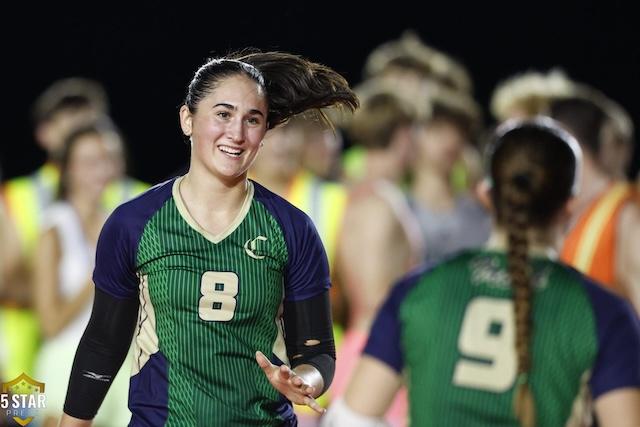
Catholic junior Mia Kinney doesn’t mind playing out of her club and college position for the Lady Irish volleyball team.
She is an offensive force as an outside hitter and is a six-rotation player for Catholic.
Yet Kinney will play defense in college, signing scholarship papers to play libero or defensive specialist at Vanderbilt.
And that’s her focus during Catholic’s offseason for volleyball, which is in-season for Kinney at K2 Volleyball.
“I’m just trying to get a little bit more polished in my libero position,” said Kinney, the 2025 5Star Preps Volleyball Player of the Year, “just because pretty much my entire volleyball career I’ve just been doing different things, and just playing whatever (position) my team needs me to.”
Her versatility and talent were a big reason Catholic (25-10) had another big season in 2025.
Kinney combined powerful hitting (332 kills) with her setting (68 assists), defense (239 digs), serving (72 aces), and excellent passing in leading the Lady Irish to the Division II-AA Final Four.
Catholic coach Brent Carter said he’s able to use Kinney’s versatility because his senior libero, Nora James, has similar talents like Kinney.
“We get creative and move our libero around because our libero (James) is also a very skilled player,” Carter said. “Sometimes, our libero is playing left-back defense and sometimes she’s playing middle-back defense, so it gives us a nuance to where we put Mia, and it gives us an attacking threat out of the back row.”
Kinney’s passing is uncanny, too, and it was on full display at the state tournament, where the Lady Irish endured an emotional rollercoaster.
Catholic staved off elimination with a 3-0 victory over Chattanooga Baylor on Oct. 21 in their second Final Four match of the day, then lost on Oct. 22 to Christ Presbyterian Academy of Nashville by a 3-0 set score.
In the loss to CPA, Kinney’s passing rating was 2.82 on the 3.0 scale used for volleyball passing statistics; Carter raved about her passing in the season ending match.
“To knock Baylor out in a sweep was like a big deal to our kids emotionally,” Carter said, “and we just could not get it together against CPA. We needed to be passing well like we normally pass, and we just weren’t, but Kinney still passed a .282 in that match. And a .282 is best in the world. It’s unbelievable.”
Kinney transferred to Catholic from Baylor before the 2024-25 school year, earning All-5Star Preps first-team honors as the Lady Irish reached the state sectionals (quarterfinals).
Her sister, Elli, and brother, Cooper, are graduates of Baylor.
Elli (2023 Baylor graduate) is a junior libero for Vanderbilt’s volleyball team and Cooper (2021 Baylor graduate) is an infielder with the Tampa Bay Rays Major League Baseball organization.
Mia’s transfer to Catholic was a natural move because she was playing full-time with K2 Volleyball while attending Baylor in Chattanooga.
“It’s helped me out in so many different ways, and I’m really glad we made that decision,” she said of going to Catholic.
Kinney committed to Vanderbilt on June 15 of this year. While Elli was influential in Mia’s decision, she didn’t push Mia toward Vanderbilt.
“She loves it (Vanderbilt), and she just really helped me out through the whole recruiting process,” Mia said. “She didn’t pressure me in any way at all, but she was just there and really helpful for me. She really loves Vandy and I kind of got to see the inside scoop of that, so it was a pretty easy decision for me.”
Kinney said the 2025 season was a thrill for her and the Lady Irish, and she looks forward to another postseason run in 2026.
“I think there’s a bit of a reputation for volleyball at Catholic,” Kinney said.
Carter expects Kinney to take another critical role next season. He said Kinney is the most competitive player he’s coached in almost 10 years, when he coached Kamila Cieslik, a 2017 Catholic graduate who played five years at Rutgers.
“Nobody anywhere competes like (Kinney), and it’s mostly with herself,” Carter said. “She wants to be better every single time she touches the ball, and we haven’t had a kid like her since Kamila Cieslik, in 2016. Just a died-in-the-wool competitor, and here’s the thing nobody would question: She is the team leader.
“After every point, she is the one saying the right things, doing the right things. What she and I spent the most time on was how to handle those situations, and the management of each kid, how they needed to be managed out on the floor. So not only was it a players’ team instead of just a coaches’ team, and it was great.”
Article written by Dave Link/5Star Preps. To read more on area high school sports or to see photo galleries, videos, stat leaders, etc., visit 5StarPreps.com — and use promo code New2025 for 30% off your first year or month subscription.
Follow KnoxTNToday on Facebook and Instagram. Get all KnoxTNToday articles in one place with our Free Newsletter.

Avery Elizabeth Merritt, born Feb. 27, 2009, embodied the best parts of all of us. The beloved daughter to Russell Merritt and Tina Dombroski, younger sister to Jackson Merritt and Nathan Young, and cherished granddaughter to Janice Merritt, journeyed beyond this world Tuesday, Dec. 23, 2025.
Avery was the glue that connected our lives. She saw through pretenses and offered advice with a depth of insight and clarity far beyond her 16 years.
Her natural creativity was boundless, and throughout her life, she produced incredible sketches, paintings, sculpture, jewelry, clothing, written stories, and culinary delights. Her attention to detail was evident in everything she did, completing even the simplest tasks with an artistic whimsy or a deeply thoughtful purpose.
Avery had a profound love for animals and was pursuing a future in veterinary medicine. She devotedly cared for her dog Lucy, her cats River Forrest and Terra, and her hamster Seuss. Her “heart horse” was Miley, with whom she shared an incredible bond of loving, trust and understanding. Together, they had become a fearless duo completing high jumps, courses, and liberty work. Avery competed in many equestrian shows and received numerous ribbons and accolades.
Avery’s natural curiosity of the world around her also included plants and herbology. She often grew plants from clippings or seeds to create natural products and art, many times drawing her inspiration from Native American culture.
Avery loved an engaging story and enjoyed reading books, listening to podcasts about a wide range of topics from true crime to indie music to survivalism. She was a true aficionado of SpongeBob SquarePants as well as the Breaking Bad series. Despite living in an age of online content, she had an innate ability to remain connected in the present moment. To say she was nonconformist by nature would be an understatement. She was a truly special person in so many ways but did not like to receive attention for her exceptionalism. She was also academically gifted, excelling in all subjects, especially math, science, and literature.
Avery also shared a love for volleyball and grew her skills while playing for Premier travel teams, Sandsharks beach team and Sussex Technical High School. The friendships she gained through these leagues were meaningful to her, and the shared experiences of victory, loss, and growth made a great positive influence in her life
Avery was taken from this world far too early, leaving before her full potential was ever realized. Her family will never allow the beauty of her life to be overshadowed by the tragedy of her death and will honor her with every beat of their collectively heavy hearts.
A viewing will be held from 10 a.m. to noon, Tuesday, Jan. 6, at Watson Funeral Home and Crematorium, 211 S. Washington St., Millsboro. A funeral service will follow at noon. Burial will be private.
In lieu of flowers, memorial contributions may be made in Avery’s name to feast-ed.org, an organization dedicated to bringing awareness and support to loved ones suffering from the illness of an eating disorder.
Visit Avery’s Life Tribute webpage and sign her online guest book at watsonfh.com.
Dec. 31, 2025, 3:04 a.m. CT
In the immediate aftermath of Kansas women’s volleyball’s NCAA tournament loss in mid-December against Nebraska, KU coach Matt Ulmer praised the winning side.
Ulmer highlighted Cornhuskers coach Dani Busboom Kelly, and her team. He mentioned it’s been exciting to watch their run, even as much as it was a bummer to be a part of it. He looked forward to seeing how far they could go, which ended up being an Elite Eight exit against eventual national champion Texas A&M.
But as much as Ulmer understood the moment didn’t feel all that great for his team, he also pointed to how much the Jayhawks achieved this season and how proud he was of them. He couldn’t help but gush over the community support, that helped make the run to the Sweet 16 special. Ulmer left Oregon to take over at KU after Ray Bechard — the program’s all-time winningest head coach — retired, and enjoyed a stellar first season at Kansas.
“That was a lot of blue shirts, as many as we could have, I think, as many as Nebraska would allow,” Ulmer told reporters in Lincoln, Nebraska. “Having the band here — we had a sendoff before. When we left, we had sendoff from the hotel. Like, things like that which, maybe Nebraska’s used to, I’m not. Never had that at Oregon. And this is my sixth one of these, and that was the first time that I’ve experienced that.”
Ulmer both hopes the seniors are proud of what they did, and sees this first year at Kansas as the foundation for what the program is going to be moving forward. He committed to the Jayhawks consistently making runs like this, as his players get a taste of what it’s like to make it this far. It’s fuel for the offseason, for those who’ll be back in 2026, because after KU made its fourth-ever trip to the Sweet 16 — and first since 2021 — he wants to keep raising the bar.
This year alone, from Ulmer’s perspective, already saw a mind-blowing journey take place. His first conversations with the team included returning players mentioning playing time as a goal, and it made him think about how far they have to go to just be competitive. And now, considering all the individual growth from those returners and how the newcomers were embraced, they can build on a Sweet 16 run as he continues to develop the roster as needed to compete at the highest level.
The journey the 2026 Jayhawks go on will be different, just as any team’s is, but one characteristic that they could take from the group in 2025 is how adaptable it was. Senior Ryan White, a libero/defensive specialist, said she learned that about her team as it went through a schedule she thought was the most competitive season she’s ever played — if not the most competitive the majority of the team’s played. White, one of those newcomers and an Oregon State transfer, described this as the best last year she could have wished for.
“At my program before this, I didn’t even make it to the tournament,” White said. “So, I’ve never been in the tournament before. I think Matt told me something earlier, like this week, but this is like the most I’ve ever won in my career, in this season. Like, the most games I’ve won. So, looking back on it, it’s been, like, such a great experience. And obviously to come in and play the best team in the nation, like they were firing on all cylinders tonight. But it’s just been the greatest experience. Like, I’m so thankful for it. And never would I have thought that I’d be in Kansas playing college volleyball, but it’s been super, super fun.”

Jordan Guskey covers University of Kansas Athletics at The Topeka Capital-Journal. He was the 2022 National Sports Media Association’s sportswriter of the year for the state of Kansas. Contact him at jmguskey@gannett.com or on Twitter at @JordanGuskey.
Dec. 31, 2025, 3:01 a.m. CT

Two of the most successful high school volleyball coaches in northeastern South Dakota, Rosemary Bellum of Watertown and Nancy Hoeke of Milbank, are stepping down.
Bellum announced her resignation, which is pending approval from the Watertown School Board in January, on Monday, Dec. 22, 2025.
The announcement came a couple of weeks after Hoeke’s resignation was approved by the Milbank School Board on Dec. 8, 2025.
Bellum is the winningest coach in Watertown High School history, leading the Arrows to a 192-80 record in nine seasons. She spent the past 28 years involved in the program either as a head coach or an assistant.
Hoeke spent 35 years as a volleyball coach, including the past 25 as a head coach at Milbank. She is the school’s all-time winningest coach with a career record of 449-279.

Successful run for former Arrow
Bellum, a 1994 Watertown High School graduate, was a member of the Arrows’ state Class AA girls basketball championship team in 1993 and the Arrows’ state Class AA volleyball runner-up team in 1994.
She became the sixth head coach in the history of the program (which began in 1990-91) when she replaced Kim Rohde in April of 2017. Other Watertown coaches and their records with the Arrows include Beth Schutt (139-71-5 in seven seasons), Tiffany Beste (88-69 in seven seasons), Rohde (64-60 in five seasons), Karen Bossman (74-150 in seven seasons) and Jeff Denzer (9-24 in one season).
Under Bellum’s guidance, the Arrows qualified for the state Class AA tournament seven times in nine seasons highlighted by a state Class AA championship in 2019 (the second in program history).
“Coach Bellum emphasized fundamentals, discipline and preparation. She not only had high expectations for her athletes but also for herself. ” Watertown School District Activities/Athletic Director Craig Boyens said. “Her dedication extended far beyond the matches as she spent countless hours in the gym developing the program and players with it. She poured herself into this program with her amazing work ethic, attention to details and a commitment of doing things the right way.”
In her final season this fall, the Arrows went 22-11 and concluded a third-straight appearance in the state Class AA tournament with a fourth-place finish.
“It was a really a hard decision. There’s just so many good things about what you do that it’s hard to step away from the girls, the families and and the athletic department,” Bellum said. “And all of my assitant coaches. They have just been an amazing part of my coaching. The hardest part about giving this up is all the relationships and memories.”
Boyens also thanked Bellum for the positive way she led the program. A search for a new head coach is underway.
Not only is Bellum the winningest coach in program history, under her watch the Arrow program has been one of the best in the state. That could very well continue.
“I feel the cupboards are well stocked,” said Bellum. “There’s so much talent and energy and the culture is good coming up. I feel it’s been left in good condition.”
Bellum plans to continue as a social studies instructor at Watertown High School.

Hoeke also left a lasting mark
Hoeke, a 1984 Aberdeen Central High School graduate, also left a lasting mark on the volleyball program at Milbank.
She took over as the third head coach is Milbank volleyball history in 2001 (following Gloria Van Dykhorst and Brad Olson) and produced a very successful run that included nine trips to the state Class A tournament.
The Bulldogs made seven consecutive appearances in the state Class A tournament from 2003 through 2009. Included in the run were state Class A championships in 2004 and 2007 and state runner-up finishes in 2007 and 2009. The Bulldogs also qualified for state in 2015 and 2016.
“It was my decision,” Hoeke said. “I wanted to go out on my terms instead of going out when somebody says you need to move on. I don’t feel like I have the edge anymore. You need to make some tough and unpopular decisions and it’s harder for me to make those.”
Hoeke also plans to continue teaching (she’s an e-mentor for online and middle school classes in Milbank) and plans to continue coaching middle school and club volleyball for Milbank.
She thanked Olson and Vaughn Johnson for their help when she first joined the program as an assistant and also all the assistants she’s worked with as a head coach. That group included Nancy Paulson, who was a long-time assistant for the Bulldogs during Hoeke’s tenure.
“I’ll remember being in the state championship four times and all of the times at state that ended with our last match being a win,” she said. “I feel very fortunate and blessed to have been in those situations and to have those players get to experience that.”
Hoeke currently serves as the executive secretary of the South Dakota Volleyball Coaches Association and has coached a variety of sports at Milbank. She will continue to serve as the Bulldogs’ head softball coach.
Follow Watertown Public Opinion sports reporter Roger Merriam on X (formerly known as Twitter) @PO_Sports or email: rmerriam@thepublicopinion.com

5 college football teams under the most pressure during the transfer portal window

Ted Kopacz – Women’s Volleyball Coach

Volleyball Signs UCLA Transfer Kiki Horne, Bolsters 2026 Attacking Force – UCF Athletics

College football transfer portal prices: Position‑by‑position ranges surge

Mia Kinney, 2025 5-Star Preps Volleyball Player of the Year

Avery Elizabeth Merritt, loved animals, volleyball
How Kansas women’s volleyball will remember 2025 season, Sweet 16 run

Boise State hoops grinds out New Mexico after a slow start
NIL gives football programs like Texas Tech a ‘taste of success’
Two of area’s best high school volleyball coaches call it quits

Sports Daily Digest December 30, 2025 – WRBI Radio

New gym opens in Santa Maria where kids can embrace their inner-warrior
Vote for Athens all-area high school volleyball player of the year

Rick’s Sports Corner: Karisma Mendez, Two-Sport Stand Out

State rep. blasts Gov. Walz for ignoring daycare fraud warnings

SoundGear Named Entitlement Sponsor of Spears CARS Tour Southwest Opener

Donny Schatz finds new home for 2026, inks full-time deal with CJB Motorsports – InForum

Black Bear Revises Recording Policies After Rulebook Language Surfaces via Lever

Men’s and Women’s Track and Field Release 2026 Indoor Schedule with Opener Slated for December 6 at Home

David Blitzer, Harris Blitzer Sports & Entertainment

How Donald Trump became FIFA’s ‘soccer president’ long before World Cup draw

DeSantis Talks College Football, Calls for Reforms to NIL and Transfer Portal · The Floridian
Elliot and Thuotte Highlight Men’s Indoor Track and Field Season Opener

JR Motorsports Confirms Death Of NASCAR Veteran Michael Annett At Age 39

Rick Ware Racing switching to Chevrolet for 2026

#11 Volleyball Practices, Then Meets Media Prior to #2 Kentucky Match

Colleges ponying up in support of football coaches, programs

23 عاما من الفضائح السياسية والجنسية منذ انقلاب حمد بن خليفة.. استغلال الفتيات الصغيرات في الدعارة.. ضبط ابنة رئيس وزراء قطر خلال ممارستها لجنس الجماعي.. ملامح الحكم تتخبط بين المنفي وتدخلات النساء
West Fargo volleyball coach Kelsey Titus resigns after four seasons – InForum

23 عاما من الفضائح السياسية والجنسية منذ انقلاب حمد بن خليفة.. استغلال الفتيات الصغيرات في الدعارة.. ضبط ابنة رئيس وزراء قطر خلال ممارستها لجنس الجماعي.. ملامح الحكم تتخبط بين المنفي وتدخلات النساء






-
 Sports3 weeks ago
#11 Volleyball Practices, Then Meets Media Prior to #2 Kentucky Match
-
 Motorsports3 weeks ago
Nascar legal saga ends as 23XI, Front Row secure settlement
-

 Motorsports3 weeks ago
Sunoco to sponsor No. 8 Ganassi Honda IndyCar in multi-year deal
-
 Sports3 weeks ago
Maine wraps up Fall Semester with a win in Black Bear Invitational
-
 Rec Sports3 weeks ago
WNBA’s Caitlin Clark, Angel Reese and Paige Bueckers in NC, making debut for national team at USA camp at Duke
-
 Motorsports2 weeks ago
Ross Brawn to receive Autosport Gold Medal Award at 2026 Autosport Awards, Honouring a Lifetime Shaping Modern F1
-
Motorsports3 weeks ago
NASCAR, 23XI Racing, Front Row Motorsports announce settlement of US monopoly suit | MLex
-

 Motorsports3 weeks ago
Rick Hendrick comments after the NASCAR lawsuit settlement
-

 Sports3 weeks ago
Hope College Tops MIAA Commissioner’s Cup Fall Update
-
Sports3 weeks ago
Wisconsin defeats Stanford in NCAA regional semifinals: Updates, recap