
Sports
Move over, WAGs


Hailey Van Lith was the No. 11 pick in the WNBA draft on April 15, where her move to join the Chicago Sky became official. As her name was called and she made her way to the stage, the camera panned to capture her biggest supporters in the crowd. One in particular stood out: Van Lith’s boyfriend, Orlando Magic star Jalen Suggs.
“We love a supportive HAB,” someone commented on ESPN’s Instagram post showing footage of the couple embracing after her big moment. What’s a HAB, others wanted to know? It’s an acronym for the “husbands and boyfriends” of female athletes, the commenter explained. “The male version of WAG.”
WAGs — a term used to identify the wives and girlfriends of professional athletes — have long been a part of sports culture. (Not to mention pop culture; when Coleen Rooney and Rebekah Vardy, the wives of British soccer stars Wayne Rooney and Jamie Vardy, respectively, went to court in 2022, the case was dubbed “Wagatha Christie.”) Being famous in one’s own right — see: Victoria “Posh Spice” Beckham or Taylor Swift — is no protection from being branded a WAG, though Axios says the latter superstar is part of a “changing guard of WAGs.” The role of a supportive female partner is evolving — but breaking free of the negative stereotypes associated with WAGs isn’t always easy.
Advertisement
Advertisement
It’s a tough term, Kylie Kelce acknowledged in an episode of her Not Gonna Lie podcast earlier this year in which guest Kristin Juszczyk, a fashion designer who happens to be married to Kyle Juszczyk of the San Francisco 49ers, shared how she was trying to redefine that image.
“They really hate the term WAGs because it reduces you to who you’re married to,” Charlotte Wilder, co-host of The Sports Gossip Show, tells Yahoo Life.
Then how might people feel about flipping the label on the men cheering their female partners on from the sidelines? We asked sports experts and enthusiasts about the rise of the HABs — and what it can tell us about the changing perception of female sports.
Meet the HABs
The term “HAB” may not yet be widely used, but it’s been in practice well before Suggs. Consider Reddit co-founder Alexis Ohanian sitting in the stands while wife, Serena Williams, did battle on the tennis court. Or Andrew East, a former football player who’s more likely to be gushing about wife, Shawn Johnson, and her accomplishments as a (now retired) gymnast. Similarly, Jonathan Owens of the Chicago Bears negotiated time away from preseason training to watch wife, Simone Biles, compete in the 2024 Paris Olympics.
Simone Biles and Jonathan Owens take time from their own careers to watch a basketball game together. (Jeff Haynes/NBAE via Getty Images)
The Paris Games is where Hunter Woodall, a Paralympic track and field athlete, went viral last summer after celebrating his wife Tara Davis-Woodhall’s gold-medal-winning result in the women’s long jump. Spencer McManes, meanwhile, was there to watch his now-fianceé Gabby Thomas win gold in the women’s 200-meter race while wearing a shirt with her name and likeness on it.
Advertisement
Advertisement
Even influencer and boxer Jake Paul has come into favor with new audiences because of the support he’s shown his fiancée, Jutta Leerdam, a world champion speed skater from the Netherlands. And Connor McCaffery, the boyfriend of WNBA star Caitlin Clark, has become a HAB-to-watch after making headlines related to the romance.
Jake Paul has been branded a HAB to fiancée Jutta Leerdam. (Evan Agostini/Invision/AP)
Why are HABs being recognized now?
It has something to do with society becoming more invested in female athletes, according to Risa Isard, assistant professor of sport management at the University of Connecticut. That includes their professional accomplishments as well as their personal lives — and, yes, who they’re dating. Social media has played a big role in this.
More in Sports
“Pre-social media, teams and athletes had to rely on traditional media to tell their story. And we know that traditional media didn’t care about telling these stories [about women in sports],” Isard tells Yahoo Life. “They didn’t value it because they assumed that there was no readership or audience for it.”
Social media, however, offers more exposure. Leagues and teams set up accounts to do their own news blasts that mainstream sports outlets wouldn’t cover. Players followed suit — and got personal.
Advertisement
Advertisement
“It has allowed women athletes to tell their own story and to really reach people on a human level. That’s been really, really monumental,” says Isard.
The phenomenon surrounding the 2020 women’s college basketball recruiting class — made up of Clark, Angel Reese, Paige Bueckers, Cameron Brink and Van Lith — is a good example. While they’re each recognized as huge talents, their popularity is also attributed to the fanbase that they’ve cultivated online.
“Social media has just made it so much easier and way more accessible to have access to these people, which in turn kind of leads to this parasocial relationship,” says Madeline Hill, Wilder’s podcast co-host and creator of Impersonal Foul, a newsletter focused on sports gossip. “People feel invested in following their lives and what’s going on behind the scenes.”
For a player like Clark, that includes her relationship with McCaffery, who was a fellow athlete at the University of Iowa and is now a member of the coaching staff for the men’s basketball team at Butler University. Clark celebrated their second anniversary with a photo of him embracing her on the sidelines during an Indiana Fever game like a true HAB.
Why does it matter?
It may represent a shift in the way that women are finally being centered in sports. While men’s accomplishments have historically been seen as more important than their female counterparts — like when former professional soccer player Julie Ertz was referred to as the “wife” of NFL player Zach Ertz in a tweet about her team’s inclusion in the World Cup — some male partners of female players are receiving that same treatment.
Advertisement
Advertisement
Marist Liufau, a linebacker for the Dallas Cowboys, who appeared at the 2025 WNBA draft to support his girlfriend, Sonia Citron, is an example. As the No. 3 pick, Citron was “drafted higher” than her boyfriend, sports journalist Holly Rowe couldn’t resist pointing out. That doesn’t seem to faze Liufau, who laughed at the observation and has praised Citron’s athleticism in interviews.
However, there’s still more work to be done to make the playing field even, according to Isard. “Men have been used to legitimize women’s sport. Like, ‘Oh, look, the NBA team is here to watch the WNBA team,’ and that’s wonderful. But people should be fans of women’s sport not because the NBA players are, but because it’s really good sport and because the athletes are amazing and because the games are super-exciting and because the fan experience is wonderful,” she says.
It’s also important not to glorify HABs when WAGs of female athletes have already been around. “We couldn’t have this conversation without talking about Cherelle Griner, who tirelessly and publicly took on the mantle of being Brittney Griner’s wife,” says Isard, referring to Cherelle’s advocacy for her spouse when the Atlanta Dream center was arrested in Russia while playing overseas. “In a segment of a sports industry that has a lot of queer athletes, queer fans and queer employees, I don’t want to overlook those amazing storylines and partnerships.”
Will we see more of HABs?
That depends on how the media chooses to represent female athletes and their sports, Hill says. She thinks a bigger spotlight on women’s teams should be prioritized, which would, in turn, lead to more coverage of the personal lives of standout players.
“It starts with the on-the-field coverage of these female athletes and then being able to kind of expand beyond that,” says Hill. “I don’t think it hurts to have more coverage around what’s happening off the field in their lives, whether it’s business ventures or their dating history. But I do think that there’s a fine line. It can’t be sexist coverage.”

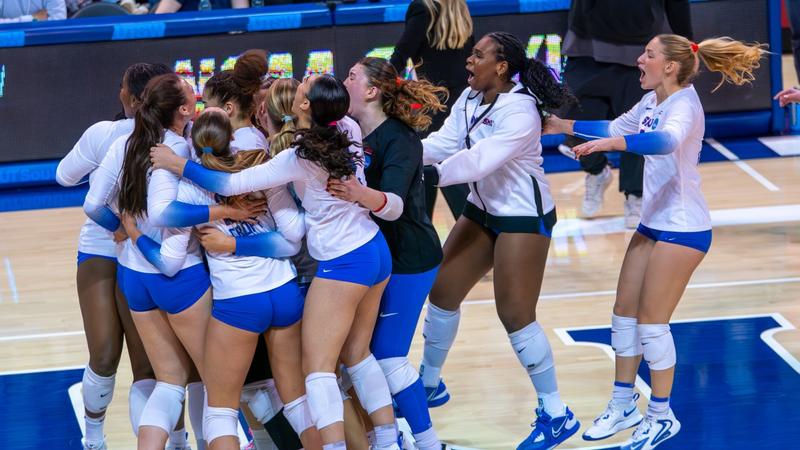
The second round had been the furthest the SMU volleyball team had ever gone in the NCAA tournament. Not anymore.
Not only did the second-seeded Mustangs win their first and second-round matchups, but they did so in emphatic and impressive fashion. SMU set a program and NCAA tournament record with a .618 hitting percentage against Central Arkansas in a first-round sweep.
Jadyn Livings led with 15 kills, with only one error on 23 swings, while Malaya Jones had her 25th double-double with 11 kills and 10 digs and Averi Carlson had 35 assists. Favor Anyanwu delivered seven blocks, and Jordyn Schilling had 11 digs to lead SMU’s defense.
“We’ve talked a lot about joy in the battle. We want to earn it,” SMU head coach Sam Erger said. “We don’t want them to give us anything. We want to earn every single point. And no one should walk away here going, ‘SMU didn’t go and make that happen.’ So we work a lot on mentality, and then when you hit so well, I think you got to talk about your setter. We have one of the best with Averi making everybody look good.”
The 25-13, 25-13, 25-13 victory got the Mustangs to the second round for the third straight year. The breakthrough came against Florida.
SMU dominated the first set for a 25-11 win, then fought for 25-21 and 26-24 wins in the second and third sets to reach the third round for the first time in program history.
“I’m just so happy and proud and excited, and we’re going to enjoy this for a moment, because this is our program’s first time to ever do this,” Erger said. “I do believe that we felt like this was something we could do, and we’re excited for the next round, but I think we should enjoy some of the history that is being made.”
It has been a season of history for the Mustangs. SMU was ranked as high as No. 7 in the country during the regular season, the program’s highest ranking ever. The victory against Florida was the team’s 27th of the season and 15th at home, both tying the program record. And it was the 100th career victory for Erger.
Individually, Jones surpassed the 500-kill mark to become just the second player in SMU history to do so. Anyanwu is within 14 blocks of the single-season record, and Carlson is third for single-season assists in the rally scoring era and sixth all-time.
No matter the challenge the Mustangs face, the new territory they enter or anything else, they feel ready to take it on together.
“I definitely had no doubt going into (the Florida) match,” Anyanwu said. “I knew whatever was thrown at us, we’ve gone through worse, so I had full-on confidence that no matter what they threw at us, we were going to be able to persevere and come through in the end. I’m just so grateful to play for a program like this, and it just means the world that we just rally behind each other and we just support each other fully. It’s amazing.”
After a dominant first set, the Mustangs trailed 16-12 in the second set. They won the next five points to take a lead. With the set tied at 19, SMU finished the set on a 6-2 run to win 25-21.
Even though it was only the second set, it was a crucial turning point in the match.
“I didn’t say this to the team, and I thought about saying this, but I really felt like if we won that second set, we would win the match,” Erger said. “That’s just where I was at.… I always think we’re going to win, but I’m like, ‘If we win the second set, this is our match’ because we’re going to come back from this adversity, and I know my team, and I know how fired up they’re going to be to close it out.”
That’s been the attitude and approach of the team all season. Erger has referred to them as fighters and having that mentality throughout the year. It now has the Mustangs in the Sweet 16 for the first time ever.
“We work a lot on our mentality,” Erger said. “Before (the Florida) match, we talked about burning the boats. Like we’re going to war and we’re on ships, and we’ve got to go to shore to fight, and we’re going to burn the boats. There’s no second option. We’re going to burn those freaking boats. There’s nothing to do but fight. There’s no cop-out, nothing.”

Burr was one of the best blockers in the country, as well as one of the most efficient attackers this past season. She ultimately finished the year with 139 blocks (1.34 blocks/set), including 25 solo blocks.
Offensively, the Goodhue, Minn., native totaled 259 kills and a .283 hitting percentage. Burr was named First Team All-Summit and made the Summit League All-Tournament team last month.
Zgonc, a native of Hartford, Wis., ranks 47th nationally in kills (451), 55th in points (4.34), and 39th in total attacks (1,233), while leading the league in kills per set (4.34) and points per set (4.77).
The junior was named the Summit League Player of the Year for the second season in a row and ended the season with 14 double-doubles for SDSU, a 23-5 overall record, and 16-0 mark in conference play.
Burr is the third Jackrabbit in the Division I era to earn an all-region honor, while Zgonc was recognized for the second straight season. Sydni Schetnan was a first-team honoree last season.
In total, there are 14 first-team All-Region members and an additional group of honorable mention selections for each of the 10 regions. A Player of the Year, Freshman of the Year, and Coach of the Year were selected for every region. The 213 student-athletes who made All-Region represent 109 different schools. Nebraska leads the way with seven All-Region selections, followed by Pittsburgh and Stanford with six apiece. Florida, Kentucky, Louisville, Minnesota, Texas A&M, and Wisconsin all have five All-Region first-team or honorable mention selections.
-GoJacks.com-
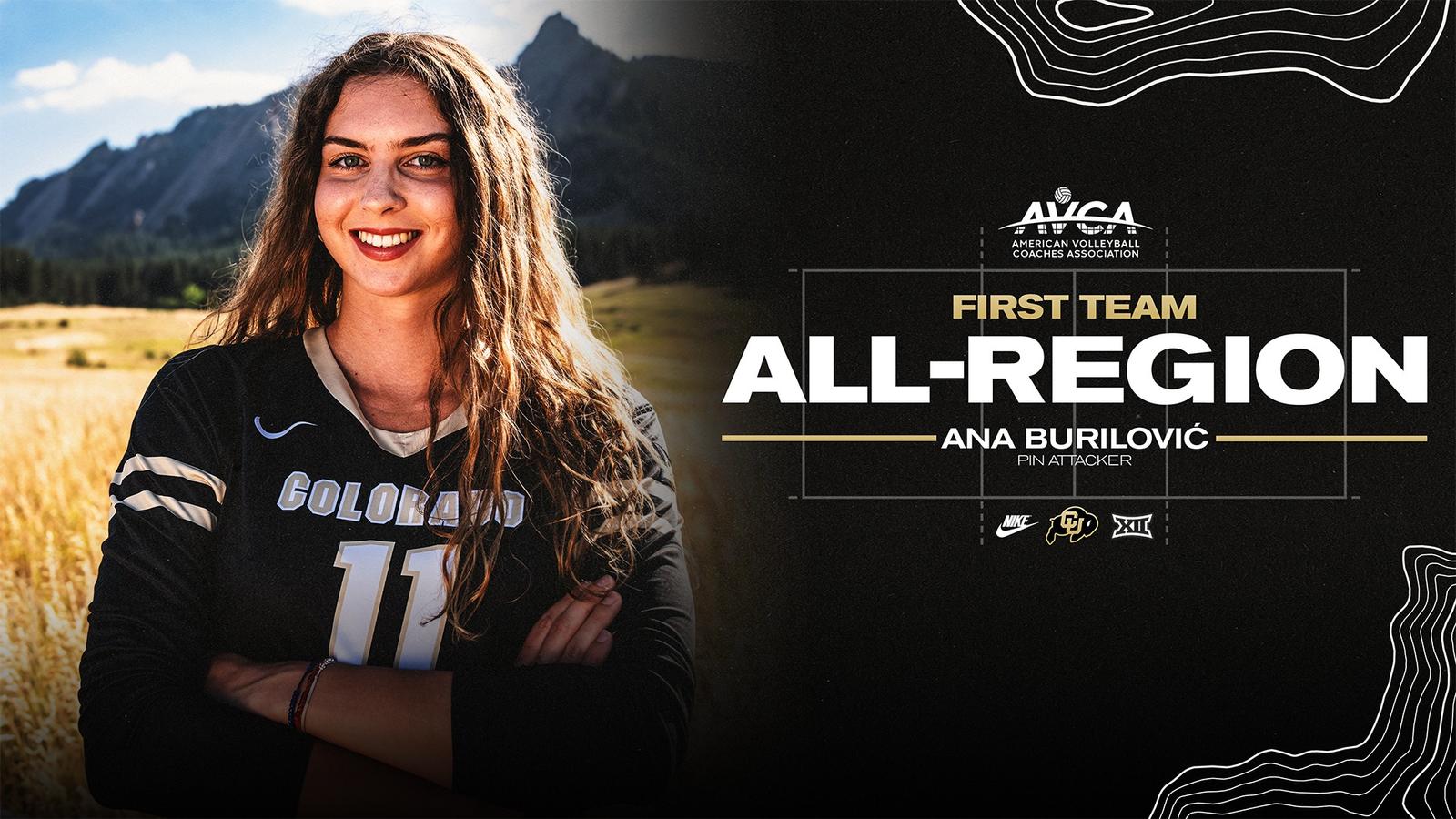
Burilovic’s all-region selection marks the program’s 30th postseason regional selection all-time. This is also her second postseason award after being named to the 2025 All-Big 12 First Team last week. The last time Colorado was named to the All-Region First Team was middle blocker Naghede Abu and outside hitter Alexa Smith in 2018. Colorado’s last all-region selection was an honorable mention for middle blocker Meegan Hart in 2020. Colorado’s first appearance on the all-region team was the first team for setter Nicole Vranesh in 1992.
Burilovic leads the Big 12 in points per set (5.47) and kills per set (4.71). She is also third in conference for aces per set (0.43). This is Burilovic’s first all-region selection of her career. In her 32 matches in 2025, she has accumulated 565 kills, 211 digs, 51 aces, 64 blocks and 19 assists. Burilovic has four kill-dig double-doubles on the season, now totaling 10 in her career. She has had 13 matches with 20 or more kills this season (a CU VB record), including two 30+ kill matches against UCF (Oct. 2) and at Northern Colorado (Oct. 28) – she is only the second player in Colorado Volleyball history to have two matches in one season with over 30 kills. On Sept. 30, Burilovic was named AVCA Player of the Week after aiding the Buffs in their road-sweep over then-No.14 BYU, and then-No.23 Utah. She was named Big 12 Offensive Player of the Week on Nov. 4, after leading Colorado’s win over Northern Colorado with 30 kills, hitting .329, nine digs, two blocks and one ace (Oct. 28). Burilovic surpassed 1,000 career kills at West Virginia, becoming the 19th Buff to total over 1,000 career kills. She now has 1,061 career kills, 521 career digs, 118 career aces and 116 career blocks.
Fourteen student-athletes were selected to the AVCA All-West Region First Team, and six were named Honorable Mention. A full list of the honorees can be found after this release.
Under 10th-year head coach Jesse Mahoney, Colorado finished the 2025 season 23-9 and went 12-6 against Big 12 opponents. Coach Mahoney has led the Buffs to a 164-135 record in his 10 seasons at the helm. The Buffs made their 22nd appearance in the NCAA tournament after the conclusion of the regular season, sweeping American in the first round before falling to four-seed Indiana in the second round. The Buffs’ last match against the Hoosiers marks the 12th second round appearance in program history. Colorado has 20 wins this season, marking the program’s 13th 20-win season and its first since 2022. With 23 wins this season, this is the most in a season since 2017 and ties for the third-most wins in a season in program history.
For more information on the Colorado volleyball team, please visit cubuffs.com/vb. Fans of the Buffs can follow @cubuffsvb on Instagram, X, and Facebook.
West Region
1st Rebekah Allick University of Nebraska MB Sr
1st Tierney Barlow Utah State University MB Sr
1st Ana Burilovic University of Colorado OH Jr
1st Laney Choboy University of Nebraska L Jr
1st Suli Davis Brigham Young University OH Fr
1st Kamryn Gibadlo University of Utah OH Jr
1st Andi Jackson University of Nebraska MB Jr
1st Brielle Kemavor Brigham Young University MB Jr
1st Kaylie Kofe Utah State University S So
1st Annalea Maeder Creighton University S Sr
1st Ava Martin Creighton University OH Sr
1st Harper Murray University of Nebraska OH Jr
1st Bergen Reilly University of Nebraska S Jr
1st Kiara Reinhardt Creighton University MB Sr
Honorable Mention
HM Virginia Adriano University of Nebraska RS Fr
HM Alex Bower Brigham Young University S So
HM Loryn Helgesen Utah State University RS So
HM Taylor Landfair University of Nebraska OH Sr
HM Claire Little Chambers Brigham Young University OH Jr
HM Avery Page Utah Valley University OH Sr
West Region Award Winners
Region Player of the Year: Bergen Reilly, University of Nebraska, S, Jr
Region Freshman of the Year: Suli Davis, Brigham Young University, OH
Region Coach of the Year: Dani Busboom Kelly, University of Nebraska
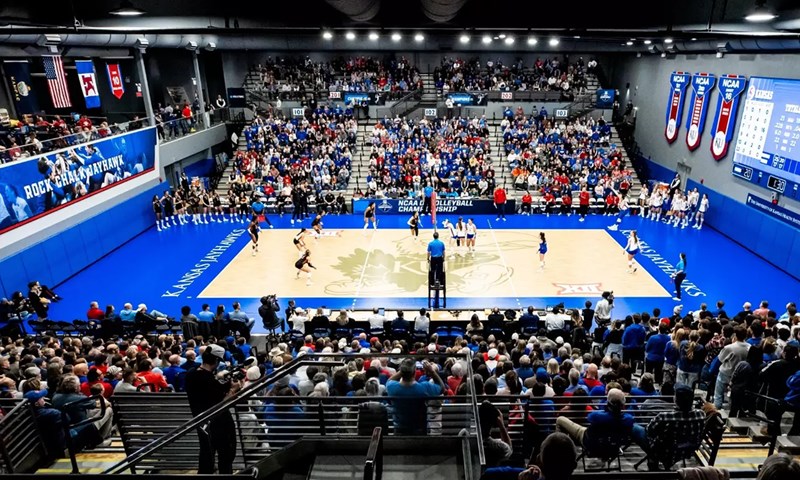
Arizona State and Kansas advanced to the Regional Semifinal round of the 2025 NCAA Division I Women’s Volleyball Championship. This is the fifth time in the last seven years that the Big 12 has sent at least two programs to the Sweet 16 and the first time since 2022. Additionally, the Big 12 finished with eight wins in the first round, the most in Conference history, surpassing the previous high of six (2004, 2006, 2023).
No. 2 seed Arizona State defeated Coppin State and Utah State to make its fourth trip to the regional semifinals in program history, and the second time in the last three years. The Sun Devils improved to 28-3 on the year, the second-most wins in school history. This marks the first time in the NCAA era that Arizona State has finished the year undefeated at home and the second time in Arizona State history. The 2025 Big 12 Offensive Player of the Year, Noemie Glover, recorded 17 kills, the second-most for the Sun Devils behind only Bailey Miller (18 kills). Arizona State will next play No. 3 seed Creighton on Thursday, Dec. 11 at Noon CT/11 a.m. MST.
No. 4 seed Kansas will play in the Sweet 16 for the first time since 2021, and the fourth time in program history after two wins at Horejsi Family Volleyball Arena. The Jayhawks swept High Point (3-0) before taking down No. 5 seed Miami (3-1) behind seniors Rhian Swanson and Katie Dalton. Swanson increased her season total to 19 games with double-digit kills, while Dalton added 59 assists across the two matches. Kansas will play top-seeded Nebraska on Friday, Dec. 12 at 8:30 p.m. CT.
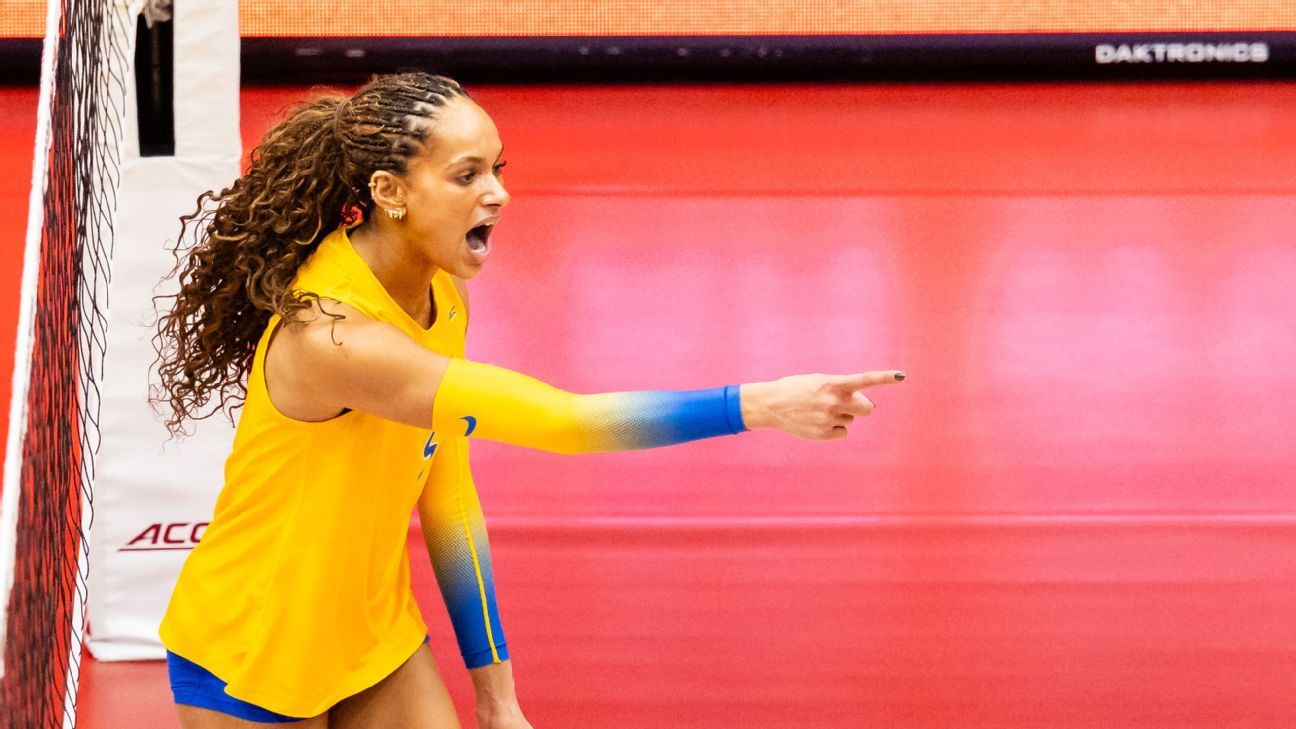
The 2025 NCAA volleyball tournament is down to its final 16 teams. But countless pressing questions remain as the tournament makes its way to the final four in Kansas City. Can Nebraska, the No. 1 overall seed, finish undefeated and claim the program’s sixth national title? Can Pitt advance to its fifth straight final four appearance? Will SEC champion Kentucky return to the final four for the first time since winning its first national championship in 2020? Is a young Texas team ready to cash in ahead of schedule?
Here are the 10 (OK, 11) players who will have a major say in answering those questions and more.
Olivia Babcock, Pitt: If the volleyball gods could issue a warning for the NCAA tournament’s stretch run, it would read something like this: “Do not take your eyes off Olivia Babcock, or else…” Arguably the most dynamic player in the college game, the 6-foot-4 Babcock averages 5.9 points per set and 5.1 kills per set for a team that is looking to return to the final four for the fifth straight time. The ACC Player of the Year had more than 40 kills in two matches this season from her opposite hitter position. With springy legs and a powerful arm from the front row, back row and behind the service line, Babcock, the 2024 AVCA Player of the Year, is magic in motion. Look away at your own risk.
Ella Swindle, Texas: Surrounded by strangers at the start of the season, the Longhorns’ junior setter holds the key to the powerful Texas attack. The 6-foot-3 Swindle led Texas to the national title in 2023 but then played a backup role a year ago when Texas fell to Creighton in the regional semifinals. This year, she has 898 assists — mostly to hitters she had never played with before the season. Texas’ top three hitters are Pitt transfer Torrey Stafford (488 kills) and freshmen Cari Spears (338 kills) and Abby Vander Wal (268 kills), and Swindle has the offense hitting at a .316 clip, tied for third-best in the nation.
Rebekah Allick, Nebraska: The top-seeded Cornhuskers take the court with a pick-your-poison approach. Every attacker around Big Ten Player and Setter of the Year Bergen Reilly can terminate (see: Andi Jackson, Taylor Landfair, Harper Murray). Every defender on the court can dig (see: Laney Choboy, Olivia Mauch, Teraya Sigler). On volleyball’s balanced behemoth, Allick stands out for her passion. Make no mistake: Allick, a 6-foot-4 senior middle blocker, is having the best statistical season of her career, hitting .437 (eighth-best in the country but seven slots below fellow middle blocker Jackson) with 235 kills. But nothing fires up the No. 1 overall seed more than an Allick roar after a stuffed block or a kill on an opponent’s overpass. The Huskers will be tested. And when they are, they’ll turn to Allick for inspiration.
Brookeva DeHudson, Kentucky: Don’t google her. It’s impossible to pick one Kentucky superstar outside hitter over the other. Brooklyn DeLeye and Eva Hudson are both that good, so we merged them into one spot. DeLeye was the SEC Player of the Year in 2024. Hudson, in her first year with the Wildcats after transferring from Purdue, is the SEC Player of the Year in 2025. The 6-foot-2 DeLeye has 495 kills on the season and averages 4.7 per set. The 6-foot-1 Hudson has 482 kills and averages 4.6 per set. Slow down one? Maybe. Stop both? Nearly impossible. Together they are the most lethal pair of pin hitters in the tournament and the engine driving Kentucky toward a shot at a second national title.
Chloe Chicoine, Louisville: Now we come upon the rarest of all sightings in the latter half of the NCAA tournament: a 5-foot-10 outside hitter. Chicoine, a transfer-portal addition to the reigning national runners-up, brings her impressive vertical leap and feisty play from Purdue to Louisville. She comes into the regional semifinals with her arm blazing. Chicoine crushed a season-high 28 kills in a five-set win over Marquette in the second round. She leads the balanced Cardinals with 387 kills and is second in digs with 332.
Mimi Colyer, Wisconsin: Two words: Instant. Offense. The 6-foot-3 senior outside hitter and Oregon transfer was a unanimous all-Big Ten selection in her first season with the Badgers. How could she not be? Colyer averages 5.32 kills per set, tops among players remaining in the tournament, and hits .340. She spent her free time getting 220 digs and 67 blocks. With setter extraordinaire Charlie Fuerbringer healthy and back on the court, the Badgers bring an offense that can pose problems for anyone and everyone.
Averi Carlson, SMU: The 5-foot-11 setter started for two seasons at Baylor, then started at Texas, then led the U.S. U23 national team to gold at the Pan American Cup, and now she orchestrates a high-powered Mustangs attack. The ACC Setter of the Year runs an offense that hits .316, tied for third-best (with Texas) in the country. She has developed a quick and lethal connection with fellow transfer Malaya Jones (503 kills) from Colorado State. She also puts up a strong block, with 85 on the season.
Noemie Glover, Arizona State: Since transferring from Oregon before the season, the Sun Devils’ opposite hitter has had exactly one match in which she didn’t produce double-digit kills — but even in that match she hit .444. The 6-foot-2 Glover has 406 kills, 108 blocks and 80 digs. Fun fact: Her dad, La’Roi Glover, played 13 seasons in the NFL and was a six-time Pro Bowler.
Elia Rubin, Stanford: The senior and four-year Cardinal starter has become synonymous with Stanford volleyball over the past four seasons. She brings a host of awards — AVCA All-America, All-ACC, All-Pac 12 — and 1,607 career kills into the regional semifinals. This season, she leads the second-seeded Cardinal in kills (378) and aces (45) and is second in digs (296). About the only thing Rubin hasn’t done in her Stanford career is play in the final four.
Logan Lednicky, Texas A&M: The 6-foot-3 senior opposite hitter is as steady as they come. She has been killing it for the Aggies for four straight seasons, and she’s poised to go out with a bang in her final NCAA tournament run. Through her first two tournament games, she has 39 kills on a .429 percentage and is averaging 6.21 points per set. The AVCA Player of the Year semifinalist plays some mean defense too — she has 83 blocks and 275 digs this season, both second-most among the Aggies.

Brands have long turned to professional athletes for their star power in big-budget commercials, but recent shifts in name, image, and likeness (NIL) policy have pushed marketers to widen the talent pool.
On July 1, the House v. NCAA settlement took effect, allowing colleges to compensate athletes for their NIL usage. Marketers expect that these athletes, many of whom have built-in communities and an engaged digital fanbase, can help brands stand out in the influencer space.
- Student athletes boast a social media engagement rate 3.7x higher than traditional influencers (5.6% compared to 1.9%), according to a June Opendorse report.
“College athletes bring a new edge by commanding hyper-loyal, local communities,” said Alison Bringé, CMO of Launchmetrics, “shaping culture on campuses and connecting with younger consumers with a level of authenticity traditional influencers can’t reach.”
Why college athletes resonate
NIL compensation has shown that sports influence functions like creator influence, as fans want more from their favorite players than just highlight reels. US sports fans look for personal life updates (31%) almost as much as game highlights (34%), according to an April YouGov survey.
“With jam-packed schedules, they don’t always fit the mold of the ‘always-on’ influencer, which makes the glimpses they share into their daily lives, routines, and preferences even more special and exciting to fans,” said Ajalin Williamson, strategy director at The Goat Agency in an October report.
Inside the sports creator economy
With the NIL settlement giving new opportunities to athletes and marketers, brands are reconsidering who is influential, recognizing that considering the full sports sphere can lead to more memorable work.
Cameo, an app where consumers buy personalized videos from celebrities, is recognizing the value of expanding athlete partnerships through a partnership with the Pro Athlete Community (PAC). The goal is to highlight how “brand deals have historically been limited to only the most prominent names,” according to a press release.
You no longer need to be in the big leagues to be a top sports creator. The Savannah Bananas, an exhibition baseball team that is known for their choreographed dances and social presence, has 11.1 million TikTok followers. The Yankees have 1.8 million, and The Mets only 801.7 thousand.

Richard Childress considered selling portion of NASCAR team

SMU Volleyball Sets Records, Makes History By Reaching Sweet 16

WVU’s Slaton Officially Inducted Into The College Football Hall of Fame

Kelley Earnhardt Miller, Dale Earnhardt Jr. voice disappointment surrounding NASCAR vs. 23XI, FRM lawsuit

Michael Jordan Hired The Best Sports Lawyer In The Country To Go After NASCAR

URochester students learn, work, and research across the globe

Dylan Ferrandis on the Ducati Desmo450 MX: “The best frame in two wheels motorsports”

Youth basketball coach indicted on predatory sex assault charges

Parella Motorsports Acquires Racing America

BURR, ZGONC NAMED AVCA ALL-REGION

WILDE Protein Snacks to Join Carson Kvapil, JR Motorsports for Three NASCAR O’Reilly Auto Parts Series Events in 2026

Which CFP teams have the most money? Breaking down field by NIL spending power

Colorado Volleyball’s Burilovic Named to AVCA All-West Region First Team

Bank of America to become new front-of-jersey sponsor for Portland Timbers

Velocity-backed Parella Motorsports Holdings and SpeedTour picks up Racing America

First Tee Winter Registration is open

Fargo girl, 13, dies after collapsing during school basketball game – Grand Forks Herald

CPG Brands Like Allegra Are Betting on F1 for the First Time

Volleyball Recaps – November 18

F1 Las Vegas: Verstappen win, Norris and Piastri DQ tighten 2025 title fight

Two Pro Volleyball Leagues Serve Up Plans for Minnesota Teams

Utah State Announces 2025-26 Indoor Track & Field Schedule

Sycamores unveil 2026 track and field schedule

Redemption Means First Pro Stock World Championship for Dallas Glenn

Bowl Projections: ESPN predicts 12-team College Football Playoff bracket, full bowl slate after Week 14

Texas volleyball vs Kentucky game score: Live SEC tournament updates

How this startup (and a KC sports icon) turned young players into card-carrying legends overnight

Jo Shimoda Undergoes Back Surgery

Indiana’s rapid ascent and its impact across college football

Robert “Bobby” Lewis Hardin, 56

 Why a rising mid-major power with an NCAA Tournament team opted out of revenue-sharing — and advertised it
 NBA Legend Michael Jordan to Join NBC Sports as Special Contributor
 Falcons mailbag
 Portal Update – Basketball and Gymnastics Take Hits
 has always dreamed in Mercurial. Now his initials are on the boots.
The new Kyl…
has always dreamed in Mercurial. Now his initials are on the boots.
The new Kyl…
-
 Rec Sports2 weeks ago
First Tee Winter Registration is open
-
 Rec Sports2 weeks ago
Fargo girl, 13, dies after collapsing during school basketball game – Grand Forks Herald
-
 Motorsports2 weeks ago
CPG Brands Like Allegra Are Betting on F1 for the First Time
-
 Motorsports2 weeks ago
F1 Las Vegas: Verstappen win, Norris and Piastri DQ tighten 2025 title fight
-
 Sports2 weeks ago
Two Pro Volleyball Leagues Serve Up Plans for Minnesota Teams
-
 Sports2 weeks ago
Utah State Announces 2025-26 Indoor Track & Field Schedule
-
 Sports2 weeks ago
Sycamores unveil 2026 track and field schedule
-
 Motorsports2 weeks ago
Redemption Means First Pro Stock World Championship for Dallas Glenn
-
 NIL1 week ago
Bowl Projections: ESPN predicts 12-team College Football Playoff bracket, full bowl slate after Week 14
-
 Sports2 weeks ago
Texas volleyball vs Kentucky game score: Live SEC tournament updates