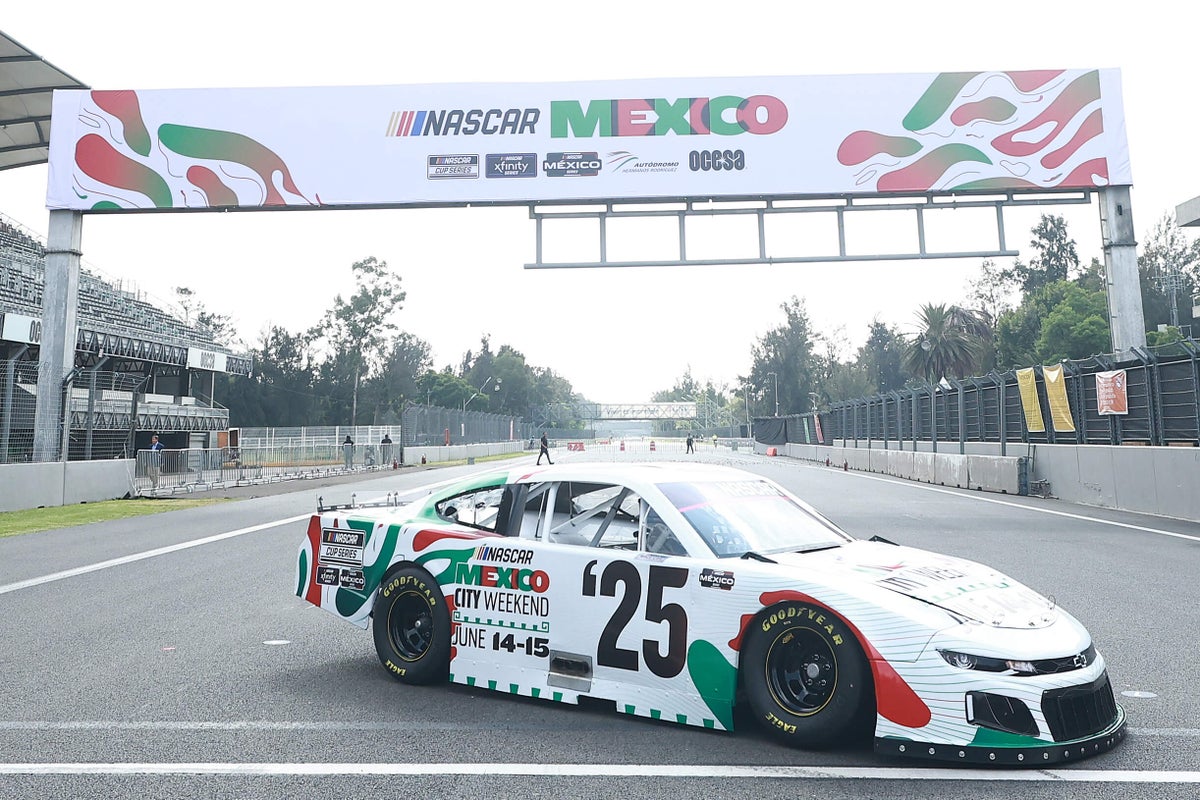
¡Vamos! NASCAR brings its premier Cup Series south of the border this week for its first international points race since 1958, as well as the first-ever Cup Series event in Mexico.
This season’s signature new event marks a significant step in NASCAR’s international plans and a key test to determine if the sport’s popularity in the United States, with its unique stock car brand, can be translated elsewhere.
The timing is especially good given NASCAR has a Mexico native on one of the top teams: Daniel Suárez, who is a two-time Cup Series race winner for Trackhouse Racing — a resume which includes a road course victory at Sonoma Raceway.
The race will be held at Autódromo Hermanos Rodríguez, on a road course most known for hosting Formula One grands prix. NASCAR has only slightly modified the track and will use an altered 2.49-mile layout versus F1’s 2.67-mile layout, rounding out a corner at Turn 4 and eliminating two corners there vs. the F1 configuration. The Cup Series will also have 29 more laps than the F1 race, making it significantly longer (242.9 miles compared to 189.7 miles for F1).
“You can see the excitement from the media people, the venue looks amazing, and I love Mexican food,” said Kyle Larson, who visited the track recently for a promotional event. “It’s going to be a great time, a great event and cool to go race in a different country in front of race fans who maybe have never seen us race in person.”
Before NASCAR makes its run for the border, here’s what you need to know about Mexico’s premier racing circuit.

How it all began
(Note: This section previously appeared in our F1 Mexico City Grand Prix circuit breakdown.)
The track’s origins are captured in its name, which quite literally translates to “autodrome of the Rodríguez brothers.”
Ricardo and Pedro Rodríguez helped increase the popularity of motorsport in Mexico. Their father served as an advisor to Mexican President Adolfo López Mateos, and he suggested the president create a motorsport circuit using existing internal roads in Mexico City’s Magdalena Mixiuhca sports park. The president agreed, and the circuit was built less than a year later.
But the Rodríguez brothers’ lives were marred by tragedy. F1 arrived in 1962 with a non-championship grand prix, but Ricardo Rodríguez died during practice when his car overturned and caught fire. Then, in 1971, Pedro Rodríguez suffered fatal injuries in a sports car race. The track was then officially named Autódromo Hermanos Rodríguez in the early 1970s.
F1 brought its first world championship event to the track in 1963, a race dominated by Jim Clark. The series stayed until the 1970s, but due to safety concerns, it was dropped until the mid-1980s. It underwent a renovation, and the sport returned from 1986 until 1992. But Mexico fell off the calendar until 2015.
Other racing series filled the void in the meantime, including CART (1980-81 and 2002-07) and the NASCAR Xfinity Series. Xfinity raced there four times in the mid-2000s (races were won by Martin Truex Jr., Denny Hamlin, Juan Pablo Montoya and Kyle Busch) before leaving following the 2008 season.
But those NASCAR races were on a different layout; when F1 returned in 2015, it was reconfigured and now includes a famous cut-through of an old baseball stadium on the property.
— Madeline Coleman
High society
With Mexico City at an altitude of 7,350 feet, this will be the highest elevation race in Cup Series history.
That will require a significant challenge for engine builders, as the motors will generate significantly less horsepower in high altitude. It will also affect the cars’ cooling because water boils at a lower temperature at elevation, and they have options to run different louvers (vents) in the hoods.
It would also affect the drivers themselves, although drivers are split on how much preparation will be necessary.
Chase Briscoe, for example, said he has been sleeping in a hyperbaric chamber (which simulates the conditions felt by the body at high elevations). Briscoe said he hopes it will be helpful, because otherwise he’s been leaving his wife to take care of their young twins at night by herself for nothing.
“If we get to Mexico and all that was a waste of time, I’ll just be in the dog house,” Briscoe said. “You get good sleep because you’re not getting woken up by the kids, but it’s like 90 degrees in this tent. It smells like straight-up plastic.”
Briscoe has also been doing two-a-day workouts on Wednesdays and going to a heat room to try and build up his endurance. Joe Gibbs Racing teammate Christopher Bell said he’s also been doing some altitude training to prepare, just in case it’s necessary.
“The last thing I would want to do is get down there and not feel well and not be able to perform in the car,” Bell said.
Larson said he went for a run during his Mexico visit and didn’t think the extra exertion required was anything particularly notable. Similarly, Ryan Blaney said there wouldn’t be any acclimation process for him. When he visited Mexico City for his own media tour earlier this year, he was told it wouldn’t even be very hot by the time NASCAR returned (temperatures are expected to be in the low 70s with rain).
“I don’t think I’ll do anything differently,” Blaney said.
Bubba Wallace joked he would practice holding his breath and “see if I can get longer and longer.”
But Denny Hamlin scoffed at the notion altogether.
“I’m not soft like these guys,” Hamlin said. “I don’t get bothered by heat or get exhausted. I know the air is thinner and all that, and I know a lot of guys are preparing for it — as they should — but I will not be.”
— Jeff Gluck

NASCAR’s inaugural Cup Series race at the Autódromo Hermanos Rodríguez should look a lot different than F1’s annual grand prix on the circuit. (Chris Graythen / Getty Images)
How it will race
Similarly to Circuit of the Americas in Austin — the only other current track shared by both NASCAR and F1 — the cars will race dramatically differently.
In the esses, for example, F1 cars blow through there wide open. But Cup drivers believe they’ll have to meander through that section in second gear.
The famous stadium section (at left in the graphic above) has a turn which will require the Cup cars to slow down to a near stop (“like 30 mph,” Erik Jones estimated) and then make a large arc into the corner — somewhat like the new Charlotte Roval turn that caused some chaos last fall.
Chase Elliott said that could be a controversial turn because there’s no real way to protect against a dive bomb move.
“It’s kind of just, ‘How much respect do you have for your competitors?’ and, ‘How silly do you want to be?’” Elliott said. “Typically, if you’re around guys you share a lot of mutual respect with, you don’t see stupid stuff happen. And when stupid stuff does happen, it’s just a sign of someone who doesn’t respect somebody else. Typically, that is when that stuff gets out of hand.”
But in general, Blaney said, the course will suit NASCAR very well with multiple passing zones.
“They did a really good job on it,” he said. “It has all different aspects from high-speed straightaways, really heavy braking zones, flowy sections and then your really slow stadium section. It has all pieces of road courses we run mashed into one, so it looks like a great racetrack.”
— Jeff Gluck
(Top photo: Manuel Velasquez / Getty Images)