
NIL
NBA Center Moussa Diabaté Voices Concern Over NIL-Fueled Pay Disparity Between College Players and NBA Role-Players


Charlotte Hornets center Moussa Diabaté joined a growing chorus of NBA players questioning the financial logic of professional basketball.
The 23-year-old forward expressed frustration during a recent podcast appearance, pointing out that college athletes earning six figures through NIL deals often make more than NBA professionals on two-way contracts. His comments highlight an unprecedented shift in basketball’s economic landscape.
NBA Veterans Struggling While College Stars Cashing In on NIL Deals
One a recent podcast appearance, Charlote Hornets center Moussa Diabaté highlighted the jarring contrast between college and professional compensation during his podcast appearance.
“You have players that are maybe averaging like six-to-seven points, making like $300-400k, like sometimes some of them, I heard some people, they [sic] making like $800k – 600k coming off the bench in college,” he explained.
The numbers support Diabaté’s frustration. Top college recruits now command massive NIL packages that dwarf entry-level NBA salaries. AJ Dybantsa, who committed to BYU this season, reportedly secured NIL deals worth $5-7 million. Cooper Flagg’s NIL contracts totaled $28 million, though his annual NIL valuation was $4.8 million during his Duke season.
Meanwhile, Diabaté’s current NBA salary of $2.27 million falls below what several college players earn annually.
This disparity hits particularly hard for players like Diabaté, who experienced college basketball before the NIL era. The consensus five-star recruit averaged 9.0 points and 6.0 rebounds as a freshman at Michigan during 2021-22 before declaring for the NBA Draft. He entered the league just as college athletes began securing lucrative endorsement deals.
Exuberant NIL Money Transforming College Basketball Culture
Financial concerns represent only part of Diabaté’s critique. He believes NIL fundamentally altered college basketball’s character and traditions.
“I definitely think it destroyed college, not more so in a sense of the game itself, like the basketball players like their skills and stuff like that, but more so like college itself,” he stated.
The combination of NIL money and the transfer portal eliminated the multi-year relationships that once defined college programs. Players who might have developed over three or four years now chase better deals elsewhere after each season.
“What you remember as being like coaches, like you have the players that stay three or four years, like you have those die-hard fans behind them, like because they’ve been growing up with those, like pretty much grown up from freshman to seniors, like you’re not going to have those anymore,” Diabaté continued.
The Charlotte Center argues that this shift created a generation of players who lack the resilience of their predecessors. When faced with adversity, today’s college athletes can simply transfer to another program rather than work through challenges.
“I think it’s the kids themselves, they losing that, I feel like the whole idea of the NBA is not as appealing no more,” Diabaté explained. “I think that, like character-wise, they’re not going to be understanding like they’re not going to be resilient at all like whenever something hard gonna happen they’re just gonna be like ‘Yeah I gotta get out, I gotta go.’”
The financial gap becomes especially pronounced for players entering the NBA through two-way contracts. These deals, designed to develop talent between the G League and NBA, pay approximately $578,577 annually, with only up to half potentially guaranteed.
Players on two-way contracts cannot participate in playoffs and face restrictions on their NBA appearances.
Diabaté articulated the frustration of watching college stars transition to the professional ranks only to earn less than they might have made staying in school.
“You have players that would be like player of the year in college, dominating college like real life dominating in college, go to, like obviously the goal is the NBA, go like maybe second rounds go as two ways and they will make less than like somebody that’s on the bench in college,” Diabaté stated.
KEEP READING: ‘Everybody Could Eat’ – Kiyan Anthony Opens Up on NIL Changing Things Drastically for College Athletes
The French-born center knows this reality firsthand. After being selected 43rd overall in the 2022 NBA Draft, he spent two seasons on two-way contracts with the Los Angeles Clippers before signing with Charlotte. His journey through the league’s developmental system exposed him to the financial challenges facing young professionals.
These economic shifts already influence player decisions about entering the draft. Only 106 players filed as early entrants for the 2025 NBA Draft, marking the lowest number in over a decade. Players increasingly choose guaranteed college money over uncertain professional opportunities.
When asked what NBA rule he would change, Diabaté focused squarely on reforming the two-way system. He believes the league must address the reality that former college stars now earn less as professionals than current college bench players make through NIL deals.
The transformation extends beyond individual players to reshape basketball’s entire developmental pipeline. Players like Diabaté represent a transitional generation that entered college before NIL riches became available, only to find themselves earning less as professionals than today’s amateur athletes.
As NIL deals continue growing and two-way salaries remain relatively stagnant, this gap will likely widen, forcing both the NBA and college basketball to reconsider their economic models.


At long last, only four teams remain. And if we’re being completely honest, it’s not the four teams we saw coming.
Either Ole Miss or Miami will play in the national championship, which is a welcome change of pace given how many college football regulars have competed for a title over the past decade.
On the other side of the bracket, Indiana and Oregon will play in a rematch absolutely no one will be angry about. The Hoosiers won the first matchup on the road, and they’re favored once again. But this is different in every way.
With the pleasantries out of the way, let’s get right to it. Enjoy every remaining college football game while you can.
Fiesta Bowl: Miami (-3.5) vs. Ole Miss

Let’s begin with some praise for both programs, as they created brilliance and drama in a postseason round that needed plenty of both.
With the other games taking on the form of blowouts, Miami pulled one of the biggest upsets in CFP history, and Ole Miss, without its former head coach, did something awfully similar.
This isn’t the semifinal we saw coming, but it’s one we will gladly embrace. And we’re going to be embracing Miami to move forward.
Oh, we’ve doubted this team. We’ve also doubted the head coach. In fairness, Miami has given us reason to doubt over the past few seasons, losing games against teams it shouldn’t lose games against.
None of that matters at this exact moment. The Hurricanes have gone on the road to beat Texas A&M and overwhelmed mighty Ohio State, coming together at the right time.
“Overwhelmed” is indeed the word to use, especially when you see just how well Miami has played in the trenches. The Hurricanes averaged more than four yards per carry against the Buckeyes, one of the nation’s elite run defenses. But the defensive line, which has been the dominant force in both playoff games to date, is where this pick takes form.
Oh, it will have its work cut out for it against Ole Miss. Quarterback Trinidad Chambliss was absolutely sensational against Georgia, and he’ll be slippery once again. Even with his wideouts and targets dropping balls, Chambliss found a way.
Still, this feels like a different challenge. The Miami defense isn’t just good up front. The Hurricanes are also sensational on the back end. And the ability to run the ball behind a dominant offensive line creates a unique challenge for Ole Miss.
Speaking of challenges, the Ole Miss staff is likely to undergo more changes, with assistants poised to leave for LSU to work under Lane Kiffin. That’s a significant disruption given how little time these teams have to prepare.
Look for Miami to dominate time of possession, kill clock and torment Chambliss just enough. With that in mind, we’re also leaning toward the under, leaning on a Miami defense that should once again be the star of the show.
Peach Bowl: Oregon (+4) vs. Indiana

Don’t assume the second coming of this delightful matchup will go like the first game did, but let’s take inventory on what we saw months ago.
Indiana went to Eugene and won 30-20, though neither offense was particularly sharp. Both quarterbacks—Oregon’s Dante Moore and Indiana’s Fernando Mendoza, perhaps the first two QBs taken in next year’s draft—combined to throw three interceptions. Mendoza, the eventual Heisman winner, threw a pick-six.
The defenses ruled, and they likely will again. These two teams combined to allow just three points last round. Oregon shut out Texas Tech, forcing four turnovers in the process.
Indiana limited Alabama to 193 yards and three points, dominating the Crimson Tide in a way we haven’t seen in many, many years. The Hoosiers limited Alabama to 23 yards rushing on 17 carries, and the defense sacked Ty Simpson three times.
Now, this total sits in the mid-40s, which feels about right. This game features a wealth of offensive firepower, although both defenses have the ability to be elite.
As for location, this one seems somewhat relevant.
While the Peach Bowl will be a neutral site, don’t be surprised if the crowd is more Indiana-heavy. It’s not an easy trip from Eugene. It’s even harder for those considering making a trip to the national championship in Miami a week later, if they get that far.
Despite the first outcome and the long travel, this feels like a field-goal game. Even the first matchup, which was ultimately decided by 10 points, was tight throughout.
Indiana has been absolutely sensational, and there is no reason to believe that will stop here. Oregon, however, just played one of the best defenses in the country, found success and still left a lot of points out there. That experience should help plenty.
Since the line was posted, it has moved slightly in Indiana’s favor. Given how sensational this team played against Alabama, this should come as no surprise.
Still, it feels a tad high. Oregon is more than capable of pulling off the upset, and the Ducks should find success on both sides of the field.
Close game. Fabulous game. Enjoy this one regardless of what side you land on.
Jan. 7, 2026, 11:51 a.m. CT
BATON ROUGE — Cincinnati transfer quarterback Brendan Sorsby was at the top of every school’s list that needed a quarterback, and LSU football was included in that.
New LSU coach Lane Kiffin and his program was one of the fortunate two to get Sorsby on campus for a visit, which he did this past weekend. It was then LSU made its Name, Image, Likeness marketing and revenue sharing deal to him which was upwards of $4.5 million altogether, Yahoo! Sports reported Wednesday.
Sorsby signed a contract with Texas Tech, the other school he visited this past weekend, that is believed to be at least $5 million total, according to the report.
The 11-page deal from LSU was made through the university’s multimedia rights partner, Playfly Sports Properties detailed how the compensation was Sorsby was going to be structured during his one year with the football program. For Sorsby, $3.5 million was going to be handled by NILSU MAX, an independent entity formed in affiliation by Playfly and LSU athletics while “likely at least $1 million” would’ve come from LSU’s revenue sharing cap money.

If NILSU MAX couldn’t fulfill the guaranteed amount of $3.5 million to Sorsby, it was contractually obligated to come up with the money using his name, image and likeness on promotional materials as well as organizing a “limited amount” of autograph signings and appearance, per the contract.
There were also incentives tied to the proposed deal to Sorsby which included a $500,000 bonus should he win the Heisman Trophy and $200,000 for winning the Maxwell Award, which is presented annually to college football’s top player. Quarterback Joe Burrow is the most recent LSU player to win the award back in 2019.
What’s interesting about LSU’s proposed deal to Sorsby is how does it fly with programs supposedly operating under a revenue-sharing pool, which is marked at $20.5 million?
The College Sports Commission, the industry’s new enforcement agency, and NIL Go signs off on third-party contract for student-athletes, determining if the deals have a “valid business purpose” and that they do not exceed an established “range of compensation.”
But the agency was only started this past June. So it’s unclear if NIL GO would have approved the deal or not as there’s very little precedent at this time.
Kiffin and LSU are still in the market for a quarterback out of transfer portal. Arizona State transfer signal caller Sam Leavitt was on campus for a visit the last two days and LSU has reported interest in Washington quarterback Demond Williams.
It’s unknown what proposed deals to those quarterbacks would look like — likely not as high as LSU’s offer to Sorsby as he was the top player in the transfer portal at his position. But the one guarantee if the offer would be competitive.
Cory Diaz covers the LSU Tigers for The Daily Advertiser as part of the USA TODAY Network. Follow his Tigers coverage on Twitter: @ByCoryDiaz. Got questions regarding LSU athletics? Send them to Cory Diaz at bdiaz@gannett.com.
Does college football need fixing? That could be argued.
It’s inarguable that there are broken aspects to the sport (see the calendar), but at the same time, the sport is gobbling up as much money as it ever has.
As I reflect on the last year, I’ve come up with two whacky ways I think college football could improve on some of its issues. I stayed away from the calendar and the portal because everyone at this point knows something has to give there.
1. NIL-Incentive-Based Preseason Bowl Games
I’m typing this out with a quad box on my TV that features three bowl games (this was written on Dec. 31), so just know if the bowl system doesn’t innovate, I’ll still be here for it.
With that said, there is no denying that the bowl season has been losing its luster over the past decade or so. So, let’s try to find a way to spruce things up. My suggestion (which I don’t think is necessarily original): move them to the next preseason.
That may sound all sorts of backward, but is it more backward than a team having to turn down a bowl because they don’t have enough players to field a team? Is it more backward than a handful of teams going into bowl season with cobbled together coaching staffs because their coach left for another job?
Here’s my idea: Based off conference finishes, teams will be slotted into bowl games to start the next season. Using the Texas Bowl as an example, say it hosts the third-place finisher in the Big 12 and the fifth-place finisher in the SEC (would’ve provided a Utah vs. Texas matchup based on this season’s results). Then, the Texas Bowl’s sponsor would have to pony up some money (how much, I have no idea) for some NIL during next season’s games.
You could argue that the roster that makes the bowl should get the NIL, which I won’t put up much of a fight arguing about, but it going to the next season’s roster would benefit the program going into the offseason. Coaches would be able to recruit the portal with, “Oh, and we’re in the X Bowl, which pays out X.” Maybe it would also be enough to keep some of the players undecided about hopping in the portal to stay in a spot.
It’s a reward to the program for having a good season that they now have the extra recruiting tool and a reward for players in that they get paid. AND it provides The College Football Playoff committee more potentially relevant interconference data points come the end of the year. It’s a win-win-win, as far as I’m concerned.
Things that would need to be figured out:
For one, a lot of teams already have nonconference games scheduled way in advance, so you’d have to deconstruct some of those deals.
Secondly, teams ineligible for a bowl would have a relatively quick turnaround to get a game scheduled. But basically every other college sport puts schedules together much quicker than football, so I think you’d be able to work around that.
2. Region-Based Promotion, Relegation
From a fun idea that could somewhat realistically be implemented smoothly to something that is bat-poop crazy that the powers that be would never agree to.
This prompt is sort of two in one, as it would take conferences realigning (again) plus the implementation of a European soccer-esque promotion-relegation system.
Starting with the conferences, nothing makes sense anymore. USC is in the same conference as Rutgers, despite the two schools having about a 40-hour drive between them. Cal and Miami share a conference despite having about a 45-hour drive between them.
I say the conferences should come together (already not going to happen) and divide schools up based on geography. Not just the Power Five, either. The American Conference hosts UTSA (San Antonio, Texas) and Army (West Point, New York). Conference USA has New Mexico State and Delaware. Those leagues don’t have the TV revenue to afford such travel expenses as easily.
So, the Power Five returns (welcome back, Pac-12!), and each of those league’s get paired with a Group of Five conference. The winner of the Group of Five conference and the last-place team in the Power Conference would switch leagues (or potentially play a winner-take-all postseason game?). Base media rights payouts would be uniform across the P5 leagues (again, never going to happen) and in the G5.
Let’s say it’s Pac-12/Mountain West, Big 12/American, Big Ten/MAC, SEC/Sun Belt and ACC/Conference USA.
I still think the college football regular season means a lot, but this would only add to that for literally every team. There’s even intrigue for teams having bad seasons. A late November game between two teams that are 2-9 might be must-see TV.
Aside from helping with travel costs for schools and fans, the regionality of things would also bring back some rivalries and create others.
Take the state of Texas, for example. There are six Group of Five programs in the Lone Star State, and those six schools are in three difference conferences. Rice (Houston, Texas) shares a conference with Temple (Philadelphia, Pennsylvania) but not with Sam Houston (Huntsville, Texas). I imagine a lot of players on those G5 Texas teams know one another and would probably very much like to prove that their college team is better than someone they grew up playing in high school. Same for regular students. Say Joe and Bob grew up as friends in Dallas. One went down to Texas State for college and the other went to North Texas. That game has a new level of care to it for bragging rights over your buddy.
Things that would need to be figured out:
Money means this idea is dead on arrival. Schools in the Big Ten or SEC right now would have no interest in sharing their portion of the pie, even if it was for the betterment of the sport. Could you imagine one of those Big Ten teams who woke up on third base despite basically never being relevant in football agreeing to a system that could have them relegated to the MAC? No way. College Football Playoff payouts to the league would have to be big with the regionality of things. The more teams that league gets in, the more money that league gets to divvy among its schools.
Promotion-relegation also isn’t as smooth an idea in college sports as it is professional sports because of A, the transfer portal, and B, eligibility. If a Group of Five team was good enough to win its league, the difference in P5 media rights money and G5 media rights money would need to be enough for the G5 team to retain at least portions of its roster rather than the whole thing getting blown up, forcing an underfunded team into a stronger league while having to replace a large chunk of the roster. But even if that money is enough for rising G5 schools to retain their rosters, what if that G5 school was filled with seniors?
Then would anyone belong to any conference anymore? Or is it sort of like the NFL but rather than AFC and NFC its Big 12, SEC, etc.?
It’s messy, there is no doubt, but if somehow the whole system was reset, I think this system would be a ton of fun.
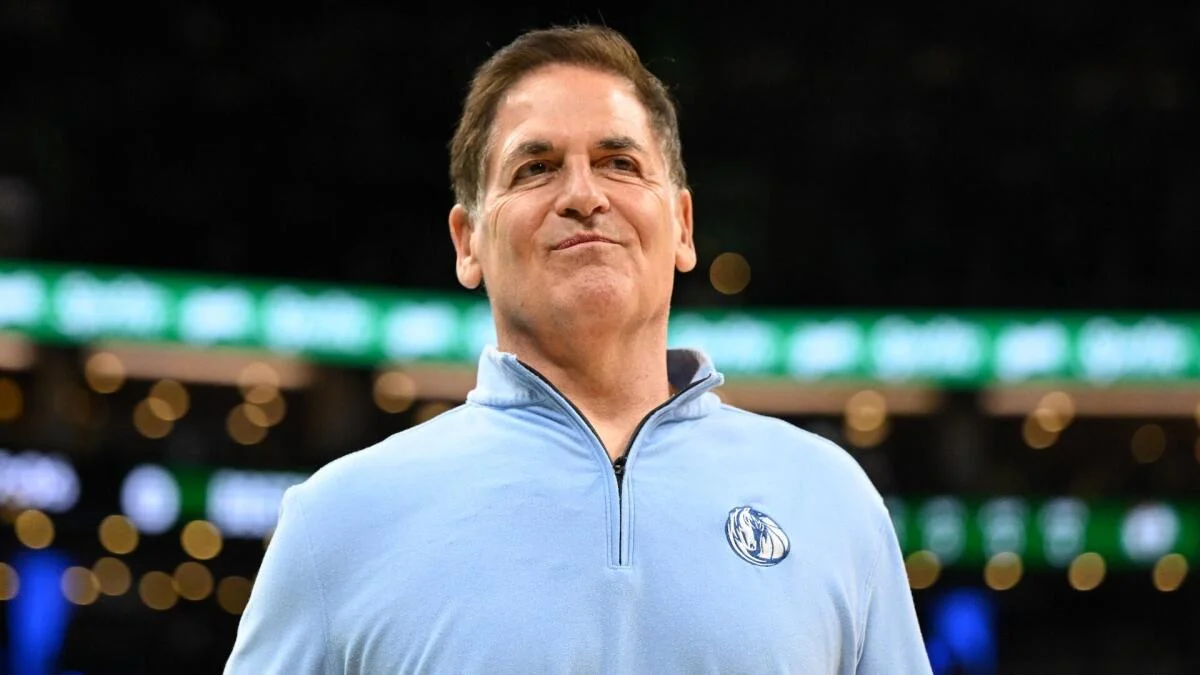
Indiana’s ascendence to the top of the college football world is nothing short of stunning, as Curt Cignetti arrived in Bloomington and immediately turned into a contender. Cignetti’s displays a powerful ability to get buy-in from all levels of the program, from players to the administration to boosters, tapping into Indiana’s alumni base to get the Hoosiers closer to the nation’s top programs in spending.
Among the alumni that Cignetti convinced to invest in the program is billionaire Mark Cuban. The investor and now-minority owner in the Dallas Mavericks has plenty of cash on hand after selling the majority stake in the Mavs, and after never giving to his alma mater’s athletics department previously, Cuban made back-to-back major donations to help the Hoosiers compete in the portal.
Cuban confirmed he sent in another donation prior to the opening of the transfer portal on Jan. 2, telling Front Office Sports he “already committed for this portal.” While he wouldn’t confirm how much he gave, he did hint that it was a bigger gift than last year — “Let’s just say they are happier this year than last year.”
That investment from Cuban and others has already paid major dividends for the Indiana program. After a playoff berth in 2024, the Hoosiers improved even further in 2025, landing the No. 1 overall seed in the College Football Playoff after an undefeated season and winning the Big Ten championship. They’re now the favorites to win it all and will look to punch their ticket to their first national title game in a rematch with No. 5 Oregon on Friday night in the Peach Bowl.
The transfer portal played a huge role in Indiana’s success, as Cignetti brought much of his James Madison team with him in addition to a number of key players via the portal — most notably Heisman Trophy winning quarterback Fernando Mendoza.
While the on-field focus remains the Ducks, the Hoosiers are aggressive once again in the portal for 2026. Indiana’s put together another big portal haul, ranking fourth in 247Sports’ transfer portal class rankings, putting Cuban’s money to good use by landing nine commits. The headliners so far are TCU quarterback Josh Hoover and Michigan State wide receiver Nick Marsh, as they look to reload at key positions on offense to stay on top of the Big Ten.
The NIL era continues to be wild.
Since the NIL era began in college athletics back in 2021, the landscape of college sports has often been described as ‘The Wild, Wild West.’ As we enter 2026, that phrase doesn’t do the current situation any form of justice. There were at least some laws in the Wild, Wild West.
While there are rules – it would be more accurate to just call them guidelines – when it comes to what you can and can not do regarding NIL, they very much feel optional at this point in the proceedings.
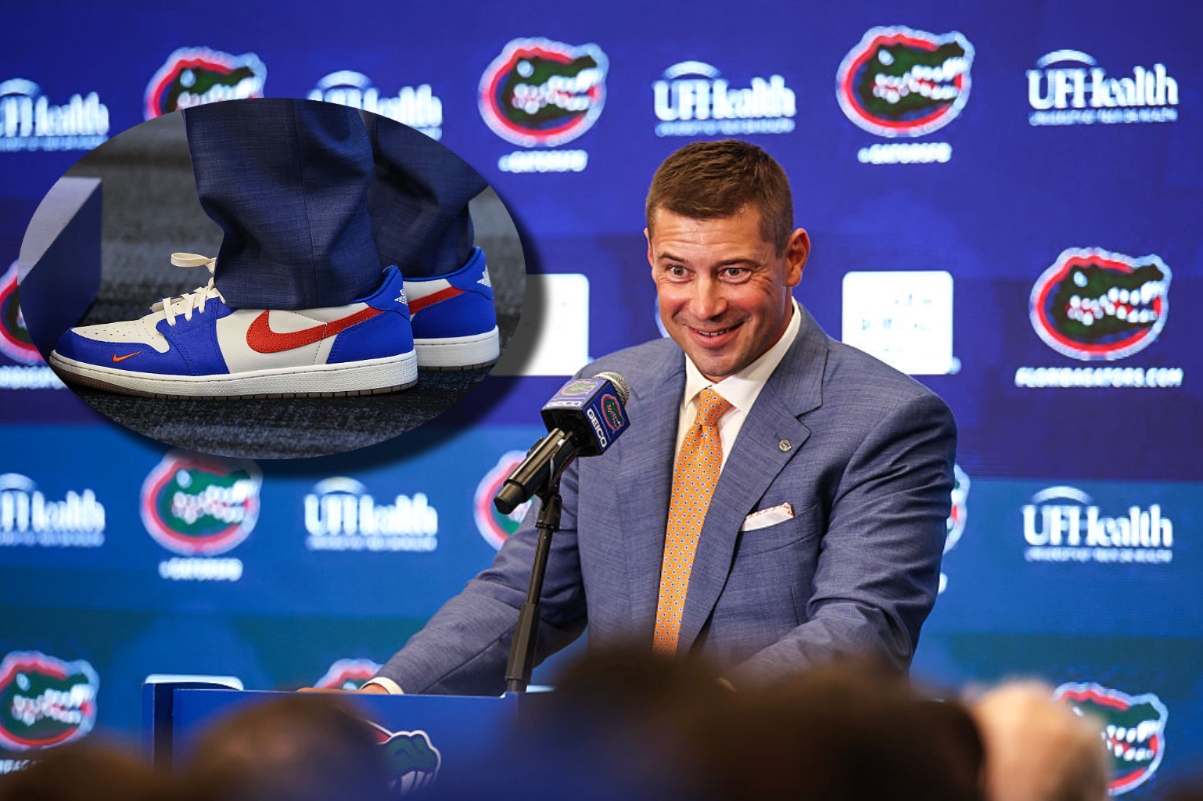
Newly appointed Florida head coach Jon Sumrall recently joined Jonathan Hutton and Chad Withrow on OutKick’s Hot Mic and gave a very real example of just how little sense said NIL guidelines make.
With Florida being sponsored by the Jordan brand, one would imagine that Sumrall could hand out as many pairs of shoes as humanly possible to players after their careers wrap up in Gainesville. But no, that isn’t the case at all.
“We give out Jordan Brand shoes here, because we’re a Jumpman school,” Sumrall noted. “So, that’s like a cool, hip thing. And I’ve got all those Jordans on my desk here, but we can’t give them to the players after their careers are over because the monetary value is too great. It’s called an extra-benefit.”
“I’m like, the shoes are worth a couple-hundred bucks, I don’t know maybe a couple thousand bucks, I don’t know how much they’re worth. But, we’re already paying these dudes. Why can’t we give them these shoes?”
That’s a valid question, coach.
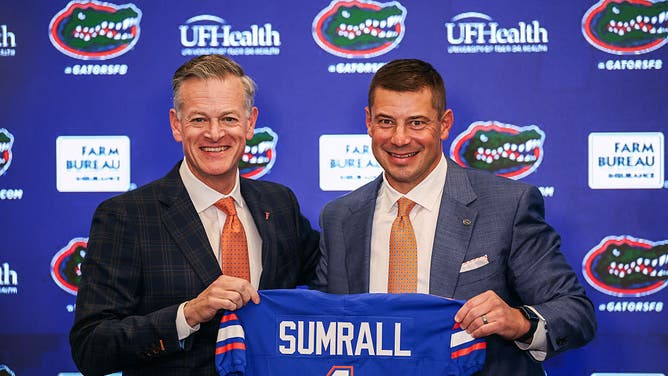
Jon Sumrall being introduced as Florida’s next head coach. (Photo by James Gilbert/Getty Images)
Many players are being paid six to seven figures per season to play, and are paid that sum regardless of performance, but handing out a pair or two of shoes that your team is already sponsored by is a no-no.
Good luck trying to make that make any sense.
The funniest piece in all of this is that someone at Florida likely had to tell Sumrall shortly after he was hired that he wasn’t allowed to hand out shoes. The look on his face when he was told that had to have been priceless.

A fresh NIL deal signed last week is now at the center of a potential legal battle as Washington challenges the quarterback’s attempt to leave football program.
Demond Williams Jr. signed a new NIL contract with Washington just days ago to return for the 2026 season as the Huskies starting quarterback. On Tuesday night, the football program was shocked to see on social media that Williams had announced his intentions to enter the transfer portal.
In a post on Instagram, Williams said that entering the portal was “best for me and my future” where he proclaimed that he was now planning on leaving Seattle.
But there’s one big problem for the quarterback, and it all centers around the revenue-sharing contract he signed with the school.
Trinidad Chambliss’ Ole Miss Future Hinges On NCAA Waiver — New NIL Deal Raises Stakes With Potential Lawsuit
His announcement came as a shock to those within the Washington football building, according to multiple sources. When you consider the fact he just signed a new deal, it’s not hard to imagine the reactions within the program.
Sources also told OutKick that the school has no reason to let Williams out of his agreement, which could end up carrying a heavy financial burden if taken to court. Right now, Washington is exploring its options when it comes to legal remedies around the situation.
The crux could come down to whether Washington will now have the rights to his NIL, meaning he would not technically be able to sign the same type of agreement with a different school. This could also mean the Huskies would own Demond’s rights pertaining to NIL, which could lead to Williams paying the school a substantial amount of money to play somewhere else next season.
After passing for over 3,000 yards and 25 touchdowns last season, the Huskies negotiated a new deal for Williams, which he had signed within the past week.
Now, we could have a major battle playing out while the transfer portal continues to produce interesting storylines, along with seven-figure deals.
In the case of Washington, the school uses a template that is provided by the Big Ten in signing Demond Williams. If you remember, this is the same type of agreement that Wisconsin used two years ago when signing Xavier Lucas.
Wisconsin Accuses Miami Of Tampering With Xavier Lucas, Has Full Support Of Big Ten
The Wisconsin transfer ended up leaving Madison, and then enrolling at Miami as a non-student athlete in hopes of skirting the contract.
The school said that Xavier Lucas entered into a ‘binding two-year NIL agreement’ with Lucas, along with a deal also executed between the DB and the Badgers collective.
Washington Prepared To Legally Fight To Uphold Contract
For Demond, the school could come after him for liquidated damages in this case. According to multiple sources, Washington is prepared to fight this through legal remedies, while also looking into other schools for potential tampering.
One prominent NIL attorney spoke with OutKick on Tuesday night, and had this to say about where we are now in terms of contracts with schools, compared to past years.
“This isn’t like it was when you were dealing with collectives and funneling money. You are now dealing with legitimate contracts and legitimate attorneys or general counsel from major universities. The stakes are larger, which means the liability is greater.
“If you don’t have real attorneys from the players’ side reviewing your contract, you’re opening yourself to potential litigation.”
Jon Sumrall Has A ‘Common Sense’ Way To Fix College Football, Hopes To Replicate Ole Miss’ NIL Strategy
Also, officials at Washington are gathering evidence that another school made contact with Williams after he had signed his new deal with the Huskies.
Even though this does play out behind the scenes every so often, this has been a hot-button topic around athletic departments on Tuesday night. There have been plenty of threats made by athletes, through their representatives, in these cases before pertaining to negotiations.
But, having an athlete sign a deal, and then potentially be shopped around in this era might not end up turning out how Demond Williams might’ve hoped.

Shots from the Hip: Cards basketball seeing success entering 2026

Cal Poly Beach Volleyball Documentary to Premiere Monday at Fremont Theater

Two killed after dirt bike collides with SUV in Midtown

Expert College Football Betting Locks for 2025 Playoff Semifinal Games

Registration now open for spring sports at Dalton Parks and Rec: Baseball, softball, soccer among those offered

Floyd Simmons Inducted Into N.C. High School TF/XC Hall Of Fame

What AI Means for College Sport Leaders

Miss-Lou Youth Basketball registration is open; tryouts upcoming

Mount Carmel hires Ashley Miller to coach volleyball | Prep Sports

“The dream was always Gonzaga”: Former Mead star Teryn Gardner’s journey comes full circle | All Gonzaga Sports

North Charleston Secures $4.5M for Youth Baseball Complex in Underserved Neighborhood

Greeny Announces Addition to 2026 Spring Roster

Spring Mountain Motorsports Near Pahrump Drives Local Economy and Traffic

Olympic Gold Medalist Benita Fitzgerald Mosley named Chief Executive Officer of the U.S. Center for SafeSport
How much LSU football offered transfer portal QB Brendan Sorsby

SoundGear Named Entitlement Sponsor of Spears CARS Tour Southwest Opener

Donny Schatz finds new home for 2026, inks full-time deal with CJB Motorsports – InForum

DeSantis Talks College Football, Calls for Reforms to NIL and Transfer Portal · The Floridian

#11 Volleyball Practices, Then Meets Media Prior to #2 Kentucky Match

Rick Ware Racing switching to Chevrolet for 2026

Maine wraps up Fall Semester with a win in Black Bear Invitational

Nascar legal saga ends as 23XI, Front Row secure settlement

Stempien to seek opening for Branch County Circuit Court Judge | WTVB | 1590 AM · 95.5 FM

Ross Brawn to receive Autosport Gold Medal Award at 2026 Autosport Awards, Honouring a Lifetime Shaping Modern F1

Princeton Area Community Foundation awards more than $1.3 million to 40 local nonprofits ⋆ Princeton, NJ local news %

Sunoco to sponsor No. 8 Ganassi Honda IndyCar in multi-year deal

Downtown Athletic Club of Hawaiʻi gives $300K to Boost the ’Bows NIL fund

WNBA’s Caitlin Clark, Angel Reese and Paige Bueckers in NC, making debut for national team at USA camp at Duke

North Florida Motorsports Park led by Indy 500 Champion and motorsports legend Bobby Rahal Nassau County, FL
NASCAR, 23XI Racing, Front Row Motorsports announce settlement of US monopoly suit | MLex





-
 Rec Sports3 weeks ago
Princeton Area Community Foundation awards more than $1.3 million to 40 local nonprofits ⋆ Princeton, NJ local news %
-

 Sports2 weeks ago
Badgers news: Wisconsin lands 2nd commitment from transfer portal
-

 Rec Sports5 days ago
Five Youth Sports Trends We’re Watching in 2026
-
 Sports3 weeks ago
Badgers news: Final Four Game Thread vs. No. 1 Kentucky Wildcats
-

 Sports2 weeks ago
Is women’s volleyball the SEC’s next big sport? How Kentucky, Texas A&M broke through
-
 Sports3 weeks ago
Four From Women’s Volleyball Named to College Sports Communicators Academic All-District Team
-

 Rec Sports2 weeks ago
NBA, Global Basketball Community Unite for World Basketball Day Celebration
-
 Rec Sports3 weeks ago
Refugee-Focused Youth Sport Initiatives : Moving for Change
-
 Rec Sports3 weeks ago
Youth Sports Business in 2025: The Year the Industry Grew Up
-
Rec Sports3 weeks ago
Inside the NWSL’s first combine: Can the league create a more robust pathway for American talent development?