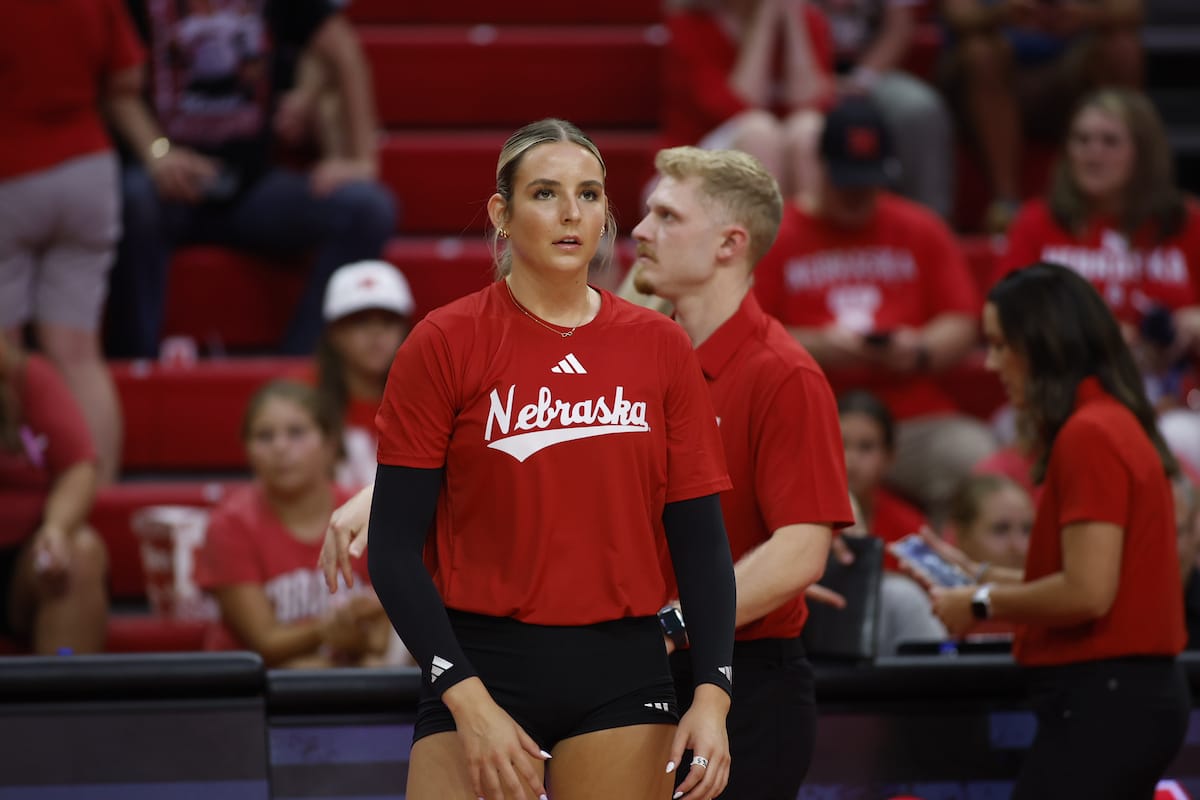
Four Nebraska volleyball newcomers made their Devaney Center debut during Saturday’s Red-White Scrimmage, including freshman middle blocker Kenna Cogill.
The 6-foot-4 middle from Gilbert, Arizona, made a great first impression on the 8,414 fans packed inside John Cook Arena.
Unlike fellow freshmen Teraya Sigler, Keri Leimbach and Ryan Hunter, Cogill wasn’t on campus for the spring exhibition against Kansas, so Saturday was her first exposure to the Devaney Center atmosphere as a Husker.
“It was so exciting,” Cogill said. “Dreaming of it and thinking about what it’s going to be like whenever I walk in is a lot different than actually doing it. Walking in and just seeing everything and everything filled up, I was like, ‘Wow, this is amazing.’ It was so fun.”
Cogill said the nerves hit her early, but after talking with her teammates she was able to settle in after the first five points and lock in on the action on the court. Cogill finished with 10 kills on .421 hitting and five blocks while splitting time between the Red and White squads. Coach Dani Busboom Kelly called her performance “super impressive.”
“Kenna is unique because she’s a really late commit for us,” Busboom Kelly said. “She knows that we were kind of teetering. Do we want a fourth middle, do we not? Is she the right one? We decided to pull the trigger, and she took a risk, knowing she was going to come here with three middles that we were really comfortable with, and she’s just been so good in practice. She’s that player, you look at the stats every day and you’re like, ‘Wow, Kenna did amazing.’ She’s just a quiet killer. She’s going to get the ball and do something great with it, and I thought she was fantastic today.”
“Are you kidding?” Allick said, with Cogill by her side. “I specifically remember a gap shot you had; one of the middles was diving in, and you recognized it, and you cut it back, and that was something that we haven’t really been working on. You saw it and you went for it. I was very proud of her. Yeah, very mature swing.”
Cogill said the speed of the game has been the most challenging adjustment to college volleyball, but she credited her teammates for helping her catch up.
“Going from club to college, it’s definitely way different, the tempo is way faster, everything’s way faster,” Cogill said. “I feel like my teammates have done an amazing job of getting me used to it and then building me up whenever I’m feeling down and feeling like I’m not doing it. So I feel like the adjustment’s been pretty easy.”
Cogill also spoke highly of fellow freshman middle blocker Manaia Ogbechie. Her offensive stats weren’t as gaudy with five kills on .188 hitting, but she put her blocking prowess on full display with a match-high eight stuffs.
“I think she did amazing,” Cogill said. “Both of us coming in, we were nervous, there were so many nerves, and I think she did amazing. Her blocking is so good, her hitting is so good.”
Freshman Ryan Hunter was the lone opposite hitter on the roster during the spring and made the most of it with an explosive debut against Kansas, but that position is a bit more crowded now with the arrival of Baylor transfer Allie Szcech and Italian recruit Virginia Adriano. With three right side hitters, Nebraska ran a 6-2 on one side and a 5-1 on the other during the scrimmage, rotating all three opposites in and out all afternoon to give them each significant opportunity.
Szcech finished with six kills on .038 hitting, five digs and three blocks. Adriano got off to a hot start, showing off a big arm and a powerful swing before the opposite side’s blocking really keyed in on her and provided some valuable teaching tape. She finished with 11 kills and nine errors, hitting .071 with five digs, three aces and one block.
“I thought Virginia had some great stuff and some things that aren’t working great, and she’s doing those in practice,” Busboom Kelly said. “This film will be great for her to kind of really see where she can improve, because she’s a smart volleyball player and she can make adjustments quickly and she takes coaching very well.”
Saturday wasn’t freshman outside hitter Teraya Sigler’s debut, but she certainly made some splash plays en route to a 10-kill, 10-dig double-double. It wasn’t a flawless performance by any means with seven errors and a .091 hitting percentage, but she displayed a powerful arm and impressive back-row ball control, and she served up two aces as well.
“I think she’s one of our athletes who can sometimes be hard on herself, but it’s because she cares so much,” Allick said. “I’m really proud of her. I think sometimes with younger athletes, you can see them get internal and not want to come out, because that’s where they’re comfortable. But even in moments that she wasn’t making great plays, she still stayed external, and from there, she got herself back on track and making great swings. So overall, I’m really proud of her.”
The ability to persevere through struggles for all the young players is something that caught Busboom Kelly’s eye on Saturday.
“Just their confidence and that when they got the ball, usually something positive happened, and if it didn’t, then their body language and their communication was still really mature for freshmen or Virginia, who’s not a typical freshman, but she’s still is; she’s new here,” Busboom Kelly said. “So I’m just really impressed with their overall maturity and confidence.”
Libero/Defensive Specialist: Ava Bessette, Iola, sr.
Copyright 2026 The Associated Press. All rights reserved. This material may not be published, broadcast, rewritten or redistributed without permission.
The 2025 Marion County girls volleyball season was one to remember. We saw breakout performances from outside hitters all over the Ocala area. The Trinity Catholic Celtics went undefeated in the county while fielding one of the program’s most talented rosters. Forest made history with its ninth county title in a row under head coach Jim Collins.
The season was much more than those leading lines. We saw scores of volleyball players give their all in hopes of having the best season of their careers. Now that the ball is no longer in play, the Star-Banner is ready to unveil the latest edition of all-Marion County volleyball players.
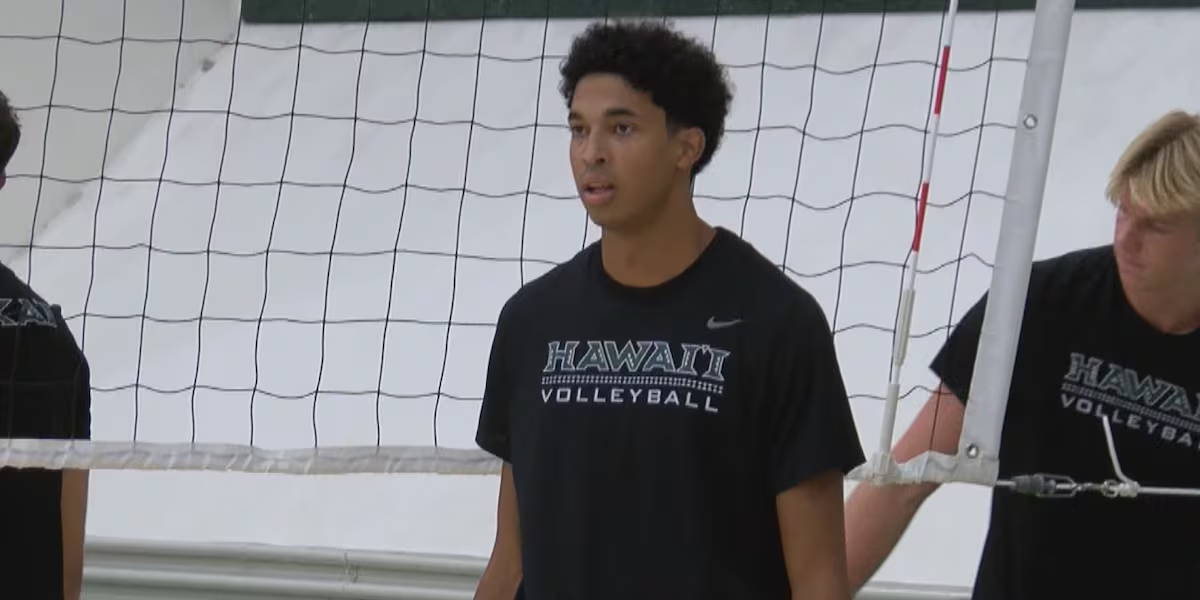
HONOLULU (HawaiiNewsNow) – It’s not uncommon for athletes to transfer schools in this era of collegiate sports.
However, for new University of Hawaii middle blocker Trevell Jordan, it wasn’t a move he was expecting to make.
Jordan — who has U.S. National team experience — had a stellar freshman season at Grand Canyon University, playing in all 21 of the Lopes’ matches as a freshman, amassing 111 kills and 67 blocks.
In April, the GCU team was blindsided when the school announced that it would no longer sponsor the sport.
“None of us saw it coming, like it was out of the blue,” Jordan said. “Went into this meeting thinking it was just gonna be how like next year was gonna go, and then that’s what they dropped the bomb, and like the meeting was like five minutes before they left.”
It was reclassified as a club sport with GCU putting out a release saying that the move was to stay competitive with other NCAA Division I programs.
Grand Canyon just joined the Mountain West Conference, a league that does not carry men’s volleyball.
With the abrupt shutdown, it left the entire Lopes roster looking for a new home, with many players catching the eyes of coaches around the country.
Jordan found his way to Manoa.
“He had offers to go to every top program in the country and ironically they were pushing him to make a fast decision,” UH head coach Charlie Wade said. “They pushed him towards us because I was the one saying, ‘hey, I’m in for the long haul, I want you here, take your time to figure it out.’”
Jordan is now getting accustomed to volleyball in the islands as he joins a squad with big aspirations in 2026.
UH ended last season one game shy of the National Championship.
“The difference in commitment here with the fans, the program, the school, as at GCU, we didn’t get as much love as we did like any other sport,” Jordan said. “It’s been really cool, the team and squad has been really inviting, so they’ve been working with me to get more like accommodated to here.”
Jordan and the ‘Bows open the 2026 season on Friday, the first of two home matches against the New Jersey Institute of Technology.
First serve is set for 7 p.m. Hawaii time.
Copyright 2026 Hawaii News Now. All rights reserved.
At a specialist treatment centre in Ukraine, as other amputees play volleyball nearby, Vladislav shows a video on his phone of how he lost his left leg. He found the footage – of a drone closing in rapidly on a buggy, Vladislav standing exposed at its rear – on a Russian military social media channel.
The 31-year-old, an arbitration lawyer before Russia launched its full-scale invasion in 2022, makes a double whistling noise to describe the drone’s ominous progress. “That’s me,” he says, pointing at the video, filmed from a fibre optic drone, chasing him down with terrifying ease as the vehicle slows for a corner. Then the screen goes blank.
Vladislav was driving between positions somewhere near Lyman, in the north-east of Ukraine, on 21 August when his life changed for ever. An explosion “bam on the left ear” threw him and the driver to the ground. Still conscious, he could see the injury to his left leg was obviously very serious. But this was not his immediate priority.
“To be honest, I checked my crotch, if everything’s in the right place,” he says, grinning. The check was affirmative and so in that moment, the stricken soldier says, he reasoned life was worth still living. “Only after that, I turned my tourniquet.” That choked off the blood supply to his left leg, giving himself a chance of survival.
Video purports to show moment Vladislav was struck by Russian drone – video
The respite was short. Once rescued, Vladislav was soon losing consciousness. “I don’t know if it’s real or a common trope, but pictured in my memory I saw a white tunnel with a light at the end.” But it was not the end. “My comrade fell on me with his elbow on my wounded leg and I opened my eyes with every curse I knew.”
Dozens of seriously wounded Ukrainians such as Vladislav, who have had or need to have amputations, come to this specialist treatment centre every month. No one will say exactly how many are being treated here, but across Ukraine crude estimates suggest the total number of amputees runs well into the tens of thousands.
Providing help, support and advice to Ukrainian staff at the centre are a small number of British military personnel – doctors, physiotherapists and occupational therapists from the UK’s defence medical services, part of Project Renovator. The Guardian observed some of their work during a day visit, including sessions where British practitioners discussed their use of temporary prosthetics with Ukrainian counterparts.
“The numbers here are truly humbling,” says Mike, a British rehab consultant and an army lieutenant colonel, who is part of the UK team helping out. Mike worked in Afghanistan, where the British military was present until 2014, and says professionals like himself can contribute “an understanding of complex amputee rehabilitation” and “can help move their patients on to new legs quicker”.
Vladislav was an arbitration lawyer before Russia launched its full-scale invasion in 2022. Photograph: Julia Kochetova/The Guardian
He is keen to emphasise that the British presence works both ways, in that there are opportunities for him and his colleagues to learn. Thanks to a combination of innovative surgery, electrical stimulation and rehab, the Ukrainians “are managing to fix nerve injuries faster than I’ve previously seen”, he says.
Britain has only minimally acknowledged a wider military presence in Ukraine, beyond its staffing at the embassy in Kyiv. Security measures around the medical crew remain tight, with only Mike able to be identified.
“I’m proud that the UK is stepping up to ensure wounded Ukrainian soldiers get the best possible treatment,” said John Healey, the defence secretary, praising their work. He said their goal was to work alongside Ukrainian teams “to deliver care and rehabilitation”, an effort that will have to continue long after the war finally ends.
Mike, a British rehab consultant helping at the centre, says he and his colleagues can ‘help move their patients on to new legs quicker’. Photograph: Julia Kochetova/The Guardian
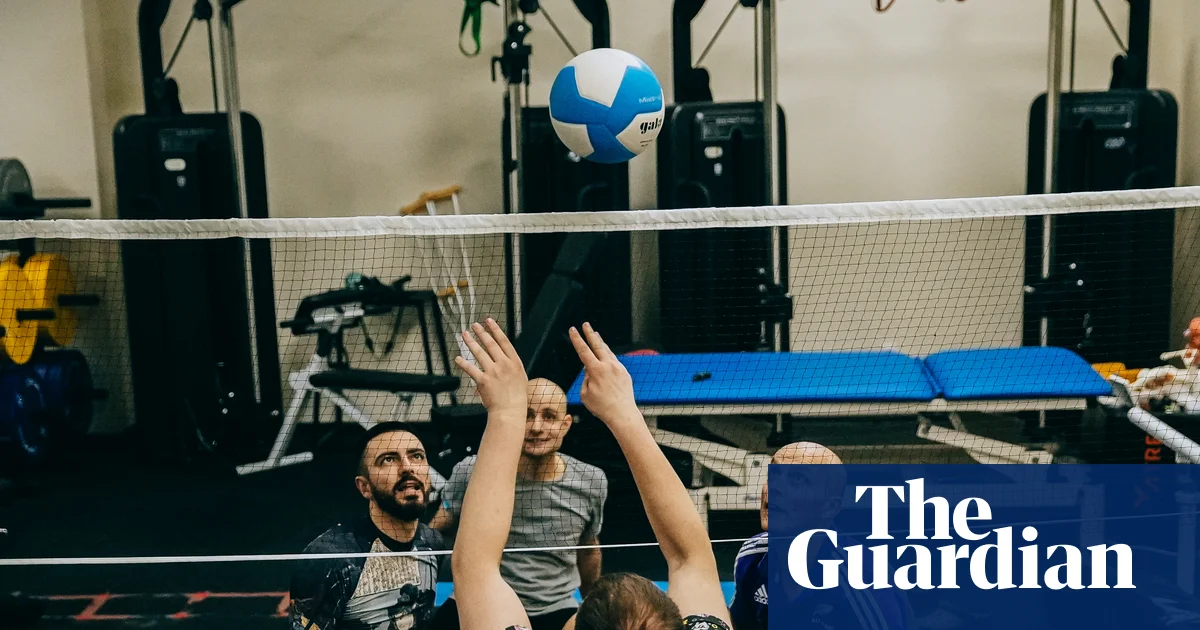
There are a wide range of classes, and family and friends are able to visit unless the staff believe it would be unhelpful to an individual’s recovery. Part of the approach is to have “psychologically aware clinicians”, according to Mike, who can identify when patients run into mental problems. But a key part, as the volleyball shows, is being part of a group so the wounded can motivate each other.
Vladislav’s case is one of the simpler. He hopes to have a final prosthetic leg ready soon and to be discharged earlythis year. He says his mental state is strong, though at some point after two or four weeks, when he was on his own, he admits, “I cried a lot”. It was “like a divorce” until he eventually thought: “Let it be.”
What helped, the former lawyer says, was having his family nearby, including baby son Adam. However, he says: “I did not tell my wife about my injury for around a month and a half because she was pregnant.” Two weeks after Adam’s birth he told her what had happened, though by then she had “suspected something”, he admits.
Injured veterans playing volleyball at the rehabilitation centre in Kyiv region. Photograph: Julia Kochetova/The Guardian
Oleksandr, 48, is a former fitness teacher and swimming instructor who had both his legs amputated below the knee after an artillery shell landed close to him on 18 October 2024. After he arrived at the treatment centre, a succession of further surgeries proved necessary. One was to stabilise his wound, which had become infected; later, a metal brace was attached to the bone so the prosthetics would fit.
It has been a long, gruelling treatment, including a month in intensive care, and at one point Oleksandr wells up in tears at the thought of it. “In the beginning it was hard for me just to sit in the wheelchair. I was sweating immediately,” he says. But gradually, going to the gym with rehabilitation experts helped, and at some point as his exercising gradually improved, “I knew then I would get through,” he says.
There is a brightness and purpose in his eyes now but the future is uncertain. He wants to leave this year, when his legs are ready. “I hope I will be able to get back to my job as a fitness trainer,” he says. “But I just don’t know. I just need to understand what my abilities will be on the prostheses, how long I can walk. When I will learn walking, I will understand what my abilities are.”
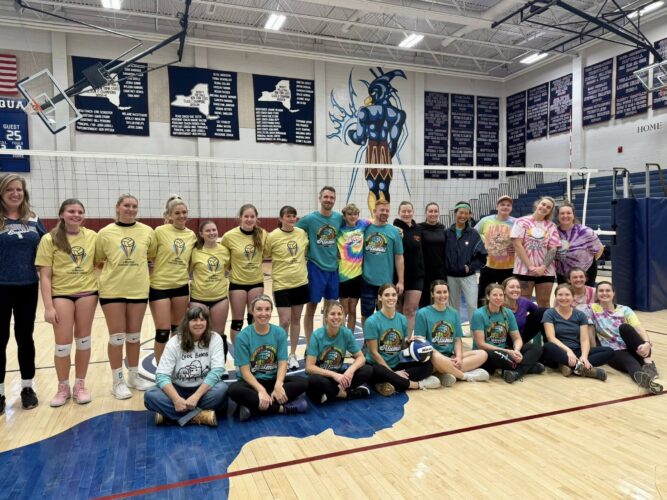
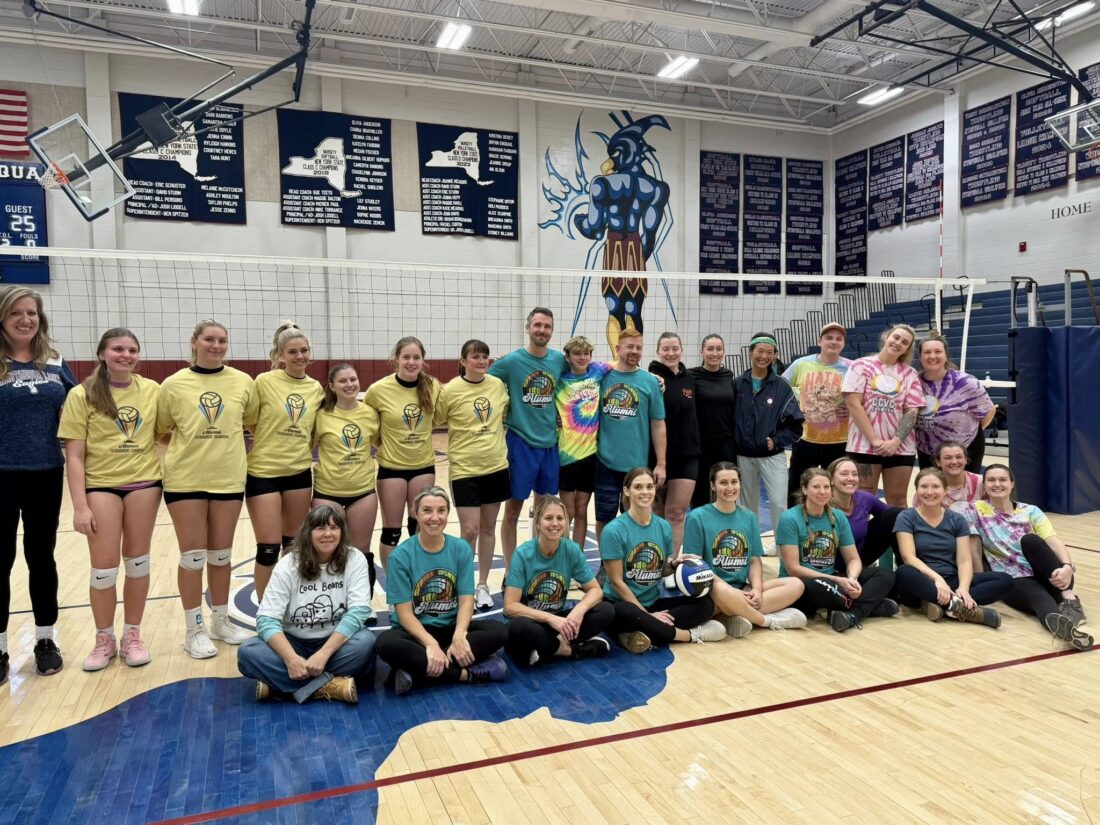
Pictured is one of the groups of participants in the recent Chautauqua Lake Central School Alumni Volleyball Tournament.
Submitted photo
MAYVILLE — Recently, Chautauqua Lake Central School hosted its first ever Alumni Volleyball Tournament, welcoming volleyball alumni back to the court for a day of friendly competition, shared memories, and community connection.
Varsity Volleyball coach Joanne Meadows came up with the idea a few months ago with the help of her brothers, David Sturm, who coaches Junior Varsity, and Eric Sturm who is the assistant coach for both teams. The goal was to create an opportunity for both former and current players to reconnect, play for fun, and celebrate the tradition of volleyball at Chautauqua Lake Central School.
Meadows said the tournament did just that, adding that it not only celebrated the tradition of the program but also strengthened the sense of community among players across generations.
“It was a great day for past and present Mayville and Chautauqua Lake Volleyball players and shows why this program has been so special for so many years,” Meadows said. “The camaraderie in the gym was amazing to see.”
To get the tournament going and gather interest, Eric Sturm created a Facebook page for the event and invited alumni from across the years through it. Some alumni responded with full teams already, while others reached out individually and were placed on rosters, with five teams of about nine players formed overall.
Participants ranged from alumni dating back to the Class of 1993 to current students. Participants were both men and women, and Chautauqua Lake officials said it served to create a unique mix of experience, camaraderie and fun.
“We are so blessed to have the Meadows family coaching at Chautauqua Lake,” Chautauqua Lake Superintendent Josh Liddell said. “Their leadership, and the incredible support of all the alumni who returned to play and reconnect, helped make an event that truly celebrated the impressive volleyball tradition and community they’ve built over the past three decades.”
Perhaps the third time is the charm.
For the third time in three years, a new restaurant is being proposed at the …