The amateur era is over. With the NCAA’s $2.8 billion
settlement now approved, student-athletes are no longer playing
only for scholarships. Real money is on the table, and so are real
legal consequences.
This shift isn’t just about opportunity. It’s about
risk. Athletes are signing contracts that look more like
professional agreements than college paperwork. These deals control
payment, performance, image rights, and mobility. Without legal
support, what looks like a win today could quietly lock down your
future.
Shifting the Landscape
Starting in the 2025–26 season, schools in the Power Five
conferences can pay athletes up to $20.5 million per year. This
revenue sharing is capped at 22% of a school’s average athletic
income. By 2034, that number rises to $33 million.
The deal also includes back pay, but only for those who claim
it. Athletes who played between 2016 and 2024 must file a valid
eligibility form to receive their share. The process isn’t
automatic. Legal help can ensure claims are filed correctly and on
time.
To manage all of this, a new College Sports Commission has been
created. It’s responsible for enforcing NIL rules, overseeing
compliance, and reviewing third-party deals. That includes
evaluating fairness and market value, possibly using AI.
Meanwhile, big questions remain. Some experts argue that
athletes should now be considered employees under labor law. Others
warn that unequal pay structures could trigger Title IX lawsuits if
gender equity isn’t addressed. As the legal structure evolves,
athletes must stay alert to how these debates may impact their
rights.
Clauses Redefining the Game
NIL agreements are changing fast, and the fine print is getting
heavier. For many athletes, these contracts now mirror employment
deals more than simple endorsement paperwork. The language used by
schools and collectives can affect how and whether you get paid,
who you can work with, and how much control you have over your
name, image, and movement.
Each clause matters. Understanding the key terms can protect
your value on and off the field.
Performance-Based Triggers
As compensation is no longer guaranteed, many NIL contracts tie
payment directly to playing time, starting status, or medical
eligibility. If you’re benched, redshirted without approval, or
held out by staff, even for non-performance reasons, your pay may
stop. These terms are often buried deep in the agreement.
Sponsorship Limitations
Some contracts limit your ability to work with brands that
compete with school sponsors. That could mean passing on major
opportunities. Even if a brand aligns with your values or audience,
you might be forced to turn it down if the school already has a
deal in place. These clauses can stay in effect year-round, even
off-season.
Conduct Requirements
Many agreements now include morality or conduct clauses. These
sections restrict the types of products you can promote, such as
alcohol, gambling, or political causes, and may even limit what you
say online. If the school believes your content hurts its
reputation, you could face financial penalties or removal from the
program.
Control of Identity and Persona
Athletes are being asked to license more than just their names.
Some contracts include rights to your tattoos, nickname, voice, or
even digital likeness. In some cases, these rights extend well
beyond graduation. Without clear limits, you may lose control over
how your image is used—and who profits from it.
Transfer Barriers
Schools are now using buyout clauses and payment termination
provisions to discourage transfers. You might be required to repay
a portion of your NIL earnings if you enter the transfer portal or
accept an offer from another program. In some cases, payments stop
the moment transfer discussions begin.
NIL contracts aren’t just legal documents; they shape
careers, brands, and life after college. In this short segment, CBS
highlights how one college athlete turned her NIL deal into a
strategic business opportunity and why guidance matters more than
ever.
Leverage Lost Without Legal Review
Most NIL contracts are drafted by institutions with one goal in
mind: protecting their interests. Athletes who sign without review
often take on all the risk without realizing it. These deals may
seem standard, but the details can create long-term traps,
especially if you plan to transfer, build a brand, or keep control
of your image.
This indicates that a legal review isn’t just helpful, but
very essential.
Buyouts and Liquidated Damages
Some NIL deals include steep financial penalties for
transferring. These buyout clauses can require athletes to repay up
to 50% of what they’ve earned, or more. In some cases, the
repayment kicks in even if you’re forced to leave due to
injury, coaching changes, or limited playing time. Without clear
terms, one decision could cost thousands.
Indefinite Licensing of NIL Rights
Contracts may grant schools the right to use your image, voice,
name, or tattoos forever. This isn’t just about promotional
posters. It can include merchandise, digital content, and
AI-generated likenesses. If the contract doesn’t set clear
limits, you may lose control of your identity long after you’ve
left campus.
Termination Power Imbalances
Schools often build in broad rights to cancel NIL agreements
“for cause” but keep athletes locked in on their side.
This means they can end the deal if they think you’ve violated
a vague rule, while you may be stuck with no exit path. Some
contracts even allow payment to stop immediately after a minor
dispute.
Automated Gatekeeping
All third-party NIL deals over $600 now go through a system
called NIL Go. This clearinghouse checks if the deal is
“legitimate” and meets market value standards. Behind the
scenes, AI could flag or block deals unfairly. If your offer is
delayed or denied due to flawed data or hidden bias, there may be
little recourse unless you know how to challenge it.
Roles That Protect or Overpromise
Having support in your corner is critical, but not all support
offers the same protection. NIL deals are legally binding, and
trusting the wrong person can lead to long-term consequences.
Athletes often rely on agents for guidance, but legal protection
requires a licensed attorney. The difference matters.
Agents
Agents help athletes grow their brand and secure deals. They
often manage endorsements, public image, and sponsorship
negotiations. But unless they’re also licensed attorneys,
agents can’t offer legal advice. That means they can’t
interpret contract clauses, spot hidden risks, or represent you in
disputes.
Some agents act like they handle everything, but reviewing legal
terms isn’t part of their job. If they overstep, you may be the
one left exposed.
Lawyers
Sports lawyers are trained to do what agents can’t. They
review, revise, and negotiate contracts. They know how to structure
deals to protect your rights, limit school control, and ensure you
stay compliant with NCAA, state, and federal regulations.
They’re also the only ones who can defend you in arbitration or
legal proceedings if things go wrong.
A lawyer won’t replace your agent. But without one, your NIL
team isn’t complete.
Agreement Pitfalls
Some collectives and booster organizations are offering NIL
representation agreements with vague language and restrictive
terms. These documents may lock you into long-term commitments or
give away rights you didn’t mean to surrender. Even worse, some
promise guaranteed payments that come with strings attached in fine
print.
Always have an attorney review any representation contract
before you sign, no matter how friendly or “standard” it
seems.
Securing More Than Just a Deal
The NIL era has transformed what it means to be a college
athlete. You’re no longer just competing; you’re
contracting. And every term you sign carries weight far beyond your
playing days.
This moment is powerful, but also personal. It’s about your
name, your voice, and your freedom to grow. Contracts that look
like opportunities today can become liabilities tomorrow. You must
ask the right questions, get every term in writing, and push back
on vague morality clauses, aggressive buyout penalties, or
open-ended rights to your image.
Before signing anything, make sure you’ve had the contract
reviewed by a qualified attorney. Understand who controls your NIL,
what happens if you transfer, and whether the agreement limits your
ability to build your brand beyond school walls. Verbal promises
won’t protect you; clear, written terms will.
Every athlete deserves more than a seat at the table. You
deserve leverage, protection, and a deal that works for your
present and the future. Traverse Legal helps athletes take control
of their contracts and protect what matters most.
The content of this article is intended to provide a general
guide to the subject matter. Specialist advice should be sought
about your specific circumstances.
Colton Cohen, a Bonners Ferry High School runner, has committed to Missouri Valley College in Marshall, Missouri, where he will compete in cross country and track at the NAIA level.
Though many athletes train for most of their lives in their sport, Cohen began running track and field in the spring of 2024, less than two years ago.
“I started running my sophomore year for track,” Cohen said. “I just wanted a sport to do.”
He explained what he enjoys most about running.
“When you hit that PR, or you get that certain place in a race, especially when you aren’t exactly sure it’s going to happen, it’s such a great feeling to experience and I want to experience it over and over again,” Cohen said. “That’s just one of my big motivations for running.”
Cohen said the running program at Missouri Valley College is on the rise and added that the opportunity still feels unreal.
“They’re just working on building their program up, trying to develop into a team that really can compete with the others in the conference,” Cohen said.
Cohen said he plans to study exercise science with the goal of becoming an athletic trainer.
“My big dream would be to be a trainer in the NBA or for professional track athletes,” Cohen said. “That would be amazing.”
Two years ago, Cohen said he had no idea he would be on the path he is currently following.
“I didn’t know what exactly I wanted to study,” Cohen said. “I didn’t expect to be able to go to college to run.”
During this past cross-country season, Cohen suffered compression fractures in both hips, which limited his training and cut his season short.
“It happened late August and I got X-rays and an MRI in September,” Cohen said. “They told me it’s a three-to-six-month recovery, so I’ve just been cross-training. I’m hoping I’ll be back by February so I can start running before practices start.”
“I’ve got a high standard for myself and what I want to do,” Cohen said. “The main focus with me and my coach is just getting me back and healthy.”
The injury came just months before the traditional signing period for high school athletes, making the setback especially difficult.
“After I got injured in the beginning of the cross country season, it felt like the end of the world,” Cohen said. “I was looking forward to being a staple and helping support my team and helping us do the best we could this season.”
Cohen said the running community has been a major source of support since he began competing, including runners from Timberlake, who are his on-field rivals.
“Most of the runners you meet, they’re some of the nicest people and are very supportive,” Cohen said. “We’re competitive out on the field, but then afterwards, it’s like family.”
Cohen also shared advice for younger athletes.
“You’ve got to believe in yourself and what you can do,” Cohen said. “No matter what happens, if you don’t run the time you want, if you don’t get the place you want, it’s all a part of the journey.”
“There’s always going to be someone with something negative to say about you,” he said. “If you take that to heart, then you’ve already let them win. Don’t let those people win.”
He credited his family and supporters for helping him reach this point.
“I’d have to really just thank my family — my mom, my dad and my little brother — they’re my biggest supporters,” Cohen said. “Through all the struggles, they’ve helped me and been there to support me. They’re really happy that I found something I’m this dedicated to and are excited to see what I do next.”
“I want to thank everyone that supported me,” Cohen said. “I appreciate all of the people that have believed in me and helped me get to the point where I am today.”
As 2025 comes to a close, we’re taking a moment to revisit some of the stories that resonated most across Vestavia Hills. These aren’t just top clicks or biggest headlines — they’re pieces that captured something real about the people, places and moments that defined the year.
Ethan Strand is the talk of the U.S. track and field scene this year — and he shows no signs of slowing down.
The Vestavia Hills native and University of North Carolina standout shattered the NCAA indoor mile record at the Boston University John Thomas Terrier Classic on Feb. 1, clocking 3 minutes, 48.32 seconds. In doing so, he became the first NCAA runner to break the 3:50 barrier indoors, surpassing the previous record of 3:50.39 set by Cooper Teare in 2021.
His performance now ranks among the fastest indoor miles in world history. As if it wasn’t clear before, when Strand set an NCAA mark in the 3,000 meters, it became undeniable — a new superstar is on the rise in U.S. track.
A CHAMPION’S BEGINNINGS
At Vestavia Hills High School, Strand was a two-time Alabama Gatorade Cross Country Runner of the Year, winning multiple championships and setting numerous records.
As a junior, he won the 1,600- and 3,200-meter races at the Class 7A state outdoor meet while anchoring the 4×800 relay team to a second-place finish. In the 800 meters, he clocked a personal-best 1:54.52 to win the state title, contributing to a runner-up team finish. That same year, he ran a blistering 4:11 mile at the Music City Distance Carnival, making him one of the nation’s top high school milers.
That drive continued into college, where he rapidly evolved into one of the most versatile distance runners in the country. His ability to compete across multiple events — 1,500 meters, 3,000 meters, and now the mile — has made him a major force in NCAA track and field.
A DEFINING PERFORMANCE
Strand’s record-breaking run at the Terrier Classic wasn’t just another race — it was a statement. Competing against a mix of elite collegiate and professional athletes, he demonstrated not only speed but also tactical intelligence beyond his years.
“I checked the clock with two laps to go and thought, ‘OK, if I close well, I’m going to run really fast,’” Strand recalled on Carolina Insider.
The race started at a blistering pace, with the leaders passing the 800-meter mark in 1:53. Strand stayed patient, moving up strategically. With two laps remaining, he was in third behind Robert Farken of On Athletics Club and Adam Fogg of Under Armour Baltimore Distance. As the final bell rang, he surged ahead, breaking away down the backstretch and crossing the finish line with arms outstretched in celebration.
“I didn’t quite know what today was going to be,” Strand told reporters after the race. “I just wanted to get a qualifier in for nationals, but to come out and run that was pretty cool.”
RIVALRY FUELS GREATNESS
A major factor in Strand’s rapid rise has been his rivalry-turned-partnership with North Carolina teammate Parker Wolfe. The two have pushed each other in training and competition, creating an environment where each runner continues to elevate his performance.
“When Parker and I are on the track and it’s just the two of us, we’re very competitive,” Strand said on Carolina Insider. “We absolutely treat each other as competitors, but when it comes down to it, we’re trying to beat everyone else first. And if it’s just the two of us left at the end, then yeah, we’re going to go at it.”
Their duel for the NCAA 3,000-meter record was a prime example. Both runners shattered the previous collegiate best, with Strand edging Wolfe in an epic final lap.
“I took a step up in fitness coming into the fall, and I think that showed in the 3K with Parker,” Strand said. “We ran six seconds faster than any collegian ever has.”
UNC head coach Chris Miltenberg believes the two are more than just standout collegiate athletes.
“Every day, I think I’m looking at the next two great American distance runners — Ethan Strand and Parker Wolfe,” Miltenberg said. “These guys are not just NCAA stars. They are the future of U.S. distance running.”
A STAR AMONG PROS
Strand’s rising stardom was on full display when he was honored at a North Carolina basketball game following his record-breaking run. As he walked onto the court at the Dean Smith Center, he received a roaring ovation from thousands of Tar Heel fans — proof that his accomplishments are being recognized far beyond the track.
His breakthrough mile also made waves beyond the NCAA ranks, catching the attention of professional runners. His time placed him third on the all-time indoor mile list at the time, but it didn’t take long for the pros to respond. Shortly after, Norwegian superstar Jakob Ingebrigtsen set a new world-best mark, demonstrating how Strand’s emergence is helping push the entire sport forward.
His rapid rise raises intriguing questions about what comes next. With two NCAA records under his belt, he faces a crucial decision about how to structure the remainder of his collegiate career and his approach to the NCAA Championships.
“This opens up so many more opportunities,” Strand said. “After the 1,500 last year, I was ninth in the Olympic Trials final. That made me think maybe I need to take a step up and focus on different events. And now, the mile is in play. I don’t really know yet, but whatever combination helps us score the most points, that’s what I’ll do.”
THE ROAD AHEAD
As a senior, Strand is entering the final stretch of his collegiate career, with major championships on the horizon. The NCAA indoor championships, set for March 14-15 in Virginia Beach, Virginia, will be his next big test. Then comes the outdoor season, culminating in the NCAA outdoor championships from June 11-14 in Eugene, Oregon.
For now, Strand remains focused on the present. The NCAA championships loom, offering another chance to prove himself against the best in collegiate running. Beyond that, the transition to professional running seems inevitable, with U.S. Olympic team aspirations likely forming in the back of his mind.
“When you finish a race and do better than you ever have, it’s a feeling you can’t beat,” Strand said. “The only way to get that feeling again is to do it again.”
Strand credits his time at UNC and the guidance of Miltenberg with helping him see his future beyond college.
“He told me, ‘We’re going to get you here, you’re going to run really fast, and we’re going to set you up for the next seven or eight years after college.’ That’s why I came here,” Strand said.
From Vestavia Hills to Chapel Hill and beyond, Strand’s journey is just beginning.
Franck Charles ’16 has turned Virginia Union University’s Track & Field and Cross Country programs into a model of excellence both on and off the track, earning him the Triad of Excellence Award from the John W. Barco Alumni Chapter.
The award honors alumni who demonstrate leadership, service and dedication to the university’s mission while serving as role models for students and the community.
Under Charles’ leadership, the Panthers have excelled in competition and community engagement. This semester, student-athletes volunteered at Kings Dominion multiple times and donated canned goods to support families in Haiti. Two team members, Gabrielle Olukoya and Mychael Tucker, received scholarships from the Barco Alumni Chapter, joining last year’s recipients Christal Rolack and Toni Middlebrooks.
Charles said the recognition reflects the collective effort of his athletes and coaching staff, who prioritize success both on the field and in the classroom. He emphasized the importance of pursuing scholarships, limiting student debt and preparing for careers after graduation.
“This award is not just about me; it belongs to our entire Cross Country and Track & Field family,” Charles said.
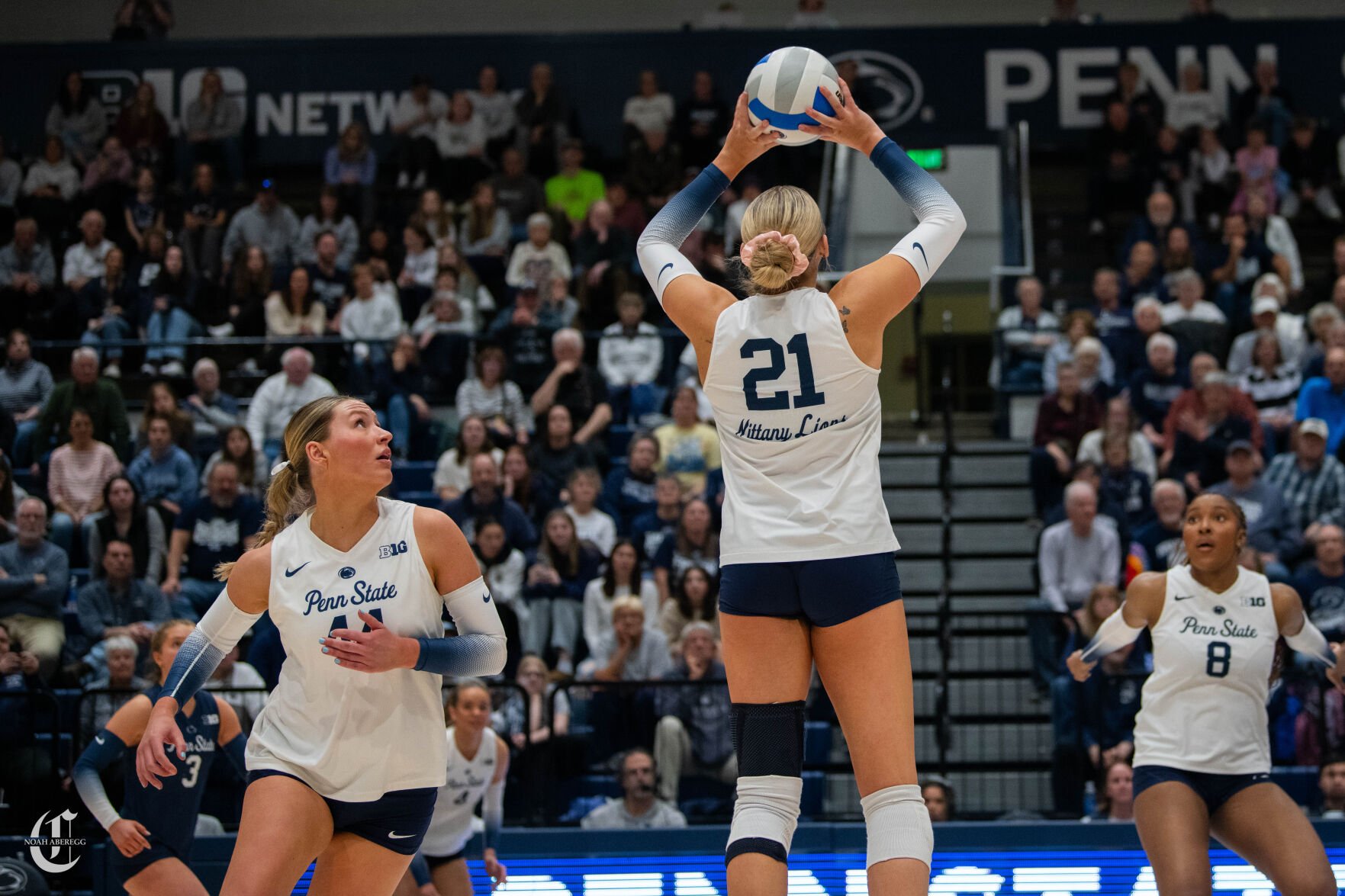
Pitt middle blocker Ryla Jones announced her commitment to Penn State women’s volleyball out of the transfer portal on Wednesday. Jones posted her decision to transfer to Happy Valley on her Instagram.
As a true sophomore this past season, Jones logged 107 kills on a .382 hitting percentage and 98 total blocks across 83 sets for the Panthers, earning AVCA East Coast Region Honorable Mention.
In her first year with Pitt, the Oxon Hill, Maryland, native started all but one game for the Panthers and was named to the ACC All-Freshman team as well as the AVCA All-East Coast Region Team.
Jones now joins Alexis Stucky as transfer players who have signed with the Nittany Lions in this cycle.
Please choose an option below.
Sign up for our e-mail newsletter:
OR
About the Author
Cadyn is a third-year broadcast journalism major at Penn State. Hailing from the great state of Texas, he is a die hard Dallas sports fan. You’ll often see him voicing his opinions on music and sports on X/Twitter @cgill214.
Full caption: Priest River High senior setter Jayda Storro was named to the 3A All-State Honorable Mention Team as the results were released recently by the Idaho State Journal newspaper in Pocatello. Players are chosen by the state’s coaches via a voting system put together by Brandon Walton, Sports Editor of the paper. Storro, a three-year varsity starter and the 2025 Central Idaho League MVP, helped the Lady Spartans clinch their first state playoff berth since 2015. Under Storro’s leadership, Priest River finished with an overall record of 17-5, one of the winningest years in school history.