Rec Sports
Pa. Senate passes sports ban for trans women and girls

Five Democrats joined all 27 Republicans to send the bill to the Pa. House. Both House Democratic leadership and Gov. Josh Shapiro opposes the bill.
-
Jordan Wilkie/WITF
 As the democracy reporter for WITF, I will cover any kind of story that has to do with how we govern ourselves. That will include doing a lot of election coverage about how to access the ballot, how public officials administer elections, the technology used to run and secure elections, and the laws that govern it all.
My work will also include accountability coverage for elected officials that use their positions to then undermine democratic institutions, like the legislators that voted against the certification of the presidential election results on January 6, 2021. If that weren’t enough, I foresee covering some local government decisions, fights over public records and transparency, and some candidate coverage in 2024. Many stories can have a “democracy frame” meant to help us all understand how our governments work and how we can shape them.
I’m most looking forward to the community reporting about which WITF is passionate. I’ll be talking to a lot of folks about what they want out of their governments, local to national, and how they want to make their visions reality. I’m excited to meet you and talk, with or without a microphone on hand.
I also like to turn my work phone off. When I do that, I’m looking for rocks to climb, trails to run on (slower and slower, somehow), and new places to visit. I’ve lived in the (extended) South for most of my life, so y’all will hear me say things funny and sometimes my hearing is funny, too, so we’ll figure out this radio thing together.


Jelani Splawn / For Spotlight PA
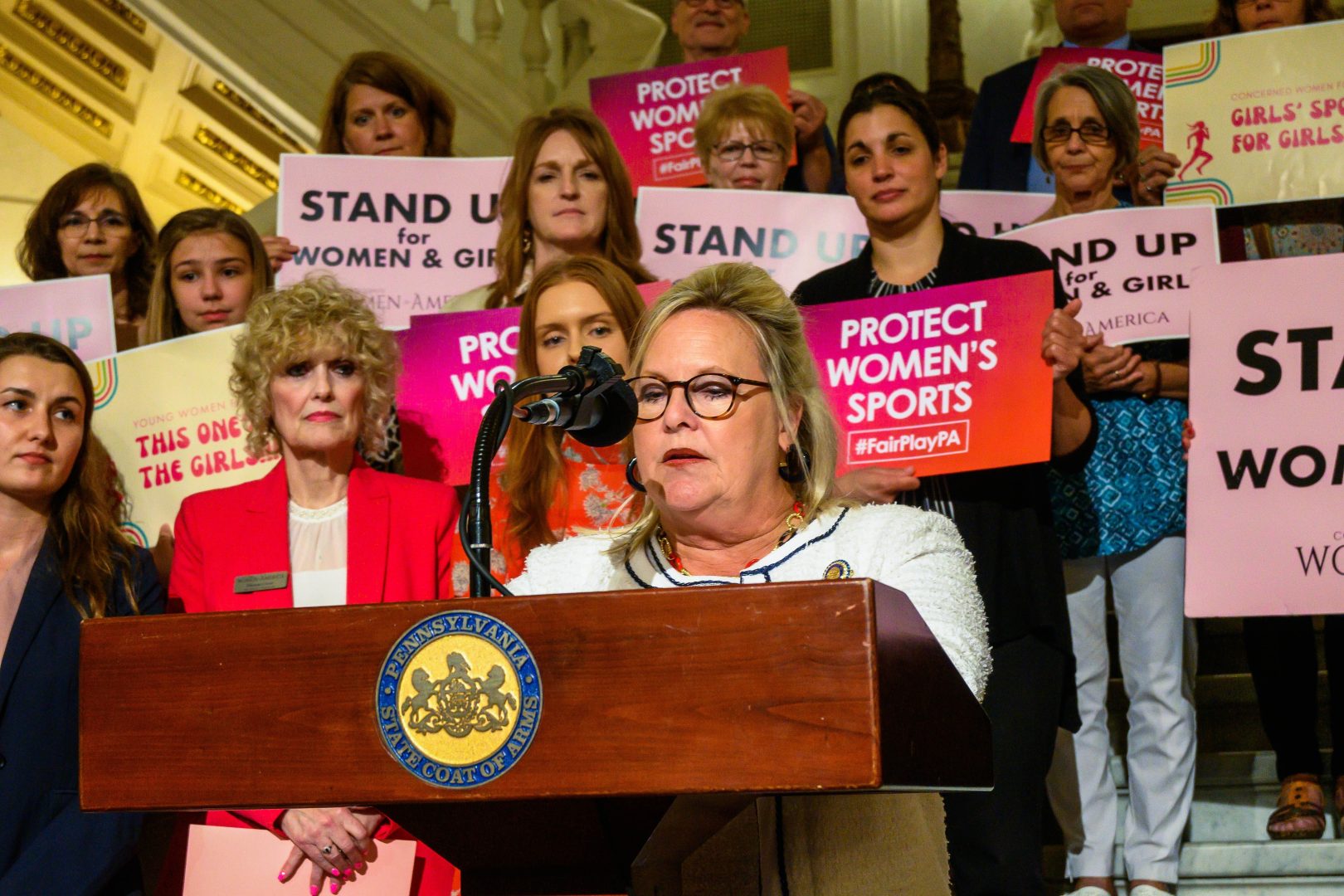
“Over the past half-century, we have fought to protect athletic opportunities for female students,” state Sen. Judy Ward (R., Blair), one of the main sponsors of the legislation, said at a rally in early June. “And now these opportunities are in jeopardy.”
After an hour-and-a-half of heated debate, the Pennsylvania Senate on Tuesday passed a bill to ban transgender women and girls from joining women’s and girls’ sports teams. Five Democrats, including newly sworn in Lancaster County Sen. James Malone, joined all 27 Republicans in voting for it.
The legislation, titled Save Women’s Sports Act, would govern child athletics in K-12 public schools and Pennsylvania colleges.
Republicans advocating for the bill said it was about protecting the advancement of women’s equality and the guarantees of equality under Title IX, a federal law prohibiting sex-based discrimination.
The bill defines a person’s “sex” by what they were assigned at birth — strictly male or female, with no consideration for gender.
“We cannot allow the opportunities that Title IX enshrined for women to be lost,” Judy Ward, R-Blair County, said after the vote. “With our passage of the Save Women’s Sports Act today, my Senate colleagues and I showed that they will defend women and their right to safe and fair competition.”
Democratic senators opposing the bill said it could result in harm to transgender children and young adults, and that Republicans were engaging in political theater rather than constructive legislation.
What “transgender” means: The Associated Press defines transgender as an adjective that “Describes people whose gender does not match the one usually associated with the sex they were assigned at birth.”
“This is not governance,” said Sen. Maria Collett, D-Montgomery County, during floor debate. “It is a failure to lead, and it is another example of the majority’s unwillingness to admit that the only answer they have for people looking to build a better future here is ‘no.’”
Democrats have opposed the proposal since it was introduced, and it’s almost certainly dead on arrival in the Democratic-led House of Representatives. Gov. Josh Shapiro has also stated he would veto the bill.
Sen. Lisa Boscola of Lehigh County, the only Democrat who voted for the bill to speak during debate, said the issue of transgender people’s participation in sports would not go away until the Legislature “creates a policy that works for all involved.” She suggested creating a third category of competition that would allow athletes of any gender identity to compete against each other.
Claims of harm to girls and women
Republican senators argued that allowing trans girls or women to participate in girls’ or women’s sports cause harm by reducing opportunities for other girls to win medals, and by potentially subjecting other girls to injury.
Defining “trans girls or women”: A person who is assigned male at birth and transitions to align with their identity as a girl or woman is a transgender girl or woman.
During the debate, Republican senators repeatedly referred to trans girls or women as “biological males,” a phrase sometimes used by opponents of transgender rights to portray sex as more simplistic than scientists assert, and to downplay the significance of gender and how it differs from sex.
“ It is a fact that girls and women have been physically injured by boys and men competing on a female team,” said Sen. Lynda Culver, R-Montour County, referring to trans girls and women. “It is a fact that girls and women have lost records, medals, titles to boys and men competing on a female team.”
In opposition to the bill, Sen. Steven Santarsiero, D-Bucks County, said a tiny number of athletes in the country are transgender.
Of roughly 500,000 athletes who compete in the NCAA, fewer than 10 are transgender, according to NCAA President Charlie Baker. There is no clear information on how many transgender youth play sports in Pennsylvania’s public schools. Approximately 1.3% of Pennsylvania’s 12- to 17-year-olds identify as transgender, or about 10,000 children, according to research from UCLA’s Williams Institute. As a national average, four out of 10 transgender highschoolers participate in sports.
One of President Donald Trump’s first actions during his return to the White House in January was to sign an executive order titled “Keeping Men Out of Women’s Sports,” similarly barring transgender women and girls from participating in competitive sports.
The NCAA Board of Governors updated the organization’s policy in early February to comply with Trump’s orders. Soon after, the Pennsylvania Interscholastic Athletic Association, which oversees public and private schools’ athletic competitions in the state, removed its “Transgender Policy” from its manual to follow suit.
Research on harm to transgender people
In their floor statements, Democrats who opposed the bill described harms to transgender people, beyond a ban on participation in sports. Passing the bill sends a bullying message to all trans people, Santarsiero said.
“ That’s the message that gets sent, and it’s a message that can do real harm to people who are struggling for acceptance, struggling for love and compassion,” he said.
Democrats referenced a study by The Trevor Project, a suicide prevention organization that focuses on LGBTQ+ youth, that showed state-level anti-transgender laws increase suicide attempts among transgender teenagers by a “statistically significant amount,” though the study found a wide rage of potential impact.
“ I cannot support legislation that would possibly cause harm to any Pennsylvanian and certainly not someone of a vulnerable population,” said Sen. Katie Muth, D-Berks.
Malone splits from Dems
Malone faced pushback from his supporters after he said in a virtual forum last month that he planned to support the bill. The Elizabethtown Democratic Committee posted to social media urging Malone to change his mind, while activist group Lancaster Stands Up did the same in a statement.
After Malone voted for the bill Tuesday, his spokesperson declined to comment.
Lancaster County’s Democratic state representatives, Izzy Smith-Wade-El and Nikki Rivera, both called the bill discriminatory against transgender people. Neither directly criticized Malone’s decision, with Rivera saying she is “only responsible for how I vote.”
The Associated Press contributed to this reporting.


Sometimes, your mornings are just too busy to catch the news beyond a headline or two. Don’t worry. The Morning Agenda has got your back. Each weekday morning, The Morning Agenda will keep you informed, amused, enlightened and up-to-date on what’s happening in central Pennsylvania and the rest of this great commonwealth.