Dear Heloise: When my children went off to college, I sent them off with a fishing tackle box that was filled with these items: a thermometer, Tylenol, Advil, NyQuil, bandages, Neosporin, rubbing alcohol, peroxide, and a timer with a magnetic back (to remind them that they had clothes in the washing machine or the dryer).
A sewing kit was also a part of the pack. Q-tips and cotton balls were included as well. My kids are now 36 and 40. My son still has his tackle box and refills it when needed. A friend of mine would give her kids gift cards for Uber or other rideshares. Thanks for the great ideas. — Cindy Wolfe, via email
CONTAINER ORGANIZATION
Dear Heloise: Searching for container lids is frustrating, so I have two drawers for food storage containers. One drawer is for the round containers and lids, and the other is for the square containers and lids. Lids are separated from the containers and placed on their edges in a plastic basket in the drawer.
To speed up the search, the color of the lid is written with marker on the bottom of the clear containers: “BLU,” “GRN” and “RED.” — Cody, in North Dakota
A SPECIAL CODE
Dear Heloise: Regarding the frustration that Susan H. had with determining whether her clothing/shoes were blue or black, I used to have the same problem. I worked in retail for 44 years, and a wonderful vendor told me that the “universal” color code for black is always 01 or 001. Every label should have a color code, and if it’s 01 or 001, it means that the color is black. Hope this helps! — Gail, in Springfield, Ohio
LEARN TO READ WITH HELOISE
Dear Heloise: Just a note to let you know that my dad and I read your column every day while I was growing up. It’s where I learned how to read and sound out words that I didn’t know. I was 4 years old back then, and I am 34 years old now and teaching my daughter to read from your column. — Diana M., in Kerrville, Texas
READY, SET, RINSE
Dear Heloise: I just read your short response concerning whether or not to rinse after brushing one’s teeth. My dentist does say not to rinse for the same fluoride reason, but I enjoy rinsing.
My own solution, which has not yet been sanctioned by anyone, is to rinse with water after brushing to get the taste out. Then I rinse with a fluoride mouth wash that tastes good and theoretically replaces the fluoride I just rinsed out. — Larry G., M.D. (But Not a Dentist), in Huntington Beach, California
DISPOSING OF MEDICATIONS
Dear Heloise: Always discard of unused medications properly to avoid contamination of the ground and waterways! In our city in Alabama, there are many pharmacies that have a public disposal container, and the police department also has one.
The discarded medications are covered with a mixture of clumping, hardening material that is then handled securely for disposal. This is so important, especially for the prevention of dangerous exposure through the local drinking water for our youth.
Check your area (search online or call city hall) and follow through. Never flush chemicals down the toilet or drain. Thanks. — N.H., An Old Nurse
LANSING, Mich. — A new Smithsonian Museum on Main Street exhibit, “Americans,” will come to Michigan in 2026, …
CRYSTAL FALLS — The Crystal Falls Musicale will have its first meeting of the 2025-2026 season at 6:30 p.m. …
NORWAY — The Niagara Lions Club will have its annual four-player golf scramble Saturday, Sept. 20, at Oak Crest …
NEW YORK — The Alzheimer’s Foundation of America has launched a newly redesigned website to help connect …
Park City Council will hold its final regular meeting of 2025 at 5:30 p.m. on Thursday in Council Chambers at City Hall. The city said attendees are encouraged to wear their ugliest holiday sweaters.
Agenda highlights include:
Clark Ranch Conservation Easement
City Council will consider adopting the updated Clark Ranch Conservation Easement.
2025 Water Conservation Plan
The council will conduct a public hearing and consider approving the 2025 Park City Water Conservation Plan, as required under the State of Utah Water Conservation Plan Act.
Youth Sports Alliance Homecoming Parade
The council will consider approving the Youth Sports Alliance 2026 Olympic and Paralympic Homecoming Parade Supplemental Plan and Level Four Special Event Permit for April 3, 2026, on Main Street.
Hamilton County is helping people find shelter from the cold through the NobleACT program.
INDIANAPOLIS — Central Indiana communities took a proactive approach as they prepared for extreme cold weather.
They took steps to get people who needed shelter from the cold inside before the temperatures got dangerously low. The Boone County Sheriff’s Office worked together with other county officials and partners to prepare.
“This was a really good idea to be ready to reach out to folks and help folks if they found themselves because it’s one of those things — a few minutes outside when you realize you’re too cold, you’re kind of behind the curve on that,” said Brent Wheat, Boone County communication director.
Wheat said they have resources like churches and community members who step up during these weather events, and Boone County officials found a warm place for a family who reached out.
Hamilton County is also helping people find shelter from the cold through the NobleACT program.
“We will be proactively patrolling, proactively doing outreach to try to get them in place before it gets to weather like this, and then when it does have weather like this, we will work out trying to find and coordinate those community-based resources,” Noblesville Police Department Sgt. Ben Lugar said.
Those resources include warming shelters, the trustees office and more. Lugar, who is also the NobleACT supervisor, said planning ahead is crucial — well before the temperatures tumble.
“A lot of these resources, they’re not just, here’s a bed, right? We’re hopefully connecting you also with social workers and counselors and other services for that long-term programming and placement to make sure you’re getting all your needs met,” Lugar said. “Everything from that immediate safety to the ongoing support.”
Lugar encourages people to visit the City of Noblesville’s website for contact information and a list of available resources by category.
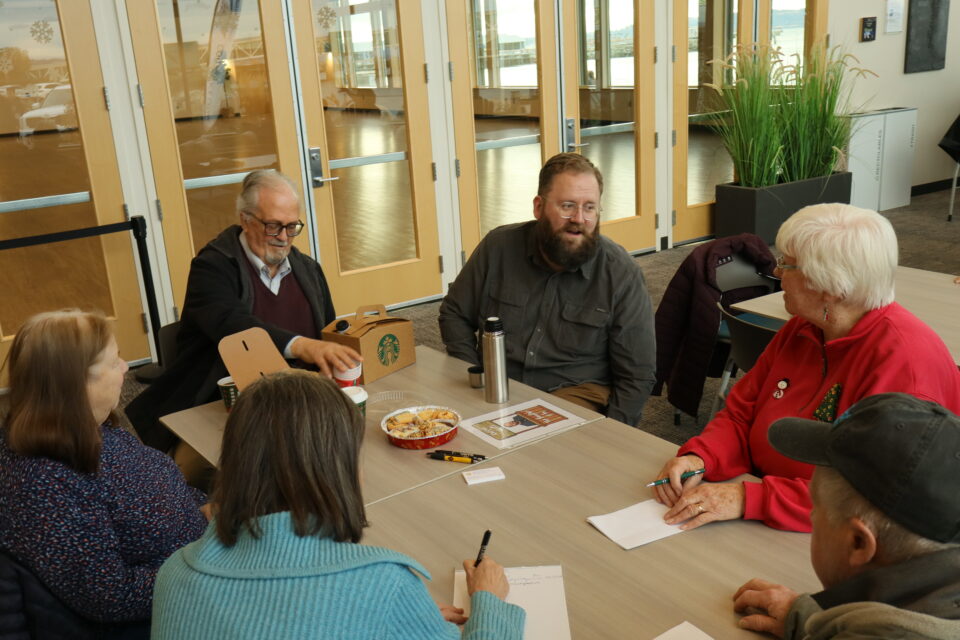
Sen. Marko Liias (D-Edmonds) hosts a casual coffee chat with 11 attendees at the Edmonds Waterfront Center Sunday afternoon. (Photos by Nick Ng)
State Sen. Marko Liias (D-Edmonds) hosted an informal coffee chat with 11 attendees at the Edmonds Waterfront Center Sunday afternoon.
Liias, who represents the 21st District, fielded a range of questions over coffee and cookies. One attendee addressed the lack of recycling requirements for apartment residents in Edmonds. “There are no recycling containers at apartment buildings,” she said. “Condos, yes. Private homes, yes. But apartment buildings, no. So my husband and I are anal about this, and we collect all our things in these separate containers and take them up to 212th Street (the location of Snohomish County’s Southwest Recycling and Transfer Facility).”
Liias said that Edmonds has a franchise agreement with Sound Disposal, and rates are regulated by the state’s Utilities and Transportation Commission. He noted that multi-family buildings are often treated as commercial customers, so they end up on a different service line than single-family homes.
He added that Legislature recently passed the “Re-Wrap Act” (SB 5284) to improve recycling rates by:
Increasing pickup from multi-family and commercial sites
Encouraging producers to use less packaging
Shifting packaging toward recyclable materials
“I think in terms of when we get recycled here, it’s probably going to be a couple years,” Liias said. “Right now, we ship a lot of our solid waste out to rural areas or Oregon and bury them in the ground. And that is not sustainable in the long term when we could be recycling.”
Two Washington initiatives
Another attendee asked about the state’s Parental Rights Initiative and the initiative on transgender people’s participation in girls youth sports. These two initiatives were proposed by Let’s Go Washington founder Bryan Heywood.
On parental rights, Liias said that the Legislature already passed a previous citizens’ initiative on parents’ rights in education because lawmakers agreed parents are a key constituency after students. Afterward, the Legislature heard concerns that some parts of that law did not fit well with other rules, especially around health records. Liias said the Legislature tried to “adjust and mesh” some of feedback they had heard, such as parents’ rights to special education services and to educational materials in their own language if the parents don’t speak English.
Liias said the original initiative sponsors disliked those changes and are now pushing a new initiative to roll the law back.
“I personally think that the amendments and changes we made are good, that they make the Parents Rights Initiative clearer,” he said. “They include things like the right to access specialists, the right to get materials in other languages, things like that. So I have not signed that initiative. I would encourage people not to sign it because I don’t think that it’s necessary.”
On girls’ youth sports and transgender participation, Liias said the issue involves a relatively small number of students – about a dozen statewide – and is highly localized. Therefore, he said local school boards and communities should set their own approaches rather than a one‑size‑fits‑all statewide mandate.
Several attendees argued that allowing transgender girls to compete in girls sports and use girls locker rooms threatens women’s rights, and they questioned why Democrats support that position. One person framed it as “boys in girls’ locker rooms and sports,” and said this position is “driving people away like crazy” from Democrats, including feminists. Others questioned whether minors are mature enough to make life‑altering decisions relating to gender‑related policies.
“I mean, we don’t let them drink till they’re 21. We don’t let them vote till they’re 18,” one attendee said. “They can make decisions on their body when they’re like 13?”
Liias said students should receive the appropriate educational environment for them. “We should make sure that we’re meeting the needs of each of our students, regardless of what their background or circumstance is,” he said. “There was a gap in providing educational services for trans youth. We’ve worked to make sure that those particular issues that impact families are addressed. The school-based health centers are not about providing gender-affirming care. They’re about making sure if there is access to behavioral health for kids [and] primary care for kids.”
Liias also mentioned SB 5599, which focuses on housing and shelter for homeless youth, not authorizing gender reassignment procedures. SB 5599 allows homeless youths to stay in shelters longer than 72 hours and requires efforts at family reunification, he said.
“I don’t have an opinion on what medical treatments young people should receive, if they can, from their doctor,” he said. “The standards of care that exist for the health condition that they’re seeking treatment for, and their family, their support, their caring network. So if a young person is transgender and wants to receive support and care in that process, that is for their doctor, for their caring community, their family, their loved ones, and them to make those decisions.”
Liias said voters can weigh in through elections and any initiatives that reach the ballot next November.
Transportation and employment
Regarding transportation, Liias said that missed sailings in Washington ferries are down over 90%, and cancellations on the Edmonds-Kingston route are “dramatically down.” He said the state has ordered three new, hybrid ferries to refresh an aging fleet.
In addition, traffic fatalities are down. “We had record-high traffic fatalities in 2023 the last two years,” Liias said. “We’ve seen 10% reductions. We’re back down to where we would be before the pandemic, and we got to keep going to our target of zero traffic fatalities.”
Liias said he was also working on the need to create jobs locally and affordability in housing, health care and food. He gave an example of a constituent who was facing debt.
“Because they don’t have good health insurance, they ended up in debt over their medical bills,” he said. “And wage garnishment laws in this state mean that you can only keep about $500 a week, about $2,000 a month, before your wage is garnished. They [the constituent] thought we should raise that limit. We looked and saw a couple of states have a higher limit. So I’m going to propose to go to the higher limit. Not that people shouldn’t necessarily pay their debt, but we should be sure that they’re able to afford their rent, to stay in their home and to take care of the family first, especially because it’s probably going to be more uninsured folks.”
Driver’s education expansion
Liias talked about a new driver’s education requirement that requires new drivers up to age 21 to take a driver’s education course before they earn their license. This is in response to increased traffic fatalities in 2021 to 2023 due to DUI and speeding.
Liias said the driver’s education requirement would include a scholarship for those from low-income families. He said for 22- to 25-year-olds, driver’s education is not required up front, but if they get into a serious crash, they will be required to complete driver’s education.
“In the late ’90s, there was this sense that our public schools weren’t focusing enough on reading, writing and math, and that they were being asked to do too many extra things,” Liias said. “It was sort of an education reform that led to the state also subsidizing schools to teach drivers so that they didn’t have to charge the student the whole cost. That subsidy went away, and the sense that this was not a good use of our schools. They should be focused on other stuff.”
Liias said that this change pushed driving instruction out of public schools and into private, for‑profit driving schools, which makes access harder and more expensive. “We talked to more schools about it. Would they take this on? The answer was still a ‘no’,” he said. “That’s why we’re working to provide scholarships.”
Despite the disagreement among the attendees, Liias said he appreciated having a “non-structure conversation” that showed “our democracy in action,” “We all have to live here together. We all have to make this work together. And, you know, we don’t all have to agree to make it all work together,” he said. “But I do think we need to be able to sit down and look each other in the eye and talk about these issues one on one, and that’s part of why I’m glad we…have this opportunity.”
Start your morning with the latest local news.
Subscribe to the FREE My Edmonds News Daily Newsletter
We will never send spam or annoying emails. Unsubscribe anytime.
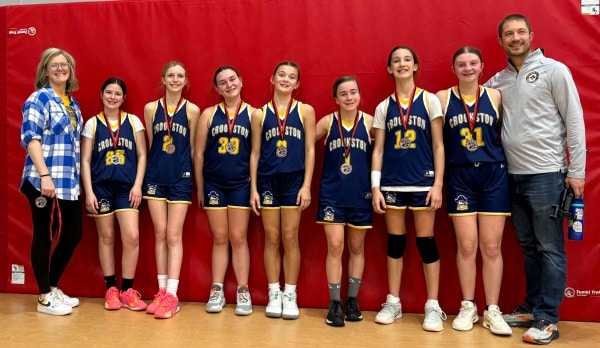
The Crookston Pirate seventh grade girls basketball team went 2-1 at the Ada-Borup-West tournament on Saturday. The girls beat Ada-Borup-West 17-16, lost to East Grand Forks 23-10 and beat Sacred Heart 26-23 to finish third place. Members of the team are Clara Cymblauk, Emma Perrault, Stormy Luckow, Keeva Kliner, Maggie Van Ruden, Alle Kollin, and Kambre Wangen. The team is coached by Garrett Kollin and Katie Perreault.
Tags: Alle Kollin, Clara Cymblauk, Crookston Pirate seventh grade girls basketball team, Emma Perrault, Kambre Wangen, keeva Kliner, Maggie Van Ruden, sports, Stormy Luckow
Data Breach Notification
,
Data Security
,
Healthcare
National Accident Health Says Breach Exposed Medical Info of 181,000 People
Marianne Kolbasuk McGee (HealthInfoSec) • December 15, 2025
The NAHGA is notifying 181,000 individuals of an April hack that potentially compromised their claims data, including medical information involving sports related accidents. (Image: NAHGA)
A Maine-based third-party administrator that handles healthcare claims involving day care centers, youth sports and NCAA athlete accidents is notifying more than 181,000 claimants that their medical information and personal identifiers may have been accessed or stolen in an April hacking incident.
National Accident Health General Agency, or NAHGA, describes itself as a third-party administrator that focuses on secondary accident insurance claims processing for clients across the country.
The company, which has been in business more than 30 years, handles claims involving specialty organizations and large health insurers that cater to day care centers; youth sports and camps for K-12 students; athletic programs such as the NCAA Divisions I, II and III; national film and television productions; and motocross and short track auto racing.
NAHGA, in a breach report submitted to Maine’s attorney general on Friday, said the hacking affected 181,160 people.
In a breach notice posted on NAHGA’s website, the company said that on April 10, it “learned” of unusual activity within its network.
NAHGA said it then immediately took measures to investigate the activity and secure its systems.
With the help of third-party cybersecurity experts, the investigation determined that an unauthorized individual may have accessed or acquired certain files and data stored within NAHGA’s systems between April 8, and April 11.
“NAHGA conducted an extensive review of these systems in order to identify the scope of the incident,” the company said, adding that it started sending breach notices to affected individuals with an available mailing address on Nov. 14.
NAHGA’s review of the compromised data found that affected information may have included individuals’ name, Social Security number, date of birth, driver’s license number, health insurance information and medical or treatment information.
NAHGA said it has taken steps to enhance its security to help reduce the risk of similar incidents in the future.
NAHGA did not immediately respond to Information Security Media Group’s request for additional details involving the company’s breach.
Several national law firms in recent days and weeks have issued public notices saying they are investigating the NAHGA breach for potential class action litigation. As of Monday, at least one such federal proposed class action lawsuit had been filed against NAHGA stemming from the incident.
That lawsuit alleges, among other claims, that NAHGA’s weak security practices failed to stop cybercriminals from accessing and exfiltrating the personally identifiable information and protected health information in its care.
“Because of defendant’s data breach, the sensitive PII/PHI of plaintiff and class members was placed into the hands of cybercriminals – inflicting numerous injuries and significant damages upon plaintiff and class members,” the complaint alleges.
That lawsuit against NAHGA seeks financial damages, including compensatory and putative, as injunctive relief requiring the company to better protect plaintiffs and class members’ personal and health information.
As of Monday, the NAHGA incident was not yet posted on the U.S. Department of Health and Human Services’ HIPAA Breach Reporting Tool listing major health data breaches affecting 500 or more individuals.
Nonetheless, the NAHGA incident is among hundreds of other large breaches – including hacking incidents – reported by third-party vendors and business associates to the HHS Office for Civil Rights so far in 2025.
The largest such HIPAA business associate incident reported in 2025 so far was a hacking incident at Episource, a medical coding and risk adjustment company owned by health insurer UnitedHealth Group’s Optum subsidiary (see: UnitedHealth Group’s Latest Health Data Breach).
That Episource breach, reported to HHS OCR on June 6, affected more than 5.4 million people. Episource in its breach notice said that the company detected unusual activity on its computer network on Feb. 6. The company said its investigation into the incident determined that cybercriminals accessed and stole copies of some Episource data between Jan. 27 and Feb. 6.
Senior Julian Horton sets up for a free throw against M.L. King on Dec. 2. The Knights won 68-45.
With the Georgia High School Sports Association reclassifying schools every two years, Midtown Athletics will move from Class 4A to Class 6A beginning with the 2026-27 school year.
Prior to 2024, GHSA consisted of seven different classifications organized by school size. In 2024, GHSA removed Class 7A, which impacted school placement, and moved the Knights from 5A to 4A. For the 2026-28 school years, GHSA has decided to transition Class 1A Division II to Class 1A and Class 1A Division I to Class 2A. These changes have reintroduced Class 7A and rapid population growth has boosted Midtown into Class 6A. Amid these recent changes, the Knights are expected to face intense competition next school year. However, Athletic Director Blair Barksdale said the jump isn’t as big of a change as most perceive it as.
“It doesn’t sound as bad as everybody took it to begin with,” Barksdale said. “Insead of having Class 1 and Class 1A, they turned 1A into 2A. So if you think about it, that moves everyone up one [classification]. So that puts us at 5A going into reclassification. And we are growing so fast, so that moves us out of 5A and into 6A.”
When GHSA goes through the reclassification process, schools have the option to appeal. Barksdale said the decision to accept going into Class 6A was carefully thought through, considering different aspects of the change. Midtown will be in Region 4-AAAAAA, consisting of Alcovy, Chamblee, Decatur, Dunwoody, Heritage, Lakeside, Meadowcreek and Shiloh.
“Dr. Bockman, [Athletic Director] Hill and I decided it was best to stay [in Class 6A],” Barksdale said. “There’s only one private school, Woodward. So then it came down to who do we think our region will be? When you look at all the sports, we determined we think we’ll have good success. Some sports have competition in the region, and some sports will have to make the schedule outside of the region really hard for more preparation looking to get through the playoffs longer. Now this allows all teams to have a better playing field.”
Whereas some sports have had minimal exposure to teams they will face in the coming season, other sports, such as soccer, have already had exposure to some of these teams and this level of competition, due to coaches scheduling games outside of the region.
“We already play higher level teams anyway,” junior soccer player Oliver Bell said. “So we’ll consistently be able to play those teams. Our coach might want us to prepare some more, but since we’ve already played some of these teams, it’s not going to be that different.”
Barksdale said she is anticipating more overall success among Midtown athletics.
“I think this will allow us to grow the program,” Barksdale said. “It will give us an opportunity to give those sports that maybe have inched into the playoffs or haven’t made the playoffs more of an opportunity, which also leads to us building a bigger athletic program. Those programs that may not have as many kids in them, like football and girls basketball, will be affected. We’re going to end up with success and we’re going to be able to build these programs and make them like soccer, baseball and lacrosse.”
Girls track coach Joshua Washington said this change was unexpected to him.
“I was a bit shocked when I saw Midtown was going up to be a 6A school,” Washington said. “From a size perspective, I’m not surprised, but from an athletics perspective, I’m surprised. Typically the larger schools in 6A and 7A have the larger populations, but they also have the larger populations of kids that play sports. Midtown is not one of those schools where the majority of the kids or students play sports. Although number-wise, we have a large total enrollment, the percentage of those kids that actually play sports is not that large.”
Despite Washington’s initial reaction, he doesn’t think much will change with the track program.
“When we have major invitationals, there can be anywhere between 15-30 schools and all of those schools are different classifications,” Washington said. “So we spend the majority of our season anyway competing with schools that are larger and smaller than us, so there won’t be much of an impact. We’ll fit right into [region play] because in a way, we spend our whole season preparing for schools like those.”
Because of the wider population at larger schools, there is a wider selection of athletes, meaning athletics typically get more competitive as the class increases. Junior volleyball player Nora Goodman said she expects the unfamiliar competition to affect her personal development.
“We’ve already played Decatur and Chamblee, so I think we have a pretty good sense of them,” Goodman said. “It will definitely be interesting watching film or preparing for other teams we’re going to play, because I haven’t even heard of some of the schools we’ll play next year. I feel like it will introduce some new, fun competition that I’ve never seen before, and really make me have to adjust my skill set or develop more in specific areas to kind of go against that new competition. So I’m excited to see what the change will bring to my personal growth, as well as the team’s [growth].”
Barksdale emphasizes that Midtown should define success through the growth of the school’s athletic program rather than overall performance.
“It’s not all about wins and losses,” Barksdale said. “It’s about growing. I think we’ll see other traditional sports start getting more wins and better placement. All of our sports are in good places, but I think that we’ll get more notoriety, more exposure. It’ll also be a new classification for coaches to see how we are too. I think that is also a good test.”