
Sports
Raleigh vs. Charlotte




A new study shows that out of 10 cities that are potential contenders to be the home of a Major League Baseball (MLB) team, Raleigh and Charlotte are strong contenders. The study analyzes and compares the cities based on feasibility and the economic impact an MLB team would have on each city.
Earlier this week, MLB Commissioner Rob Manfred hinted at an MLB expansion.
“I think if we expand, it provides us with an opportunity to geographically realign,” Manfred said on the ESPN broadcast of the Little League Classic between the Mariners and Mets, according to reports. “I think we could save a lot of wear and tear on our players in terms of travel. I think our postseason format would be even more appealing for entities like ESPN because you’d be playing out of the East, out of the West and that 10 o’clock where we sometimes get Boston-Anaheim would be two West Coast teams. That 10 o’clock slot that’s a problem for us sometimes becomes a real opportunity for our West Coast audience.”
Manfred indicated that he hopes to have the locations of two new MLB teams picked out by 2029, when he plans to retire.
“Major League Baseball believes the strongest two expansion markets remain Salt Lake City, Utah; and Nashville, with no plans to put an expansion franchise back into Oakland,” according to USA Today, sports columnist Bob Nightingale.
Feasibility
The report breaks down each city’s feasibility as a potential contender. Feasibility is influenced by multiple factors, including population size and growth, income levels, media market reach, proximity to existing MLB teams, and — perhaps most critically — the ability to secure a dedicated MLB stadium, based on the report’s analysis.
Raleigh and Charlotte are North Carolina’s powerhouse cities, commanding national and global attention with rapid growth. Charlotte has risen as the nation’s second-largest financial hub. At the same time, Raleigh thrives as a technology center, supported by the University of North Carolina at Chapel Hill, North Carolina State University, and Duke University. Together, they reflect the state’s growing influence.
Population growth is a significant factor in attracting an MLB team. While overall rankings remain steady through 2050, Raleigh stands out with a projected 45.8% increase — second only to San Antonio — while Charlotte ranks sixth, according to the study. Both cities are expected to outpace Nashville, a key Southern rival.
Income levels are also factors, as higher household earnings boost ticket demand. Among the 10 MLB contender cities, Charlotte and Raleigh place fourth and fifth in average weekly wages, at $1,060 and $1,015, respectively, according to the study.
Media market size adds another layer. For 2024–25, Charlotte ranks third and Raleigh fourth among the 10 contenders, rising nationally to 21st and 22nd, according to the study. Both show upward momentum.
Stadium feasibility remains a challenge. Raleigh has two main prospects: “Downtown South,” just south of downtown with strong interstate access; and an 80-acre entertainment district near the Lenovo Center, though space could be tight. If neither fit, sites along I-40 or NC-70 between Raleigh and Durham might be explored, though the Durham Bulls’ 10,000-seat park is too small. Charlotte lags, with Truist Field’s 10,000 seats and potential renovation costs of up to $1 billion. Past stadium proposals have faced pushback over public funding.
According to the study, a new MLB stadium would cost $1–$2 billion. State and local governments traditionally cover much of the expense, recouping through economic growth, through private or investor-led funding is possible. Ownership models also matter: Most teams are privately held, though the Braves have been publicly traded since 2023.
In a recent column by John Locke Foundation board member John Hood, he said decades of academic research show that the public funding of ballparks, stadiums, and arenas does not bring the promised economic benefits. Hood says state and local governments do not derive sufficient return on investment (ROI) in job creation, financial gains, etc., to justify the significant payout. He says the money spent on advertised products would have been spent on other goods or services in the market. And taxpayers would get a better ROI if the funds were invested in public services such as public safety, education, or infrastructure.
Other factors analyzed for feasibility include schedule, competition, and professional performance. Given that both Raleigh and Charlotte already host professional and collegiate sports teams, an important consideration is whether an MLB schedule would overlap with existing sports calendars — particularly those of the popular ACC programs in the Raleigh-Durham area. Major League Baseball runs from April through September, with playoffs and the World Series potentially extending into October and early November.
Charlotte has demonstrated strong support for professional sports, with the Panthers averaging 70,000 fans per game in their 75,000-seat stadium for three decades (except the COVID-impacted 2020 season), the Hornets drawing 17,000 per game despite a 42% winning record, and Charlotte FC setting the MLS single-game attendance record while remaining among league leaders. Even the Charlotte Knights, a minor league baseball team, have posted impressive attendance, sometimes leading all minor league baseball teams.
The primary scheduling overlap in Charlotte would be between MLB and MLS (Major League Soccer), while in Raleigh, the central conflict would be with college football for only two months — unless a team advanced into the postseason — similar to other candidate cities like Mexico City and Montreal, facing overlaps with professional and college teams.
Economic ImPACT
This report measures economic impact in both the public and private sectors. It only measures the effect that stays in the selected area and is not countered by reductions elsewhere in the local economy. The economic impact is measured from the construction of the stadium and the annual MLB season.
Economic projects have three effects: direct, indirect, and induced. The estimated cost of this report’s analysis is $1.75 billion. Direct impact is at the project site. Construction activities include design, materials, and labor. Only activities generated from the project’s host area are included in the calculations. Impact is measured by private spending, employment, payroll, and public revenue. Indirect impact is the economic impact on local suppliers to the project. The induced effect reflects the additional private spending, job creation, and public revenue generated when the project’s extra labor income is spent at local retailers and businesses.
“Annual additional jobs are between 2000 and 2500, with annual labor income of nearly $120 million. Total additional economic output is over $300 million,” according to the study. “Cities in each county will receive over $2 million annually, the county will take in more than $3 million, State tax revenues will be an additional $7 million annually, and the Federal government will collect over $20 million yearly.”
The study says building an MLB stadium in either metro area would generate about 5,500 jobs, over $400 million in payroll, $140–160 million in economic activity, and more than $80 million in public revenues.

Sports
Jaguars Women’s Track & Field Posts Multiple Top-10 Finishes to Launch Inaugural Indoor Campaign
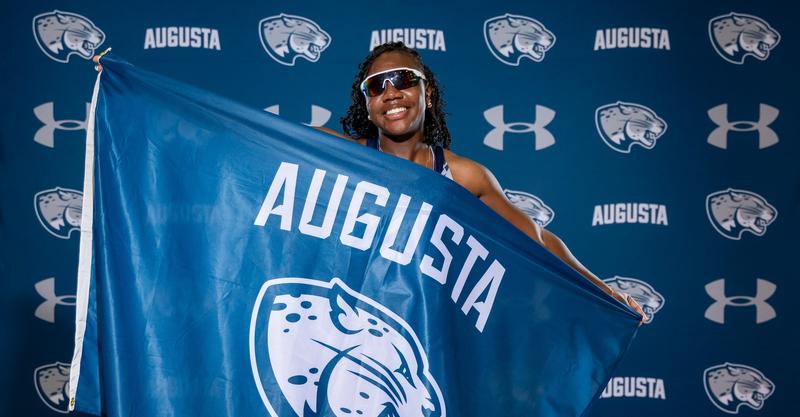
AUGUSTA, Ga. – The Augusta University women’s track and field team opened its inaugural indoor season on Saturday at the Visit Winston-Salem College Kick-Off, competing against a deep field of Division I and Division II programs at JDL Fast Track. The Jaguars produced a strong slate of early-season marks across sprints, middle distance, and distance events, highlighted by a top-three 5,000-meter finish from Madison Thomas and multiple top-10 performances.
Sprint Group Opens Season With Strong 200 and 400 Marks
Freshman Madison Mitchell paced Augusta in the 200 meters with a time of 26.15, placing 17th overall. Fellow freshman Taneiha Bowman followed in 26.72. Sophomore Josalyn Branch also opened her season in the event.
In the 400 meters, freshman Ava Adams led the group with a 1:01.25 to finish 13th. Sophomore Janiya England added a 1:03.98 in her season debut. Freshman Thanna Davis delivered Augusta’s fastest 400 of the day, placing 10th in the seeded section in 58.67.
Middle-Distance Athletes Deliver Solid Early Times
Freshman Brie Andrews opened her indoor campaign in the 800 meters, finishing 20th in 2:28.67.
Augusta’s mile group produced one of the most complete team showings of the meet, placing five runners inside the top 25. Freshman Josabeth Graciano led the Jaguars in 5:15.54 for seventh, followed by freshman Caleigh Munro in ninth at 5:19.12. Freshman Gabriella Burton placed 15th in 5:26.02, with juniors Grace Gyetko (5:32.02) and Cheyenne Ryan (5:38.46) rounding out the group.
Distance Squad Secures Five Top-10 Finishes in the 5,000 Meters
Junior Madison Thomas led Augusta with a third-place finish in the 5,000 meters, running 17:49.24. Sophomore Danielle Thayer placed seventh in 18:31.71, followed by sophomore Maria Biondolillo in eighth (19:05.37), freshman Amelia Ogden in ninth (19:14.81), and junior Swaye Mohler in tenth (19:27.44).
Sophomore Ansley Graddy and freshman Elkin Regina also opened their indoor seasons in the event.
In addition to this weekend’s performances, junior Madison Kennedy—reigning PBC Cross Country Runner of the Year—recorded the third-fastest 5K time in Outdoor Peach Belt Conference history this past fall.
Reed Leads Augusta in High Jump
Freshman Jamiya Reed cleared 1.44 meters (4-8.75) in the high jump to finish 14th in her collegiate debut. Freshman Paige Justice also competed in the event.
The team returns to Winston-Salem the following week for the ‘Twas the Meet Before Christmas on Friday, Dec. 12.
Fans of Jaguar Athletics can subscribe to the email listserve by clicking here. Fans can follow Augusta University at www.augustajags.com and receive short updates on Facebook at Augusta University Athletics and on Twitter at @AugustaJags
Dec. 7, 2025, 6:30 a.m. CT
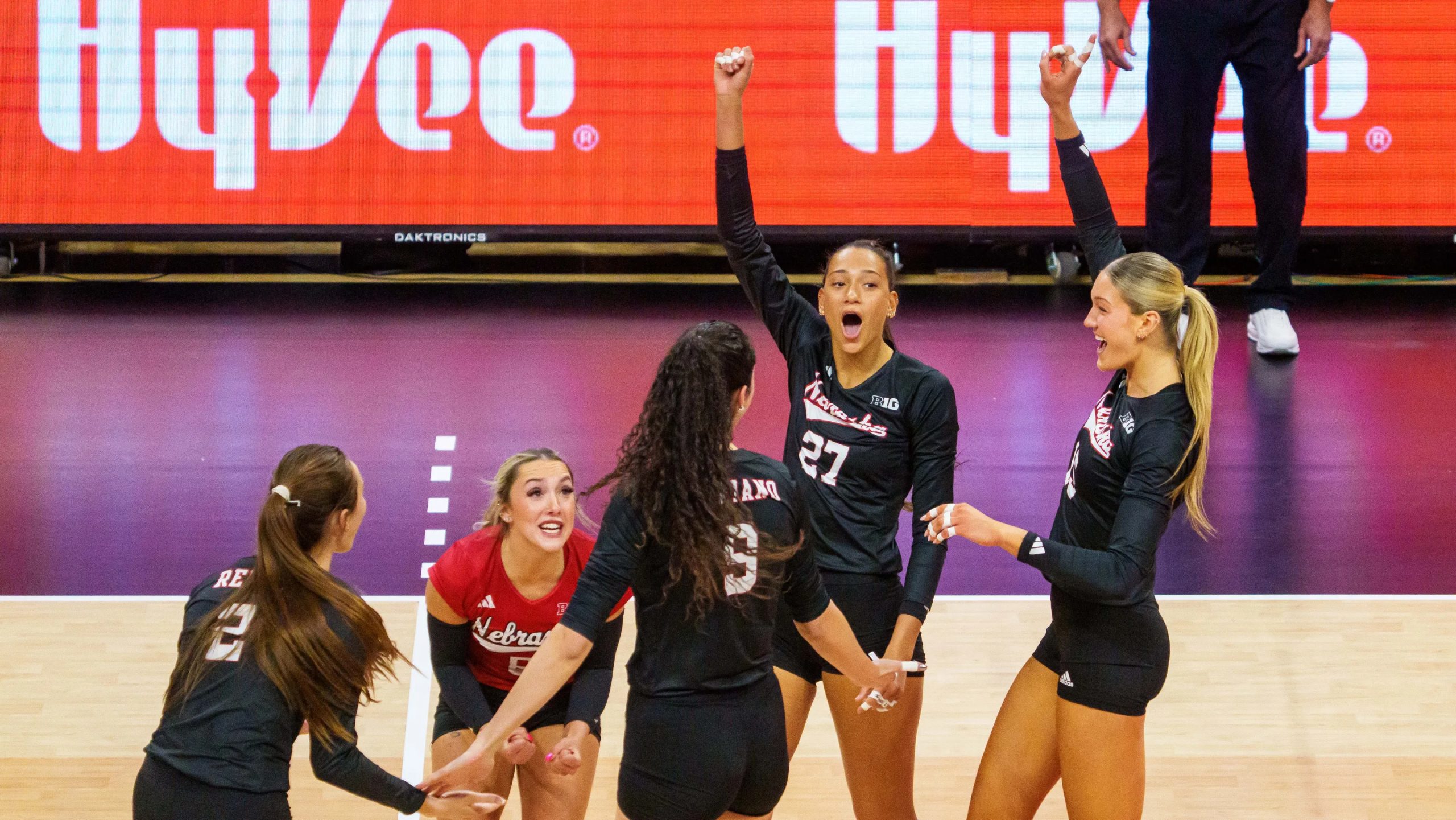
Nebraska (32-0) entered the second round of the NCAA tournament on Saturday, taking on Kansas State (18-10). Though the Wildcats put up a fight, the Huskers swept the night (25-17, 25-21, 25-16) to advance to the Sweet 16.
Nebraska struggled at times against the Kansas State defense, the Wildcats posted 14 blocks and 32 digs. This helped KSU stay in each set against the Huskers, even taking the lead multiple times. But Nebraska found itself out in front by the time it reached the red zone, allowing it to get the sweep.
The Huskers finished with 43 kills off 99 attacks for a .253 hitting percentage and posted 48 digs and eight blocks to hold Kansas State to .118 and 27 kills on 102 attacks. Nebraska also delivered seven service aces in the win.
Harper Murray and Andi Jackson co-led Nebraska, each delivering ten kills in the sweep. Murray also snatched six digs while Jackson posted a team-high three blocks and earned her ten kills off 15 attacks. Taylor Landfair hit 8-of-18 on the night, while Virginia Adriano finished 7-of-12 with a service ace.
Rebekah Allick posted six kills off 13 attacks for the Huskers, while Allie Sczech finished 2-of-4. Bergen Reilly tallied 34 set assists and a service ace. Laney Choboy and Olivia Mauch each delivered two service aces. The duo also combined for 25 digs, with Mauch earning 13 and Choboy grabbing 12.
Nebraska will host Kansas on Friday in the Sweet 16. The match is scheduled for 8:30 p.m. and can be seen on ESPN2.
Contact/Follow us @CornhuskersWire on X (formerly Twitter) and like our page on Facebook to follow ongoing coverage of Nebraska news, notes and opinions.
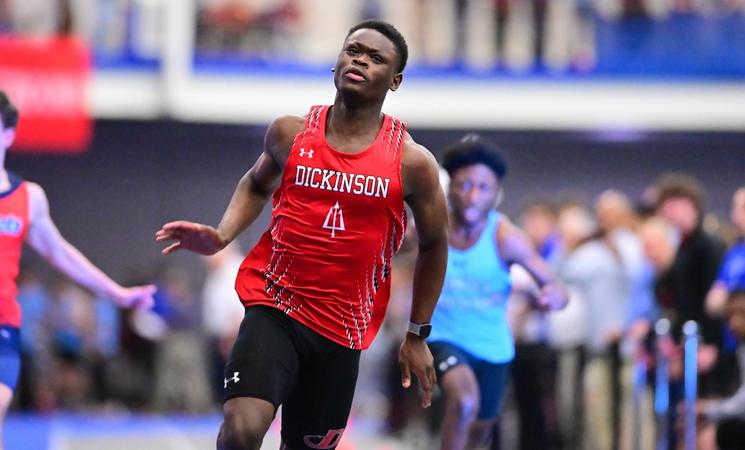
WINCHESTER, Va. – The Dickinson men’s indoor track and field team opened up their 2025-26 slate in emphatic fashion on Sunday afternoon by winning the Shendandoah University Holiday Kickoff Open inside the James Wilkins Jr. Athletics & Events Center.
Sprints
Franklyn Akabi-During picked right up where he left off last season by winning the 60m with a time of 6.86, while Darian Crim joined him on the podium in third at 7.01. Josh Gould and Dominick Rosini claimed 23rd (7.42) and 33rd (7.68). With hurdles added to the distance Barrett Chalmers and Aidan Coyne hit the line in fifth (9.61) and sixth (9.68).
Akabi-During nabbed his second win of the day during the 200m thanks to a time of 22.07, followed right behind by Crim who took second at 22.69. Jack Shronk rounded out the Top-5 by crossing in 23.59. Owen Seveland claimed tenth (23.89) as Rosini, Coyne and Chalmers earned 18th (24.98), 24th (25.80) and 28th (26.17).
The trio of Shronk, Sveland and Benjamin Dench competed in the 400m securing eighth (52.67), ninth (53.10) and eleventh (55.07).
Distance
The 800m event was packed with Devils as the duo of Michael Dooley and James Masterson finished one (1:58.70) and two (1:58.92). Sean Harris (2:07.80), Matthew Gareau (2:08.93), Alexander Radishofski (2:09.49), Quinn Chewning (2:10.34), Jack Rickleman (2:11.37), Evan Feldman (2:14.86), Walker Crochet (2:16.09) and Dylan Elder (2:17.09) occupied spots seven through 14.
Two members of the Red and White were involved in the 3000m with Nathan Caldwell grabbing second (8:50.70), while Alexander Kane seized fourth (9:03.67).
Caldwell added another victory to the Devils ledger with a time of 15:09.29 in 5000m, followed by Kane at 15:26.76. Slots six to eleven were filled with Dickinson athletes thanks to Wiley Mulholland (16:38.98), Jacob Sokatch (16:40.39), Jad Jamaleddine (16:50.89), Matthew Colden (16:57.34) and Andrew Edwards (17:00.52). William Kane completed the group of Devils by hitting the line in 17:24.42 for 14th.
Dickinson filled the podium for the mile run as Avi Ghorai won the race in 4:47.45, followed by Crochet (4:50.52) and Griffin McConnville (4:51.54). The trio of Chewning (5th – 4:52.35), Feldman (7th – 4:58.49) and Jack Solovey (8th – 5:00.07) also competed in the event.
Relay
The Red and White put three different teams out for the 4x400m with the group of Akabi-During, Crim, Harris and Seveland taking second (3:29.02). The unit of Dooley, Gareau, Masterson and Shronk clocked in at 3:32.56 for fourth, while Chalmers, Coyne, Crochet and Radishofski earned sixth (3:47.17).
Field
Elder grabbed sixth in the high jump after clearing 1.48m.
Oliver Stroka posted another DC win during the weight throw by dropping down at 15.86m.
Three Devils tried the shot put with Daniel Echeverri grabbing fifth at 11.83m, followed by Stroka in eighth (10.79m) and Elder nabbing 16th (7.97m).
Up Next
Dickinson will next compete after the New Year holiday when they take part in the Moravian University Indoor Meet in Bethlehem, Pennsylvania on Saturday, January 17th beginning at 10am.
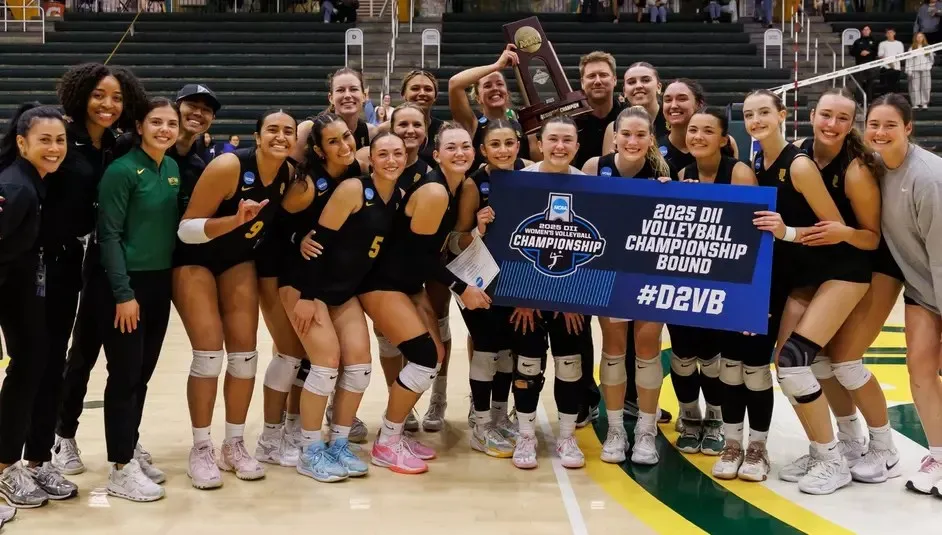
Third-seeded Point Loma Nazarene will play sixth-seeded Bentley at 10 a.m. Thursday in the quarterfinals of the NCAA Division II women’s volleyball tournament in Sioux Falls, S.D.
PLNU advanced to the NCAA quarterfinals for a second straight year Saturday night by defeating Fresno Pacific 3-1 in the Western Regionals championship hosted by the Sea Lions at Golden Gym.
Meanwhile, Mesa College was defeated 3-0 by Feather River College Sunday afternoon in the championship match of the California Community College Athletic Association women’s volleyball tournament in Folsom.
Top-seeded Feather River (36-1) won the state title for the third time in four years. Second-seeded Mesa College (31-2) had won 28 straight matches going into Sunday’s match. The Olympians won the state title in 2023 and lost in the semifinals in 2024.
Feather River swept by scores of 25-12, 25-19, 25-23. Mia Lundberg led Mesa with 10 kills and four digs. Charlotte Underwood had five kills and two digs while Bella Town (Carlsbad High) had five kills and two blocks. Ruby Ennis (Lakeside) had 17 assists and seven digs while Trina Nguyen (Mira Mesa High) had 11 digs.
Point Loma Nazarene (27-4) prevailed Saturday night by set scores of 25-17, 17-25, 25-16, 25-18. Fresno Pacific finished with a 27-2 record, with both losses coming to PLNU in Golden Gym.
Thursday’s match against Bentley (also 27-4) will also be a rematch. PLNU scored a four-set win over Bentley on Sept. 12 en route to winning the Colorado Premier Challenge Tournament in Denver.
Freshman middle blocker Hailey Clark paced PLNU against Fresno Pacific with 14 kills, while senior outside hitter Abigail Nua finished with 13 kills and a block, while sophomore outside hitter Saren Rogers (Victory Christian Academy) had 13 kills.
Junior setter Sophia Baugh had 50 assists and a service ace. Senior libero Macy Reynolds had 19 digs and freshman defensive specialist Hailey Wilson had 18 digs to 17 for freshman setter Jolyna Salas (Tri-City Christian).
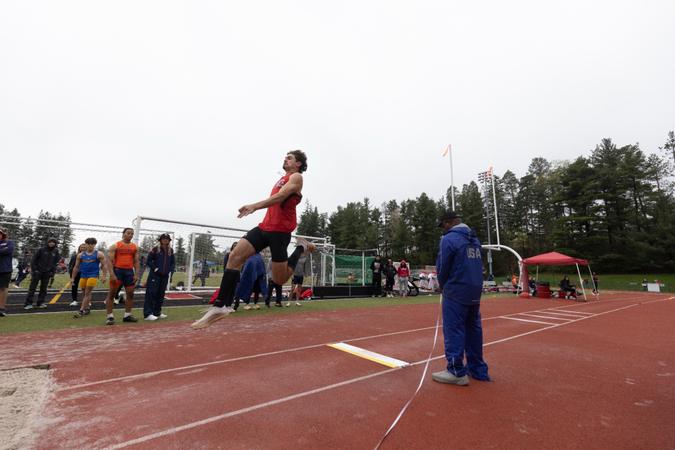
Men’s Track & Field | 12/6/2025 7:48:00 PM
WHAT YOU NEED TO KNOW
>> The Saint Francis track & field teams opened its indoor season at the Bison Opener.
>> Saint Francis compiled 19 top 10 finishes.
>> The Red Flash faced the following colleges: Shippensburg, Lock Haven, Bucknell, Carnegie Mellon, Lincoln (Pa.), West Chester, Millersville, Mount St. Mary’s, Penn State, Bloomsburg, and Indiana (Pa.)
FLASH WOMEN NUGGETS
The women’s team accumulated seven top 10 performances.
Olivia Renk finished second in the 200-meter and fourth in the 60-meter on the women’s side. The sophomore clocked in a time of 25.46 in the 200-meter and a 7.72 time in the 60-meter.
In the women’s long jump, Taylor Foster finished in fifth place in the event with a jump of 5.29m. Foster also claimed eighth place in the women’s triple jump with 10.63m.
Aubrie Wells and Karsyn Ford both finished with 3.25m to tie for eighth place.
Rounding out the top 10 finishes was Rylee Nicklas taking 10th in the women’s weight throw with a toss of 14.22m.
FLASH MEN NUGGETS
The men’s team registered 12 top 10 finishes on the day.
1-weight throw,
Jayden Foster took eighth place in the men’s 200-meter dash with a time of 22.81. Meanwhile, Tyler Craft claimed the ninth spot with a time of 37.08 in the 300-meter. Craft jumped his way into second place in the long jump with 6.94m.
Staying in the meter dashes, James Parmelee (1:10.38) took third and Holden Schreier finished seventh (1:12.90) in the men’s 500-meter.
Two more Red Flash placed top 10 in the high jump, Ayden Martinage (8th, 1.85m) and Braydon Beach (10th, 1.80m).
Running over to the pole vault, Dylan Andrews finished with a jump of 4.25 to give himself seventh place.
Clark Gulycz took fourth in the men’s shot put with a mark of 17.07m.
Saint Francis took another two top 10 finishes, this time in the men’s triple jump. Nehemyah Williams gained third place with a leap of 14.35m. Ian Conway was not far behind him in seventh with 12.54m.
Vincent Franco finished out the Red Flash in sixth place with a time of 15.94m.
NEXT UP FOR FLASH
Track & field will next compete at the Wagner College Seahawk Shootout hosted by Wagner College on Friday the 12.
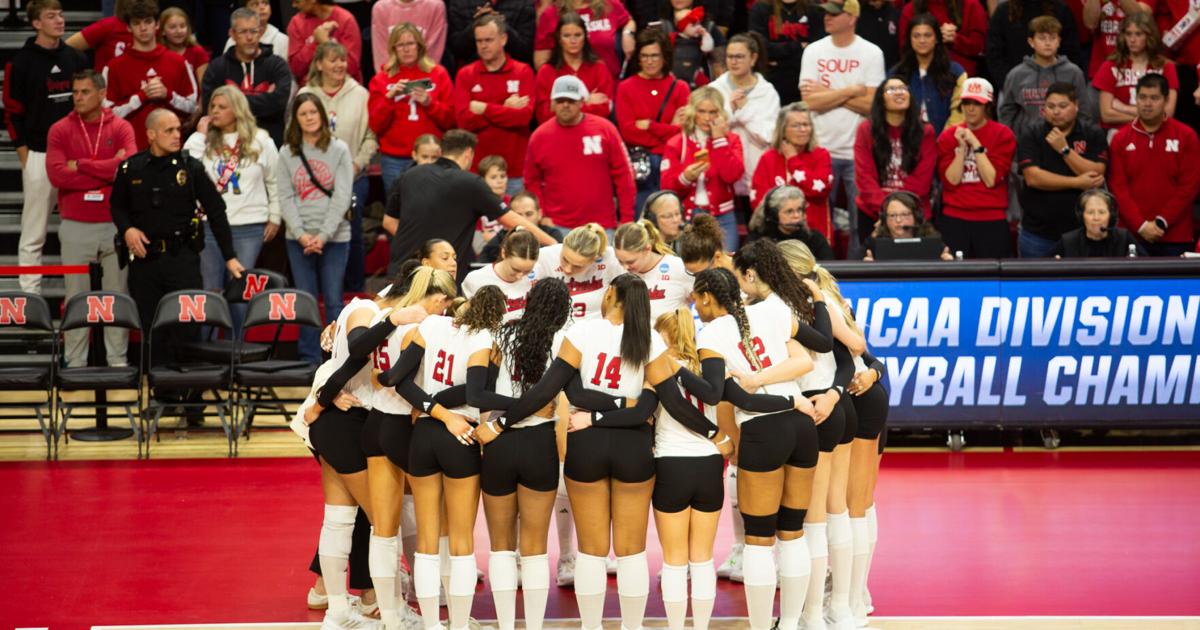
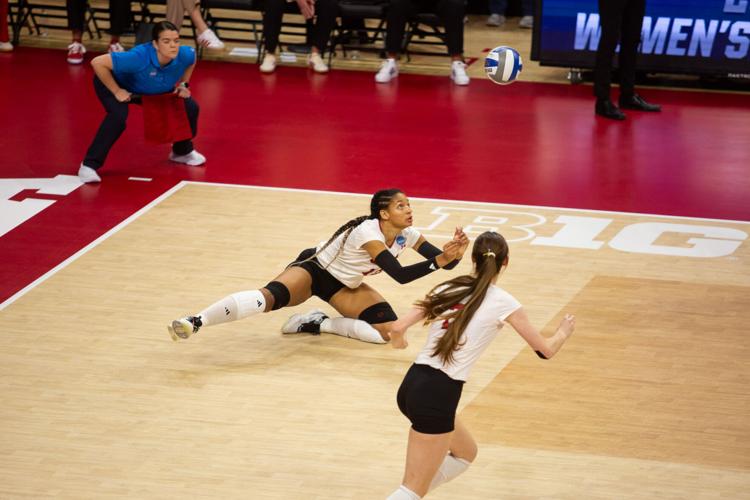
The Nebraska Huskers showed up to battle and proved their grit and capability, adapting to Kansas State’s style of play on Dec. 6, 2025, at John Cook Arena inside the Bob Devaney Sports Center. Nebraska continued its dominant postseason run and swept Kansas State (25-17, 25-21, 25-16) in front of 8,601 fans. With the win, the No. 1 Huskers advanced to the NCAA Sweet Sixteen.
Nebraska controlled the match, out-hitting Kansas State, .253 to .118, and extending its streak of out-hitting opponents by at least .100 for seven consecutive matches. Nebraska was still tested in many areas throughout the game and had to overcome and adapt under pressure.
“You know, they really challenged us in a lot of areas and thought this was one of the first matches in a while,” said coach Dani Busboom Kelly. “We had to gut it out with our serve and pass and floor defense, which is kind of like classic Nebraska volleyball. And I felt like we handled it really well.”
Juniors Andi Jackson and Harper Murray led the way with 10 kills each, with Jackson having a .533 hitting percentage on 15 swings. Nebraska’s balanced attack featured eight kills from senior outside hitter Taylor Landfair, seven from freshman opposite hitter Virginia Adriano and six from senior middle blocker Rebekah Allick, while junior outside hitter Bergen Reilly was a huge threat on offense with 34 assists.
Defensively, the Huskers fulfilled their high postseason standard. Nebraska totaled 48 digs, led by Olivia Mauch’s 13 and Laney Choboy’s 12, limiting Kansas State to only 27 kills. Nebraska placed their serves well, which brought them seven aces.
“Our defense hung in there, and just we were ready for long rallies. So, I was really proud of us even when it didn’t feel super clean, like we still we’re just playing Nebraska volleyball,” said setter Bergen Reilly.
Nebraska will next host No. 16 Kansas in a regional semifinal on Friday, Dec. 12, 2025, at 8:30 CST at John Cook Arena inside the Bob Devaney Sports Center.
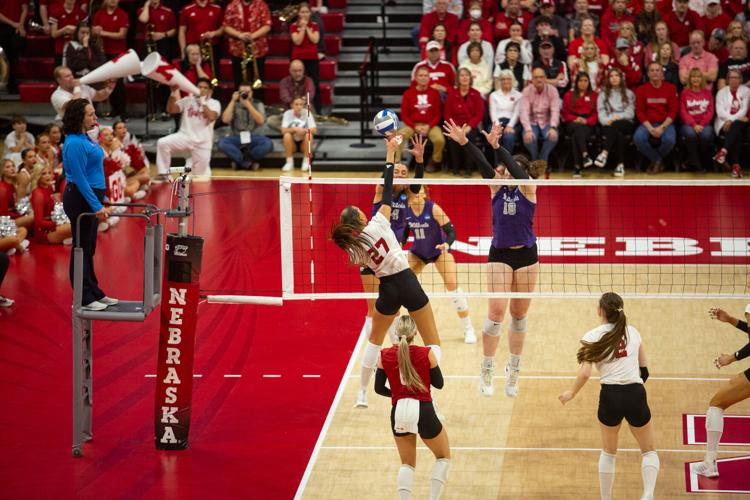
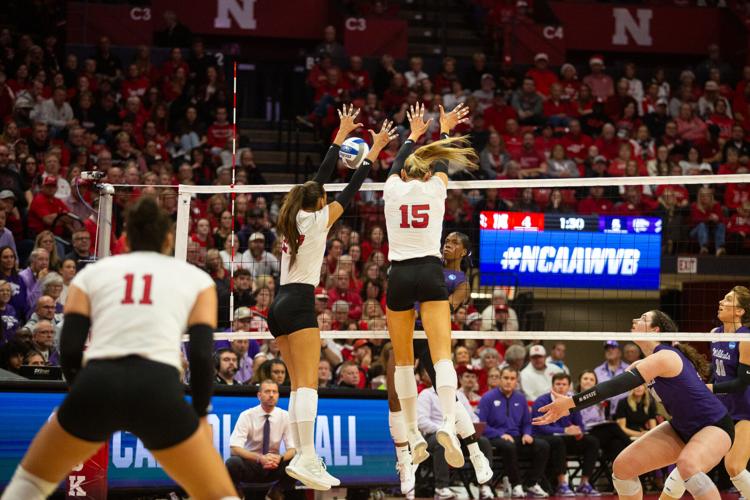
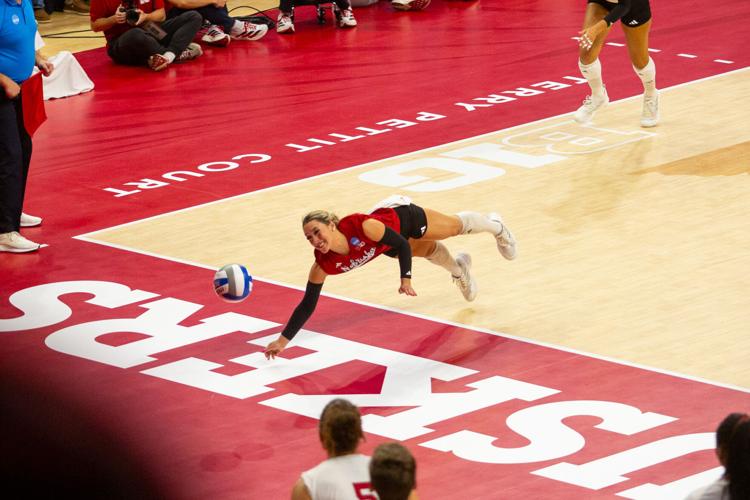
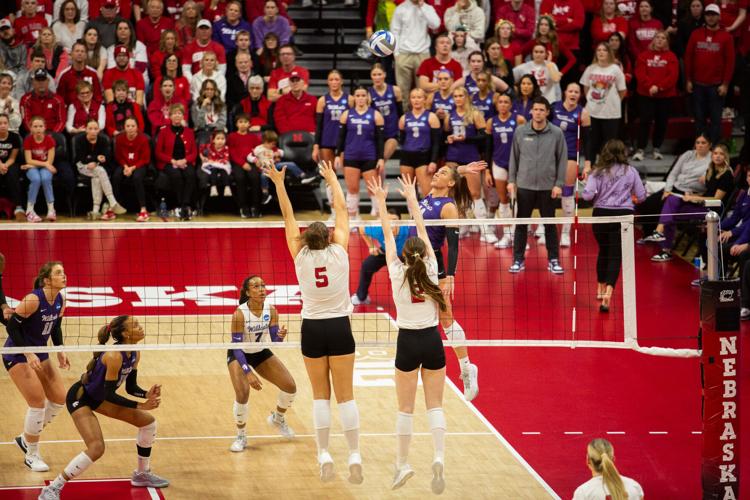
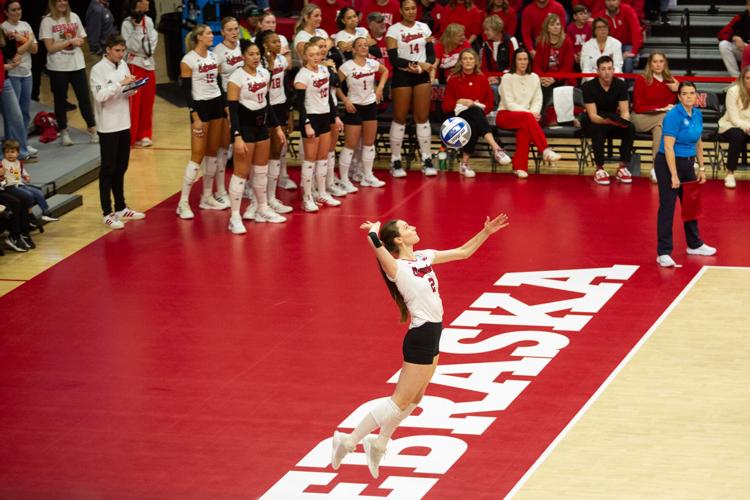
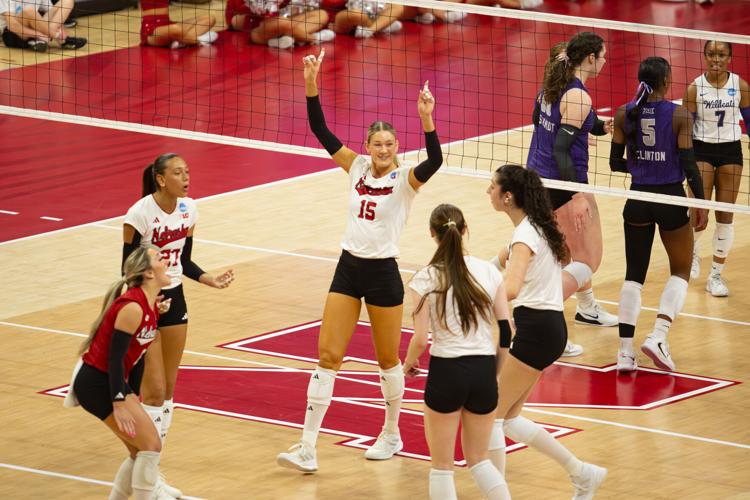
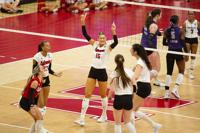
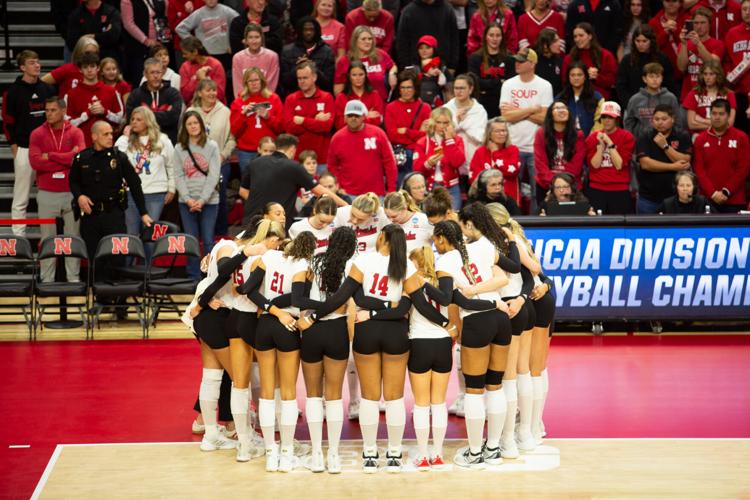
The Nebraska Huskers huddle together before taking on Kansas State on Dec. 6, 2025, at the Bob Devaney Sports Center. The Nebraska Huskers claimed a 32-0 overall record after beating Kansas State.

Jaguars Women’s Track & Field Posts Multiple Top-10 Finishes to Launch Inaugural Indoor Campaign

Nebraska volleyball advances to Sweet 16 with sweep of Kansas State

Devils Begin 2025-26 Season With Victory at SU Kickoff Open

Point Loma Nazarene wins volleyball regional; Mesa’s season ends with loss

Booger McFarland calls out historical college football program for skipping bowl game

Track & Field Teams Claim 19 Top-10 Finishes

PHOTO: Nebraska volleyball showcases grit in a sweep against Kansas State | Unlimited Sports

Hayes, Covington power North Park Track & Field to strong season-opening start

Barrera sets school mark, Champagnie wins triple jump in first indoor meet

Notre Dame AD calls College Football Playoff rankings an ‘absolute joke’ after Irish CFP snub

Falcons Win Two Races at Season Opening Suffolk Relays

Devils Win SU Holiday Open for Third Straight Year

Lehman Wins Two Events in Season Opener

PC Gaming Accessories Market to Reach USD USD 18.2 billion

Rotary Youth Exchange helps Canudas find home at Gibraltar

First Tee Winter Registration is open

Fargo girl, 13, dies after collapsing during school basketball game – Grand Forks Herald

CPG Brands Like Allegra Are Betting on F1 for the First Time

Volleyball Recaps – November 18

F1 Las Vegas: Verstappen win, Norris and Piastri DQ tighten 2025 title fight

Two Pro Volleyball Leagues Serve Up Plans for Minnesota Teams

Utah State Announces 2025-26 Indoor Track & Field Schedule

Sycamores unveil 2026 track and field schedule

Redemption Means First Pro Stock World Championship for Dallas Glenn

Texas volleyball vs Kentucky game score: Live SEC tournament updates

Bowl Projections: ESPN predicts 12-team College Football Playoff bracket, full bowl slate after Week 14

How this startup (and a KC sports icon) turned young players into card-carrying legends overnight

Indiana’s rapid ascent and its impact across college football

Pohlman admits ‘there might be some spats’ as he pushes to get Kyle Busch winning again

Robert “Bobby” Lewis Hardin, 56

 Why a rising mid-major power with an NCAA Tournament team opted out of revenue-sharing — and advertised it
 NBA Legend Michael Jordan to Join NBC Sports as Special Contributor
 Falcons mailbag
 Portal Update – Basketball and Gymnastics Take Hits
 has always dreamed in Mercurial. Now his initials are on the boots.
The new Kyl…
has always dreamed in Mercurial. Now his initials are on the boots.
The new Kyl…
-
 Rec Sports2 weeks ago
First Tee Winter Registration is open
-
 Rec Sports2 weeks ago
Fargo girl, 13, dies after collapsing during school basketball game – Grand Forks Herald
-
 Motorsports2 weeks ago
CPG Brands Like Allegra Are Betting on F1 for the First Time
-
 Sports3 weeks ago
Volleyball Recaps – November 18
-
 Motorsports2 weeks ago
F1 Las Vegas: Verstappen win, Norris and Piastri DQ tighten 2025 title fight
-
 Sports2 weeks ago
Two Pro Volleyball Leagues Serve Up Plans for Minnesota Teams
-
 Sports2 weeks ago
Utah State Announces 2025-26 Indoor Track & Field Schedule
-
 Sports2 weeks ago
Sycamores unveil 2026 track and field schedule
-
 Motorsports2 weeks ago
Redemption Means First Pro Stock World Championship for Dallas Glenn
-
 Sports2 weeks ago
Texas volleyball vs Kentucky game score: Live SEC tournament updates