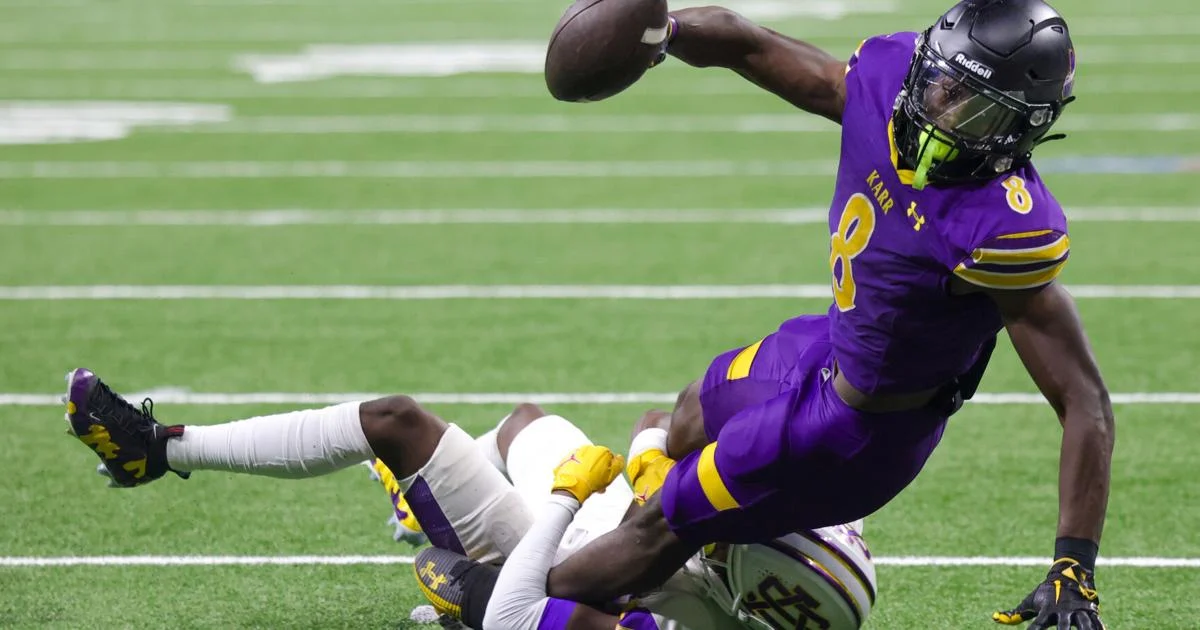
With elite high school football and basketball traditions stretching from Shreveport to New Orleans, the new pay-the-players era that allows kids to profit from paid endorsements has led to big business in Louisiana, and some athletes are bringing home six-figure incomes before they even graduate.
But it’s also spawned a host of concerns around a lack of financial protections for young athletes, and who can claim a stake in the money they’re now allowed to earn.
Those concerns were a key focus this year of a 22-person legislative task force involving Louisiana lawmakers, lawyers, college athletic administrators, coaches and student athletes. The group was empaneled to study the effects of paid endorsements and salaries for the state’s high school and college players.
They began shortly after a landmark NCAA settlement in June, which allowed college athletes to begin collecting salaries directly from their universities this season. For the past four years, college athletes could earn money through outside endorsement deals but not directly from their schools.
Over the course of five meetings, the panel zeroed in on the so-called “NIL” era in high school sports, named for the money that athletes have been allowed to earn since 2021 through endorsements or other use of their name, image and likeness.
Under the task force’s recommendations, which will be forwarded to lawmakers in January, the state would require that anyone other than a parent who helps high schoolers negotiate endorsement contracts must register as an agent with the Louisiana Attorney General’s Office. That requirement is already in place for professional sports agents in Louisiana.
The agents would also be subject to background checks and required to complete training.
Lawmakers could craft the changes to allow high schoolers to recoup any money paid to an unlicensed agent, said Harry J. “Skip” Philips, Jr., assistant Chief Deputy Attorney General.
“You’d try to get back as best you can the ill-gotten gains, as it were, and give it to the student athlete,” Philips said during the task force’s December meeting.
“I’m not sure we’ve fixed this problem altogether,” Philips added, but the changes give authorities a mechanism for pursuing what Phillips called “renegaders,” or people posing as professional agents in order to reap the benefits.
The panel’s chair, Rep. Rashid Young, said in an interview that the recommendations are meant to be a starting point, and lawmakers are welcome to add revisions.
“This is sort of one of those building-a-plane-as-we-fly type of situations,” said Young, a Homer Democrat and former linebacker and strong safety at Grambling State. “We’ll see how it works. If we need to come back and adjust, I think everybody is open to doing that.”
The task force didn’t recommend any specific NIL-related changes to state law regarding college athletics, other than a resolution that would study the “funding structures of athletic departments” and “evaluate the financial implications of NIL activities.”
The panel did recommend a list of best practices for Louisiana college athletic departments, including educating athletes on “available mental health resources” and to “carefully consider Title IX implications” when deciding how to dole out college athlete salaries.
LSU has said 90% of the $18 million it has earmarked in salaries will go to football and men’s basketball players. The university — and all others in the state — have rejected public records requests to turn over salary data per individual athlete.
The task force turned its attention to high school agents after J.T. Curtis, football coach at John Curtis Christian School in River Ridge, told the panel of “rampant” problems among the state’s premier football schools.
Adults with no professional certifications or backgrounds in the law swoop in to secure representation from Louisiana’s top recruits, some as young as 12 or 13 years old, Curtis told the panel.
“Until we find a way to get outside influences out of the lives of our high school athletes, we’re going to continue struggling with this,” Curtis said during an August meeting.
In the task force’s final meeting in December, Curtis called the panel’s recommendations “a good beginning.”
Historically, Louisiana has one of the nation’s largest shares of high school football players who are recruited by Division I colleges.
In the upcoming 2026 class, eight football players from Louisiana high schools are ranked in the Top 200, according to 247 Sports. In 2025, it was nine.
For athletes under the age of 17, the task force recommended legislation requiring them to deposit a portion of their compensation into a trust account, which they’d have access to later as an adult.
The account could be drawn from “under specified conditions, such as educational expenses or milestone events, while maintaining safeguards to prevent misuse,” per the task force’s adopted language.
The task force also recommended the Louisiana High School Athletic Association adopt a formal set of NIL bylaws that it would police among the state’s members.
They include prohibiting athletes from endorsing products associated with alcohol, cannabis, tobacco, adult entertainment and gambling.
The rules would allow schools to prohibit students from NIL activities if they interfere with classes, practices, games or competitions.