It’s summer optimism time. August is the slowest month of the calendar year for college basketball coaches, and they’ve spent the last two months getting sneak peeks at their teams during summer school.
Last month at Peach Jam, I asked coaches one question: Who has been good this summer? Mainly, my focus was on new players. Then, I spent the last couple of weeks calling more coaches and NBA scouts to find out which newcomers — both freshmen and transfers — have had great summers and could exceed expectations.
Advertisement
First up is the freshmen. I look at this list like this: If we were to poll the college basketball media and ask for projections on how the rest of someone’s college career plays out, who would I bet on to outperform those projections?
Obviously, it’s hard to get intel on every team, but four of these freshmen I got eyes on myself, and the two others kept coming up in conversations with NBA scouts.
(Note: Players appear in alphabetical order.)
Matt Able, guard, NC State
Able’s name kept coming up with NBA scouts this summer. He was on the summer circuit, attending camps hosted by Damian Lillard, Donovan Mitchell and Chris Paul, and his stock shot up.
“My phone’s been ringing off the hook,” NC State coach Will Wade said.
Able doesn’t precisely fit with the rest of this list, because he was a top-30 recruit, but it’s possible we could look back and wonder why he wasn’t ranked higher based on the feedback from the summer.
A 6-foot-5 guard, Able’s scoring and shooting helped generate the buzz and belief that he can be a star right away. And one reason why he’s prepared to shine so quickly, Wade believes, is his maturity.
“When we signed him, we knew he was a really talented player, really good player, but you don’t know how their disposition is on the court, how they’re going to be day to day,” Wade said. “And that’s one of the biggest separators, is sometimes you get these kids that are 18 years old going on 8 years old. He’s 18 going on 28.”
That, of course, required a follow-up. What exactly does it look like to be 18 going on 28?
To start, even with some newly earned name, image and likeness money, Wade said, Able is still driving a Nissan Altima. And recently, when Wade was with him in California, they were at the mall and there was a Louis Vuitton store.
“He said, ‘Man, I’d really like that. I’m gonna wait. I can’t do it. I’m going to wait.’ He’s not into the status stuff that a lot of those kids are into,” Wade said. “I think that just shows a very mature outlook.”
Advertisement
Trevin Jirak, center and Tate Sage, guard, Iowa
In late July, I took a trip to Iowa and instantly fell in love with Jirak’s game. The one thing first-year Hawkeyes coach Ben McCollum did not have last year at Drake was a pick-and-pop big man, something his best offenses have typically featured. Jirak, at 6-11, is that and so much more. He’s going to excel in the two-man tangos with Iowa’s guards that are so common in McCollum’s offense, with endless ball screens and dribble handoffs. Jirak makes quick decisions, has excellent hands and understands spacing.
“When he starts to understand the offense, he is so smart,” McCollum said.
What’s exciting for McCollum is that he’s never coached a big man like this at previous stops, Drake and Division II Northwest Missouri State. “We don’t get 6-11 guys at that level,” he said.
McCollum’s eye for under-the-radar players helped him build a four-time Division II national champion and then win the Missouri Valley in his lone season at Drake. Jirak fits the mold. He ranked 192nd in the class according to 247Sports, and he initially committed to Northern Iowa. Jirak is a lifelong Iowa fan, so when McCollum, who recruited him at Drake, got the job, Jirak made the correct assumption that he’d want him at Iowa.
Sage, a 6-7 guard, could be the type of player McCollum sneaks away with and leaves everyone else wondering why he didn’t end up at a higher level. He initially committed to Drake last fall.
Sage was unranked by 247Sports after averaging 13.1 points per game his senior year at Weatherford High in Oklahoma, where he won the state title after back-to-back runner-up finishes. His high school team went 110-12 in his four years.
“He doesn’t put up like a ton of numbers, but he wins a lot,” McCollum said. “The thing with his game is it translates levels, meaning he’s really athletic and he’s just such a good shooter that he’s great at playing off people. He’s a good passer and all that stuff, and then he won in high school.
Advertisement
“So naturally, your numbers aren’t going to be 25 points a game, because that’s not his game. But it also is why he can translate quicker, because he doesn’t change roles as much.”
It could take some time for Jirak and Sage to see the payoff. McCollum typically plays a tight rotation, and it’s hard for freshmen to crack Big Ten rotations. Unlike the others on this list, these two may not be instant contributors. However, within a few seasons, they’ve got the potential to play important roles for a winning team.
Acaden Lewis could be a key player immediately for Villanova in Kevin Willard’s first season. (Stu Boyd II / The Commercial Appeal / Imagn Images)
Acaden Lewis, guard, Villanova
Lewis is not a completely under-the-radar prospect, as he was ranked 48th by 247Sports and was once a Kentucky commit. However, one scout told me he was better than he remembered.
New Villanova coach Kevin Willard had a similar experience.
“Sometimes you don’t see this in high school, he is so competitive,” Willard said. “He works. He has an unbelievable work ethic. But he’s a competitor, man. He doesn’t like to lose in anything, and he’s gonna go at ya.
“Every second he’s on the floor, he’s coming at ya, and you know in high school, he had such great ball skill and he plays with a lot of pizzazz and flash that I think sometimes I didn’t even realize just how much of a competitor he really was.”
When Willard was at Maryland, he recruited Lewis, who is from Washington, D.C. Willard got the impression Lewis didn’t want to stay close to home, so he backed off. Still, when Lewis decommitted from Kentucky, Willard had a pitch ready: I’m coming back to a blue blood program that’s been down for a little bit. You’re going to be my guy. Let’s rebuild this thing back up.
“He stepped on campus with that attitude,” Willard said.
One example: Willard’s teams always have a summer weight room competition, and Lewis, a 6-2 guard, finished fifth.
“No freshman comes in fifth,” Willard said. “Because it’s all about competing. It’s not about lifting. It’s about how much weight. It’s how much reps you’re doing, how much output you’re doing, and no freshman ever is up there. And he was fifth, which was like unheard of.”
Advertisement
With freshmen, most coaches are going to try to temper expectations at least a little bit, but Willard isn’t holding back.
“I think he can get close to being a one-and-done (player),” Willard said. “I definitely think he might need two years. He worked hard on his shot this summer, which is great. I think he really improved his range this summer. He has the ball skills. He has the passing ability. He’s longer than people think. He defends at a very high level, again, which is something I didn’t really see it at the high school level, just because he didn’t have to.
“He’s on the cusp of being one of those guys that could be a one-and-done guy. If he shoots it at like a 36-37 percent clip from 3, he’s gonna have a good shot.”
Kohl Rosario, guard, Kansas
This spring, Bill Self felt like he needed one more piece. He was looking for a guy who could average 14-15 points per game, and the targets at that point were Texas Tech transfer Darrion Williams, the No. 3 transfer in our rankings, and Italian guard Dame Sarr, one of the top prospects overseas. KU missed on both, with Williams going to NC State and Sarr to Duke.
That led KU to Rosario, a 6-foot-5 shooting guard who was a sub-100 recruit in the 2026 entering the spring. Rosario became an option because of his play on Nike’s EYBL circuit, where he averaged 14.2 points and was the most efficient scorer on the circuit over the first two EYBL sessions. However, a 14-15 point scorer? From the player who ended up 72nd in the 2025 class?
Obviously, the priorities changed, and Kansas just needed another shooter who could realistically play in the rotation. And that’s likely what Self was hoping for when KU landed Rosario, but those expectations might be changing again — for the better — after Rosario’s summer on campus.
“We knew that when we got him that he was a good shooter,” Self said. “We knew he was a good athlete. I probably did not know that he is quite as bouncy as he is. I probably didn’t know the level of competitiveness that he has. I mean, he is a competitive young guy. Is he a surprise? No. But if anything, he is more than what I probably thought he would be this early.”
Advertisement
Rosario’s game is simple. He scores consistently in transition because he runs the floor hard. In the half court, he’s a floor spacer as a shooter who is always ready to shoot. He is also a sneaky offensive rebounder, whose effort and hops generate extra possessions.
Here’s why Rosario is a Self player: He sticks to what he’s good at. KU has encountered issues in fitting square pegs into round holes in the portal. Rosario fits neatly into the role he’ll be given. Will he average 14-15 points? That might be a reach, but he could win a starting spot and average double figures.
“He’s definitely going to play,” Self said when asked if he’ll end up a starter, “and probably play a lot.”
Keaton Wagler, guard, Illinois
The storyline dominating Illinois basketball is the Balkan Five. Brad Underwood signed three players from that region to go with returner Tomislav Ivisic (Croatia) and added transfer Andrej Stojakovic, whose father, Peja, is one of the all-time greats from Serbia.
However, Underwood also might have landed one of the best under-the-radar recruits in the 2025 class in Keaton Wagler.
Wagler was only being recruited by mid-majors during the summer of 2024 before several high-majors entered the picture late after the grassroots season. Illinois beat out schools like Minnesota and Colorado State for Wagler, who grew up in the Kansas City metro area but was overlooked by the local schools.
A reason Wagler was not more highly recruited was that he did not participate in any of the shoe circuits. Instead, he stayed loyal to former Oklahoma State guard Victor Williams’ team (VWBA). In full disclosure, I’ve been interested in where Wagler ends up because he played for my high school, Shawnee Mission Northwest (Kan.). My oldest son was also in his graduating class, and I’ve been playing pickup ball with Wagler and his dad for a few years.
Advertisement
Wagler started high school as a small freshman, grew to 6-6 and became the best player in the state. He won back-to-back state titles — the first in school history — playing alongside 7-footer Ethan Taylor, who is ranked 23rd in the 2026 class. The Illinois staff has been excited to share how good he’s been this summer.
“Without trying to put a lot of pressure on him, (Wagler) was maybe better than what we expected,” Underwood said last week. “He’s as good a player as we’ve had as a freshman in his decision-making. There are a lot of guys who are playmakers, and he’s a good playmaker. Kasparas (Jakučionis) was an elite playmaker, but I think the ability in a ball screen to get below the free-throw line and make decisions is another art. He is very, very, very gifted in that area.
“He’s (Wagler) got a great finishing package for a freshman. Great size, obviously. But very impressed with his ability to make decisions below the free-throw line and that will bode well for him.”
Wagler fits the Illini system well because of his positional size — he’s 6-6 — and his ability to play out of the pick-and-roll. He never gets rushed and glides to his spots. He has a smooth off-the-dribble jumper and can play multiple positions depending on who he is playing with. The Illini return veteran guard Kylan Boswell and added Mihailo Petrovic, a 22-year-old point guard who was an MVP candidate in the Adriatic League. Wagler is a good enough shooter to be valuable off the ball.
His body was the biggest thing he needed to work on, and Underwood happily reported that he’d put on some weight. Wagler said he’s added 11-12 pounds.
Because of his talent, Underwood takes exception to labeling Wagler “a steal” or “a hidden gem.”
“I mean, he played with the second-best center in the country, according to all the geniuses, and all he did was win state championships,” Underwood said. “But it’s great for us. You can call him sneaking through, but I think it’s a slap in the face to the kid.
Advertisement
“He’s got a very, very high basketball IQ, and I always say this: people see what they want to see in players. I think he’s elite. I’m very much into recruiting guys who can process and play the game mentally.”
(Top photo of Kohl Rosario: Courtesy of Kansas athletics)
We’ve got Thursday night football to kick off Week 1 around the Garden State as JSZ brings you three games from the gridiron. Princeton and Allentown meet in a Mercer County thriller, Demarest looks to start strong against Bergen Tech plus Washington Township tries to reach 2-0 against Pennsauken in the WJFL. Check back as the highlights are posted throughout the night!
Down 6-0, senior Ellinton Hinds who already had an interception on the first drive of the game, made one of the best catches in all of New Jersey high school football so far this season to keep Princeton (2-0) undefeated in 2025. Hinds had two leaping catches from QB Quinton deFaria, who threw for 109 yards and a TD. The Tigers beat Allentown (0-2) for the first time since 2005 and look to keep their win streak alive with a Week 2 matchup against Ewing.
JSZ’s Tyler Mroz has the highlights + reaction from Allentown:
Jersey Sports Zone’s coverage of Princeton and Allentown is brought to you by Princeton Orthopaedic Associates.
The Minutemen took care of business in their home opener by racing out to a 35-0 halftime lead and cruising the rest of the way. Colin Beeler scored a pair of touchdowns to lead a bruising rushing attack in the victory. Paris Pratt hauled in a touchdown and added a fumble return touchdown for Washington Township (2-0). Pennsauken (1-1) will look to bounce back next Thursday against Highland.
JSZ’s James Mooney has the highlights from Sewell:
Jersey Sports Zone’s coverage of Washington Township is made possible by Horizon Blue Cross Blue Shield of New Jersey.
With lead running back Reed Kauderer unavailable for the majority of the game, the Norsemen needed their other playmakers to step up. They ultimately answered the bell. Quarterback Joseph Yun accounted for three total touchdowns as Demarest (1-0) begins their 2025 season with a bang. Daejuan Joseph caught a pair of touchdown passes in the win. Bergen Tech (0-1) will now turn their focus to a game against Ferris next week.
JSZ’s Sean Dugan has the highlights from Little Ferry:
Five games dotted the high school football schedule Thursday night.
In Class AA, Butte stormed past Billings Skyview 33-13 on the road while Missoula Sentinel knocked off No. 3 Great Falls CMR 6-0. A big showdown in 8-Man lived up to its billing as No. 3 Fort Benton beat No. 2 Belt 24-22.
Check out the highlights and details below:
CLASS AA
Missoula Sentinel 6, No. 3 Great Falls CMR 0
After a scoreless first half, Sentinel struck with a 32-yard touchdown pass from Rudy Hess to Kyler Haslam. That ended up being the game’s only score, as the Spartans’ defense kept Great Falls CMR off the scoreboard entirely.
WATCH THE HIGHLIGHTS:
Missoula Sentinel knocks off No. 3 Great Falls CMR in defensive slugfest
Sentinel held CMR to six first downs, and 0-for-9 showing on third down and 132 total offensive yards. The Spartans’ Jake Boggust recovered a fumble on a promising CMR drive in the fourth quarter that helped preserve the shutout.
Butte 33, Billings Skyview 13
Hudson Luedtke caught three touchdown passes from Brooks Vincent to lead Butte to a road victory. Peyton Johnson had a scoring run and Jaeger Hansen returned an interception for a TD as the Bulldogs built a sizable first-half lead.
WATCH THE HIGHLIGHTS:
Butte picks up convincing win at Billings Skyview
The Falcons got their points on two touchdown passes from Jaxon Zagata to Jackson Carter.
At halftime, Skyview celebrated the 30th anniversary of its 1995 state title team. That year, the Falcons went 11-1 under coach Rob Lebsock and won the Class AA championship with a 27-20 victory over Bozeman.
MTN Sports
The 1995 state champion Billings Skyview Falcons are honored at Daylis Stadium on Thursday, Sept. 4, 2025, in Billings.
8-MAN
No. 3 Fort Benton 24, No. 2 Belt 22
Truman Giese’s fourth-quarter touchdown and two-point conversion gave Fort Benton the lead and two defensive takeaways in the final minutes helped maintain it as Fort Benton knocked off Belt in a ranked matchup.
WATCH THE HIGHLIGHTS:
No. 3 Fort Benton knocks off No. 2 Belt in 8-Man showdown
Blake Waldner set an early tone for the Huskies with a 29-yard touchdown run, but Giese scored from 3 yards out to help tie it 8-8 in the second quarter.
Slater Lords had a long catch and run for a touchdown, putting Belt up 16-8, but a Giese-to-David Olson TD pass tied the game again. In the third, Waldner turned a Huskies interception into another touchdown run as Belt grabbed a 22-16 advantage. But it didn’t hold up.
Australian Sam Groth has the honour of having the fastest recorded tennis serve of all time.
The 6ft 4 Australian set the record during an ATP Open Challenger match in Busan, South Korea, in 2012 against Belarusian tennis player Uladzimir Ignatik.
Groths serve clocks in at a staggering 263.4kph (163.7mph).
Frenchman Albano Olivetti holds the record for the second-fastest serve ever recorded. The French tennis pro also remains the second person to break the 160mph serve speed barrier.
Olivetti’s serve came in 2012 at the challenger level during the Internazionali Trofeo Lame Perrel–Faip.
Albano Olivetti holds the second-fastest record serve on the tour.
It would be hard not to include the American giant John Isner in this list. The 6ft 10 American is known best for his monster serves, which are delivered consistently throughout.
His monstrous serve is thanks in part to his stature. Isner clocks in as the third-tallest tennis player on the ATP behind the Croatian giant Ivo Karlovic and American young gun Reilly Opelka (both 6ft 11 inches). Ivo Karlovic currently holds the record for the fourth fastest recorded tennis serve.
Isner currently holds the third fastest serve in tennis. The Americans serve, clocking in at 253 kph (157.2 mph) during a 2016 Davis Cup tie against Bernard Tomic.
John Isner also holds the record for playing the longest match in Grand Slam history against Nicolas Mahut. During Wimbledon 2010, Isner beat Mahut in 5 sets: 6–4, 3–6, 6–7, 7–6, 70–68. The match lasted 11 hours and 5 minutes.
Isner’s serve is the fastest recorded serve in tennis, recognised by the ATP.
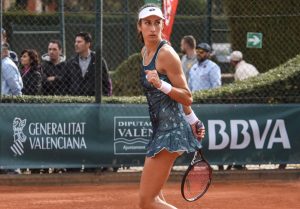
Spaniard Georgina Garcia Perez holds the record for the fastest recorded tennis serve by a woman.
Perez clocked a serve of 200kph (136.7 mph) during the Hungarian Ladies Open in 2018.
Georgina Garcia Perez holds the record for the fastest serve by a female.
Why is it nearly impossible to hit a 160 mph tennis serve?
A considered calculation of stature, technique, coaching, mechanics and good old practice is said to make the perfect concoction for a fast serve.
A direct correlation has been proven between the height of a player and power during a serve. Therefore, it is no coincidence that the top servers of the game are all giants by nature.
The trajectory of a serve remains ever important. Players who are 6ft 7 or above have the ability to hit the ball with a downward trajectory, whereas those who are under that height are unable to do so.
Modern technology has also greatly aided in the incremental increase of server power over time. The changeover from wooden rackets to today’s modern racket is a huge factor in determining serve power. Advancements in string technology and racket materials also play a huge part in determining a fast serve.
Other mitigating factors include court conditions. Faster serves are much more likely to happen on a hard court and during hotter temperatures, where there is less resistance to air density, translating to faster speeds.
When you compare the fastest tennis serve with other sports, you can see how fast it is.
Fastest Football shot – 114 mph by David Hirst in 1996 Fastest Baseball pitch – 105.1 mph by Aroldis Chapman in 2010 Fastest Cricket Bowling speed – 100.2 mph by Shoaib Akhtar in 2003
What is the average tennis serve speed?
The average tennis serve speed differs between both men and women, as well as between pros and amateurs. Data shows us that for professional male tennis players, the average tennis serve speed is approximately 114 mph (on their first serve) and 93 mph (on their second serve).
For women, the average tennis serve speed clocks in at 98 mph (on their first serve) and 82 mph (on their second serve).
This data was recorded between 2002-2013, so bear in mind the average speeds have likely increased by a few miles per hour in the modern era, as racquet technology and athletes continue to evolve and adapt within the sport.
Check out Wired’s video, which covers the topic more in-depth.
It’s the second edition of Blue Federal Credit Union‘s Fort Collins-area Athlete of the Week for the 2025-26 high school sports season.
And this week’s honor is hitting the local tennis courts with a top singles player.
Advertisement
Advertisement
Advertisement
Poudre boys tennis player Owen Addington took top honors in the Fort Collins area for the week of Aug. 25-30 after a couple of dominant sweeps.
Playing on the No. 1 singles line, the Impalas senior dropped just six games in four sets across two match wins over Windsor and Northglenn’s top players.
He beat Windsor’s Joseph Bisceglia (6-2, 6-3) and followed that up with a 6-0, 6-1 over Northglenn’s Emrah Mehidic.
Poudre’s Owen Addington bends down to hit a shot during a city rivalry boys tennis dual on Tuesday, Sept. 17, 2024 at Fort Collins High School in Fort Collins, Colo.
Addington, also a basketball player and tennis team captain, has helped Poudre get off to a 3-1 start this season that also included a team tournament title at the Thompson Valley Invitational.
Advertisement
Advertisement
Advertisement
The senior and third-year varsity player is the first tennis player to earn Blue FCU Athlete of the Week honors in the award’s third school year. He joins Rocky Mountain’s Bode Nesbitt as the first winners in the 2025-26 prep sports season.
Poudre fans pushed Addington atop the polls, giving him the victory with 51.5% of the fan vote.
That propelled him past these other four outstanding Athlete of the Week nominees:
Brooke Pravlik, PSD flag football (runner-up at 36.7%)
Taylor Morgan, Wellington softball
Judd Nikkel, Fossil Ridge boys golf
Nora Ebel, Rocky Mountain girls cross country
The Blue Federal Credit Union Athlete of the Week series features five nominees on Mondays, with voting at Coloradoan.com until 11:59 p.m. every Wednesday.
Fans can nominate their favorite athletes (deadline: 11:59 p.m. every Sunday), and the Coloradoan Sports staff will ultimately select the nominees each week.
Advertisement
Advertisement
Advertisement
If you have nominations for a future Athlete of the Week, please send them via email to ChrisAbshire@coloradoan.com for consideration.
View the full results:
Chris Abshire covers high school and community sports for the Coloradoan.
BB&N senior Sam Kelley (right) announced he will play football at Brown. Jonathan Wiggs/Globe Staff
With sincere apologies to all the games played Thursday, here at Globe Schools it feels a lot like Christmas Eve, with a full slate of high school football arriving under the tree Friday evening.
Over the last two weeks we talked to nearly 200 football coaches and wrote more than 30,000 words previewing every team in Eastern Mass. There’s still time for a cram session!
Team-by-team previews for every Eastern Mass. program
Trevor Hass wrote about Whittier football coach Kevin Bradley, who is continuing to coach the team while battling tongue cancer. Read coach Bradley’s inspirational story.
The first three football games of the season were played Thursday night, with Pentucket topping Northeast (26-22), Waltham holding off Belmont (24-12), and Brookline beating Lexington (27-10).
1. Milestones
▪ Two golf teams made history, as Canton set a new low home score at Blue Hill Country Club, scoring a 138 as a team to best Mansfield by 15 strokes thanks to 1-under-par 33s from senior Joey Ryan and freshman Chase Thomas.
▪ Rockport set a record for most points on its home course, Rockport Country Club, posting a 168-151 win over Hamilton-Wenham behind a 38-point showing from Sam Kesterson, who shot a 1-under-par 34 with three birdies.
▪ St. John Paul II field hockey coach Leah Pierce got her first win with the program, beating Bishop Stang, 3-0. Ariana Liakos got her first win helming the Pembroke girls’ volleyball, beating Falmouth, 3-1. And Acton-Boxborough girls’ soccer coach Manny Lopes notched his first victory, 4-0, over Algonquin.
▪ On the pitch, No. 18 Medfield boys’ soccer shocked No. 10 Oliver Ames, the defending Division 2 state champions, with a 2-0 win powered by goals from Max Tillmann and Sebastian Cole.
Keene State freshman Kayla DiPasquale, a Marshfield High graduate, was named Little East Conference women’s soccer Rookie of the Week after scoring her first two collegiate goals in a 4-2 win over Rivier.
4. Commitment central
BB&N senior captain Sam Kelley, a 6-foot-2-inch, 228-pound two-way athlete from Natick, announced he will play football at Brown.