Michael Annett, a longtime competitor in NASCAR’s national series has passed away, he was 39 years old.
Born in Des Moines, Iowa, Annett began his racing journey after a stint in hockey, transitioning to motorsports in his early 20s.
He first made headlines in the ARCA Menards Series, earning two victories at Talladega Superspeedway in 2007 and Daytona International Speedway in 2008. These wins paved the way for his move into NASCAR.
Annett competed across all three of NASCAR’s top divisions during his career. He made nine starts in the Craftsman Truck Series, highlighted by a second-place finish at Kentucky Speedway in 2008. His time in the NASCAR Cup Series spanned 106 races from 2014 to 2016, driving for teams including Germain Racing, Rusty Wallace Racing, Richard Petty, Tommy Baldwin Racing, HScott Motorsports and more throughout his career.
We are sad to have lost a family member. Michael Annett will always be in our hearts. Our thoughts are with the Annett family at this time.
The bulk of Annett’s success came in the NASCAR O’Reilly Auto Parts Series, where he raced in 321 events over 11 seasons. Driving primarily for JR Motorsports in the later stages of his career, Annett scored his lone Xfinity Series victory in the 2019 season opener at Daytona International Speedway.
He recorded 95 top-ten finishes and one pole position in the series.
After battling injuries during the 2021 season, Annett announced his retirement from full-time racing at the end of that year ending a 16 year career.
CHARLOTTE, N.C. (AP) — NASCAR teams went to the sanctioning body in early 2022 asking for an improved revenue model and argued the system at the time was unsustainable, the president of the series testified Thursday in the antitrust case lodged against the top motorsports series in the United States.
Steve O’Donnell, named president of NASCAR earlier this year, was at that March meeting when representatives of four teams asked that the negotiating window on a new charter agreement open early because they were fighting for their financial survival. The negotiating window was not supposed to open until July 2023.
O’Donnell testified that in that first meeting, four-time series champion Jeff Gordon, now vice chair of Hendrick Motorsports, asked specifically if the Florida-based France family was “open to a new model?”
Ben Kennedy, the great-grandson of NASCAR founder Bill France Sr., told Gordon yes.
But O’Donnell testified that NASCAR chairman Jim France was opposed to a new revenue model.
Thus began more than two years of bitter negotiations on a new charter agreement that was finalized in September 2024. The teams had asked in that first meeting for a deal to be reached by July 2022.
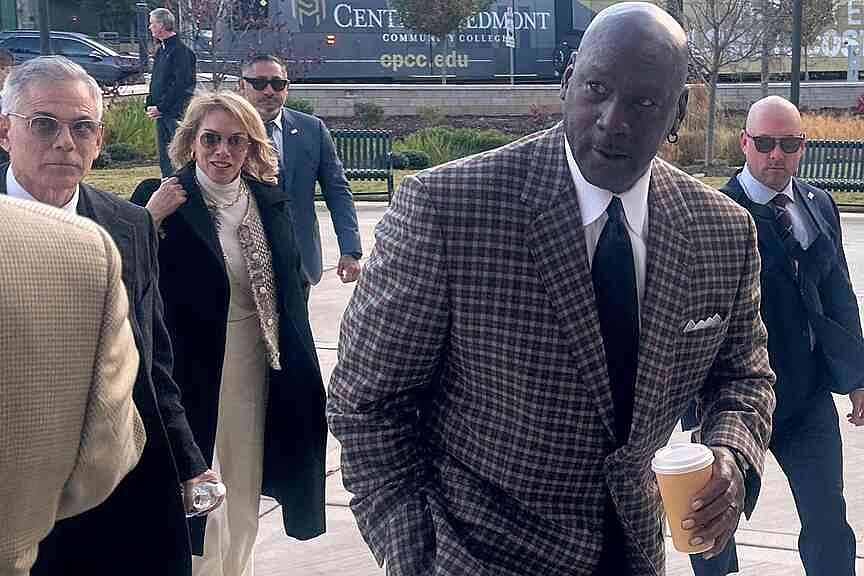
When the final deal was presented to the teams on the eve of the 2024 playoff opener, they were given a six-hour deadline to sign the charter agreements. All but two of 15 organizations signed; Front Row Motorsports and Michael Jordan-owned 23XI Racing refused to sign and instead sued, bringing the case to federal court for what is expected to be a two-week trial.
O’Donnell testified that the team representatives had very specific requests: maximized television revenue, the creation of a more competitive landscape, a new cost model and a potential cost cap.
NASCAR spent the next few months in internal discussions on how to approach the charter renewal process, said O’Donnell, who was called as an adverse witness for the plaintiffs. NASCAR acknowledged the teams were financially struggling, and worried they might create a breakaway series similar to the LIV golf league.
In a presentation made to the board, O’Donnell listed various options that both the teams and NASCAR could take. O’Donnell noted the teams could boycott races, build their cars internally, and race at non-NASCAR owned tracks, or potentially sell their charters to Liberty Media, the commercial rights holder for Formula 1.
“We knew the industry was challenged,” O’Donnell testified.
As far as NASCAR’s options, O’Donnell told the board it could lock down an exclusivity agreement with tracks not owned by NASCAR, dissolve the charter system, or partner directly with the drivers.
A charter is the equivalent of the franchise model used by other sports leagues, but in NASCAR it guarantees a team a spot in the field for all 38 races plus a designated percentage of revenue. The extensions that began this year upped the guaranteed money for every chartered car to $12.5 million in annual revenue, from $9 million.
Denny Hamlin, co-owner of 23XI, and Front Row owner Bob Jenkins have both testified it costs $20 million to bring a single car to the track for all 38 races. That figure does not include any overhead, operating costs or a driver’s salary.
Jenkins opened the fourth day of the trial with continued testimony. On Wednesday the fast-food franchiser said he was a passionate NASCAR fan who fulfilled a longtime dream when he was finally able to own a car in the top racing series in the United States.
But he said he has lost $100 million since becoming a team owner in the early 2000s — and that’s even with a 2021 victory in the Daytona 500. He said Thursday he “held his nose” when he signed the 2016 charter agreements because he didn’t think the deal was very good for the teams.
When the extensions came in 2024 the weekend the playoffs opened at Atlanta Motor Speedway, he said the 112-page document went “virtually backward in so many ways.” He refused to sign and joined 23XI in filing a lawsuit.
Jenkins said no owners he has spoken to are happy about the new charter agreement because it falls short of so many of their asks. He refused to sign because “I’d reached my tipping point.”
Jenkins said he was upset that Jim France refused a meeting the week before the final 2025 offers were presented with four owners who represented nine charters, only to learn France was talking to other team owners.
“Our voice was not being heard,” said Jenkins, who believes NASCAR rammed the 2025 agreement through. “They did put a gun to our head and got a domino effect — teams that said they’d never sign saw their neighbor sign.”
Jenkins also said teams are upset about the current Next Gen car, which was introduced in 2022 as a cost-saving measure. The car was supposed to cost $205,000 but parts must be purchased from specified NASCAR vendors and teams cannot make any repairs themselves so the actual cost is now closer to double the price.
“To add $150,000 to $200,000 to the cost of the car — I don’t think any of the teams anticipated that,” Jenkins testified. “What’s anti-competitive is I don’t own that car. I can’t use that car anywhere else.”
ABU DHABI — After 23 races, spanning nearly nine months and five continents, the 2025 Formula 1 World Championship is down to three drivers in the season finale.
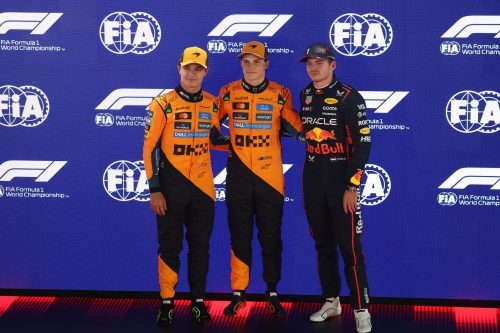
LUSAIL CITY, QATAR – NOVEMBER 29: Pole position qualifier Oscar Piastri of Australia and McLaren Second placed qualifier Lando Norris of Great Britain and McLaren and Third placed qualifier Max Verstappen of the Netherlands and Oracle Red Bull Racing during qualifying ahead of the F1 Grand Prix of Qatar at Lusail International Circuit on November 29, 2025 in Lusail City, Qatar. (Photo by Sam Bloxham/LAT Images) // Getty Images / Red Bull Content Pool // SI202511290450 // Usage for editorial use only //
McLaren’s Lando Norris leads the 2025 Formula 1 World Championship by 12 points over Red Bull’s Max Verstappen and 16 over teammate Oscar Piastri, coming into the Dec. 7 Abu Dhabi Grand Prix season finale race.
In just nine races, since the Dutch Grand Prix where Piastri and Verstappen finished 1-2 as Norris finished 18th, Verstappen gained 108 points on Piastri and 58 points on Norris — who gained 46 points on Piastri.
After his Dutch GP win, Piastri led the standings by 34 over Norris and 104 over Verstappen. Now, Piastri is behind both of them after this stretch:
Race
Lando Norris’s finish
Max Verstappen’s finish
Oscar Piastri’s finish
Italian GP
2nd
1st
3rd
Azerbaijan GP
7th
1st
20th (Crash)
Singapore GP
3rd
2nd
4th
US GP at COTA
2nd
1st
5th
Mexican GP
1st
3rd
5th
Brazilian GP
1st
3rd
5th
Las Vegas GP
19th (DQ)
1st
20th (DQ)
Qatar GP
4th
1st
2nd
Max Verstappen hasn’t finished off of the podium since August, making him the favorite for the title coming into the finale. However, practice showed Lando Norris is not going to go down without a fight.
Norris topped Verstappen in both practices but Verstappen closed the gap, lagging by 0.363-of-a-second in FP1 and then just 0.008 in FP2.
Meanwhile, Piastri clocked in 11th in FP1, almost seven tenths off of Norris, before having to hand the car to INDYCAR star Pato O’Ward in FP2.
McLaren stated they will use team orders if it becomes apparent one driver is going to win the title over another. Early on, that appears to be Norris.
Norris was going to be the favorite, no matter how practice went. He won last year’s race after leading every lap, one-upping Max Verstappen’s effort the year before where he won but spent six laps not out in front.
F1 World Championship Clinching Scenarios 2025
With a podium finish (third or better), Norris can win the championship no matter what Verstappen does.
Ex: If Norris finished fourth (13 points) and Verstappen won (25 points), Verstappen would win the title by a point
Meanwhile, Verstappen has to finish on the podium to keep his championship hopes alive:
If Verstappen finished third (15 points) and Norris finished 11th (no points), Verstappen would win by three points
If he finished fourth (12 points) and Norris finished 11th, Norris would win on a tiebreaker.
Here’s how the clinching scenarios break down for Norris based on Verstappen’s finishing position:
If Verstappen finishes second (18 points):
Norris can finish no worse than seventh (6 points)
Norris would win tiebreaker with equal wins (7) but more second-place finishes (8 vs. 6)
If Verstappen finishes third (15 points):
Norris can finish no worse than eighth (4 points)
However, Verstappen and Norris still have to watch out for Oscar Piastri. With a 16-point deficit to Norris, Piastri must finish better than second (18 points) to get the championship. Finishing third (15 points) won’t be enough:
If Piastri wins while Verstappen finishes second and Norris finishes sixth or worse, then Piastri would get the title.
If Piastri finished second while Verstappen finished fourth or worse and Norris finished 10th or worse, Piastri would get the title.
All three drivers each have seven wins this season.
F1 2025 World Championship Finale Weekend Schedule at Abu Dhabi
Jonathan Fjeld is the co-owner of the The Racing Experts, LLC. He has been with TRE since 2010.
A Twin Valley, MN, native, Fjeld became a motorsports fan at just three years old (first race was the 2002 Pennsylvania 500). He worked as a contributor and writer for TRE from 2010-18. Since then, he has stepped up and covered 24 NASCAR race weekends and taken on a larger role with TRE. He became the co-owner and managing editor in 2023 and has guided the site to massive growth in that time.
Fjeld has covered a wide array of stories and moments over the years, including Kevin Harvick’s final Cup Series season, the first NASCAR national series disqualification in over 50 years, Shane van Gisbergen’s stunning win in Chicago and the first Cup Series race at Road America in 66 years – as well as up-and-coming drivers’ stories and stories from inside the sport, like the tech it takes for Hendrick Motorsports to remain a top-tier team.
Currently, he resides in Albuquerque, N.M., where he works for KOB 4, an NBC station. He works as a digital producer and does on-air reports. He loves spending time with friends and family, playing and listening to music, exploring new places, being outdoors, reading books and writing among other activities. You can email him at fjeldjonathan@gmail.com
In late morning of the fourth day of the “23XI Racing and Front Row Motorsports v. NASCAR” antitrust trial, NASCAR president Steve O’Donnell took the stand as an adverse witness called by plaintiffs’ lead attorney Jeffrey Kessler.
What soon became abundantly clear on Thursday at the Western District of North Carolina courthouse were the points of emphasis Kessler would use to try to establish anti-competitive behavior on the part of NASCAR toward its chartered race teams.
Kessler asked O’Donnell repeatedly about the exclusivity provisions in NASCAR’s sanctioning agreements with race tracks, most prominently properties owned by Speedway Motorsports.
Other significant issues included the potential threat to NASCAR of competing racing series—notably SRX; the lack of permanence of the charters under the 2025 agreement; and governance of the sport, given the specific exclusion of the so-called “three strikes” provision in the current charter agreement.
To that last point, O’Donnell testified, NASCAR wanted to eliminate team owners’ veto power over cost increases in order to grow the sport.
With the three-strikes provision (owners with voting power) in place, O’Donnell said, “We would not have been in Mexico City (in 2025), and the TV partner (Amazon Prime Video) would not have paid the money they did.”
Similarly, three years of races on the Chicago Street Course—initially a hard sell to the NASCAR board headed by chairman and CEO Jim France—cost NASCAR an estimated $55 million, but the enterprise served a broader purpose.
“Amazon said there was no way they would have engaged with our sport without that,” O’Donnell told NASCAR outside counsel Chris Yates after Kessler finished his questioning. “It was a long shot, but we were able to pull it off, and it was a successful event.”
O’Donnell explained that the sanction agreements with Speedway Motorsports were expanded from a single year to five years in 2016 to coincide with the initial term of the charter agreements, which changed the economic paradigm of the sport.
The exclusivity provisions in the sanctions were expanded starting in 2016, as NASCAR strove to establish a predictable revenue model that would function under the charter agreements with the race teams.
In his initial questioning, Kessler asked O’Donnell about a litany of contingency plans NASCAR had considered, if race teams opted not to sign the 2025 charter agreement.
Kessler pointed to SRX as a potential competitor to NASCAR, and O’Donnell acknowledged the sanctioning body had become more concerned with the new series as it evolved in a direction more closely resembling a NASCAR product.
However, both NASCAR drivers and team owners (23XI principal Denny Hamlin, Brad Keselowski, Chase Elliott and Justin Marks) drove in SRX races, which took place exclusively on short tracks.
O’Donnell also pointed out that SRX was owned by Tony Stewart, who simultaneously held NASCAR Cup Series charters as co-owner of Stewart-Haas Racing.
O’Donnell’s testimony, which will conclude Friday, followed the completion of the cross-examination and redirect of Front Row Motorsports owner Bob Jenkins, one of the plaintiffs in the case.
Earlier in the morning, concluding his testimony, Front Row Motorsports (FRM) owner Bob Jenkins admitted he incorrectly stated Wednesday that it costs FRM $20 million per season to a run a single car in the NASCAR Cup Series. The Defense cited FRM’s own financial records, which showed that the most it has spent in a year on running two Cup Series car was around $28 million ($14 million per car).
At the close of the court session on Thursday, Judge Kenneth D. Bell expressed displeasure with the pace of the trial and urged attorneys from both sides to use discipline in the questioning of witnesses.
As a parting shot, Bell added that some of the questioning involved “beating the horses well beyond their deathbeds.”
The pace of the trial may affect the appearance of team owner Roger Penske as a witness for NASCAR. Yates said Penske’s only available day is Monday, and the plaintiffs have not agreed to let him testify before they have rested their case.
CHARLOTTE, N.C. (QUEEN CITY NEWS) — Tensions flared in a Charlotte courtroom Thursday as testimony continued in the antitrust trial between NASCAR and two racing teams, focusing on the sport’s controversial charter system.
The charter system, introduced in 2016, was designed to give teams guaranteed entry into races and provide financial stability. At the center of the lawsuit is whether NASCAR’s control over charters and exclusivity agreements violates antitrust laws.
Front Row Motorsports owner Bob Jenkins opened the day by describing text message exchanges with driver and 23XI Racing owner Denny Hamlin about selling a charter. Jenkins acknowledged he gave Hamlin a short deadline — similar to the one NASCAR imposed for its new 2025 charter agreement — but dismissed the comparison, arguing Hamlin had options while teams had none under NASCAR’s deal.
Jenkins testified that the deadline for signing the updated charter agreement was Sept. 6, 2024, later extended to Sept. 17 at his request. Even with the extension, Jenkins refused to sign, citing concerns over a side letter that kept changing. He said he didn’t want to agree to something without clarity on what he was signing and ultimately never signed the deal.
From NASCAR’s side, President Steve O’Donnell took the stand and read notes from a March 2022 meeting with team representatives. According to O’Donnell, teams warned that the business model under the 2016 charter agreement was broken and demanded immediate changes. Their top concerns included maximizing TV revenue, creating a more competitive landscape and implementing cost caps.
O’Donnell testified that he feared teams might break away from NASCAR, prompting the organization to explore its options. Plaintiffs pressed him on exclusivity agreements that prevent other racing series, such as SRX, from being other options for competing. O’Donnell defended the agreements, saying they were necessary to protect TV deals and relationships with media partners.
O’Donnell said he has been frustrated by the process because none of the sides could come to an agreement in 2.5 years. He said 13 of the teams did end up signing the updated charter agreement. The trial resumes Friday morning.
The 23XI Racing and Front Row Motorsports v NASCAR antitrust trial is raging on as the two sides do battle inside a North Carolina courtroom with the future of the sport likely to be reshaped by the outcome.
Here, you can find a recap of some of the most important and interesting moments from each day of the trial, with links back to more in-depth stories from our Senior NASCAR Editor Matt Weaver, who is inside the room as the trial unfolds.
Day 4 — NASCAR’s Steve O’Donnell and the ‘threat’ of SRX,
Read Also:
The now defunct Superstar Racing Experience Series was at the heart of Day 4’s courtroom battle. In previously unsealed messages, NASCAR leadership made it clear that they saw SRX as a threat and took issue with their drivers/team owners taking part in the weekly series run by NASCAR Hall of Famer Tony Stewart.
Team attorney Jeffrey Kessler tried to drive home the point that NASCAR reacted in a clear way to stifle SRX, which could be critical in how this case goes in the end. It could answer in part if NASCAR is using its position as a monopoly in the premier Stock Car racing space to harm competition or those operating in the space, like the teams.
NASCAR president Steve O’Donell was questioned by Kessler about the previously unsealed messages and NASCAR’s issue with SRX. While the Sanctioning Body was praised for returning beloved short tracks Bowman Gray and North Wilkesboro to the schedule, the trial has revealed that was at least partially motivated by the fact that SRX could beat them there. They also prevented Speedway Motorsports from hosting SRX events.
O’Donnell said NASCAR was in the middle negotiating a new broadcast rights agreement ‘and SRX started to look like NASCAR, so we said no.’ He added that ‘ NASCAR wanted to gain as much TV revenue for the teams and tracks as possible,” and that they were concerned SRX could hinder those efforts. They were frustrated that the drivers and teams didn’t appear to be ‘all in’ on NASCAR by their choice to compete in SRX.
O’Donnell was asked why he wanted NASCAR’s legal team to look at SRX, and he claimed it was simply IP infringement concerns. The existence of LIV Golf and how it challenged the hegemony of the PGA Tour, clearly rattled NASCAR leadership as they saw the possibility of something similar happening in stock car racing.
During one 2022 meeting, Jeff Gordon of Hendrick Motorsports asked Ben Kennedy, the great grandson of NASCAR founder Bill France and nephew to Jim, if “the family was open to a new financial model” to help the teams. Kennedy had told him ‘yes,’ but when Kessler asked O’Donnell if that was actually true, he said ‘no.
In February of 2023, O’Donnell said in an hand-written note: “I was hoping the future board would include the next generation and was hoping to see that change.” Jim France is 81, and O’Donnell believed the ‘legacy mindset’ in the NASCAR Board ‘inhibited growth.’
“Mr. France was the brick wall in the negotiations,” Kessler suggested to O’Donnell, when referring to those 2023 messages.
“Those are your words, not mine,” replied O’Donnell.
On Thursday, O’Donnell also revealed that NASCAR lost $55 million in running the Chicago Street Course for three years. However, NASCAR still says it was worth it, as “it was a strategic investment because if not for that, Amazon would not have become a broadcast partner.” NASCAR also said they lost $6 million by racing in Mexico City this year, but did so because it was important to Amazon, who kicked in an addition $1 million in race purse.
The day also included some more testimony from FRM team owner Bob Jenkins, who was cross-examined. Jenkins testified that it costs $20 million per car to race in the Cup Series, but NASCAR attorney Lawrence Buterman produced discovery documents that showed the most FRM ever spent on a Cup car was actually $14 million.
There was also some discussion about the proposed FRM/23XI merger from a few years back, with NASCAR attorneys trying to draw parallels between those failed negotiations and the ones between the teams and the Sanctioning Body over the 2025 Charter Agreement, where a deadline was imposed.
‘We can’t keep negotiating this forever,” Jenkins wrote in a text and that’s “…why we decided we had to have a deal by 5 p.m.” Jenkins pushed back against what NASCAR’s legal team was trying to do, saying “this is another one of your analogies that doesn’t work.”
There was also some concern at the end of the day that the trial wasn’t moving quick enough, with Judge Bell saying: “I get the impression that this is not moving along the way we all would like it to.” He encouraged both sides to speed it along, and said the jury is being subjected to redundancy ‘and they’re seeing a lot of trees and not a lot of forest.’ Both sides are cutting witnesses to speed it up, but Roger Penske is only available on Monday, and while that timeline is unlikely to work out, Judge Bell said Penske needs to be present whenever he’s needed.
Day 3 — Prime faces more questions, FRM owner Bob Jenkins takes the stand
Read Also:
NASCAR’s Executive Vice President and Chief Strategy Officer Scott Prime was being cross-examined for the second day in a row. The exchanges between prime and team attorney Jeffrey Kessler was sometimes contentious, with the attorney even apologizing to Prime and the court for raising his voice at one point.
Kessler locked in on the goodwill provision in the 2025 Charter Agreement, which is basically a clause that prevents team owners from competing in another series or owning one without NASCAR approval. Kessler called it ‘anti-competitive will,’ which drew an objection from the NASCAR side. He also focused on the Next Gen car, trying to paint its intellectual property restrictions (as the parts are supplied by a third party) as a tool utilized to restrain trade and prevent competition.
Reacting to an email from NASCAR commissioner Steve Phelps where he took a ‘take it or leave it’ attitude, Kessler said: “Only a monopolist has the power to say, ‘Take my offer and if you don’t take it, you will no longer be in this business, and someone else will take your place.’”
He was also questioned about NASCAR’s exclusivity agreement with tracks, but Prime tried to say that a rival series could race at other short tracks or street courses all around the country. Kessler did not accept that, and pushed back.
Kessler also took time to focus on the The Amanda (Oliver) Chart, which reflected a series of 22 asks made by the race teams and showed only a single ‘win’ for the teams as they negotiated with NASCAR. Prime had previously NASCAR’s September 6 a ‘gun to the head’ offer and Kessler seized on that moment in questioning him. One of the asks was for permanent charters, but NASCAR CEO Jim France was unwilling to go that route, despite Prime doing some work behind the scenes to make that happen.
After Prime’s lengthy testimony concluded, Bob Jenkins took the stand. He is the owner of Front Row Motorsports — the only team that stood with 23XI against NASCAR as the other 13 chartered organizations signed the eleventh hour agreement last September.
Jenkins noted that he loses $6.8 million per year and has never turned a profit under the race team banner. He doesn’t take a salary either. He went on to say that he spends $4.7 million per year on car components under the Next Gen model, and that the number was only $1.8 million under the previous generation of car.
When asked why do it then, Jenkins replied: “That sounds like something my wife would say. I just believe in it. It’s why I feel so strongly about changing this system. There are 150 employees at that race shop who believe in me to make this work.”
When asked about the September 6 deadline, Jenkins called it ‘insulting’ and ‘backwards’ as he recalled those critical hours. “There was a lot of passion, a lot of emotion, especially from Joe Gibbs, he felt like he had to sign it,” Jenkins said. “Joe Gibbs felt like he let me down by signing. Not a single owner said, ‘I was happy to sign it.’ Not a single one.”
Jenkins was asked how he could sue NASCAR for placing non-compete clauses in their schedule and charter contracts while placing non-compete clauses in his driver contracts. Hamlin faced the same question from NASCAR attorneys earlier in the trial, and the answer was similar, pointing out that drivers have options on who to sign with.
After court proceedings concluded for the day, Judge Bell took issue with NASCAR attorneys for violating his orders.
Day 2 — Hamlin faces tense cross-examination and NASCAR executive grilled
Read Also:
Hamlin was grilled by NASCAR attorneys in a somewhat contentious back-and-forth. “We’re not a monopoly like you are,” Hamlin said multiple times while on the stand. Hamlin gave insight into his personal frustrations with France, saying it dates back to the 2022 banquet. “He told me directly the problem in NASCAR is that teams spend too much money,” recalled Hamlin, who says he was very ‘discouraged’ by how differently they viewed the financial landscape of the sport.
“Cutting is not growth. I can’t cut my costs in half. It’s not realistic,” asserted Hamlin. He verbally sparred with Lawrence Buterman as the attorney tried to poke holes in the claim that the teams were strapped for cash and struggling to make a profit.
We also learned that Hamlin makes $14 million per year with his current contract as a driver for Joe Gibbs Racing. When asked why he makes more than most drivers, Hamlin simply replied: “I am at the top of my game.”
Scott Prime is not usually front and center, but he was on Tuesday, December 2nd, as NASCAR’s Executive Vice President and Chief Strategy Officer faced uncomfortable questions from Kessler, representing the teams. He was forced to try and explain the internal strife within NASCAR over the charter terms, and the fact that CEO Jim France seemed committed to imposing on teams after shutting down negotiations. There have been numerous unsealed communications that appear to show that France was the roadblock in granting team’s better terms.
Prime was also asked about a possible breakaway series and NASCAR’s efforts to block a potential CART/IRL split in the stock car racing world. He was also questioned about Project Gold Codes, which he described as a ‘contingency plan’ in case multiple charter holding teams boycotted races and/or didn’t sign the charter agreement in time for the 2025 Daytona 500.
Day 1 – Jury selection, opening statements and Hamlin testimony
Read Also:
After jury selection, the trial officially began. Denny Hamlin, the co-owner at 23XI Racing and one of NASCAR’s top drivers, was the first witness to take the stand. However, he was only on the stand for 40 minutes with cross-examination from NASCAR’s legal team yet to commence.
There appeared to be a clear strategy of bringing up the fact that teams frequently compete with NASCAR for sponsorships, as Motorsport.com Senior NASCAR Editor Matt Weaver noted that Hamlin brought it up three times under questioning from his own attorney.
“First, I have to fend off the series,” Hamlin said. “If a new sponsor want to come in, NASCAR will go after them. I have to fight them. I have to fight other teams for them. I have to fight them for employees.”
Both sides also laid out their arguments to the assembled jury and repeated many of the key points that have been repeated throughout the course of this lawsuit. NASCAR attorney John E. Stephenson framed 23XI/FRM as attacking the charter system and that they only brought up claims of antitrust violations after refusing to sign the new agreement.
Kessler, representing the teams, prepared the groundwork to prove that there was a clear anti-competitive strategy orchestrated by NASCAR CEO Jim France. He showed eyebrow-raising text messages from NASCAR leadership to support his claims.