MR: Yet, here you are. What do people say now that you’ve made it as an artist?
S: It’s about proving a point. At first it was, “Oh my God, you’re insane. You’re going to die.” But it worked out. I think if you have something to say, you’ve got to prove it. Obviously, it could have gone the other way; not everyone runs away from home and lands on their feet. But I stayed focused. I treated this like a job from day one. And now I’m making them proud—with art and design. That feels amazing.
MR: How does your African background shape you as an artist?
S: The name Soldier came from growing up in Nigeria, where there’s a lot of civil unrest— military coups, the army taking over. Civilians aren’t even allowed to wear camouflage. I remember having a pair of camo pants, and some soldiers stopped me like, “stop fucking around with that shit.” Then I came to England and realized you could walk into a store, buy camo, and wear it freely. I was young, and I took the name Soldier as a way to claim freedom, rebellion, all of that. It stuck. As for the work, I paint portraits and figurative pieces mostly of people from the Black community—people who look like me, where I’m from. I’ve painted my mum, my dad, my whole extended family. That part of me is always there. Nigeria is in all of it.
MR: What are the main visual elements and themes in your work?
S: I try to stay as honest as possible with myself and to keep learning, never limiting myself to one style or idea. As an artist, if you’ve got something to say, just do it. In the art world, you see a lot of people sticking to the same theme or style for years. But if you look at my work, I think you’ll see freedom of thought and experimentation. I’m always exploring new things, pushing boundaries, and going different places. I don’t want to repeat myself—that shit’s boring.
MR: Is there an expectation of how a Soldier work should look?
S: If there is, I don’t care. Let people think whatever they want. When I make work, I don’t focus on how it will be perceived. It’s about me first. People tell me, “That camera work was sick,” but that was years ago. I’m not doing that anymore. Maybe next I’ll be painting with sticks or something. I don’t worry about controlling how people feel about my work. Yeah, some things I do are recognizable, and sure, it might make good money, but I try not to stay in that lane for too long, so that I don’t get boxed in.
MR: Part of your practice is infused with a religious, quasi-sacred aesthetic, reminiscent of church icons. Why?
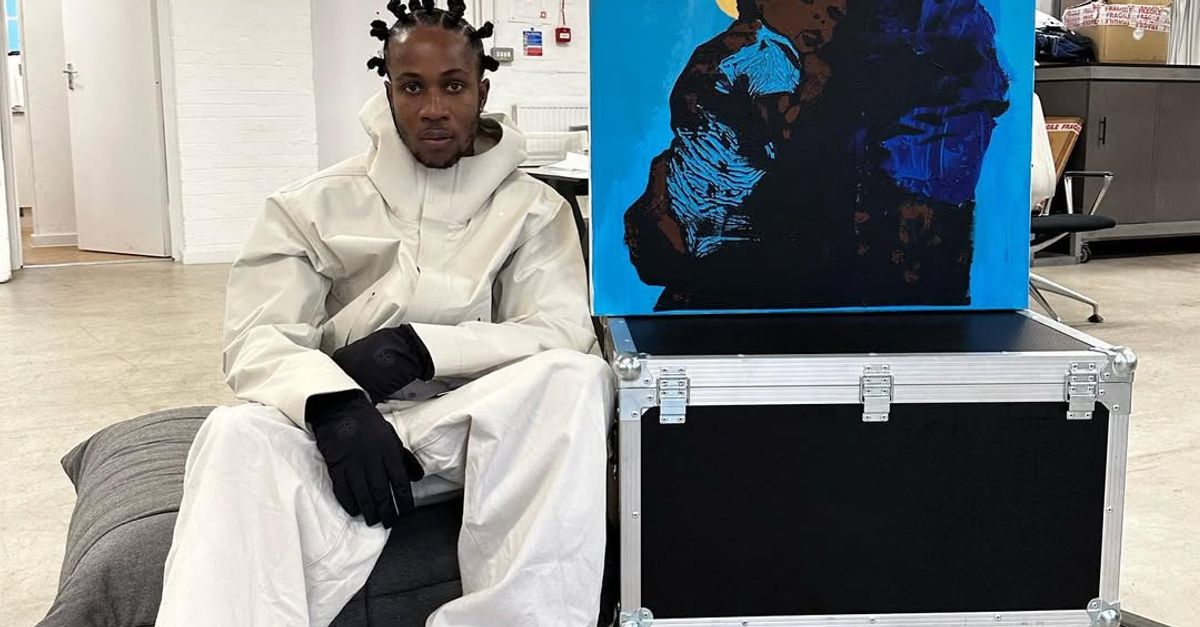
S: I grew up in the church, and a big part of my introduction to art were the illustrations and engravings you see in the Bible and religious literature. Even though I didn’t realize it at the time, I was inspired by it. I feel like whenever I paint people, I want to capture personal details but also give it an impersonal take that feels almost magical, like icons on the tinted glass in a Church.
In my last show, “When the Saints Go Marching,” I painted my mother, my dad, siblings, and even some actors I admired growing up. I want these people to live forever through my work. For me, painting is about making loved ones—and the things you love— immortal.
MR: Much of your work doubles as social critique, but can you separate art from politics?
S: You can, but then you’ll turn up with some shit like the Teletubbies. I feel like when you’re making work, you need to say something. The world we’re living in is too crazy to not address. I don’t consider myself overly political, but I can’t make art that doesn’t respond to something. I’m not out here scanning the newspapers every morning for inspiration—I don’t even want to go near that. What I do know is that whatever I absorb as a human being, I end up funneling into my work.
Also, I think the beautiful thing about art is that it lets people latch whatever they want onto it. If others want to inject their own meanings into it, I don’t mind. But you should have fun with it.
MR: Later, you started collaborating with brands like Louis Vuitton and MARNI. Is fashion and commercial work just a way to get your message out or are you exploring something else entirely?
S: I think both. When you make art, you do it in tiers. The highest tier, the painting, is more expensive and harder to get. But you also want regular people to experience your work, which is why I started painting on boards. When I work with fashion brands or create art for them, it’s about spreading the message, but also about giving people different avenues to experience what I do. If I could, I’d make music too. I want people from all walks of life to be able to grab a piece of me. For this exhibition I partnered with Salomon who came in and supported the show and so I feel there’s always an element of fashion influence, whether that be in what I wear or who’s involved, in a lot of what I do.
15