
Sports
Spartanburg's Fifth Third Park Demonstrates How PDL


Image credit:
Fifth Third Park in Spartanburg, S.C. (Photo by J.J. Cooper)
What is state of the art in baseball stadium construction is an ever-evolving concept.
A smart idea at one new stadium—see Camden Yards in the early 1990s and its nod to past parks—is quickly adopted elsewhere. Well-designed group/picnic areas, table tops and open concourses went from cutting edge to standard practice quite quickly.
This year, new minor league ballparks have opened in Spartanburg, S.C. and Knoxville, Tenn. A near complete rebuild of a park in Columbus, Ga. also opened. Next year will see another wave of new ballparks in Richmond, Va., Wilson, N.C., Chattanooga, Tenn., Ontario, Calif. and Hillsboro, Ore. All of these are the first of the Professional Development League (PDL) era, replacing stadiums that were deemed unsuitable for upgrading to meet significantly increased facility requirements. They are stadiums built from the start to meet the stricter requirements, and as such, we’re seeing how stadiums have continued to adapt and change.
MiLB ballparks have largely been divided into a small number of eras. Because of the steady decline of the minor leagues in the 1960s, 70s and early 80s, many minor league teams were still playing in Works Progress Administration (WPA)-built, depression-era ballparks until the 1990s. Ballparks built in the 60s and 70s were rarities, as most teams largely operated in old ballparks that had received little more than modest maintenance for years.
The 1990 Professional Baseball Agreement (PBA) changed expectations. Major League Baseball pushed through increased facility standards in its agreement with Minor League Baseball.
At the time, many MiLB owners thought the new requirements would be impossible to meet and that the PBA could kill the minors. Instead, numerous cities agreed to build new ballparks to meet the demands. Fans found new seats, improved bathrooms and concession areas much more inviting than ancient stadiums with sun-bleached bleachers and plenty of peeling paint.
The PBA era showed how far stadiums had come over the preceding few decades. The building boom led to an attendance boom. And that led to a second building boom, because even the WPA-era stadiums that had been upgraded to meet the PBA standards soon found themselves left behind. Before long, they were replaced by newer stadiums. By 2021, 80% of MiLB full-season teams were playing in ballparks built after the 1990 PBA was adopted.
We won’t see that kind of building boom in the 2020s, but we are seeing a new wave of construction. With that in mind, Baseball America recently traveled to Fifth Third Park in Spartanburg to see the Hub City Spartanburgers’ new home and provide a look at what’s new in ballparks in the PDL era.
New Parks Are Roomier Than Ever
In the 21st century, stadiums have largely adopted a more open concourse design that allows fans to continue to see the field/game while walking around the stadium. But the concourses themselves were asked to do a lot, as they were both the main traffic arteries, spaces for concessions and a standing room area for fans taking in different views of the park.
The idea remains an excellent one, but congestion often defeated some of the goals of these open concourse designs. The concourses were designed to encourage fans to check out the field from multiple angles and to wander around, but long lines and packed concourses discouraged getting up and exploring different areas of the park.
Much like the U.S. Interstate system, the answer has been to widen the traffic arteries. In Spartanburg’s Fifth Third Park (and other new designs), the concourses are extremely wide, allowing enough room for fans heading in either direction, plus room for small stand-up concession stands and their lines without halting traffic flow.

According to Hub City general manager Tyson Jeffers, feedback on the roomier layout has been positive.
“A comment that we’ve gotten a lot in these first two homestands of games is that, even with a full crowd, people still feel like they have space within the concourses to move about freely,” Jeffers said.
Concession Stands Are More Efficient & Fan-Friendly
In the WPA era, concession stands were afterthoughts. They were placed seemingly wherever there was space and plumbing. If stands caused traffic jams, so be it.
The second wave of PBA-era stadiums fixed many of those problems but did so by putting the concession stands largely against the back walls of the concourses. An unintended result was the creation of new pinch points for traffic jams. Long lines meant fans were blocking other fans from crossing through the concourse. They also discouraged fans from making repeat trips to the concession stands.
Jeffers said the team was “really conscious” of potential foot traffic headaches in constructing the park.
“(With the concourse concessions) you might be making that person’s buying experience a little bit better while they’re waiting, but then you’re ruining someone else’s while they’re trying to get wherever they need to go,” Jeffers said, adding that the stadium’s property footprint helped make addressing traffic flow problems easier.
“It gave us the real estate to be able to do this. To be able to tuck (concessions) back beyond the concourse a little bit, create them in a marketplace style so that they flow a lot easier.”
Fifth Third Park puts the main concession stands into cutouts that extend off the back side of the concourse. Doing so ensures any lines are contained within the concession area without causing backups on the concourses. In the 1990s and 2000s, such construction would have meant fans couldn’t see the game. Today, television monitors line the area so fans can watch the broadcast if they don’t have a direct sightline to the field.

The concession stands themselves have also been updated. Traditional ballpark items such as popcorn, hamburgers and chicken sandwiches are self-serve fare.
“Each of those marketplaces have their own kitchen,” Jeffers said. “So they’re cooking hot food and just sliding it out. You’re grabbing it, you’re going. There’s always a little bit of fear about what happens when it sits there, but our food and beverage department has done an amazing job to make sure that they’re pushing it out when people need it. And those people can grab it and keep going.”
The grab-and-go setup reduces lines by allowing fans to quickly get their food, scan and pay at a self-checkout touch-screen display and then quickly return to their seats. The end effect, Jeffers said, is fans feel more comfortable in their decision to get up from game action to buy food.
“If you know you’re going to have to stand in line, you’re making a conscious decision of ‘Do I need that extra hot dog?’ You might say it’s not worth the minutes that I’m going to miss some of the game.”

For MiLB teams, in addition to increased concession stand sales, the marketplace layout may also reduce employee head count. Not dramatically, as the self-service food areas need continual restocking, and the self-pay kiosk area needs multiple employees supervising and helping any customers who have issues, but it’s a change from traditionally-staffed concession counters.
Parks Are Year-Round Facilities
It’s hard to imagine any team building a new park in the 2020s without a multi-purpose club-level area. Such a space can serve as an upscale restaurant/bar during games, but just as importantly, it provides an all-weather area for non-game day activities.
Spartanburg features a large club area on the second level that serves as a restaurant/bar/gathering place during games. It can also be used for conferences, wedding receptions, proms and most any other event a group could conceive. It has a full-service kitchen/bar as well as an outdoor patio area for events that want inside-outside versatility. In an era when teams are looking to increase the number of calendar dates the stadium is used, these types of multi-purpose areas are becoming must-haves in both new and retro-fitted ballparks.

“We’re providing an unbelievable experience and a top-tier experience for our fans at baseball games,” Jeffers said. “But then we have an amazing space that we can utilize on non-game days. And so we’re talking about our facility operating 365 days out of the year or as close to that as possible.
“Conferences coming in, chamber events, wedding receptions—all of those things. And it’s built in a way that one gives it the square footage and the layout to be able to accommodate those. But then it also has the technologies to be able to execute every type of event that you can think of.”
Seating Areas Are More Intimate
Under the old PBA rules, different MiLB levels had different seating requirements. A Triple-A stadium had to have 10,000 seats, a Double-A stadium required 6,000 and a Class A stadium needed 4,000. Those rules do not exist in the current PDL era, so individual teams can decide how big to build their stadium bowls.
Fifth Third Park’s seating bowl reflects this. The stadium has roughly 3,500 fixed seats, although group areas and berms mean up to 5,000 can get into the park.
“All of that was built intentionally to make sure that it always felt like that place is rocking and rolling every single night,” Jeffers said. “There was a stretch there in the 90s where people overbuilt. On July 4th, it’s great, but it makes your normal night crowd feel like it kind of loses something in exchange. To build for those anomaly games—opening night, the Fourth of July—you’re building for two days out of your year. We built for every day.”

There’s A Lot Fans Never See
Modern PDL requirements were focused on items for MiLB players, staff and player development. For example, the required size of visitor clubhouses was increased significantly. There must now be dining areas for the players. There must be bathrooms that are easily accessible from the dugouts.
Stadiums are required to have air-conditioned batting cages/pitching tunnels and enlarged weight rooms and storage space, as well as locker rooms for female staff and umpires.
Ballpark lighting and field requirements have also been increased.
These are non-negotiable requirements for both upgraded existing stadiums and new construction, so much of what’s been done in the bowels of a stadium will be similar to what’s been upgraded elsewhere. But with a new build, it’s possible to leave room for further expansion, new loading docks and other touches that may be tougher to add to an existing facility.

Sports
Cougars come back to win Pop-Tarts Bowl 25-21 over Georgia Tech – BYU Athletics – Official Athletics Website
Fourth Quarter
On second-and-nine, Bachmeier found Roberts in a tight window for a gain of 18. Damuni added four yards, and on third down, Roberts caught a 7-yard pass to move the chains. Bachmeier and Ryan connected for the seventh time, this time for 13 yards to pin BYU at the Yellow Jacket six-yard line. After Kingston recorded a four-yard carry, Nawahine took the direct snap and plowed into the end zone. Keeping the offense on the field to go for two, Bachmier rushed it into the end zone to cut the deficit to three.
BYU forced the game’s first three-and-out. Kingston returned the punt 34 yards to set BYU up at its 45.
Bachmeier pitched to Damuni for a gain of five on first down. The freshman running back gained one yard on the next play, but the Cougars were unable to convert on third-and-four, and Vander Haar and the punting unit returned to the field, resulting in the second three-and-out of the game.
An illegal snap penalty pushed Georgia Tech back to its four-yard line. On second-and-14, King hit Rutherford for a gain of 12, and then another illegal snap penalty was enforced on the Yellow Jackets to set up third-and-seven. Haynes got just short of the line of gain before Glasker and Tanner Wall tackled him to force a punt. Kingston returned the punt four yards and set BYU up at its own 30 with 5:44 on the clock.
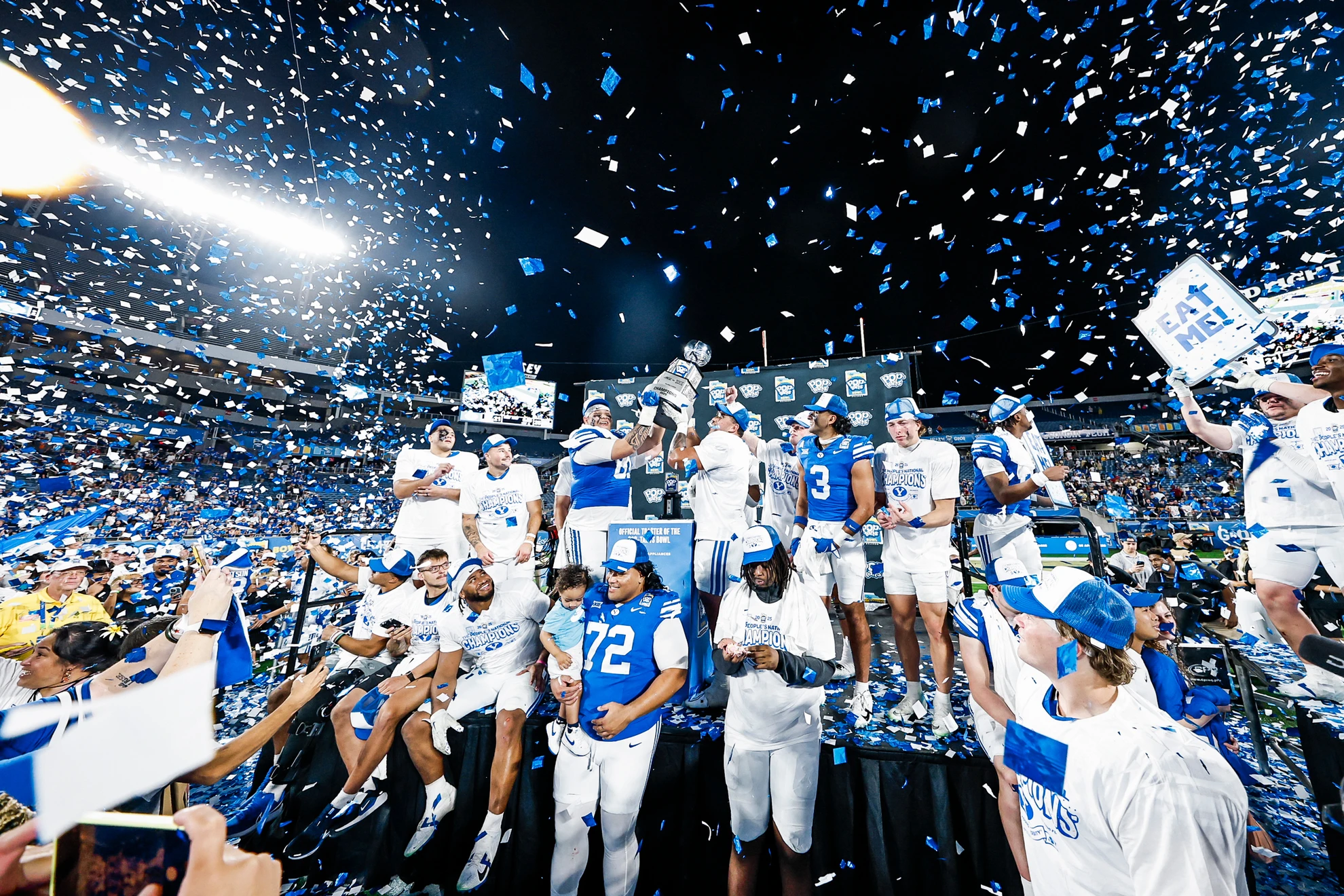
Following two incomplete passes, Bachmeier found Kingston at the BYU 34, and he advanced to the 43-yard line to grab the first down. Phillips secured a 14-yard pass from Bachmeier, and then Kingston caught a 15-yard pass to cap three consecutive first downs. After an eight-yard pass to Ryan to the Georgia Tech 20, the running back room led the way, kick-started by Nawahine picking up nine yards with a hurdle over a defender. Bachmeier passed to Damuni for a gain of seven, and then the Providence, Utah product powered into the end zone for his first career touchdown. Alongside Ferrin’s extra point, the Cougars took the lead, 25-21 with two minutes left.
Ferrin’s kickoff was returned 13 yards to pin Georgia Tech at its 21. Nusi Taumoepeau and Lutui hurried King and his pass fell incomplete on first down. On the next play, King lost the ball on a low snap but recovered his fumble for a loss of five yards. On third-and-15, another pass fell incomplete, forcing fourth-and-15. On the play, King went deep to Rivers for a gain of 66 at the BYU 18 with 52 seconds on the clock. The defense held the Yellow Jackets to three-straight incomplete passes, setting up fourth down with 14 seconds remaining. King attempted to hit Haynes in the end zone but his pass was intercepted by Johnson to seal the Pop Tarts Bowl victory 25-21.

The Bearkats (8-4) controlled the temp on both ends of the court, shooting close to 60 percent while limiting the Ambassadors to 31 percent. Sam Houston used its height advantage to dominate the paint, outscoring Biblical Studies 62-12 and outrebounding the Houston area team 66-29.
Isaiah Manning led the Kats with a career-high 27 points to go along with 10 rebounds for his first career double-double. Freshman Jacob Walker also scored a new career high with 24 points, Veljko Illic added 16 points and nine boards, freshman Matt Dann chipped in a career-high 12 points, freshman Jacoby Coleman finished with 11 and Damon Nicholas Jr. had 10.
Sam Houston built a huge first-half lead and never looked back.
The Kats went on a 10-0 run thanks to back-to-back 3s by Walker and Manning, who added a pair of layups to grab a 23-10 advantage. Dann punched in consecutive dunks after a free throw and a two more layups by Nicholas to cap the run at 19-0 to put the game away early as the Ambassadors went more than seven minutes without scoring.
Sam Houston shot a blistering 66 percent from the field in the first half, making 25 of 40 shot attempts. The Bearkats also held Biblical Studies to just 23 percent shooting to build a commanding 59-21 lead at the break.
Conference USA action resumes Jan. 2 when Sam Houston heads to Bowling Green, Kentucky to face WKU at 4 p.m. on ESPN+.

Dec. 28, 2025, 12:20 p.m. CT
At the end of the season, after some of the adrenaline from the Texas A&M championship run had subsided, head coach Jamie Morrison revealed that a few players on his roster would have the opportunity to compete at the next level. While he didn’t name names, we had a pretty strong idea of which standout athletes he was referring to.
On Sunday morning, it was officially announced that senior middle blocker and 2025 NCAAVB Champion Ifenna Cos-Okpalla signed a professional contract to play with League One Volleyball (LOVB) Salt Lake. She joins senior opposite Logan Lednicky in the league, who recently signed with LOVB Houston. Cos-Okpalla was also drafted by MLV but ultimately chose to pursue her career with LOVB. We knew a move was coming soon after the news broke that she had signed with Valor Sports Agency just days before this announcement.
Cos-Okpalla is one of the foundational members of this Aggie championship team, having been part of the program for all four years and choosing to stay committed when Coach Morrison arrived to take over. She elevated her game each season under his leadership, helping her reach new heights and shatter multiple program records. She will leave Texas A&M as the all-time leader in total blocks (566), the single-season block leader (199), and the program’s hitting percentage leader (.422).
It’s fair to say she will be remembered as an Aggie legend, and she now turns her focus toward new goals with a promising professional volleyball career on the horizon.
Ifenna Cos-Okpalla Career stats:
Kills: 637 / 1.70 per set
Hitting %: .372
Blocks: 565 / 1.6 per set
Aces: 41 / .12 per set
Ifenna Cos-Okpalla Career Accolades:
- 2X All-SEC Team
- 4X SEC Player of the Week
- 10X SEC Defensive Player of the Week
- AVCA All-America First Team
- 2X AVCA All-Southwest Region Team
- NCAA Championship All-Tournament Team
- NCAA Champion
Contact/Follow us @AggiesWire on X and like our page on Facebook to follow ongoing coverage of Texas A&M news, notes, and opinions. Follow Jarrett Johnson on X: @whosnextsports1.

Sherry Bryant was born deaf, but that hasn’t stopped her from becoming a wife, mother and volleyball coach for Copper Sky Multigenerational Center’s youth volleyball league.
Bryant can’t hear and she doesn’t speak, but she uses hand gestures and written notes to communicate with players. During practice, she is often in the action pointing players to proper positions and cheering on successful plays.
Her desire to coach stems from more than her love of the game. She is able to spend time with her daughter on the court and show that deaf people are not limited.
“My daughter plays, and I feel it benefits her and the girls,” Bryant said. “If there are no volunteers, there might be no one to coach. Another reason is to show deaf people can do it.”
From time to time, Bryant’s players are unable to understand their coach’s instructions.
“This is my first (coaching) experience,” Bryant said. “My assistant coach (Nikki Lucchesi) helps me a lot. She speaks to the players.”
For Copper Sky Sports Coordinator David Aviles, picking Bryant to coach was simple.
“When you run a sports program there are times you run low on coaches,” Aviles said. “I reached out to the parents for the girls, and [Bryant] volunteered. She’s done a great job and really enjoys it.”
Bryant’s team won its first game. The players were attentive to her instructions.
“It’s inspirational for the kids to see that she’s out there coaching,” Aviles said. “She takes a hands-on approach and plays with them. It seems to be working well.”
This story appeared in the February issue of InMaricopa News.
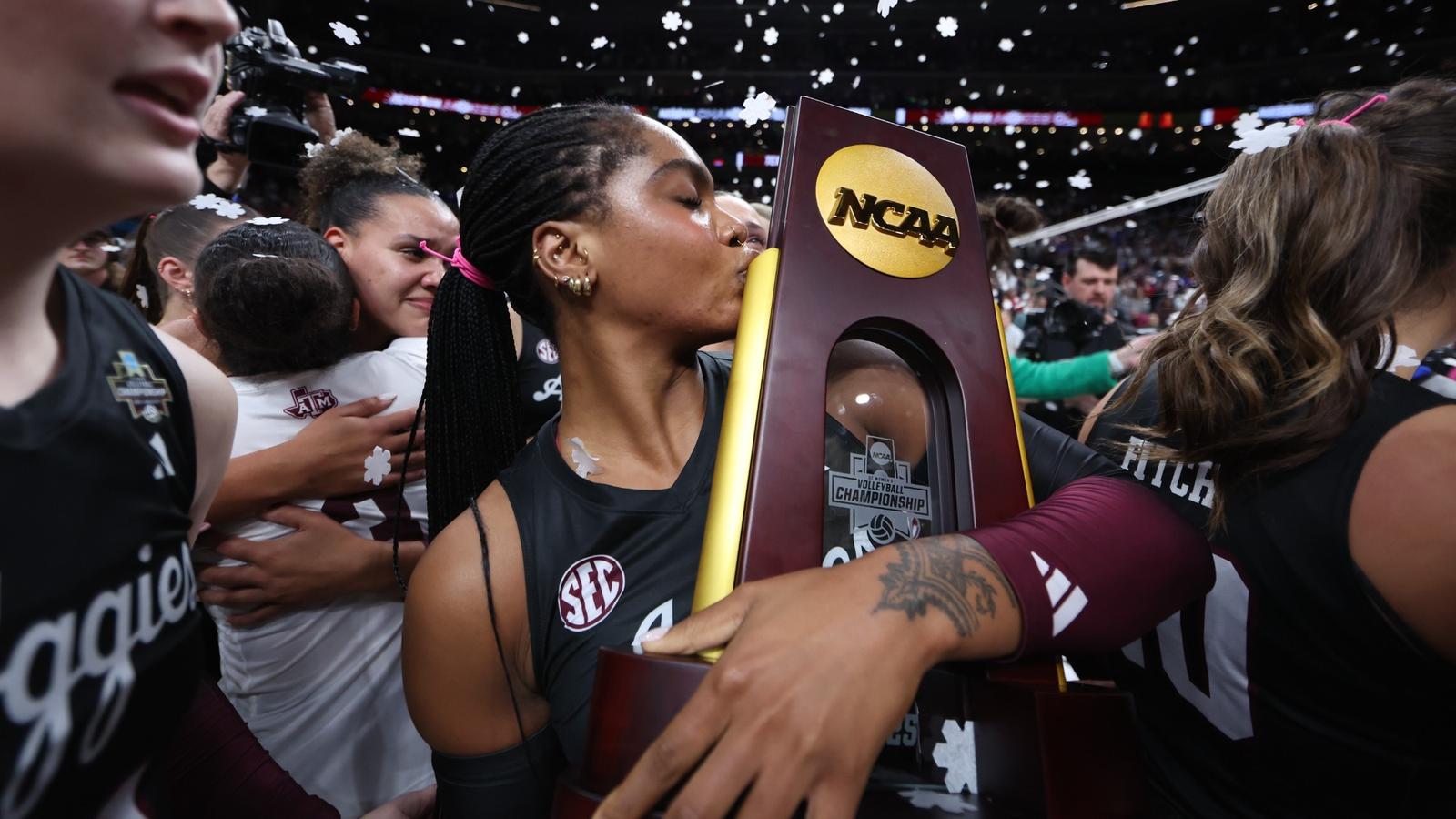
Fresh off leading the Aggies to their first NCAA title, Cos-Okpalla was announced as one of seven collegiate athletes selected for LOVB and will take her talents to Utah. The middle blocker was highly sought after following her senior season, as she garnered First Team All-America honors and led the country in blocks with 199 on the year.
“I couldn’t be happier for Ifenna [Cos-Okpalla] as she starts her pro career,” head coach Jamie Morrison said. “When I took this job one of my goals for the program was to become the best place to develop our athletes into professional and international players. We want to build a clear pathway from college to the professional game, and I know Ifenna is going to thrive at the next level.”
The Flower Mound, Texas, native made history in the final match of her career, setting the program record for career blocks. She entered the contest with 561, one shy of the Jazzmin Babers former record (562), and with her second of the match passed the milestone and added two more to finish her career with 565. Her senior season on its own also made history, as she tallied 199 stuffs which was a single-season record.
Cos-Okpalla’s versatility is what made her stand out, as offensively she recorded 629 kills over her four years while recording back-to-back years with over 200 in 2024 (228) and 2025 (236). Not only did her production rise every year, so did her efficiency which culminated in the program record for hitting percentage in a season this year at .422 percent.
The All-American separates herself from other middle blockers nationwide from the service line, racking up a team-high 42 aces this season which is the most by an Aggie since 2019. Her variety of scoring helped her accumulate 396.5 points on the year.
Leaving a legacy, Cos-Okpalla departs Aggieland a two-time All-American, two-time All-SEC First Team honoree, three-time All-Region selection, an NCAA and SEC All-Tournament Team member and a program record 14-time SEC weekly award winner.
FOLLOW THE AGGIES
Visit 12thMan.com for more information on Texas A&M volleyball. Fans can keep up to date with the A&M volleyball team on Facebook, Instagram and on Twitter/X by following @AggieVolleyball.
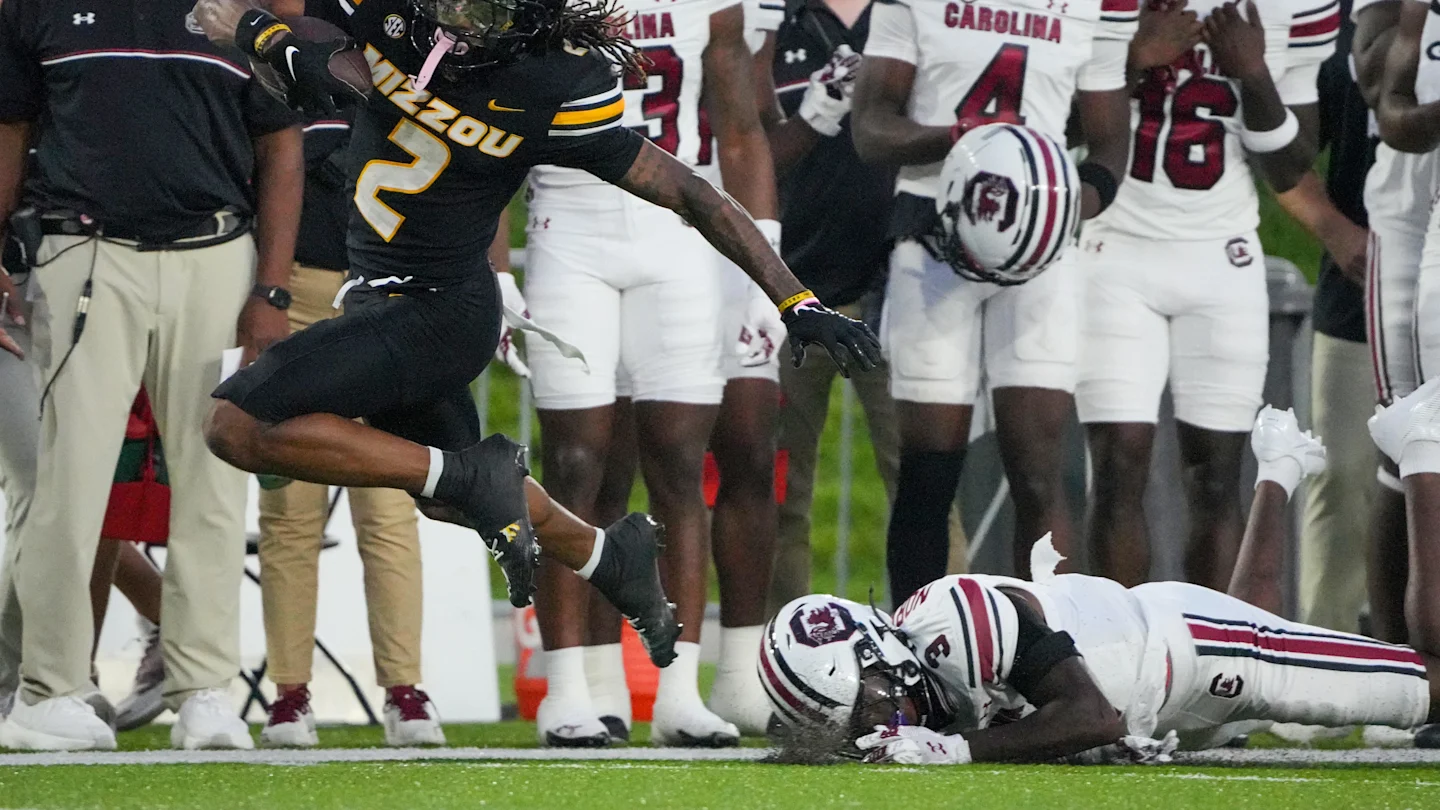
After transferring to South Carolina prior to the 2025 season, defensive back Myles Norwood will enter the transfer portal in hopes of finishing his last year of eligibility elsewhere next fall. Norwood began his career at Iowa State, transferred to Ball State, and then to South Carolina. He will be looking for his fourth home this offseason.
Norwood was a collegiate track star turned defensive back in his college career. His journey began at Iowa Western Community College where he was a track and field participant for the Reivers. Following his freshman year in track he moved on to Iowa State to play for then head coach Matt Campbell (now Penn State). He spent two seasons with the cyclones appearing in just one game against West Virginia in 2022. In 2024, he transferred to New Mexico State in February, but never played for the Aggies before transferring to Ball State just three months later.
At Ball State, Norwood appeared in all 12 games for the Cardinals making seven starts. He was credited with with 38 tackles including 2.0 tackles for loss, one fumble recovery and a team-leading 10 pass breakups. After his breakout season with the Cardinals, Norwood commited to the Gamecocks for the 2025 season. He appeared in 10 games, with two starts, in his time in Columbia as he racked up 19 total tackles this past season.
Updated Transfer Portal Tracker

In addition to Norwood, 11 other Gamecocks have entered the portal so far with the offensive line room taking the biggest hit. That list includes OL Tree Babalade, OL Cason Henry, WR Brian Rowe Jr., QB Air Noland, OL Mac Walters, OL Nick Sharpe, OL Trovon Baugh, DL Zavian Hardy, LB Jaron Willis, LB Taeshawn Alston, and K Peyton Argent.
A few others have already declared their move to the 2026 NFL Draft. Wide receiver Jared Brown was the latest to make his intentions known. He joins defensive tackle Monkell Goodwine, defensive tackle Nick Barrett, and defensive end Bryan Thomas Jr. as those entering their names in the 2026 NFL Draft, with tight end Jordan Dingle expected to be the next name as his eligibility is out.
Join the community:
- Follow Alex Joyce on Twitter: @AlexJoyceSI
- Follow Joey Walraven on Twitter: @thejoeywalraven
You can follow us for future coverage by clicking “Follow” on the top right-hand corner of the page. Also, be sure to follow us on X at @GamecocksDigest and on Facebook!
You Might Also Like:

Germie Bernard responds to Alabama being cheered against in College Football Playoff: ‘Nobody wants to see Bama win’

Wink Martindale discusses Michigan vs Texas, state of college football in Citrus Bowl press conference

NIL Agents Laid Out In No Uncertain Terms The Handcuffs Shackling Petrino from UA to UNC

Texarkana’s Wacha family builds something bigger than a camp

Petaluma Police Arrest Suspect For Hate Crime Targeting Former Globetrotter and Youth Coach

Eckols Funeral Home » Jewel Annette Devall RodgersEckols Funeral Home

Parks and Rec to offer youth swim lessons at Bemidji State

Inconsistency costs Tesoro in loss to St. Anthony at Ringo Bossenmeyer Holiday Classic –

$2.6 million QB ranked as No. 1 transfer in college football

Bill introduced to protect youth sports participants in Washington state | News

Cougars come back to win Pop-Tarts Bowl 25-21 over Georgia Tech – BYU Athletics – Official Athletics Website

Kats take care of Biblical Studies 117-57

Brad Keselowski’s first racing job involved ‘mowing grass’ – Motorsport – Sports

Tom Izzo on Pro Players Getting College Eligibility: ‘Shame’ on NCAA, Coaches

Michigan NIL collective Champions Circle hits ground running after Kyle Whittingham hire

SoundGear Named Entitlement Sponsor of Spears CARS Tour Southwest Opener

Donny Schatz finds new home for 2026, inks full-time deal with CJB Motorsports – InForum

Black Bear Revises Recording Policies After Rulebook Language Surfaces via Lever

Jo Shimoda Undergoes Back Surgery

Bowl Projections: ESPN predicts 12-team College Football Playoff bracket, full bowl slate after Week 14

Robert “Bobby” Lewis Hardin, 56

Men’s and Women’s Track and Field Release 2026 Indoor Schedule with Opener Slated for December 6 at Home

David Blitzer, Harris Blitzer Sports & Entertainment

How Donald Trump became FIFA’s ‘soccer president’ long before World Cup draw
Wisconsin volleyball sweeps Minnesota with ease in ranked rivalry win

Michael Jordan’s fight against NASCAR heads to court, could shake up motorsports

JR Motorsports Confirms Death Of NASCAR Veteran Michael Annett At Age 39

Rick Ware Racing switching to Chevrolet for 2026

Increased Purses, 19 Different Tracks Highlight 2026 Great Lakes Super Sprints Schedule – Speedway Digest
Elliot and Thuotte Highlight Men’s Indoor Track and Field Season Opener





-
 Motorsports3 weeks ago
SoundGear Named Entitlement Sponsor of Spears CARS Tour Southwest Opener
-

 NIL3 weeks ago
DeSantis Talks College Football, Calls for Reforms to NIL and Transfer Portal · The Floridian
-
 Sports2 weeks ago
#11 Volleyball Practices, Then Meets Media Prior to #2 Kentucky Match
-
 Motorsports2 weeks ago
Sunoco to sponsor No. 8 Ganassi Honda IndyCar in multi-year deal
-
 Motorsports3 weeks ago
NASCAR owes $364.7M to teams in antitrust case
-
 Motorsports2 weeks ago
Nascar legal saga ends as 23XI, Front Row secure settlement
-

 Motorsports3 weeks ago
Accelerating Inclusion: Breaking Barriers in Motorsport
-
 Rec Sports2 weeks ago
WNBA’s Caitlin Clark, Angel Reese and Paige Bueckers in NC, making debut for national team at USA camp at Duke
-
 Sports2 weeks ago
Maine wraps up Fall Semester with a win in Black Bear Invitational
-

 Motorsports3 weeks ago
North Florida Motorsports Park led by Indy 500 Champion and motorsports legend Bobby Rahal Nassau County, FL