The Sports Analytics Market is witnessing strong growth fueled by rising adoption of AI-powered analytics, increased demand for real-time performance tracking, and the need for strategic player and team management. However, high implementation costs and data integration challenges may hinder adoption, especially in emerging markets.
LEWES, Del., Aug. 11, 2025 /PRNewswire/ — The Global Sports Analytics Market Size is projected to grow at a CAGR of 30.70% from 2024 to 2031, according to a new report published by Verified Market Research®. The report reveals that the market was valued at USD 1.15 Billion in 2024 and is expected to reach USD 8.23 Billion by the end of the forecast period.
VMR_Logo
The Sports Analytics Market leverages big data, AI, and IoT to enhance player performance, fan engagement, and operational efficiency. Increasing investment from leagues and sports organizations is boosting adoption, making analytics a crucial tool in competitive sports strategies worldwide.
Key Highlights of the Report:
Market Size & Forecast: In-depth analysis of current value and future projections
Segment Analysis: Breaks down the market by Deployment, Type, Solution, Technology, and End-User for focused strategy development.
Regional Insights: Comprehensive coverage of North America, Europe, Asia-Pacific, and more
Competitive Landscape: Profiles key players, their strategic initiatives, and innovation-driven growth approaches.
Growth Drivers & Challenges: Analyzes the forces accelerating growth and the restraints hindering large-scale adoption.
Challenges and Risk Assessment: Evaluates ethical debates, off-target effects, and regulatory complexities.
For more information or to purchase the report, please contact us at: https://www.verifiedmarketresearch.com/download-sample/?rid=1887
Browse in-depth TOC on “Global Sports Analytics Market Size”
202 – Pages 126 – Tables 37 – Figures
Global Sports Analytics Market Overview
Market Driver
1. Rising Adoption of Data-Driven Decision-Making in Sports The sports analytics market is expanding rapidly as teams, leagues, and sports organizations increasingly rely on advanced data insights to guide strategies.
Sports analytics tools are being used to monitor player performance, track fatigue levels, and prevent injuries.
AI, machine learning, and predictive modeling are helping coaches and analysts identify strengths and weaknesses in real time.
Wearable technology and IoT sensors are enabling constant data collection during training and matches.
Insights from analytics are being applied across football, basketball, cricket, tennis, and even esports to enhance competitiveness.
This data-centric approach allows organizations to make more informed decisions, leading to better team performance and higher returns on player investments.
2. Growing Demand for Enhanced Fan Engagement and Monetization Fan engagement is becoming a major revenue driver in the sports ecosystem, and analytics plays a critical role in delivering personalized, immersive experiences.
Real-time match statistics, heat maps, and player insights are being shared with fans to increase interactivity.
Sports organizations are using analytics to tailor marketing campaigns and ticket promotions to specific audience segments.
Data from social media platforms is being analyzed to understand fan sentiment and predict engagement trends.
OTT streaming platforms and digital fan portals are integrating analytics to deliver customized viewing experiences.
The result is increased ticket sales, merchandise purchases, broadcast subscriptions, and higher sponsorship value.
3. Expanding Application of Predictive Analytics in Betting and Sponsorship The rise of predictive analytics is creating new commercial opportunities in sports betting, sponsorship evaluation, and marketing ROI tracking.
Sports betting operators are using analytics to refine odds, manage risks, and improve customer retention.
Historical and live data are being combined to forecast match outcomes with greater accuracy.
Sponsors are leveraging performance analytics to assess brand exposure and engagement during events.
AI-powered simulations are helping brands decide on the most profitable sponsorship deals.
This use of predictive insights is enabling all stakeholders to maximize profitability while reducing business risks.
To Purchase a Comprehensive Report Analysis: https://www.verifiedmarketresearch.com/select-licence/?rid=1887
Market Restraint
1. High Implementation and Integration Costs The adoption of sports analytics can be challenging due to significant upfront and maintenance expenses.
Advanced analytics platforms often require heavy investment in hardware, software, and cloud infrastructure.
IoT sensors, wearable devices, and tracking systems add to operational costs.
Smaller sports clubs and emerging leagues may find it difficult to justify these expenditures.
Integration of multiple data sources requires skilled IT teams and time-consuming system upgrades.
These high costs slow market penetration, particularly in regions with limited sports funding.
2. Data Privacy, Security, and Ethical Concerns Managing and protecting sensitive sports data is a growing concern for organizations.
Athlete health metrics, performance statistics, and biometric data require strict security measures.
Breaches or misuse of sensitive information can harm brand reputation and result in legal consequences.
Compliance with global data protection regulations such as GDPR adds complexity to analytics operations.
Ethical questions arise over how much player data should be shared with the public or betting agencies.
These concerns make some stakeholders hesitant to fully adopt advanced analytics solutions.
3. Lack of Skilled Professionals and Analytical Expertise The shortage of trained analytics professionals is limiting the market’s potential growth.
Many sports organizations lack in-house expertise to interpret complex data outputs effectively.
Without skilled sports data scientists, performance analysts, or machine learning experts, analytics platforms remain underutilized.
Emerging markets face a larger skills gap due to limited access to specialized analytics education.
The absence of analytical talent delays the ability to convert raw data into actionable strategies.
This talent shortage poses a challenge to maximizing ROI from analytics investments.
Geographical Dominance: North America dominates the Sports Analytics Market, driven by high adoption of AI-powered performance tracking, strong investment from leagues like the NFL, NBA, and MLB, and advanced sports technology infrastructure in the U.S. and Canada. The region benefits from a mature sports ecosystem, early integration of IoT and wearable analytics, and growing demand for fan engagement platforms. With tech giants collaborating with sports organizations, North America continues to lead in innovation, market share, and revenue generation in the global sports analytics industry.
Key Players
The “Global Sports Analytics Market” study report will provide a valuable insight with an emphasis on the global market. The major players in the market are IBM Sports, SAS Institute, Stats Perform, Catapult Sports, Opta Sports, Sportradar, Zebra Technologies, Tableau Software (now part of Salesforce), Second Spectrum, Hudl, Kinexon.
Sports Analytics Market Segment Analysis
Based on the research, Verified Market Research has segmented the global market into Deployment, Type, Solution, Technology, End-User and Geography.
Sports Analytics Market, by Deployment
Sports Analytics Market, by Type
Sports Analytics Market, by Solution
Sports Analytics Market, by Technology
Artificial Intelligence
Big Data
Sports Analytics Market, by End-Users
Sports Analytics Market, by Geography
North America
Europe
Germany
France
U.K
Rest of Europe
Asia Pacific
China
Japan
India
Rest of Asia Pacific
ROW
Middle East & Africa
Latin America
Why This Report Matters:
This report equips market professionals, investors, and decision-makers with actionable insights into the rapidly evolving sports analytics industry. It enables stakeholders to identify profitable opportunities, understand technological advancements, and plan data-driven growth strategies.
Who You Should Read This Report:
Market research professionals
Sports organizations & leagues
Technology & AI solution providers
Investors & venture capitalists
Consultants & strategic planners
Browse Related Reports:
Global Predictive Analytics Tools Market Size By Component (Software Solutions, Services), By Deployment Mode (On-Premise, Cloud-Based), By End-User Industry (BFSI, Retail and E-commerce), By Geography, And Forecast
Global POS Hardware Market Size By Product Type (Fixed POS Terminals, Mobile POS (mPOS) Devices), Self-Service Kiosks, Cash Registers, Barcode Scanners), By Deployment Mode (On-Premise, Cloud-Based), By End-User Industry (Retail, Hospitality, Healthcare, Entertainment & Sports Venues, Transportation & Logistics), By Geography, And Forecast
Global Kinetic Energy Recovery System (KERS) Market Size By System Type (Mechanical KERS, Electrical KERS, Hydraulic KERS), By Vehicle Type (Passenger Cars, Commercial Vehicles, Two-Wheelers), By End-User (Original Equipment Manufacturers (OEMs), Aftermarket, Motorsports), By Geography, And Forecast
Global Cricket Analysis Software Market Size By Offering (Software, Services), By Deployment Mode (On premises, Cloud), By End-user (Sports Association, Coaching Institution), By Geography, And Forecast
Top 9 Sporting Goods Manufacturers leading way in performance and innovation
Visualize Sports Analytics Market using Verified Market Intelligence -:
Verified Market Intelligence is our BI Enabled Platform for narrative storytelling in this market. VMI offers in-depth forecasted trends and accurate Insights on over 20,000+ emerging & niche markets, helping you make critical revenue-impacting decisions for a brilliant future.
VMI provides a holistic overview and global competitive landscape with respect to Region, Country, Segment, and Key players of your market. Present your Market Report & findings with an inbuilt presentation feature saving over 70% of your time and resources for Investor, Sales & Marketing, R&D, and Product Development pitches. VMI enables data delivery In Excel and Interactive PDF formats with over 15+ Key Market Indicators for your market.
About Us
Verified Market Research® stands at the forefront as a global leader in Research and Consulting, offering unparalleled analytical research solutions that empower organizations with the insights needed for critical business decisions. Celebrating 10+ years of service, VMR has been instrumental in providing founders and companies with precise, up-to-date research data.
With a team of 500+ Analysts and subject matter experts, VMR leverages internationally recognized research methodologies for data collection and analyses, covering over 15,000 high impact and niche markets. This robust team ensures data integrity and offers insights that are both informative and actionable, tailored to the strategic needs of businesses across various industries.
VMR’s domain expertise is recognized across 14 key industries, including Semiconductor & Electronics, Healthcare & Pharmaceuticals, Energy, Technology, Automobiles, Defense, Mining, Manufacturing, Retail, and Agriculture & Food. In-depth market analysis cover over 52 countries, with advanced data collection methods and sophisticated research techniques being utilized. This approach allows for actionable insights to be furnished by seasoned analysts, equipping clients with the essential knowledge necessary for critical revenue decisions across these varied and vital industries.
Verified Market Research® is also a member of ESOMAR, an organization renowned for setting the benchmark in ethical and professional standards in market research. This affiliation highlights VMR’s dedication to conducting research with integrity and reliability, ensuring that the insights offered are not only valuable but also ethically sourced and respected worldwide.
Follow Us On: LinkedIn | Twitter | Threads | Instagram | Facebook
Contact Us
Mr. Edwyne Fernandes Verified Market Research® US: +1 (650)-781-4080 US Toll Free: +1 (800)-782-1768 Email: sales@verifiedmarketresearch.com Web: https://www.verifiedmarketresearch.com/
View original content:https://www.prnewswire.com/news-releases/sports-analytics-market-is-expected-to-generate-a-revenue-of-usd-8-23-billion-by-2031–globally-at-30-70-cagr-verified-market-research-302526375.html
Pune, India – December 15, 2025 – Exactitude Consultancy, a global leader in market research and intelligence, today announced the publication of its Gaming Headset Market Report, delivering a detailed analysis of industry trends, segmentation, competitive landscape, and growth forecast through 2034. This report equips manufacturers, gaming peripheral brands, distributors, investors, and technology stakeholders with actionable insights into the evolving gaming audio accessory ecosystem.
Download Full PDF Sample Copy of Market Report @ https://exactitudeconsultancy.com/request-sample/70022
Market Overview
The global gaming headset market was valued at approximately USD 3.6 billion in 2024 and is projected to grow at a CAGR of 7.1 % over the forecast period (2025-2034), reaching an estimated USD 7 billion by 2034. Growth is driven by rising eSports participation, immersive gaming demand, and technological advancements in audio features.
Key Growth Drivers & Trends
• eSports & Online Gaming Boom: Global expansion of competitive gaming amplifies demand for high performance headsets that offer superior positional audio and communication clarity.
• Technological Innovation: Enhanced features such as noise cancellation, surround sound, wireless connectivity, and spatial audio are increasingly integrated, improving player immersion and comfort.
• Streaming & Content Creation: Growth in gaming streaming and content production influences headset demand, as creators seek high quality audio capture and playback.
• Casual & Mobile Gamers: A broadening gamer base – especially casual players – continues to drive headset adoption for both competitive play and entertainment.
Market Segmentation
The report segments the gaming headset market by:
• Product Type: Wired and wireless gaming headsets. Wired remains significant due to low latency, while wireless is rising with improved battery tech and convenience.
• Application: Gaming, music, virtual reality (VR), and streaming usage.
• End User: Casual gamers, professional gamers, and eSports athletes.
• Technology: Surround sound, noise cancellation, RGB lighting, built in microphones – key immersive and functional features driving differentiation.
• Distribution Channel: Online retail, offline retail stores, and direct manufacturer sales.
Explore Full Report here: https://exactitudeconsultancy.com/reports/70022/gaming-headset-market
Regional Insights
• North America remains the largest regional market, accounting for about 40 % of global revenue, buoyed by a strong gaming culture and high accessory spend.
• Asia Pacific is a dynamic growth region with an ~10 % CAGR, driven by expanding middle class gaming populations and significant eSports adoption in China, Japan, and SEA.
• Europe shows solid growth supported by widespread console and PC gaming infrastructure.
• Latin America and Middle East & Africa are among the fastest growing emerging regions with projected double digit regional CAGRs by 2034.
Competitive Landscape
The gaming headset market is highly competitive with both established brands and specialized gaming audio companies. Key players include:
• Logitech
• Razer
• Corsair
• SteelSeries
• HyperX
• ASUS
• Turtle Beach
• Sennheiser
• JBL
• Creative Labs
These companies continually innovate with features such as spatial audio, advanced noise suppression, enhanced wireless protocols, and ergonomic design to meet diverse gamer preferences.
Market Challenges
Challenges facing the market include price competition and saturation in certain product tiers, as well as evolving platform compatibility requirements across PC, console, mobile, and VR devices.
Strategic Importance
Gaming headsets have become essential peripherals for modern gaming ecosystems, influencing play experience, communication, and competitive performance. As the gaming sector – including casual, competitive, and VR gaming – continues to expand, high fidelity audio gear remains a key differentiator for brands and consumers alike.
This report is also available in the following languages : Japanese (ゲーミングヘッドセット市場), Korean (게이밍 헤드셋 시장), Chinese (游戏耳机市场), French (marché des casques de jeu), German (Markt für Gaming-Headsets), and Italian (Mercato delle cuffie da gioco), etc.
Request for a sample of this research report at (Use Corporate Mail ID for Quick Response) @ https://exactitudeconsultancy.com/request-sample/70022
Exactitude Consultancy is a market research & consulting services firm which helps its client to address their most pressing strategic and business challenges. Our market research helps clients to address critical business challenges and also helps make optimized business decisions with our fact-based research insights, market intelligence, and accurate data.
Games including Rocket League, Marvel Rivals, Super Smash Bros, Mario Kart 8, and others.
FLINT, Mich. (WJRT) – The University of Michigan-Flint’s College of Innovation & Technology joined forces with the Michigan High School Esports Federation to host the fall 2025 state finals event.
More than 120 teams and 350 players from over 70 schools across the state participated in the event on Saturday.
Eleven champions were crowned in games such as Rocket League, Marvel Rivals, Super Smash Bros, and Mario Kart 8.
“It’s amazing. It’s my first time in a tournament or anything,” said Corunna esports player Jackson Donley.
“Especially in person, and the atmosphere is just amazing. You can tell it’s tense, especially when the matches are so close,” Donley said.
Corunna Middle School secured first place in the middle school division of the Team Super Smash Bros competition.
Davison High School claimed first place in the high school division.
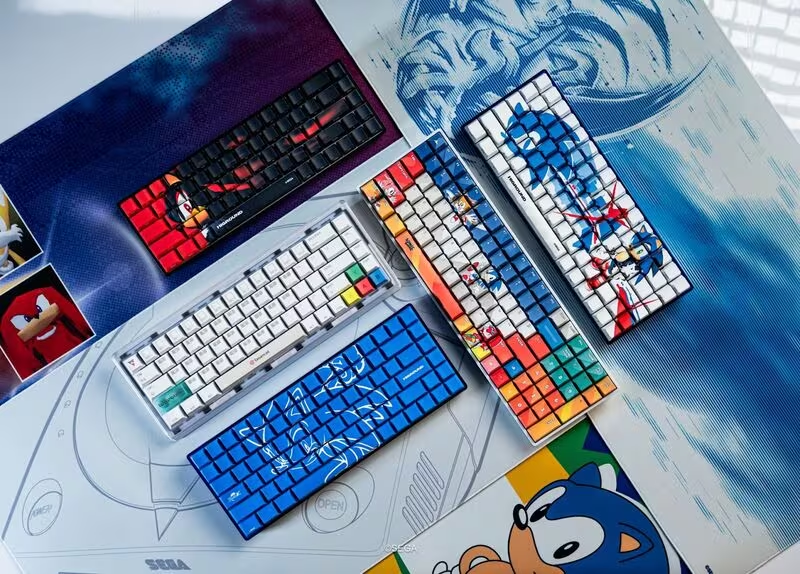
The Sonic the Hedgehog collection, a renewed collaboration between lifestyle gaming peripheral brand Higround and SEGA, highlights a design concept that merges retro nostalgia with modern performance engineering. Drawing from the cultural legacy of Sonic the Hedgehog and the visual language of the Dreamcast era, the collection introduces peripherals that blend archival aesthetics with contemporary functionality. This release also expands Higround’s product range “through updated 75% and 96% keyboard layouts and the introduction of a Hall Effect model, each referencing the theme of Sonic’s characteristic speed.”
The ‘Summit 65+,’ presented in a Dreamcast-inspired design, features a CNC aluminum case, stainless steel back plate, and Higround’s ‘Dampening Plus’ five-layer system for a stable, quiet typing experience. The ‘Basecamp 65HE,’ influenced by the Radical Highway level, debuts Hall Effect technology for increased precision. Additional offerings—including the Classic Sonic–themed ‘Basecamp 96+,’ two ‘Basecamp 75+’ versions inspired by Escape from the City and Sonic CD, a Sonic CD keycap set, and four coordinated XL mousepads—further unify the collection’s nostalgic yet contemporary character.
The Competitive Spirit That Powers Both Sports and Startups
Miami sports fans know that greatness comes from more than talent alone. Whether it’s the Heat grinding through a tight fourth quarter or the Dolphins executing a perfectly timed offensive scheme, winning requires discipline, fast thinking, and an unshakeable competitive spirit. Interestingly, these same qualities power the tech and startup world, where entrepreneurs make split-second decisions that can define the future of an entire business.
In both arenas, success belongs to those who can read momentum, adapt under pressure, and turn small opportunities into game-changing wins. That overlap is why so many sports-minded individuals naturally thrive in the world of business, innovation, and technology.
Why Analytics in Sports Fuel Smarter Business Thinking
Today’s sports landscape is driven by analytics—shot charts, win probability graphs, EPA metrics, and possession efficiency numbers are all part of modern fan knowledge. This analytical mindset doesn’t stop at the arena. Tech entrepreneurs, founders, and investors rely on the same data-driven thinking to navigate product decisions, market shifts, and competition.
This crossover is why the startup world attracts problem solvers shaped by sports culture. And platforms in the entertainment-tech space—such asFoxy gold casino—reflect this growing connection between digital innovation, predictive thinking, and user engagement.
Understanding Momentum: A Shared Advantage for Founders and Athletes
Momentum is everything. In sports, a single run, turnover, or three-pointer can change the energy in seconds. In business, momentum might be a viral post, a successful beta launch, or hitting a major funding milestone. Leaders in both fields understand how to recognize momentum and capitalize on it.
This parallels perfectly:
Athletes ride hot streaks.
Founders capitalize on traction.
Sports teams adjust mid-play.
Startups pivot product strategy just as quickly.
The ability to shift gears on the fly is one of the most important skills in sports and tech alike.
Building a Winning Strategy: What Startups Can Learn From Miami Sports
1. Scouting and Research Matter
Sports teams invest heavily in scouting reports and film studies. They evaluate:
Opponent strengths
Player tendencies
Lineup matchups
Efficiency ratings
Startups mirror this with market research, user interviews, competitive analysis, and data modeling. Knowing the landscape allows founders to execute smarter, faster, and with more confidence.
2. Team Culture Determines Long-Term Success
The Miami Heat built the “Heat Culture,” known for discipline, conditioning, and accountability. Startups adopting similar cultural principles see major benefits:
Clear leadership and communication
Defined expectations
Continuous improvement
Resilience under pressure
A strong culture is often the difference between a startup that scales—and one that collapses.
3. Adaptability Separates Winners From the Rest
Sports demand constant adjustments: defensive rotations, halftime strategies, and clutch-time decisions. Startups face equally rapid shifts:
Market changes
New competitors
Shifting user demand
Technological breakthroughs
Founders who adapt quickly, without losing their vision, stay competitive.
Table: Business Lessons Inspired by Miami’s Sports Playbook
Miami Sports Principle
Startup Application
Tech/Innovation Impact
Heat Culture
Strong internal systems
Higher productivity & retention
Film study & analytics
Market and user research
Better decision-making
In-game adjustments
Product pivots
Faster adaptation to trends
Team chemistry
Cross-functional collaboration
Smoother product scaling
Game-winning mentality
Resilient leadership
Strong long-term growth
How Miami’s Fast-Paced Environment Fuels Innovation
South Florida’s sports scene is known for energy, excitement, and bold plays. Coincidentally, Miami’s startup scene mirrors that same intensity. The city has quickly become a hub for fintech, AI, gaming, and digital entertainment. Entrepreneurs here are used to speed—speed of execution, iteration, and scaling.
A few reasons Miami is thriving in the innovation sector:
Diverse global talent
High investor interest
Strong tech community backing
Growing digital entertainment market
Crossover influence from sports and media
Miami is one of the few cities where sports culture and startup culture genuinely feed each other.
Technology Is Changing the Game—On the Field and in the Office
Technology has reshaped sports with player-tracking systems, real-time analytics, and dynamic stat models. Meanwhile, tech startups use automation, AI-driven insights, and SaaS platforms to accelerate growth. Both industries depend on innovation to stay ahead.
Today’s fans and founders alike have access to tools such as:
Predictive analytics
Machine learning insights
Automated reporting dashboards
Real-time performance tracking
Competitive intelligence platforms
This shared tech ecosystem keeps both sports teams and startups laser-focused on performance.
The Role of Mindset: What Makes Sports Fans Natural Innovators
Sports fans understand pressure. They analyze plays, debate strategies, track performance trends, and anticipate outcomes. These instincts make them naturally suited for entrepreneurship and tech leadership.
Key mindset overlaps include:
Confidence under pressure
Long-term thinking
Understanding risk and reward
Embracing competition
Continuous improvement
Sports create thinkers who thrive in fast-paced, unpredictable environments—the exact conditions startups face daily.
Why the Connection Between Sports and Startups Keeps Growing
Sports influence is everywhere—from data modeling to team culture to leadership strategy. At the same time, tech continues to elevate sports through analytics, digital enhancements, and real-time engagement tools. The crossover strengthens every year, especially in vibrant markets like Miami.
As both industries push forward, one thing remains true: the mindset that wins games is the same mindset that builds the next big company. Athletes, analysts, fans, and founders all share a core advantage—a competitive drive, sharpened by strategy, that fuels consistent growth.
Lakeview Academy in Gainesville recently unveiled its newly renovated Innovation and Technology Wing.
The learning environment is designed to inspire creativity, collaboration, and hands-on problem-solving.
“The expanded robotics and esports facilities give our students room to imagine bigger and build bolder,” Technology Director Mikhail Lovell, said. “With advanced tools like industrial laser cutters and high-performance 3D printers, they can design and create with a level of precision and freedom that we couldn’t offer before. This renovation strengthens the programs our students already love while opening the door to new opportunities for innovation, growth, and achievement.”
School officials said the renovation was made possible through Lakeview donors and community partners who share in the school’s mission to cultivate curiosity, excellence, and forward-thinking leadership.
“This renovation represents more than just new facilities,” John Simpson, Head of School at Lakeview Academy, said. “It is an investment in our students’ future and a reflection of Lakeview’s vision to provide a learning environment that mirrors the innovation and collaboration found in today’s leading industries.”
The Game Awards 2025 concluded on December 11 in Los Angeles, celebrating a standout year in gaming. The ceremony unveiled the full All Winners List across major categories, including Game of the Year, Best Art Direction, Best Narrative, and more. Fans tuned in worldwide to see whether Clair Obscur Expedition 33, Death Stranding 2 On the Beach, or Donkey Kong Bananza would claim top honors.
This year delivered an unusually competitive field. Nearly every major genre saw multiple critically acclaimed releases. The All Winners List highlights how diverse the gaming landscape has become, rewarding innovation, storytelling, performance, and design. Below is the complete breakdown of winners as confirmed during the live show.
Full All Winners List for The Game Awards 2025
The Game Awards recognized excellence across more than 30 categories. The All Winners List below reflects the official results announced during the broadcast. These selections were made through a combination of jury voting and fan participation. Trusted outlets such as Reuters and AP covered the event throughout the week, citing its global impact on the entertainment industry.
The ceremony featured wins for established franchises, emerging studios, and standout indie titles. Clair Obscur Expedition 33 dominated several major categories, cementing its status as one of the year’s most influential releases. Death Stranding 2 On the Beach and Hollow Knight Silksong also secured notable wins across art, music, and direction.
The winners list includes categories such as:
Game of the Year
Player’s Voice
Best Game Direction
Best Adaptation
Best Narrative
Best Art Direction
Best Score and Music
Best Audio Design
Best Performance
Innovation in Accessibility
Games for Impact
Best Ongoing Game
Best Community Support
Best Independent Game
Best Debut Indie Game
Best Mobile Game
Best VR/AR Game
Best Action Game
Best Action/Adventure Game
Best RPG
Best Fighting Game
Best Family Game
Best Sim/Strategy Game
Best Sports/Racing Game
Best Multiplayer Game
Most Anticipated Game
Content Creator of the Year
Best Esports Game
Best Esports Athlete
Best Esports Team
Each winner reflects the shifting trends of interactive entertainment. Publishers invested heavily in cinematic storytelling, AI-driven mechanics, and world-building. Indie studios saw renewed recognition, demonstrating how smaller teams continue to push creative boundaries.
How the 2025 All Winners List Shapes the Industry
The impact of the All Winners List extends far beyond the ceremony. Industry analysts note that Game Awards recognition often boosts sales, renews franchise momentum, and influences publisher strategies for the following year. Reuters reported that award-winning titles typically experience a significant rise in global downloads after the show’s conclusion.
For indie creators, nominations and wins can accelerate distribution partnerships and platform support. For major studios, standout wins in categories such as Game Direction or Narrative reinforce creative leadership and help guide long-term development pipelines.
The All Winners List also redirects attention toward emerging technologies showcased in nominated titles. VR advancements, accessibility innovations, and audio engineering breakthroughs from this year’s winners are expected to shape next-generation game design approaches.
The Game Awards 2025 All Winners List underscores how far the medium has evolved. It highlights a year defined by risk-taking, creativity, and boundary-pushing design. Fans now look ahead to 2026 as studios aim to build on the momentum created by this remarkable lineup of winners.
FYI (keeping you in the loop)-
Q1: What is included in The Game Awards 2025 All Winners List?
The list includes winners across more than 30 categories, covering major genres and industry achievements. Categories range from Game of the Year to Best Esports Team.
Q2: Which game won the most awards in 2025?
Clair Obscur Expedition 33 earned multiple major category wins, reflecting strong critical and fan support.
Q3: Why is The Game Awards All Winners List important?
The list influences sales trends, industry recognition, and future project investment decisions. It sets expectations for upcoming releases.
Q4: How are winners selected for The Game Awards?
A combined jury and public voting system determines winners. Both professional critics and global players contribute.
Q5: Does winning an award impact game development studios?
Recognition often leads to increased funding, hiring, and platform visibility. It can also validate creative direction for future titles.
iNews covers the latest and most impactful stories across
entertainment,
business,
sports,
politics, and
technology,
from AI breakthroughs to major global developments. Stay updated with the trends shaping our world. For news tips, editorial feedback, or professional inquiries, please email us at [email protected].
Get the latest news and Breaking News first by following us on
Google News, Twitter,
Facebook,
Telegram , and subscribe to our YouTube channel.