
Technology
Sports Broadcasting Technology Market Size

Report Overview
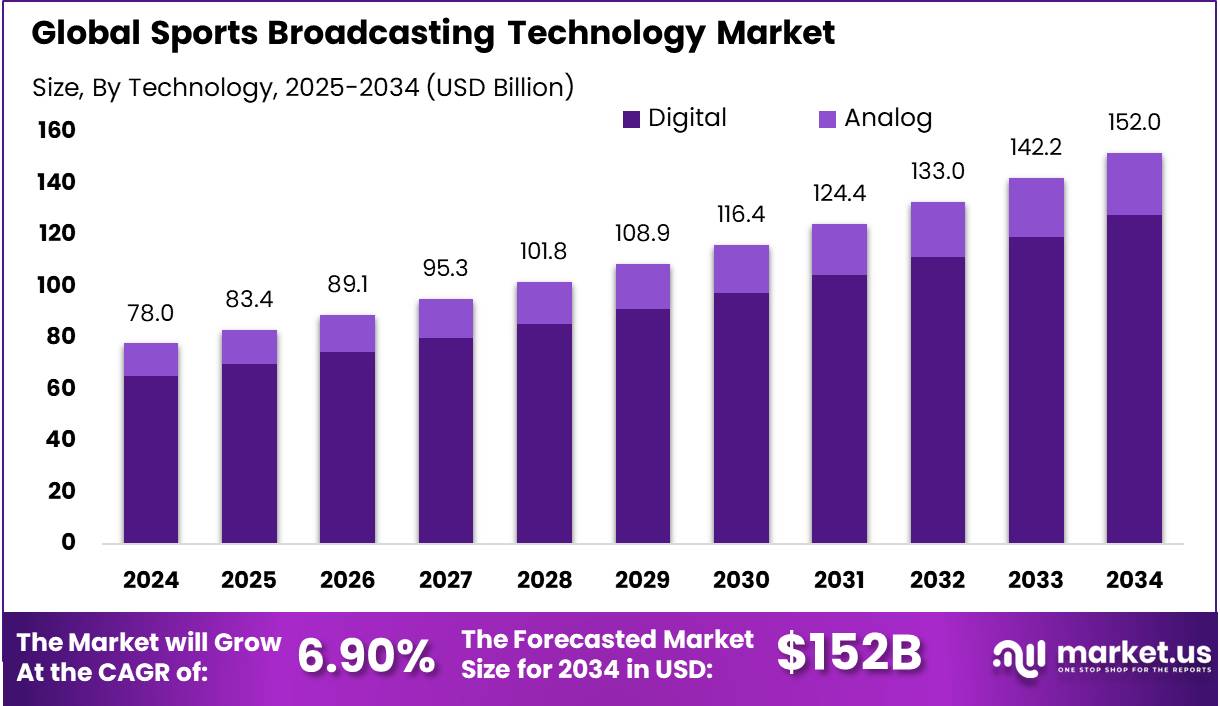
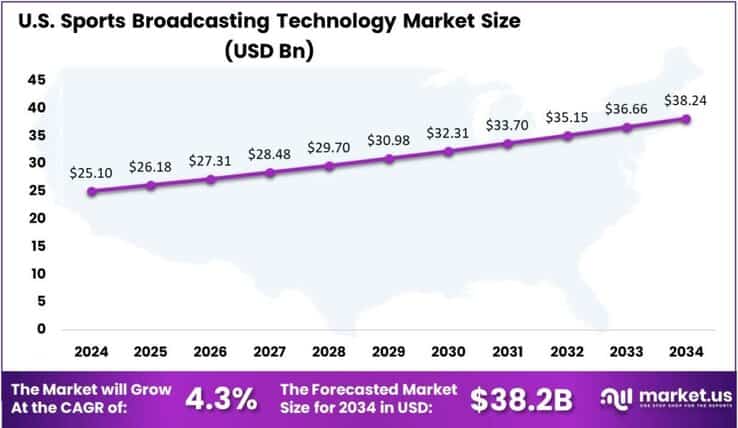
The Global Sports Broadcasting Technology Market size is expected to be worth around USD 152 Billion By 2034, from USD 77.98 Billion in 2024, growing at a CAGR of 6.90% during the forecast period from 2025 to 2034. In 2024, North America held over 34% of the global sports broadcasting technology market, with a revenue of approximately USD 26.5 billion. The U.S. market was valued at USD 25.1 billion, growing at a steady CAGR of 4.3%.
Sports broadcasting technology encompasses the tools and systems used to capture, produce, and distribute live and recorded sports content across various platforms. This includes HD cameras, drones, VR/AR setups, and advanced graphics systems, designed to bring fans closer to the action and provide immersive, interactive experiences beyond traditional viewing.
The growth of sports broadcasting technology is driven by the demand for real-time, high-quality content across multiple platforms. Audiences engage through second-screen apps, live stats, and social media, prompting investment in low-latency streaming, edge computing, and 5G. OTT platforms have disrupted traditional cable models, making sports content more accessible and fueling global demand for mobile streaming and flexible subscriptions.
Investors are seizing lucrative opportunities in the sports tech sector, with significant capital flowing into startups and established companies. The growth of OTT services and e-sports is opening new markets and revenue streams, with companies forming partnerships and making acquisitions to enhance technology and expand reach, highlighting a strong investment climate in sports broadcasting.
The integration of advanced broadcasting technologies boosts viewer engagement, advertising revenues, and premium services. Features like real-time stats and multiple camera angles enhance the experience, increasing customer satisfaction and loyalty. Data analytics help broadcasters tailor content and marketing strategies based on audience preferences.
Emerging trends in broadcasting include AR and VR to enhance fan immersion, with AR providing tactical insights and VR offering courtside or behind-the-goal experiences. AI-based player tracking and data visualization enrich live commentary, while NFTs and blockchain are being explored for digital collectibles and interactive fan engagement.
The sports broadcasting market is expanding globally, with regions like Southeast Asia, Africa, and Latin America seeing growth in digital infrastructure and smartphone use. This fuels demand for localized content as fan bases strengthen. Partnerships between sports franchises, media companies, and tech firms are also increasing to create tailored broadcasting ecosystems.
Key Takeaways
- The global sports broadcasting technology market size is projected to reach USD 152 billion by 2034, up from USD 77.98 billion in 2024, growing at a CAGR of 6.90% during the forecast period from 2025 to 2034.
- In 2024, the Solutions segment held a dominant market position, capturing more than 72% of the global sports broadcasting technology market share.
- The Digital segment held a dominant market position in 2024, commanding more than 84% of the global sports broadcasting technology market.
- The Television segment dominated the sports broadcasting technology market in 2024, accounting for more than 55% of the total market share.
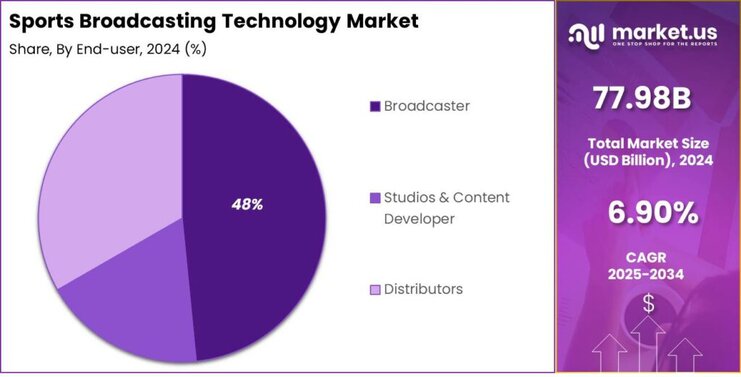
- In 2024, the broadcaster segment led the sports broadcasting technology market, holding over 48% of the total market share, owing to their direct influence over content transmission and viewer engagement.
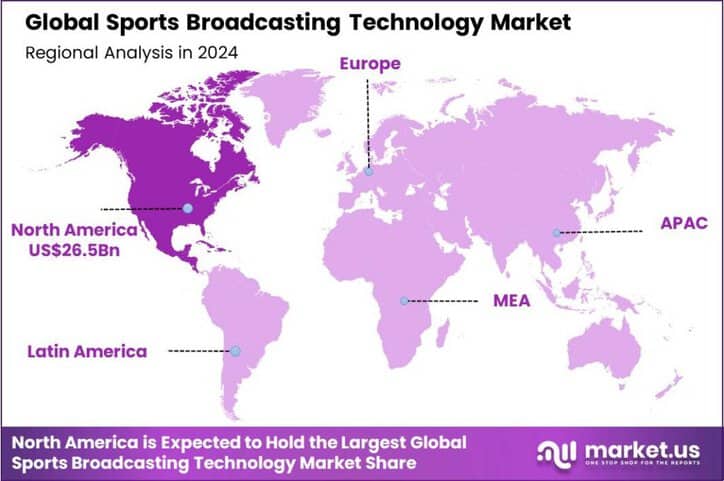
- North America held a dominant market position in 2024, capturing over 34% of the global sports broadcasting technology market, translating to a revenue of approximately USD 26.5 billion.
- The U.S. sports broadcasting technology market was valued at USD 25.1 billion in 2024 and is growing at a steady CAGR of 4.3%.
Analyst’s Viewpoint
The increasing demand for immersive and interactive viewing experiences has opened avenues for investment in technologies such as augmented reality (AR), virtual reality (VR), and artificial intelligence (AI). These technologies enhance fan engagement by providing real-time statistics, personalized content, and immersive experiences.
Several factors are influencing the sports broadcasting landscape. The proliferation of high-speed internet and mobile devices has shifted viewer preferences towards on-demand and streaming services. This change necessitates broadcasters to adapt their content delivery methods. Moreover, the integration of data analytics allows for personalized content, catering to individual viewer preferences and enhancing engagement.
Technological innovations are at the forefront of transforming sports broadcasting. The deployment of 5G networks facilitates seamless streaming of high-definition content, reducing latency issues. AI-powered tools assist in automating production workflows, enabling real-time analytics and enhancing storytelling.
AI Impact On The Market
- Smarter Camera Work: AI helps cameras follow the action automatically, choosing the best angles without human control. This means smoother coverage and less chance of missing important moments.
- Personalized Viewing: With AI, broadcasts can be tailored to individual preferences. Fans can receive real-time updates about their favorite teams or players, making the viewing experience more relevant and exciting.
- Real-Time Highlights: AI can quickly identify exciting moments and create highlight clips almost instantly. This allows fans to catch up on key plays without waiting.
- Global Accessibility: With AI-driven translation, broadcasts can be understood by audiences worldwide, breaking down language barriers. This makes sports more inclusive and accessible to a global audience.
- Supporting All Levels of Sports: AI makes it easier to broadcast games that might not have had coverage before, like local or amateur matches. This brings attention to more athletes and events, promoting inclusivity in sports.
U.S. Market Analysis
In 2024, the U.S. Sports Broadcasting Technology Market reached a substantial valuation of USD 25.1 billion, reflecting the growing influence of digital innovation in the way sports content is delivered, consumed, and monetized. This expansion has been largely fueled by a rising demand for immersive viewing experiences, multi-platform content delivery, and the integration of real-time data and analytics into live broadcasts.
The market is progressing at a steady compound annual growth rate (CAGR) of 4.3%, indicating consistent momentum in the adoption of smart broadcasting tools across the industry. Innovations such as augmented reality (AR), virtual reality (VR), 5G-enabled streaming, and AI-powered production are transforming traditional sports broadcasting into a highly personalized and data-rich experience.
This growth reflects broader trends like greater collaboration between sports leagues and tech firms, and rising investment in proprietary content platforms. The U.S. leads in sports media thanks to its strong infrastructure, diverse sports landscape, and high consumer spending. Evolving regulations and legal support for digital broadcasting are also attracting more private and institutional investment.
In 2024, North America held a dominant market position in the global Sports Broadcasting Technology Market, capturing over 34% share, which translated to a revenue of approximately USD 26.5 billion. This leadership is driven by the region’s mature sports ecosystem, widespread digital infrastructure, and high consumer demand for premium, interactive content.
Major leagues like the NFL, NBA, and MLB are driving innovation through tech partnerships, using tools like ultra-HD streaming, AR, and AI-powered content. With strong media and tech support, 5G rollout, and high smartphone use, North American fans gain early access to cutting-edge broadcast experiences.
North America’s lead in sports media stems from strong sports viewership and high media consumption. Growing use of streaming and OTT platforms drives investment in cloud-based and real-time tech. Enhanced live feeds with player stats, automation, and immersive graphics boost fan engagement and open new revenue streams through personalized ads and data insights.
Well-established media rights and regulations in North America provide a clear path for content licensing and monetization. Ongoing investment in sports tech startups and R&D by firms like ESPN, Amazon, and NBCUniversal drives innovation, reinforcing the region’s role as a global leader in sports media technology.
Component Analysis
In 2024, the Solutions segment held a dominant market position, capturing more than a 72% share of the global sports broadcasting technology market. This dominance is largely due to the rising demand for integrated broadcasting systems that streamline production, transmission, and distribution workflows.
Software is key to the Solutions segment, driving improvements in content quality and delivery. Tools for editing, analytics, and cloud-based playout enable AI commentary, instant replays, and automated workflows. This has led to rising software investment, especially from OTT and digital-first broadcasters seeking scalable, infrastructure-light solutions.
On the hardware side, advancements in encoders, modulators, and transmitters support more mobile and flexible broadcasting. Compact, modular designs lower costs and maintain signal quality, enabling mid-sized and regional broadcasters to deliver professional-grade live sports coverage affordably.
The services subsegment lags behind Solutions in market share, as many organizations opt for in-house operations using advanced tools. However, demand for managed services and consulting is growing in emerging markets and among smaller firms, driven by the need for scalable, end-to-end support and adaptability to evolving sports content formats.
Technology Analysis
In 2024, the Digital segment held a dominant market position, capturing more than an 84% share in the global Sports Broadcasting Technology market. This overwhelming dominance is largely due to the rapid shift from traditional analog systems to high-definition, internet-enabled broadcasting solutions.
A key reason why the Digital segment leads the market is its compatibility with OTT (Over-the-Top) streaming platforms and mobile-first delivery models. Sports fans today consume content not just on television, but across smartphones, tablets, and laptops. Digital broadcasting allows content to be customized, localized, and delivered on demand.
Another contributing factor to the digital segment’s dominance is its ability to support advanced technologies such as 4K/8K resolution, augmented reality overlays, AI-powered analytics, and real-time player tracking. These features enrich the fan experience and are only possible through digital frameworks. Broadcasters are increasingly integrating cloud-based editing, remote production workflows, and AI-led camera systems, all of which require digital capabilities.
The shift to digital is accelerating as analog signals are phased out, especially in North America and Europe. With sports leagues launching their own platforms and broadcasters adopting digital-first strategies, analog use is now limited to rural or legacy systems. Digital broadcasting is clearly shaping the future of global sports media.
Platform Analysis
In 2024, the Television segment held a dominant position in the Sports Broadcasting Technology Market, capturing more than a 55% share. This dominance reflects the continued reliance on traditional broadcast mediums for live sports content across both developed and developing nations.
Television’s lead is also supported by the deep-rooted infrastructure and high household penetration of cable and satellite connections, particularly in North America and parts of Europe. These platforms offer reliable high-definition content delivery with minimal latency, a key requirement for live sports where viewer experience depends on real-time broadcast quality.
Television maintains its lead due to long-term contracts and exclusive broadcasting rights with sports leagues, keeping marquee content out of digital-only platforms. TV broadcasters have also evolved, integrating enhanced graphics, multi-angle replays, and interactive features, merging traditional delivery with a modern viewing experience.
While OTT platforms and IPTV are growing, especially among younger audiences, they face challenges like bandwidth dependency, content rights issues, and regional restrictions. Television remains the backbone of sports broadcasting, offering broad accessibility and reliable coverage of major events, ensuring its continued dominance alongside the rise of digital channels.
End-User Analysis
In 2024, the broadcaster segment led the sports broadcasting technology market, holding over 48% of the total market share, due to their direct influence over content transmission and viewer engagement. Broadcasters, especially major networks and sports channels, have long-standing contracts with sports leagues and federations, giving them priority access to live games and exclusive rights.
Moreover, broadcasters have been the first to integrate hybrid transmission models blending traditional satellite or cable with IP-based delivery systems to reach wider and more diverse audiences. This strategic move has helped them stay ahead of content developers and distributors, as they are not only transmitting games but also actively shaping how fans consume them.
Mega events like the Super Bowl and Olympics give broadcasters a competitive edge by driving massive viewership spikes. With scalable infrastructure, broadcasters control the entire delivery process from content acquisition to final output ensuring better monetization and performance optimization compared to digital distributors relying on third-party platforms.
Broadcasters have adapted by forming strategic partnerships with OTT platforms and social media, expanding their reach while retaining control over content rights. This combination of traditional strength and digital flexibility keeps broadcasters at the forefront of the sports broadcasting technology landscape, leading in both technology adoption and market revenue.
Key Market Segments
By Component
- Solutions
- Software
- Hardware
- Dish Antennas
- Amplifiers
- Switches
- Encoders
- Video Servers
- Transmitters/Repeaters
- Modulators
- Others
- Services
By Technology
By Platform
- OTT
- Radio
- Television
- Satellite Direct-to-Home
- Digital Terrestrial Television (DTT)
- Cable Television
- IPTV
By End-user
- Broadcaster
- Studios & Content Developer
- Distributors
Key Regions and Countries
- North America
- Europe
- Germany
- France
- The UK
- Spain
- Italy
- Rest of Europe
- Asia Pacific
- China
- Japan
- South Korea
- India
- Australia
- Singapore
- Rest of Asia Pacific
- Latin America
- Brazil
- Mexico
- Rest of Latin America
- Middle East & Africa
- South Africa
- Saudi Arabia
- UAE
- Rest of MEA
Driver
The Rise of Immersive and Interactive Fan Experiences
In today’s digital age, fans crave a front-row seat to the action. This drive has sparked a wave of innovation in sports broadcasting, creating immersive and interactive experiences that bring the game closer than ever before.
Technologies like AR and VR have turned passive viewing into active participation, engaging tech-savvy, younger audiences with video game-like avatars and interactive broadcasts. These broadcasts blend animation and STEM education to captivate younger viewers.
Ultra-low-latency streaming, as seen with platforms like Panasonic Connect, enables real-time interactions like live chats and instant replays. These innovations enhance viewer engagement and create new monetization opportunities through personalized content and targeted advertising.
Restraint
The Complexity of Broadcasting Rights and Licensing
While technology offers numerous possibilities, the intricate web of broadcasting rights and licensing poses significant challenges. Securing rights to broadcast sports events often involves complex negotiations, with rights holders, leagues, and broadcasters each seeking favorable terms.
The complexity of rights and licensing can hinder the adoption of new technologies in sports broadcasting, as integrating innovative features may require renegotiating existing agreements. The entry of big tech companies has intensified competition, raising rights costs and creating uncertainty for traditional broadcasters. This competitive landscape may deter investment in new technologies due to the high risks and licensing fees.
Opportunity
Expanding into Emerging Markets with Tailored Content
Emerging markets present a vast opportunity for sports broadcasters to expand their reach and tap into new audiences. In regions like India, Africa, and Southeast Asia, there’s a growing appetite for sports content, driven by increasing internet penetration and smartphone usage.
By tailoring content to local preferences and languages, broadcasters can better engage their audiences. For instance, the NRL is expanding into the U.S. market, aiming to introduce its content to American fans. Leveraging platforms like social media enables broadcasters to connect with younger demographics, offering highlights, behind-the-scenes content, and interactive features that resonate with local cultures. By embracing localization and regional preferences, sports broadcasters can unlock new revenue streams and build global fan communities.
Challenge
Ensuring Technological Infrastructure and Accessibility
Technological advancements bring many benefits, but ensuring the infrastructure to support them is a major challenge. In many developing regions, limited access to high-speed internet and advanced devices can impede the adoption of new broadcasting technologies. The digital divide creates disparities, with some audiences enjoying ultra-HD streams and interactive features, while others struggle with basic access.
The global variation in 5G implementation also affects the consistency of viewer experiences, particularly for low-latency streaming and real-time interactions. Addressing these challenges requires collaboration between broadcasters, governments, and tech companies to invest in connectivity solutions and ensure sports broadcasting innovations are accessible to all.
Emerging Trends
Sports broadcasting has transformed with the adoption of new technologies. A key change is the shift from traditional TV to digital streaming, enabling fans to watch live sports on various devices. These platforms enhance the experience with interactive features like real-time stats and multiple camera angles.
AI is transforming sports broadcasting by personalizing content based on viewer preferences, offering custom highlights and player-focused views. Meanwhile, AR and VR enhance broadcasts with immersive features like virtual stadium tours and interactive replays, bringing fans closer to the game.
Another growing trend in sports broadcasting is the rise of alternative broadcasts, or “altcasts,” which feature unique perspectives, such as commentary from celebrities or former athletes, for a more casual and entertaining experience. Additionally, social media platforms like Instagram and Twitter are transforming fan engagement through short clips, behind-the-scenes content, and interactive polls, keeping fans connected beyond the live game.
Business Benefits
Sports broadcasting technology offers key business benefits, including the ability for fans to watch games anytime, anywhere through online streaming. Modern tools allow viewers to customize their experience with features like different camera angles, real-time stats, and language options. This personalization boosts viewer satisfaction, increases engagement, and provides greater value for advertisers and sponsors.
Advanced technologies enable broadcasters to insert virtual ads tailored to specific regions or audiences. For example, the NHL uses digitally enhanced dasherboards to display different ads to viewers in various locations during the same game. This targeted approach increases ad effectiveness and revenue potential.
By analyzing viewer data, broadcasters and teams can understand what content resonates most with fans. This insight allows them to tailor programming, improve marketing strategies, and enhance overall fan engagement. For instance, data analytics help in determining the best times to air games or which highlights to promote on social media.
Key Player Analysis
The sports broadcasting technology market is growing fast, driven by the rising demand for high-quality live sports coverage and immersive viewing experiences.
NEC Corporation is a global tech leader known for integrating AI and 5G in broadcasting solutions. In sports broadcasting, NEC stands out with its biometric recognition systems and advanced data analytics. This gives broadcasters tools to offer personalized content and targeted advertising.
Rohde & Schwarz is a powerhouse in signal transmission and broadcast infrastructure. They stand out for ultra-reliable transmitters and encoding solutions that support 4K and HDR, with a focus on broadcast resilience and low-latency live feeds for smooth viewing during major sports events.
Evertz Microsystems Ltd. is a key innovator in live video production and media transport. Their IP-based solutions and cloud production tools allow broadcasters to manage and switch between multiple live feeds with ease. Evertz’s strength lies in flexibility and scalability, supporting everything from small events to major leagues.
Top Key Players in the Market
- IBM Corporation
- NEC Corporation
- Rohde & Schwarz
- Evertz Microsystems Ltd.
- NEP Group Inc.
- ESPN Sports Media Ltd.
- NBC Universal
- Fox Corporation
- Sportradar AG
- Muvi
- Deltatre
- Pixellot
- PlaySight Interactive
- Hawk-Eye Innovations
- Genius Sports
- Others
Top Opportunities for Players
- Personalized Viewing Experiences: Viewers now expect content tailored to their preferences. AI-driven tools are enabling broadcasters to offer customizable camera angles, real-time stats, and interactive features. This personalization enhances engagement and opens avenues for targeted advertising.
- Expansion of OTT and Streaming Platforms: The shift from traditional TV to over-the-top (OTT) platforms is accelerating. Streaming services are investing heavily in live sports rights, recognizing the demand for flexible, on-the-go viewing options. This trend offers broadcasters opportunities to reach wider audiences and explore new revenue models.
- Integration of Immersive Technologies: Augmented reality (AR) and virtual reality (VR) are transforming the sports viewing experience. By providing immersive replays and interactive features, these technologies are enhancing fan engagement and offering new sponsorship opportunities.
- Data-Driven Advertising and Sponsorship: Advanced analytics are enabling broadcasters to offer targeted advertising, maximizing sponsor ROI. Virtual advertising overlays allow for region-specific promotions during live events, increasing the value of ad slots.
- Cloud-Based Production and Remote Workflows: The adoption of cloud technologies is streamlining production processes. Remote workflows reduce costs and increase flexibility, allowing for efficient content creation and distribution. This shift is particularly beneficial for covering multiple events simultaneously.
Recent Developments
- In February 2025, Kudan Inc., a global SLAM technology pioneer, is teaming up with FOX Sports to revolutionize AR in live sports broadcasting. Debuting at Super Bowl LIX, Kudan’s cutting-edge 3D LiDAR SLAM software will drive next-gen AR visuals, bringing fans an immersive viewing experience.
- In March 2024, Sportradar announced its plan to buy IMG ARENA, a company known for global sports betting rights and data services. This move aims to strengthen Sportradar’s position in the sports technology and betting industry.
Report Scope

The Samsung Odyssey 3D G90XH gaming monitor features a 165Hz refresh rate that can be boosted to 330Hz in Dual Mode. The monitor is slated to arrive in 2026 and is expected to be a hit amongst avid gamers.
The Tandem WOLED technology will offer fast response time, high refresh rates, low motion blur, dual modes, enriched color depths and more. The Tandem OLED technology will allow screens to blend more seamlessly into everyday spaces thanks to its natural performance.
The latest LG Display OLED technology comes as part of the company’s rebranding of its screen technology to help usher in a new age for the brand.
Technology
Abu Dhabi to Showcase Its Esports and Motorsports Excellence: Gran Turismo World Series 2026 Kicks Off in the UAE
Published on
December 22, 2025

In a historic first for the Middle East, Abu Dhabi, the vibrant capital of the United Arab Emirates, will host the opening event of the Gran Turismo World Series 2026 on March 28, 2026. This prestigious event will take place at the Space42 Arena, showcasing Abu Dhabi’s growing influence in esports and motorsports. As the world’s most exciting digital racing series kicks off its new season in the heart of the UAE, the city’s status as a global hub for innovation, entertainment, and technology is further solidified.
This announcement was made during the Gran Turismo World Series 2025 Finals held in Fukuoka, Japan, by S.E. Saeed Al Fazari, the Executive Director of Strategic Affairs at the Department of Culture and Tourism – Abu Dhabi (DCT Abu Dhabi), and Kazunori Yamauchi, the producer of the Gran Turismo series. Their collaboration highlights Abu Dhabi’s readiness to host an event that will attract millions of esports fans and motorsport enthusiasts from around the world.
Abu Dhabi: The Perfect Location for the Gran Turismo World Series 2026
Abu Dhabi, already known for its world-class motorsport events such as the Formula 1 Abu Dhabi Grand Prix, is now expanding its footprint in the esports industry by welcoming the Gran Turismo World Series. This high-profile event, which brings together the best virtual drivers from around the globe, will elevate the UAE’s presence in the digital gaming and motorsport communities.
The Gran Turismo World Series: A Global Racing Championship
The Gran Turismo World Series is an annual competition that aims to crown the best Gran Turismo player in the world. The competition begins with online qualifiers, where players from across the globe compete to earn their spots in the live events. The series then moves to major international venues, where the top drivers from each region meet to race for the title. The 2026 series opener in Abu Dhabi will mark a monumental step in the history of the event, as it’s the first time the series has taken place in the Middle East.
Yas Marina Circuit in Gran Turismo 7: A Digital Tribute to Abu Dhabi’s Motorsports Legacy
Adding to the excitement, the Yas Marina Circuit, one of the most iconic motorsport venues in the world, will be featured in Gran Turismo 7. This addition allows players to virtually race on the very track that has hosted the Formula 1 Grand Prix since 2009. With this integration, Gran Turismo 7 connects real-world motorsports with virtual racing, offering players the chance to experience the thrill of Yas Marina from the comfort of their homes.
Key Highlights of the Gran Turismo World Series 2026 in Abu Dhabi
- Event Date: March 28, 2026
- Venue: Space42 Arena, Abu Dhabi, UAE
- Region’s First: This marks the first time the Gran Turismo World Series will take place in the Middle East.
- Key Features: The event will showcase the best virtual drivers, live competitions, and interactive experiences for fans.
- Inclusion of Yas Marina Circuit: The iconic Yas Marina Circuit will be featured in Gran Turismo 7, bringing a unique virtual motorsports experience to players globally.
Abu Dhabi’s Growing Role in Esports and Digital Innovation
Abu Dhabi has rapidly become a global leader in the esports sector, thanks to its investments in cutting-edge technology, entertainment infrastructure, and strategic partnerships. The opening of the Gran Turismo World Series 2026 marks a milestone in Abu Dhabi’s growing presence in the world of competitive gaming and motorsports. The event also supports the UAE’s Vision 2021, which aims to position the country as a leader in innovation, technology, and global partnerships.
The Role of Abu Dhabi Gaming
The event is organized by Abu Dhabi Gaming, an initiative led by the Department of Culture and Tourism – Abu Dhabi. Abu Dhabi Gaming is dedicated to transforming the emirate into a world-class esports and gaming hub, attracting global talent, investors, and partnerships that will help develop and expand the gaming ecosystem. With Gran Turismo World Series 2026, Abu Dhabi continues to build on its reputation as a city that hosts world-class events and provides a platform for esports growth.
Abu Dhabi’s Vision for Esports and Motorsports
S.E. Saeed Al Fazari expressed the importance of this event for both Abu Dhabi and the Middle East. He stated, “Hosting the opening of the Gran Turismo World Series is a moment of pride for Abu Dhabi and the entire MENA region, reflecting our ambition to be a destination with limitless possibilities. This marks a significant step for our esports and motorsport sectors, bringing the world’s elite competitors to the emirate and showcasing Abu Dhabi’s proven capacity to deliver world-class experiences in these fields.”
The Gran Turismo World Series 2026 will also contribute to Abu Dhabi’s broader vision of becoming a global center for innovation, entertainment, gaming, and motorsports. The emirate continues to offer a safe, future-ready environment for businesses, investors, and talent, providing opportunities for growth in emerging industries such as esports.
Kazunori Yamauchi on the Middle East’s Growing Impact on Esports
Kazunori Yamauchi, the producer of the Gran Turismo series, also expressed excitement about this landmark event. He said, “We are excited that Abu Dhabi will host the opening of the Gran Turismo World Series in March 2026, marking the first time the event will be held in the Middle East. This is a historic milestone for our championship and a testament to the region’s growing presence in esports and motorsports worldwide. We are also thrilled that the Yas Marina Circuit is now available in Gran Turismo 7, offering players an authentic experience of one of the world’s most remarkable motorsport venues.”
The Road Ahead: Esports and Abu Dhabi’s Future in the Digital Age
The Gran Turismo World Series will continue to evolve, and Abu Dhabi’s role in the esports and digital gaming industry will only continue to grow. Events like this serve as catalysts for the city’s vision to become a global leader in the sectors of esports, technology, and digital innovation. For Abu Dhabi, hosting the Gran Turismo World Series 2026 is just the beginning of its journey to build an esports ecosystem that connects global talents with world-class facilities.
How to Attend the Gran Turismo World Series 2026 in Abu Dhabi
Tickets for the Gran Turismo World Series 2026 opening event in Abu Dhabi will be available through Ticketmaster at website. Fans from around the world can look forward to witnessing this exciting event live, making it a must-attend for all esports and motorsports enthusiasts.



Playstation Market
The global PlayStation Market continues to be a cornerstone of the interactive entertainment industry, driven by technological innovation, immersive gameplay, and a rapidly expanding gaming ecosystem. Valued at USD 34.12 billion in 2025, the market is projected to reach USD 54.12 billion by 2035, growing at a steady CAGR of 4.72% between 2024 and 2035. This sustained expansion reflects the increasing popularity of console gaming, digital distribution, and evolving consumer engagement models across the world.
With 2024 as the base year and historical data spanning 2019 to 2024, the market outlook for 2025-2035 highlights long-term stability supported by loyal user bases and continuous innovation. The PlayStation brand has evolved beyond hardware into a comprehensive entertainment platform, integrating online services, exclusive titles, cloud gaming, and virtual reality experiences that redefine modern gaming.
The competitive landscape of the PlayStation Market is highly dynamic and innovation-driven. Sony Interactive Entertainment (JP) remains the dominant force with its PlayStation console ecosystem, while competitors and partners such as Microsoft Corporation (US), Nintendo Co., Ltd. (JP), Electronic Arts Inc. (US), Activision Blizzard, Inc. (US), Take-Two Interactive Software, Inc. (US), Ubisoft Entertainment S.A. (FR), and Bandai Namco Entertainment Inc. (JP) play critical roles in shaping content, technology, and user engagement. These companies compete through exclusive titles, cross-platform compatibility, subscription services, and cutting-edge gaming engines.
“Access Full Report Now” – Gain Comprehensive Insights into the Market with Our Detailed Research Report
https://www.marketresearchfuture.com/reports/playstation-market-22446
One of the most influential growth drivers in the PlayStation Market is the continuous advancement of gaming technology. High-performance consoles, ultra-realistic graphics, faster load times, and enhanced processing capabilities have significantly elevated user experiences. Additionally, the growing popularity of online multiplayer gaming and esports has further strengthened platform engagement, particularly among younger demographics.
Market segmentation reveals a diverse and evolving ecosystem. The market is segmented by platform, game genre, revenue source, age group, gaming style, and region, enabling companies to tailor offerings to specific consumer segments. Action-adventure, role-playing, and sports games continue to dominate demand, while digital downloads, in-game purchases, and subscription-based services generate a growing share of overall revenue.
“Free Sample Copy” – Access A Complimentary Copy of Our Report to Explore Its Content and Insights
https://www.marketresearchfuture.com/sample_request/22446
A key market opportunity lies in the integration of virtual reality (VR) to enhance player immersion. PlayStation VR technologies are reshaping how users interact with games, offering deeper engagement and new gameplay formats. As VR hardware becomes more affordable and content libraries expand, adoption rates are expected to rise, opening new revenue streams and redefining console gaming experiences.
Geographically, the PlayStation Market spans North America, Europe, Asia-Pacific (APAC), South America, and the Middle East & Africa (MEA). North America remains a leading market due to strong console adoption, high disposable income, and a well-established gaming culture. Europe follows closely, supported by a robust player base and strong presence of global publishers. APAC, particularly Japan, South Korea, and emerging Southeast Asian markets, continues to demonstrate rapid growth driven by technological advancements and a digitally native population.
The market is also influenced by shifting consumer preferences toward digital ecosystems. Physical game sales are increasingly replaced by digital downloads, cloud gaming services, and subscription models. This transition not only enhances convenience but also allows companies to maintain continuous engagement with users through regular updates, downloadable content (DLC), and live-service games.
“Proceed To Buy” – Move Forward with Your Purchase and Gain Instant Access to the Complete Report
https://www.marketresearchfuture.com/checkout?currency=one_user-USD&report_id=22446
Intensifying competition remains a defining market dynamic. Companies are investing heavily in exclusive franchises, strategic acquisitions, and cross-platform compatibility to maintain competitive advantage. Strategic partnerships with game developers and technology providers are also playing a crucial role in expanding content libraries and enhancing user retention.
Another critical trend shaping the market is the growing emphasis on social and community-driven gaming. Features such as live streaming, social sharing, and interactive online communities have transformed gaming into a social experience. This evolution has strengthened brand loyalty and expanded PlayStation’s reach beyond traditional gaming audiences.
The report provides comprehensive coverage, including revenue forecasts, growth drivers, competitive analysis, and emerging trends, offering valuable insights for stakeholders across the gaming ecosystem. As segmentation analysis deepens, opportunities continue to emerge across age groups, gaming styles, and monetization models.
Looking ahead, the PlayStation Market is well-positioned for sustained growth through 2035, supported by innovation, immersive technologies, and evolving consumer expectations. As gaming continues to converge with entertainment, social interaction, and digital lifestyles, PlayStation remains a key force shaping the future of global interactive entertainment.
Discover More Research Reports on Consumer and Retail By Market Research Future:
Residential Food Waste Disposer Market Size, Share, Growth | Report, 2035 – https://www.marketresearchfuture.com/reports/residential-food-waste-disposer-market-37125
Residential Hob Market Size, Trends, Analysis By 2035 – https://www.marketresearchfuture.com/reports/residential-hob-market-37057
Residential Induction Cooktop Market Size, Trends, Growth, 2035 – https://www.marketresearchfuture.com/reports/residential-induction-cooktop-market-41404
Residential Outdoor Gas Fire Pit Market Size, Growth, 2035 – https://www.marketresearchfuture.com/reports/residential-outdoor-gas-fire-pit-market-37242
Residential Outdoor Storage Product Market Size, Share, Outlook, Demand – https://www.marketresearchfuture.com/reports/residential-outdoor-storage-product-market-34934
Contact us:
Market Research Future (part of Wantstats Research and Media Private Limited),
99 Hudson Street,5Th Floor, New York, New York 10013, United States of America
Contact Number:
+1 (855) 661-4441 (US)
+44 1720 412 167 (UK)
+91 2269738890 (APAC)
Email: info@marketresearchfuture.com
About Market Research Future:
At Market Research Future (MRFR), we enable our customers to unravel the complexity of various industries through our Cooked Research Report (CRR), Half-Cooked Research Reports (HCRR), Raw Research Reports (3R), Continuous-Feed Research (CFR), and Market Research & Consulting Services.
MRFR team have supreme objective to provide the optimum quality market research and intelligence services to our clients. Our market research studies by products, services, technologies, applications, end users, and market players for global, regional, and country level market segments, enable our clients to see more, know more, and do more, which help to answer all their most important questions.
This release was published on openPR.
Technology
How eSports Is Shaping Competitive Mindsets in Miami and Beyond – Five Reasons Sports Network

The Rise of eSports Culture
In recent years, eSports has surged from niche communities to mainstream entertainment, capturing the attention of fans across Miami and South Florida. Competitive gaming now mirrors traditional sports in intensity, strategy, and fan engagement. Players and spectators alike are drawn to the thrill of high-stakes competition, the precision required in gameplay, and the communal energy that surrounds tournaments and streaming events.
As eSports grows, so does the sophistication of its audience. Fans analyze strategies, follow performance metrics, and engage with personalities just as they do with local sports teams. This analytical mindset is becoming a defining feature of modern competitive culture.
Strategy, Skill, and Community
Successful eSports athletes rely on more than reflexes—they depend on strategy, preparation, and teamwork. Understanding the meta, predicting opponents’ moves, and adapting to real-time scenarios are all crucial skills. Fans develop similar abilities, honing their analytical thinking by following tournaments, studying player performances, and discussing tactics in online communities.
For those looking to explore competitive gaming beyond spectating, platforms like spacehills.nl offer immersive experiences where fans can engage directly with games. These platforms combine accessibility, real-time updates, and strategic challenges, allowing users to test their skills while enjoying the thrill of eSports.
Why Miami Is a Hotspot for eSports Engagement
Miami’s sports culture has always been vibrant, energetic, and fiercely loyal. These traits translate naturally to eSports, where fans are eager to cheer, analyze, and participate. Several factors make the region a prime hub for competitive gaming:
- Diverse audience: A mix of cultural influences contributes to a rich eSports fan base.
- Tech-savvy population: Familiarity with digital platforms and streaming technology facilitates engagement.
- Community-driven events: Local tournaments and fan meetups foster interaction and competition.
- Proximity to international markets: Miami’s global connectivity attracts players and content creators worldwide.
These elements combine to create a thriving ecosystem where both professional and amateur gamers can flourish.
Table: eSports vs Traditional Sports Skills
| Skill | Application in eSports | Application in Traditional Sports |
| Strategic Thinking | Planning moves, predicting opponents | Game strategy, tactical plays |
| Teamwork | Coordinating with teammates online | On-field collaboration and communication |
| Adaptability | Reacting to dynamic in-game scenarios | Adjusting to opponent strategies |
| Focus & Concentration | Multi-tasking, split-second decisions | Maintaining performance under pressure |
| Analytics | Tracking stats, meta trends | Performance metrics, player analytics |
This comparison shows how eSports demands similar cognitive and social skills as traditional sports, further bridging the gap between the two worlds.
Technology Driving eSports Innovation
Platforms and tools have revolutionized the way fans interact with eSports. Live streaming, predictive analytics, and interactive dashboards make gaming more engaging and accessible. Players can study opponent tendencies, track personal performance, and participate in global tournaments—all from their homes.
Key technological features that enhance the experience include:
- Real-time performance tracking and statistics
- Interactive leaderboards and rankings
- Multi-platform streaming for convenience
- Gamification elements such as achievements and badges
- Community forums and chat integration
These innovations keep fans invested, ensuring that competitive gaming continues to grow at a rapid pace.
The Psychology of Competitive Play
Just as sports fans experience adrenaline and anticipation during live events, eSports participants experience similar psychological engagement. Competitive gaming taps into natural drives for achievement, mastery, and social recognition.
- Adrenaline and excitement: High-stakes matches create intense emotional investment.
- Skill development: Continuous improvement fosters personal growth.
- Community recognition: Rankings, leaderboards, and tournaments provide status and validation.
- Strategic satisfaction: Applying analytical thinking to achieve victory delivers mental rewards.
Platforms like spacehills.nl leverage these psychological aspects to create compelling experiences that resonate with both casual and dedicated players.
Bridging Sports Fandom and eSports Participation
Miami’s sports enthusiasts are naturally inclined to embrace eSports. Their experience following teams, analyzing plays, and engaging with communities translates seamlessly into competitive gaming. The crossover between sports fandom and gaming participation represents a new frontier for entertainment, blending strategy, skill, and social engagement.
Fans now have the opportunity to expand their competitive horizons, applying knowledge of traditional sports to virtual arenas where skill, adaptability, and teamwork are just as critical.
Building a Thriving Digital Ecosystem
The success of platforms like spacehills.nl demonstrates the potential for digital gaming to capture fan engagement on multiple levels. By providing accessible, interactive, and strategic experiences, these platforms create spaces where community, competition, and technology intersect.
Miami’s unique sports culture—energetic, analytical, and community-focused—positions it as a natural hub for this type of digital innovation. Fans are not merely spectators; they are active participants, shaping the eSports landscape through engagement, analysis, and competition.
The growth of competitive gaming highlights a cultural shift where traditional sports enthusiasm merges with digital innovation, creating new arenas for interaction, learning, and excitement.
Technology
How Miami’s Sports Mindset is Fueling Innovation in Online Casinos and Startups – Five Reasons Sports Network

Competitive Energy: From the Court to the Screen
Miami sports fans thrive on intensity, strategy, and split-second decision-making. Whether analyzing the Heat’s fast breaks, predicting Dolphins’ next offensive play, or tracking Marlins’ pitching stats, fans are constantly evaluating risks, probabilities, and momentum. This same drive and analytical thinking is now making waves in the online casino and tech startup world, where strategy and timing can define success.
Both arenas—sports and digital gaming—demand sharp instincts, adaptability, and the ability to respond to evolving circumstances. Fans who excel at reading the field often translate those skills into online environments, spotting opportunities, managing risks, and making informed decisions.
Analytics and Strategy in Modern Gaming
Today’s sports landscape is fueled by analytics. Player efficiency ratings, win probabilities, advanced metrics, and in-game stats allow fans to make data-driven predictions. Online casinos and tech startups have embraced a similar model, offering platforms that use real-time analytics, predictive insights, and interactive interfaces to engage users strategically.
For sports-savvy users looking for a tech-driven challenge, Shakebet casino provides an immersive platform that blends strategy, entertainment, and real-time engagement. Users can interact with live games, monitor outcomes, and apply critical thinking skills, extending the competitive mindset from the sports arena to digital play.
Core Elements of Success: Sports Principles Applied to Digital Casinos
Data-Driven Decisions
Like evaluating opponents or analyzing game footage, successful players in online casinos leverage analytics and patterns. Platforms that provide clear and accessible data enable smarter, more strategic choices.
Risk Management
Athletes understand when to take risks and when to play it safe. Online gaming requires similar discipline:
- Set personal betting limits
- Track wins and losses carefully
- Avoid chasing high-risk outcomes
- Adjust strategies based on ongoing results
Community and Competition
Sports are social, and digital platforms encourage collaboration and competition. Leaderboards, discussion forums, and community challenges create an environment reminiscent of stadium energy, where fans celebrate victories and analyze strategies together.
Table: Translating Sports Skills into Online Casino Strategy
| Sports Skill | Casino Application | Benefit |
| Analyze Opponents | Study odds and trends | Better predictions |
| Manage Energy | Manage bankroll and sessions | Long-term sustainability |
| React to Momentum | Adjust strategies during play | Maximize gains |
| Team Collaboration | Community and forums | Collective insight |
| Long-Term Planning | Strategic betting | Consistent performance |
This table demonstrates how skills developed in sports directly enhance performance in digital gaming environments.
Technology Elevates Engagement
Modern online casinos combine analytics, live updates, and gamified experiences to maintain excitement. Fans can watch, analyze, and engage in real-time, creating a sense of immediacy similar to watching a live sporting event.
Key features driving engagement include:
- Live odds and performance tracking
- Predictive algorithms and analytics
- Interactive leaderboards and rewards
- Mobile-friendly interfaces for on-the-go play
- Historical trend analysis for informed decisions
These tools provide a dynamic, interactive experience that keeps fans engaged and invested.
Psychology of the Competitive Player
Successful sports fans and online players share similar traits:
- Thrill of competition
- Satisfaction from correct predictions
- Motivation from challenges
- Engagement through social interactions
Digital platforms harness these psychological drivers, offering experiences that combine strategy, entertainment, and rewards in a single interface.
Miami as a Hub for Tech-Driven Gaming
Miami’s sports culture—energetic, analytical, and community-focused—creates an ideal environment for the growth of online casinos and tech platforms. Fans accustomed to evaluating games, predicting outcomes, and debating strategies are quick to adopt digital platforms that replicate and enhance the competitive experience.
Key regional advantages include:
- Tech-savvy and engaged sports audience
- Passionate, interactive fan communities
- Overlap of sports, entertainment, and digital innovation
- Rapid adoption of cutting-edge platforms
This synergy positions Miami as a growing hub for gaming technology and innovative digital experiences.
Bridging Sports, Tech, and Digital Casinos
The same mindset that fuels sports fandom—strategic thinking, risk assessment, and pattern recognition—translates seamlessly into digital gaming. Platforms provide the structure and technology for fans to apply their knowledge, experiment with strategies, and engage competitively.
Fans are no longer passive observers—they actively participate, analyze, and make calculated decisions, mirroring the intensity and analytical focus they exhibit in traditional sports. This integration of sports intelligence, digital innovation, and online casino strategy highlights the evolving landscape where Miami’s sports culture meets tech-driven gaming, offering fans a new arena to compete, learn, and win.

IHRA Acquires Historic Motorsports Facility in Millington, Tennessee

The NCAA has made a mess of college football. Here’s a remedy.

Volleyball: Harrison County athletes named to All-East Texas volleyball team

Pirelli 2025 Formula 1 Season in Review

Watertown High School Announces Resignation of Head Volleyball Coach | Local News

Daytona 500 field taking shape with two NASCAR icons back – Motorsport – Sports

Evans, Jones and Casale Sign with Houston Volleyball

2026 Seahawks NFL FLAG regional tournament to be hosted in Everett
3D Glasses-Free Gaming Monitors : Samsung Odyssey 3D G90XH

MOTORSPORTS: Land of Legends releases ’26 schedule | Sports

Georgia Tech Student-Athletes Shatter Records in the Classroom – Athletics — Georgia Tech Yellow Jackets

Obituary: Browne, Maribeth Miller

Steelers’ Mike Tomlin supportive but doesn’t condone DK Metcalf’s actions

Scotts Valley stays undefeated midway through the winter campaign
Dairy Queen coming to Montgomery, AL. Opening date, location

Fargo girl, 13, dies after collapsing during school basketball game – Grand Forks Herald

CPG Brands Like Allegra Are Betting on F1 for the First Time

Sycamores unveil 2026 track and field schedule

Utah State Announces 2025-26 Indoor Track & Field Schedule

Two Pro Volleyball Leagues Serve Up Plans for Minnesota Teams

SoundGear Named Entitlement Sponsor of Spears CARS Tour Southwest Opener

Jo Shimoda Undergoes Back Surgery

Redemption Means First Pro Stock World Championship for Dallas Glenn

Bowl Projections: ESPN predicts 12-team College Football Playoff bracket, full bowl slate after Week 14

Black Bear Revises Recording Policies After Rulebook Language Surfaces via Lever

Texas volleyball vs Kentucky game score: Live SEC tournament updates

How this startup (and a KC sports icon) turned young players into card-carrying legends overnight

Donny Schatz finds new home for 2026, inks full-time deal with CJB Motorsports – InForum

Robert “Bobby” Lewis Hardin, 56

Indiana’s rapid ascent and its impact across college football






-
 Motorsports2 weeks ago
SoundGear Named Entitlement Sponsor of Spears CARS Tour Southwest Opener
-
 Rec Sports3 weeks ago
Black Bear Revises Recording Policies After Rulebook Language Surfaces via Lever
-
 Motorsports2 weeks ago
Donny Schatz finds new home for 2026, inks full-time deal with CJB Motorsports – InForum
-

 Rec Sports3 weeks ago
How Donald Trump became FIFA’s ‘soccer president’ long before World Cup draw
-

 Rec Sports2 weeks ago
David Blitzer, Harris Blitzer Sports & Entertainment
-

 Motorsports3 weeks ago
JR Motorsports Confirms Death Of NASCAR Veteran Michael Annett At Age 39
-
Sports2 weeks ago
Elliot and Thuotte Highlight Men’s Indoor Track and Field Season Opener
-

 Motorsports2 weeks ago
Rick Ware Racing switching to Chevrolet for 2026
-
Sports2 weeks ago
West Fargo volleyball coach Kelsey Titus resigns after four seasons – InForum
-

 Sports3 weeks ago
Temple Begins Indoor Track & Field Season at UPenn This Weekend