Cannon Beach, the mixed-use development that’s brought surfing back to the desert, is also expected to bring a lot of dollars into the City of Mesa.
Anchor Revel Surf, a 2-acre surf lagoon with a white sandy beach, a skate park and restaurant opened last December. Additional amenities, including more retail and restaurants, two hotels, a seven-screen theater, four pickleball courts, a gym and a 10,000-square-foot med spa are coming to the 37-acre site at Power and Warner roads in southeast Mesa.
“You’re talking about really big numbers here,” said developer Cole Cannon at last week’s Economic Development Advisory Board. “When you add in all the tenants and all the total economic impact – $643 million.”
That total represents 20 years in direct and indirect economic benefits to Mesa with a $242 average daily rate for a hotel room. If the average daily rate was $400 a night, that would bump the figure to $899 million for 20 years, according to Cannon.
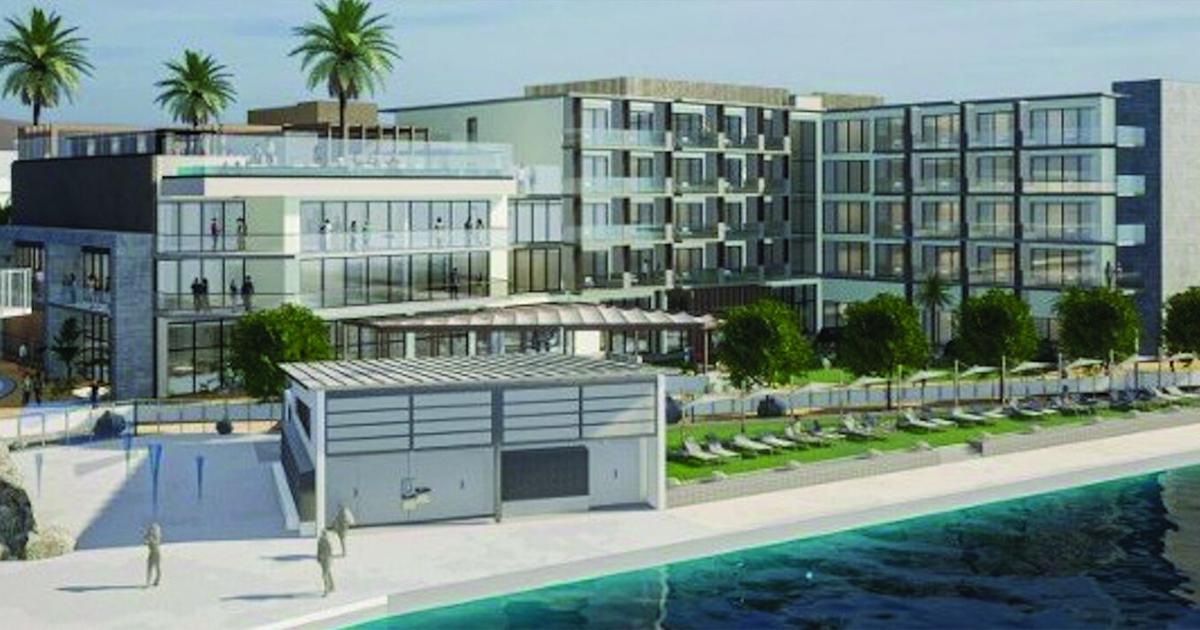
A three-star hotel and a 150-room four-star hotel, both four stories tall, are planned for Cannon Beach.
The four-star hotel will be right up against the waterfront of the surf lagoon with offerings such as room service, towel service and a wellness center, Cannon said. It’ll be the nicest hotel in the Southeast Valley with an annual revenue forecast of $12.8 million, according to Cannon.
“We hope that this is going to create some drivers for Mesa,” he said. “And that you’re going to send a lot of your corporate clients here, and they’d be happy to stay and get a taste of Mesa.”
Cannon Beach has secured a number of tenants that have already opened, including It’s Boba Time, Live IV Hydration and Guru’s Indian Kitchen. Coming soon are George’s Sports Bar, Color Me Mine and KTR-Indoor Action Sports Playground.

Developer Cole Cannon showed the layout of the master-planned 37-acre Cannon Beach venue in southeast Mesa.
“We made a really big effort to not have any real national tenants here,” Cannon said. “Investors love national tenants. But we really made it a goal to find the mom-and-pop shops – to find the unique tenants who maybe it isn’t their first rodeo, but maybe their second or third rodeo. Their balance sheets weren’t really deep but we want to give them a chance to be part of something special.”
Focusing on the small-business owner also was consistent with the vision of creating “a little bit of that Encinitas Beach, that La Jolla Shores, that unique environment where you only find in these long-time beach communities,” according to Cannon.
“We’ve really done our best to make sure we’re not cannibalizing each other,” Cannon added. “So we only have one Korean barbecue, we only have one hot dog place, we only have one ice cream place. And believe me, I got hit up by about every ice cream place in America.”
Cannon said that to his knowledge Cannon Beach has the highest rent rate in Arizona at $75 a square foot. Tenants are signing leases, which shows the kind of energy the wave pool is bringing as an economic driver, he said.
“That’s more expensive than Paradise Valley or Scottsdale,” Cannon said. “Not that we’re trying to gouge anybody (but it’s) just a very expensive project to build.”
The total cost of build-out was $300 million. To date, $110 million has been spent on the project. Cannon anticipated completing Cannon Beach in 30 months.
According to Cannon, the venue was currently attracting 1,000 visitors a day. He anticipated that to increase to 3,000 when everything’s built. The employee headcount also was expected to rise to 755 from the current 80.
And there won’t be a lack of visitors willing to part with their money, according to Cannon.
“Surfers spend money,” he said. “We have a lot of case studies in the surf market. To my knowledge there’s only three in America currently.
“I think there’s 21 worldwide but there’s a lot more coming. A lot of people think that surf pools are the next golf course, where residential communities will be fanning out around these wave pools.”
Although a 25-acre surf park is under construction in nearby Gilbert, Cannon said he wasn’t worried about the competition.
“We’re not threatened by that because the more surfers the better,” he said. “Our real competition are things like Topgolf and other activities. But if people want to learn how to surf, it just creates more surfers, which I think is good for everybody.”
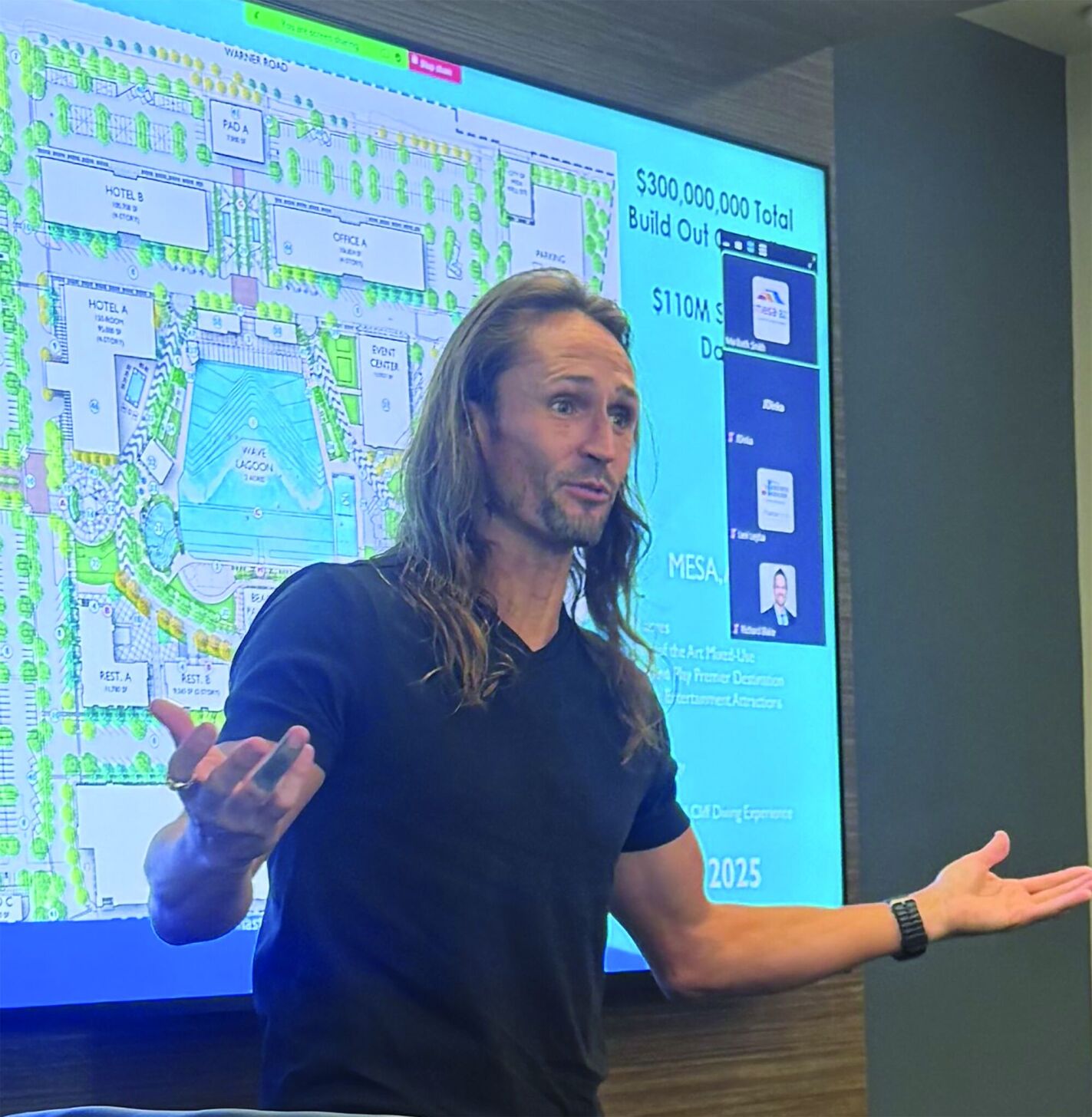
Developer Cole Cannon gave a presentation on Cannon Beach last week to the Mesa Economic Development Advisory Board.
Arizona’s first surf park – and also the nation’s – was Big Surf Waterpark in Tempe, which opened in 1969 but closed in 2019 and was demolished.
According to Cannon, surfing took off as a result of COVID.
“It went from $3.9 billion to $9.1 billion in spending,” he said. “We get a lot of these, what I call silver surfers that come from California. They got money to spend, and we’re happy they’re spending it here in Mesa.”
He also noted that Arizona was fourth in the country for net migration in 2022 and second behind Texas for the number of Californians relocating.
“We got a lot of Californians coming out here,” Cannon said. “I can’t tell you how many hugs I’ve gotten from strangers, ‘We moved here and the only that that Arizona is missing is a wave and thank you for bringing the beach here. We’re just feeling right at home here in Mesa.’ So that’s a nice welcome for our California friends.”
Cannon’s vision came to fruition after a lot of trial and error.
“Building this project was like building an airplane while you’re flying,” he said; “because we really didn’t know what we’re doing, to be blunt with you.”
Inventing the patented wave technology began in his partner Matt Gunn’s backyard, Cannon said.
“We actually flooded his neighbor’s yard twice,” he said. “They still don’t talk to this day.”
He assured the board that building a surf pool in the desert does not use a lot of water – just 5.5 million gallons annually. The annual consumption of an average golf course in Arizona was 164 million gallons.
“We consume so little water at the surf park,” Cannon said. “It’s the equivalent of a kid’s soccer field. It’s just the evaporation per year and it’s very little.”
The annual evaporation loss was calculated at 4.5 million gallons of water.
Cannon, a dad of six children, said he was motivated to create a venue where the entire family can hang out together.
“I’m married to a woman who’s wonderful,” the Gilbert resident said. “But a lot of times my hobbies don’t align with her. So this whole park was designed that me and my wife can go here at the beach. I can go surf for an hour. She’s very content knowing that our kids are fully entertained at the cliff diving to playing beach volleyball or whatever they’re doing, and she knows they’re safe because they’re lifeguarded the whole time.
“It’s not just for dad, it’s not just for mom. And if mom wants to head over to a Med Spa …while I’m surfing, she can do that, too. So we’re doing our best to make this an inclusive place. We’re the first one that’s really tying together all that full holistic experience, a hotel, med spa, restaurant, food, and that pattern is being followed now.”
Board member Natascha Ovando-Karadsheh asked Cannon why he chose Mesa for his project.
Cannon responded that former Mayor John Giles was instrumental in his decision when he approached him about his “crazy” idea.
“‘Do you want to build a surf park here?’” Cannon recalled asking Giles. “‘Or should I go to Gilbert?’ “He said, ‘Oh, no, don’t go to Gilbert. Keep it here.’”
Cannon said he told Giles that there would be challenges with water rights but he was committed and supported the project.
“This has been such an incredible project,” said Jaye O’Donnell, Economic Development director. “Cole is very passionate about it. The vision that he has for the full build-out is phenomenal and it’s already put Mesa on the map. It will continue to do so. This is such as great destination driver for the community.”