Motorsports
The “Barn Find Hunter” Remembers His Late Boss, Humpy Wheeler
Near the end, it was tough for Tom Cotter to see his old boss and mentor, Humpy Wheeler, suffering the debilitating effects of old age. Wheeler, stooped and needing two canes to try to walk, said quietly to Cotter, “Look what I’ve become.”
“It hurt to watch him go through that,” Cotter said. “He had been so vital—a successful boxer, a bicycle rider, he ate well, he kept himself in good shape—it was hard.” Wheeler died last week at the age of 86.
Cotter, known primarily as “The Barn Find Hunter” from his videos featuring discoveries of the most elusive species in all of vehicle collecting—the mostly-mythical, forgotten “car in a barn” scattered across the country’s largely rural automotive landscape—had a very successful career in motorsports public relations long before that video series premiered 10 years ago. I used to tell Cotter he invented motorsports PR, and I wasn’t entirely joking.
Let Cotter, a native New Yorker, explain it himself in a Facebook post dated August 21: “Forty years ago, H.A. ‘Humpy’ Wheeler interviewed me for an opening in Charlotte Motor Speedway’s PR department. I was hired and moved south. He taught me the basics, then encouraged me to break all the rules. It was a magical time to have been involved in the growth of NASCAR. When I left to open Cotter Communications four years later, our friendship remained intact. I visited him last week to say goodbye to a guy I loved like a father. RIP, Humpy.”


Howard Augustine Wheeler Jr. was saddled with a nickname that he inherited from his father, a university football coach, who picked it up during his own college football career. Known then as “Little Humpy” while his father was still alive, Wheeler said the nickname was arguably a negative during his own search for public relations employment; he was once up for a job at a “high-flying” New York firm, but was flatly told, “We can’t have a ‘Humpy’ working here.” Eventually, though, he realized that in a business where it was important to be remembered, the nickname was an asset. In a 1975 interview, Wheeler said that he might talk to 30 people a day who don’t know him, but afterwards those folks “are going to remember me, that’s for sure.”


Wheeler was a native of Belmont, North Carolina, located west of Charlotte. After graduating from college, he worked in public relations for the racing wing of Firestone tires, but his position was eliminated. In 1975, Wheeler began a job that would define him for the next 33 years when he was hired to handle PR for the Charlotte Motor Speedway, then was promptly named track president. Charlotte and several other speedways were owned by Speedway Motorsports, Inc., run by bombastic businessman Bruton Smith. SMI was, and still is, the largest owner of major racetracks in the country, aside from NASCAR itself. The battles between the stubborn-as-a-mule Smith, who made his fortune owning car dealerships, and Wheeler were legendary. Smith died in 2022.
When Wheeler was hired to run Charlotte, truly innovative promotions were uncommon at major speedways, though they were plentiful at smaller tracks, at minor-league baseball parks, and traveling circuses. Wheeler changed that, and was always on the lookout for ideas that would put his track on the map and in the newspaper headlines.


In 1976, when she didn’t qualify for the Indianapolis 500, he helped arrange for Janet Guthrie to race in NASCAR the same day at Charlotte. And though unfortunate circumstances prevented him from competing, Humpy greased the way for black driver Willy T. Ribbs to get a ride in the 1978 World 600, the Memorial Day weekend NASCAR race.
But Humpy’s ideas weren’t just about big promotions. He was the one who pushed to have the entire track lighted for night racing—a first for a major speedway—and he backed the construction of condominiums that overlooked the turns at the track. Many thought that was an absurd idea, right up until they were promptly sold out.
That said, Wheeler’s successful promotional style made its way to other SMI tracks as his staff, graduates of “Humpy University,” as it was called by his former employees, spread out. His most notable disciple, perhaps, was Eddie Gossage. Then vice-president of public relations for the Charlotte track, Gossage was tapped by Smith in 1994 to oversee the construction of Texas Motor Speedway, north of Fort Worth, and then to run the completed track. Despite their closeness, Gossage and Wheeler quarreled often, and Gossage, who died last year, once said that Wheeler sometimes tried to push the envelope a little too far.
Gossage said in an interview that he was called into Wheeler’s office one day, where Humpy revealed his latest promotional idea. “He said, ‘Eddie, I got this idea: Man vs. Shark—One Must Die!’” Humpy envisioned this big glass tank at the start-finish line, and he’d put a big Hammerhead shark in there with an old friend from Belmont, noted Belmont Sports Hall of Fame swimmer Reginald Lee “Moon” Huffstetler, armed with a knife. Moon Huffstetler, nicknamed the “Catawba Catfish” for swimming upstream in the Catawba River for 15 miles when he was 21, had already starred in one Wheeler promotion: Placed in a clear tank at the track, he treaded water for 98.5 hours, supposedly setting a world record for water-treading.
But even Gossage was gobsmacked by the “Man vs. Shark” concept. He told Wheeler that they’d be protested by animal-rights activists, to which Humpy replied, “Good! If there aren’t any protesters, hire some!” For reasons lost to time, Man vs. Shark never happened. “But everything after that,” Gossage recalled, “was kind of a letdown.”
Is there any doubt why Wheeler was once dubbed, “The P.T. Barnum of motorsports?”
Certainly not to Tom Cotter.
Members of Wheeler’s public relations staff love to tell stories about the ideas Wheeler would throw out for discussion. Sometimes it would be how the staff might handle a legit crisis: Suppose, Wheeler once asked, someone in the crowd smuggled in a high-powered rifle, and took out the driver leading the Coca-Cola 600? What would we do then?
That kind of mental preparation unfortunately proved its worth at least twice under Wheeler’s watch at the Speedway: In 1999, when two cars collided on the front straight during an Indy Racing League event, the right rear wheel and tire assembly from one of the cars launched into the grandstands, killing three spectators and injuring eight. And in 2000, a five-year-old pedestrian bridge leading to a parking lot collapsed, injuring 107 fans, who fell as far as 17 feet to the ground. Remarkably, there were no fatalities, but—as in that other tragedy—there were multiple lawsuits.

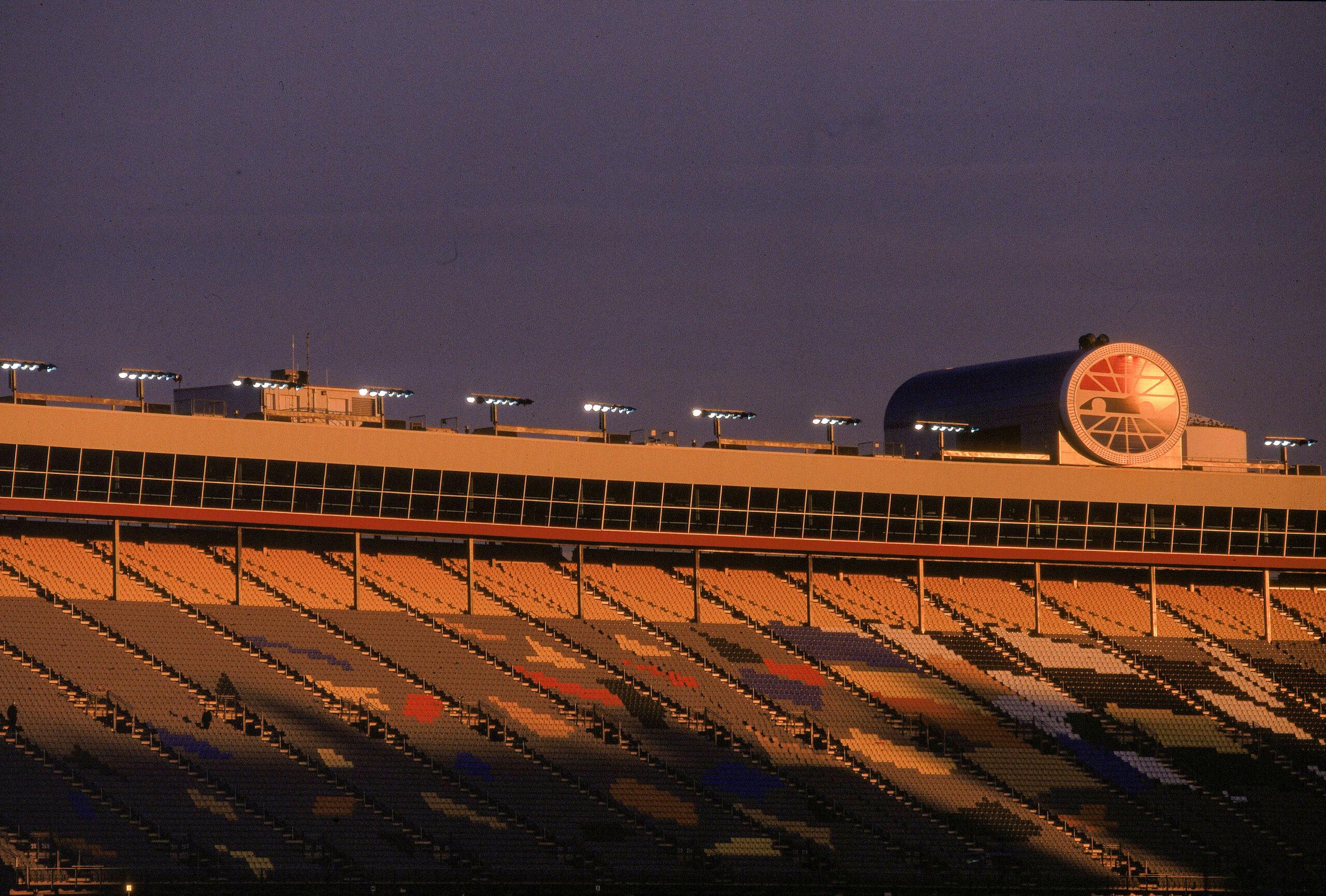
Still, it isn’t those what-if scenarios, or even his promotional ideas, that Wheeler should be best remembered, Cotter says: It’s his unwavering, and arguably rare, dedication to the people who paid his salary—the race fans. “Humpy never forgot what it was like to be a 12-year-old kid in the grandstand, and how he could make it so that kid could take the experience home.
“During the race, sure, he’d be down in the infield visiting with sponsors, then up in the press box. But in the middle of the races, he’d be in the grandstands, talking to people, asking them, ‘How do you like the show? Is there anything we can do better?’” Plus, Cotter said, he emphasized what promoters of every event should remember: “Clean restrooms, good food, and proper, well-lit parking lots. He took NASCAR and helped bring it into the modern era, to make it into a major sport.”


Three years into his tenure working for Wheeler, Cotter was called into Humpy’s office. “He asked me, ‘What do you see yourself doing in five years?’ The right answer would have been, ‘I’d like to have your job.’ But I told him the truth: I said, ‘I want to own the best public relations agency in the world for motorsports. Not just NASCAR—I want to own the best one in the world.’ He was shocked. Six months later, I gave him my notice.”
Cotter’s last day was in January of 1989, “and we had this great farewell party. And Humpy said. ‘I wish you well, and if there’s anything I can do for you, please let me know. Let’s stay connected.’ And the next morning, I opened my agency, Cotter Communications.”
That PR agency grew into The Cotter Group, and it was indeed the best, and largest, motorsports public relations agency in the world. Cotter eventually sold it, making enough money to do a couple of things he always wanted to: Write books, which led him into the Barn Find Hunter franchise, and teach public relations, which he does at Belmont Abbey College, located in Humpy’s hometown.
My favorite recollection of Humpy Wheeler came at the now-defunct NASCAR Media Tour, where motorsports writers were invited to Charlotte pre-season—yes, another one of his ideas—where we’d talk to drivers and crew members and owners, and tour the shops of several teams. At the end of one of those long days, some of us would head down to a conference room in the hotel for what we’d call “Humpy Wheeler’s Fireside Chat.”
It was just us and Humpy, talking about—well, anything. As you likely know, NASCAR is such a buttoned-down, happy-talk sport, where sometimes it’s uncomfortable discussing real issues that may not always place it in an invariably positive light. Not so with Humpy: If it needed to be talked about, he was game.


I looked forward to it every year. I miss it, and I miss Humpy.
So does Cotter. “He was one of a kind. For him, the representative fan was an imagined millworker who lived in a small town in North Carolina. ‘If I can get him to come to the track, it’ll become part of his life, and he’ll return every year. That’s our customer,’ Humpy would say. And he never stopped looking out for that guy.”