
Sports
The real story of how Larry Doby came to Cleveland 78 years ago this weekend


CLEVELAND, Ohio – I first met Bill Veeck early in the 1979 baseball season. He was the owner of the Chicago White Sox. I was in Chicago’s old Comiskey Park covering the Orioles for the Baltimore Evening Sun.
It was before the game. Veeck was sitting in the press box, smoking a cigarette. A few writers were with him. Veeck put his wooden leg up on the press box counter.
As Veeck talked, he chain-smoked. He put out one cigarette after another on the wooden leg, tossing the butt into a cup. Then he took out a match, fired it up on the wooden leg, then lit up another cigarette.
At the time, Veeck was a 65-year-old chain-smoker with a leathery, wrinkled face and tired eyes. His right leg was initially injured during World War II. He was operating an anti-aircraft gun on the South Pacific island of Bougainville. The gun recoiled, mashing Veeck’s leg. Doctors immediately wanted to amputate it, but Veeck refused.
Eventually, he relented after battling infections for a few years. He had several surgeries. The former Marine wasn’t talking about the leg on that night in 1979. He was telling stories about buying the Indians in 1946 and packing fans into the old Municipal Stadium with fun promotions.

The dreamer
The subject of Larry Doby came up. Doby was the first Black player in the American League. Veeck signed Doby in the middle of the 1947 season. He took the 23-year-old directly from the Newark Eagles of the Negro Leagues to join the Tribe in Chicago for a game on July 5, 1947.
“I wanted to do that (integrate the Majors) for years,” Veeck said, snuffing out one cigarette, lighting up another. “I tried to buy the Phillies (in 1942). I had watched Satchel (Paige) and others from the Negro Leagues. My plan was to sign a bunch of them, and we would have immediately had one of the best teams in baseball.”
Veeck said he believed he had to tell former Baseball Commissioner Judge Kenesaw Mountain Landis of his plans. Landis said baseball had no formal rules against having Black players in the Majors. But Veeck believed Landis fought against his bid with other owners and he was rejected.
But that goal of adding Black players remained when he bought the Tribe.
He also said the player he first wanted to sign for Cleveland was Paige, the legendary Negro League pitcher. Paige had barnstormed with Bob Feller at the end of several baseball seasons. They played exhibition games with stars from the Majors and Negro leagues in different towns – and made money.
“But if I signed Satchel, I was afraid they (the media and the baseball establishment) would say it was ‘just another of Veeck’s gimmicks,’ ” he said.
Veeck was known for having fireworks, clowns, bands, crazy giveaways – anything to attract a crowd.
Paige loved to give reporters different ages, often 10 years apart. It was later discovered Paige was born on July 7, 1906. That means he would have been 40 when Veeck considered bringing him to Cleveland.
Instead, he focused on Doby, a young star in the Negro Leagues for the Newark Eagles.

The planner
Most fans know that Jackie Robinson broke MLB’s color line when he opened the 1947 season with the Brooklyn Dodgers. Dodgers GM Branch Rickey not only was determined to bring Black players into Majors, but he also was dedicated to finding the right man and putting him in the right plan so it would be a success.
Rickey picked Robinson, a former star at UCLA in four different sports. Robinson had served in the military. Rickey signed Robinson to play the 1946 season for Class AAA Montreal. Rickey’s goal was for Robinson to spend some time in the minors not only to help his own development, but also to allow the people in the Dodgers organization to see his talent.
Robinson batted .349 (.929 OPS) with 40 steals in 1946, his only minor league season. He then went to spring training with the Dodgers’ Major League team in 1947. He excelled there.
This is an important part of the Doby story.
Some of the Dodgers players didn’t like the idea of having the first Black player as a teammate, but they knew Robinson could play. He’d proved it in the minors and spring training. Robinson also had the benefit of dealing with the white world of baseball during that 1946 minor league season and the spring training of 1947.
Robinson batted .297 (.810 OPS) with 29 stolen bases, the most in the National League. He also was the NL rookie of the year.
Another key fact about Robinson in 1947: He was 28 years old.

The player
I interviewed Larry Doby while I was still in college. He was a coach with the Chicago White Sox, who trained in Sarasota. I believe it was the spring of 1976 or 1977 when I talked to Doby late one Florida morning. I was selling stories to a Cleveland based weekly called “The Sports Beat.”
Doby was kind to a young reporter. He was the White Sox hitting coach. We talked for a while about his time in Cleveland. I wish I could find the story, but my search came up empty.
I wrote about him being “second” to break the color line, and how he felt about that.
“I went through the same things Jackie did,” I remember him telling me. “What had changed in the three months between when Jackie came in and I did? Nothing.”
Doby said it in a soft voice. No bitterness. It was a simple statement of fact.
Only, it wasn’t.
Later I would understand that Doby had it worse than Robinson. Doby didn’t go to the minors for a year. Doby didn’t go to spring training with Cleveland.
One day, Doby was playing the first game of a doubleheader for the Newark Eagles of the Negro Leagues. After the opener, he was put on a train to Chicago to join the Tribe for a July 5, 1947 game with the White Sox.
The manager
Early in July, Lou Boudreau talked with Veeck. Cleveland’s shortstop and manager had been asking the owner to acquire an outfielder.
When Veeck reached out to Boudreau, the manager assumed a player move was coming. The Tribe had kept an open roster spot since June 14.
“We have a new player,” said Veeck, who also served as his own general manager.
Boudreau waited.
“He’s a Negro,” said Veeck. “Larry Doby.”
At first, Boudreau said nothing. He had never heard of Doby. While Veeck was quietly having Doby scouted by a few friends and contacts in the Negro Leagues, he never mentioned that to the manager.
“What does he play?” asked Boudreau.
“Second base,” said Veeck. “He can also play shortstop.”
Boudreau was stunned. All-Star Joe Gordon was his second baseman. Boudreau was his own shortstop.
The manager kept thinking things such as, “Where will I play him? How will the players handle this? Is this kid any good? It’s the middle of the season and they are just bringing him straight to the big leagues? Really?”
The promoter & the writers
Veeck used Louis Jones to help scout the Negro Leagues. Jones, who was Black, had the role of Veeck’s personal assistant. He had been married to actress/singer Lena Horne. Most of Jones’ experience was in show business as a promoter.
Veeck had Jones spend a few weeks in Newark, checking out various players. Monte Irvin was a star who later signed with the New York Giants. Doby was batting .354 (1.182 OPS) with eight homers and 41 RBI in 30 games for Newark. At 23, he was the best young player in the league.
Doby said he had encountered Jones in the middle of June:
“I met Mr. Louis Jones when we were playing in New York,” said Doby. “When he left me, he said, ‘You’ll probably be in our organization in two or three weeks.’ I thought he was kidding.”
Veeck also was friends with several sportswriters for Black newspapers. One was Cleveland Jackson, who wrote for the Cleveland Call & Post. Jackson and other writers were more aware of Veeck’s decision to integrate the American League than their white counterparts.
This is part of a letter Jackson wrote to Veeck on June 14, 1947:
“I have looked over the two Negro baseball leagues and have noticed several players who deserve some attention from leading baseball men. I am especially enthusiastic about Larry Doby, an infielder with the Newark Eagles. His outstanding hitting, his top-flight fielding and general all-around playing ability have been instrumental in the Eagles maintaining a high place in the circuit. He’s college-trained and from the North.”
Three days later, Veeck wrote to Jackson that he had sent Bill Killefer to scout Doby, and he “sent in an enthusiastic report.”
The Call & Post wrote, “We consider Doby a very special project and we are pulling for him with every fiber of our being for his success in the major leagues.”
Veeck settled on Doby. He contacted Effa Manley, who owned the Newark Eagles along with her husband Abe Manley. She served as the GM and handled most of the business. When Branch Rickey had signed Robinson and others from the Negro Leagues, he didn’t make an attempt to purchase their contracts. He just signed them and the Negro League teams received nothing in return.
Veeck vowed to do it differently. He offered $10,000 for Doby. Effa Manley countered that Doby would be a lot more if he were white and a free agent. The negotiations continued with Veeck adding he’d pay another $5,000 if Doby remained with Cleveland for 30 days.
The Call & Post praised Veeck for his “scrupulous honesty.”

The train ride
On the morning of July 3, Doby received a phone call from Manley informing him that he had been sold to Cleveland. He was to report to the team in Chicago for a game on July 5. In Cleveland, Veeck had a team meeting telling the players of Doby’s signing.
Then Veeck held a press conference. One of his comments was: “I don’t think anyone who has the ability should be barred from baseball because of his color … The entrance of Negroes is not only inevitable, it’s here.”
Why the rush to sign Doby in the middle of the season?
“Jackie Robinson has proven to be a real big leaguer,” said Veeck. “I wanted to get the best available Negro boys while the grabbing was good. Why wait?”
Hearing the news of Doby, Franklin Lewis of the Cleveland News took a train from Cleveland to Newark. Doby had played the first game of a doubleheader on July 4 for Newark. He homered but also made two errors at second base. He then headed to the Newark train station, where Lewis found him.
“Larry had been so nervous during the game, he couldn’t field a simple grounder,” wrote Lewis. “Larry, sporty in a tieless shirt, fidgeted on the hard bench as he held his pretty wife’s hand. He said, ‘I feel … well .. more than nervous. I feel like I’m going to a new and strange world.’ ”
Dan Burley of the African-American Amsterdam News watched Doby board the train, then wrote that Doby was feeling “the strangeness of his position and deeply afflicted by the role he was called upon to play … He seemed like a boy going off from all things that had been familiar to him.”
A last thought about Doby from Lewis from that day at the train station: “He was … and is … plain scared.”
Rules of the new game
Doby was on the train for about 12 hours from Newark to Chicago. He was exhausted, and had barely slept for three days since hearing Cleveland call. When he arrived in Chicago, he met Veeck for the first time.
Veeck put out his hand and said, “Lawrence, I’m Bill Veeck,”
Doby shook the hand and said, “Nice to meet you Mr. Veeck,”
Veeck said: “You don’t have to call me Mr. Veeck, I’m Bill.”
Then Veeck had a talk with Doby. In a 1997 New York Times interview, Doby said Veeck explained: “Lawrence, you are going to be a part of history … no arguing with umpires. Don’t even turn around on a bad call at the plate. No dissertations with opposing players … those may cause a race riot. No associating with female Caucasians … remember, people are watching you.”
Those were the same basic rules given Jackie Robinson by Branch Rickey. Don’t react negatively to anything on the field. You just have to take it, no matter how awful and insulting were the comments.
Veeck then said, “We’re in this together, kid … Just remember, you’re only another baseball player.”
Doby was anything but another player on July 5, 1947.
The Plain Dealer’s Gordon Cobbledick wrote:
“The actual signing was accomplished before a battery of cameras in the office adjoining White Sox general manager Leslie O’Connor. Doby was nervous and a little frightened, but he said he’d get over it.”
The reception
Several Cleveland media members were with Doby when he walked into the Tribe’s locker room.
“When the door was thrown open, Doby stepped into the stuffy, steamy and small clubhouse,” wrote Lewis. “More than 25 players were in full uniform, each in front of his locker. Not even the scuffle of a solitary spike on the bottom of a shoe broke the horrible tomblike muteness … Boudreau approached, shook hands with Doby and said, ‘Get dressed now, we’ll be out on the field.’ The Indians filed out of the room. Not a word was uttered. Larry Doby had been welcomed to the big leagues.”
The Plain Dealer’s Cobbledick wrote: “an electric tension charged the steaming air (as Doby entered the locker room). The wordless hostility seemed to crackle and spark. No one spoke even a tentative ‘Hello.’ ”
In interviews over the years, Doby later said two players refused to shake his hand. Others did, but the temperature remained frosty.
When they took the field, Joe Gordon saw Doby by himself. The veteran second baseman went over and offered to play catch. Gordon would become one of Doby’s close friends.
“Where will Doby play?” reporters asked Boudreau.
“At short or second, that’s where they tell me he belongs,” said the manager.
It’s worth putting yourself in the place of Boudreau and the players. Doby was unknown as a person and player. He didn’t pay the minor league dues. Some players wondered if this was another Veeck publicity stunt to draw more fans and media attention to his team.
Doby was dropped into their midst in the middle of a frustrating season where Cleveland had a 29-30 record and was 8½ games behind the Yankees. This was not the Majors of today with division and wild card playoff berths. Baseball had two leagues, each with eight teams. The winner of each league went to the World Series, the others went home.
Boudreau was in the final year of his contract. He sensed Veeck wanted another manager. The manager knew many players thought Doby was taking someone’s job – and Doby hadn’t earned it. Boudreau also had no idea where to play the young man. The manager had to wonder if this would lead to him being fired after the season.

The game
Boudreau didn’t have Doby in the lineup for the game vs. the White Sox. In the seventh inning, Cleveland was behind, 5-1. They had two runners on base with two outs. Pitcher Bryan Stephens was due up.
Boudreau sent Doby to pinch hit. He was surprised, then jittery as he came to the plate. He had gotten off the train only eight hours ago. He was given no indication of the team’s plans for him. Mostly, he sat alone in the corner of the dugout.
“For Larry Doby, it took but a few short minutes to walk up to that plate,” wrote Cleveland Jackson in the Call & Post. “But for 13 million American Negroes, that simple action was the climax of a long uphill fight whose annals are like the saga of the race.”
If this were a movie, Doby would have hit a homer. Or at least a base hit. He did lash a line drive that was just foul down the left field line. But he struck out.
After the game, all the Cleveland players went to the Del Pardo Hotel in Chicago. Make that all but one … Larry Doby. That hotel had a “whites only” policy.
Veeck’s assistant Louis Jones took Doby to the DuSable Hotel on Chicago’s South Side. That’s where he stayed. He went out to eat with Jones along with African-American writers Frank “Fay” Young and Cleveland Jackson.

The season
Doby rarely played that first season. His initial big league start was the next day – at first base. Doby didn’t know the position. He didn’t have a first baseman’s glove. Traveling secretary Harold Goldstein asked first baseman Eddie Robinson if Doby could use his glove. Robinson refused.
According to the book “Our Team,” an excellent account of the Tribe during this era by Luke Epplin, Goldstein eventually convinced Robinson to hand over his glove. But after doing so, Robinson threatened to quit the team. He eventually changed his mind.
Ed McAuley of the Cleveland News reported the players were upset about Doby starting “at the expense of Eddie Robinson … as a publicity stunt for which the prospects of some other members of the squad will be sacrificed.”
Doby never played first base or even started a game for the rest of the 1947 season. He had five hits in 33 at-bats.
Doby was a man alone. Because he was Black, no white player roomed with him.
“(Doby) suffered an iceberg act,” wrote Doc Young in the Chicago Defender. “(His teammates) allowed him more space on the bench than anyone in the history of the game.”
Players such as Joe Gordon and Jim Hegan spent time with Doby, but few others did. Since he rarely played, he had no chance to prove he was worthy of being in the Majors. He was viewed as a failure, a mistake. He feared he would be released before the 1948 season.

The Statue
Jackie Robinson and Doby both faced the same racial taunts and discrimination. They were the only Black players on their teams.
But there was a major difference …
“Rickey planned Robinson’s entrance as carefully as a man would build a house with match sticks,” wrote Doc Young in the Chicago Defender.
If Veeck were building a house with the blueprint he used for Doby, he would have started with the roof full of holes and not bothered to build a foundation or put up some walls.
But during the season, Veeck realized Doby was mishandled.
“Rickey was smarter than me,” Veeck told reporters after the 1947 season. “I tried to bring him along too fast.”
This time, Veeck planned. Doby’s speed and arm made him a natural for the outfield. Doby would go to spring training, and not only learn the outfield – he also would have a special teacher.
“They brought in Tris (Speaker),” former Plain Dealer sports columnist Hal Lebovitz told me years ago. “Tris was perfect. He was patient. He connected with Doby, who was shy and really struggling with his confidence.”
Speaker was a Hall of Fame center fielder. He also was Cleveland’s player/manager when they won the 1920 World Series. Lebovitz said Speaker helped save Doby’s career. Lebovitz was in spring training with the team in 1948 and saw the two men work together.
“I’ve never seen a young ballplayer with such a high potential,” Speaker told Shirley Povich of the Washington Post. “I get a personal pleasure out of working with a kid who can do so many things so well.”
In 1948, Doby batted .301 (.873 OPS) with 14 HR and was superb in center field. He went on to make nine All-Star teams.
I’ve heard that he was a “Gold Glove-caliber outfielder” from some who saw Doby play. But the Gold Glove award didn’t start until 1957. Doby retired after the 1959 season.
Veeck and Doby remained close. When I talked to Veeck that Chicago day in 1979, Doby was the White Sox hitting coach. He had been the White Sox interim manager in 1978. Yes, that made him second again … Cleveland’s Frank Robinson was the first Black manager.
In the end, Bill Veeck was right about Larry Doby. He did belong in the Majors. In his own impulsive, inspired way, the man smoking all those cigarettes and putting them out in his wooden leg made it happen.
As for Doby, he was inducted into the Hall of Fame in 1998. He thanked Tris Speaker in his speech for the help in 1948.
Doby’s statue was put up in front of Progressive Field in 2015. But the real story is how Doby was almost set up to fail in his early days, but found a way to overcome even more obstacles than most people realize.
Note: Material for the story came from conversations I had over the years, including with Larry Doby and Bill Veeck. I wish I had kept my notes and those stories.
I have an extensive old newsclip file from Doby’s debut, stories from The Plain Dealer, Press, Cleveland News, the Cleveland Call & Post and other publications. I did the research for my book, “Our Tribe.”
The book “The Cleveland Indians” by Franklin Lewis is an excellent history of the franchise from its birth through the 1948 season. Lewis has some excellent material on Doby.
“Our Team” by Luke Epplin is an incredible account of how the 1948 Indians came together.
If you purchase a product or register for an account through a link on our site, we may receive compensation. By using this site, you consent to our User Agreement and agree that your clicks, interactions, and personal information may be collected, recorded, and/or stored by us and social media and other third-party partners in accordance with our Privacy Policy.

RESULTS
ITHACA, N.Y. –
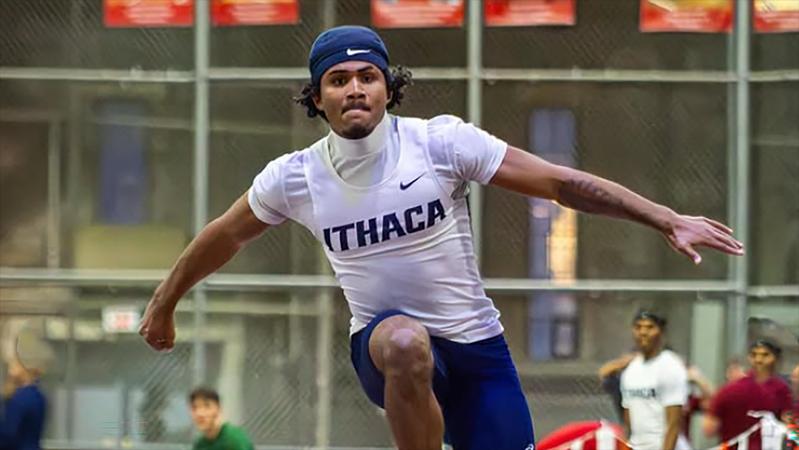
The Ithaca College men’s track & field team opened its 2025-26 season over the weekend as the Bombers made the short trip across town to compete in the Greg Page Relays hosted by Cornell University on December 5-6.
Anik Vossschulte claimed third in the 200-meter dash in a time of 23.32 seconds, while Jacob Antilety was seventh at 23.71 seconds.
Matt Lokshin posted a time of 8.65 seconds in the 60-meter hurdles to place third in the event. Aidan Irwin took fourth in the high jump with a mark of 1.70 meters.
Quinten Lewis posted a mark of 13.73 meters in the triple jump to place fourth and Sebastien-Oliver Lacrete was sixth at 12.68 meters, while Evan Cherry secured fifth in the long jump with a leap of 6.84 meters.
IC’s 4×400-meter relay team of Damian Simmonds, Griffin Lupes, Noah McKibben and George Nilson placed sixth in 3:34.49.
Luke Ellor finished sixth in the shot put with a mark of 14.40 meters.
Three Bombers finished within the top eight in the 500-meter dash as Brad Kellogg was sixth in 1:09.73, Peter Tysiak followed in seventh with 1:10.74 and Matthew DeJulio was next at 1:11.59.
Kaiden Chandler and Luke Ferrer posted times of 4:41.29 and 4:53.44 in the mile to finish in seventh and eighth.
Raf Campanile was seventh in the pole vault with a clearance of 4.25 meters.
Ithaca is off for the remainder of 2025 and will return to Cornell on January 10 for the Southern Tier Invitational.
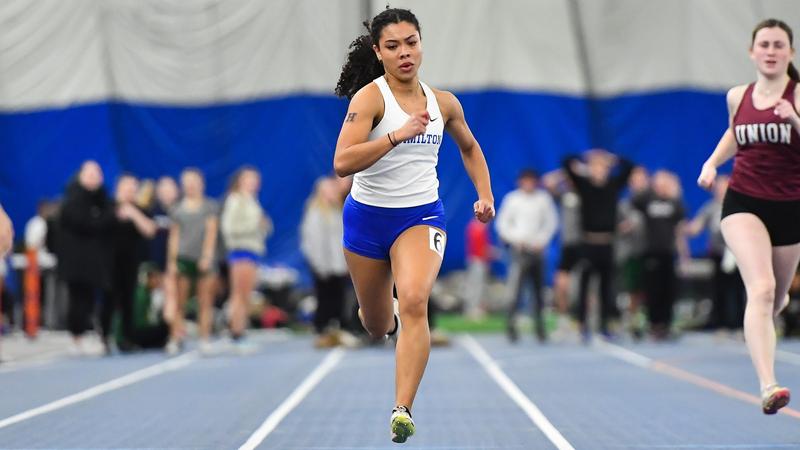
UTICA, N.Y. – The Hamilton College Continentals competed against 13 teams at the non-team scoring 2025 Utica University Track & Field Holiday Classic inside the Todd & Jenn Hutton Sports and Recreation Center on Saturday, Dec. 6.
The meet was the first of the 2025-26 season for the Hamilton women, who will be back at Utica for the Pioneers’ Winter Opener on Friday, Jan. 16 after taking a break for finals and the winter holiday.
The Continentals qualified for the 2026 All-Atlantic Region Track & Field Conference Indoor Championships in four different events and finished first in three events.
Emily Pogozelski ’26 won the 3,000-meter run by over 20 seconds with a regional-qualifying time of 10:27.93. Mackenzie Loudon ’29, who was competing in her first collegiate meet, took first place and qualified for regionals in the triple jump.
Loudon was also part of Hamilton’s winning 4×200-meter relay with Tatiana McCray ’28, Ava Chiappinelli ’29 and Marley Meyers ’28. Their performance was more than five seconds faster than the regional-qualifying time.
McCray ran a regional-qualifying 7.96 seconds and finished in second place in the 60-meter dash final. Chiappinelli also qualified for regionals in her first collegiate meet and finished right behind McCray with a time of 7.99 seconds.
TOP PERFORMANCES
300-Meter Dash (17 Runners)
4. Marley Meyers ’28, 43.08
7. Hannah Turner ’26, 43.91
60-Meter Dash (35 Runners)
2. Tatiana McCray ’28, 7.96 (PR, AARTFC)
3. Ava Chiappinelli ’29, 7.99 (AARTFC)
600-Meter Dash (16 Runners)
5. Aisha Kandji ’29, 1:47.31
4×200 Meter Relay (9 Teams)
1. McCray ’28, Mackenzie Loudon ’29, Chiappinelli ’29, Meyers ’28 (1:46.42, AARTFC)
3000-Meter Run (19 Runners)
1. Emily Pogozelski ’26, 10:27.93 (PR, AARTFC)
Triple Jump (15 Athletes)
1. Loudon, 11.29 meters (37 feet, 0.5 inches; AARTFC)
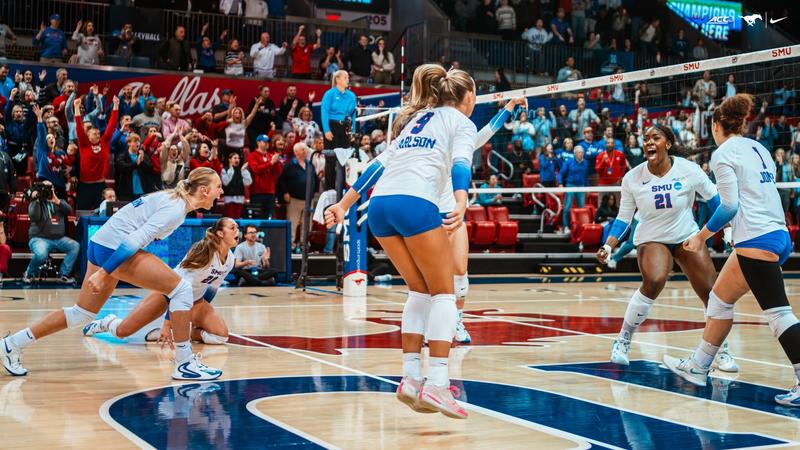
DALLAS (SMU) – For the first time in program history, SMU volleyball is headed to the Sweet Sixteen after sweeping Florida (16-12) in the Round of 32 on Saturday with set scores of 25-11, 25-21, 26-24.
With the win, SMU won its 27th match of the season, tying the program record for single-season wins. It also gave coach Sam Erger her 100th victory at SMU and in her Division I head coaching career.
Averi Carlson dished out 38 assists, the most in a three-setter for the senior setter this season. Carlson led the Mustangs to a .370 hitting percentage in the win. Kennedi Rogers went for 14 kills, hitting .440, with four digs and three blocks. Malaya Jones closely trailed Rogers with 13 kills, eight digs and seven blocks, tying her career high.
SMU out-blocked the Gators 15-4, spearheaded by a career-high nine blocks from freshman Maggie Croft. The Mustangs’ blocking efforts helped hold the Gators to a .156 hitting percentage for the match.
MATCH NOTES
- With 13 kills against Florida, Jones (503) is now the second player in SMU Volleyball history to reach 500 kills in a season. She joins Rachel Giubilato, who notched 568 kills in 2006.
- Averi Carlson (1,341) moved to third in the rally scoring era and sixth all-time for single-season assists at SMU.
- Jones reached the double-digit kill mark for the 26th time this season and for the ninth straight match.
- Rogers recorded double-digit kills for the sixth time this season.
- It marked Schilling’s 22nd time in double-figures this season and her fifth straight.
- With six blocks against the Gators, Anyanwu draws within 14 of breaking the program record for most blocks in a season. (188 by Janelle Giordano in 2015)
- SMU had double-digit blocks (15) for the 17th time this season and for the second straight match.
- SMU has won 20 of its last 21 matches and its 12th straight.
- The Mustangs end the 2025 season with 15 wins at Moody Coliseum, tying the program record for most in a season.
- The win marks the Mustangs’ 15th sweep, 11th at home this season.
HOW IT HAPPENED:
SMU controlled the first set from start to finish in all phases of the game. SMU hit .483 with no errors on 29 swings in the first, while holding Florida to a .000 hitting percentage. Rogers put in five kills to lead the Mustangs, who got point production from six different players to help propel them to a 25-11 set one victory. SMU commanded the net with a 5-0 advantage in blocks.
Down four (16-12) in the second frame, SMU responded with five straight points on a run that included two aces from Madison Scheer. After trading points, SMU went on a 4-0 run to pull away in the frame. The Mustangs went on to win the frame 25-21.
Tied 20-20 entering the red zone of the third set, SMU got the first two points on an ace from Carlson and a block from the freshman tandem of Rogers and Croft. Despite a 3-1 run by Florida that put the Gators at set point first, the Mustangs responded with three straight to close the match, ending the frame with their sixth block of the set to win 26-24.
SMU LEADERS:
SMU Kills Leader: Kennedi Rogers (14)
SMU Assists Leader: Averi Carlson (38)
SMU Digs Leader: Jordyn Schilling (11)
SMU Blocks Leader: Maggie Croft (9)
SMU Ace Leader: Madison Scheer (2)
SMU Points Leader: Malaya Jones (17.5)
Up Next: SMU will get a rematch with No. 3 seed Purdue in the NCAA Regional Semifinal on Thursday evening in Pittsburgh, Pa.
Sports
Trans volleyball player Blaire Fleming hits back at claim about female teammate’s eating disorder
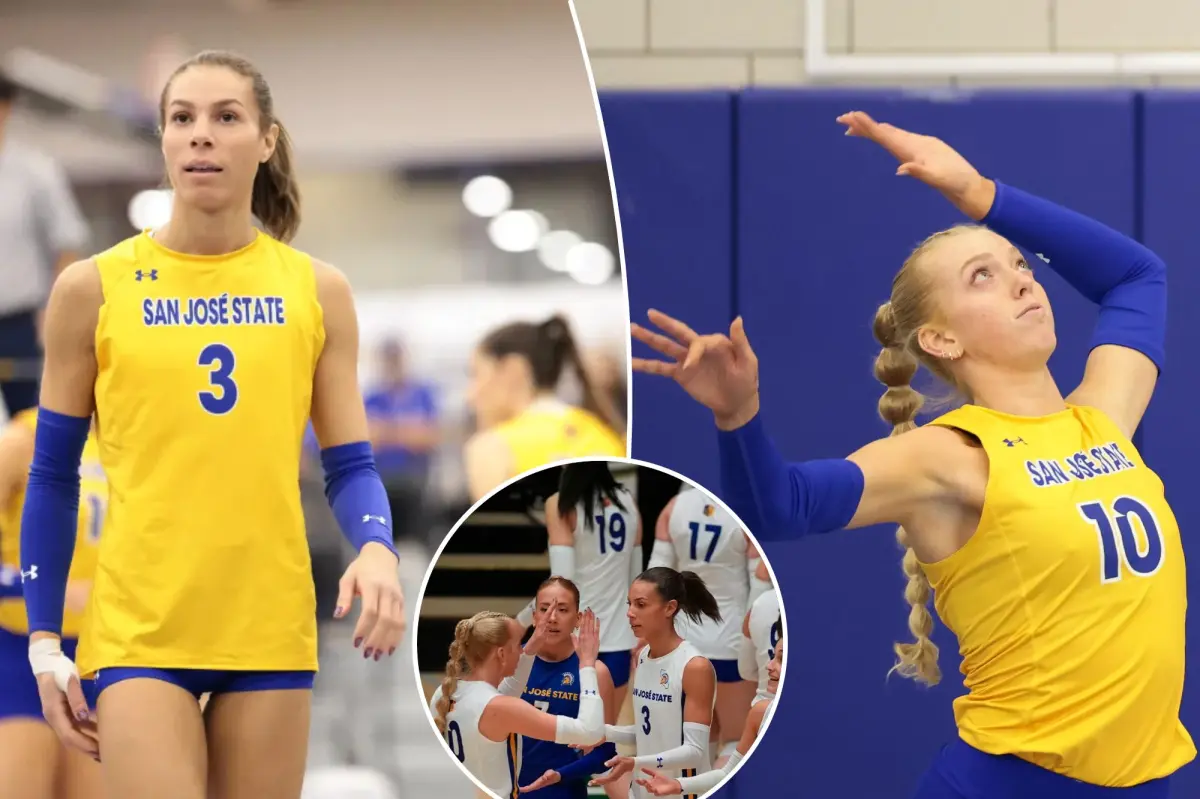
Transgender college volleyball player Blaire Fleming has hit back at claims that she triggered her teammate’s eating disorder due to emotional distress — and said that she doesn’t “feel bad for her.”
Fleming, 23, was at the center of a scandal last year involving Brooke Slusser, who filed multiple lawsuits against her San Jose State University (SJSU) teammate after discovering that she was transgender.
Slusser alleged that the panic and stress from that period of her life led her to develop an eating disorder, leading to anorexia so severe that her menstrual cycle stopped for nine months.
The pair had previously shared hotel rooms and changing spaces for a whole season in 2023 before Slusser said she found out that Fleming, who is biologically male but reportedly started medically transitioning at 14, was trans.
“From the stress and how anxious I was every single day, I just wasn’t eating really at all,” Slusser told Fox News Digital last week.
“I went from around 160 to 128 [lbs] in that one semester. It definitely isn’t healthy for someone of my size to be that weight, and I ended up losing my menstrual cycle for nine months. So it was definitely severe,” she said.
Slusser later dropped her classes in the final semester this past spring, citing constant in-person harassment by students who opposed her stance.
Fleming has since responded, claiming that Slusser’s eating disorder dated back for as long as she knew her, prior to her learning that she was trans.
“She’s been anorexic and struggled with food since I’ve known her aka since 2023. She literally would weigh herself 2-3x a day and keep track of it on her whiteboard in her room,” Fleming told Fox News Digital on Sunday.
“So I really don’t care or feel bad for her. And she didn’t drop her classes, she failed out, hope that helps!” Fleming said.
Slusser has now come back and disputed Fleming’s allegations.
“These statements are just not true. I have always lived a very healthy lifestyle. Before these events took place I was very disciplined in fueling myself for athletics and [kept] track to make sure I was where I need to be to be the best athlete,” Slusser told Fox News Digital.
“It wasn’t until all the craziness started that my healthy lifestyle turned very unhealthy into not eating the amount I should,” Slusser said.
“As for school, I decided to stay home after fall 2024 to better myself and heal. So no, I did not return to San Jose and enroll myself in more courses at an institution that didn’t have my best interest,” she added.
Slusser alleged that she was never told Fleming’s birth sex and said the two regularly shared hotel rooms on away trips, according to her lawsuits filed against the NCAA and Mountain West Conference.
Fleming allegedly requested to be roomed with Slusser, a request she said was granted by team leadership, according to lawsuits.
Slusser said that the 6ft1 Fleming confessed to being transgender during a conversation over ice cream with another teammate in April 2024.
In September 2024, Slusser joined swimmer Riley Gaines’ lawsuit against the NCAA.
At the same time, SJSU’s volleyball team saw a series of forfeits by opposing teams, with police protection regularly assigned.
The US Department of Education is currently investigating SJSU for potential Title IX violations.
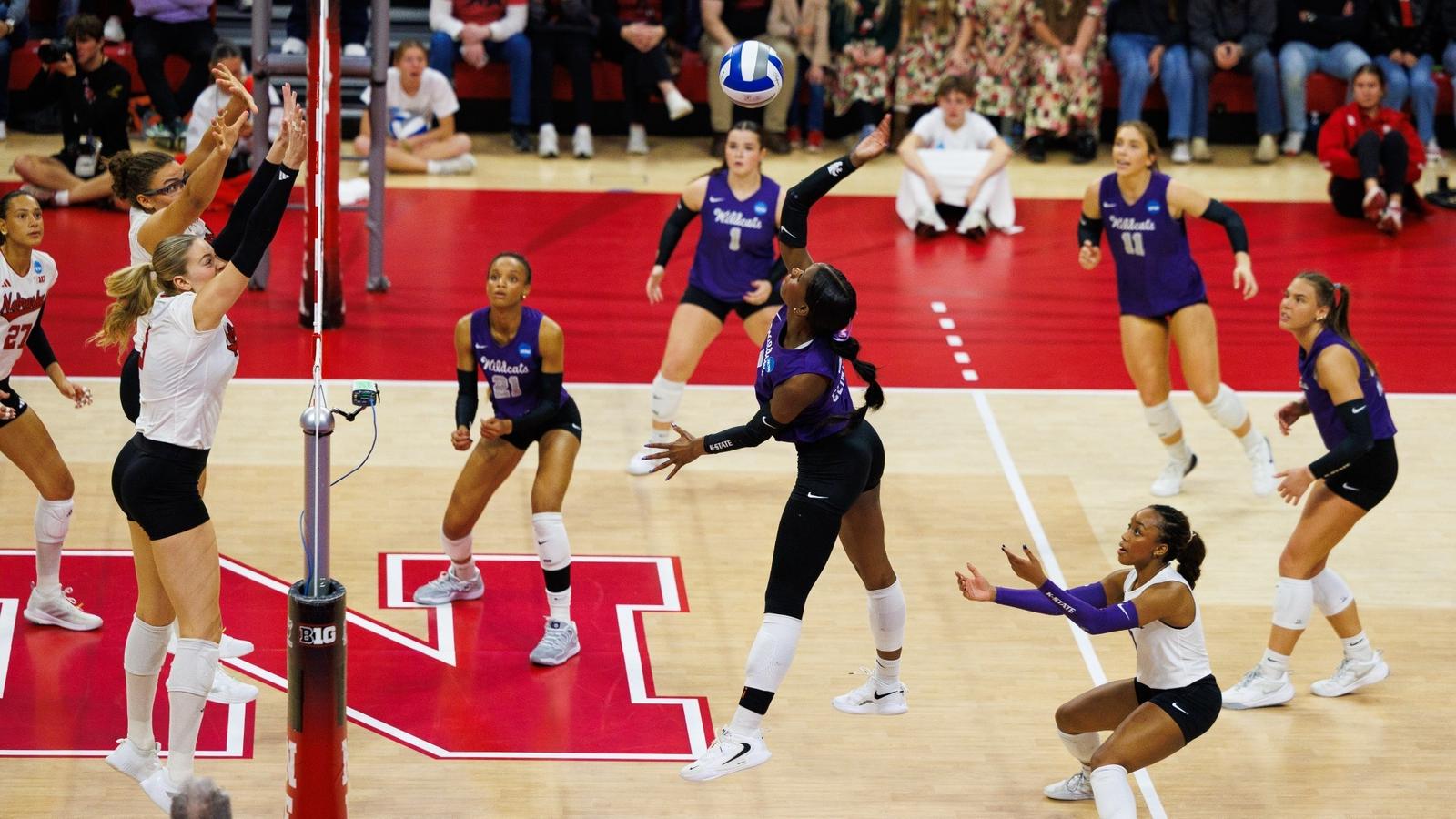
Nebraska (32-0, 20-0 Big Ten), the No. 1 overall national seed, carded 43 kills with Andi Jackson and Harper Murray each putting down 10 kills. Jackson hit at a .533 clip with two errors on 15 attempts. Taylor Landfair added eight kills.
Six different Wildcats (18-10, 10-8 Big 12) contributed a kill in the match paced by seven from Aniya Clinton. An All-Big 12 Second Team selection, Clinton turned in five digs with three blocks to lead the Cats with nine total points.
The Wildcats forced 18 errors from the Cornhuskers – Nebraska’s most since September 16 against Creighton (26) – producing an 8.0-5.0 advantage in total team blocks, led by five from senior Brenna Schmidt.
The 18 attack errors marked the Huskers’ fourth-highest total of the season, joining 20-plus error outings against Creighton (26), Kentucky (25) and Pittsburgh (23).The match also marked just the fifth time in which the Cornhuskers were held below the .300 threshold, as the team’s .253 hitting percentage was the team’s fourth lowest output of the year.
Of the 52 sets played at the Devaney Center, K-State’s 21 points in Set 2 marked just the 11th set Nebraska allowed 20-plus points at home.
LeGrand, who earned All-Big 12 Second Team recognition Tuesday, handed out 19 assists to go along with a team-high nine digs. K-State also got six digs from Symone Sims and Shaylee Myers, who put down six kills.
Nebraska will advance to the Regional Semifinals of the 2025 NCAA Tournament and will face No. 16 national seed Kansas (24-10, 13-5 Big 12) on Friday, December 12 in Lincoln.
FROM THE CATS
JASON MANSFIELD, K-STATE HEAD COACH
Overall Statement…
“Congratulations to Nebraska on a really good match. Elite defensive team and their offense was good at times. I’m really proud of our team and just the fight that we had in all three sets. I felt like we battled with them for a while, just couldn’t sustain it. Just really proud of this team and what we accomplished this season.”
On the 2025 senior class…
“They’ve been special. We’ve talked about it all the way back in January, I felt like this team was going to take the program to a different place and the seniors were going to lead us in that direction, and they have. All five of them are very unique, very special, they’re different in their own way. They’ve added so much to our program their whole career, really, but their senior season was special. There’s no substitute for urgency and I think they were really urgent this whole season in trying to get us to this place. I’m really proud of them and they’ll be remembered forever.”
AVA LEGRAND, SENIOR SETTER
On setting the standard for the next generation of K-State players…
“We want it to be the standard to make it to the tournament and not only make it to the tournament, but to make it to the next round. And hopefully every year we get past the next hump. That is something we tried instilling in the freshmen and younger girls, and hopefully for the future of this program we will have a standard here and K-State is going to be one to remember.”
On ending her career in her hometown state…
“It comes full circle. I had such a great cheering section with so many friends and family members that it was so awesome to see them all out there. But also, just Bob Devaney is a special place. Growing up in Nebraska, it’s a volleyball state, can’t deny that, but hearing the fans cheer for all us Nebraska girls was pretty awesome, but I think full circle comes to mind.”
ANIYA CLINTON, SENIOR OUTSIDE HITTER/OPPOSITE
On the senior leadership…
“This is kind of where we want our program to be and we don’t want it to start here. This is a spot that we’ve brought our program, and we don’t want it to stop here. This is a spot that we’ve brought our program, and I think we’ve done a really good job as seniors leading so I hope that the next group of seniors continues to follow in our footsteps.”
SET-BY-SET
Set 1 – #1/(1) Nebraska 25, K-State 17
- Nebraska jumped out to a quick 7-2 lead behind a pair of kills from Rebekah Allick and aces from Laney Choboy and Virginia Adriano.
- Four unanswered points for K-State highlighted a 6-1 scoring run that trimmed a seven-point deficit, 15-8, to two. The run included a block by Clinton and Schmidt, along with a service ace from Emerson Van Lannen – her 28th of the season.
- The Wildcats were held to a .086 hitting percentage (8 kills, 5 errors, 35 swings) in the opening frame against the Cornhuskers’ .250 (16 kills, 7 errors, 36 attempts).
- K-State out-blocked Nebraska in Set 1, 4.0-2.0.
Set 2 – #1/(1) Nebraska 25, K-State 21
- The Wildcats captured their first lead of the match, 4-1, with a pair of blocks from Schmidt, Clinton and LeGrand.
- After seven tied scores, Nebraska ran away with a 4-0 scoring run to take the first substantial lead of the set, 13-10, but was answered with kills from Schmidt and Reagan Fox to make it a one-point score.
- K-State came out of a timeout with a kill from LeGrand to spark a 4-1 run, that included three consecutive kills from LeGrand, Fox and Clinton, bridging the gap to two, 22-20.
- The run forced a timeout from Nebraska, their first of the match, and was followed by a solo stop by Schmidt.
- With the score notched at 22-21, Nebraska put together a 3-0 closing run to put the set away.
- K-State recorded a set-best .171 hitting percentage behind 12 kills on 35 attempts with six errors, while the defense limited Nebraska to a .139 clip (12 kills, 7 errors, 36 swings) with four blocks.
Set 3 – #1/(1) Nebraska 25, K-State 16
- After back-and forth action, the Wildcats pieced together a 4-0 scoring run to take a one-point lead.
- Tied 8-8, the Cornhuskers rattled off an 8-1 scoring run to overcome the deficit and take control of the set.
- K-State managed just seven kills in the final set, hitting at a .097 efficiency, while Nebraska turned in a match-high .393 clip (15 kills, 4 errors, 28 errors).
INSIDE THE BOX
- Nebraska defeated K-State in straight sets to advance to the Regional Semifinals – 25-17, 25-21, 25-16.
- K-State turned in a .118 hitting percentage (27 kills, 15 errors, 118 attempts), while Nebraska finished with a .243 efficiency (43 kills, 18 errors, 99 attempts).
- The 18 attack errors marked the Huskers’ fourth-highest total of the season.
- The match also marked just the fifth time the Cornhuskers were held below a .300 hitting percentage.
- The team’s .253 hitting percentage was the team’s fourth lowest output of the year.
- Clinton led the Wildcats with seven kills to go with five digs and three blocks.
- Myers finished with six kills while Fox added five.
- LeGrand handed out 19 assists and logged a team-leading nine digs.
- LeGrand and Van Lannen each recorded a service ace.
- The Cats out-blocked the Cornhuskers, 8-5.
- Nebraska was led by Jackson’s 10 kills at a .533 clip. Murray also put down 10 kills.
- Olivia Mauch finished with a match-high 13 digs and Laney Choboy picked up 12.
- Of 52 sets played at the Devaney Center, K-State’s 21 points in Set 2 marked just the 11th set Nebraska allowed 20-plus points at home.
BEYOND THE BOX
- In its history, K-State has made the NCAA Tournament 19 times, advancing to the Regional Semifinal three times (2000, 2003, 2011).
- K-State is 16-19 overall in the tournament, that includes a 3-10 record in the second round.
- The Wildcats advanced to the second round of the NCAA Tournament for the first time since 2016, making the program’s 12th overall appearance in the round.
- The 2025 postseason run marks K-State’s sixth time being sent to Lincoln for the first-round in school history (2011, 2012, 2014, 2015, 2021, 2025).
- Nebraska leads the all-time series 84-4, that includes a 36-3 record at home.
- Saturday’s contest marks the third meeting between the Wildcats and Cornhuskers in the postseason and first since 2011.
- The Cats are 1-2 in the postseason series vs. the Huskers.
- In 2011, K-State upset third-seeded Nebraska in five sets to advance to the team’s third NCAA Regional Semifinal (Sweet 16).
- The Wildcats were 9-5 in three-set matches this season.
- K-State is now 9-9 is three-set matches all-time in the NCAA Tournament.
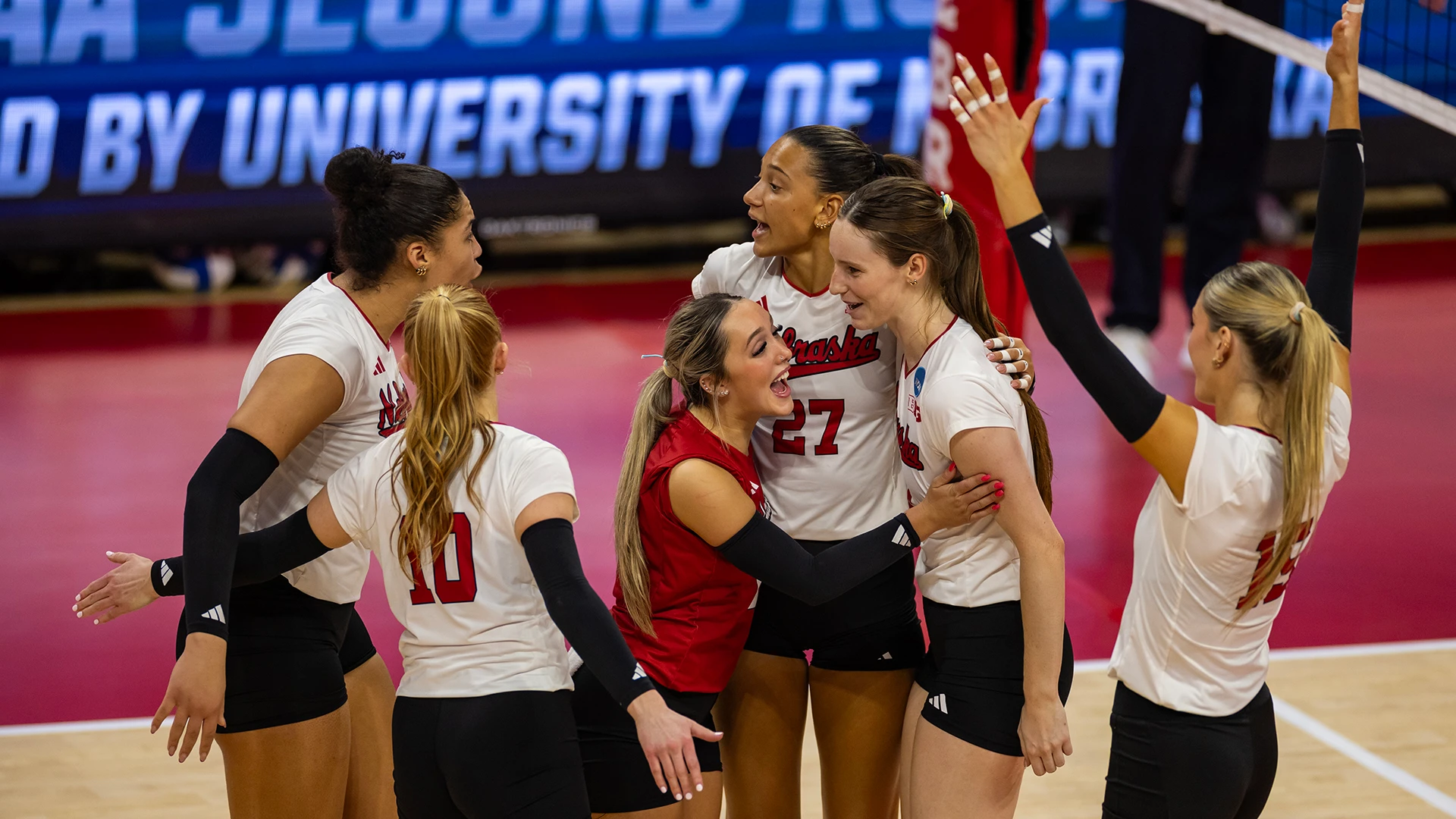
LINCOLN, Neb. – The No. 1 Nebraska volleyball team advanced to an NCAA Regional for the 14th year in a row with a 25-17, 25-21, 25-16 win over Kansas State on Saturday in front of a crowd of 8,601 at John Cook Arena at the Bob Devaney Sports Center.
Andi Jackson and Harper Murray tied for match-high honors with 10 kills apiece, as the Huskers improved to 32-0 on the season. Aniya Clinton led Kansas State with seven kills, as the Wildcats ended their season with an 18-10 record.
Nebraska hit .253 in the match and held Kansas State to a .118 attack percentage, the seventh straight match the Huskers out-hit their opponent by at least .100. Nebraska had a 43-27 advantage in kills and a 48-32 edge in digs, while the Wildcats out-blocked the Huskers, 8-5.
Jackson hit .533 in the match, producing her 10 kills on just 15 swings. Taylor Landfair (8 kills), Virginia Adriano (7) and Rebekah Allick (6) all had more than five kills, as Bergen Reilly dished out 34 assists. Defensively, Olivia Mauch had 13 digs and Laney Choboy added 12 digs. Both players also had two aces apiece, as Nebraska served up seven aces while allowing only two aces.
Set 1: Early aces by Choboy and Adriano and two kills by Allick helped the Huskers to a 7-2 advantage. The Wildcats pulled within 9-7 before a pair of Landfair kills and a solo block by Adriano helped NU to a 14-7 lead after a 5-0 run served by Reilly. Kansas State cut it to 16-14, but Murray tooled a block and Jackson tacked on a kill to make it 18-14 Big Red. Sigler made an unbelievable one-handed save over the net to keep a rally alive that resulted in another Murray kill. Jackson and Reilly swatted a Wildcat attack, and Murray added a kill to make it 21-14 after Mauch’s 5-0 service run. Kills by Murray and Landfair made it 23-15, and the Big Red won 25-17.
Set 2: The Huskers fell into a 4-1 hole to begin the set, but two kills by Murray around an ace by Mauch erased the deficit. Landfair put the Huskers on top 6-5 with a kill. KSU regained a 10-9 lead, but a service error by the Wildcats, an ace by Choboy and a block by Jackson and Adriano led to NU going up 13-10. A pair of kills by Jackson had NU ahead 15-13 at the media break. A Landfair kill and ace by Reilly pushed NU’s lead to four, 19-15, and Landfair and Murray tacked on kills to make it 21-16. NU led 22-17 when Kansas State went on a 4-0 run to cut it to 22-21. Allie Sczech posted a key sideout kill, and K-State hit wide for set point. Murray and Jackson ended the set, 25-21, with a block.
Set 3: The Huskers came out swinging with kills by Allick and Adriano, and three in a row by Jackson helped NU take a 7-6 lead. A decisive 8-1 run put the Huskers up 16-10. Landfair and Adriano had kills, and Sigler served an ace. Adriano’s fourth kill of the set made it 18-12, and Mauch served an ace before a Jackson kill increased NU’s lead to 20-12. Murray tacked on two kills to extend the run to 5-0. The Huskers finished off the sweep, 25-16.
Up Next: The Huskers will play No. 16 Kansas in a regional semifinal on Friday night on ESPN2. No. 6 Texas A&M and No. 9 Louisville are also headed to Lincoln and will play in the first regional semifinal at 6 p.m. (CT) on Friday. Nebraska and Kansas will begin 30 minutes following the conclusion of the Texas A&M-Louisville match.
The regional final will be played on Sunday with the time to be determined on Friday night.
Nebraska Post-Match Notes
- With the win, Nebraska advanced to an NCAA Regional for the 14th consecutive season and for the 41st time in program history. The Huskers’ 41 regional appearances are the most in NCAA history, while Nebraska’s 14 consecutive regional appearances rank second nationally.
- With the win, Nebraska improved to 136-38 all-time in the NCAA Tournament. The Huskers rank second in NCAA history in postseason wins and winning percentage (.782).
- The win was Nebraska’s 32nd consecutive victory, which ties for the third-longest winning streak in school history.
- Nebraska improved to 31-2 all-time in second-round NCAA Tournament matches.
- The Huskers improved to 89-7 all-time in home NCAA Tournament matches, including a 34-2 record at the Devaney Center.
- Nebraska has won 28 consecutive home matches in the NCAA Tournament, a school record.
- Overall, Nebraska has won 62 consecutive home matches dating back to Dec. 1, 2022. That ranks as the sixth-longest streak in NCAA Division I history and the third-longest streak in Husker history.
- The Huskers improved to 64-1 all-time against unranked opponents in the NCAA.
- Nebraska was the first to 20 points in each of the three sets. The Huskers are now 92-0 this season in sets when reaching 20 points first.
- Nebraska took a 2-0 lead in the match, and the Huskers are now 105-2 all-time in the NCAA Tournament when taking a 2-0 lead.
- With the sweep, the Huskers have won 45 consecutive sets at home. On the season, Nebraska has a 51-1 set record at home.
- Kansas State scored the first two points of set two, marking the first time Nebraska had trailed in the NCAA Tournament. The Huskers did not trail in their first four sets of the postseason.
- Nebraska limited Kansas State to 27 kills, marking the 13th time this season the Huskers have allowed fewer than 30 kills.
- Andi Jackson had 10 kills on 15 swings against Kansas State. In two matches on the weekend, Jackson had 20 kills on 27 swings, hitting .667.

Men’s Track & Field Opens Indoor Season at Cornell Greg Page Relays

Verstappen expected to win race, Norris title

Alonso hints at ‘favorites’ as Max hunts allies

Revised plan for Good Life District Aquatics Center appears to meet city’s needs

Forget Kiffin — NIL is the real villain here

BangShift.com Pro 10.5 Racing Action From The DI Winter Series Snowbird Nationals At Bradenton Motorsports Park In Florida

What Happened To Michael Annett? Everything We Know About The Former NASCAR Driver’s Death

Women’s track and field athletes win three events at Utica Holiday Classic

Volleyball Advances to Program’s First Sweet Sixteen, Sweeps Florida Saturday

LIVE: F1 Abu Dhabi GP updates – Max Verstappen leads Lando Norris in Q3 | Live text

Garrett Brown

Trans volleyball player Blaire Fleming hits back at claim about female teammate’s eating disorder

Agretelis Continues to Roll Saturday at the HSR Sebring Pistons & Props Presented by Alan Jay Automotive Network

John Calipari Said What? Must-Hear Quote About NIL Era Goes Viral After Arkansas Video

Rochester-based North Star FC has been serving kids and adults for 50 years – Post Bulletin

First Tee Winter Registration is open

Fargo girl, 13, dies after collapsing during school basketball game – Grand Forks Herald

CPG Brands Like Allegra Are Betting on F1 for the First Time

Volleyball Recaps – November 18

F1 Las Vegas: Verstappen win, Norris and Piastri DQ tighten 2025 title fight

Two Pro Volleyball Leagues Serve Up Plans for Minnesota Teams

Utah State Announces 2025-26 Indoor Track & Field Schedule

Sycamores unveil 2026 track and field schedule

Redemption Means First Pro Stock World Championship for Dallas Glenn

Bowl Projections: ESPN predicts 12-team College Football Playoff bracket, full bowl slate after Week 14

Texas volleyball vs Kentucky game score: Live SEC tournament updates

How this startup (and a KC sports icon) turned young players into card-carrying legends overnight

Indiana’s rapid ascent and its impact across college football

Pohlman admits ‘there might be some spats’ as he pushes to get Kyle Busch winning again

Ole Miss Reveals Troubling News Before Egg Bowl vs Mississippi State

 Why a rising mid-major power with an NCAA Tournament team opted out of revenue-sharing — and advertised it
 NBA Legend Michael Jordan to Join NBC Sports as Special Contributor
 Falcons mailbag
 Portal Update – Basketball and Gymnastics Take Hits
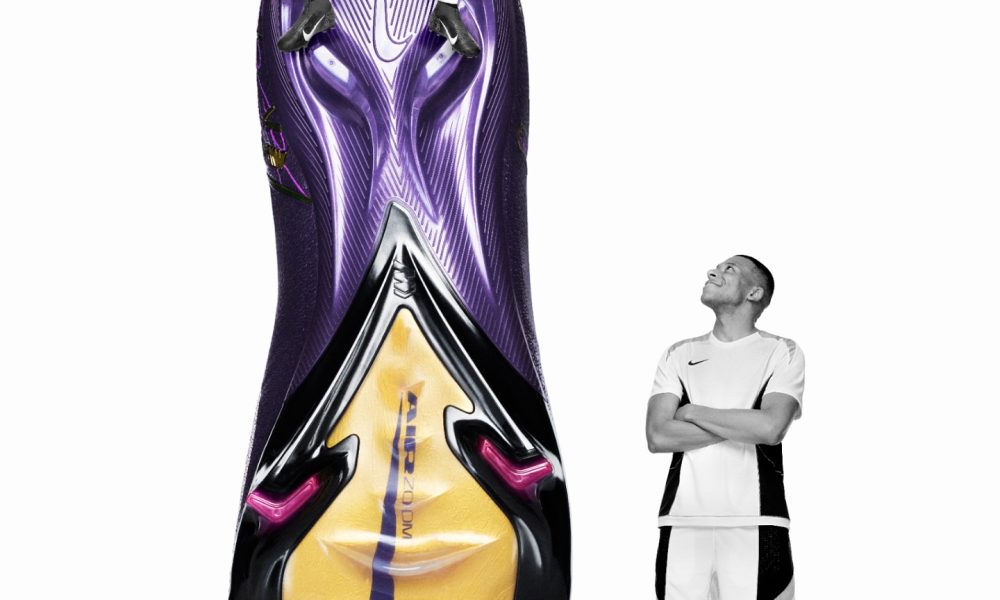 has always dreamed in Mercurial. Now his initials are on the boots.
The new Kyl…
has always dreamed in Mercurial. Now his initials are on the boots.
The new Kyl…
-
 Rec Sports2 weeks ago
First Tee Winter Registration is open
-
 Rec Sports2 weeks ago
Fargo girl, 13, dies after collapsing during school basketball game – Grand Forks Herald
-
 Motorsports2 weeks ago
CPG Brands Like Allegra Are Betting on F1 for the First Time
-
 Sports3 weeks ago
Volleyball Recaps – November 18
-
 Motorsports2 weeks ago
F1 Las Vegas: Verstappen win, Norris and Piastri DQ tighten 2025 title fight
-
 Sports2 weeks ago
Two Pro Volleyball Leagues Serve Up Plans for Minnesota Teams
-
 Sports2 weeks ago
Utah State Announces 2025-26 Indoor Track & Field Schedule
-
 Sports2 weeks ago
Sycamores unveil 2026 track and field schedule
-
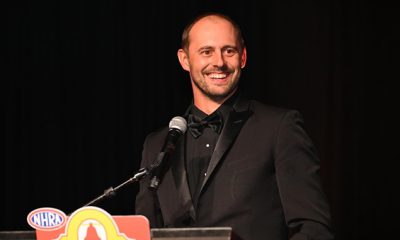 Motorsports1 week ago
Redemption Means First Pro Stock World Championship for Dallas Glenn
-
 NIL7 days ago
Bowl Projections: ESPN predicts 12-team College Football Playoff bracket, full bowl slate after Week 14