Rec Sports
The U.S. Ski Team Star You Won’t See on Snow This Weekend – FasterSkier
On Friday afternoon, as World Cup sprinters snap into their skis in Trondheim and the SuperTour fields gather in Fairbanks, one of the United States’ most electrifying young Nordic athletes will step onto an entirely different stage. Stanford University, the No. 1 seed in the NCAA Women’s Soccer Tournament, is marching toward the College Cup—and at the center of it all is a player who, in just a matter of days, will also begin her bid for the U.S. Olympic Cross-Country Ski Team.


The athlete is Sammy Smith: 20 years old, a national-team skier, an Environmental Systems Engineering major, and a starter for one of the most dominant college soccer programs in the country. The U.S. Ski Team views her as one of the most promising sprinters of her generation. And yet this weekend, instead of warming up on hard-packed snow in Norway or chasing early-season points in Alaska, she’ll be preparing to face Michigan State with advancing to the NCAA Championship Game on the line.
“Get ready to cheer for one of the U.S. Ski Team’s top skiers this weekend,” you might tell Nordic fans. “Just… not on skis.”
From the outside, the collision of seasons looks impossible to manage. For Smith, it is simply the life she has known since childhood.

Idaho in Two Parts
Smith grew up in a pattern that almost feels mythic now: winters in Sun Valley, summers and the rest of the year in Boise. Her family built the rhythm—her mom moving the kids north each winter so they could ski full-time and homeschool them in those snowy months.
“I kind of grew up splitting time between Boise and Sun Valley,” Smith says. “My mom would move up to Sun Valley during the winter with my siblings and me so we could ski, and she would homeschool us up there… I did that all through high school.”
In Boise, she was a typical public school student. In Sun Valley, she became a multi-sport anomaly. Her childhood was not just active—it was encyclopedic.


“Growing up, I played about every sport one can imagine,” she says. “I ran track and cross country all through high school… I played hockey for a long time. Played football. Yeah, like, you name it, I pretty much did it.”
Soccer was the constant. She started as soon as a child could sign up—though the Smiths occasionally bent age rules to make sure she could play with older kids. When her older sister started soccer, she was right behind her.
“It’s probably like three years old when I started,” Smith says.
And then there was freestyle skiing—a considerable part of her identity, something she expected to pursue more seriously than Nordic. Until one day, she couldn’t.
“I ended up fracturing my tibia in my sophomore year,” she says. “And so I focused on Nordic that winter… I ended up having a great season, and then haven’t really looked back since.”
The transition was abrupt, but the groundwork had already been laid: years of downhill confidence, years of skiing, years of learning to read terrain and push limits.
“I’ve been on skis my entire life,” she says. “Very comfortable on downhills… I love to ski aggressively.”
The athlete emerging in those years was already something unusual. The athlete she would become—balancing multiple sports at world-class levels—was still unimaginable.


Against the Specialization Tide
From the outside, Smith’s career appears to defy the common wisdom of modern youth sports. Increasingly, top athletes specialize early; by high school, many are all-in on one discipline.
Smith resisted that. Not because she lacked ambition, but because multiple sports gave her joy—and made her better.
“I think that’s something I’ve really thought a lot about,” she says. “There’s been more and more pressure to specialize… but growing up and doing so many different sports just kind of added to different components of skiing that I think are really important.”
Soccer, for example, translates directly into sprint racing.
“It’s a very high-paced game,” she says. “There’s a lot of change of direction, a lot of accelerating and decelerating. Particularly when you’re looking at heats, a lot of it is reacting to other people’s moves, trying to find little gaps and squeeze through.”
The skill set becomes a competitive edge: quickness, agility, and decision-making under pressure.
“That ability to shift gears really quickly and take openings when you can really emulates in soccer,” she says.
Freestyle skiing contributed something else entirely: creativity and courage on skis, especially in chaotic or technical downhill sections.

“At World Juniors last year,” she recalls, “everyone was in the track. I hopped out of the track, went far on the inside, and just double poled… It was a risky move, but it was something I saw.”
She paused for only a moment before going all-in. It worked.
The blend—soccer fuel, freestyle instinct, Nordic engine—gives her a uniqueness rarely seen in American skiing.
U.S. Ski Team head coach Matt Whitcomb sees it clearly.
“She’s a world-class athlete,” Whitcomb says. “She’s already exhibited the early signs of being a World Cup star.”
That she is doing this while starting for Stanford’s soccer team? To him, it’s not a contradiction. It’s part of the magic.

Why Stanford — and Why Now
Choosing Stanford was not simple. Smith had options—many of them. But a few factors stood out.
“I really value my education,” she says. “Stanford’s a great school. It’s where my mom went. And my sister is also on the soccer team, so the opportunity to get to play college soccer with her is pretty hard to pass up.”
Her academic path—Environmental Systems Engineering with an energy concentration—fits a pattern among elite U.S. skiers. Many of the top men (Gus Schumacher, Ben Ogden, et al.) have gravitated toward engineering. Smith sees the overlap, too.
“You look at a skier and the training that they do,” she says. “They’re very self-motivated, very committed. So I’m sure certain aspects translate pretty well.”
The challenge, of course, is that Stanford is far from snow. It is not close to ski culture. It is not close to the European World Cup circuit. It is very near, however, to one vital piece of equipment:
“Fortunately, I have a classic roller-ski treadmill… in a little office space,” she says. “That’s been an irreplaceable part of my training.”
She uses it for high-quality sessions, often squeezed between classes, labs, or soccer obligations. Running remains a central component, helped by the demands of soccer conditioning.
But she knows her preparation is different—less volume, more precision. Not ideal. Not textbook. Not expected. And yet:
“I think I’ve tried to accept that,” she says. “I know that I am not at my best, but skiing is a sport you can do for a very long time. I don’t necessarily need to be the best skier I can be at 20 years old.”
Again, Whitcomb backs the long view.
“We’re willing to postpone that timeline,” he says. “We’re just happy for Sammy being happy in her current environment. We’ll take what we can get at this moment, but we want more down the road, and we’re excited for it.”
This, in many ways, is the crux of the story: the U.S. Ski Team is betting on Sammy Smith not despite her dual identity, but because of it.


The Final Four — and Then the Sprint Start Line
The most astonishing part of Smith’s season is its timing.
If Stanford beats Michigan State on Friday in Kansas City, they move directly to the College Cup championship game. The semifinal is December 5th; the final is December 8th, Monday. Smith has already mapped out the days that follow.
“We’ll get back Tuesday night from Missouri… I have a final at 8 a.m. Wednesday morning,” she says. “I’m going to fly out right after my final, and then I’ll have one day of snow on Thursday in Alaska, and then I’ll be hitting that sprint on Friday.”
She says this calmly, matter-of-factly, like someone describing a standard weekend trip.
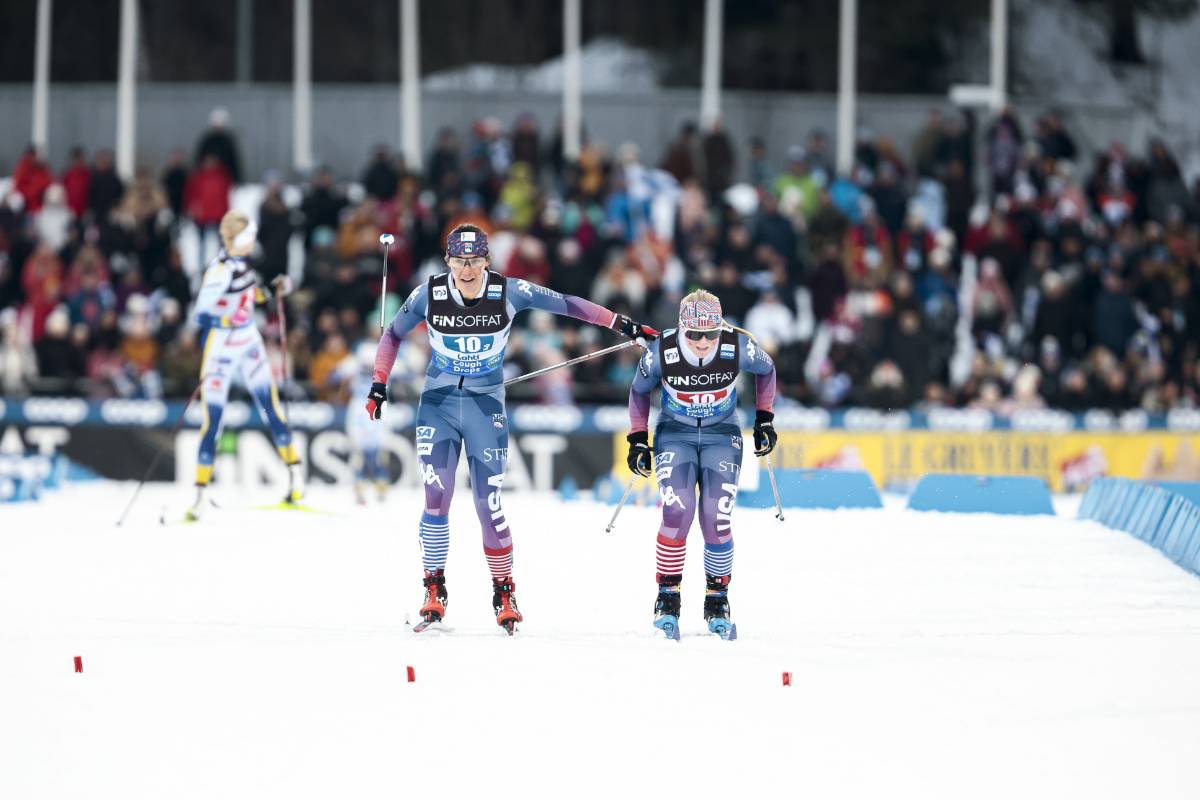
The Anchorage SuperTour sprint is not just any race—it is her re-entry into skiing, her first day on snow of the season, and a crucial tune-up before U.S. Nationals in Lake Placid, where she hopes to qualify for the Olympic team.
The Anchorage races, she says, are not performance indicators—they are simply a way to “bust the rust off.”
“Obviously, a lot of other skiers will have been on snow for well over a month, and I won’t,“ she says. “It’ll just be an opportunity to get on skis, do something fast.”
Her real focus is the 10-day window between Anchorage and Lake Placid.
“For me, as more of a sprinter, and the way the criteria is set up, I’ve got to target the qualifiers,“ she says. “So being really deliberate… knowing exactly what I’m going for.”
The stakes are simple: she must race well at U.S. Nationals to have a shot at Milano-Cortina.
The stakes are also massive.
The Domestic Gamble
If Smith had a regular ski season—if she weren’t in the NCAA Tournament—she might have chased World Cup points, fought to crack the top 45, and used international racing to establish selection priority.
But that route is closed.
“If you’re only racing a few of the international races, it’s incredibly challenging to get into that top 45,“ she says. “Whereas if you were able to do all of them, it’s a lot more feasible.”
She knows she has “had some really good World Cup sprints,“ and she wonders—without bitterness—what might be possible in a different academic or athletic setup.
But this year, it is the domestic route or nothing.
“That’s what I’m planning on,“ she says. “I need to have some killer races at U.S. Nationals.”
What sounds like a gamble is, for her, simply the version of the sport she can access this season. And she is okay with that.
“Just being consistent… being intentional,“ she says. “Doing what I can.”

Who She Wants to Be
Ask Smith what success looks like decades from now, and she doesn’t list medals or championships.
“You look at Jessie’s legacy,“ she says, referencing Jessie Diggins. “The amount of skiers she’s inspired and how much she’s done for the sport… I want people to look back on my career and feel like I’ve done a lot for the sport, inspired the younger generation of skiers, and brought a lot back to my community.“
It is the kind of answer that feels too mature for her age, but entirely in character.
She is not racing to avoid mistakes—she is racing toward something: possibility, growth, a long future. Maybe a future on the World Cup. Maybe a future in engineering. Maybe a future doing both.
But first, she has Michigan State.

The Athlete You’ll Watch Twice This Month
When you tune in this Friday—whether you are a Nordic diehard refreshing live timing from Trondheim, or an American fan checking SuperTour results—remember that one of the most important U.S. prospects in cross-country skiing will be competing too. She just happens to be wearing soccer cleats instead of ski boots.
And next week, she’ll be back on snow, sprinting against the country’s best, staking her claim for a place on the Olympic team.
The duality is not a distraction for Sammy Smith.
It is her identity.
It is what built her.
And it might be what carries her into the future of American skiing.
“She’s been playing a ton this year,“ Whitcomb says. “Of course, we want her all to ourselves… but we want more down the road, and we’re excited for it.”
This weekend, she wants one thing: a berth in the College Cup Final.
Next weekend, another: a ticket to the Olympics.
Two worlds.
Two uniforms.
One athlete.
A lot of people will be cheering for Sammy Smith this month. Nordic fans just get to do it twice.
*You can watch #1-ranked Stanford vs. #2-ranked Duke in the women’s College Cup semifinal tomorrow, Friday, December 5, at 8:45 p.m. EST on ESPNU. The game can also be streamed on the ESPN app, Fubo, or Hulu.
Love Stories Like This? Help Keep Them Coming.
Feature interviews like this one take time, access, and care to produce. If you value thoughtful storytelling and independent ski journalism, please consider becoming a Voluntary Subscriber. Your support directly fuels the work we do to cover the people, places, and moments that make our sport special.
Join the FasterSkier community!
