Sign up for the Today newsletter
Get everything you need to know to start your day, delivered right to your inbox every morning.


Two years ago, Michael Brown died while playing golf on the Vineyard due to anaphylactic shock from a wasp sting, an allergy he didn’t know he had. This year, thanks to the advocacy work of his wife Megan Shai Brown, three bills have been introduced at the State House that could increase access to lifesaving allergy medication.
The bills aim to make it easier for police departments, schools and other organizations to store and use epinephrine auto-injectors, such as EpiPens, in emergency situations, and in the process save lives.
Mr. Brown died suddenly in 2023 at the age of 41. He first visited the Island during summers and eventually moved here full time, working at the Wharf, where he and Ms. Shai Brown met. He later worked for Performance Mechanical Industries on the Island, and was an Little League coach for he and Megan’s two sons.
Following Mr. Brown’s death, Ms. Shai Brown began to advocate to make epinephrine more accessible. Her work started on the Vineyard. Thanks in part to her advocacy, the Edgartown police department began to carry EpiPens to administer in emergency situations this fall.
“He is, of course, my motivation for this doing in his honor, keeping his memory alive and going, and to try and ensure that no other families have to go through this senseless pain,” Ms. Shai Brown said in a recent interview with the Gazette.
Epinephrine auto-injectors are only available to individuals through prescription. People who experience a severe allergic reaction for the first time, as Mr. Brown did, do not have access to the medication.

Ms. Brown with sons Calvin and Miles.
— Ray Ewing
The new legislature, if passed, would make it possible for more locations, including restaurants and youth sports leagues, to carry the medication. The bills would also provide legal protections to police departments carrying epinephrine auto-injectors and require schools to stock the medication.
In order to increase awareness about these bills, Ms. Shai Brown and others will host an education day at the
state house on June 24. Physicians, law enforcement and people impacted by anaphylaxis will present on the topic.
State Rep. Thomas Moakley, who introduced one of the three bills in February with state Sen. Julian Cyr, said that Ms. Shai Brown has been instrumental in organizing the event.
“Megan Shai has done amazing advocacy work on the Island and beyond,” Mr. Moakley said.
The first bill, which Ms. Shai Brown calls the Michael Brown Law, would allow for any organization where allergens may be present to stock auto-injectors and train employees to use them. She also emphasized the importance of training.
“It will take the fear factor out if it happens in their place of business,” she said. “It will give staff the tools to recognize the symptoms and act fast.”
She added that she knew nothing about allergic reactions before her husband suffered an anaphylactic shock.
“Before this happened to my husband, to be honest, I thought if you touched an EpiPen, you could die,” she said. “Since this has happened, I’ve talked to so many people across different aspects of life, and there is so much misinformation out there about EpiPens.”
Ms. Shai Brown compared the idea to the availability today of automated external defibrillators (AED). She goes through CPR-AED training every other year because her family owns restaurants. In the training, she said, everyone is taught how to use the AED and to call 911.
“You want to try to get that medical device that’s life saving on the person as fast as possible,” she said. “That is the same idea with the EpiPens, having them in our communities and available in restaurants and in stores, hotels, wherever it is, available as fast as possible.”
While researching how to make epinephrine more accessible, Ms. Shai Brown met others in similar situations, including Chandler Smalling Sullivan, from Walpole, whose daughter almost died from an anaphylactic reaction in preschool. Since the incident, Ms. Smalling Sullivan had been advocating for the Walpole Police Department to carry auto-injectors.
According to Ms. Shai Brown, Ms. Smalling Sullivan’s daughter had an allergic reaction to sunflower butter. The police were the first to respond, but did not have an EpiPen. The ambulance followed close behind, and those responders did have the medication.
“You could see a way where, if the ambulance was held up, that’s a horrible, very different outcome,” Ms. Shai Brown said.
Ms. Shai Brown and Ms. Smalling Sullivan worked with state Rep. John Rogers, a Democrat from Norwood, to re-file a second bill that would help protect police who administer medical assistance for an anaphylactic reaction.
“It increases liability protection for police officers and hopefully encourages police chiefs to put [EpiPens] in their medic bags,” Ms. Shai Brown said. “They are usually the first on the scene….Let’s give them all the tools that they need to save a life.”
The third bill Ms. Shai Brown is seeking support for would require schools to maintain a stock of epinephrine auto-injectors. She said that it is important to have non-patient specific medication in schools because many people do not know that they have allergies before a reaction happens.
For example, during the 2021-2022 school year, the Massachusetts Department of Health reported 286 anaphylactic events across schools in the state. Of those, 19.2 per cent did not have have a known history of allergies. These numbers include students, teachers and visitors to schools.
“If the school doesn’t have undesignated EpiPens in their school, then they have to call an ambulance and wait for that ambulance to come, and that’s again, valuable life saving time,” Ms. Shai Brown said.
At present, the three bills have been referred to committees. The next step will be for each bill to receive a public hearing, where people will be able to testify in person, virtually or in writing.
Ms. Shai Brown is encouraging people to reach out to their representatives and senators to help her honor her husband’s legacy, who she said was a strong community member, incredible father and wonderful husband.
“We have the medicine that can save lives,” Ms. Shai Brown said. “Let’s make sure that we can get it out there, so it can do what it’s there for.”

ESCONDIDO, Calif. — Like many mothers in Southern California, Paula Gartin put her twin son and daughter, Mikey and Maddy, into youth sports leagues as soon as they were old enough. For years, they loved playing soccer, baseball and other sports, getting exercise and making friends.
But by their early teens, the competition got stiffer, the coaches became more demanding, injuries intervened and their travel teams demanded that they focus on only one sport. Shuttling to weekend tournaments turned into a chore. Sports became less enjoyable.
Maddy dropped soccer because she didn’t like the coach and took up volleyball. Mikey played club soccer and baseball as a youngster, then chose baseball before he suffered a knee injury in his first football practice during the baseball offseason. By 15, he had stopped playing team sports. Both are now in college and more focused on academics.
“I feel like there is so much judgment around youth sports. If you’re not participating in sports, you’re not doing what you’re supposed to be doing as a kid,” Gartin said. “There’s this expectation you should be involved, that it’s something you should be doing. You feel you have to push your kids. There’s pressure on them.”
Youth sports can have a positive effect on children’s self-esteem and confidence and teach them discipline and social skills. But a growing body of recent research has shown how coaches and parents can heap pressure on children, how heavy workloads can lead to burnout and fractured relationships with family members and friends, and how overuse injuries can stem from playing single sports.
A report published by the American Academy of Pediatrics in 2024 showed how overuse injuries and overtraining can lead to burnout in young athletes. The report cited pressure by parents and coaches as additional risk factors. Another study, in the Journal of Sport &Social Issues, highlighted how giving priority to a win-at-all-costs culture can stunt a young athlete’s personal development and well-being. Researchers at the University of Hawaii found that abusive and intrusive behavior by parents can add to stress on athletes.
Mental health is a vast topic, from clinical issues like depression and suicidal thoughts to anxiety and psychological abuse. There is now a broad movement to increase training for coaches so they can identify signs and symptoms of mental health conditions, said Vince Minjares, a program manager in the Aspen Institute’s Sports &Society Program. Since 2020, seven states have begun requiring coaches to receive mental health training, he said.
Domineering coaches and parents have been around for generations. But their pressure has been amplified by the professionalization of youth sports. A growing number of sports leagues are being run as profit-driven businesses to meet demand from parents who urge their children to play at earlier ages to try to improve their chances of playing college or pro sports. According to a survey by the Aspen Institute, 11.4% of parents believe that their children can play professionally.
“There’s this push to specialize earlier and earlier,” said Meredith Whitley, a professor at Adelphi University who studies youth sports. “But at what cost? For those young people, you’re seeing burnout happen earlier because of injuries, overuse and mental fatigue.”
The additional stress is one reason more children are dropping out. The share of school-age children playing sports fell to 53.8% in 2022, from 58.4% in 2017, according to the National Survey of Children’s Health. While more than 60 million adolescents play sports, up to 70% of them drop out by age 13.
While groups like the Aspen Institute focus on long-standing issues of access and cost in youth sports, combating mental health problems in young athletes is an emerging area. In recent years, professional athletes like Naomi Osaka and Michael Phelps have shined a light on the issue. But parents who want to teach their children the positive parts of playing sports are finding that some of the worst aspects of being a young athlete are hard to avoid.
That was apparent to the parents who took their sons to hear Travis Snider speak at Driveline Academy in Kent, Washington, one Sunday last spring. Snider was a baseball phenom growing up near Seattle and was taken by the Toronto Blue Jays in the first round of the 2006 MLB draft.
But he finished eight unremarkable seasons as an outfielder and played his last major league game at 27. While attempting a comeback in the minor leagues, he worked with a life coach to help him make sense of why his early promise fizzled. He unearthed childhood traumas and unrealistic expectations on the field.
In a playoff game as an 11-year-old, he had had a panic attack on the mound and was removed from the game.
Though he reached the highest level of his sport, Snider felt as if distorted priorities turned baseball into a burden, something he wanted to help others avoid.
Last year, he started a company, 3A Athletics, to help children, parents and coaches develop healthier approaches to sports that include separating professional aspirations from the reality that most young athletes just want to get some exercise and make friends.
“We as a culture really blended the two into the same experience, which is really toxic for kids as they’re going through the early stages of identity formation,” Snider said. “You have a lot of parents who are sports fans that want to watch youth sports the same way they watch pro sports without recognizing, ‘Hey, the thing I love the most is out there running around on the field.’”
He added, “We’ve got to take a step back and detach from what has become normalized and what kind of vortex we get sucked into.”
Driveline Academy, an elite training facility filled with batting cages, speed guns, sensors and framed jerseys of pro players, might be the kind of vortex Snider would want people to avoid. But Deven Morgan, director of youth baseball at Driveline, hired 3A Athletics to help parents and young athletes put their sport in context.
“It’s part of a stack of tools we can deploy to our families and kids to help them understand that there is a structural way that you can understand this stuff and relate to your kid,” he said.
“We are going to get more out of this entire endeavor if we approach this thing from a lens of positivity.”
During his one-hour seminar, Snider and his partner, Seth Taylor, told the six sets of parents and sons how to navigate the mental roadblocks that come from competitive sports. Snider showed the group a journal he kept during the 2014 season that helped him overcome some of his fears, and encouraged the ballplayers to do the same.
“It’s not just about writing the bad stuff,” he said. “The whole goal is to start to open up about this stuff.”
Taylor took the group through a series of mental exercises, including visualization and relaxation techniques, to help players confront their fears and parents to understand their role as a support system.
His message seemed to get through to Amy Worrell-Kneller, who had brought her 14-year-old son, Wyatt, to the session.
“Generally, there’s always a few parents who are the ones who seem to be hanging on too tight, and the kids take that on,” she said. “At this age, they’re social creatures, but it starts with the parents.”
Coaches play a role, too. The Catholic Youth Organization in the Diocese of Cleveland has been trying to ratchet down the pressure on young athletes. At a training session in August, about 120 football, soccer, volleyball and cross-country coaches met for three hours to learn how to create “safe spaces” for children.
“Kids start to drop out by 12, 13 because it’s not fun and parents can make it not fun,” said Drew Vilinsky, the trainer. “Kids are tired and distracted before they get to practice, and have a limited amount of time, so don’t let it get stale.”
Coaches were told, among other things, to let children lead stretches and other tasks to promote confidence. Track coaches should use whistles, not starting guns, and withhold times from young runners during races.
“We’re trying not to overwhelm a kid with anxiety,” said Lisa Ryder, a track and cross-country coach for runners through eighth grade. “CYO is not going to get your kid to be LeBron.”
© 2025 The New York Times Company
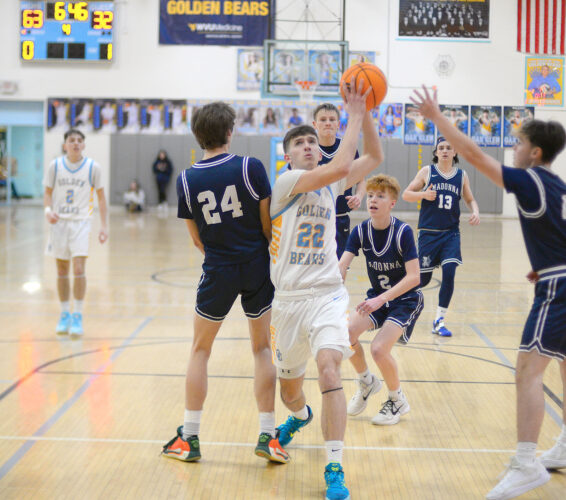
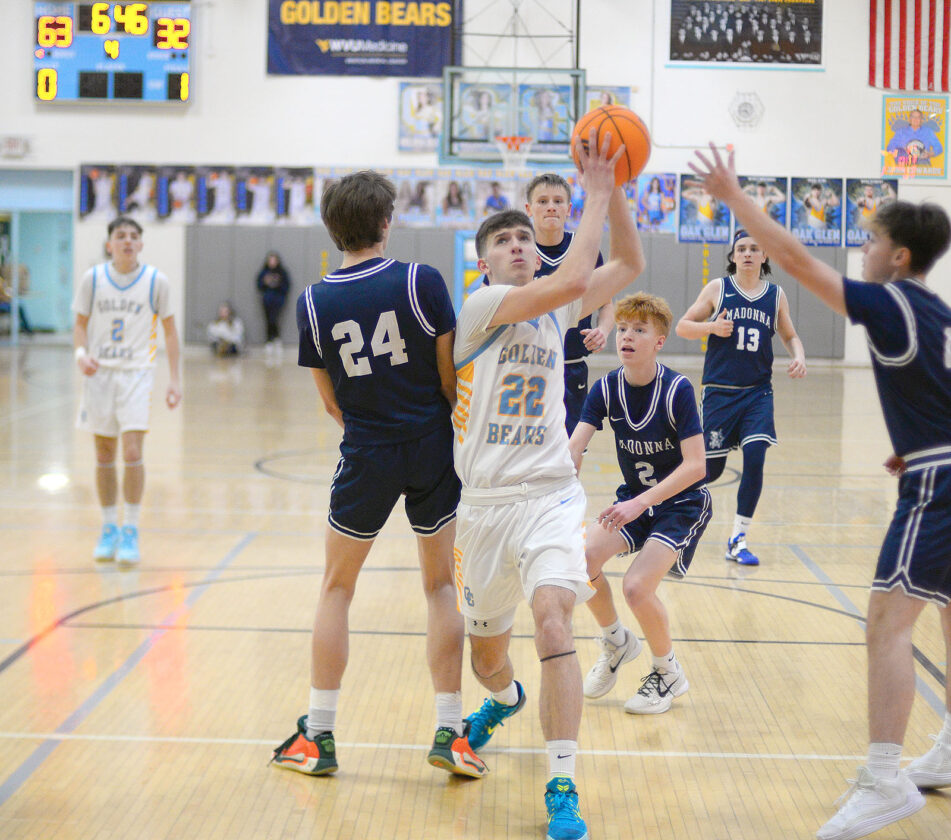
STRONG TO THE HOOP — Oak Glen’s Gavin Geisse drives to the hoop past Madonna’s Reno Fuscardo and Luke Wingett during Tuesday’s game. – Andrew Grimm
NEW MANCHESTER — Knowing his team had a big edge in experience, veteran Oak Glen head coach Jerry Everly wanted to see his group take care of business against Madonna in its last game before the new year.
His Golden Bears did just that, pulling away for an 80-34 victory over the youthful Blue Dons inside the Bears Den Tuesday night.
The victory sends Oak Glen into the new year above the .500 mark at 3-2.
“We played well against a team that we should beat,” Everly said. “They’re very young, their time will come, so we wanted to take care of business and get them while they’re young. We wanted to take care of ourselves, worry about our own game and execute, and I thought we did.
“I told them to take care of business and not take anything for granted, not come out sloppy and execute the things we work on in practice and I thought we did a good job of that. We still have some things to work on, but that’s good, we’ll keep working.

Madonna’s Tyler Dillon jumps against defense from Oak Glen’s Elijah Knisley. – Andrew Grimm
“It’s good to go into the new year above .500.”
Oak Glen had four players reach double figures — two of whom did so coming off the bench — and knocked down nine 3s in the victory.
Gavin Geisse netted 14 points to lead the way, while Mason Kell hit three of the triples to finish with 11. Colt Hissam also tallied three treys and finished with 11 points off the bench, while Tyler Evans came off the bench and also tallied 11.
All told, 10 of 11 players to see the floor for Everly’s team scored, all 10 contributing at least five points.
Oak Glen opened an 18-8 lead after one, then scored 25 points in the second quarter to push the lead to 24 at halftime, then continued to build it the rest of the way to the 46-point victory.
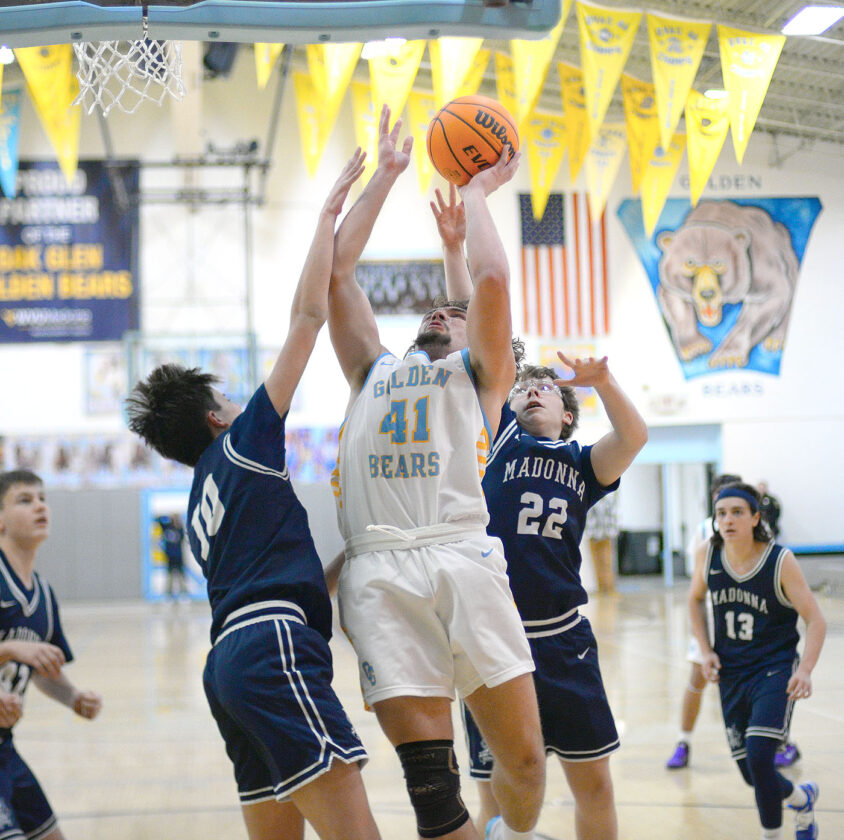
Oak Glen’s Kam Hebron puts up a shot past the Blue Dons Vinny Chiodi and Anthony DeCaria. – Andrew Grimm
For Madonna (1-6), which dressed a lineup of five sophomores, three freshman and a junior, the early season growing pains continued, though they continue to play hard for their veteran coach.
“We’re learning, there are growing pains,” Madonna head coach George Vargo said. “Our kids play hard, they just have to learn the game better. But they keep playing hard and they don’t give up. We start a freshman and four sophomores, so we know we’re going to go through the growing pains. We’ll get better as we go and keep learning and keep growing.
“We’ve seen a lot of improvements from Game 1 to Game 7.”
The Dons were led by 14 points from Reno Fuscardo and eight from Jake Druga.
UP NEXT
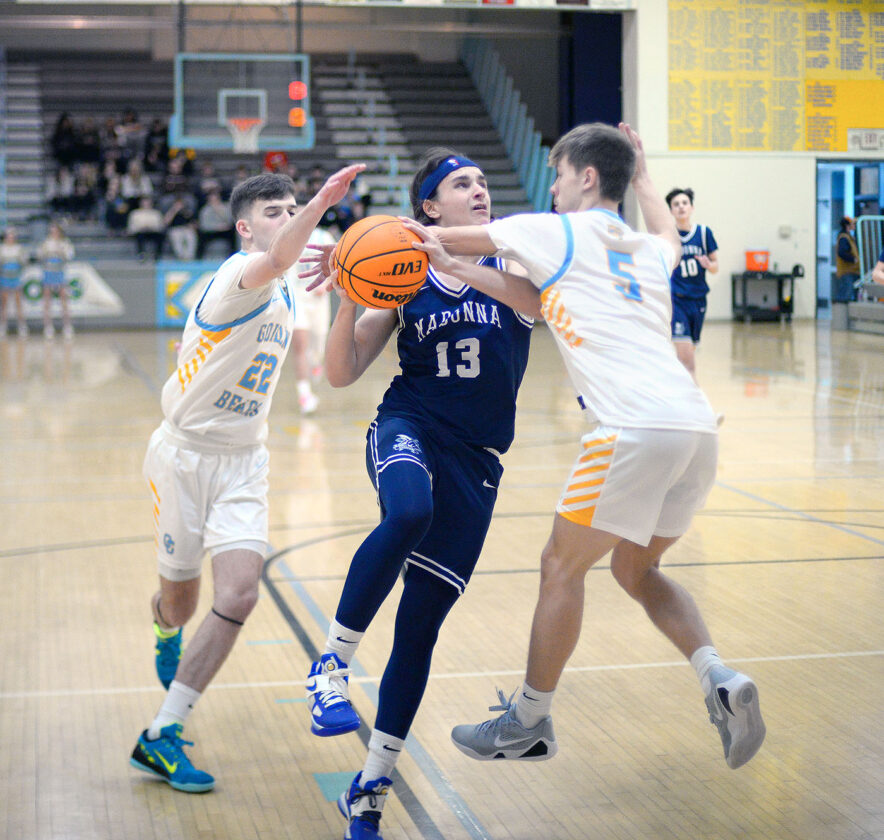
Madonna’s Jake Druga drives against Oak Glen’s Gavin Geisse and Will Weekley. – Andrew Grimm
Madonna: Has another tough match up Saturday when it travels to Toronto.
Oak Glen: Has a big game on the road Saturday night at Wellsville.
Oak Glen 80, Madonna 34
M 8-11-11-4 — 34
OG 18-25-18-19 — 80
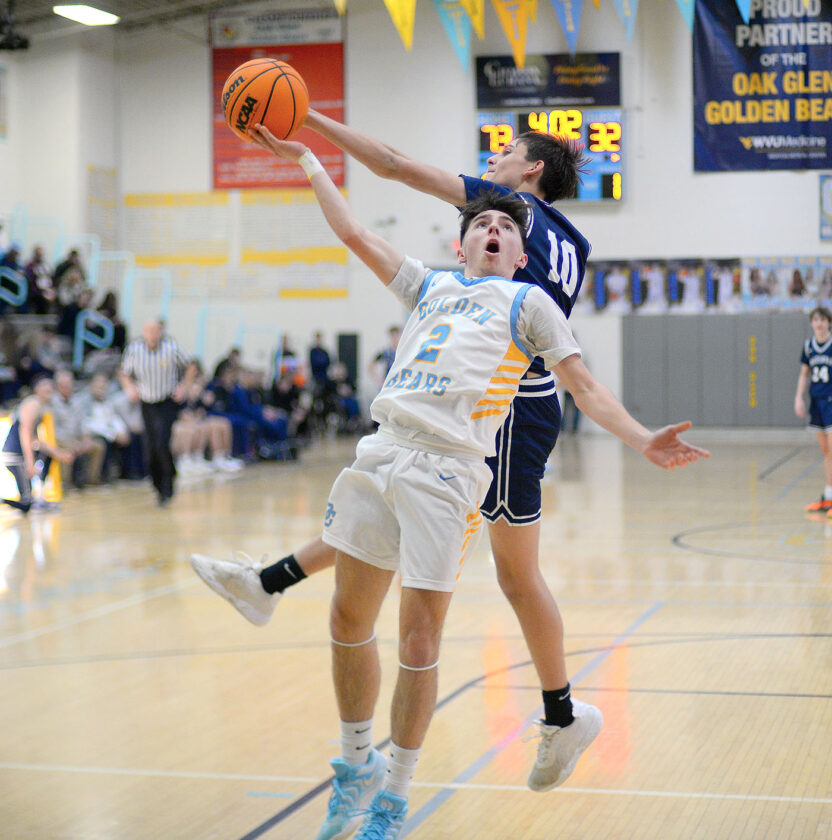
Below, Oak Glen’s Mason Kell shoots past Madonna’s Vinny Chiodi. – Andrew Grimm
MADONNA (1-6): Wingert 1 1-2 3; Dillon 1 2-2 4; Chiodi 2 0-0 5; Druga 4 0-0 8; Fuscardo 5 4-8 14; Gray 0 0-0 0; Welch 0 0-0 0; Decaria 0 0-0 0. TOTALS: 13, 7-12; 34.
OAK GLEN (3-2): Hartung 3 0-0 7; Kell 4 0-0 11; Weekley 2 0-0 4; Willey 3 0-0 6; Geisse 7 0-0 14; Evans 4 2-2 11; Ates 2 0-0 5; Herbock 2 1-2 5; Dawson 3 0-0 6; Hissam 4 0-0 11; Dittman 0 0-0 0. TOTALS: 34, 3-5; 80.
3-POINTERS: Madonna 1 (Chiodi); Oak Glen 9 (Kell 3, Hissam 3, Hartung, Evans, Ates).

New England Revolution

The Revolution have continued an offseason path of adding young players who have experience playing under new head coach Marko Mitrović.
On Wednesday, New England announced the acquisition of defender Ethan Kohler as a transfer signing from German club SV Werder Bremen. New England has signed Kohler to a contract through the 2028-29 season, with a club option for 2029-30.
Kohler, 20, is California native, and returns to the U.S. after signing with Werder Bremen in 2023. He appeared at both the U-19 and reserve team levels for the German club, helping Werder Bremen II win the Bremen-Liga title in 2023-24. Kohler also recently made nine appearances for another German club, SC Veri, during a loan stint.
Seen as a versatile defender by New England, Kohler — like fellow recent acquisition Brooklyn Raines — has experience playing under Mitrović at the 2025 FIFA U-20 World Cup. The now current New England head coach led the U.S. team during the tournament, guiding the Americans to a quarterfinal appearance.
Kohler started four games at the U-20 World Cup as a center-back, helping the U.S. achieve clean sheet wins over Italy and France.
“I met and worked with Ethan for the first time almost four years ago,” Mitrović said in the team announcement. “He is an elite professional and highly competitive player who loves to win. His work ethic and standards are very high, important qualities for our team and environment in creating a winning culture.
“Ethan’s strength on the ball can help us control the game in possession, though he is also one of those players who takes great pride in his defending. I am excited to have Ethan with us.”
New England will begin preseason training in January as the club tries to reverse a two-year trend of being shut out of the postseason. Mitrović, hired in November, will have some interesting choices to make as he reshapes the team in his image. The Revolution kick off the 2026 MLS regular season in Nashville on Feb. 21.
Get everything you need to know to start your day, delivered right to your inbox every morning.

NORTH BRANFORD — A youth hockey coach and a parent both were arrested Monday after an argument over a child’s ice time during a game at the Northford Ice Pavilion escalated into a fight, North Branford police said.
The two Rhode Island men were taken into custody around 6:30 p.m. after officers responded to the Firelite Place facility for a report of a physical altercation, according to the North Branford Police Department.
Police said in a Facebook post that the fight took place in a hallway outside a locker room after the men began arguing over the amount of playing time the parent’s child had received during the game.
“The North Branford Police Department maintains a zero-tolerance policy for physical altercations involving parents and coaches at youth sporting events,” police said.
Police identified the individuals as Joseph Desmarais, 46, of Scituate, Rhode Island, and Brian Lacombe, 50, of West Warwick, Rhode Island.
Police said both men are charged with second-degree breach of peace and are scheduled to appear at state Superior Court in New Haven Jan. 13.

After attracting record sums in 2021, startup founders faced extinction-level threats two years later as interest rates rose and the dollars dried up.
Where did 2025 end up on this fundraising rollercoaster?
“It was not the rebound that a lot of venture participants were hoping for coming into the year,” said Emily Zheng, a venture capital researcher at the financial data firm PitchBook. “There was honestly a lot of macro volatility. Both from tariffs to the government shutdown. There were a lot of fits and starts.”
The two biggest trends in startup fundraising, Zheng said, were artificial-intelligence bullishness and the concentration of capital into bigger deals.
North Carolina’s top startup fundraises this year came from Triangle health care companies. A pair of gene-therapy companies led the way, followed by providers of 3D-printed knees, hospital logistics software, a trial emergency allergy treatment, and an employee health analytic platform. Filling out the list were two sports software firms, a pet policy tech platform (from a former N.C. state representative), and a Morrisville company that’s growing due to the rise in ultra wealthy families.
Here are the 10 largest deals for North Carolina tech startups this year, according to figures PitchBook provided to The News & Observer.
Started in 2004 by a Duke University offensive lineman, Teamworks today says its software is used by more than 6,500 sports teams worldwide, including every NFL team and the vast majority of those in the NBA, MLB, and English Premier League.
Teamworks technology focuses on four areas: talent recruitment, developing players, preparing for games, and overall operations. The Durham startup is now a “unicorn” after raising $235 million in Series F (late stage) funding, in June at a $1 billion-plus valuation.
“This significant investment validates our vision of creating the most comprehensive technology ecosystem in sports,” Teamworks founder and CEO Zach Maurides wrote in a statement in June.
In early 2025, Tune Therapeutics raised $175 million in Series B funding to support its first clinical trial for a new epigenome editor which the company says can turn off or “silence” disease-causing genes.
“We don’t change the DNA,” Tune’s chief scientific officer Derek Jantz told The N&O in January. “But we do change those parts that are being read and interpreted. It’s a kind of control that no one has ever tried before in patients.”
Jantz said his team picked chronic hepatitis B for its first trial because the human body naturally tries to control the virus in a way Tune’s technology mimics.
Tune formed in 2021 from research by Duke professor Charles Gersbach, who is a cofounder. Duke Capital Partners, the university’s early-stage venture firm, backed Tune in its latest funding round. The company also has an office in Seattle.
Research Triangle Park ocular gene therapy company Atsena Therapeutics raised $150 million in an oversubscribed Series C round as the 35-person startup advances two clinical-stage programs in its effort to prevent or reverse blindness.
“We’re in space that is exciting,” Atsena CEO Patrick Ritschel said in an interview Tuesday. “We’re on a cutting edge of technology, and we’re having clinical success.”
Atsena uses gene replacement, also known as gene augmentation, to deliver a healthy copy of a defective gene to allow the cell to produce missing proteins and work properly. Ritschel said eyes are strong, safe candidates for gene therapies because they are confined within the human body, unlike more systemic organs like livers.
restor3d makes customized ankle, knee, hip and shoulder joints forged by 3D printer lasers inside Research Triangle Park. Spun out of a Duke University lab eight years ago, the company today has several hundred employees between its Boston office and Morrisville headquarters
Its joints have touched more than 150 bones and been used by more than 650 surgeons, restor3d cofounder Ken Gall said during a site tour in September. And Duke Health surgeon Dr. Samuel Adams says the fitted body parts have helped him save people’s legs. “Everyone’s anatomy is different,” Gall said. “It’s no different than like a face. Everyone has a different bone structure.”
The company announced two fundraises in 2025: $38 million in April and then $104 million over the summer.
Founded by former N.C. House Rep. John Bradford III, Petscreening offers property managers software to organize their tenant pet policies. Bradford was serving his second term in 2017 when he started the company. He’s run the Mooresville business full time since losing his Republican primary and leaving office in 2024.
“It’s common that property managers and landlords will have varying pet-related policies from one rental property to another and, from my own experience, their pet record keeping is often inconsistent,” he wrote in an email to The N&O.
Petscreening has roughly (or “ruffly,” as Bradford joked) 180 employees, and this year launched a platform he wrote.
An increase in the number of very rich families worldwide has meant big business for the Triangle financial technology company Eton Solutions. Based outside of Research Triangle Park, Eton services private companies that manage the wealth of families.
“In recent years, the growth of ultra-high-net-worth families and individuals has resulted in a significant expansion of family offices globally,” Eton wrote in a July statement as it announced its $58 million Series C funding round.
The startup said its quadrupled its revenue in the last three years. Its latest funding round was led by the private equity firm Navis Capital Partners.
Charlotte’s Fastbreak AI raised $40 million in Series A funding this year, with investments from professional leagues (the NBA, NHL) and former professional players like retired Carolina Panthers star linebacker Luke Kuechly. But it is the growth opportunities in youth sports that most excites Fastbreak founder and CEO John Stewart .
“It’s a massive marketplace,” he said in a phone interview Tuesday.
The company’s software helps optimize scheduling in top professional leagues. On the youth side, Fastbreak promises to deliver an all-in-one platform for scheduling, registration, payments, logistics, and sponsorships — from YMCA leagues to elite travel teams.
“We focus our technology in a way that we enable revenue generation from things other than the parents and the athletes themselves,” Stewart said. “Which hopefully drives down the cost of participation.”
Intelligent Locations CEO Bogdan Nedelcu would not “confirm or deny” whether his Raleigh health care software startup in fact raised $35 million in July, as Pitchbook reports.
“With our partners, we decided that we’re not going to disclose any financials,” Nedelcu said.
Founded in 2015 and headquartered along Six Forks Road, Intelligent Locations makes a platform called INTRAX that helps hospitals track supplies, patients and operations.
Another Triangle biotech company notched a significant investment in 2025. Raleigh’s Belhaven Biopharma raised around $11 million, with convertible notes from previous rounds brining its yearly total, on paper, to north of $30 million.
“That’s really a summation of all the different rounds that we raised,” Belhaven CEO Scott Lyman said in a phone interview Tuesday.
The 4-year-old company has 10 employees and is planning to move into a new office closer to Research Triangle Park. It focuses on treating emergency allergic reactions through nasal sprays.
“This first product that we’re bringing to the market is essentially an EpiPen alternative to treat severe allergies that can bring on anaphylaxis,” Lyman said.
In May, the Chapel Hill health care software startup Well raised $30 million in an extended Series B to fund its operations. Well aims to give employers insights into their employees’ health to improve outcomes and control costs.
The company serves more than 400,000 people through its platform, chief financial officer Jared Sokolsky said in an interview earlier this month.
In 2019, North Carolina awarded Well a performance-based economic incentive to create 400 jobs in Orange County. The company missed its hiring benchmark earlier this year, but Sokolsky is confident the startup will keep growing.
“We’re going after large, jumbo enterprise employers, and it’s a lumpy sales cycle,” he said. “It’s a tough one to predict. But we’ve demonstrated that we can win. We’re working with a number of Fortune 50, Fortune 100, Fortune 500 companies. We know over time we’re going to get there.”
Well currently employs around 150 people in Chapel Hill, according to Sokolsky, up from about 120 at the start of the 2025.
This story was originally published December 31, 2025 at 8:00 AM.

Brian Gordon
The News & Observer
Brian Gordon is the Business & Technology reporter for The News & Observer and The Herald-Sun. He writes about jobs, startups and big tech developments unique to the North Carolina Triangle. Brian previously worked as a senior statewide reporter for the USA Today Network. Please contact him via email, phone, or Signal at 919-861-1238.
Whether it’s in AAU youth basketball or the NBA Finals, most basketball fans can tell you a team isn’t likely to win a game when it misses its first 11 shots.
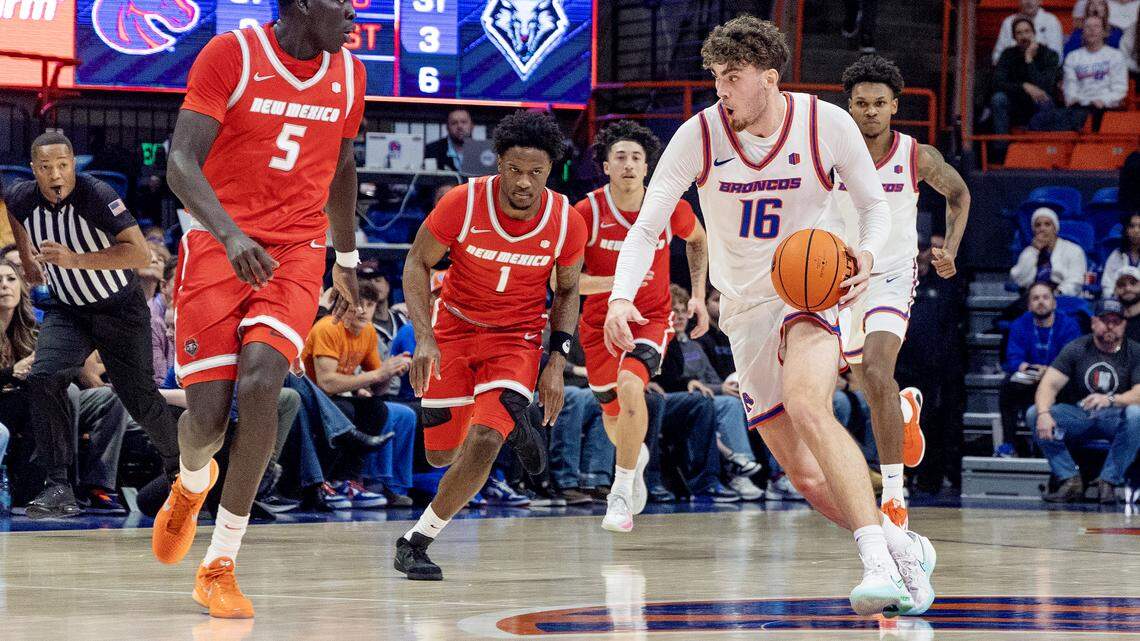
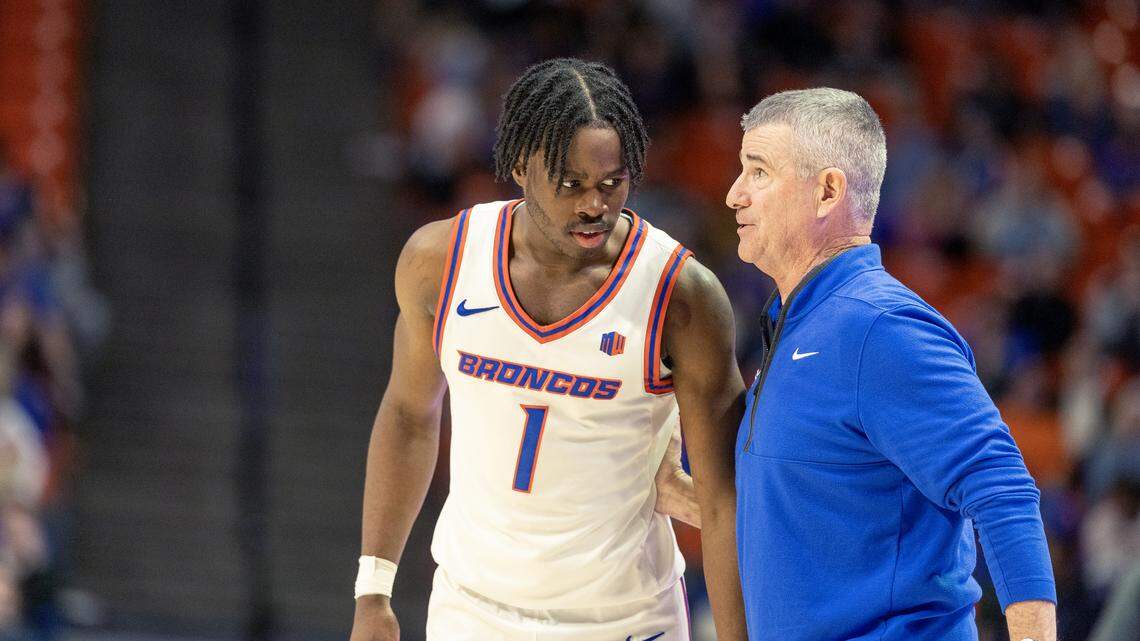
But once in a while, a team manages to defy the odds. That team on Tuesday night was Boise State. Despite starting 0-for-11 from the field and not scoring their first field goal until over 8 minutes into the game, the Broncos managed to defeat New Mexico 62-53 at ExtraMile Arena.
Boise State (9-4, 1-1 Mountain West) went just 20-for-56 (35.7%) from the field, but fortunately for the Broncos, New Mexico (10-3, 1-1) didn’t fare much better. Although the Lobos didn’t start the game quite as poorly, they ended shooting an even worse 20-for-65 (30.8%), including making just three of their final 15 shots.
“Some nights the game of basketball just is like that,” Boise State head coach Leon Rice said after the game. “Credit their defense, credit our defense. Both teams did a really nice job defensively.”
The win marks Rice’s 169th regular-season win in the Mountain West, surpassing legendary coach Steve Fisher for the most regular-season wins in conference history. Fisher coached San Diego State from 1999 to 2017 and won the NCAA National Championship as Michigan’s head coach in 1989.
Boise State came into Tuesday night’s late tipoff assuming it would need to be hot from beyond the arc. The Lobos boast one of the best interior defenses in the Mountain West and have forced opponents this year into taking over half of their shots (51.2%) from beyond the arc.
So when Boise State missed its first nine three-point attempts of the game, the Broncos’ outlook wasn’t too optimistic. Yet, thanks to some poor Lobos shooting down the other end of the court, by the time junior forward Drew Fielder sunk the Broncos’ first field goal of the game after the 12-minute media timeout, Boise State trailed just 8-5.
Fielder’s 3-pointer finally opened things up for the Broncos, who ended the half on a 19-5 run to take a testy 21-19 lead into the half.
“It seemed like we got some open looks, but every one of our shots was a three, and some of them were really open,” Rice said. “Not that I don’t want to shoot those, but we seemed like we were a step slow or (taking) the path of least resistance, we were settling.”
By the end of the night, Boise State shot just 6-for-30 (20%) from 3-point range. But with the Lobos shooting just 3-for-25 (12%) from beyond the arc, down from their usual 33.4%, the Broncos got away with a poor night from the field.
The 53 points scored by New Mexico were its lowest point total of the season. Parallel to that, the Broncos’ 62 points also tied their lowest point total of the season. However, Boise State has also won all three of those games — 62-58 over Montana State and 62-59 over Wichita State.
“It’s all about defense,” said freshman guard AG Neto, who ended the night with 10 points and two defensive rebounds.
“Every team that plays us, they know we’re a good defensive team,” Neto continued. “So we don’t worry about offense if we play good defense.”
For as poor as the first half was offensively, New Mexico appeared to put that behind them coming out of the halftime break. The Lobos embarked on a quick 13-0 run to take a sudden 30-21 lead and take the air out of ExtraMile Arena.
But just as Neto stepped up off the bench to produce a solid 25 minutes of play, it was a fellow freshman, forward Spencer Ahrens, who pulled the Broncos out of the ditch.
Ahrens scored a team-high 12 points off the bench, with 10 of those coming in a four-minute stretch early in the second half. Ahrens ended the Lobos’ 13-0 run with a pair of jumpers before then sinking two 3-pointers, the second of which came deep from downtown and charged life back into ExtraMile Arena as the Broncos quickly narrowed the score to 36-33.
“The team needed a spark, and I’ve been working so hard in practice and stuff, I knew it was going to come,” Ahrens said. “I’m not forcing anything, just letting the game come to me.”
The Broncos took a 42-41 lead a few minutes after Ahrens’ run, thanks to a layup from Neto, and didn’t look back for the rest of the game.
The pair of freshmen led an impressive night from a Boise State bench that scored 37 points, more than the 25 the starting five managed. Sophomore forward Pearson Carmichael also chipped in off the bench with 11 points.
After the Broncos started the game 8-0 down, Rice went to his bench and subbed out four of the starters, with only Meadow left on the court. The switch helped stymie the Lobos’ early domination before several starters returned to the court.
“When on the bench, we’re reading the game,” Neto said. “We see what the team needs at the moment we get in. So when I get in the game, I kind of know what the team needs, and the game is easier for us coming off the bench because you can see it from outside.”

Shaun Goodwin
Idaho Statesman


#11 Volleyball Practices, Then Meets Media Prior to #2 Kentucky Match

Nascar legal saga ends as 23XI, Front Row secure settlement


Sunoco to sponsor No. 8 Ganassi Honda IndyCar in multi-year deal

Maine wraps up Fall Semester with a win in Black Bear Invitational

WNBA’s Caitlin Clark, Angel Reese and Paige Bueckers in NC, making debut for national team at USA camp at Duke
NASCAR, 23XI Racing, Front Row Motorsports announce settlement of US monopoly suit | MLex


Ross Brawn to receive Autosport Gold Medal Award at 2026 Autosport Awards, Honouring a Lifetime Shaping Modern F1


Rick Hendrick comments after the NASCAR lawsuit settlement


Hope College Tops MIAA Commissioner’s Cup Fall Update


Nike Signs 10 LSU Athletes to NIL deals