Sign up for the Today newsletter
Get everything you need to know to start your day, delivered right to your inbox every morning.


Peninsula High School parents say their students are being left behind — not in the classroom, but on the field. As district programs grow and facilities age, they ask why Seahawks athletes, musicians, and coaches must make do with less while Gig Harbor’s teams practice on better, brighter fields with fewer obstacles. To them, it’s not just about sports. It’s about fairness.
Peninsula School District officials said they “remain committed to providing safe, functional, and equitable facilities for all students across our campuses.” In an emailed statement to Key Peninsula News, the district said it manages facilities through a comprehensive approach that balances space demands, safety, and academics. But for many parents, those words don’t match what they see on any given day.
A Tale of Two Fields
On most fall afternoons at Peninsula High School, it’s hard to tell where one team ends and another begins. Football players run drills on half of Roy Anderson Field, while the girls soccer team practices corner kicks on the other. Nearby, marching band members use spray-painted lines on a shortened field to rehearse halftime routines.
For parent Stephanie Johnson, it’s a familiar sight — and a growing frustration.
“We have 100 football players sharing a field with 40 soccer players,” she said. “They’re supposed to be able to run full practices and prepare for games like everyone else, but there’s nowhere for them to go.”
At Gig Harbor, every major field is synthetic lighted turf, and another one appears to be in the planning stages. At Peninsula, there’s one turf field — Roy Anderson Field, shared by both high schools — and several grass surfaces that flood or turn to mud after heavy use.
Johnson, whose son plays both baseball and football, has spent two years documenting field-access disparities between the district’s two largest campuses. As an example, using PSD’s public Tandem scheduling calendar, she found that as of October, Gig Harbor’s girls soccer program logged about 264 hours of full-field turf time this season, compared to about 81 hours of half-field practice at Peninsula, a gap of more than 180 hours of play.
The district said it tracks only scheduled reservations, not actual field time, through its Tandem system. Day-to-day field use, it said, is managed by individual schools.
The district said that “both of our comprehensive high schools have the flexibility to schedule their practices for the duration needed to support their student athletes.”
Safety Comes at a Cost
The conditions don’t just inconvenience teams; they can endanger them. At Peninsula, parents say the lack of funding has pushed booster clubs to pick up the slack, sometimes covering costs that should fall to the district.
Swim parent Julia Buel said boosters were asked to buy new safety lane lines for the school pool after the district declined to cover the cost.
“The lane lines we have aren’t even the right size,” Buel said. “We’ve got homegrown fixes with chains and turnbuckles that are rusty and sharp.”
Baseball boosters, Johnson added, have also been asked to buy basic safety gear, even though WIAA rules require the district to provide it.
Anne Bunker, whose children run cross-country, said poor drainage and uneven surfaces have forced coaches to take runners off campus just to find safe routes.
“Our kids have to drive to Gateway Park just to find a proper trail,” Bunker said. “Who wants their kids running along busy Purdy Spit? It’s not just about fairness; it’s about safety and cost.”
The travel cuts into practice time, and paying for district buses would drain the program’s budget, she said. Younger runners without rides often must skip practice altogether.
The varsity baseball team also practices and plays at Sehmel Park because the field on campus can’t handle multiple teams. Like the cross-country runners, some baseball players rely on older teammates because bus costs, parents say, are also out of reach.
Band booster Misty Pomeroy said the problem extends beyond sports. While Gig Harbor teams practice under stadium lights, Peninsula’s marching band boosters had to rent temporary lighting, and sometimes waited weeks for the district to install it.
“For a month, they were up there in the dark trying to march,” Pomeroy said.
Because the band rarely has access to the football field, boosters buy field paint to turn the baseball field into a makeshift gridiron. They mark yard lines so members can learn the exact spacing for halftime shows at Roy Anderson Field. Boosters also cover all repair costs from their own fundraising.
“It’s not about having fancy stuff,” Pomeroy said. “It’s about giving the kids the basics they need to do their best.”
Sometimes it’s not just about safety, it’s about the way things were built. The track around Roy Anderson Field is shorter than regulation, and the pool doesn’t meet 25-yard race standards. The size mismatches prevent Peninsula from hosting district-level meets and force athletes to train under mismatched conditions, while Gig Harbor athletes train on regulation-grade surfaces.
Where Does the Money Go?
If all fields fall under the same district, parents ask, why is there such a gap in quality and care?
Johnson believes the answer lies in how PSD manages rental revenue.
Each year, the district rents its gyms, fields, and auditoriums to community groups: churches, club teams, Harbor Soccer, Peninsula Youth Football, and others. The income adds up quickly.
In just nine days last October, two turf fields and a baseball field at Gig Harbor High brought in $14,000, according to Johnson’s research.
That’s not counting dozens of other rentals across the district’s 17 schools. All that money must go somewhere, but parents say there’s little visibility into how it’s spent. PSD confirmed that facilities rental income — more than half a million dollars in the 2024-25 fiscal year — is deposited into the district’s general fund, used primarily for custodial and facilities staffing and general maintenance costs. The rental revenue, the district said, doesn’t generate sufficient funds to cover major capital projects like installing turf fields.
The district budgets a consolidated amount for overall facility maintenance across all district properties. Each January, the district facilities team creates a list of projects based on “safety needs, educational impact, and condition of the facilities,” funding the projects until budget resources are exhausted.” Parents counter that even the most basic repairs linger for years, citing broken scoreboards, leaking irrigation, and uneven grass fields.
The district also confirmed it hasn’t conducted a formal Title IX assessment of its athletic facilities in at least five years, a review meant to ensure fairness between male and female athletes. Without one, parents say, inequities are left to fester without oversight and documentation.
Little League, Big Divide
The inequity isn’t limited to high schools. Johnson’s review of rental logs shows wide gaps between youth teams using Gig Harbor facilities and those on the Peninsula side.
Johnson found Peninsula Youth Football’s Tides teams use two lighted turf fields at Gig Harbor High School, paying about $13,800 in total rental fees for the season. Their Seahawks counterparts practice on an unlit grass field at Purdy Elementary School and the district office, paying just $864 — but at the cost of quality, fairness, and safety.
“Every kid pays the same $450 to play,” Johnson said. “But one side gets lighted turf, and the other gets mud and darkness.”
By midseason, the grass fields become what one coach described as “ankle-breakers.”
Michael Perrow, a former Gig Harbor City Council member and current member of the Gig Harbor Peninsula Youth Sports Coalition, has spent years urging the district to fix those disparities.
“It’s bad government,” Perrow said. “Take care of what you have and stop blaming the community for the condition of your own facilities.”
In their statement, district officials said proper grass-field maintenance “requires removing fields from the usage cycle for approximately six months each year to allow grass to recover.” With limited field space, they said, it’s difficult to rotate fields out of play without hurting school and community programs.
Overwatering and neglected storm drains are making things worse, Perrow said. Public records show some campuses using millions of gallons of water each year to maintain fields that flood when overwatered, costing more than $10,000 annually at several sites.
The combination of poor drainage and inconsistent maintenance, he said, leaves some fields nearly unusable.
The PenMet Agreement: Two Sides of the Line
It’s not just poor maintenance that frustrates Perrow. He said a facility-use agreement between PSD and PenMet Parks, designed to share access to gyms and fields, has instead deepened the divide.
Under the deal, he said, PenMet uses school gyms for youth basketball, while the district can use PenMet’s turf fields for school sports — all at no cost. But there’s a catch, Perrow said: PenMet gives registration priority to its own taxpayers, shutting out most Key Peninsula and some Gig Harbor city residents for the first week of sign-ups and tacking on a 20% “out-of-district” fee.
“It’s not acceptable for the school district to give PenMet free use of its facilities when PenMet doesn’t treat all district residents equally,” Perrow said at a recent school board meeting.
He urged the district to renegotiate the deal so all PSD residents — including the Key Peninsula — are treated equally.
“The only boundary that should matter,” he told board members, “is the school district boundary.”
The district responded that school programs always receive priority access, and community groups use facilities only when they don’t conflict with school operations.
The Well’s Run Dry
It doesn’t look like it’ll get much better. The 2027–29 levy plan offers a glimpse at why the imbalance persists: Most new revenue is earmarked for operational costs like staff pay, programs, and transportation, with little left for field upgrades or maintenance.
“Like many public school districts in Washington, PSD faces the ongoing challenge of maintaining extensive facilities with a limited and fluctuating revenue stream,” the district said in its statement.
The levy plan lists minor funds for “facility modernization” but no significant investments in turf, lighting, or athletic upgrades. That leaves the district dependent on future bonds, an uncertain prospect after several failed attempts.
“Even if a bond passed tomorrow,” Johnson said, “we wouldn’t see a new school or new fields until 2032. We can’t wait that long.”
Perrow agreed: “They keep saying they don’t want to fix Peninsula because they plan to build a new one,” he said. “But that doesn’t help the students playing there now.”
PSD denied that claim outright and said there are no active plans to build a new school or stadium that would affect current investments, though the district’s long-range planning committee continues to evaluate future needs.
The Case for Turf
For parents like Pomeroy, turf isn’t a luxury — it’s a necessity. With built-in drainage systems, synthetic fields can handle year-round use, even during the area’s wettest months.
“If it’s a drainage problem, you need to turf it,” Pomeroy said. “Otherwise, you’ll just keep pouring money into mud.”
A single well-maintained turf field can host soccer, football, lacrosse, band, and community events without tearing up the surface.
By contrast, Roy Anderson Field is overused and, when closed for repairs, leaves the school in a bind.
But turf isn’t a silver bullet: while it can solve drainage and usage bottlenecks, it comes with a high upfront cost, with many companies quoting between $700,000 to $1.5 million to install, and annual maintenance up to $23,000, according to KP News research into regional turf companies. The district said these costs must be weighed against “classroom needs.”
A Fair Shot
Despite their frustration, most parents say they aren’t looking to pit one school against the other. They just want equity, transparency, and a plan.
Johnson outlined three practical steps the district could take:
Turf the baseball field off 144th Street to create a multi-sport surface for soccer, baseball, softball, and marching band.
Develop Purdy Elementary’s open field into a district-wide recreation site with lighted turf — an idea parents frame as a Peninsula counterpart to Gig Harbor High’s planned lighted turf field.
Publish a transparent breakdown showing how much rental revenue is reinvested in facilities.
“Why not improve what we already have?” Johnson said. “Purdy could be a huge success for the whole community.”
Bunker said the district needs to acknowledge the hidden costs of inequity: transportation, safety, and morale.
“Our kids deserve to practice safely on their own campus,” she said. “That shouldn’t depend on which side of the bridge they live on.”
And Buel said small steps, like replacing the unsafe pool equipment, would show that parents’ concerns are being heard.
“We don’t want to be better than anyone,” she said. “We just want safe, functional facilities.”
Transparency and Trust
Parents say this isn’t about who has nicer fields, it’s about trust. They want to know whether a district that promotes equity is willing to invest in ways that treat every community the same.
“We’re not asking for miracles,” Johnson said. “Just equal opportunity for all our students.”
Youth coach Alvin Coit, a father of three district athletes, said it’s not just about better equipment and facilities. It’s about what message the district sends to students.
“The district has a responsibility to utilize taxpayer dollars fairly,” Coit wrote in an email to KP News. “They’re showing our students that the neighborhood they come from affects the opportunities they’re given. That’s not just troublesome — it’s disturbing.”
Coit called for an immediate review of field scheduling, rental revenue, and maintenance practices — and a public plan to fix them.
Others say the district’s silence speaks for itself.
“It’s one of three things,” Johnson said. “Either they don’t know this is happening, they don’t have time to fix it, or they are waiting for our kids to graduate and we all go away. We’re not going away.”
The district said it “values the vital role athletic programs play” but must “balance the educational needs before allocating remaining funds to athletic improvements.” In other words, classroom needs come first. That explanation may not satisfy those demanding equity in sports, but it confirms the crux of the issue: sports, maintenance, and the classroom experience are all competing for the same shrinking pool of district dollars.
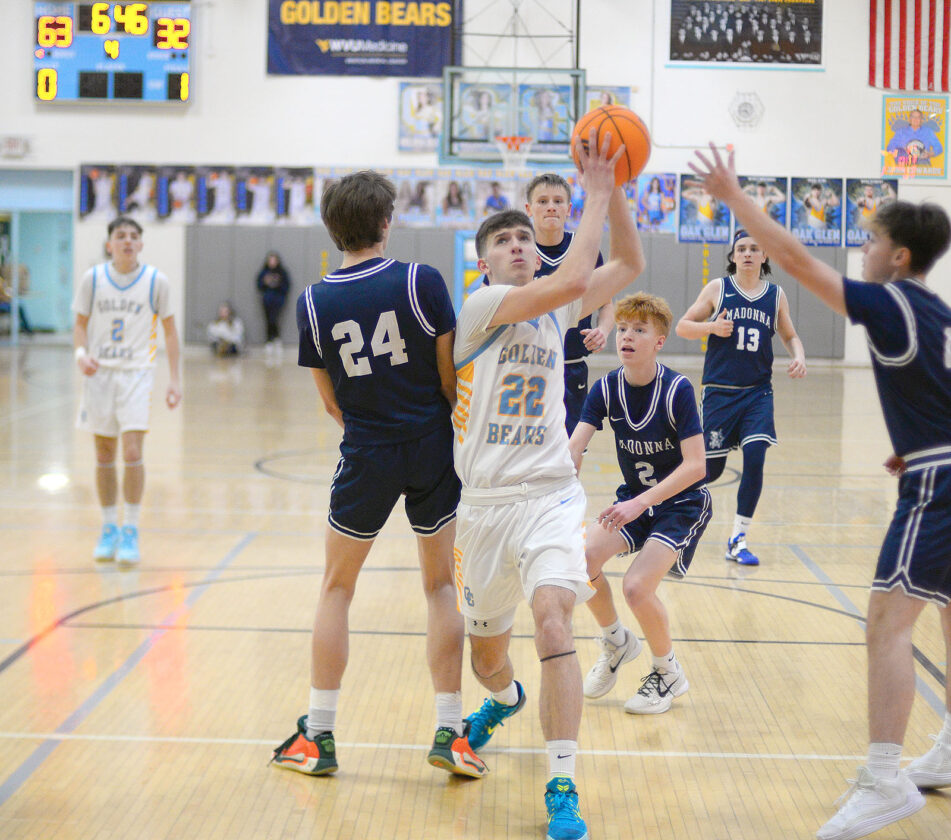
STRONG TO THE HOOP — Oak Glen’s Gavin Geisse drives to the hoop past Madonna’s Reno Fuscardo and Luke Wingett during Tuesday’s game. – Andrew Grimm
NEW MANCHESTER — Knowing his team had a big edge in experience, veteran Oak Glen head coach Jerry Everly wanted to see his group take care of business against Madonna in its last game before the new year.
His Golden Bears did just that, pulling away for an 80-34 victory over the youthful Blue Dons inside the Bears Den Tuesday night.
The victory sends Oak Glen into the new year above the .500 mark at 3-2.
“We played well against a team that we should beat,” Everly said. “They’re very young, their time will come, so we wanted to take care of business and get them while they’re young. We wanted to take care of ourselves, worry about our own game and execute, and I thought we did.
“I told them to take care of business and not take anything for granted, not come out sloppy and execute the things we work on in practice and I thought we did a good job of that. We still have some things to work on, but that’s good, we’ll keep working.

Madonna’s Tyler Dillon jumps against defense from Oak Glen’s Elijah Knisley. – Andrew Grimm
“It’s good to go into the new year above .500.”
Oak Glen had four players reach double figures — two of whom did so coming off the bench — and knocked down nine 3s in the victory.
Gavin Geisse netted 14 points to lead the way, while Mason Kell hit three of the triples to finish with 11. Colt Hissam also tallied three treys and finished with 11 points off the bench, while Tyler Evans came off the bench and also tallied 11.
All told, 10 of 11 players to see the floor for Everly’s team scored, all 10 contributing at least five points.
Oak Glen opened an 18-8 lead after one, then scored 25 points in the second quarter to push the lead to 24 at halftime, then continued to build it the rest of the way to the 46-point victory.
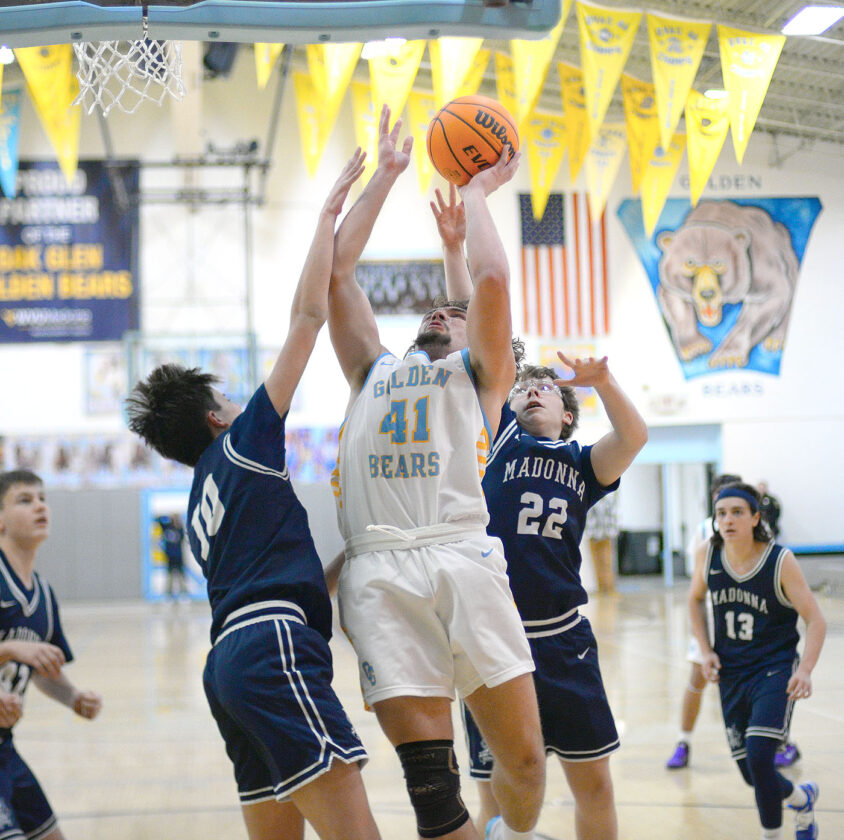
Oak Glen’s Kam Hebron puts up a shot past the Blue Dons Vinny Chiodi and Anthony DeCaria. – Andrew Grimm
For Madonna (1-6), which dressed a lineup of five sophomores, three freshman and a junior, the early season growing pains continued, though they continue to play hard for their veteran coach.
“We’re learning, there are growing pains,” Madonna head coach George Vargo said. “Our kids play hard, they just have to learn the game better. But they keep playing hard and they don’t give up. We start a freshman and four sophomores, so we know we’re going to go through the growing pains. We’ll get better as we go and keep learning and keep growing.
“We’ve seen a lot of improvements from Game 1 to Game 7.”
The Dons were led by 14 points from Reno Fuscardo and eight from Jake Druga.
UP NEXT
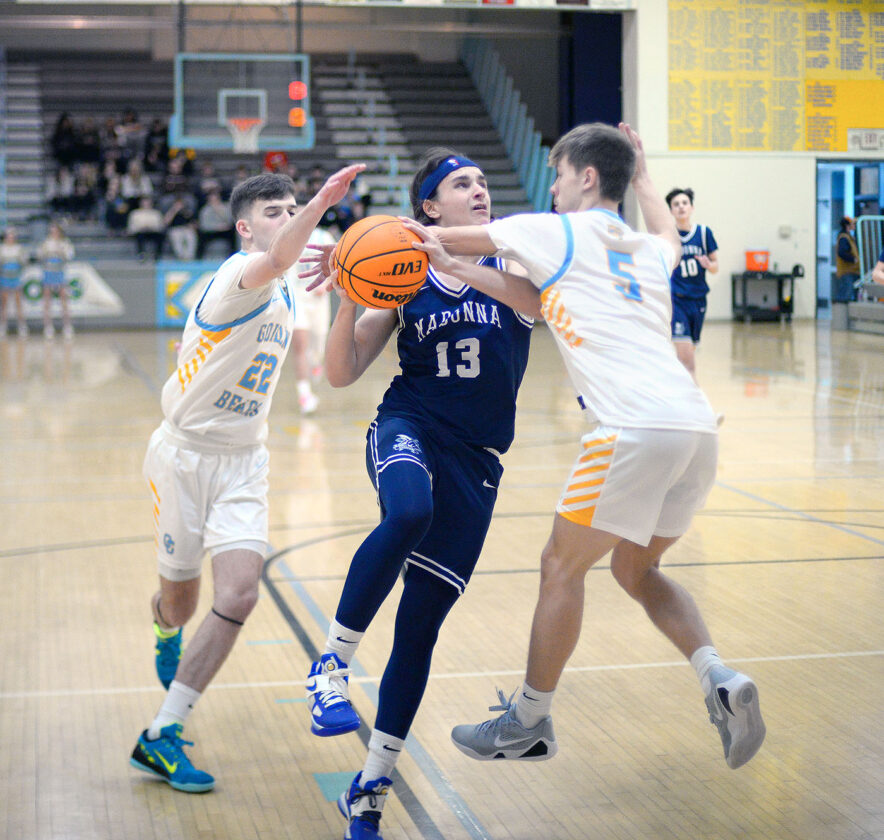
Madonna’s Jake Druga drives against Oak Glen’s Gavin Geisse and Will Weekley. – Andrew Grimm
Madonna: Has another tough match up Saturday when it travels to Toronto.
Oak Glen: Has a big game on the road Saturday night at Wellsville.
Oak Glen 80, Madonna 34
M 8-11-11-4 — 34
OG 18-25-18-19 — 80
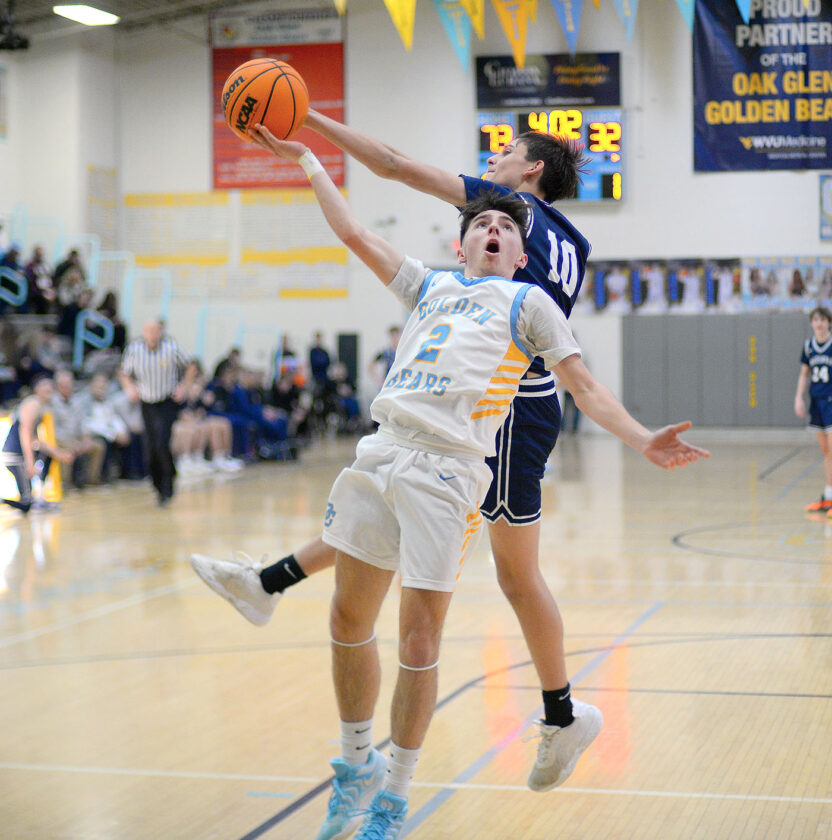
Below, Oak Glen’s Mason Kell shoots past Madonna’s Vinny Chiodi. – Andrew Grimm
MADONNA (1-6): Wingert 1 1-2 3; Dillon 1 2-2 4; Chiodi 2 0-0 5; Druga 4 0-0 8; Fuscardo 5 4-8 14; Gray 0 0-0 0; Welch 0 0-0 0; Decaria 0 0-0 0. TOTALS: 13, 7-12; 34.
OAK GLEN (3-2): Hartung 3 0-0 7; Kell 4 0-0 11; Weekley 2 0-0 4; Willey 3 0-0 6; Geisse 7 0-0 14; Evans 4 2-2 11; Ates 2 0-0 5; Herbock 2 1-2 5; Dawson 3 0-0 6; Hissam 4 0-0 11; Dittman 0 0-0 0. TOTALS: 34, 3-5; 80.
3-POINTERS: Madonna 1 (Chiodi); Oak Glen 9 (Kell 3, Hissam 3, Hartung, Evans, Ates).

New England Revolution

The Revolution have continued an offseason path of adding young players who have experience playing under new head coach Marko Mitrović.
On Wednesday, New England announced the acquisition of defender Ethan Kohler as a transfer signing from German club SV Werder Bremen. New England has signed Kohler to a contract through the 2028-29 season, with a club option for 2029-30.
Kohler, 20, is California native, and returns to the U.S. after signing with Werder Bremen in 2023. He appeared at both the U-19 and reserve team levels for the German club, helping Werder Bremen II win the Bremen-Liga title in 2023-24. Kohler also recently made nine appearances for another German club, SC Veri, during a loan stint.
Seen as a versatile defender by New England, Kohler — like fellow recent acquisition Brooklyn Raines — has experience playing under Mitrović at the 2025 FIFA U-20 World Cup. The now current New England head coach led the U.S. team during the tournament, guiding the Americans to a quarterfinal appearance.
Kohler started four games at the U-20 World Cup as a center-back, helping the U.S. achieve clean sheet wins over Italy and France.
“I met and worked with Ethan for the first time almost four years ago,” Mitrović said in the team announcement. “He is an elite professional and highly competitive player who loves to win. His work ethic and standards are very high, important qualities for our team and environment in creating a winning culture.
“Ethan’s strength on the ball can help us control the game in possession, though he is also one of those players who takes great pride in his defending. I am excited to have Ethan with us.”
New England will begin preseason training in January as the club tries to reverse a two-year trend of being shut out of the postseason. Mitrović, hired in November, will have some interesting choices to make as he reshapes the team in his image. The Revolution kick off the 2026 MLS regular season in Nashville on Feb. 21.
Get everything you need to know to start your day, delivered right to your inbox every morning.
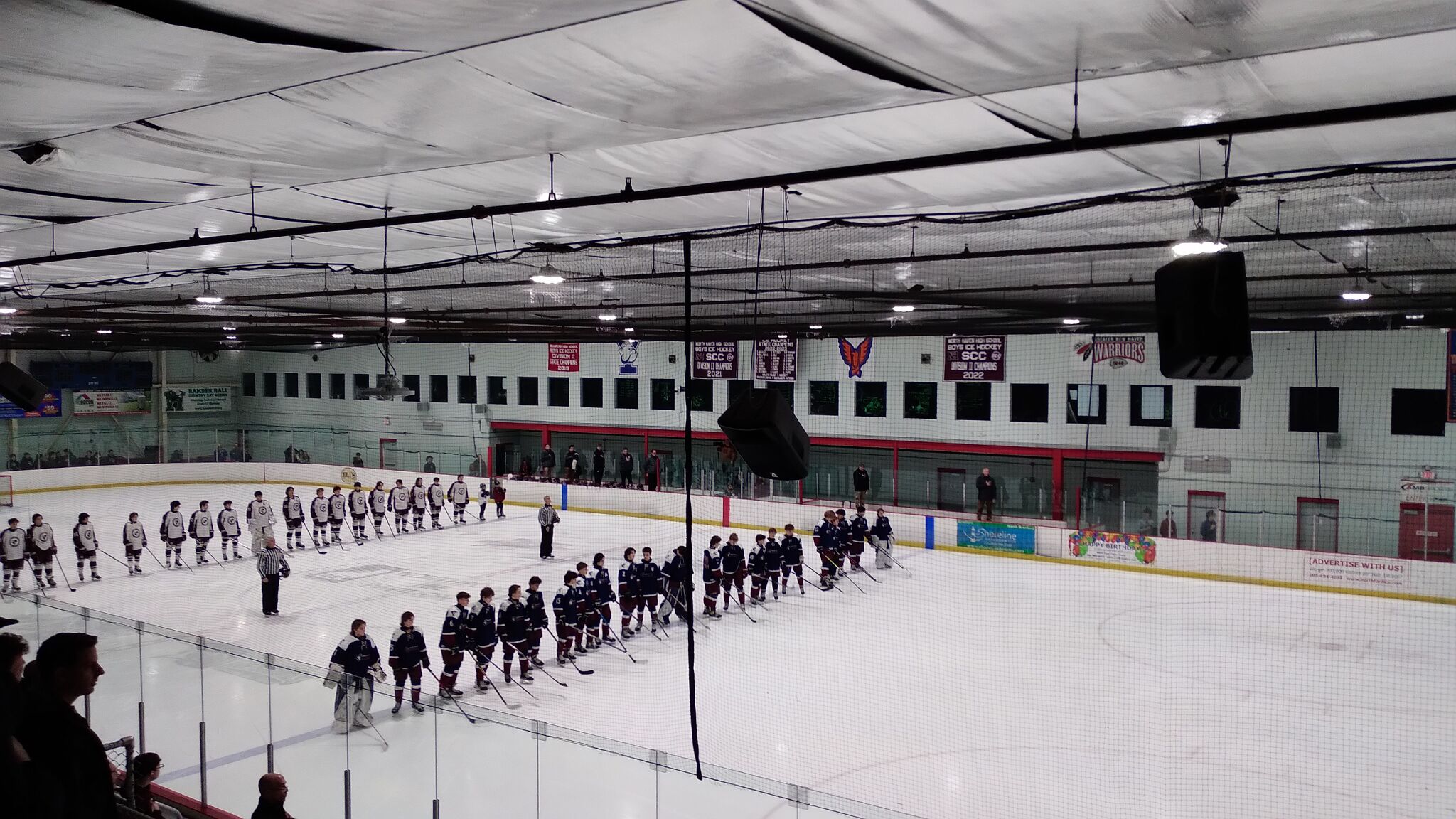
NORTH BRANFORD — A youth hockey coach and a parent both were arrested Monday after an argument over a child’s ice time during a game at the Northford Ice Pavilion escalated into a fight, North Branford police said.
The two Rhode Island men were taken into custody around 6:30 p.m. after officers responded to the Firelite Place facility for a report of a physical altercation, according to the North Branford Police Department.
Police said in a Facebook post that the fight took place in a hallway outside a locker room after the men began arguing over the amount of playing time the parent’s child had received during the game.
“The North Branford Police Department maintains a zero-tolerance policy for physical altercations involving parents and coaches at youth sporting events,” police said.
Police identified the individuals as Joseph Desmarais, 46, of Scituate, Rhode Island, and Brian Lacombe, 50, of West Warwick, Rhode Island.
Police said both men are charged with second-degree breach of peace and are scheduled to appear at state Superior Court in New Haven Jan. 13.

After attracting record sums in 2021, startup founders faced extinction-level threats two years later as interest rates rose and the dollars dried up.
Where did 2025 end up on this fundraising rollercoaster?
“It was not the rebound that a lot of venture participants were hoping for coming into the year,” said Emily Zheng, a venture capital researcher at the financial data firm PitchBook. “There was honestly a lot of macro volatility. Both from tariffs to the government shutdown. There were a lot of fits and starts.”
The two biggest trends in startup fundraising, Zheng said, were artificial-intelligence bullishness and the concentration of capital into bigger deals.
North Carolina’s top startup fundraises this year came from Triangle health care companies. A pair of gene-therapy companies led the way, followed by providers of 3D-printed knees, hospital logistics software, a trial emergency allergy treatment, and an employee health analytic platform. Filling out the list were two sports software firms, a pet policy tech platform (from a former N.C. state representative), and a Morrisville company that’s growing due to the rise in ultra wealthy families.
Here are the 10 largest deals for North Carolina tech startups this year, according to figures PitchBook provided to The News & Observer.
Started in 2004 by a Duke University offensive lineman, Teamworks today says its software is used by more than 6,500 sports teams worldwide, including every NFL team and the vast majority of those in the NBA, MLB, and English Premier League.
Teamworks technology focuses on four areas: talent recruitment, developing players, preparing for games, and overall operations. The Durham startup is now a “unicorn” after raising $235 million in Series F (late stage) funding, in June at a $1 billion-plus valuation.
“This significant investment validates our vision of creating the most comprehensive technology ecosystem in sports,” Teamworks founder and CEO Zach Maurides wrote in a statement in June.
In early 2025, Tune Therapeutics raised $175 million in Series B funding to support its first clinical trial for a new epigenome editor which the company says can turn off or “silence” disease-causing genes.
“We don’t change the DNA,” Tune’s chief scientific officer Derek Jantz told The N&O in January. “But we do change those parts that are being read and interpreted. It’s a kind of control that no one has ever tried before in patients.”
Jantz said his team picked chronic hepatitis B for its first trial because the human body naturally tries to control the virus in a way Tune’s technology mimics.
Tune formed in 2021 from research by Duke professor Charles Gersbach, who is a cofounder. Duke Capital Partners, the university’s early-stage venture firm, backed Tune in its latest funding round. The company also has an office in Seattle.
Research Triangle Park ocular gene therapy company Atsena Therapeutics raised $150 million in an oversubscribed Series C round as the 35-person startup advances two clinical-stage programs in its effort to prevent or reverse blindness.
“We’re in space that is exciting,” Atsena CEO Patrick Ritschel said in an interview Tuesday. “We’re on a cutting edge of technology, and we’re having clinical success.”
Atsena uses gene replacement, also known as gene augmentation, to deliver a healthy copy of a defective gene to allow the cell to produce missing proteins and work properly. Ritschel said eyes are strong, safe candidates for gene therapies because they are confined within the human body, unlike more systemic organs like livers.
restor3d makes customized ankle, knee, hip and shoulder joints forged by 3D printer lasers inside Research Triangle Park. Spun out of a Duke University lab eight years ago, the company today has several hundred employees between its Boston office and Morrisville headquarters
Its joints have touched more than 150 bones and been used by more than 650 surgeons, restor3d cofounder Ken Gall said during a site tour in September. And Duke Health surgeon Dr. Samuel Adams says the fitted body parts have helped him save people’s legs. “Everyone’s anatomy is different,” Gall said. “It’s no different than like a face. Everyone has a different bone structure.”
The company announced two fundraises in 2025: $38 million in April and then $104 million over the summer.
Founded by former N.C. House Rep. John Bradford III, Petscreening offers property managers software to organize their tenant pet policies. Bradford was serving his second term in 2017 when he started the company. He’s run the Mooresville business full time since losing his Republican primary and leaving office in 2024.
“It’s common that property managers and landlords will have varying pet-related policies from one rental property to another and, from my own experience, their pet record keeping is often inconsistent,” he wrote in an email to The N&O.
Petscreening has roughly (or “ruffly,” as Bradford joked) 180 employees, and this year launched a platform he wrote.
An increase in the number of very rich families worldwide has meant big business for the Triangle financial technology company Eton Solutions. Based outside of Research Triangle Park, Eton services private companies that manage the wealth of families.
“In recent years, the growth of ultra-high-net-worth families and individuals has resulted in a significant expansion of family offices globally,” Eton wrote in a July statement as it announced its $58 million Series C funding round.
The startup said its quadrupled its revenue in the last three years. Its latest funding round was led by the private equity firm Navis Capital Partners.
Charlotte’s Fastbreak AI raised $40 million in Series A funding this year, with investments from professional leagues (the NBA, NHL) and former professional players like retired Carolina Panthers star linebacker Luke Kuechly. But it is the growth opportunities in youth sports that most excites Fastbreak founder and CEO John Stewart .
“It’s a massive marketplace,” he said in a phone interview Tuesday.
The company’s software helps optimize scheduling in top professional leagues. On the youth side, Fastbreak promises to deliver an all-in-one platform for scheduling, registration, payments, logistics, and sponsorships — from YMCA leagues to elite travel teams.
“We focus our technology in a way that we enable revenue generation from things other than the parents and the athletes themselves,” Stewart said. “Which hopefully drives down the cost of participation.”
Intelligent Locations CEO Bogdan Nedelcu would not “confirm or deny” whether his Raleigh health care software startup in fact raised $35 million in July, as Pitchbook reports.
“With our partners, we decided that we’re not going to disclose any financials,” Nedelcu said.
Founded in 2015 and headquartered along Six Forks Road, Intelligent Locations makes a platform called INTRAX that helps hospitals track supplies, patients and operations.
Another Triangle biotech company notched a significant investment in 2025. Raleigh’s Belhaven Biopharma raised around $11 million, with convertible notes from previous rounds brining its yearly total, on paper, to north of $30 million.
“That’s really a summation of all the different rounds that we raised,” Belhaven CEO Scott Lyman said in a phone interview Tuesday.
The 4-year-old company has 10 employees and is planning to move into a new office closer to Research Triangle Park. It focuses on treating emergency allergic reactions through nasal sprays.
“This first product that we’re bringing to the market is essentially an EpiPen alternative to treat severe allergies that can bring on anaphylaxis,” Lyman said.
In May, the Chapel Hill health care software startup Well raised $30 million in an extended Series B to fund its operations. Well aims to give employers insights into their employees’ health to improve outcomes and control costs.
The company serves more than 400,000 people through its platform, chief financial officer Jared Sokolsky said in an interview earlier this month.
In 2019, North Carolina awarded Well a performance-based economic incentive to create 400 jobs in Orange County. The company missed its hiring benchmark earlier this year, but Sokolsky is confident the startup will keep growing.
“We’re going after large, jumbo enterprise employers, and it’s a lumpy sales cycle,” he said. “It’s a tough one to predict. But we’ve demonstrated that we can win. We’re working with a number of Fortune 50, Fortune 100, Fortune 500 companies. We know over time we’re going to get there.”
Well currently employs around 150 people in Chapel Hill, according to Sokolsky, up from about 120 at the start of the 2025.
This story was originally published December 31, 2025 at 8:00 AM.

Brian Gordon
The News & Observer
Brian Gordon is the Business & Technology reporter for The News & Observer and The Herald-Sun. He writes about jobs, startups and big tech developments unique to the North Carolina Triangle. Brian previously worked as a senior statewide reporter for the USA Today Network. Please contact him via email, phone, or Signal at 919-861-1238.
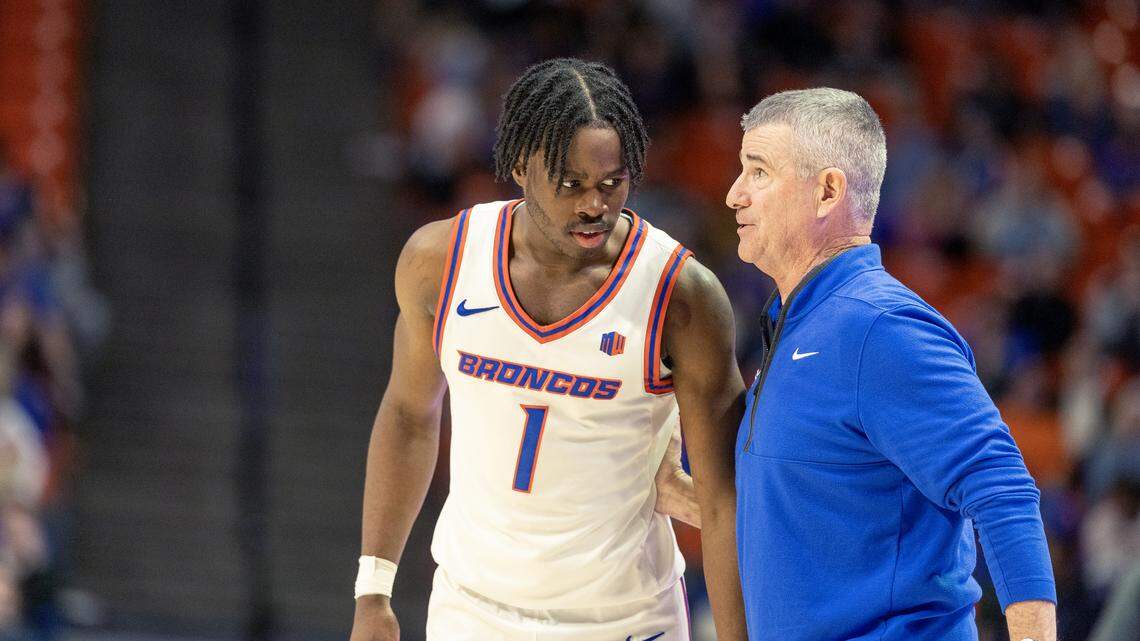
Whether it’s in AAU youth basketball or the NBA Finals, most basketball fans can tell you a team isn’t likely to win a game when it misses its first 11 shots.
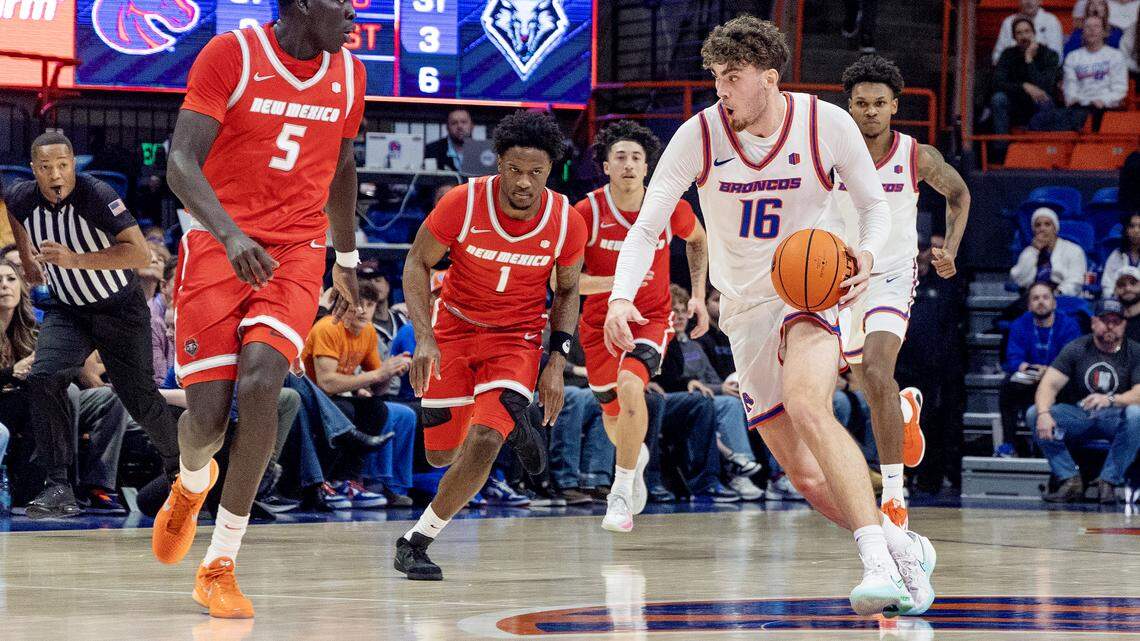
But once in a while, a team manages to defy the odds. That team on Tuesday night was Boise State. Despite starting 0-for-11 from the field and not scoring their first field goal until over 8 minutes into the game, the Broncos managed to defeat New Mexico 62-53 at ExtraMile Arena.
Boise State (9-4, 1-1 Mountain West) went just 20-for-56 (35.7%) from the field, but fortunately for the Broncos, New Mexico (10-3, 1-1) didn’t fare much better. Although the Lobos didn’t start the game quite as poorly, they ended shooting an even worse 20-for-65 (30.8%), including making just three of their final 15 shots.
“Some nights the game of basketball just is like that,” Boise State head coach Leon Rice said after the game. “Credit their defense, credit our defense. Both teams did a really nice job defensively.”
The win marks Rice’s 169th regular-season win in the Mountain West, surpassing legendary coach Steve Fisher for the most regular-season wins in conference history. Fisher coached San Diego State from 1999 to 2017 and won the NCAA National Championship as Michigan’s head coach in 1989.
Boise State came into Tuesday night’s late tipoff assuming it would need to be hot from beyond the arc. The Lobos boast one of the best interior defenses in the Mountain West and have forced opponents this year into taking over half of their shots (51.2%) from beyond the arc.
So when Boise State missed its first nine three-point attempts of the game, the Broncos’ outlook wasn’t too optimistic. Yet, thanks to some poor Lobos shooting down the other end of the court, by the time junior forward Drew Fielder sunk the Broncos’ first field goal of the game after the 12-minute media timeout, Boise State trailed just 8-5.
Fielder’s 3-pointer finally opened things up for the Broncos, who ended the half on a 19-5 run to take a testy 21-19 lead into the half.
“It seemed like we got some open looks, but every one of our shots was a three, and some of them were really open,” Rice said. “Not that I don’t want to shoot those, but we seemed like we were a step slow or (taking) the path of least resistance, we were settling.”
By the end of the night, Boise State shot just 6-for-30 (20%) from 3-point range. But with the Lobos shooting just 3-for-25 (12%) from beyond the arc, down from their usual 33.4%, the Broncos got away with a poor night from the field.
The 53 points scored by New Mexico were its lowest point total of the season. Parallel to that, the Broncos’ 62 points also tied their lowest point total of the season. However, Boise State has also won all three of those games — 62-58 over Montana State and 62-59 over Wichita State.
“It’s all about defense,” said freshman guard AG Neto, who ended the night with 10 points and two defensive rebounds.
“Every team that plays us, they know we’re a good defensive team,” Neto continued. “So we don’t worry about offense if we play good defense.”
For as poor as the first half was offensively, New Mexico appeared to put that behind them coming out of the halftime break. The Lobos embarked on a quick 13-0 run to take a sudden 30-21 lead and take the air out of ExtraMile Arena.
But just as Neto stepped up off the bench to produce a solid 25 minutes of play, it was a fellow freshman, forward Spencer Ahrens, who pulled the Broncos out of the ditch.
Ahrens scored a team-high 12 points off the bench, with 10 of those coming in a four-minute stretch early in the second half. Ahrens ended the Lobos’ 13-0 run with a pair of jumpers before then sinking two 3-pointers, the second of which came deep from downtown and charged life back into ExtraMile Arena as the Broncos quickly narrowed the score to 36-33.
“The team needed a spark, and I’ve been working so hard in practice and stuff, I knew it was going to come,” Ahrens said. “I’m not forcing anything, just letting the game come to me.”
The Broncos took a 42-41 lead a few minutes after Ahrens’ run, thanks to a layup from Neto, and didn’t look back for the rest of the game.
The pair of freshmen led an impressive night from a Boise State bench that scored 37 points, more than the 25 the starting five managed. Sophomore forward Pearson Carmichael also chipped in off the bench with 11 points.
After the Broncos started the game 8-0 down, Rice went to his bench and subbed out four of the starters, with only Meadow left on the court. The switch helped stymie the Lobos’ early domination before several starters returned to the court.
“When on the bench, we’re reading the game,” Neto said. “We see what the team needs at the moment we get in. So when I get in the game, I kind of know what the team needs, and the game is easier for us coming off the bench because you can see it from outside.”

Shaun Goodwin
Idaho Statesman


Purdue delivered a dominant performance Monday night (Dec. 29), routing Kent State 101-60 at Mackey Arena as the No. 5 Boilermakers topped the century mark in nonconference play.
Purdue improved to 12-1 on the season while emptying the bench, with Mr. Indiana Basketball runner-up (2024) Jack Benter leading the way with 20 points. The Boilermakers return to Big Ten action against Wisconsin on Saturday (Jan. 3).
Elsewhere on the college hardwood Monday night (Dec. 29), Indiana State edged Belmont 81-80 in overtime in Terre Haute, while Ball State cruised past Earlham 93-30.
Notre Dame opens Atlantic Coast Conference play with a late road test at Stanford tonight (Dec. 30), marking the start of league action for both programs.
In the NBA, the Indiana Pacers dropped their ninth straight game Monday night (Dec. 29), falling at Houston 126-119. Pascal Siakam led Indiana with 23 points as the Pacers slipped to 6-27 on the season. Indiana returns home to host the Orlando Magic tomorrow afternoon (Dec. 31), with coverage on 103.9 FM and the WRBI App.
Local teams were also in action Monday (Dec. 29) during holiday tournament play, with the St. Louis seventh-grade boys team finishing runner-up in its tournament.
The Cardinals opened the day with a 25-17 win over Rushville before falling to Connersville 57-18 in the championship game. Nathaniel Fuentes led St. Louis in scoring on the day with 15 points, followed by Nicholas Lieland with 12 and Carter Meyer with 10. Cooper Ulmer, Nolan Steinkamp, and Jacob Hillenbrand each added two points as the Cardinals moved to 7-4 on the season.
The St. Louis eighth-grade boys team also played host during the holiday tournament but came up short in both contests. The Cardinals fell to Rushville 30-23 in the opener, with Cam Walke scoring 11 points and Evan Jennings adding eight.
In the second game, St. Louis nearly completed a comeback against Connersville before a late putback sealed a 39-35 loss. Walke again led the way with 12 points, Jennings finished with eight, and Brock Scheibler added six. The eighth-grade Cardinals return to action with a road trip to Greendale on Saturday (Jan. 4).
Milan and Greensburg met in a competitive co-ed dual meet in the Pirates pool Monday evening, with each team claiming a side of the scoreboard.
Milan’s girls earned the team win, 86-70. Greensburg’s boys answered with an 84-56 victory.
On the girls side, Milan was paced by Lainey Stock, who won the 200 free and 500 free, and Kaitlynn Hicks, who swept the 50 free and 100 free. Milan also captured both freestyle relays, winning the 200 free relay (Ashlyn Dewire, Jordyn Huebner, Kami Laws, Lainey Stock) and the 400 free relay (Dewire, Hicks, T Stock, L Stock).
Greensburg’s girls collected event wins in the 200 IM and 100 breast from Audra Gehl, the 100 fly from Mallory Mains, and the 200 medley relay (Jameson, Gehl, Mains, Walden).
Greensburg’s boys produced wins across the board, led by Jack Bennett in the 200 IM and 100 back, Harrison YU in the 200 free and 100 breast, Tyler Williams in the 50 free and 100 free, and Joseph Hawkins in the 100 fly and 500 free. Greensburg also swept the boys relays, winning the 200 medley relay (Bennett, Reynolds, YU, Koors), 200 free relay (Koors, Hawkins, Williams, Bennett), and 400 free relay (Hawkins, Reynolds, Williams, YU).
Team scores: Girls: Milan 86, Greensburg 70 — Boys: Greensburg 84, Milan 56
In baseball, the Cincinnati Reds continued reshaping their roster for the 2026 season by adding outfield depth. Cincinnati signed free-agent outfielder JJ Bleday to a one-year, $1.4 million contract and acquired Dane Myers from the Miami Marlins in exchange for minor leaguer Ethan O’Donnell. To make room on the roster, the Reds designated pitchers Keegan Thompson and Lyon Richardson for assignment.
College football also took center stage, as Indiana arrived in California this week ahead of its Rose Bowl matchup with Alabama. The Hoosiers are listed as a seven-point favorite, with the winner advancing to the College Football Playoff semifinals.
And while South Ripley’s Centerville Holiday Tournament championship was mentioned on air Tuesday (Dec. 30), one moment from the weekend continues to draw attention: Claire Samples’ three-quarter-court shot at the buzzer to end the first quarter during tournament play.
Tonight on The Sports Voice, it’s girls’ basketball action — as North Decatur visits Jac-Cen-Del. Jackson Voss and Garry Sauley have the call, with pregame coverage starting around 6:45 on 103.9 FM and The WRBI App.
Here is the video of Claire Samples’ buzzer-beater from the Centerville Holiday Tournament:



#11 Volleyball Practices, Then Meets Media Prior to #2 Kentucky Match

Nascar legal saga ends as 23XI, Front Row secure settlement


Sunoco to sponsor No. 8 Ganassi Honda IndyCar in multi-year deal

Maine wraps up Fall Semester with a win in Black Bear Invitational

WNBA’s Caitlin Clark, Angel Reese and Paige Bueckers in NC, making debut for national team at USA camp at Duke


Ross Brawn to receive Autosport Gold Medal Award at 2026 Autosport Awards, Honouring a Lifetime Shaping Modern F1
NASCAR, 23XI Racing, Front Row Motorsports announce settlement of US monopoly suit | MLex


Hope College Tops MIAA Commissioner’s Cup Fall Update


Rick Hendrick comments after the NASCAR lawsuit settlement


Nike Signs 10 LSU Athletes to NIL deals