The last time the United States hosted the World Cup, the U.S. Soccer Federation built on the the financial infusion and the public’s excitement to help launch Major League Soccer two years later.
Much has changed with the 2026 World Cup. This time the tournament is hosted by three nations, with the United States joined by Mexico and Canada. And the financial windfall will go to FIFA, which is running the tournament for the first time rather than a local organizing committee, such as the one in 1994 that used its $40 million surplus to fund the U.S. Soccer Foundation — the charitable arm of the national federation.
So what will the World Cup’s legacy be for U.S. soccer’s governing body? The not-for-profit is undertaking ambitious and sprawling projects to boost the game from the youth ranks to the pros.
U.S. Soccer’s ultimate aim is to spread the sport at the youth level through school and community programs, expand fundraising efforts and position the U.S. professional leagues and national teams for future success.
It’s a tall order, CEO JT Batson admits.

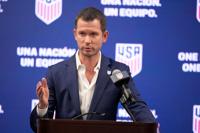
JT Batson, CEO of U.S. Soccer, speaks during a news conference on Sept. 16, 2023, in Atlanta.
“We already have this massive engine that is people who love soccer in this country, and the infrastructure of our professional leagues and clubs, and all the youth soccer across the country. That’s a really powerful group that if organized and supported, can do some pretty incredible things,” he said.
Soccer Forward, the federation’s legacy project announced last year, has started to roll out. With the motto “Soccer Everywhere for Everyone,” it sells schools on expanded soccer programs, brings mini-fields into communities where soccer doesn’t have a big footprint, and supports community-led efforts to grow the game at a grassroots level. It includes everything from best practices for fundraising, to securing grants for building soccer fields, to tips for youth coaches.
U.S. Soccer says such initiatives are sorely needed: One in four schools have no sports programs.
But it goes beyond just the game, with elements of health and charity. In October, the Kansas City Current partnered with Soccer Forward for an event at the Kansas City Girls Preparatory Academy. More than 100 girls took part in small-sided soccer games and programming focused on women’s health. The girls also packaged hygiene kits for women in need.
An emphasis on equity in the sport was aided by a $25 million donation from Michele Kang, owner of the NWSL’s Washington Spirit, as well as Lyon and the London City Lionesses in Europe. The money will be used to grow the women’s game through research and innovation projects.


United States head coach Mauricio Pochettino, center, talks to Gil Reyna during the second half of an international friendly against Uruguay on Nov. 18 in Tampa, Fla.
Batson said the goal is to ensure that “everyone who wants to play soccer can play, and that we have the right resources going to the right levels of the game to achieve the right resources.”
That means there’s an opportunity not just to benefit the kids who want to play recreationally, but to also bring future players into the game who may go on to academies, colleges or professional soccer careers.
“I think one of the big shifts for U.S. Soccer is sort of articulating ourselves as being in service to soccer, and we take that very seriously around our role of supporting those who are brining soccer to life in communities all across the country,” Batson said. “This is a huge flipping of how U.S. Soccer sees itself and the role we play with our members and everyone else who loves soccer, and (we) are trying to do things every day to earn the trust of those folks to continue on that journey with us.”
Former Deloitte executive Dan Helfrich, hired as the USSF’s chief operating officer this month, will help oversee In Service to Soccer, the federation’s overarching strategy.
“It is our responsibility to drive lasting legacy from hosting the World Cup,” Helfrich said. “We take that responsibility very seriously and believe that we will have national holistic impact that comes from this World Cup, not just sporadic impact limited to a few communities or cities.”
To achieve these lofty goals, U.S. Soccer needs funding. So the federation has also launched the Behind the Dream campaign which aims to raise $250 million — and also hopes to capitalize on the excitement of the World Cup.


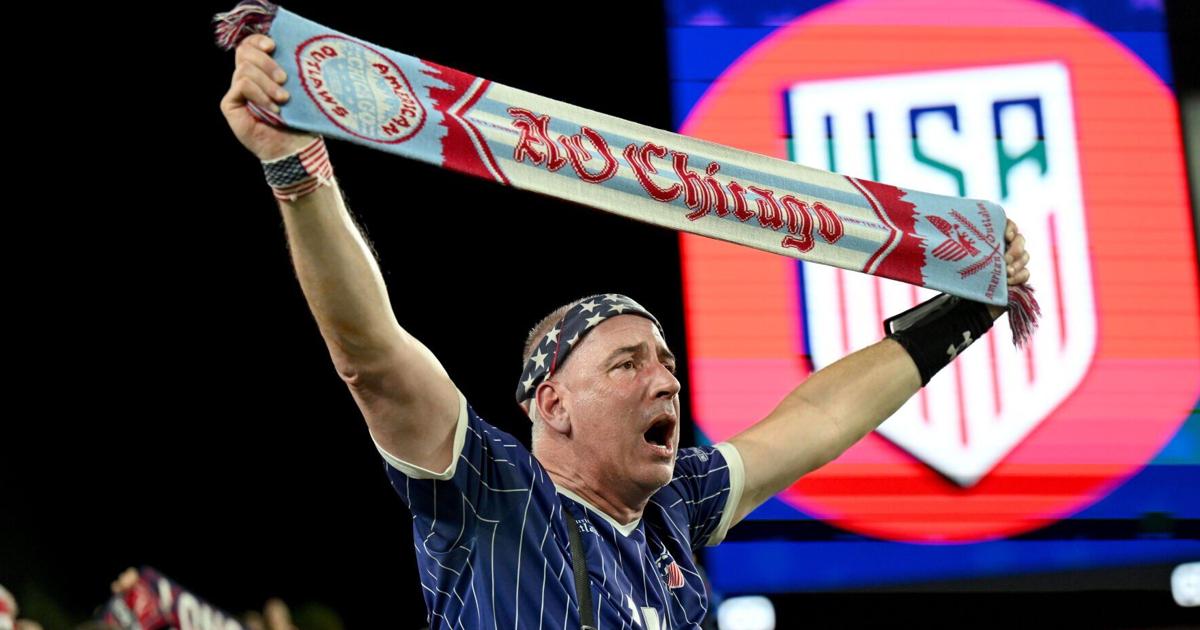
A United States fan cheers on the team following an international friendly against Uruguay on Nov. 18 in Tampa, Fla.
In many countries the government helps fund sports federations. For example, the English Football Association gets funding from several government entities, including Sport England. Sports federations in the United States are non-profit organizations.
U.S. Soccer has put an emphasis on fundraising in the past two years. In 2023, U.S. Soccer’s expenses exceeded its revenues. That has since flipped.
U.S. Soccer took in $257.4 million in revenue for the 2025 fiscal year, a 36% increase over 2024, in part because of fundraising and sponsorship deals in anticipation of the World Cup.
“U.S. Soccer is in a fortunate position by virtue of our financial growth to be able to invest in our soccer strategies at unimaginable levels, even five years ago,” Batson said. “And we also have been very intentional about learning from other very successful movements to say `OK, how do we approach this in a way that leads to the outcomes that we care about.’”
The new playbook: Why personalized coaching is taking over youth sports
The new playbook: Why personalized coaching is taking over youth sports
Updated


In the past, finding a private sports coach often meant word-of-mouth referrals, expensive training facilities, and time-consuming scheduling. But as technology continues to reshape the way we work, learn, and connect, the world of youth sports training is getting its own upgrade.
Just as Airbnb revolutionized travel and Uber reimagined transportation, new digital platforms are now decentralizing the $20 billion youth sports industry, giving families more direct access to qualified coaches—and providing former athletes with flexible, gig-style income opportunities after their playing careers end. It’s the era of on-demand coaching.

Training on Your Terms
Updated


This model, often referred to as the “platformization” of sports training, is catching on fast. Rather than committing to year-round training fees or expensive academies, families can now access high-quality coaching one session at a time—often from athletes who’ve competed at the highest levels. Proprietary data from Athletes Untapped, an on-demand coaching platform, shows a threefold increase in the number of youth training sessions booked online between 2018 and 2024. The spike reflects a growing comfort with using digital tools to find and schedule specialized coaching, echoing consumer trends seen in fitness, tutoring, and other service sectors.
Much of this growth has been driven by parents seeking personalized, flexible training options that fit into increasingly busy family schedules. Rather than enrolling in seasonal or year-round programs, families are opting to book single sessions based on their child’s needs and availability—often working directly with former collegiate or professional athletes in their local area.
A Win-Win Era for Sports
Updated


Former athletes get a meaningful, flexible path forward. And the game itself? It gets to live on in new and evolving forms.
Further analysis of platform data reveals which sports are driving the most interest in private coaching. Basketball, soccer, baseball, and volleyball rank as the most-booked disciplines on Athletes Untapped, consistent with broader youth sports participation trends in the U.S.
That data shows some of the most popular sports for youth training—including basketball, soccer, and baseball. But the bigger takeaway? The way we think about skill-building is changing. Kids want coaches they connect with. Parents want transparency and trust. And both want access—without the red tape.
Whether you’re a parent looking for flexible training options or an ex-athlete figuring out your next chapter, the message is clear: Coaching, like almost everything else, is going on-demand.
This story was produced by Athletes Untapped and reviewed and distributed by Stacker.