
Sports
USC Paralympian Ezra Frech is a pioneer under pressure


EZRA FRECH PLACES two black boxes in his backpack and jumps on his electric scooter to ride a few blocks to the University of Southern California, where he is about to give his professors a very good reason for having missed the first three weeks of the semester.
The boxes contain the two gold medals the 19-year-old just won at the 2024 Paralympics in Paris, in the 100-meter and the high jump for the T63 classification (athletes with a single-leg amputation above the knee).
“It’s USC; they are known for their Olympians,” says Frech, who was born with congenital limb differences. “I know the professors can understand the Olympics, but I wasn’t sure if they even realized the Paralympics were going on.”
As Frech, wearing shorts and a T-shirt, waits at a stoplight on Jefferson Boulevard near downtown Los Angeles, two USC students not-so-subtly whisper, “Is that that Paralympian?” One student takes out her phone and snaps a picture of him crossing the street. By the time Frech arrives at the Cinematic Arts building, multiple people have stopped him to ask for photos.
“I had been recognized before Paris, a little bit, because of the Tokyo Paralympics and my social media where I posted everything from my disability to training to modeling for fashion brands, but never to this extent,” Frech says. “I couldn’t believe it, honestly. It just made me feel like, ‘Wow, this is happening. I’m here for a purpose and reason.'” Frech keeps his gold medals in his backpack for his first few weeks of school, handing them to anyone who wants to put them around their necks.
Frech has been in the national spotlight since the 2020 Tokyo Games, where he was featured in the ads from Team USA and NBC. He’s also one of the faces of the 2028 Olympic and Paralympic Games in Los Angeles, where his Angel City Sports foundation provides sports clinics and competition opportunities to people with disabilities. With a social media following of more than 250,000, and celebrities such as Selena Gomez reposting his achievements, Frech gained the attention of the fashion world, where he has modeled for designers such as Hugo Boss.
But Paris brought new levels of fame to Frech, who, on his way to class on this clear September day, knows he’s making history just by being on USC’s campus. As the first above-the-knee amputee to be recruited to an NCAA Division I track and field program — let alone the winningest program in the country — Frech’s goal is to show the world that an athlete with a disability can compete against the best college athletes without disabilities.
He embraces the pressure of that goal with USC’s outdoor track and field season just months away. It will be a season in which he’ll struggle to medal as he confronts the challenges of such competition, and where he’ll hear from coaches, teammates and those he has inspired that his effort and determination are what matter the most. He’ll hear those messages, but he’ll also resolve to make the marks.
“For me, this is life or death,” Frech says. “I believe what I do out on the track, my marks, my medals, all impact how the world views disabilities. I genuinely believe my purpose on this Earth is to normalize disability, be an example of what’s possible as an amputee.”
HIGH JUMPER SAM Grewe, now Ezra’s mentor and Team USA teammate, became the first amputee to compete in NCAA Division I track and field when he walked onto Notre Dame’s track and field program in 2019. When Frech was in high school, he realized there weren’t any adaptive programs at the colleges he wanted to attend. So he made it his goal to become the first above-the-knee athlete to be recruited to a Division I program.
“I wanted to do something no one’s ever done before,” Frech says. “Trailblazing is in my DNA. I love pursuing things that seem impossible.”
Frech, who won gold in the high jump at the World Para Athletics Junior Championships at 15 and placed fifth in the high jump at the Tokyo Paralympic Games at 16, reached out to hundreds of NCAA coaches during his junior and senior years at Brentwood School in Los Angeles. “Our current marks to make the squad are seven meters in the long jump and 1.96 meters in the high jump,” one coach wrote to Frech. “We have some guys on the squad who are not quite at those marks yet, but they’re primarily decathletes or have other events.”
Those marks became a recurring theme in the coaches’ responses. “I realized that a lot of it had to do with the numbers alone,” he says. “And although I was trying to do everything to get there, I think it was also a little bit that some coaches weren’t willing to take a risk on a kid who was an amputee. There’s a lot of variables and unknowns with that. And maybe they just didn’t know if I was going to hit them in the time period, or ever.”
At the 2020 Tokyo Paralympics, 16-year-old Frech placed fifth in the high jump with a personal best 1.80 meters and eighth in the long jump with 5.85 meters. Shortly after, he was jumping 6.20 meters in the long jump and 1.83 meters in the high jump. Between his junior and senior years in high school, Frech raised his marks to 6.86 meters in the long jump and 1.95 meters in the high jump. In 2023, Frech set a world record and earned the gold medal in the men’s high jump T63 category with 1.95 meters at the world championship. Before his Paralympics and worlds experiences, Frech held the title for high jump at the World Para Athletics Junior Championships.
“I needed someone to believe in the vision,” Frech said. “Because this is the coach that I was going to be spending the most important four years of my career with. And if this coach isn’t going to believe in me when I’m on the cusp of accomplishing a specific mark, then how am I going to sit here with this coach and say, ‘I want to win three gold medals in L.A. in 2028 at the Paralympics’?”
The inquiries and rejections went on for nearly six months. Then, in summer of 2023, he heard from USC’s newly hired jumping coach, Jeff Petersmeyer.
“The first time I saw him jump, he just kept making bars,” Petersmeyer said. “He just kept making bars, and I was really impressed. And I was like, ‘Man, this guy’s got some potential.’ You could be the highest high jumper, the further long jumper, but if it’s not a good match, then you’re probably not the right person for us here at USC.
“But for Ezra, it’s not all about how high he jumps and how far he jumps, it’s about the person and what he brings to us and what we can bring for him and his development.”
By December, USC had offered Frech admission to the university with “the understanding that you will compete as a member of USC’s Men’s Track and Field team during at least your first year of enrollment at the university.” Ezra also received the inaugural Swim With Mike Foundation’s Amir Ekbatani Paralympic Scholarship, awarded to a Paralympian attending USC or UCLA.
“Ezra brings so much to the table with the team,” Petersmeyer said. “His energy, his drive, his resolve, his determination, his charisma. Everything is so important and salient to what we’re trying to do as a team. Having Ezra train with the upperclassmen who have titles and records already is so important to not only his success but the success of them too. He’s a valuable member of this team.”
ON MAY 11, 2005, Bahar Soomekh lay in the hospital bed at Cedars-Sinai in Los Angeles, her newborn son wrapped in a blanket in her arms. She wasn’t aware of the pandemonium happening around her in the delivery room.
Soomekh heard her husband, Clayton, asking everyone to leave the room. “What’s going on?” Soomekh remembers asking. She saw her doctor pacing back and forth. “What’s happening?” Soomekh yelled.
More doctors piled into the delivery room and took the newborn out of his mother’s arms. Bahar and Clayton were told their son was born with congenital limb differences — a condition where the limbs do not fully develop or form while the baby is in the womb. Physically, the newborn didn’t have a left knee, left fibula or four fingers on his left hand. His left leg was curved up toward his waist, and his left arm and hand were curled toward his chest. Despite numerous tests and 3D ultrasounds during the pregnancy, doctors missed the signs of a congenital condition.
Less than 24 hours later, doctors told the new parents that their son’s leg would have to be amputated and discussed options for surgeries that would provide mobility on his left hand. Soomekh’s mind raced. How is he going to be at school? Is he going to have problems? Are kids going to make fun of him? Bully him? What is his life going to be like?
The new parents decided on a name for their newborn: Ezra. The biblical name meaning “help” or “helper” in Hebrew spoke to the parents.
At 2 years old, Frech underwent groundbreaking surgery to amputate his left leg and transplant his left big toe to his left hand. Frech’s surgeons, at Boston Children’s Hospital pioneered the procedure with the goal of improving hand function and allowing engagement in physical activities. While his parents made a point of never hiding his disabilities, as he grew older, Frech began to realize how his body was different from those of other people he saw.
When he was 4, the year he got his first prosthetic leg, Frech was staring at himself in the bathroom mirror at his home in Brentwood, tears streaming down his face. He called to his mother. “Who looks like this, Mom? Who? No one is like me,” Frech sobbed. “Why did God pick me to not have the leg? Why did God pick me not to have the fingers?”
This was the first time Soomekh had seen her son break down over his disabilities. “Look at me,” she told him. “Remember your name. Ezra, which means to help, which means to teach. Your purpose is to help and teach the world about the beauty of disability. God picked you because you’re going to change the world.”
“Everything we did for Ezra was to build him up,” Soomekh says. “I would tell him, ‘Ez, put your head up. Walk with your chest out. I want you to walk into every room, every park and look and stare down everybody in that room. You let them know you arrived.'”
A few years later, on the grassy field at Brentwood School, 6-year-old Frech cradled a football in his left arm and looked around to see who was open. He was playing flag football with his classmates, and he was the quarterback. With only a few yards between him and the end zone, Frech took off running.
As he picked up speed, he realized his prosthetic leg was starting to detach. Within a matter of seconds, Frech’s running blade flew off his body and landed in front of four kids from the opposing team. Everyone froze. Still clutching the football, he hopped into the end zone for a touchdown.
“Everywhere I went in public, people were staring and pointing fingers and whispering. I felt like a zoo animal,” Frech says. “I was battling my own insecurities, battling my own perception of myself. The way I got through that was genuinely realizing that there was nothing I could do. I might as well make the most out of my life.”
By his 10th birthday, sports had become a huge part of that life. “When I was playing a sport, I wasn’t thinking about the fact that I was the only person at my school with a disability,” he says. “I was just one of the athletes.”
Playing on a club basketball team, Frech practiced a few times a week with his teammates and coaches. But he would dedicate time in his backyard, before and after school, to honing his skills, dribbling the basketball between his right leg and left prosthetic, navigating his own mobility on the court.
At practice and on game days, Frech displayed unwavering confidence. But as his skills developed, so did the disparaging comments. One day during basketball practice, Frech heard his coach yelling, “Are you guys kidding me? You’re letting the kid with one leg score on you right now?”
“Underestimating me probably pisses me off the most,” Frech says. “I always had to go the extra length to prove my worth, because it was so unlikely that the kid with the disability was going to be a starter on the team.”
“I’M READY TO go,” Frech says, as he walks onto the field at Allyson Felix Stadium on USC’s campus.
It’s February, less than one month away from his collegiate debut, and Frech has arrived at the track almost an hour before his teammates. He starts his warmup routine. After a few minutes, he removes his walking prosthetic and wipes down the upper part of his left thigh. Sliding on a rubber covering, he pushes his running blade onto his left thigh. Frech jogs up and down the turf field.
He removes his running blade and replaces it with his jumping prosthetic. “I’m ready to go,” he says again.
With teammates Elias Gerald and Brady Palen and Coach Petersmeyer standing adjacent to the high jump, Frech walks to his starting mark. In his first attempt, he clears the bar at 1.90 meters. Bouncing off the bright red mat, Frech races back to the starting mark. “Let’s go again,” he says. Catapulting off his right leg, he rotates his body to face his chest toward the sky and positions his left prosthetic to swing over the bar. Creating a gap between his body and the bar, Frech clears it with room to raise the bar even more.
Running into a curve with his prosthetic, Frech has little room for error in the high jump. Without a foot or ankle on his left leg, he can’t strike the ground in an angled position. Instead, he must run on the outside of the prosthetic, which increases his chances of slipping or falling. While propelling himself over the bar, Frech doesn’t have any control over the lower part of his prosthetic leg.
“If I place the blade literally centimeters to the left, right front or back off in any direction, it will throw off the entire run and everything will be messed up,” Frech says. “I’ve gotten really good at learning how to place it over the last 19 years so I know how to put it in the right position. Once I’m in the air, the prosthetic leg doesn’t provide me with a ton of momentum the same way swinging an able-bodied leg would. The reason I miss bars is because the blade takes it off.”
Springing off the mat, Frech moves to the side to watch a replay video from his coach’s phone. Catching his breath, Frech watches closely as his teammates prepare for their jumps.
Having recently returned from winning the NCAA Division I men’s indoor national championship — the 32nd national championship for the Trojans men — Gerald and Palen are two of the best jumpers in the nation. Clearing above 2.0 meters on a regular basis, the two upperclassmen set the standard for USC’s team. As the two took turns clearing above 2 meters, Frech focused on their form and energy.
“Having these three guys train together is so important to success, and Ezra’s development is going to be enhanced by having Brady and Elias,” Petersmeyer says. “Realistically, this season, we want him to earn a spot on the Big Ten roster. I know that’s something he’s trying to attain. He needs to get faster and stronger, and that’ll happen.”
Retreating back to the men’s locker room, Frech grabs at his phone and starts scrolling on social media. He shakes his head in disbelief. “Can you believe this?” Frech says to Gerald and Palen, showing them his phone. After posting videos on social media of him clearing bars at practice from the past few weeks, in anticipation of his season opener, Frech received a flood of comments and messages: “Isn’t this cheating?” “How is this not an advantage?” “Bro has a built in spring!” “You’re cheating.”
“People don’t understand how a prosthetic works,” Frech says. “They don’t understand the disabled community. And they just say ignorant stuff that makes absolutely zero sense. But usually the good comments outweigh the bad.
“But ever since posting about USC, it’s definitely increased.”
A few hours later, Frech sits in his car and hits record on his phone. The next day, he uploads a reel on Instagram: “People say I have an advantage. Let’s talk about it.
“If having a prosthetic leg was cheating, then why is my world record in the long jump, 100-meter and high jump way less than an able-bodied athlete?”
In the weeks following, Frech competed for USC at four invitationals where he battled to find a place on the leaderboard. After claiming second in the high jump and seventh in the long jump at the first outdoor meet of the year, the Trojan Invitational, Frech traveled with the team to the LSU Battle of the Bayou, where he failed to clear a valid height and didn’t place on the leaderboard. Finishing 27th in the long jump at the 65th annual Mt. SAC Relays in April, Frech knew his first season was coming to a close. In his last meet with the team, at the USC vs. UCLA Invitational, Frech finished fifth in the high jump and seventh in the long jump.
“It’s disappointing to not perform my best,” Frech says. “I know what I’m capable of, and I know I have what it takes to get there. We knew that there was going to be a learning curve and that it would take some time.”
USC went on to win its 33rd men’s national championship in June.
“Ezra wasn’t one of the jumpers for us at the national championships, but he showed up and gave it his all,” Petersmeyer says. “He helped us win these titles. He’s a valuable member of the team.”
This summer, as Frech prepares for the 2025 World Para Athletics Championships in October, he’s not shy about his goals for his next season with the Trojans.
“I will make the Big 12 team. I will travel to more away meets. And I will continue to improve my skills and develop.
“It wasn’t expected that I would come out and win everything in college. This is new territory. But I’m here,” Frech says.
WHEN FRECH WAS 12, he sprinted to the middle of a grassy field, away from other competitors and parents. He pounded his hands against his head and started crying.
It was the 2013 Endeavor Games in Oklahoma, Frech’s first time participating in sporting events alongside other athletes with disabilities. The 8-year-old’s father, Clayton Frech, signed him up for everything, including every track and field event.
Frech attempted the long jump first. With his running blade securely attached, Frech took off down the runway. He sprang into the air and landed in the sand. “We had no idea what we were doing,” Clayton Frech says. “It was his first time long-jumping. He was just running and jumping.” But then, Frech jumped farther and farther, soon breaking the youth record in long jump.
Later in the day, in the high jump, Frech ran toward the mat and flung himself in the air. His prosthetic hit the bar. Some of the adult athletes in attendance started giving him pointers to control his prosthetic and carry himself high enough over the bar.
After multiple failed attempts, Frech scurried to the middle of the grassy field adjacent to the high jump event. “I was so upset about how I jumped,” Frech says. “This was my first time ever high-jumping. I don’t even know what I was comparing myself to, why I was so upset. I was so competitive. It’s not even competitive against other people but competitive against what I believe I’m capable of.”
Clayton Frech saw a need for more sporting events and clinics for children and adults with physical disabilities. Soon after that first Endeavor Games experience, he created Angel City Sports, a nonprofit dedicated to providing free access to adaptive sports opportunities for youth, veterans and other adults in Southern California. The organization hosts the Angel City Games each year in L.A., with sports clinics and competitions.
Five years later, in 2018, Frech walked onto the track at Harvard-Westlake school in Los Angeles. He watched as a young boy hurled himself over the high jump bar at the fifth annual Angel City Games. Nathan Kuhn, a 7-year-old born with congenital limb differences, was clearing bar after bar. “Is this his first time?” Frech asked the officials. “This is unbelievable.”
Kuhn, inspired by Frech’s social media posts as he trained for Tokyo, had asked his mother, Patty Kuhn, if he could attend the Angel City Games and try “Ezra’s events.”
“I just wanted to be like him,” says Kuhn, now 12. “I watched videos of him jumping over the bar, and I thought if he could do it, then maybe I could try it too. It was the first time I ever saw anyone that looked like me do something like that.”
Kuhn is in the stands at USC in March as Frech prepares to compete in the high jump competition of his first collegiate meet.
Frech swaps out his prosthetic for his high jump blade. There are only four competitors in the high jump event. Gerald, who holds the collegiate record for high jump at 2.30 meters, told Frech when he joined the team, “Welcome home. This is where you belong.” Gerald reminds him of that today. “You are USC track now. Show everyone why you’re here.” Frech takes his starting mark and clears his first attempt at 1.80 meters.
In his second attempt, Frech clears 1.85 meters. Pushing him to the top spot on the leaderboard. Frech clears his next attempt at 1.90 meters. For his fourth attempt, the bar is raised to 1.95 meters, just above his Paris Paralympic record of 1.94.
Looking at the crowd, Frech stars clapping his hands. “Let’s go!” he yells. The crowd chants, “Ezra, Ezra, Ezra.” Kuhn nudges his mom, smiling. “This is so cool.”
With a dash toward the mat, Frech leaps over the bar before snagging it with the crest of his body. The bar drops to the mat. “Ahhh,” the crowd sighs collectively. The scoreboard flickers to reveal Frech’s second-place finish, behind USC alumnus Earnest Sears III, who entered the competition as an unaffiliated competitor and finished with a 2.15-meter best. Frech ties with Long Beach State’s Cytres Vives, finishing ahead of Harvard’s Daire Mahon.
Hugging his coach, Frech pauses on the track before retreating to the stands to greet his family and friends. A small crowd grows around Frech, and he shakes hands and poses for more photographs. Clayton pulls out Ezra’s two gold medals.
“Nathan, want to put them on?” Frech says. “You’re going to get these one day.”
The 12-year-old hangs them around his neck.
“How does it feel?” Frech asks.
“It feels powerful,” Kuhn says.

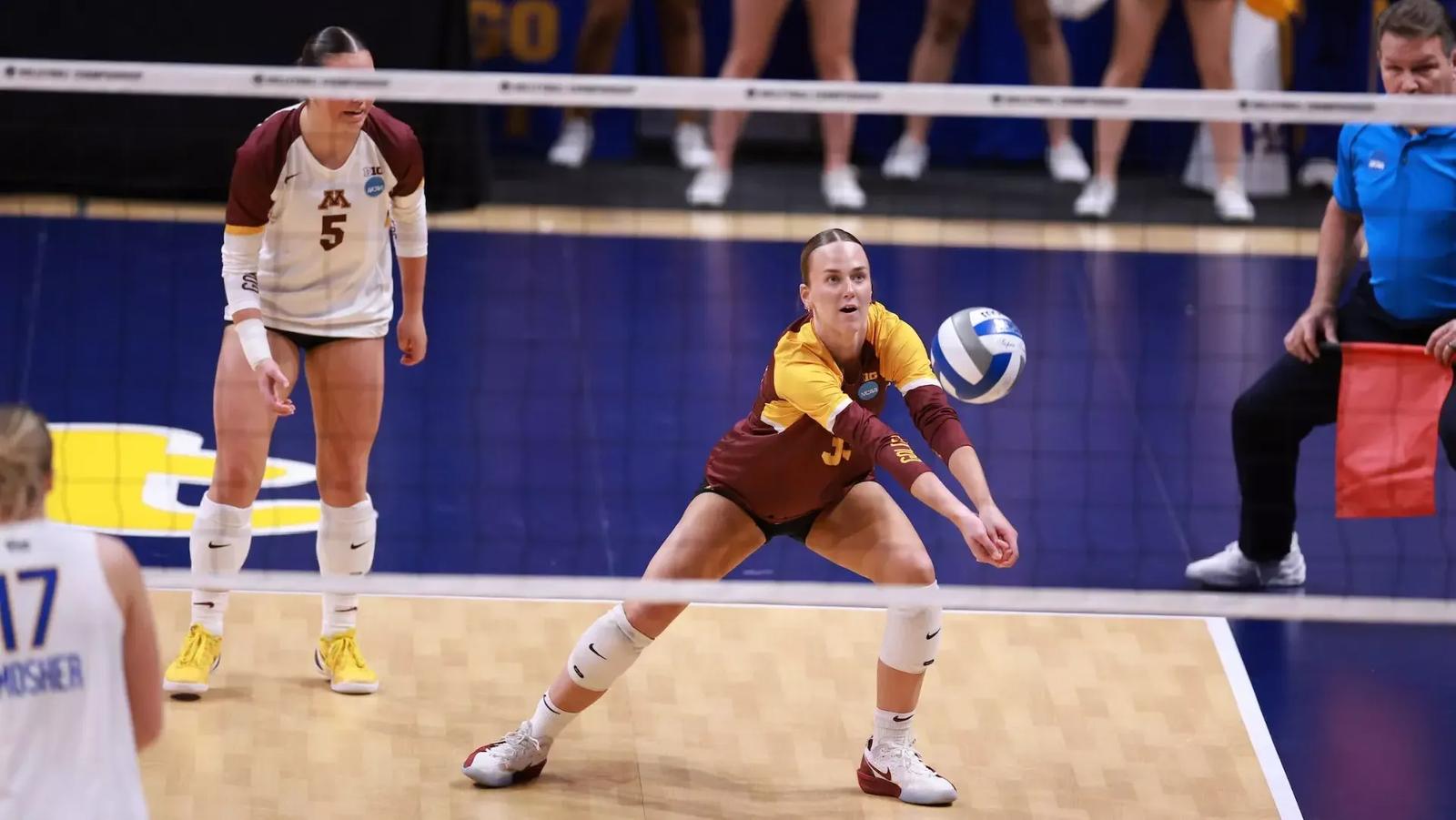
The Gophers season ended in the Sweet 16 for the 21st time in program history with a 24-10 (12-8 B1G) record.
“Congrats to Pittsburgh on the win and for the university and city for being such great hosts,” said head coach Keegan Cook. “I’m proud of the way our team battled tonight and throughout the season. We just fell a little bit short tonight. I told the team I have loved coaching them all year and appreciate their willingness to learn and grow. We’re going to miss these seniors next year, but we’re glad to get back to the second weekend of the NCAA Tournament and continue to push the program forward.”
Kelly Kinney and Carly Gilk led Minnesota with nine kills while Stella Swenson had 28 assists, three blocks and three aces. Julia Hanson was held to eight kills in her final collegiate match.
The Gophers (24-10, 12-8 Big Ten) were outhit the Panthers (29-4, 18-2 ACC) .271 to .178, leading in kills (47 to 33) and digs (48 to 34). Minnesota had more aces (4 to 3) and blocks (10 to 5).
Julia Hanson commented on her time at Minnesota and what it meant for her to end her career as a Golden Gopher.
“There were times that I questioned myself and how things were going after my sophomore year,” Hansen said. “But I’m so glad to be a part of this program and so proud to have that ‘M’ on my chest. It means everything to me. I’m so thankful for my time at Minnesota.”
For Pittsburgh, Olivia Babcock had 19 kills while Brooke Mosher went for 35 assists. Bre Kelly and Blaire Bayless also had eight kills for the Panthers.
How It Happened
SET 1 | Pittsburgh started out hot, scoring six of the first seven points before Minnesota called a timeout. The Gophers tallied a pair of kills to get it to four at 7-3 before the Panthers scored three straight on two kills and a block to go up 10-3. An attacking error followed by a kill from Kinney and a block from Myers cut it to four again at 11-7. Following a service error from Minnesota, the Gophers scored four of the next five to force a Pitt timeout, trailing 13-11. Swenson tallied an ace, Gilk had a kill and Taylor combined with Gilk on a block. After the timeout, the Panthers bounced back by scoring four of five, taking a 17-12 lead and forcing coach Cook’s final timeout of the frame. The Gophers would get no closer than five the rest of the way as the Panthers closed out the first frame, 25-16. Pitt hit .267 for the set while Minnesota hit just .026.
SET 2 | Minnesota came out strong, scoring seven of the first 12. Swenson had two aces while Kinney tallied a pair of kills. A kill from Myers and a block from Kinney and Myers put the Gophers up 10-9 before three straight from Pitt forced a Minnesota timeout, trailing 12-10. Kills from Swenson and Gilk combined with a Panthers attacking error helped give Minnesota back the lead at 14-13. The Panthers scored three of the next four to tie it up at 16-16. Two more kills put them up 18-16, forcing Minnesota’s final timeout of the set. Pitt would go up by as many as three at 22-19 before two errors cut the lead to just one at 22-21, leading to a Pitt timeout. A Panthers hitting error and kill from Hanson tied it up at 23-23, forcing one more Pitt timeout. A kill and a block won the set for Pitt, 25-23.
SET 3 | Pitt scored seven of the first 11 points before kills from Taylor and Gilk combined with a block from Hanson and Taylor tied it up at 7-7. The Panthers went on a 5-2 spurt after that, getting four kills and an ace to go up 12-9, forcing a Minnesota timeout. The Gophers would battle back, scoring five of the next seven to cut it to 15-14. Kills from Gilk and Myers combined with an ace from Garr tied it up at 17 apiece. A pair of kills from Myers put Minnesota up 19-18, leading to a Panthers timeout. After the break, Minnesota got a block and a Pitt error to go up 21-19 before the Panthers answered back with two more to tie it at 21. The two teams exchanged the next pair of points before the Panthers closed out the match on a 3-0 run to win, 25-22.
Game Notes
» Minnesota is now 1-3 all-time against Pitt, including 0-2 in the NCAA Tournament.
» The Gophers are now 10-11 in the NCAA Regional Semifinals.
» Minnesota posted 10+ blocks for the 15th time this season.
» Minnesota is now 4-7 against ranked opponents this season.
» McKenna Garr (10) posted 10+ digs for the 24th time in 2025.
» Lourdes Myers went for six blocks to lead Minnesota.
» Stella Swenson went for 28 assists and a team-best three aces.
Up Next
Minnesota’s spring season begins in January.

LINCOLN, Neb. (KOLN) – Nebraska volleyball is keeping the practices light-hearted as they prep to play Kansas in the NCAA Regional.
The Huskers come into the Round of 16 with a 32-0 record and a lot of pressure to make the Final Four. With the mountain of expectations, the players and coaching staff are keeping the training fun and focused on each round rather than the latter goals.
“We still have a lot of fun in our practice, so even though the level is so high, we’re still managing to find ways to have fun,” junior middle blocker Andi Jackson said.
The light-hearted practices and emphasis on playing freely, has really proven to help Jackson’s game. This season she is hitting a nation-best .483 and is averaging 1.14 blocks per set.
“If you look too far into the future, you’re probably going to get a little nervous and get a little stressed out. So just really focusing on what we’re doing in the moment and focusing on where our feet are,” junior outside hitter Harper Murray said.
No. 1 ranked Nebraska will face off against 16th ranked Kansas on Friday, Dec. 12. The match starts 30 minutes after the conclusion of the two-seed Louisville versus three-seed Texas A&M match, which begins at 6 p.m. CT.
Click here to subscribe to our 10/11 NOW daily digest and breaking news alerts delivered straight to your email inbox.
Copyright 2025 KOLN. All rights reserved.
Dec. 12, 2025, 5:10 a.m. ET

No. 2 Louisville volleyball takes on No. 3 Texas A&M in the NCAA Tournament Sweet 16 today at Bob Devaney Sports Complex in Lincoln, Nebraska.
This match marks UofL’s seventh straight regional appearance and first with Dan Meske as head coach.
Here’s everything you need to know to follow today’s match from home:
Today’s match between No. 2 seed Louisville and No. 3 seed Texas A&M is scheduled for 7 p.m. at Bob Devaney Sports Center in Lincoln, Nebraska.
Buy Louisville volleyball tickets here
No. 2 Louisville versus No. 3 Texas A&M will be broadcast live on ESPN2.
Authenticated subscribers can access ESPN2 via TV-connected devices or by going to WatchESPN.com or the WatchESPN app.
Those without cable can access ESPN2 via streaming services, with Fubo offering a free trial.
If Louisville wins tonight, it will play the winner of No. 1 Nebraska vs. No. 4 Kansas Sunday in Lincoln, Nebraska. Here’s a look at the tournament schedule:
- First and second rounds: Dec. 4-6
- Regionals: Dec. 11-14
- Semifinals: Dec. 18 at T-Mobile Center in Kansas City, Missouri
- Championship: Dec. 21 at T-Mobile Center in Kansas City, Missouri
Click here to view the complete bracket.
- Aug. 29: Louisville 3, Auburn 0
- Aug. 31: Louisville 3, Morehead State 0
- Sept. 1: Louisville 3, St. John’s 0
- Sept. 7: Louisville 3, Illinois 1
- Sept. 10: Texas 3, Louisville 2
- Sept. 12: Louisville 3, Creighton 1
- Sept. 13: Louisville 3, UNI 1
- Sept. 14: Louisville 3, Rice 1
- Sept. 18: Kentucky 3, Louisville 2
- Sept. 22: Louisville 3, Western Kentucky 0
- Sept. 26: Louisville 3, Boston College 0
- Sept. 28: Louisville 3, Syracuse 0
- Oct. 3: Louisville 3, California 0
- Oct. 5: Louisville 3, Stanford 1
- Oct. 10: Louisville 3, Virginia Tech 0
- Oct. 12: Louisville 3, Virginia 1
- Oct. 17: SMU 3, Louisville 2
- Oct. 19: Pitt 3, Louisville 2
- Oct. 24: Louisville 3, Duke 0
- Oct. 26: Louisville 3, North Carolina 1
- Oct. 29: Louisville 3, Notre Dame 0
- Nov. 1: Louisville 3, Notre Dame 0
- Nov. 7: Louisville 3, N.C. State 0
- Nov. 9: Louisville 3, Wake Forest 1
- Nov. 13: Louisville 3, Florida State 1
- Nov. 16: Louisville 3, Miami 2
- Nov. 21: Louisville 3, Georgia Tech 1
- Nov. 23: Louisville 3, Clemson 0
- Nov. 26: Pitt 3, Louisville 0
- Nov. 29: Stanford 3, Louisville 2
- Dec. 5: Louisville 3, Loyola Chicago 0 (NCAA Tournament First Round)
- Dec. 6: Louisville 3, Marquette 2 (NCAA Tournament Second Round)
- Dec. 12: Louisville vs. Texas A&M (NCAA Tournament Regional Round)
Reach college sports enterprise reporter Payton Titus at ptitus@gannett.com and follow her on X @petitus25. Subscribe to her “Full-court Press” newsletter here for a behind-the-scenes look at how college sports’ biggest stories are impacting Louisville and Kentucky athletics.
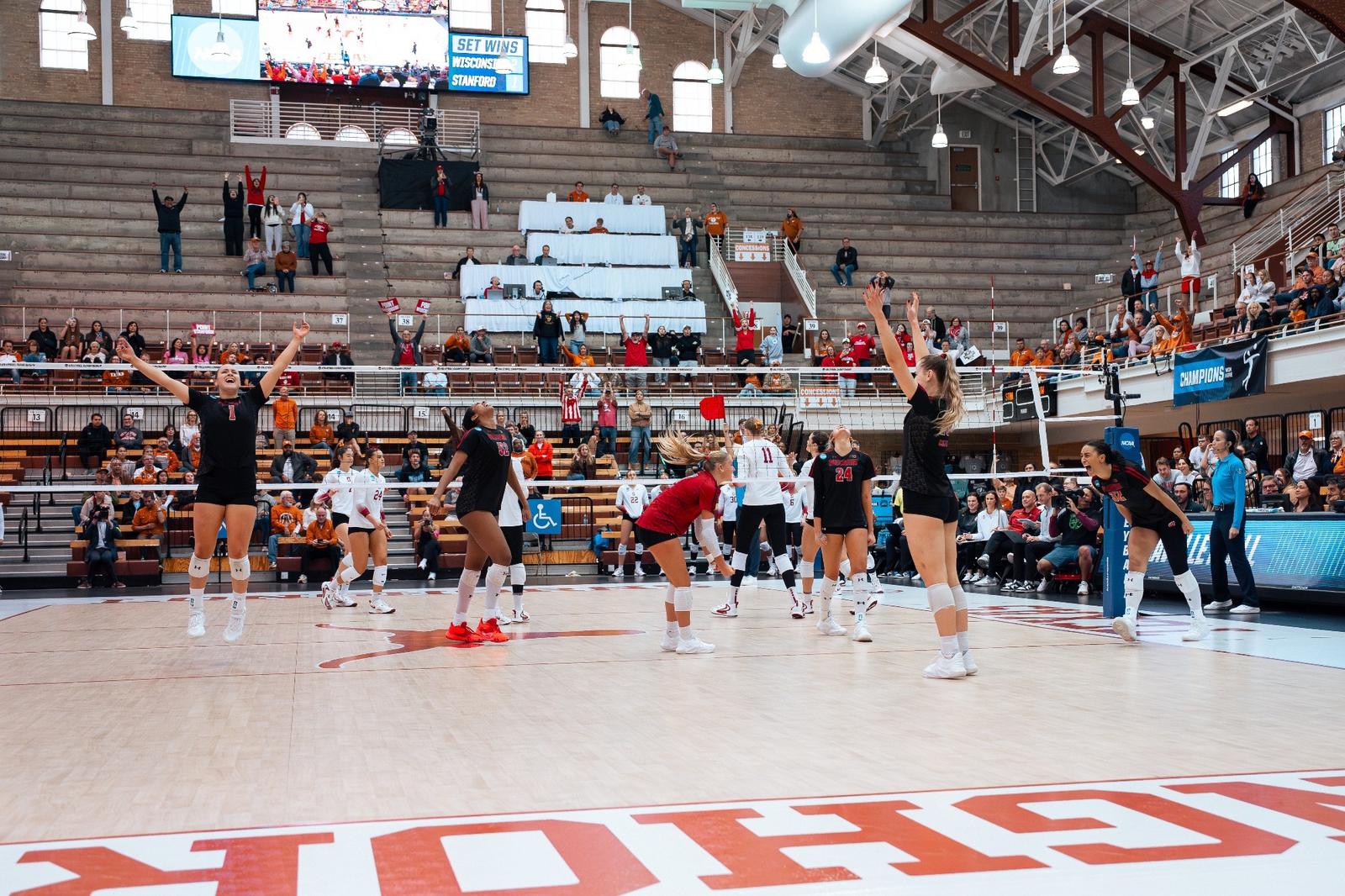
The Badgers (27-4) were clicking on all cylinders in the first frame, as UW exploded for a .514 swinging percentage to jump out to a hot start in the first frame.
Wisconsin utilized a 5-0 serving run from libero Kristen Simon, highlighted by an ace turned in by the freshman—guiding the Badgers to a 15-9 advantage. UW and the Cardinal (29-5) continued to trade points throughout the latter half of the set, led by nine kills from outside hitter Mimi Colyer.
Stanford was quick to provide a response in this back-and-forth affair, as they put together three separate 3-0 runs to put away the Badgers and even up the match. UW fought back late with the help of a kill apiece from middle blocker Carter Booth and Colyer. Unfortunately for the Badgers, it was not enough, as they fell 21-25 to even up the match at one apiece.
The teams continued to be even throughout the first half of the third frame, with Stanford building a 17-14 cushion. In one of the largest turning points of the match, freshman Natalie Wardlow stepped up in the clutch with three-straight service aces to give UW an 18-17 lead. Wardlow’s four aces on the afternoon tied a career-best, as she last finished with four against No. 1 Nebraska on Oct. 31.
The Badgers kept the pressure on, forcing the Cardinal out of the system for the remainder of the third set. Right side Grace Egan capped it off with a kill to secure a 25-23 victory.
Set four brought the same intensity, as Wisconsin jumped out to a 10-6 lead with a pair of kills turned in by outside hitter Una Vajagic. The redshirt sophomore finished with her 10th double-double, hitting .411 with 13 kills, complemented by 11 digs on the defensive end.
The Cardinal battled and tied it up at 14-14 before the Badgers’ rattled off three consecutive points. Colyer racked up her 2,000th kill of her career in the process—accumulating a match-high 27 at Gregory Gym. The senior earned her final three in the late stages of set four, pushing Wisconsin to the Regional Finals.
Offensively, Booth tied a career-best with 14 kills, last doing so in the Regional Semifinal last season against Texas A&M. The Denver, Colorado, native swung .700 (14 – 0 – 20) against the Cardinal, as she finished errorless for the fourth-straight match.
Middle blocker Alicia Andrew joined her in the process, racking up seven kills on nine attempts without an attack error.
Setter Charlie Fuerbringer was the centerpiece throughout the entirety of the match, tallying a career-high 61 assists to guide the Badgers to their highest hitting percentage in a four-set match in program history.
Straight from the Court
Head Coach Kelly Sheffield (on this afternoon’s match): “It was just two teams that were just battling like crazy. The level of talent out there on the court and the level of play out there, that easily could have been a Final Four match. It’s unusual to see that high level and back-and-forth in the Sweet 16.”
(On freshman Natalie Wardlow’s serving): “It was huge because we were down by a few points, and she got in there and got three aces in a row. She’s put in the work, and she’s got that ability to doubt people as a passer and get you doubting. She’s got that ability, we have a few of those players who can do that.”
Middle Blocker Carter Booth (on what went right offensively): “I think it was just coming into the match with the mentality that we’re on the attack, knowing that we have a bit of an advantage in transition from what we’ve studied over the film. I think it was really an emphasis for us to always be the ones throwing punches, not the ones taking them.”
Outside Hitter Mimi Colyer (on playing in marquee matches): “I want to get in these big games and be competitive and play with a group of girls that want to win and need to win. I think our team is doing just that, I think we’re gelling at the right time and I think we’re gaining so much momentum.”
Setter Charlie Fuerbringer (on Una Vajagic’s performance): “I think she’s literally the most underrated player in the whole NCAA. She hit .444 and had 13 kills tonight, and she passes dimes. When Una passes, I think we hit over .500 every time, so I just don’t think she’s talked about enough and the amount she does for our team is huge.”
Notes:
- For the first time in program history, Wisconsin beat Stanford. The Badgers and Cardinal met six times previously in program history.
- Wisconsin will advance to the Regional Finals for the eighth-straight season.
- UW improves to 16-7 in program history in Regional Finals, and head coach Kelly Sheffield is 11-2.
- The Badgers improve to 73-29 all-time in the NCAA tournament.
- Wisconsin wore its black jersey for just the second time this season. The Badgers previously wore black in a 3-1 victory over Florida on Sept. 16. This marks just the third time in program history UW has worn black, and it’s first in 1999 at Penn State.
- Freshman Natalie Wardlow tied a career-best with four service aces against Stanford.
- Senior Carter Booth recorded a season-best 14 kills. She totaled 14 kills on 20 swings, while also hitting .700 for the match. This also marks her fourth-straight match without a hitting error.
- For the 12th match this season, outside hitter Mimi Colyer tallied 20 or more kills. She had a match-high 27 kills on 51 swings while hitting 373. With 27 kills, Colyer joins the 2,000 career kill club.
- For the eighth time this season, Wisconsin hit .400 or better. The Badgers hit .420 (70-15-131).
- Badgers had three players with double-figure kills, Colyer (27), Booth (14) and Una Vajagic (13).
- Setter Charlie Fuerbringer set a career-best 61 assists against Stanford. She previously totaled 59 against Ohio State on November 27, 2024.
Up Next: The Badgers are set to take on No. 1 Texas in the NCAA Regional Final on Sunday, Dec. 14 for a trip to the NCAA Championship. Match time is still to be determined.

THE HILL | Twenty-six Alabama A&M University student-athletes earned degrees at the University’s fall commencement ceremony on Friday at the AAMU Event Center.
Of the class, six of the graduates were baseball student-athletes, five were from volleyball, four were from women’s basketball, three were from football and softball, two from women’ s bowling and one each from men’s track & field, women’s soccer and women’s tennis.
Below are the graduates, listed by sport with their major.
| Name | Sports | Major |
| Isaac Casto | Baseball | Liberal Studies |
| Chevalier Dorris | Baseball | Mechanical Engineering |
| Brycen Hammonds | Baseball | Communications Media |
| Juan Rey | Baseball | Finance |
| Trey Scott | Baseball | Management |
| Avery Seaton | Baseball | Business Administration |
| Tyrell Lawrence | Football | Master’s in Business Administration |
| Jordan Milton | Football | Communications Media |
| Nikobe Myers | Football | Management |
| Preston London | Men’s Track & Field | Mechanical Engineering |
| Jalia Callway | Softball | Plant Biochemistry |
| Paige Scott | Softball | Political Science |
| Alyssa Charter-Smith | Softball | Liberal Studies |
| Moses Davenport | Women’s Basketball | Master’s in Business Administration |
| Kamaria Gibson | Women’s Basketball | Liberal Studies |
| Jaiyah Smith | Women’s Basketball | Liberal Studies |
| Mailyn Wilkerson | Women’s Basketball | Master’s in Business Administration |
| Tamyra Long | Women’s Bowling | Biology |
| Megan Whorton | Women’s Bowling | Sport Management |
| Daniela Marroquin | Women’s Soccer | Business Administration |
| Yana Dhamija | Women’s Tennis | Computer Science |
| Fatoumata Camara | Volleyball | Liberal Studies |
| Kemora Coachman | Volleyball | Business Administration |
| Bailey Duckett | Volleyball | Management |
| Myiah Porter | Volleyball | Psychology |
| Kennedy Robinson | Volleyball | Computer Science |
For complete coverage of Alabama A&M Athletics – Huntsville’s only Division I program – check out the official homepage at www.aamusports.com. Remember to follow us on social media: Instagram (@aamuathletics), Facebook (aamubulldogathletics), Twitter (@_aamuathletics) and TikTok (aamuathletics).
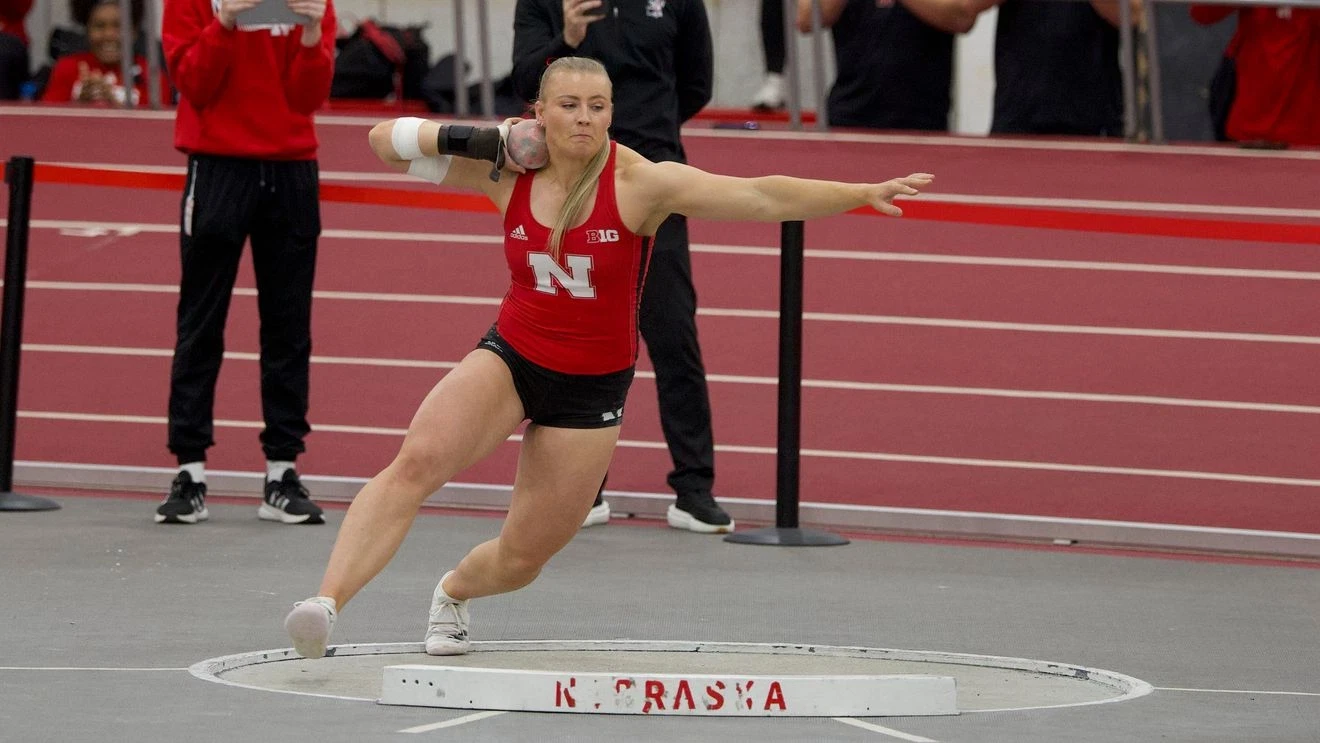
LINCOLN, Neb — Nebraska’s track and field team made a powerful start to their season at the Husker Holiday Open, securing event titles in 18 of 29 events and setting two new school records. Axelina Johansson highlighted the meet by breaking both the school and Swedish records in the shot put with a mark of 19.72m (64-8 1/2). Dyson Wicker also set a new school record in the men’s pole vault, clearing 5.62m (18-5 1/4).
Cade Moran claimed the men’s shot put title, achieving a mark of 20.07m (65-10 1/4), which ranks fifth in school history. Donna Douglas made an impressive debut, winning the women’s weight throw with a mark of 19.33m (63-5). Aspen Fears took the women’s pole vault title, clearing 3.96m (12-11 3/4).
Seth Schnakenberg set a personal best in the men’s weight throw with a mark of 20.87m (68-5 3/4), while Abrielle Artley won the women’s 300m with a time of 39.00. Elo Blessing Okpah and Ashriel Dixion excelled in the 60m races, with Okpah taking first in the women’s event and Dixion securing second in the men’s.
Brayden Bergkamp and Kate Campos both won their respective 60m hurdles events, with Bergkamp setting a personal best of 8.18. Alea Hardie and Gabe Nash claimed the mile titles, with Hardie achieving a personal best of 4:56.18.
In the men’s 600m, William McDavid emerged victorious with a time of 1:20.05. Ela Velepec claimed the women’s high jump title with a personal best of 1.83m (6-0). The Huskers also dominated the 4×400 relays, with both the men’s and women’s teams taking first place.
Desire Tonye-Nyemeck won the men’s high jump, clearing 2.14m (7-0 1/4). Nebraska will next host the Graduate Classic on Jan. 16-17 at the Devaney Sports Center Indoor Track.

Motorsports icon retires after four decades |

What You Don’t Know About the Two People Who Own NASCAR

Winston & Strawn Secures Landmark Settlement for 23XI Racing and Front Row Motorsports in NASCAR Antitrust Trial

‘U’ Falls in Sweet 16 to No. 4 Pittsburgh

‘Golden’ Tiara Bolden forges her own path to stardom at Oregon State

Next HC will be ‘critical’ for QB Bryce Underwood’s future at Michigan Football

Spire Motorsports names new NASCAR Cup competition director

Records Fall For Women’s Basketball In Kids Day Romp Over Coastal Georgia, 136-74

Nebraska Volleyball keeping practices light-hearted as they prep for NCAA Regional

Petaluma coach finds swastikas — police suspend case

Sander Racing Wheels Named Official Wheel Partner of Elite Motorsports

NHL Power Players youth advisory board announced for 7th season
Louisville vs Texas A&M channel, TV, UofL volleyball game time today

Long Beach Boys’ Basketball – The562.org

Spire Motorsports sets Crew Chief Lineup as NASCAR offseason news accelerates

First Tee Winter Registration is open

Fargo girl, 13, dies after collapsing during school basketball game – Grand Forks Herald

CPG Brands Like Allegra Are Betting on F1 for the First Time

Volleyball Recaps – November 18

F1 Las Vegas: Verstappen win, Norris and Piastri DQ tighten 2025 title fight

Two Pro Volleyball Leagues Serve Up Plans for Minnesota Teams

Utah State Announces 2025-26 Indoor Track & Field Schedule

Sycamores unveil 2026 track and field schedule

Redemption Means First Pro Stock World Championship for Dallas Glenn

Jo Shimoda Undergoes Back Surgery

Texas volleyball vs Kentucky game score: Live SEC tournament updates

How this startup (and a KC sports icon) turned young players into card-carrying legends overnight

Robert “Bobby” Lewis Hardin, 56

Bowl Projections: ESPN predicts 12-team College Football Playoff bracket, full bowl slate after Week 14
Wisconsin volleyball sweeps Minnesota with ease in ranked rivalry win

 NBA Legend Michael Jordan to Join NBC Sports as Special Contributor
 Why a rising mid-major power with an NCAA Tournament team opted out of revenue-sharing — and advertised it
 Falcons mailbag
 Portal Update – Basketball and Gymnastics Take Hits
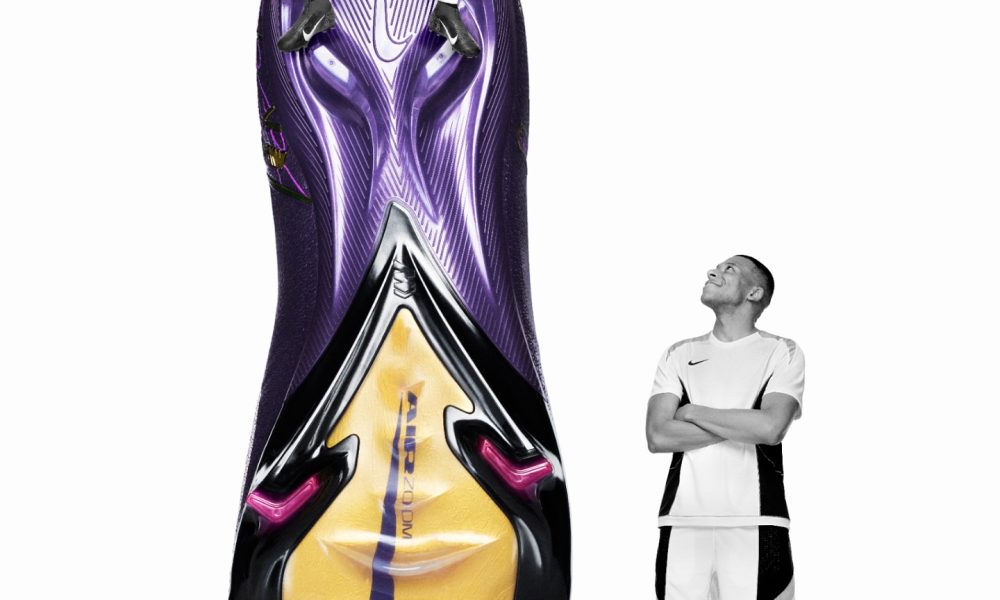 has always dreamed in Mercurial. Now his initials are on the boots.
The new Kyl…
has always dreamed in Mercurial. Now his initials are on the boots.
The new Kyl…
-
 Rec Sports3 weeks ago
First Tee Winter Registration is open
-
 Rec Sports2 weeks ago
Fargo girl, 13, dies after collapsing during school basketball game – Grand Forks Herald
-
 Motorsports2 weeks ago
CPG Brands Like Allegra Are Betting on F1 for the First Time
-
 Motorsports3 weeks ago
F1 Las Vegas: Verstappen win, Norris and Piastri DQ tighten 2025 title fight
-
 Sports2 weeks ago
Two Pro Volleyball Leagues Serve Up Plans for Minnesota Teams
-
 Sports2 weeks ago
Utah State Announces 2025-26 Indoor Track & Field Schedule
-
 Sports2 weeks ago
Sycamores unveil 2026 track and field schedule
-
 Motorsports2 weeks ago
Redemption Means First Pro Stock World Championship for Dallas Glenn
-
 Motorsports2 weeks ago
Jo Shimoda Undergoes Back Surgery
-
 Sports2 weeks ago
Texas volleyball vs Kentucky game score: Live SEC tournament updates