
On winter nights in Fairfield, when the band is loud and the student section louder, it is easy to focus on the players in uniform and forget about the three people in stripes who hold the whole thing together. In Fairfield, six of those officials have a story worth telling.
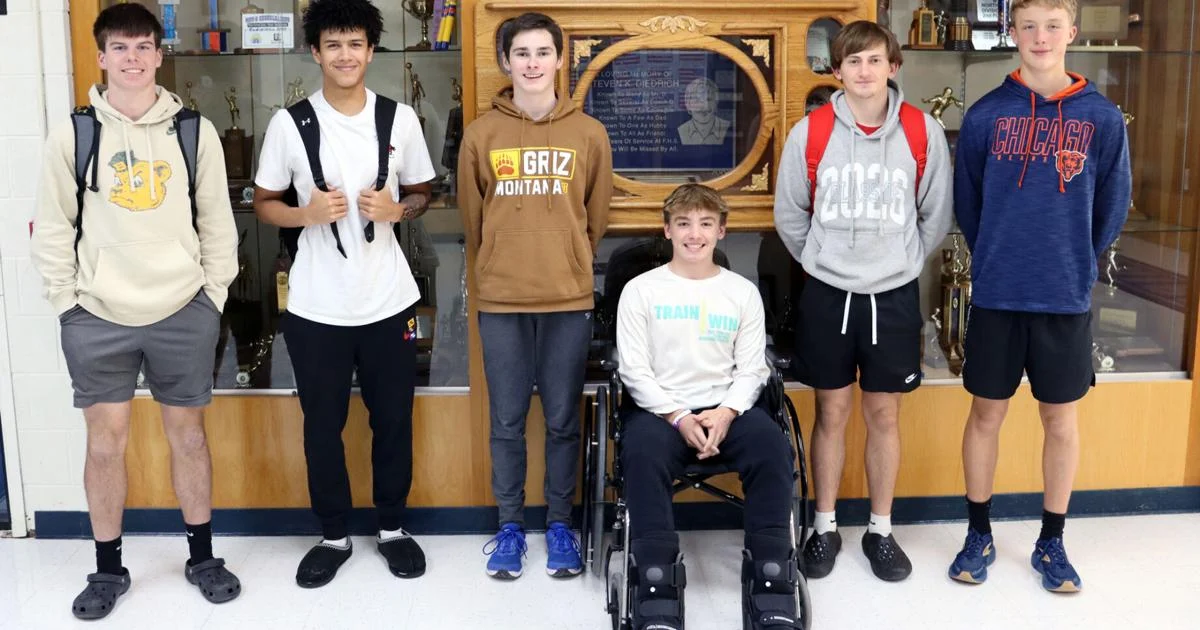
All six began in the 127 Sports Intensity Junior Referee program. Today, as registered members of the Montana Officials Association (MOA), they are working meaningful junior high school games and assorted youth basketball games, while still walking the same hallways as the students they officiate.
They are: Deron Lear, Senior (Grade 12); Travis Cartwright, Senior (Grade 12); Reed Von Stein, Senior (Grade 12); Cameron Keel, Freshman (Grade 9); Ryan Mathison, Freshman (Grade 9) and Beckett Rau, Freshman (Grade 9)
Individually, they are teenagers. Collectively, they are something far more rare: a homegrown officiating crew that has quietly become one of the Fairfield Basketball Club’s most important assets.
A Long Road from First Whistle to Varsity Floor
None of this happened by accident.
These six officials started where nearly every official dreams of never returning: elementary and middle school gyms. They learned to blow the whistle with conviction in front of parents sitting 10 feet away. They figured out how to explain calls to kids still learning to dribble. They worked youth tournaments when the rest of their friends were just watching from the bleachers.
Over time, game by game, they logged a large number of assignments across: youth and Fairfield Basketball Club games; Junior high schedules; weekend and holiday tournaments; summer league and camp games.
Most people see one game at a time. These six see a season as a stack of opportunities to improve. They have spent evenings and Saturdays in gyms from Fairfield to neighboring communities, not for highlight reels, but for the quiet satisfaction of getting the game right.
Training, Evaluation, and the Standard They Chose
The JR REF program gave them a runway: clinics on mechanics and positioning, instruction on signals and rules, guidance on how to handle coaches and game situations with composure. But they didn’t stop at “good enough for youth ball.”
They sought out more—more feedback, more instruction, more accountability.
Each of these officials has been evaluated by college-level evaluators, people who work regularly with officials well beyond the high school ranks. Those evaluations have done more than check a box; they have confirmed what some Fairfield fans have already seen from the bleachers: they move with purpose and proper mechanics; they communicate clearly and respectfully with coaches and players; they adjust when they receive feedback, rather than defending bad habits; they carry themselves like professionals in a place that is not always friendly to officials.
To be a teenager and willingly invite that level of scrutiny is unusual. To respond to it by earning MOA status is impressive. It signals that if any of them choose to pursue officiating at higher levels, they already understand what the profession demands.

Fairfield’s Answer to a Statewide Problem
Across Montana—and the country—the story is the same: not enough officials. Games are rescheduled, junior varsity contests are shortened, and assignors spend long nights begging for one more crew to cover one more gym.
127 Sports Intensity has chosen a different response: grow its own.
These six MOA officials are a direct result of that decision. The impact is felt every week: games get covered. With a larger, local pool of trained officials, Fairfield Schools and the Fairfield Basketball Club are better positioned to keep schedules intact; expectations stay consistent. Officials who have grown up in the system understand local standards, rivalries, and what Fairfield basketball means to the community; younger athletes see a new path. When a fifth grader watches a high school student officiate, the message is simple: this is something I could do, too.
In an era where the question is often “Where will we find officials?” Fairfield can answer, at least in part, “We are developing them right here.”
More Than a Side Job
Yes, officiating pays. For teenagers, it is a better-than-average way to earn money.
But framing it only as a side job undersells what is actually happening.
By stepping onto the floor in stripes, Deron Lear, Travis Cartwright, Reed Von Stein, Cameron Keel, Ryan Mathison, and Beckett Rau are learning high-level, real-world skills long before many of their peers: managing conflict in emotionally charged environments; communicating with adults and peers under pressure; making immediate, public decisions and living with the result; handling criticism and staying composed when the gym disagrees
Those are leadership skills. They will matter in college classrooms, workplaces, and communities long after the last horn sounds on their high school careers.
A Blueprint for
the Future of Officiating
There is a larger lesson inside Fairfield’s story.
If high school sports want a sustainable future, then communities will need more than short-term fixes and recruitment slogans. They will need pipelines—programs that introduce officiating early, train young people well, give them real experience, and then guide them into associations like the MOA.
These six names—Deron Lear, Travis Cartwright, Reed Von Stein, Cameron Keel, Ryan Mathison, and Beckett Rau—represent more than the current officiating crew. They represent proof that when a community invests intentionally in young officials, the payoff shows up on the scoreboard, in the stands, and in the long-term health of the sport itself.
Fairfield’s players may supply the highlights.
But on many nights, its officials are supplying something just as valuable: a future where the games can go on, called by people who learned to love this work in the very same gyms where they now toss the ball in the air and blow the opening whistle.
The Next Wave: Jr Ref Clinic Participants
The story does not end with the six MOA officials. Behind them stands a growing group of Jr Ref clinic graduates—young students who have already taken their first steps with a whistle and a rulebook in hand.
These are the Jr Ref participants from last year:
Kohl Barnett, Kyla Cooley, Eli Cowgill, Willa Cowgill, Colton Dahl, Conley Dahl, Kingston Egbert, Natalie Harrell, Grace Helmer, Paige Helmer, Kale Hinderager, Nora Hinderager, Bryce Hooper, Cameron Keel, Madison Keel, Edan Keller, Eve Keller, Angus Lidstrom, Ryan Mathison, Easton Misner, Brynn Neuman, Aundra Passmore, Charlotte Pearson, Jack Rasmussen, Natalie Rasmussen, Beckett Rau, Calder Rosenkrance, Carsten Rosenkrance, Brendon Schenk, Reed Von Stein, Gretta Wilson, Samuel Woodhouse.
Some of these names—Cameron Keel, Ryan Mathison, Beckett Rau, and Reed Von Stein—have already climbed from that list into the MOA ranks. The rest are at various points on the same path: learning mechanics, working youth games, absorbing feedback, and discovering what it means to be the steady voice in a noisy gym.
For Fairfield, this group is more than a roster; it is the future.
In the seasons ahead, many of these Jr Refs will work more games, clean up their positioning, sharpen their signals, and grow more confident in their decision-making. Some will decide that officiating is something they want to pursue seriously. When they do, they will not have to guess how to get there—they will have six living examples in Deron, Travis, Reed, Cameron, Ryan, and Beckett showing them exactly what is possible.
If the first wave of MOA officials proves that Fairfield can grow its own referees, this Jr Ref cohort is proof that the pipeline is alive and working. With every clinic they attend and every youth game they officiate, they move one step closer to joining the MOA ranks themselves—and to ensuring that, in Fairfield, the games will always have someone ready to toss the ball, blow the whistle, and get things started.