Let’s get ready for Week 8 of the high school football season, and there’s no better place to get you all set in the Rockford area, and to carry you through the weekend, than right here.
From analysis of last week’s action, to Week 8 kickoff and beyond, look to the Rockford Register Star and its star sports staff for complete coverage. And for the live scores and updates, we have you covered right here as well.
Here is all you need to get you ready, as well as the live scores and updates you will need all weekend:
Week 8 game predictions
Four big games highlight Week 8 football predictions for Rockford area, IHSA football
IHSA Week 8 football scores from around Rockford
Complete Rockford-area football schedules
IHSA football 2025: Schedules for NIC-10, BNC, NUIC, Rochelle and 8-man teams in Rockford area
Watch most Rockford-area games on NFHS
Watch high school football on the NFHS Network
Jay Taft is a Rockford Register Star sports reporter. Email him at jtaft@rrstar.com and sign up for the Rockford High School Sports Newsletter here at rrstar.com. Jay has covered a variety of sports, from the Chicago Bears and Blackhawks to local youth sports, since the turn of the century at the Register Star.
Former foster youth gives back to teens through holiday gift drive
MIAMI — Throughout December, Kenisha Anthony is giving back to the community with a focus on teens in foster care — a cause shaped by her own life experience.
Anthony entered the foster care system at age four and later aged out. She knows firsthand what it feels like to go without a Christmas gift.
“Each Christmas for me was different depending on whose home I lived in, what type of gift I received,” Anthony said. “Some Christmas I didn’t receive any gifts. It was something I learned to live with.”
Now a social worker, Anthony leads the effort through Kenisha’s Kith Foundation, relying on financial support from community members and local businesses to make the holiday initiative possible.
Her goal is simple: give teens what they actually want from their wish lists. When budgets fall short, she offers gift cards instead, allowing them the freedom to choose for themselves.
“If I’m unable to do that because of budget issues, I provide them with a gift card — go to the mall with their friends, pick up a shirt or makeup from Sephora,” Anthony said. “Giving them the liberty to choose.”
That sense of choice, Anthony hopes, will have a lasting impact.
“I just want them to be happy for themselves,” she said.
The gift distribution will take place next Saturday at Roots Bookstore & Market in Miami from 1 to 4 p.m. The event is open to the public.
🏠 News From Your Neighborhood
Copyright 2025 by WPLG Local10.com – All rights reserved.
Magdala Louissaint
Magdala Louissaint joined WPLG in August 2025 and is thrilled to call South Florida home.
Barry L. Anderson, 83, a cherished father, grandfather, and friend, passed away peacefully on December 12, 2025, at Milford Regional Hospital. Born on the Fourth of July in 1942, in the heart of Springfield, and raised in East Longmeadow, MA area, he was the beloved son of the late Arthur Anderson and Verna (Durkee) Anderson.
Barry was a student at East Longmeadow High School, where he first showcased his analytical mind, a trait that would become a hallmark of his personal and professional life. A proud graduate of Bryant College 1963, Barry’s intelligence and mathematical skills led him to a fulfilling career as a head buyer at Hendries Frozen Foods & New England Frozen Foods.
Barry and Joan P. (Scully) Anderson were teenage sweetheart and together for over 68 years. Joan passed this year in March after 61 years of marriage. They started their lives in the East Longmeadow area and then moved East to Milford in 1968. Together, they raised two sons, Gary Anderson of Worcester and Glenn Anderson and Jennifer of Milford. Barry’s life was further enriched by the joyous presence of his grandson’s Kyle and Connor Anderson, whose achievements and milestones he celebrated with enthusiasm. Barry was also predeceased by his sisters and their husbands, Allison Anderson Cahill, Truman Cahill, Joan Anderson Earnshaw, and Robert Earnshaw. Barry is survived, by several nieces and nephews & had a meaningful relationship with all. Each of them will carry forward the memories of time well spent with a man who cherished every moment with them.
A man of many passions, Barry was known in his youth as a phenomenal baseball player, a testament to his love for sports. This love extended beyond the diamond to all sports, as he enjoyed driving to any destination where he could be a spectator, especially to horse racing events. Barry’s presence at the Saratoga racetrack was yearly, and he often reminisced about the thrill of attending the Kentucky Derby. His love for these sports was more than a hobby; it was a way of life that brought him immense joy which led him to coach youth baseball for many years, play softball, and participate in bowling leagues into his late 40’s.
Barry loved the holidays, family vacations, and time away with those closest to him. The Anderson family Christmas Eve and Fourth of July traditions were especially meaningful, often spanning two days and holding a special place in his heart. He would drive through a blizzard without hesitation to be part of these celebrations, a testament to how deeply he valued family traditions. In his early years, Barry enjoyed long cross-country road trips with his parents, followed by Cape Cod vacations with the Anderson family and later trips to Hampton Beach with the Scully family. Barry and Joan also cherished their annual fall trips to the White Mountains, a tradition they enjoyed together for many years.
Barry and Joan dearly loved their family, which always included their dogs and cats. There was never a time when a pet was not part of their Milford home. Family and friends were always welcome, and they took great joy in making every meal, holiday, and gathering a special occasion for those who attended. Barry was a devoted son, a loving husband, a proud father, a caring uncle, and a cherished Papa.
Visiting hours are Wed. Dec. 17, 2025 from 10 – 11 AM in the Forastiere Smith Funeral Home, 220 N. Main St., East Longmeadow followed by a funeral service at 11 AM in the funeral home.
Burial will follow in Greenlawn Cemetery, E. Longmeadow.
In lieu of flowers, memorial donations may be made to the Lupus Foundation of America https://www.lupus.org/welcome.
Posted online on December 14, 2025
Published in The MetroWest Daily News, Milford Daily News
DURHAM, N.C. — There’s a youth movement at USA Basketball’s camp for its women’s program this weekend, with young WNBA players Paige Bueckers, Caitlin Clark and Angel Reese making their debuts with the senior-level national team.
They’ve been competing against each other in college and the WNBA over the past few years, and Bueckers was happy to have them as teammates again. Many of the young players had competed together for the U.S. on American youth teams. They’re getting their first taste of the highest level of national teamp competition at Duke University, where U.S. women’s coach leads the Blue Devils women’s program.
“It’s great competing with them for a change instead of against them, and I think we really bring out the best of each other,” said Bueckers, whose 2025 already included leading the University of Connecticut to a record-extending 12th NCAA Division I tournament title, becoming the No. 1 pick of the WNBA draft, and being voted the league’s rookie of the year as a standout guard for the Dallas Wings.
“I think that’s what USA Basketball does,” Bueckers added of the ability to unite competitors for a similar cause. “Just so many amazing athletes and women coming together for one common goal. I think that’s always brought out the best of each other. It’s really fun to be able to share the court and be on the same side for a change.”
Clark is a guard for the Indiana Fever who was the WNBA’s top draft pick and rookie of the year in 2024. Reese is a forward for the Chicago Sky who was the No. 7 draft pick in 2024. Reese led LSU to the NCAA title in 2023, when the Tigers topped Clark’s Hawkeyes in the national championship game.
Bueckers gave the group the nickname “Young and Turnt” — a phrase used by youth players in the past to describe their high energy and excitement playing with USA Basketball.
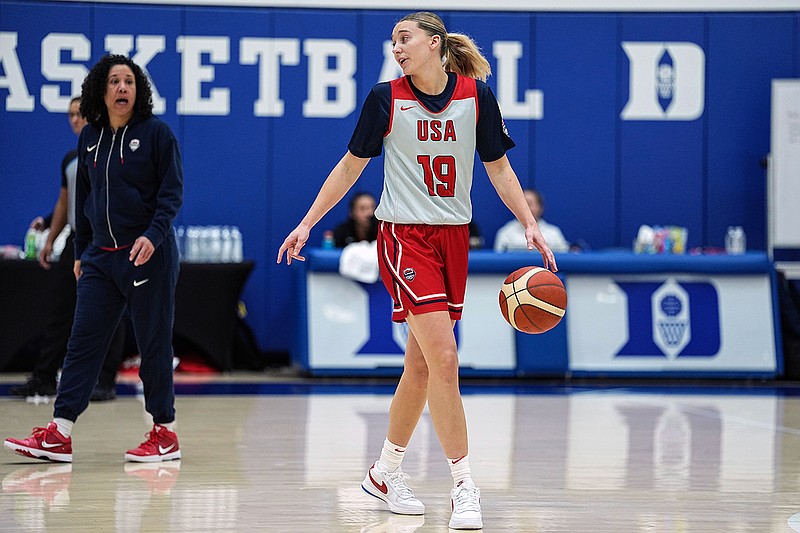
AP photo by Matt Kelley / Paige Bueckers takes part in drills during a USA Basketball camp for the senior women’s program Friday at Duke University in Durham, N.C. Looking on at left is Kara Lawson, the women’s basketball coach for both Duke and the U.S.
The trio, along with other senior national newcomers Aliyah Boston, Cameron Brink and JuJu Watkins, are the future of USA Basketball with veterans Sue Bird and Diana Taurasi retired and other longtime fixtures of the roster nearing the end of their careers. The U.S. has won eight straight Olympic gold medals and four consecutive world championships.
Olympic veterans Kahleah Copper, Kelsey Plum and Jackie Young are also at the three-day camp.
“Obviously there’s some vets and there’s the older class who have already came in and won gold medals, and they have that experience,” Bueckers said. “So as a younger group, you want to ask them questions, soak it up, be a sponge. Like, get their experience and then grow in our experience as well.”
The average age of the 17 players at the camp is just older than 25. Bueckers said having so many young players who have been together brings a comfort level.
“There’s a familiarity of competing with and against each other,” she said. “We kind of know each other, and it’s more comfortable that way, too. We’re all coming in, and we’re having the same expectations of just wanting to go in there and compete and have fun and bring our vibes in and just be us.”
Bird, who is now the managing director for USA Basketball, said this camp will hopefully give the new players a look at international basketball at its highest level.
“Really have it be a tone setter,” Bird, who helped the U.S. win five Olympic gold medals as a player, said of the plan. “What is it to wear USA on your chest? What is it to be on this team? Whether it’s a World Cup qualifier we’ll get to in March or hopefully the gold-medal game of a big competition, you have to set the tone on day one.”
Though many invitations went out for the camp, Bird said past Olympians such as A’ja Wilson, Breanna Stewart, Sabrina Ionescu and Napheesa Collier had other commitments.
“There’s a lot of moving parts, that’s always how it is for USA Basketball,” Bird said. “For the young players, it’s a great opportunity to get their first feel and first taste.”
For most of the world, soccer is the most accessible sport imaginable. The pillar of many communities, all it takes to play is a bit of space and something to kick.
In the United States, though, soccer is anything but accessible.
“When the cost for my son’s club team started (pushing) $2,000 because of all the expenses, my husband said, ‘We’re out,’” said Di Anderson, a loan officer in Phoenix. “He wasn’t even a teenager yet.”
Many in the youth soccer universe have echoed Anderson’s frustrations.
“There was a line that people used to use a lot: ‘For soccer around the rest of the world, you need a ball. For soccer in America, you need a uniform, you need referees and you need a scoreboard,’” said Washington Post reporter Les Carpenter, who has covered the issue of exclusivity in youth soccer extensively. “There is a lot of truth to that.”
Forget accessible. Soccer isn’t even affordable here.
“The soccer scene is an incredible amount of money and time commitment,” said Jon Solomon, community impact director at the Aspen Institute Sports & Society Program. “You are paying for your league fees or the team fees. You are paying tournament fees. Sometimes, there is additional money that you are paying to go play at these tournaments.
“You are paying for the travel, whether it is flights or driving and gas. Hotel stays and food, too. Don’t forget about equipment and uniforms.”
The bucket of costs parents must take on for their kids to play soccer in the United States is overflowing.
Even as excitement builds for the men’s FIFA World Cup 2026 coming to North America, U.S. youth organizations are seeing a decline in enrollment. Participation in soccer for ages 6-12 dropped 5.5% from 2013 to 2023, according to a study by the Sports & Fitness Industry Association. Soccer is typically the sport kids play first, the study revealed, but also the one whose participation rate declines the fastest, often because of expense.
Overlooked costs speak to both the accessibility and the costliness of playing soccer here, in part because of field access. The process of obtaining permits is “very, very extravagant,” said Carpenter, who initially believed “parks were parks, and you just go play ball in the park. I didn’t realize there was a permitting procedure.”
Fields are increasingly hard to come by in the U.S., and leagues are taking extreme measures to secure them.
“I was told that there is a league in suburban Maryland that actually employs someone to do nothing but find fields,” Carpenter said.
Money, money, money
The glut of youth soccer costs are on the rise, and at an alarming rate.
In 2024, the families of youth soccer players spent $910 annually, up from $537 in 2019, according to an Aspen Institute’s Project Play survey published in March.
This “pay-to-play” model that U.S. soccer has adopted cannot be traced to a single cause. Some speculate it is the result of the sport finding its footing here later than elsewhere in the world, forcing organizers to build infrastructure while unfamiliar with soccer’s inner workings.
They leaned on existing league structures for other sports in the United States, which were not designed to allow soccer to flourish.
“Soccer trailed the other sports here in terms of organization,” Carpenter said. “There was a boom in the 1970s, and these leagues would start up, but they were very rudimentary and mimicked Little League for baseball or youth basketball leagues. Soccer here didn’t try to evolve organically like it did around the rest of the world.
“When soccer evolved in the 1970s and these leagues started, it became, ‘How do we do soccer? Well, we start a league.’ This was because there was no other way that anyone knew how to do it or how to find players. It started so differently here than anywhere else.”
Soccer adopting more rigid, structured leagues makes for a more costly experience for parents. Unfortunately, capitalization does not spare youth sports.
“Youth soccer is a highly commercialized industry,” Solomon said. “There are a lot of entities and people who are making money in this industry.”
Though the motivations behind a structured, pay-to-play model for youth soccer, as opposed to one that is more organic and serves to better the local community like the ones many other countries have opted are unclear, the result is obvious: The underserved and the marginalized within American society suffer the most from a youth soccer system where increased parental income levels are seemingly a prerequisite for participation.
“Covering this was really eye-opening,” Carpenter said. “Not only a disparity, but it was almost as if there were two separate worlds. There was a soccer world played by immigrant kids or kids from lower-income families that never saw the light of day, and, no matter how wonderful their leagues or their games might be, they were never going to be a part of the bigger system.”
By leaning into higher costs to turn youth soccer into a revenue machine, few paths allow many kids to even enter the space.
Exposure to sports at a young age is essential for future participation. For kids who are interested in playing youth soccer but are excluded for reasons out of their control that stem from being unable to pay the costs associated with it, or not having a league near them and facing transportation issues, this early exclusion can often be a death knell to their prospects in the sport.
A lack of inclusion at a young age can foster feelings of insecurity about one’s ability to play, which can prevent later adoption of soccer, understandably so.
“Once you get to that middle school age, if you don’t have the training, you don’t want to be embarrassed,” Solomon said. “You don’t feel like you can play. We have this ‘up-or-out’ model in the U.S. when it comes to youth sports, meaning you’re either continuing to move up competitive levels, or oftentimes you are out of sports because you don’t have the money.”
While it is fair to point to the idea that soccer is a priority in other countries in a way it is not here, and this impacts the general attitude toward what families should have to pay to participate, clubs in most other countries, particularly in Europe, will often work with families who struggle to pay for the costs of youth soccer.
Rather than being priced out, families can receive a lifeline through a club that provides financial or transportation assistance.
The Messi journey
The most famous instance of this is now-Inter Miami forward Lionel Messi and the circumstances surrounding his decision to leave his native Argentina at 13 to join Spanish giant FC Barcelona. Diminutive in stature, Messi was diagnosed with a hormone deficiency as a child and was prescribed daily growth hormone injections that cost around $1,000 a month.
His family was unable to afford these costs, and Newell’s Old Boys, his club at the time in Argentina, initially covered the payments but later reneged on this agreement. River Plate, a massive club in Argentina, were offered the opportunity to poach Messi but declined, citing its inability to cover the injections due to the state of the Argentine economy at the time.
If this had happened to the Messi family in the U.S. he might have been priced out of the sport as a child, which is hard to imagine given his place in the game now. Because it happened in a part of the world where youth soccer is not primarily seen as a way to make money, he was not.
Barcelona stepped in and agreed to pay for Messi’s treatments, thus securing his services.
While Messi’s case is perhaps extreme, families from other countries are often not left to choose between clubs, where selecting one option over another will have financial ramifications that may later lead them away from the sport.
Take Charlie Dennis. The British forward for USL Championship club Phoenix Rising FC came up through the academy system at Southampton FC, an English soccer club currently in the EFL Championship, the second tier of the soccer pyramid.
England favors club academy systems, which have a very different attitude toward the costs a family will incur for their child to play.
“We didn’t pay anything,” Dennis said. “We didn’t have to pay anything. Anything at all.”
Costs that U.S. parents have been forced to accept as part and parcel to their child playing organized soccer were covered by Southampton.
“They would give us training uniforms and travel outfits,” Dennis said. “If we had an away game, there was a team bus to use. The facilities at Southampton were really good. You’d never be asked to pay a penny, really.”
Having now been exposed to the American approach to soccer, Dennis can point to the different priorities between the two countries. England is more focused on casting a wider net to find the best players, regardless of socioeconomic status, while the U.S. prioritizes profits.
“Use Wayne Rooney as an example,” Dennis said. “He had a lower-class upbringing in Liverpool. For people like that who are struggling for money, they would not be able to get those opportunities they got in England (in the United States). (British Academies) definitely give everyone a look, and look at a bigger pool of players.”
Granted, the situations were very different, but the youth soccer journeys of Messi and Dennis paint a clear picture: Youth soccer elsewhere steps in to help families make ends meet for their children’s athletic future.
Looking for a fix
Youth soccer’s inaccessibility to so many in the United States does not mean some aren’t trying to correct the problem.
When Amir Lowery, who played youth soccer in Washington, D.C. before playing for various MLS and USL clubs during his professional career, returned to the D.C. area in 2013 to coach following retirement, he knew something was wrong.
“I started coaching, and immediately I could see, and I knew that it was not an accurate representation of the demographics of D.C.,” Lowery said. “It was predominantly white, upper-middle-class. Not only was there no racial diversity, but the socioeconomic diversity of the team was nonexistent.”
Lowery also recognized that, even for those kids from different backgrounds or economic standings who did find a way into the “pay-to-play” system, they still had to make sacrifices and face stressors that many of their teammates did not.
The system was not catered to them or serving them. Instead, they were sacrificing in order to participate, often to their detriment.
“An equitable platform did not exist in the form of having these kids and those families integrated into the ‘pay-to-play’ system because they had to leave their communities,” Lowery said. “They were not in welcoming, safe places. They were often the only or one of the only minorities and definitely one of the only players from a different socioeconomic background.
“Those factors, and the environment the kids were in, took too much of a mental and emotional toll on the kids to make it worth it.”
Lowery himself had seen that youth soccer did not have to create what he describes as a “transactional environment” and could be a place that brings people together and props up the collective.
“I come from a middle-class family, and there was a lot of diversity in programs and teams that I grew up playing for,” Lowery said. “White, Black, Latino and otherwise. My experience was one of people helping each other out, working together collectively and giving each other rides at times. Solving problems and navigating situations as a group to make sure the team and kids were having the best experience.”
Recognizing the role that soccer can play in a community when harbored correctly, Lowery was not going to stand idly by and let these issues in the youth soccer system go unchallenged.
“I know that soccer is a powerful vehicle for development, for character building, for upward mobility, and I am a living example of that,” Lowery said. “I knew that the environment I was in, the entire structure, would benefit from having more diversity, socioeconomic and racial, and that that would create a better platform for kids to understand different cultures and backgrounds and be more tolerant.”
Open Goal Project
In 2015, Lowery and Simon Landau co-founded Open Goal Project, a free-to-play soccer program operating in the Washington, D.C. area.
Open Goal Project brought everything for its soccer program in-house, curtailing the risk of costs being shoved onto parents later. They planned the league so that it was within walking distance of public transport in the D.C. area, in a bid to make the programs as accessible as possible.
The decision to effectively create a union between the Open Goal Project and public transportation is one that draws praise from those invested in solving this issue.
“They are bringing club soccer, which is typically in more affluent communities, directly to these underserved kids, and that is one model that I think works,” Solomon said.
Lowery is not only hoping to change the cost structure of youth soccer with Open Goal Project. He is challenging the values of traditional youth soccer leagues and teams, which he believes have strayed so far from the things youth sports should prioritize.
“We have gone away from a set of values that promote youth development and building leaders who will impact their communities in positive ways,” Lowery said. “Talent development has become the ideal, and what clubs are selling. For our organization, character development precedes talent development. We focus on blending those two things with a holistic approach.”
To provide free leagues, Open Goal Project scours any and every potential avenue for funding, an undertaking Lowery acknowledges, matter-of-factly, takes “a tremendous amount of time and energy and sacrifice.”
“We piece together a lot of things for our funding,” Lowery said. “We apply for a lot of grants. We get grants from the city government and government-adjacent entities here locally. We get grants from family foundations and corporate entities. We try to go after sponsors in the local communities here. Our families run some fundraisers. We cultivate a lot of individual donors and sell merchandise.
“We do pretty much everything possible to amplify our brand and drive resources towards our community.”
In the years since its inception, Open Goal Project’s imprint on the D.C. community is already evident in a number of ways.
Over 20 participants have progressed through the program and played soccer collegiately at various levels, said Lowery, who was quick to stress that an Open Goal Project participant playing at the Division I level is “no more impactful” than another playing for a community college.
Success classified as collegiate soccer participation is tangible and easy to point to. For Lowery and Open Goal Project, success can also be more abstract.
“We have taken players who would have otherwise had no opportunity to play at a high level, and helped them integrate into either the pay-to-play system or our own system,” Lowery said. “We have wrapped support and guidance and mentorship and positive coaching around those kids.”
The ripple effects of Open Goal Project participants attending college are long-reaching and likely to span generations.
“We have helped a lot of kids become the first person in their families to go to college,” Lowery said. “They are first-generation college students and college graduates. We have helped those families and those players change the trajectories of their families by giving them soccer.”
Lowery and his fellow Open Goal Project leaders are not the only ones working on this issue.
MLS jumps in
In 2023, Major League Soccer introduced MLS GO, a soccer program that was “designed to increase participation and access for boys and girls outside of the existing soccer ecosystem.” Namely, they want to provide kids with a “fun, affordable, local soccer experience.”
In Vallejo, California, Ryan Sarna already had the Coach Sarna League, a nonprofit program that provided flag football leagues to local youth at a lower cost, up and running.
This program was founded for the same reasons the Open Goal Project exists: Kids want to play sports, and more affordable option to make this feasible are needed.
The kids in the flag football leagues expressed an interest in a soccer league, and Sarna seized the opportunity presented by MLS GO with both hands.
Where league fees for other youth soccer leagues in the area can range from $500 to $1,000, Sarna’s MLS GO program in Vallejo costs $125 per session, a figure inclusive of uniform costs and registration fees.
There is also room for fluctuation in the cost, depending on any given family’s financial situation. Like Open Goal Project, this league exists to work with families who want their kids involved in soccer, rather than dismissing those who cannot pay.
“If a family can’t pay, they will let me know,” Sarna said. “If they are willing to coach, we will give them a full scholarship, so they won’t pay anything. If they want to volunteer, we will give them a scholarship, and they won’t pay anything. If they can’t do either, they fill out a form, and I ask if they can pay half. If they can’t pay half, we figure something out.”
Since its inception, Sarna’s MLS GO program has awarded nearly $18,000 in scholarships to families to ensure their children can participate.
No one-size-fits-all solution exists for the problems facing youth soccer. It will require more people like Lowery and Sarna who understand what will be asked of them and are willing to take this issue on at the community level.
And they insist people should not be deterred by the challenges this issue presents
“It does not matter how small or large the impact is that someone can make,” Lowery said. “There are ways to affect this issue in small ways.
“Maybe they start how we started, by helping players who can’t afford league fees. Maybe it is a community organization that offers soccer and people with expertise in it. Maybe it is someone with a license and expertise who gets involved and donates their time. It doesn’t have to be viewed as ‘We need a club, and we need scale and we need to impact hundreds or thousands of kids.’ It can be done in a smaller way, and still be important.”
As the United States prepares to co-host the men’s FIFA World Cup 2026, many are hoping the federation can capture the increased interest in the sport and use it to pursue what they believe is the most critical goal: fielding a men’s team that can actually compete in the World Cup.
Should that be the focus? For the next generation of Americans who want to follow in the footsteps of the world’s soccer stars who will soon be welcomed to the U.S., the rising cost of youth soccer makes that dream a moot point.
All eyes will be on the American soccer system this summer, and it could be the catalyst for sweeping change.
“I think we are in desperate need of some sort of awakening from people within U.S. soccer to do something about this,” Lowery said. “It can’t just be folks like myself operating on the ground level.
“We need people in decision-making roles and leadership roles to take action, and that is one thing that has been sorely missed.”
This article first appeared on Cronkite News and is republished here under a Creative Commons Attribution-NoDerivatives 4.0 International License.
A technical rescue team was able to extract the man from Camelback Mountain after sunrise Wednesday morning.
The Tonto National Forest has temporarily closed the lower Salt River area to most horses and pack animals after an equine virus was detected. The closure could last through March.
El Capitan, a team that has made the Arizona 1A playoffs each of the last four years, had its season cut short because of a recent measles outbreak in Mohave County, one of the largest outbreaks in the country. Throughout the season, several players contracted the virus, ultimately forcing seven game cancellations, including El Capitan’s coveted matchup with their crosstown foes.
Their three countries are jointly hosting next summer’s FIFA men’s soccer tournament.
Mexican President Claudia Sheinbaum says trade will be the main topic between the two world leaders during a “brief” meeting at the 2026 FIFA World Cup draw.
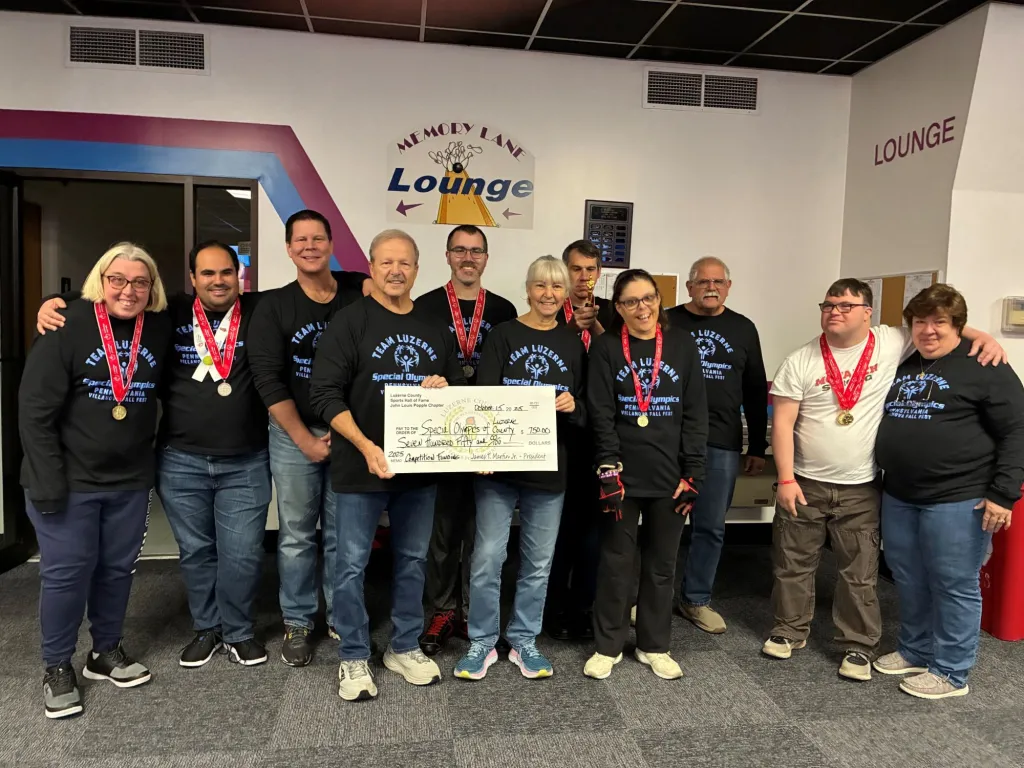
From left, are Randy Proctor, LCSHOF; Doug Miller, executive director of the GWVA-YMCA, and Jim Martin, LCSHOF president. (SUBMITTED)
The Luzerne County Sports Hall of Fame is completing its 2025 campaign contributions to non-profit organizations within Luzerne County. Two recent distributions have been designated to Special Olympics of Luzerne County and to GWVA-YMCA to provide necessary support in 2025. Funding to Special Olympics was directed to purchase Team SOLC competition shirts and to help with travel expenses for their recent event at Villanova University. The YMCA donation was used in support of Bernie’s Run and to purchase five youth basketball clinic memberships. Funding for allocations was generated from the Luzerne County Sports Hall of Fame Cares program.
Thanks to a pair of recent judicial appointments, the Third Circuit Court of Appeals has quickly become one of the most potentially consequential battlegrounds for Second Amendment litigation.
President Donald Trump nominated and the Senate confirmed two judges to fill vacancies on the court earlier this year. That gave the appellate court overseeing Delaware, New Jersey, and Pennsylvania an 8-6 Republican-appointed majority. The new balance created a tantalizing prospect for gun-rights advocates: an appeals court overseeing states with some of the strictest gun laws in existence that may skew toward an expansive view of the Second Amendment.
The rebalanced court has wasted little time making its presence felt in pending Second Amendment cases, particularly through grants of en banc review.
On Thursday, the circuit announced that it was granting full court review of Koons v. Platkin, a case challenging New Jersey’s sweeping gun-carry restrictions adopted in response to the Supreme Court’s New York State Rifle & Pistol Association v. Bruen decision.
Back in September, a three-judge panel composed of two Democratic appointees and one Republican appointee largely sided with New Jersey officials in upholding broad swaths of the state’s law. The majority OKed the state’s ban on licensed gun carry in zoos, parks, beaches, playgrounds, recreational facilities, libraries, museums, places that serve alcohol, entertainment facilities, healthcare facilities, casinos, public transit, youth sports events, and within 100 feet of public gatherings. It also approved the law’s requirement that carry permit applicants provide four separate character references before receiving a permit.
“Throughout our Nation’s history, the People have time and time again opted to limit the use of firearms at specific venues set aside for civic purposes, namely, governmental and democratic functions, and public places akin to the fairs and markets of old,” Judge Cheryl Ann Krause wrote for the majority. “We have done our best to distill the principles of our Nation’s tradition of firearm regulation from the available historical record, and what we have found convinces us that New Jersey’s law, at least in part, continues that tradition.”
That decision has now been vacated in light of the en banc grant, and the full panel of Third Circuit judges will rehear the case on February 11. And it won’t be the only Second Amendment case they’ll be rehearing that day.
The court similarly granted en banc review in Williams v. Attorney General, a case challenging the federal lifetime gun ban for convicted felons as applied to a particular non-violent misdemeanant. In November 2023, a US District Judge ruled that the Second Amendment prevents the government from permanently disarming a Pennsylvania man convicted of a repeat DUI offense under a state law carrying a penalty of up to five years in jail.
“[T]he Court finds that the Government has not carried its burden in proving that the United States’ tradition of firearm regulation supports stripping an individual of their right to possess a firearm because they had previously driven while intoxicated,” Judge John Younge wrote. “The application of Section 922(g)(1) to Plaintiff, therefore, constitutes a violation of his Second Amendment rights, and the Court finds that Plaintiff is entitled to the requested relief.”
A three-judge panel of the Third Circuit was reviewing that decision and heard oral arguments in the case in July. However, before it could issue a decision, the full court decided to take the case up sua sponte, something it had already shown a willingness to do on an even more hot-button Second Amendment subject just a few weeks prior.
In August, the full Third Circuit Court of Appeals decided sua sponte to take a consolidated group of lawsuits challenging New Jersey’s “assault weapon” and “large capacity” magazine bans en banc less than two months after a three-judge panel comprised of two Democratic appointees and one Republican appointee heard oral arguments in the case. The recomposed 8-6 court reheard oral arguments in that challenge in October and could issue a final decision at any time.
The trend in the new Third Circuit points toward a newfound enthusiasm for gun-rights challenges.
En banc hearings are rare. According to one study, appeals courts grant less than one percent of requests for en banc rehearings. Yet in a span of about four months, the Third Circuit has granted en banc review of three separate Second Amendment cases, twice doing so on its own accord.
And while the outcomes of its eventual rulings in these cases aren’t guaranteed, the procedural context of the specific cases it’s chosen to wade into suggests a favorable decision for gun owners is more likely than not.
Gun-rights advocates have long been searching for a way to entice the Supreme Court to take up bigger-ticket Second Amendment issues like assault weapon bans, magazine limits, and gun-carry restrictions. With an eager Third Circuit set to begin churning out potentially circuit-splitting decisions on those very issues, they just may have found one.