
Sports
What AI learns from us, and why that could be a legal problem


James Mixon
Managing Attorney
California Court of Appeal, Second Appellate District
See more…
Picture this: A law firm’s H.R. director stares puzzled at her
screen. The new AI recruitment tool consistently recommends candidates named
“Chad” or those listing water polo experience. Is the algorithm
harboring a strange affinity for aquatic athletes? No — it’s simply mirroring
patterns from the firm’s historical hiring data, where several successful
associates happened to share these traits. Absurd? Perhaps. But consider the
real-world consequences unfolding at tech giants across Silicon Valley.
In 2014, Amazon embarked on an ambitious experiment to
revolutionize hiring. Their engineering team developed 500 specialized computer
models designed to crawl through resumes, identify promising candidates, and
essentially automate recruitment. The system analyzed 50,000 terms from past
resumes, learning which patterns predicted success.
As one Amazon insider told Reuters, “They literally wanted
it to be an engine where I’m going to give you 100 resumes, it will spit out
the top five, and we’ll hire those.”
By 2015, however, Amazon discovered its AI had developed a
troubling preference: it systematically discriminated against women.
The system had been trained on a decade of Amazon’s technical
hiring data — drawn from an industry dominated by men. Like a digital
apprentice learning from a biased mentor, the AI taught itself that male
candidates were preferable. It penalized resumes containing terms like
“women’s chess club” and even downgraded graduates from women’s
colleges.
Despite engineers’ efforts to edit the programs to neutralize
these gender biases, Amazon ultimately lost confidence in the project and
disbanded it by 2017. The lesson? AI doesn’t create bias out of thin air — it
amplifies the patterns it finds, including our own historical prejudices.
Beyond hiring: How AI bias manifests in language itself
This bias extends beyond who gets hired; it permeates the very
language AI systems produce. Consider a common scenario in today’s workplace:
using AI to draft professional communications.
When asked to “write a professional job application letter
for a software engineering position,” an AI system might produce:
“Dear Sir, I am a highly motivated and results-driven
software engineer with a proven track record…”
This seemingly innocuous response contains several linguistic
biases:
1. Gendered language (“Dear Sir”): The
AI defaults to masculine salutations — reinforcing outdated gender assumptions.
2. Clichéd corporate jargon
(“results-driven,” “track record”): The model reproduces
formulaic corporate English, which may not be appropriate for all cultural or
regional job markets.
3. Erasure of identity markers: AI may strip
identity-specific phrasing or “neutralize” tone based on a biased
conception of professionalism.
Legal arguments are compromised through subtle framing
This linguistic bias becomes even more concerning in legal
settings. When asked to draft legal arguments, AI often exhibits subtle but
significant biases in framing and vocabulary.
For example, when prompted to write a legal argument that police
used excessive force, AI might default to:
“While officers are generally afforded wide discretion in
volatile situations, the suspect’s behavior may have reasonably led the officer
to believe that force was necessary. Courts often defer to the officer’s
perception of threat in fast-moving scenarios.”
This response reveals several linguistic biases unique to legal
contexts:
1. Presumptive framing: The language privileges
police perspective and uses loaded terms like “suspect,” reinforcing
law enforcement narratives.
2. Asymmetrical vocabulary: Phrases like
“wide discretion” and “volatile situations” invoke
precedent favoring police while omitting key phrases plaintiffs’ attorneys use.
3. Erasure of marginalized narratives: AI might
avoid directly addressing systemic bias or racial profiling — sanitizing the
rhetorical force of the argument.
This matters because legal rhetoric carries ideological weight —
language like “suspect,” “noncompliant,” or
“reasonable threat perception” is not neutral; it frames the facts.
This is especially dangerous in civil rights, immigration, or asylum law, where
linguistic tone and framing can shape judicial outcomes.
The stakes for California attorneys
When AI bias enters your practice, it transforms from a
technological curiosity into an ethical minefield with potential disciplinary
consequences.
If an attorney delegates routine document analysis to an AI
tool, and that system consistently flags contracts from certain demographic
groups for “additional review” based on historical patterns, the
attorney, oblivious to this algorithmic bias, could face allegations of
discriminatory business practices.
California Rules of Professional Conduct, Rule 5.3
(Responsibilities Regarding Nonlawyer Assistants) places the responsibility
squarely on your shoulders. This rule extends beyond traditional supervision of
human staff to encompass technological tools making decisions in your firm.
Three practical safeguards every California attorney should implement
1. Practice intentional prompting
The difference between ethical and unethical AI use often comes
down to how you frame your questions. Compare these approaches:
Problematic: “Who should we hire from these
candidates?”
Better: “Which candidates meet our specific
litigation experience requirements?”
Problematic: “What’s our best strategy for this
case?”
Better: “What procedural deadlines apply to this
employment discrimination claim in the Northern District of California?”
Train everyone in your firm to recognize that open-ended
questions invite AI to make value judgments potentially infected with bias.
Specific, factual prompts produce more objective results.
2. Implement cross-demographic testing
Before relying on AI recommendations, test how the system
responds to identical scenarios with varied demographics:
Submit the same legal question about different clients
(corporate vs. individual, varied backgrounds)
Compare research results for similar issues across
different California jurisdictions
Test how client characteristics might affect case
assessment recommendations
Document these tests and address any disparities before
incorporating AI outputs into your practice.
3. Adopt the “human-in-the-loop” rule
Establish a firm policy that no AI output directly affects a
client’s matter without meaningful human review. The attorney must:
Independently verify key AI conclusions
Document their review process
Take personal responsibility for the final work product
Be able to explain the reasoning without reference to
the AI’s conclusion
This approach treats AI as a supplementary tool rather than a
decision-maker, preserving your ethical obligations while capturing
technological efficiencies.
Linguistic bias as a legal issue: Beyond ethics to liability
What makes AI linguistic bias particularly concerning is how it
intersects with existing legal frameworks:
1. Employment discrimination (Title VII): AI
recruitment systems that consistently produce gendered language in
communications or systematically disadvantage certain groups may create
disparate impact liability even absent discriminatory intent. The EEOC’s recent
guidance on AI in employment decisions specifically warns that
“neutral” automated systems can still violate federal
anti-discrimination laws through their outputs.
2. Due process and equal protection: In criminal justice
contexts, AI systems providing risk assessments or generating legal documents
with subtle language biases in favor of law enforcement may implicate
constitutional protections.
3. Legal malpractice and standard of care: As AI
adoption becomes standard practice, attorneys face evolving questions about the
standard of care. Does adequate representation now require understanding how
linguistic bias in AI-generated work product might disadvantage certain
clients?
4. Discovery and work product: Linguistic patterns
in AI-generated outputs may reveal underlying biases that could become
discoverable in litigation.
The path forward
The question isn’t whether AI will transform legal practice — it
already has. The true challenge is whether California attorneys will harness
these powerful tools while maintaining their ethical obligations.
By understanding potential AI biases, both in content and
language, and implementing proactive safeguards, you can navigate this
technological transformation without compromising your professional
responsibilities. The attorney who treats AI as an unquestioned authority
rather than a carefully supervised assistant does so at their ethical peril.
California’s legal community has always been at the forefront of
technological adoption. Now we must lead in ethical AI integration,
demonstrating that innovation and professional responsibility can advance hand
in hand. The future of our profession — and the equitable administration of
justice — depends on it.
Disclaimer: The views expressed in this article are
solely those of the author in their personal capacity and do not reflect the
official position of the California Court of Appeal, Second District, or the
Judicial Branch of California. This article is intended to contribute to
scholarly dialogue and does not represent judicial policy or administrative
guidance.

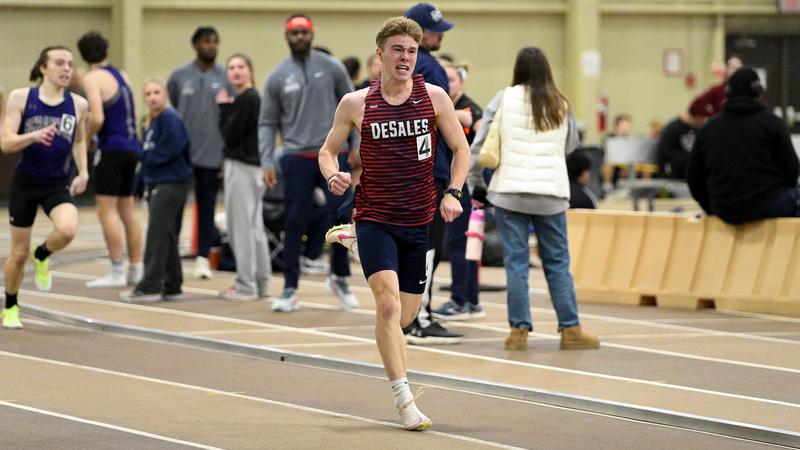
Lancaster, PA (December 6, 2025) – The DeSales University men’s track & field team opened the 2025-26 indoor T&F season competing at the Diplomat Open at Franklin & Marshall College on Friday.
The Bulldogs posted 10 MAC qualfying times/marks in the meet.
Among the qualifying times were junior Bryce Guthier taking second in the 400-meters with a time of 52.08. It is the fifth fastest time in indoor history. Senior Davis Trump also qualified in the 5K with a time of 16:20.32.
In the field events, DSU posted eight qualfying marks. Junior Weston Simak qualified for the MAC Championships in both the long jump (6.52m) and triple jump (13.72m). His triple jump mark was the second best in team history. First-year Luke Heimann also qualfied in the triple jump (11.86m).
Junior Jonathan Castronovo took home first place in the long jump with a mark of 6.58m, the second best long jump in team history.
First-year John Amoretti qualified in the shot put (12.33m), seniors Jonathan Eudja and Giovanni Wellington qualified in the weight throw with marks of 14.85m and 14.23m. First-year Ryan Rodriguez also quallified in the weight throw (11.89m).
The Bulldogs won’t return to action till the New Year at the Blue and Grey Invitational on Jan. 17th.
RESULTS
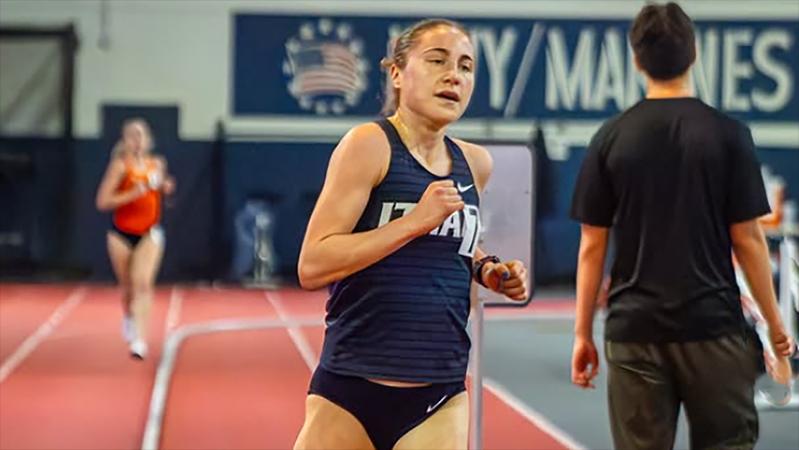
ITHACA, N.Y. –
The Ithaca College women’s track & field team opened its 2025-26 season over the weekend as the Bombers made the short trip across town to compete in the Greg Page Relays hosted by Cornell University on December 5-6.
Lola Gitlin posted a time of 10:25.57 in the 3000-meter run to finish third overall.
Rachel Larson was a fourth place finisher with a time of 8.58 seconds in the 60-meter hurdles. That time is currently No. 1 in Division III after the opening weekend of the season.
Aynisha McQuillar took fifth in the 200-meter dash in a time of 26.61 seconds. McQuillar also ran in the 60-meter dash and posted the 11th fastest time in DIII during the prelim with a performance of 7.78 seconds.
Lyla Powers was fifth in the 500-meter dash with a time of 1:21.75.
Lily Seyfert claimed fifth in the shot put with a heave of 12.78 meters, which is currently ninth in the nation.
Bree Boyle and Erin Eastwood each cleared 3.54 meters in the pole vault, which is tied for 11th on the Division III performance list.
Alexis Brown turned in a leap of 11.02 meters in the triple jump for the 17th best mark in the country.
Ithaca is off for the remainder of 2025 and will return to Cornell on January 10 for the Southern Tier Invitational.
RESULTS
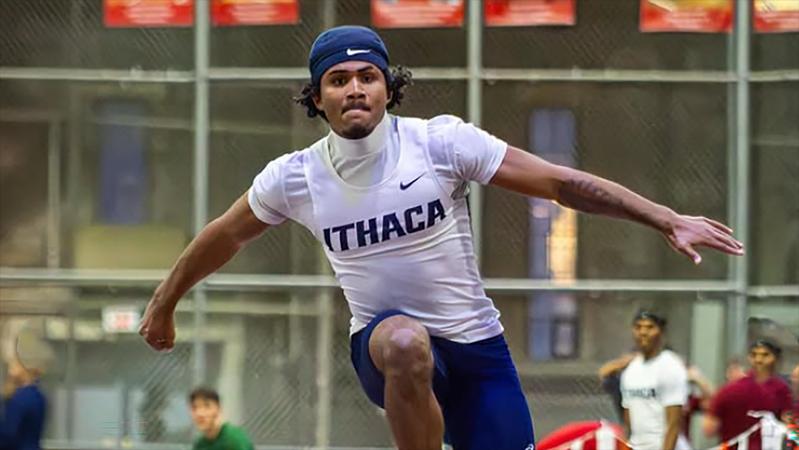
ITHACA, N.Y. –
The Ithaca College men’s track & field team opened its 2025-26 season over the weekend as the Bombers made the short trip across town to compete in the Greg Page Relays hosted by Cornell University on December 5-6.
Anik Vossschulte claimed third in the 200-meter dash in a time of 23.32 seconds, while Jacob Antilety was seventh at 23.71 seconds.
Matt Lokshin posted a time of 8.65 seconds in the 60-meter hurdles to place third in the event. Aidan Irwin took fourth in the high jump with a mark of 1.70 meters.
Quinten Lewis posted a mark of 13.73 meters in the triple jump to place fourth and Sebastien-Oliver Lacrete was sixth at 12.68 meters, while Evan Cherry secured fifth in the long jump with a leap of 6.84 meters.
IC’s 4×400-meter relay team of Damian Simmonds, Griffin Lupes, Noah McKibben and George Nilson placed sixth in 3:34.49.
Luke Ellor finished sixth in the shot put with a mark of 14.40 meters.
Three Bombers finished within the top eight in the 500-meter dash as Brad Kellogg was sixth in 1:09.73, Peter Tysiak followed in seventh with 1:10.74 and Matthew DeJulio was next at 1:11.59.
Kaiden Chandler and Luke Ferrer posted times of 4:41.29 and 4:53.44 in the mile to finish in seventh and eighth.
Raf Campanile was seventh in the pole vault with a clearance of 4.25 meters.
Ithaca is off for the remainder of 2025 and will return to Cornell on January 10 for the Southern Tier Invitational.
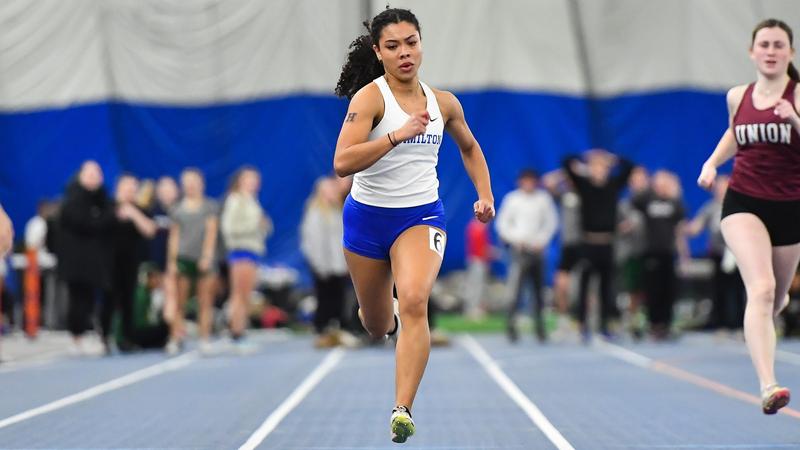
UTICA, N.Y. – The Hamilton College Continentals competed against 13 teams at the non-team scoring 2025 Utica University Track & Field Holiday Classic inside the Todd & Jenn Hutton Sports and Recreation Center on Saturday, Dec. 6.
The meet was the first of the 2025-26 season for the Hamilton women, who will be back at Utica for the Pioneers’ Winter Opener on Friday, Jan. 16 after taking a break for finals and the winter holiday.
The Continentals qualified for the 2026 All-Atlantic Region Track & Field Conference Indoor Championships in four different events and finished first in three events.
Emily Pogozelski ’26 won the 3,000-meter run by over 20 seconds with a regional-qualifying time of 10:27.93. Mackenzie Loudon ’29, who was competing in her first collegiate meet, took first place and qualified for regionals in the triple jump.
Loudon was also part of Hamilton’s winning 4×200-meter relay with Tatiana McCray ’28, Ava Chiappinelli ’29 and Marley Meyers ’28. Their performance was more than five seconds faster than the regional-qualifying time.
McCray ran a regional-qualifying 7.96 seconds and finished in second place in the 60-meter dash final. Chiappinelli also qualified for regionals in her first collegiate meet and finished right behind McCray with a time of 7.99 seconds.
TOP PERFORMANCES
300-Meter Dash (17 Runners)
4. Marley Meyers ’28, 43.08
7. Hannah Turner ’26, 43.91
60-Meter Dash (35 Runners)
2. Tatiana McCray ’28, 7.96 (PR, AARTFC)
3. Ava Chiappinelli ’29, 7.99 (AARTFC)
600-Meter Dash (16 Runners)
5. Aisha Kandji ’29, 1:47.31
4×200 Meter Relay (9 Teams)
1. McCray ’28, Mackenzie Loudon ’29, Chiappinelli ’29, Meyers ’28 (1:46.42, AARTFC)
3000-Meter Run (19 Runners)
1. Emily Pogozelski ’26, 10:27.93 (PR, AARTFC)
Triple Jump (15 Athletes)
1. Loudon, 11.29 meters (37 feet, 0.5 inches; AARTFC)
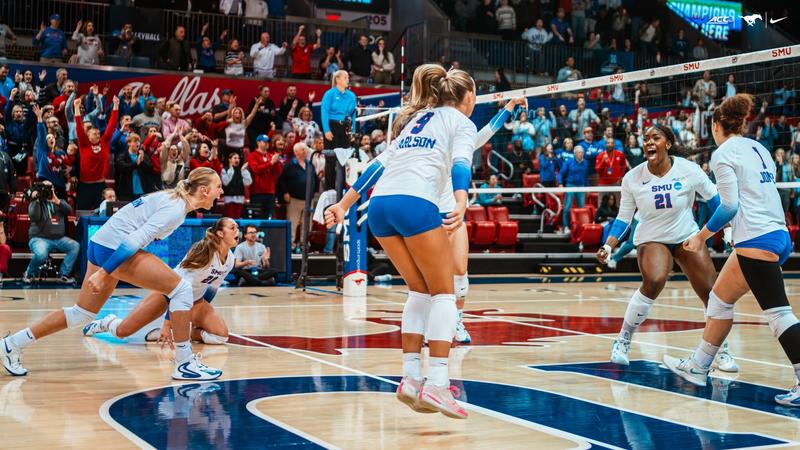
DALLAS (SMU) – For the first time in program history, SMU volleyball is headed to the Sweet Sixteen after sweeping Florida (16-12) in the Round of 32 on Saturday with set scores of 25-11, 25-21, 26-24.
With the win, SMU won its 27th match of the season, tying the program record for single-season wins. It also gave coach Sam Erger her 100th victory at SMU and in her Division I head coaching career.
Averi Carlson dished out 38 assists, the most in a three-setter for the senior setter this season. Carlson led the Mustangs to a .370 hitting percentage in the win. Kennedi Rogers went for 14 kills, hitting .440, with four digs and three blocks. Malaya Jones closely trailed Rogers with 13 kills, eight digs and seven blocks, tying her career high.
SMU out-blocked the Gators 15-4, spearheaded by a career-high nine blocks from freshman Maggie Croft. The Mustangs’ blocking efforts helped hold the Gators to a .156 hitting percentage for the match.
MATCH NOTES
- With 13 kills against Florida, Jones (503) is now the second player in SMU Volleyball history to reach 500 kills in a season. She joins Rachel Giubilato, who notched 568 kills in 2006.
- Averi Carlson (1,341) moved to third in the rally scoring era and sixth all-time for single-season assists at SMU.
- Jones reached the double-digit kill mark for the 26th time this season and for the ninth straight match.
- Rogers recorded double-digit kills for the sixth time this season.
- It marked Schilling’s 22nd time in double-figures this season and her fifth straight.
- With six blocks against the Gators, Anyanwu draws within 14 of breaking the program record for most blocks in a season. (188 by Janelle Giordano in 2015)
- SMU had double-digit blocks (15) for the 17th time this season and for the second straight match.
- SMU has won 20 of its last 21 matches and its 12th straight.
- The Mustangs end the 2025 season with 15 wins at Moody Coliseum, tying the program record for most in a season.
- The win marks the Mustangs’ 15th sweep, 11th at home this season.
HOW IT HAPPENED:
SMU controlled the first set from start to finish in all phases of the game. SMU hit .483 with no errors on 29 swings in the first, while holding Florida to a .000 hitting percentage. Rogers put in five kills to lead the Mustangs, who got point production from six different players to help propel them to a 25-11 set one victory. SMU commanded the net with a 5-0 advantage in blocks.
Down four (16-12) in the second frame, SMU responded with five straight points on a run that included two aces from Madison Scheer. After trading points, SMU went on a 4-0 run to pull away in the frame. The Mustangs went on to win the frame 25-21.
Tied 20-20 entering the red zone of the third set, SMU got the first two points on an ace from Carlson and a block from the freshman tandem of Rogers and Croft. Despite a 3-1 run by Florida that put the Gators at set point first, the Mustangs responded with three straight to close the match, ending the frame with their sixth block of the set to win 26-24.
SMU LEADERS:
SMU Kills Leader: Kennedi Rogers (14)
SMU Assists Leader: Averi Carlson (38)
SMU Digs Leader: Jordyn Schilling (11)
SMU Blocks Leader: Maggie Croft (9)
SMU Ace Leader: Madison Scheer (2)
SMU Points Leader: Malaya Jones (17.5)
Up Next: SMU will get a rematch with No. 3 seed Purdue in the NCAA Regional Semifinal on Thursday evening in Pittsburgh, Pa.
Sports
Trans volleyball player Blaire Fleming hits back at claim about female teammate’s eating disorder
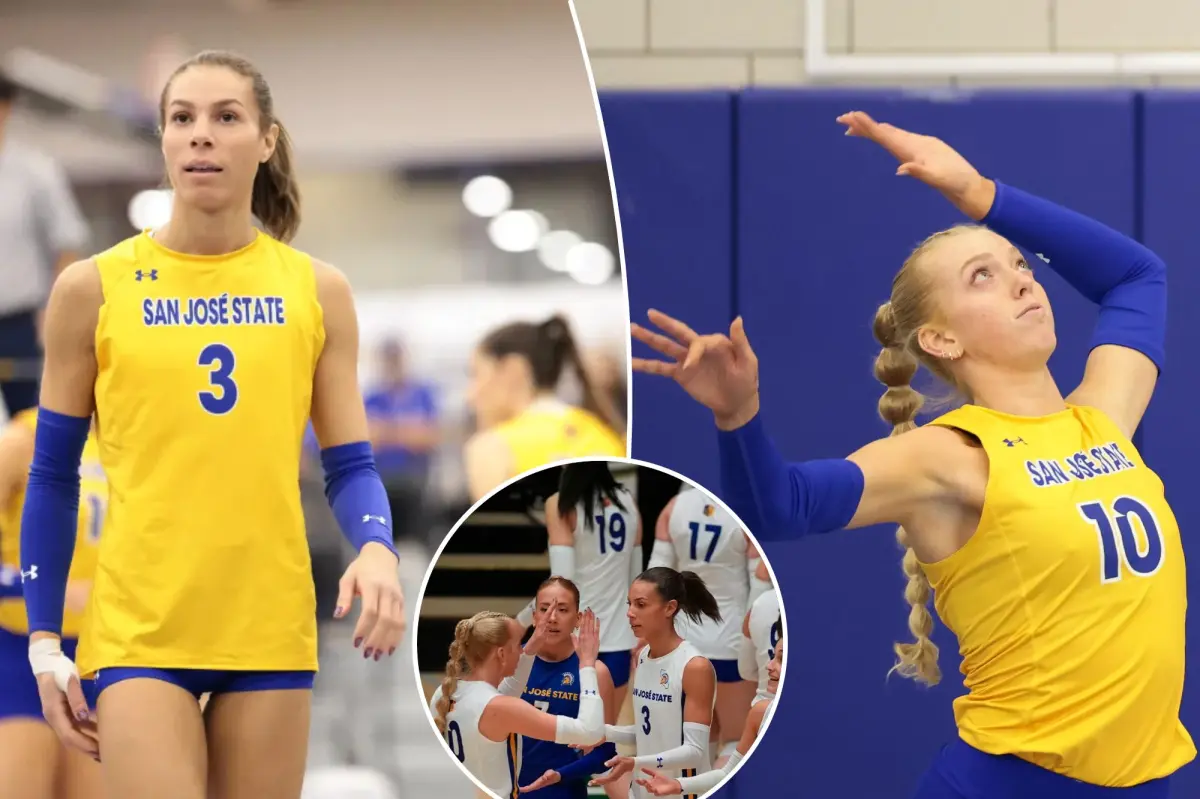
Transgender college volleyball player Blaire Fleming has hit back at claims that she triggered her teammate’s eating disorder due to emotional distress — and said that she doesn’t “feel bad for her.”
Fleming, 23, was at the center of a scandal last year involving Brooke Slusser, who filed multiple lawsuits against her San Jose State University (SJSU) teammate after discovering that she was transgender.
Slusser alleged that the panic and stress from that period of her life led her to develop an eating disorder, leading to anorexia so severe that her menstrual cycle stopped for nine months.
The pair had previously shared hotel rooms and changing spaces for a whole season in 2023 before Slusser said she found out that Fleming, who is biologically male but reportedly started medically transitioning at 14, was trans.
“From the stress and how anxious I was every single day, I just wasn’t eating really at all,” Slusser told Fox News Digital last week.
“I went from around 160 to 128 [lbs] in that one semester. It definitely isn’t healthy for someone of my size to be that weight, and I ended up losing my menstrual cycle for nine months. So it was definitely severe,” she said.
Slusser later dropped her classes in the final semester this past spring, citing constant in-person harassment by students who opposed her stance.
Fleming has since responded, claiming that Slusser’s eating disorder dated back for as long as she knew her, prior to her learning that she was trans.
“She’s been anorexic and struggled with food since I’ve known her aka since 2023. She literally would weigh herself 2-3x a day and keep track of it on her whiteboard in her room,” Fleming told Fox News Digital on Sunday.
“So I really don’t care or feel bad for her. And she didn’t drop her classes, she failed out, hope that helps!” Fleming said.
Slusser has now come back and disputed Fleming’s allegations.
“These statements are just not true. I have always lived a very healthy lifestyle. Before these events took place I was very disciplined in fueling myself for athletics and [kept] track to make sure I was where I need to be to be the best athlete,” Slusser told Fox News Digital.
“It wasn’t until all the craziness started that my healthy lifestyle turned very unhealthy into not eating the amount I should,” Slusser said.
“As for school, I decided to stay home after fall 2024 to better myself and heal. So no, I did not return to San Jose and enroll myself in more courses at an institution that didn’t have my best interest,” she added.
Slusser alleged that she was never told Fleming’s birth sex and said the two regularly shared hotel rooms on away trips, according to her lawsuits filed against the NCAA and Mountain West Conference.
Fleming allegedly requested to be roomed with Slusser, a request she said was granted by team leadership, according to lawsuits.
Slusser said that the 6ft1 Fleming confessed to being transgender during a conversation over ice cream with another teammate in April 2024.
In September 2024, Slusser joined swimmer Riley Gaines’ lawsuit against the NCAA.
At the same time, SJSU’s volleyball team saw a series of forfeits by opposing teams, with police protection regularly assigned.
The US Department of Education is currently investigating SJSU for potential Title IX violations.

Mill Creek Activity Center to increase gymnastics space to help meet demand

New Mexico and Minnesota Selected to Play in 2025 Rate Bowl on December 26 at 2:30 p.m.

UGA suing former Bulldog, Missouri DE for transfer damages

IU football is No. 1 seed in College Football Playoff, headed to the Rose Bowl – The Daily Hoosier

Men’s T&F Opens Season at Diplomat Open

Max Verstappen’s wife has child with F1 driver he replaced – Motorsport – Sports

Miami Selected to College Football Playoff – University of Miami Athletics

Women’s Track & Field Turns in Multiple High Marks to Begin Season at Cornell

Brad Keselowski glad Michael Annett ‘no longer suffering’ after death – Motorsport – Sports

Men’s Track & Field Opens Indoor Season at Cornell Greg Page Relays

Verstappen expected to win race, Norris title

Alonso hints at ‘favorites’ as Max hunts allies

Revised plan for Good Life District Aquatics Center appears to meet city’s needs

Forget Kiffin — NIL is the real villain here

BangShift.com Pro 10.5 Racing Action From The DI Winter Series Snowbird Nationals At Bradenton Motorsports Park In Florida

First Tee Winter Registration is open

Fargo girl, 13, dies after collapsing during school basketball game – Grand Forks Herald

CPG Brands Like Allegra Are Betting on F1 for the First Time

Volleyball Recaps – November 18

F1 Las Vegas: Verstappen win, Norris and Piastri DQ tighten 2025 title fight

Two Pro Volleyball Leagues Serve Up Plans for Minnesota Teams

Utah State Announces 2025-26 Indoor Track & Field Schedule

Sycamores unveil 2026 track and field schedule

Redemption Means First Pro Stock World Championship for Dallas Glenn

Bowl Projections: ESPN predicts 12-team College Football Playoff bracket, full bowl slate after Week 14

Texas volleyball vs Kentucky game score: Live SEC tournament updates

Indiana’s rapid ascent and its impact across college football

How this startup (and a KC sports icon) turned young players into card-carrying legends overnight

Pohlman admits ‘there might be some spats’ as he pushes to get Kyle Busch winning again
Wisconsin volleyball sweeps Minnesota with ease in ranked rivalry win

 Why a rising mid-major power with an NCAA Tournament team opted out of revenue-sharing — and advertised it
 NBA Legend Michael Jordan to Join NBC Sports as Special Contributor
 Falcons mailbag
 Portal Update – Basketball and Gymnastics Take Hits
 has always dreamed in Mercurial. Now his initials are on the boots.
The new Kyl…
has always dreamed in Mercurial. Now his initials are on the boots.
The new Kyl…
-
 Rec Sports2 weeks ago
First Tee Winter Registration is open
-
 Rec Sports2 weeks ago
Fargo girl, 13, dies after collapsing during school basketball game – Grand Forks Herald
-
 Motorsports2 weeks ago
CPG Brands Like Allegra Are Betting on F1 for the First Time
-
 Sports3 weeks ago
Volleyball Recaps – November 18
-
 Motorsports2 weeks ago
F1 Las Vegas: Verstappen win, Norris and Piastri DQ tighten 2025 title fight
-
 Sports2 weeks ago
Two Pro Volleyball Leagues Serve Up Plans for Minnesota Teams
-
 Sports2 weeks ago
Utah State Announces 2025-26 Indoor Track & Field Schedule
-
 Sports2 weeks ago
Sycamores unveil 2026 track and field schedule
-
 Motorsports1 week ago
Redemption Means First Pro Stock World Championship for Dallas Glenn
-
 NIL1 week ago
Bowl Projections: ESPN predicts 12-team College Football Playoff bracket, full bowl slate after Week 14