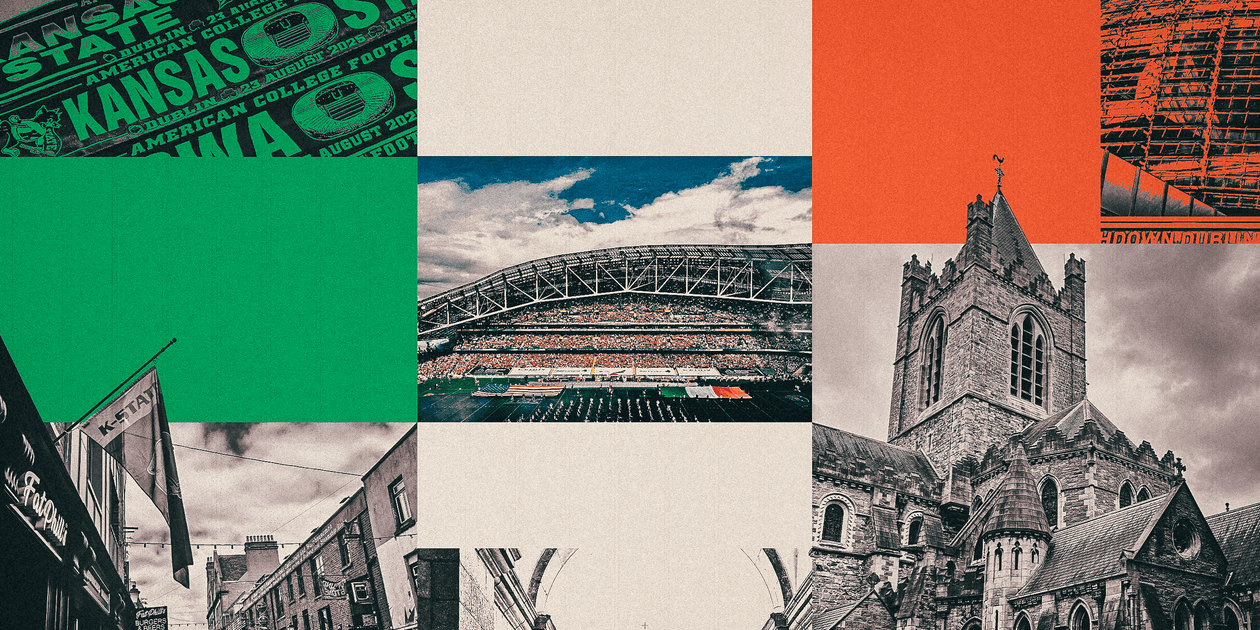
DUBLIN —If you ever visit Dublin, don’t be alarmed by the sound of smashing steel erupting from the bustling roads here. In this fair city, the clanging is just a flatbed truck absorbing the bounces off concrete as it hauls dozens of kegs of Guinness around town.
The locals were unbothered by the familiar racket. But as the truck rounded a corner at St. Patrick’s Cathedral, it caused hundreds of American tourists in purple and white and cardinal and gold to turn their heads and furrow their brows. The visitors in American football jerseys and T-shirts stood on hallowed grounds where, 1,500 years ago, Saint Patrick first baptized Christian converts.
Tour groups went back to listening about the church built in 1191. One shaggy-haired young visitor lagged behind as he twirled a football.
A foreign object to many in this city, but for how long?
For the fourth straight year, college football kicked off another season from its quaint vacation home on the east coast of the Emerald Isle. Kansas State and Iowa State brought 22,000 fans to Ireland for the premier Week 0 matchup of AP Top 25-ranked teams in the Aer Lingus College Football Classic. The NFL will come to town in September for its first-ever regular-season game on Irish soil.
The 109th straight rendition of “Farmageddon” will be remembered for the endless empty beer glasses, Irish weather that finally showed up after a splendid few days and the frantic fourth quarter that saw the Cyclones win their third straight against the Wildcats, 24-21.
The fan bases speckled the streets with their school colors. And even before Saturday evening when they packed the green stands inside Aviva Stadium, the air of Americana — and some of the absurdity that comes with it — overran parts of the city.
I walked over 40 miles to see how the two worlds collided — an ancient (by American standards) rivalry from the heartland of the U.S. relocated to an ancient city (first settled by visiting Vikings over 1,200 years ago) that, for the most part, had zero clue what was going on.
The differences between the two sporting cultures were on display throughout the week. In Iowa State’s news conference on Thursday, an Irish reporter taught players Tyler Miller and Dom Orange how to say “kiss my ass” in Gaelic. Imagine that happening in the hyper-controlled media operations back in the States.
An estimated 30,000 locals attended the game. One in a Sam Darnold New York Jets jersey talking to a friend in a DK Metcalf Seattle Seahawks jersey about the guts it took Iowa State head coach Matt Campbell to call the fourth-and-3 pass play that iced the win.
Other Dubliners marveled at the atmosphere. As they planned their next move of the night, five friends huddled at the intersection of Landsdowne and Shelbourne roads. Ally, an American football superfan, plays flag football, one of the fastest-growing sports in Ireland. So along came Ruth, Sara, Ciara and Aoife, paying about 100 euros apiece for their tickets, on par for a national rugby and soccer game at Aviva.
“These ones,” Ally said, pointing to all her friends, “came for the spectacle.”
And there were some confusing elements to the evening.
“They’ll stop to do something, and then they’re all set to go, and then they take time off again,” Sara said. “I mean, it went on for three-and-a-half hours.”
Ciara was amazed by the physicality, but clearly hasn’t been exposed to the college football controversy of targeting: “It seems like you’ll do anything when you’re hitting. Hit hard no matter what.”
Earlier in the week, on the grounds of Trinity College, Kansas State’s cheerleaders shook their pompoms on the steps of buildings built over 400 years ago as passersby voiced their confusion: “What the hell are they?”
Two Kansas State fans struck up a conversation with a local on the benches inside the court of Dublin Castle. The local asked the Wildcats fans if there is promotion and relegation in college football like there is in most soccer leagues around the globe.
“I haven’t got a f—ing clue how American football works,” the local said. “But it looks good.”
The night before the main event featured an Irish version of Friday night lights.
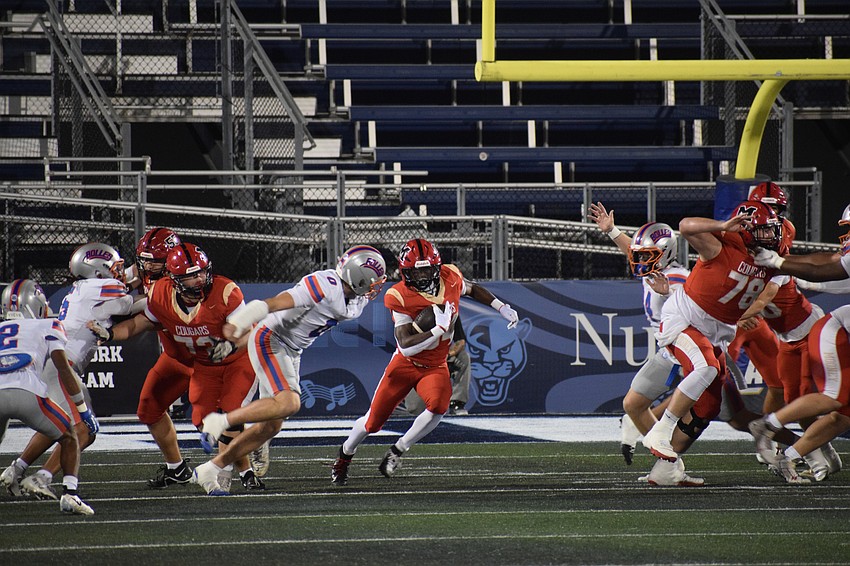
The Irish Wolfhounds, the awesomely named U19 Irish national American football team, hosted The Kiski School Cougars (a prep school team from Saltsburg, Pa.), inside the also awesomely named Donnybrook Stadium, grounds that have hosted rugby tilts for more than 100 years.
The Wolfhounds dressed only 34 players because 15 were injured in recent weeks. They wore mismatched helmets, and some paled in size to American players. But they got to play a football game on home soil, which is rare.
A few superfans crowded together in one end zone. At this stadium, you can pick your poison: beer or espresso. It was just the Wolfhounds’ fifth game as a national team since the program started in 2023. The player pool, drawing from all over Ireland, has expanded from 40 in Year 1 to nearly 70.
The game was organized by the Global Ireland Football Tournament, which started in 2012 when Notre Dame and Navy played here that season. Alan Lomasney, Wolfhounds coach and president of the American Football Ireland organization, who has been coaching since 2002, said at least once a week he hears, “Oh, I didn’t know there was football in Ireland.”
Friday night, he heard the roars of the fans during every Wolfhounds tackle. A false start call on the Wolfhounds in the first quarter drew chants of “bulls—!” Irish football fans, they’re just like us.
The growth stage of the sport here, however, is still in its infancy. The Wolfhounds lost to Kiski 59-0. The two teams huddled together afterward hoisting Irish flags.
“The fact these kids get to play under the Friday night lights at home? Every football player’s dream,” Lomasney said. “I tell them, ‘Look, in 60 years’ time, you have a chance to tell your grandkids you got to represent Ireland.’”
During Saturday’s main bout, members of the Wolfhounds helped unfurl the Irish flag at midfield.
Outside of the U.S., Ireland has more history with college football than any other country. Before game organizers turned this into an annual event, games were held in Dublin as far back as 1988. Ireland’s tourism office said over 1.2 million American tourists visited in 2023, spending over $1 billion.
This year’s game is estimated to have an economic impact of over $150 million on the city. Which means organizers will continue to sell college teams on making the jaunt over. Next year, TCU and North Carolina are scheduled. In 2027, it’s Pittsburgh and Wisconsin. Big 12 commissioner Brett Yormark said prior to the game Saturday the experience exceeded his lofty expectations.
“There are a lot of countries interested in bringing college football to their markets,” he said. “There’s probably not a week where we don’t get a call or some kind of interest. I think what Ireland has done here, they have a blueprint. They’ve been at it for quite some time. It’s more than just a game. Because there’s a lot more around the game.”
It was as if Dublin were hosting its very own bowl game.
I stumbled upon the two surviving Pop-Tart mascots from the Pop-Tarts Bowl, held in December in Orlando, Fla. Nothing says Americana like life-sized grinning breakfast pastries partaking in shameless brand promotion. They were near Grafton Street, one of the busiest shopping streets in Europe. A tourist trap if there ever was one.
But who can turn down filming an Irish stepdance just a few streets away from the home of the Irish Riverdance?
Or pass by a make-yourself-into-a-leprechaun booth?

Who could pass by a “Leprechaun yourself” booth? (Christopher Kamrani / The Athletic)
The Pop-Tarts ran riot, making kids smile, making kids cry. They danced and posed for too many selfies to count.
Ireland has exhausted magical stereotypes like leprechauns, four-leaf clovers and pots of gold at the end of the rainbow. College football has these rectangular bulging-eyed snacks that fans of the sport go wild over.
Whether you donned a Wildcat or Cy the Cardinal, you could find designated school pubs around the heart of the city to grab a pint of Guinness.
One bar’s Google search went awry, as it purchased the state flag of Kansas — not a Kansas State University flag — in an attempt to lure customers, flying it high in the breeze.
Irish paddy caps were handed out at pep rallies. A local Irish band played John Denver.
Lane Lowery of Wichita, Kan., was one of the thousands packed Friday inside Merrion Square Park for Kansas State’s rally.
He “wore” the jersey of KSU quarterback Avery Johnson, a 45-minute purple paint job done by brush. His wife, Tabitha, packed the paint in a trash bag in their suitcase to ensure it didn’t explode. He busted it out on Friday because Aviva Stadium has a strict dress code: shirts must be worn.
“Too bad,” Lowery said, “because it’s beautiful.”
For 40 percent of the players, the trip earned their first stamp in their first passport. Kansas State running back Dylan Edwards called traveling abroad and playing football a blessing. KSU linebacker Austin Romaine said all he knew about Ireland before this game was announced 16 months ago was that “they drive on the other side of the road.”
The Week 0 game further magnifies American football’s presence in Ireland as the NFL prepares to make its regular-season debut here next month with the Minnesota Vikings versus the Pittsburgh Steelers.
“It’s cool as hell,” said Michael McQuaid, an Irish reporter who covers the NFL and college football for NFL Ireland.
McQuaid and his colleague, Daire Carragher, have encountered roadblocks in explaining their devoted following of such a foreign sport to their fellow Irish. Last year’s game between Florida State and Georgia Tech marked the first time the event was broadcast live on local Irish TV channel TG4.
“It’s a slow burn,” Carragher said. “People say there’s too many ads.”
It’s flag football, with its scheduled debut inclusion in the 2028 Olympic Games in Los Angeles, that is gaining ground. Lomasney and others said flag football is being integrated at the youth level all over Ireland. The European flag football championships take place next month in Paris. Ireland will be competing.
McQuaid knows two Wolfhounds players who also play rugby and Gaelic football — a fast-paced game in which players use their hands and feet to control a volleyball-style ball. Maybe his lens is a bit influenced by his adoration for football, but McQuaid believes that with more NFL and college football games in Ireland, young athletes will be more intrigued by either tackle or flag football.
After all, Ireland has its first born-and-bred college football commit in punter Adam Gibbs, who is committed to Penn State.
“It feels like we’re at the tip of the iceberg here and the growth is just going to come,” McQuaid said. “You can imagine what it will be like 10 years from now.”
College football’s foothold here in recent years includes Dame Street keeping the nickname “Notre Dame Street” after the Fighting Irish visited in 2023. And Dublin businesses leaned into the tourists’ passion. The Guinness drafthouse designed school emblems into its maple-colored foam. When Iowa State fan and alumni association employee Shellie Andersen hit up Starbucks, a comfort of home, with friends and family, the baristas wrote “Enjoy the game!” on their cups. Another wrote, “Go Iowa State!”
“This means more because our team was selected to be here,” Andersen said.

A shop offered Iowa State and Kansas State merchandise. (Christopher Kamrani / The Athletic)
On the rugby field of famed Irish poet and writer Oscar Wilde’s alma mater, Trinity College, marching bands from both schools left their instruments Friday and took walks around the campus founded in 1592. Iowa State members grabbed a football out of a backpack and chucked it around as faculty members and students looked on. But it wasn’t the first football thrown on that field that day.
Just a few minutes earlier, a local youth sports camp had kids suited up in flag football gear running post and fly routes. Before they shoved off to lunch, one of the coaches handed a football to a youngster who had the catch of the day — a fingertip grab off his shoelaces while staying inside the orange cones. Seated next to me on a bench, an elderly Irishman couldn’t wait to explain to his wife, who soon arrived with a warm cup of coffee, what he’d just seen.
“Brilliant,” he told her.
As they lined up in pairs to head out, the young man proudly tucked the football into his left arm.
(Illustration: Dan Goldfarb / The Athletic; photos: Christopher Kamrani / The Athletic)