Connect with us
https://yoursportsnation.com/wp-content/uploads/2025/07/call-to-1.png

Technology

When sports stats become the real-life superpower

Published

on


Sports stats used to be just trivia for die-hard fans and coaches scribbling in notebooks. Now, they’re at the heart of every smart decision in the game—on the field, in fantasy leagues, and even at the betting window.

The shift has been dramatic. Athletes and coaches fine-tune strategies using detailed analytics. Bettors leverage performance data to improve their odds. Even casual fans get a front-row seat to insights once reserved for insiders.

This article looks at how sports statistics have evolved into a genuine superpower, fueling sharper performance, deeper engagement, and a new era of transparency across the sports world.

Unlocking the power of sports data

Sports data is no longer reserved for analysts or pro teams. Today, everyone from fantasy league regulars to serious bettors can tap into a wealth of stats that were once out of reach.

What’s really changed is how accessible and actionable this information has become. Platforms now deliver verified insights, real-time analytics, and detailed records on athletes, teams, and even tipsters. This lets everyday fans make smarter choices—whether they’re setting a fantasy lineup or placing their first wager.

If you’ve ever wondered how some people always seem one step ahead in office pools or why certain bettors consistently win, it usually comes down to their ability to read and interpret data. No more gut feelings or guesswork—stats are fueling smarter strategies and raising the bar for everyone involved.

For those looking to move beyond casual fandom, there’s a new breed of tools designed for transparency and accountability. To see these data-driven resources in action—and learn how verified performance records can help you bet smarter—click here.

How athletes and coaches use stats for a competitive edge

Elite teams no longer leave performance up to chance. Analytics now drive every training session, lineup, and on-field adjustment.

For coaches and athletes at the highest level, stats aren’t background noise—they’re the foundation of smarter preparation and better results. One well-timed insight can separate a good season from a great one.

From personal bests to team dynamics, today’s sports pros treat data as their secret advantage. Let’s look at how they put it to work.

Performance metrics that matter

The best athletes focus on what’s measurable. Tracking speed, agility, shooting percentage, or pass accuracy helps them spot progress—and identify plateaus before they become problems.

These numbers aren’t just for post-game recaps. They shape practice plans, reveal hidden strengths, and highlight where efficiency can be gained. A runner might discover their fastest sprints happen late in a session; a basketball player could see that shot selection is far more accurate from one wing than the other.

By zeroing in on these key indicators, coaches set clear goals and tailor drills for real-world improvement. Over time, even small upticks in these stats translate into noticeable advantages on game day.

Injury prevention and recovery analytics

No athlete wants to spend time sidelined. That’s why teams are turning to data-driven monitoring of workload, biomechanics, and recovery patterns to cut down risk.

A 2024 study of elite Turkish handball teams highlights how analytics are used to track and address injury incidence throughout the season. By using real-time data, teams can better prevent injuries and adapt their training approaches to boost athlete safety and recovery (Injury Analysis Elite Handball).

This approach isn’t limited to pros—college programs and youth leagues are following suit. With tech like GPS trackers or force plates in shoes, it’s now possible to detect subtle signs of fatigue or overload before they turn into serious issues.

Opponent analysis and game planning

No two opponents play the same way—and that’s where detailed statistical breakdowns come in handy. Coaches pore over data on shot charts, set piece tendencies, or possession patterns to anticipate what’s coming next.

This intel helps teams fine-tune strategy down to individual matchups. For example: If an opponent scores most goals from crosses on the left side, defenders know exactly where to tighten up coverage.

The result? Smarter pre-game prep and more confident adjustments mid-match. By making sense of trends that used to slip by unnoticed, coaches give their teams every possible edge when it counts most.

The fan’s superpower: data-enhanced engagement

Fans are no longer just spectators—they’re becoming savvy insiders, armed with stats that shape every decision and debate.

Whether it’s picking a fantasy team, joining a heated online forum, or placing a well-researched wager, access to quality data has changed how we connect with sports.

What I’ve noticed is that fans now treat game-day like a puzzle, using real numbers to spot hidden value and even predict upsets before they happen.

This shift is turning casual viewing into an active, competitive experience—and making the journey just as exciting as the result.

Fantasy leagues and stat-based competition

Fantasy sports have raised the bar for everyone who loves stats. Winning isn’t luck—it’s about knowing which metrics matter most for each player or match-up.

I’ve seen office pools where participants debate over advanced analytics instead of gut feelings. Things like usage rates, expected goals, or efficiency ratings aren’t just for analysts—they’re everyday tools for millions of fantasy managers.

This focus on data-driven picks keeps leagues fresh and competitive. It rewards those who do their homework and aren’t afraid to challenge conventional wisdom with numbers that tell the real story.

Social sharing and community insights

The social side of sports stats has exploded. Fans gather in online communities to share graphs, argue about trends, and swap predictions based on real-time data.

PewC’s Global Sports Survey 2024 reports a surge in these communities built around data analysis. Industry leaders say this trend is fueling loyalty and deeper collaboration among fans across different platforms.

I’ve joined discussions where someone’s obscure stat changes everyone’s perspective on an upcoming match. The camaraderie—and competition—make following sports feel less solitary and more connected than ever before.

Responsible betting with verified stats

Bettors have wised up. Access to verified performance records means people can move beyond guesswork when putting money on the line.

The best platforms now show detailed win-loss records, profit margins, or yield percentages—taking much of the mystery out of picking a trusted tipster or making your own picks based on transparent history rather than hype.

This transparency helps bettors make more responsible choices and encourages a culture where both fun and accountability matter. Instead of chasing hot streaks or rumors, fans are basing decisions on data they can actually trust.

The future: data as the ultimate sports equalizer

Sports data has moved far beyond simple box scores and basic averages. Today, it’s the great equalizer—giving every competitor, coach, and fan access to insights that once belonged only to big-budget teams or professional scouts.

As technology becomes more accessible, even underdogs can harness analytics to challenge traditional powerhouses. Whether you’re tracking a youth soccer player’s progress or making predictions as a die-hard fan, data is opening doors for everyone.

The next generation of innovation—driven by artificial intelligence and wearable tech—promises tools that will reshape how we play, watch, and understand sports. The playing field has never been more level or more exciting.

AI and predictive analytics in sports

Artificial intelligence is quickly becoming a game-changer across the sports world. Machine learning models now analyze thousands of variables to predict outcomes with striking accuracy—whether it’s who might win a tennis match or which basketball team is primed for an upset.

This goes way beyond odds-making. Teams use predictive analytics for scouting new talent and planning lineups. Fans see personalized content based on their viewing habits or fantasy interests. Even casual viewers get smarter recommendations about what games to watch and which players to follow.

I’ve noticed how some clubs use AI-driven insights during matches for quick tactical adjustments—something unheard of just a few years ago. As these systems grow more advanced, they’ll help everyone make sharper decisions both on and off the field.

Wearables, sensors, and real-time insights

If you’ve seen players wearing smartwatches or chest straps during training, you’ve glimpsed the power of wearable tech in action. Sensors now track heart rate, sprint speed, jump height—even hydration levels—in real time.

This isn’t just about performance stats; it’s also reshaping injury prevention and recovery. A 2025 industry report from Catapult (Key Trends in Sports 2025) details how wearables provide instant feedback that helps athletes train smarter—not just harder—and spot early warning signs before small issues turn into injuries.

Fans benefit too. Imagine receiving live updates on your favorite player’s fitness during a match or seeing interactive stats right on your phone at the stadium. This blend of technology and insight makes the entire experience more immersive for everyone involved.

Conclusion

Sports stats are no longer just for analysts or hardcore fans—they’re shaping how everyone experiences the game.

Whether you’re a coach fine-tuning strategy, a bettor hunting for an edge, or a fan looking to outsmart your rivals, data is your superpower.

The trend is clear: as access to quality stats and insights keeps expanding, the benefits reach further across all levels of sport.

If there’s one thing I’ve seen firsthand, it’s that the smartest decisions come from facts, not hunches.


Link

Continue Reading
Click to comment

Leave a Reply

Your email address will not be published. Required fields are marked *

Technology

How eSports and Gaming Platforms Are Shaping Interactive Digital Communities

Published

on


The gaming and eSports industries have grown far beyond simple entertainment. Today, they represent a complex ecosystem where competition, social engagement, and technology intersect. Fans don’t just play—they spectate, strategize, and participate in online communities that feel immersive and dynamic.

Competitive gaming has influenced not only game design but also how digital platforms structure engagement. Leaderboards, progression systems, and interactive features once reserved for video games now appear across entertainment, social, and even educational platforms. This approach keeps users invested and encourages continuous interaction.

Platforms like spacehills.de are perfect examples of this trend. While focusing on gaming and eSports experiences, the platform integrates community-driven features, gamified interactions, and real-time engagement tools that resonate with pop-culture and tech-savvy audiences. Users find themselves drawn into a system that feels familiar yet innovative, combining the thrill of competition with interactive platform design.

The Mechanics Behind Engagement

Gamification remains one of the strongest drivers of user engagement in modern digital spaces. Borrowed from video games, these mechanics transform standard interactions into meaningful experiences. Users enjoy clear goals, rewards for skill or participation, and tangible progress that mirrors in-game achievements.

Core Gamification Elements

  • Achievement tracking – recognizing user milestones
  • Progression bars and levels – visually representing growth
  • Daily or weekly challenges – encouraging consistent engagement
  • Reward systems – motivating repeated interactions

By leveraging these mechanics, platforms create a sense of investment and personal growth, even outside traditional gaming contexts.

eSports Influence on Platform Design

The structure and intensity of eSports competitions have heavily influenced digital platform design. Just as tournaments require skill, strategy, and adaptability, interactive platforms aim to provide layered experiences that challenge and reward users in meaningful ways.

Key Design Features Inspired by eSports

  • Real-time updates – keeping users informed and engaged
  • Interactive dashboards – allowing immediate response and action
  • Community integration – fostering connection among players
  • Performance metrics – tracking progress and achievements

These elements ensure that users feel involved and motivated, replicating the engagement loop found in competitive gaming.

Social Interaction and Community Building

A defining feature of modern gaming and eSports culture is community. Whether it’s clan systems, guilds, or Discord channels, shared experiences amplify engagement. Digital platforms that integrate social features replicate this environment, creating a sense of belonging and collaboration.

Community-Driven Features

  • Forums and chat systems for discussion and collaboration
  • Leaderboards to encourage friendly competition
  • Collaborative challenges or events
  • Transparent systems that reward fair play

Strong communities increase retention and make platforms more attractive to both new and experienced users.

Strategy, Skill, and Decision-Making

Gaming and eSports emphasize strategy and skill, which naturally translate into interactive platforms. Users are drawn to experiences that reward decision-making, resource management, and tactical thinking. This dynamic creates depth and keeps users engaged over time.

Strategic Engagement Elements

  • Risk versus reward decisions
  • Progression-based challenges
  • In-game or in-platform resource management
  • Analytical decision-making feedback

By incorporating these elements, platforms encourage thoughtful participation rather than passive consumption.

Technology Driving Immersion

Technological advancements have enabled platforms to support high-performance, real-time interaction similar to competitive gaming environments. Cloud computing, low-latency servers, and responsive design ensure that users experience smooth, immersive engagement.

Tech Features Enhancing User Experience

  • Mobile-optimized and responsive interfaces
  • Low-latency real-time updates
  • Secure user accounts and transactions
  • Scalable architecture to handle peak traffic

These features make platforms feel modern, reliable, and aligned with user expectations shaped by gaming and eSports experiences.

Personalized Experiences and Adaptive Systems

Modern platforms increasingly rely on data to provide personalized experiences. By monitoring user behavior, preferences, and engagement patterns, platforms can dynamically adapt content, challenges, and rewards to each individual.

Benefits of Personalization

  • Tailored challenges and events
  • Customized interfaces and dashboards
  • Adaptive difficulty and content progression
  • Enhanced user satisfaction and retention

This approach mirrors personalized gameplay experiences in video games, where user choices and performance influence outcomes.

The intersection of eSports, gaming, and digital platform design demonstrates how interactive experiences are evolving. Platforms like spacehills.de illustrate how combining community, gamification, and technological innovation creates compelling environments for users, where engagement, strategy, and social interaction coexist seamlessly.


Link

Continue Reading

Technology

Superbet Group Becomes Super Technologies, Shaping the Future of Digital Entertainment Ecosystems

Published

on


Our website uses cookies, as almost all websites do, to help provide you with the best experience we can.

Cookies are small text files that are placed on your computer or mobile phone when you browse websites.

Our cookies help us:

– Make our website work as you’d expect

– Remember your settings during and between visits

– Offer you free services/content (thanks to advertising)

– Improve the speed/security of the site

– Allow you to share pages with social networks like Facebook

– Continuously improve our website for you

– Make our marketing more efficient (ultimately helping us to offer the service we do at the price we do)

We do not use cookies to:

– Collect any personally identifiable information (without your express permission)

– Collect any sensitive information (without your express permission)

– Pass personally identifiable data to third parties

– Pay sales commissions

{short version}This Privacy Policy discloses the privacy practices for EEGReport Magazine, EEGaming.org, GamblingIndustryB2B.com, iGamingRadio.com, GamblingAffiliateVoice.com and EuropeanGaming.eu, including subdomains, our email newsletters and other applications owned and operated by our company (collectively referred to as the “European Gaming Media and events” – formerly known as “EEGMedia“), and to any services that display this notice. The Privacy Policy also sets out the ways in which we may use your personal data.

{long detailed version} To read this in full, click on the Privacy Policy button found in this window.

{short version} These terms and conditions govern your use of the websites owned and operated by European Gaming Media and Events; by using our websites, you accept these terms and conditions in full and without reservation. If you disagree with these terms and conditions or any part of these terms and conditions, you must not use these websites.

You must be at least 18 [eighteen] years of age to use our websites. By using our websites and by agreeing to these terms and conditions, you warrant and represent that you are at least 18 years of age.

The list of the websites owned and operated by European Gaming Media and Events can be found here.

In other words,
You must be at least 18 years old to use our service and fully agree with everything stated on this page. Otherwise, sorry, guys, ours websites are not for you.

License to use our websites
Unless otherwise stated, European Gaming Media and Events and/or its licensors own the intellectual property rights published on our websites and materials used on the European Gaming Media and Evnts network. Subject to the license below, all these intellectual property rights are reserved.

You may view, download for caching purposes only, and print pages, files or other content from the websites for your own personal use, subject to the restrictions set out below and elsewhere in these terms and conditions.

You must not:

republish material from these websites in neither print nor digital media or documents (including republication on another website);
sell, rent or sub-license material from the websites;
show any material from the websites in public;
reproduce, duplicate, copy or otherwise exploit material from our websites for a commercial purpose;
edit or otherwise modify any material on these websites;
redistribute material from these websites – except for content specifically and expressly made available for redistribution; or
republish or reproduce any part of these websites through the use of iframes or screenscrapers.
Where content is specifically made available for redistribution, it may only be redistributed within your organisation.

In other words,
Everything on our websites belongs to us. You can read it, but you cannot republish it. Sounds fair, doesn’t it?

Acceptable use
You must not use these websites in any way that causes, or may cause, damage to the websites or impairment of the availability or accessibility of the European Gaming Media network or in any way which is unlawful, illegal, fraudulent or harmful, or in connection with any unlawful, illegal, fraudulent or harmful purpose or activity.

{long detailed version} To read this in full, click on the Terms of Service button found in this window.


Link

Continue Reading

Technology

Gaming Headset Market reaching an estimated USD 7 billion by 2034

Published

on


Gaming Headset

Gaming Headset

Pune, India – December 15, 2025 – Exactitude Consultancy, a global leader in market research and intelligence, today announced the publication of its Gaming Headset Market Report, delivering a detailed analysis of industry trends, segmentation, competitive landscape, and growth forecast through 2034. This report equips manufacturers, gaming peripheral brands, distributors, investors, and technology stakeholders with actionable insights into the evolving gaming audio accessory ecosystem.

Download Full PDF Sample Copy of Market Report @ https://exactitudeconsultancy.com/request-sample/70022

Market Overview

The global gaming headset market was valued at approximately USD 3.6 billion in 2024 and is projected to grow at a CAGR of 7.1 % over the forecast period (2025-2034), reaching an estimated USD 7 billion by 2034. Growth is driven by rising eSports participation, immersive gaming demand, and technological advancements in audio features.

Key Growth Drivers & Trends

• eSports & Online Gaming Boom: Global expansion of competitive gaming amplifies demand for high performance headsets that offer superior positional audio and communication clarity.

• Technological Innovation: Enhanced features such as noise cancellation, surround sound, wireless connectivity, and spatial audio are increasingly integrated, improving player immersion and comfort.

• Streaming & Content Creation: Growth in gaming streaming and content production influences headset demand, as creators seek high quality audio capture and playback.

• Casual & Mobile Gamers: A broadening gamer base – especially casual players – continues to drive headset adoption for both competitive play and entertainment.

Market Segmentation

The report segments the gaming headset market by:

• Product Type: Wired and wireless gaming headsets. Wired remains significant due to low latency, while wireless is rising with improved battery tech and convenience.

• Application: Gaming, music, virtual reality (VR), and streaming usage.

• End User: Casual gamers, professional gamers, and eSports athletes.

• Technology: Surround sound, noise cancellation, RGB lighting, built in microphones – key immersive and functional features driving differentiation.

• Distribution Channel: Online retail, offline retail stores, and direct manufacturer sales.

Explore Full Report here: https://exactitudeconsultancy.com/reports/70022/gaming-headset-market

Regional Insights

• North America remains the largest regional market, accounting for about 40 % of global revenue, buoyed by a strong gaming culture and high accessory spend.

• Asia Pacific is a dynamic growth region with an ~10 % CAGR, driven by expanding middle class gaming populations and significant eSports adoption in China, Japan, and SEA.

• Europe shows solid growth supported by widespread console and PC gaming infrastructure.

• Latin America and Middle East & Africa are among the fastest growing emerging regions with projected double digit regional CAGRs by 2034.

Competitive Landscape

The gaming headset market is highly competitive with both established brands and specialized gaming audio companies. Key players include:

• Logitech

• Razer

• Corsair

• SteelSeries

• HyperX

• ASUS

• Turtle Beach

• Sennheiser

• JBL

• Creative Labs

These companies continually innovate with features such as spatial audio, advanced noise suppression, enhanced wireless protocols, and ergonomic design to meet diverse gamer preferences.

Market Challenges

Challenges facing the market include price competition and saturation in certain product tiers, as well as evolving platform compatibility requirements across PC, console, mobile, and VR devices.

Strategic Importance

Gaming headsets have become essential peripherals for modern gaming ecosystems, influencing play experience, communication, and competitive performance. As the gaming sector – including casual, competitive, and VR gaming – continues to expand, high fidelity audio gear remains a key differentiator for brands and consumers alike.

This report is also available in the following languages : Japanese (ゲーミングヘッドセット市場), Korean (게이밍 헤드셋 시장), Chinese (游戏耳机市场), French (marché des casques de jeu), German (Markt für Gaming-Headsets), and Italian (Mercato delle cuffie da gioco), etc.

Request for a sample of this research report at (Use Corporate Mail ID for Quick Response) @ https://exactitudeconsultancy.com/request-sample/70022

Our More Reports:

Standalone Trackpad Market

https://exactitudeconsultancy.com/reports/33610/standalone-trackpad-market

Virtual Reality Devices Market

https://exactitudeconsultancy.com/reports/34652/virtual-reality-devices-market

Professional Monitors Market

https://exactitudeconsultancy.com/reports/35764/professional-monitors-market

About Us

Exactitude Consultancy is a market research & consulting services firm which helps its client to address their most pressing strategic and business challenges. Our market research helps clients to address critical business challenges and also helps make optimized business decisions with our fact-based research insights, market intelligence, and accurate data.

https://bulletin.exactitudeconsultancy.com/

https://www.thehealthanalytics.com/

https://www.analytica.global/

https://www.marketintelligencedata.com/

https://www.marketinsightsreports.com/

https://exactitudeconsultancy.com/

Connect Us:

Irfan Tamboli

PHONE NUMBER +1 (704) 266-3234

EMAIL ADDRESS: sales@exactitudeconsultancy.com

This release was published on openPR.


Link

Continue Reading

Technology

UM-Flint event sees Corunna, Davison win top esports honors | News

Published

on


Games including Rocket League, Marvel Rivals, Super Smash Bros, Mario Kart 8, and others.


FLINT, Mich. (WJRT) – The University of Michigan-Flint’s College of Innovation & Technology joined forces with the Michigan High School Esports Federation to host the fall 2025 state finals event.

More than 120 teams and 350 players from over 70 schools across the state participated in the event on Saturday.

Eleven champions were crowned in games such as Rocket League, Marvel Rivals, Super Smash Bros, and Mario Kart 8.

“It’s amazing. It’s my first time in a tournament or anything,” said Corunna esports player Jackson Donley.

“Especially in person, and the atmosphere is just amazing. You can tell it’s tense, especially when the matches are so close,” Donley said.

Corunna Middle School secured first place in the middle school division of the Team Super Smash Bros competition.

Davison High School claimed first place in the high school division.


Link

Continue Reading

Technology

Retro Cartoon Tech Accessories : Higround x SEGA

Published

on


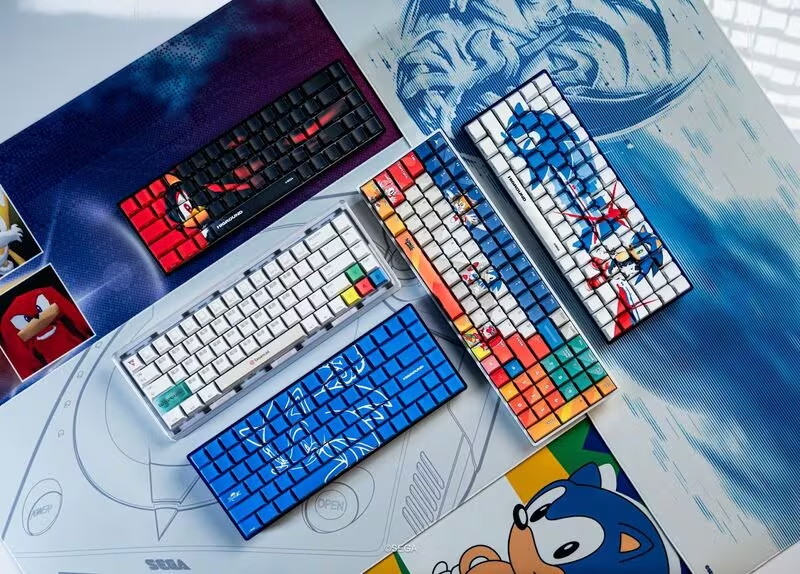
The Sonic the Hedgehog collection, a renewed collaboration between lifestyle gaming peripheral brand Higround and SEGA, highlights a design concept that merges retro nostalgia with modern performance engineering. Drawing from the cultural legacy of Sonic the Hedgehog and the visual language of the Dreamcast era, the collection introduces peripherals that blend archival aesthetics with contemporary functionality. This release also expands Higround’s product range “through updated 75% and 96% keyboard layouts and the introduction of a Hall Effect model, each referencing the theme of Sonic’s characteristic speed.”

The ‘Summit 65+,’ presented in a Dreamcast-inspired design, features a CNC aluminum case, stainless steel back plate, and Higround’s ‘Dampening Plus’ five-layer system for a stable, quiet typing experience. The ‘Basecamp 65HE,’ influenced by the Radical Highway level, debuts Hall Effect technology for increased precision. Additional offerings—including the Classic Sonic–themed ‘Basecamp 96+,’ two ‘Basecamp 75+’ versions inspired by Escape from the City and Sonic CD, a Sonic CD keycap set, and four coordinated XL mousepads—further unify the collection’s nostalgic yet contemporary character.

Image Credit: Higround


Link

Continue Reading

Technology

How Miami’s Sports Culture Reflects the High-Energy Mindset Driving Today’s Tech Innovations – Five Reasons Sports Network

Published

on


The Competitive Spirit That Powers Both Sports and Startups

Miami sports fans know that greatness comes from more than talent alone. Whether it’s the Heat grinding through a tight fourth quarter or the Dolphins executing a perfectly timed offensive scheme, winning requires discipline, fast thinking, and an unshakeable competitive spirit. Interestingly, these same qualities power the tech and startup world, where entrepreneurs make split-second decisions that can define the future of an entire business.

In both arenas, success belongs to those who can read momentum, adapt under pressure, and turn small opportunities into game-changing wins. That overlap is why so many sports-minded individuals naturally thrive in the world of business, innovation, and technology.

Why Analytics in Sports Fuel Smarter Business Thinking

Today’s sports landscape is driven by analytics—shot charts, win probability graphs, EPA metrics, and possession efficiency numbers are all part of modern fan knowledge. This analytical mindset doesn’t stop at the arena. Tech entrepreneurs, founders, and investors rely on the same data-driven thinking to navigate product decisions, market shifts, and competition.

This crossover is why the startup world attracts problem solvers shaped by sports culture. And platforms in the entertainment-tech space—such as Foxy gold casino—reflect this growing connection between digital innovation, predictive thinking, and user engagement.

Understanding Momentum: A Shared Advantage for Founders and Athletes

Momentum is everything. In sports, a single run, turnover, or three-pointer can change the energy in seconds. In business, momentum might be a viral post, a successful beta launch, or hitting a major funding milestone. Leaders in both fields understand how to recognize momentum and capitalize on it.

This parallels perfectly:

  • Athletes ride hot streaks.
  • Founders capitalize on traction.
  • Sports teams adjust mid-play.
  • Startups pivot product strategy just as quickly.

The ability to shift gears on the fly is one of the most important skills in sports and tech alike.

Building a Winning Strategy: What Startups Can Learn From Miami Sports

1. Scouting and Research Matter

Sports teams invest heavily in scouting reports and film studies. They evaluate:

  • Opponent strengths
  • Player tendencies
  • Lineup matchups
  • Efficiency ratings

Startups mirror this with market research, user interviews, competitive analysis, and data modeling. Knowing the landscape allows founders to execute smarter, faster, and with more confidence.

2. Team Culture Determines Long-Term Success

The Miami Heat built the “Heat Culture,” known for discipline, conditioning, and accountability. Startups adopting similar cultural principles see major benefits:

  • Clear leadership and communication
  • Defined expectations
  • Continuous improvement
  • Resilience under pressure

A strong culture is often the difference between a startup that scales—and one that collapses.

3. Adaptability Separates Winners From the Rest

Sports demand constant adjustments: defensive rotations, halftime strategies, and clutch-time decisions. Startups face equally rapid shifts:

  • Market changes
  • New competitors
  • Shifting user demand
  • Technological breakthroughs

Founders who adapt quickly, without losing their vision, stay competitive.

Table: Business Lessons Inspired by Miami’s Sports Playbook

Miami Sports Principle Startup Application Tech/Innovation Impact
Heat Culture Strong internal systems Higher productivity & retention
Film study & analytics Market and user research Better decision-making
In-game adjustments Product pivots Faster adaptation to trends
Team chemistry Cross-functional collaboration Smoother product scaling
Game-winning mentality Resilient leadership Strong long-term growth

How Miami’s Fast-Paced Environment Fuels Innovation

South Florida’s sports scene is known for energy, excitement, and bold plays. Coincidentally, Miami’s startup scene mirrors that same intensity. The city has quickly become a hub for fintech, AI, gaming, and digital entertainment. Entrepreneurs here are used to speed—speed of execution, iteration, and scaling.

A few reasons Miami is thriving in the innovation sector:

  • Diverse global talent
  • High investor interest
  • Strong tech community backing
  • Growing digital entertainment market
  • Crossover influence from sports and media

Miami is one of the few cities where sports culture and startup culture genuinely feed each other.

Technology Is Changing the Game—On the Field and in the Office

Technology has reshaped sports with player-tracking systems, real-time analytics, and dynamic stat models. Meanwhile, tech startups use automation, AI-driven insights, and SaaS platforms to accelerate growth. Both industries depend on innovation to stay ahead.

Today’s fans and founders alike have access to tools such as:

  • Predictive analytics
  • Machine learning insights
  • Automated reporting dashboards
  • Real-time performance tracking
  • Competitive intelligence platforms

This shared tech ecosystem keeps both sports teams and startups laser-focused on performance.

The Role of Mindset: What Makes Sports Fans Natural Innovators

Sports fans understand pressure. They analyze plays, debate strategies, track performance trends, and anticipate outcomes. These instincts make them naturally suited for entrepreneurship and tech leadership.

Key mindset overlaps include:

  • Confidence under pressure
  • Long-term thinking
  • Understanding risk and reward
  • Embracing competition
  • Continuous improvement

Sports create thinkers who thrive in fast-paced, unpredictable environments—the exact conditions startups face daily.

Why the Connection Between Sports and Startups Keeps Growing

Sports influence is everywhere—from data modeling to team culture to leadership strategy. At the same time, tech continues to elevate sports through analytics, digital enhancements, and real-time engagement tools. The crossover strengthens every year, especially in vibrant markets like Miami.

As both industries push forward, one thing remains true: the mindset that wins games is the same mindset that builds the next big company. Athletes, analysts, fans, and founders all share a core advantage—a competitive drive, sharpened by strategy, that fuels consistent growth.


Link

Continue Reading

Most Viewed Posts

Trending