Youth shelters are much more than a place to sleep for teens in crisis; they are a vital part of the safety net that helps vulnerable young people break cycles of instability, trauma and justice system involvement.
As communities across the nation grapple with rising concerns about youth homelessness and juvenile delinquency, the benefits of youth shelters have become increasingly clear: They provide stability, healing and direction and play a critical role in reducing recidivism.
Every year, thousands of youth find themselves without a safe place to go. Some are fleeing abuse or neglect at home, while others are aging out of foster care or have been kicked out due to family conflict.
Many turn to couch surfing, sleeping on the streets or engaging in illegal activities just to survive. Without intervention, these youth are at higher risk for arrest, detention and ongoing involvement in the juvenile justice system.
Youth shelters offer a lifeline. They provide a safe, stable environment where young people can access basic needs like food, clothing and shelter, but also wraparound services that address the underlying issues that brought them there. These services often include mental health counseling, substance abuse treatment, academic support, job training and family reunification programs.
One of the key benefits of youth shelters is their focus on trauma-informed care. Many youth who end up in the juvenile justice system have experienced significant trauma, whether through abuse, neglect or chronic instability. Youth shelters provide a structured, supportive setting where young people can begin to process their experiences and develop healthier ways of coping.
This supportive environment plays a powerful role in reducing recidivism. According to research from the Coalition for Juvenile Justice, youth who are diverted to community-based programs, like shelters, are significantly less likely to reoffend compared to those who are placed in detention centers. This is because shelters focus on rehabilitation rather than punishment, addressing the root causes of delinquent behavior and giving youth the tools they need to succeed.
Programs that combine shelter with consistent mentorship and skill-building help youth set goals, build confidence and make positive choices. Case managers and counselors work with young people to create individualized plans that support long-term stability – whether through re-engagement with school, job placement or connecting them with permanent housing.
Youth shelters also collaborate with local courts and law enforcement to serve as an alternative to detention for non-violent offenders.
These diversion programs emphasize accountability and growth, giving youth a second chance while relieving pressure on overcrowded juvenile justice systems.
Perhaps most importantly, youth shelters send a clear message to young people: you matter and your future isn’t defined by your past.
By providing safety, structure and support, they help youth rewrite their stories and build lives of purpose and promise.
In the effort to reduce youth recidivism and support long-term success, investing in youth shelters isn’t just compassionate, it’s effective. These shelters are not just temporary stops; they are launching pads for hope, healing and lasting change.
More information about Youth Emergency Shelter & Supports can be found at www.yesshubbard.org, @YESSHubbard on Facebook or by emailing youthmatterinhubbardcounty@gmail.com.
VANCOUVER, Wash. – Lawmakers from the 18th Legislative District are taking steps to protect children in youth sports programs with new legislation.
House Bill 2180, sponsored by Rep. John Ley (R-Vancouver) and endorsed by Rep. Stephanie McClintock (R-Vancouver), would require youth sports organizations to conduct background checks via the Washington State Patrol. It also prohibits hiring anyone with convictions for crimes against children.
It also instructs the Department of Children, Youth, and Families to create mandatory training on reporting child abuse specifically for youth sports coaches.
Ley emphasized the importance of these measures, stating that the bill was prompted by a concerning incident.
“This legislation was prompted after concerned parents encountered a convicted sex offender who failed to disclose his conviction while seeking to coach their children,” said Ley. “By requiring background checks — paid for by the individual or organization — we give parents and program administrators better tools to protect kids.”
McClintock expressed her dedication to child safety, stating her support for the bill.
“Protecting kids will always be a top priority for me,” said McClintock. “As a mom, this legislation closes dangerous loopholes and helps ensure youth sports remain a safe environment for kids and families.”
Ley also extended gratitude to the community member who raised the issue.
“I also want to thank the constituent that brought this matter to our attention,” said Ley.
The 2026 legislative session is set to begin on Monday, Jan. 12.
Registration for spring sports runs from Jan. 1 – Jan. 25. The parks and recreation department offers baseball for ages 5-14, softball for ages 5-16, t-ball for ages 5-6, and spring tennis for ages 8-14. Registration must be completed online and is open from Thursday, Jan. 1, through Sunday, Jan. 25.
Grayson Touchard, a spokesperson for the parks and recreation department said about 1,800 kids sign up for spring sports each year.
“We do not place a cap on registration,” she said. “Everyone who registers will have the opportunity to play if there are enough players in their age group.”
She said parents will have about a week and half after Little League players have been chosen to register for spring ball if their child does not make the team.
The Parks and Recreation Department announced Nov. 25 that the department is now a part of the Little League Official Community and the holder of the new St. Charles Little League charter, bringing a new opportunity for young athletes across St. Charles and St. John parishes.
The newly established Little League program is open to boys and girls ages nine through 12 and will serve eligible athletes who live or attend school in St. Charles or St. John the Baptist Parish.
All tryouts will be held at the West Bank Bridge Park in Luling.
All registrations for spring sports must occur with the individual’s affiliated booster club, except for spring tennis.
The Parks and Recreation Department will provide registration information regarding track and field, First Tee-Greater New Orleans (youth golf), and SuperTots offerings in early 2026.
Editor’s note: Sheng Peng is a regular contributor to NBC Sports California’s Sharks coverage. You can read more of his coverage on San Jose Hockey Now, listen to him on the San Jose Hockey Now Podcast, and follow him on Twitter at @Sheng_Peng.
VANCOUVER — This wasn’t a must-win for the San Jose Sharks, but it certainly felt like a more important regular-season game than usual.
Macklin Celebrini admitted, after the Sharks went into the holiday break bombed by the Vegas Golden Knights 7-2, that the team needed to respond. San Jose did just that, doubling the Vancouver Canucks up 6-3 on Saturday night, in their first post-Christmas tilt.
“It’s awesome, especially with how we ended [before] break. I think we all wanted this one pretty bad,” Celebrini said, about the team’s bounceback and his first win in hometown Vancouver. “It’s cool to win here.”
This victory also put the 18-17-3 Sharks back into the last wild card berth.
I’ve been on record many times saying that I don’t believe San Jose will make the playoffs. Of course, I’m not changing that belief because of one win, though I stress that I hope they prove me wrong.
But three things stood out Saturday that will help the Sharks in their quest to qualify for the postseason.
Download and follow the San Jose Hockey Now podcast
The562’s coverage of Long Beach Poly Athletics for the 2025-26 school year is sponsored by Former Jackrabbits Wendell “WoWo” Moe, Jr. & Tyson Ruffins.
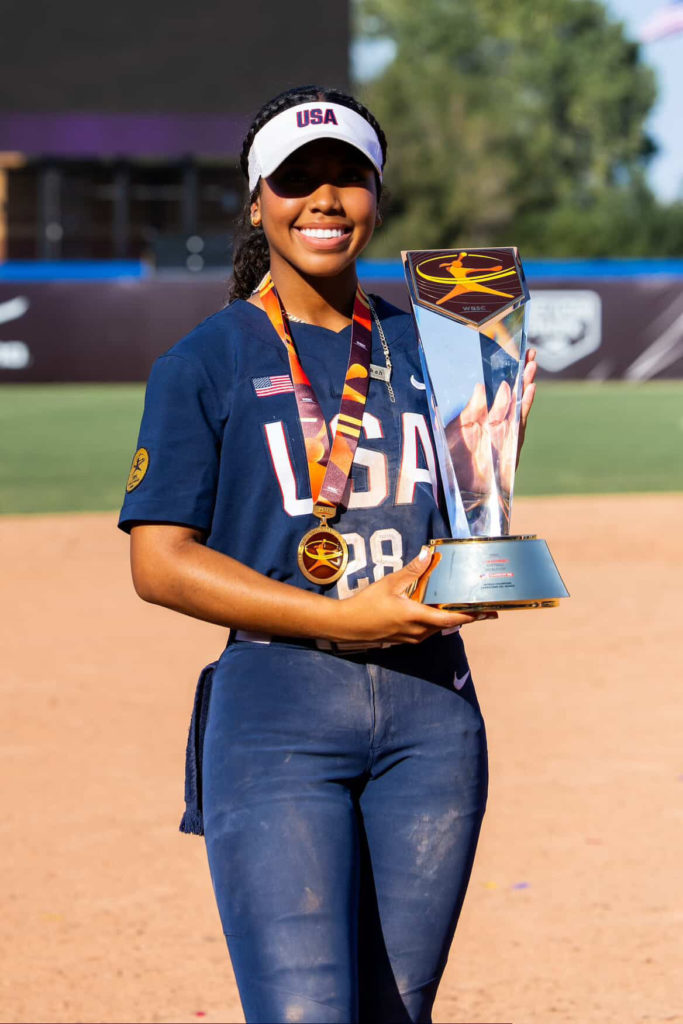
Long Beach Poly softball star Ki’ele Ho-Ching capped off an impressive 2025 campaign winning a gold medal with the USA Women’s U-18 Softball Team at the WBSC Women’s Softball World Cup in Oklahoma City. In the gold medal game, Ho-Ching drove in a run with a single during Team USA’s 7-2 championship win over world-ranked No.1 Japan.
Team USA’s medal marks its fifth-consecutive world championship after winning in 2015, 2017, 2019, 2021 and now, 2025. This victory also extended a 48-game winning streak at the World Championship for the stars and stripes squad, remaining undefeated at the World Cup with victories over China, Chinese Taipei, Canada, Mexico and two wins against Japan. Ho-Ching scored three runs during the five-day stretch in the fall tournament, collecting three hits and an RBI.
Ho-Ching is currently ranked as the No. 1 player in the nation, according to Prep Softball, and was one of 16 players from 10 states selected to the USA U-18 team. Her appearance makes her the first Moore League softball player to play on a USA Softball Youth National Team, according to USA Softball archives.
Ho-Ching joins the ranks of local sports icons to put on the “USA” jersey, including Lisa Fernandez, a Long Beach native who attended St. Joseph, and Tiare Jennings, a San Pedro native who attended St. Anthony. Both Fernandez and Jennings have represented the Senior National Team.
The Oklahoma commit is poised for another standout season as a senior with Long Beach Poly, leading a talented Jackrabbit squad looking to dethrone perennial Moore League champions Millikan. The Jackrabbits are coming off a CIF-SS Division 4 championship—the first in program history.
According to MaxPreps, Ho-Ching batted an astounding .500 with a .568 on base percentage last year through 11 games with Long Beach Poly. As a junior, she tallied 19 hits, 18 RBIs and 13 runs scored for the Jackrabbits.
STATEN ISLAND, N.Y. — The snow couldn’t keep young ballers from competing in the 4th Annual Finest AAU Holiday Classic Saturday afternoon.
The annual tournament included 86 teams ages 2nd to 8th grade this year. A whopping 106 games are to be played between Dec. 26-31 at St. Teresas, St. Patrick’s and Moore Catholic High School.
New to the competition this year was the addition of six Brooklyn teams.
“We’re seeing more girls teams register this year, as well as several Brooklyn teams,” said league director James Fleschner. “It’s exciting to diversify the competition and really challenge the players to compete over the holiday break.”
Staten Island’s Finest AAU Travel Basketball Organization holds the competition annually to keep players active during the break.
Participants received a commemorative shirt in honor of the events.
The St. Teresa’s gymnasium was full of energy as players competed Saturday afternoon.
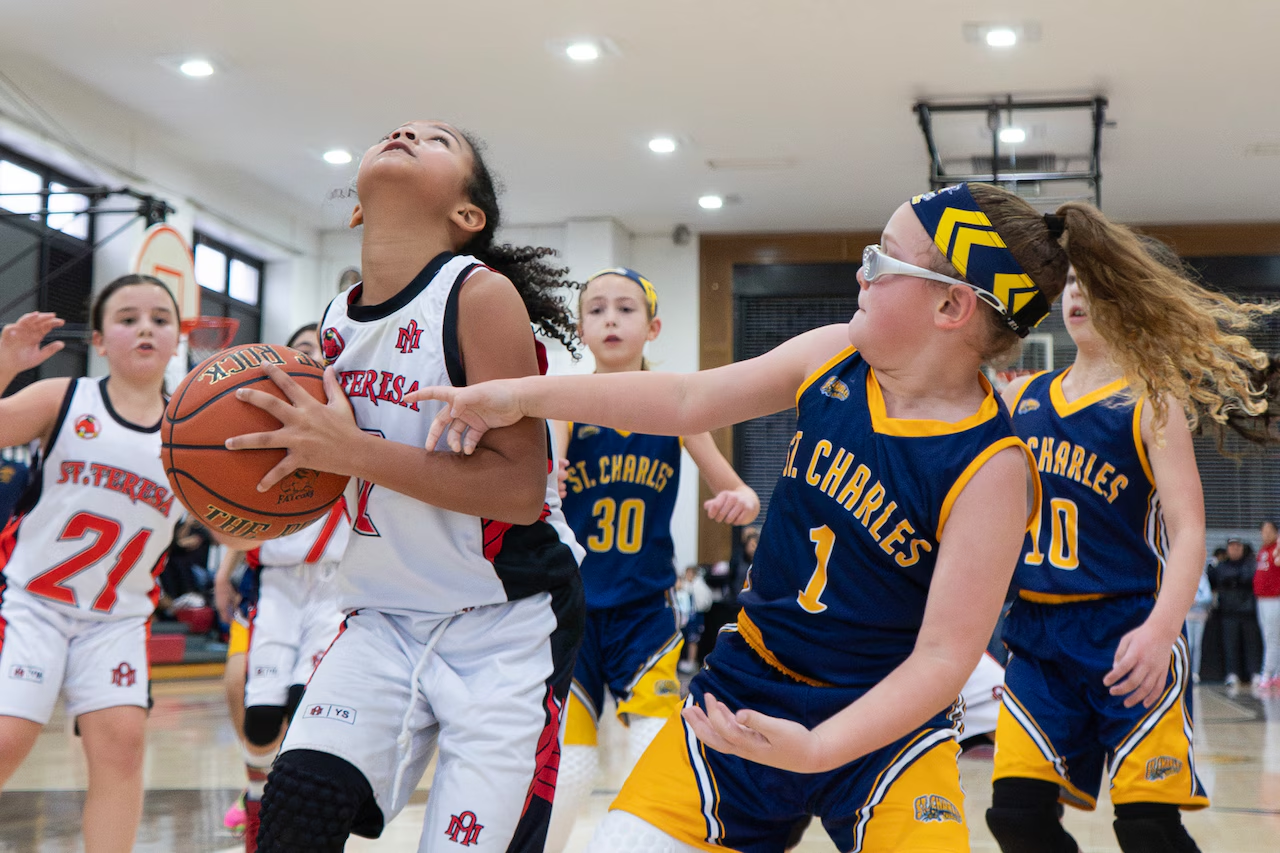
The girls 2nd/3rd St. Teresas team defeated St. Charles by a final score of 16-14 in an electric match. The girls 2nd/3rd Holy Child team fell to St. Joseph Hill Academy, 8-5.
Check out the gallery below for the best photos of the day.
1/90
4th Annual Finest AAU Holiday Classic at St. Teresas
SUBSCRIBER BENEFIT:SILive.com is offering a perk exclusively for subscribers: Log in, click on the photo gallery and choose GET PHOTO to download print-quality images free of charge. Note to SILive.com mobile app users: To download high-resolution photos, please access this report and gallery from a standard mobile or desktop/laptop web browser
LUBBOCK — The morning before his fight, as he waited in line for his 6 a.m. weigh-in, slurped an Orangesicle protein shake in a strip mall and later watched his younger sister practice her punch combinations with their father, Jayden Hernandez reminded himself what he knew about boxing.
The day’s bout — a third-round matchup in the 2025 USA Boxing National Championships that would pit him against the top seed in his bracket — would have to be won with discipline and specificity, not a tit-for-tat brawl, he repeated to himself and to his father that December morning. The 15-year-old from Kyle, who stands 5-foot-6 and weighs 105 pounds, would have to be perfect.
“One good hit, and this guy can knock you,” his father and coach, Fabian Hernandez, told him. Jayden, his face solemn beneath wispy brown hair, nodded.
Article continues below this ad
Jayden Hernandez trains at Let ‘Em Fly boxing, his father’s gym in Kyle.
Sara Diggins / Austin American-Statesman
Jayden Hernandez trains at Let ‘Em Fly boxing, his father’s gym in Kyle.
Sara Diggins / Austin American-Statesman
Boxing no longer produces American heroes nor commands national attention like it did half a century ago. But like practitioners of other faiths, the Hernandezes aren’t especially interested in America’s waning devotion. They remain committed to the sport’s grueling sacraments in hope of its rewards. It’s why Fabian Hernandez first took his son to a ring almost a decade ago. It’s why his son, who is by nature calm, and already hardened by several second-place finishes at national tournaments, has kept dealing and taking blows.
American boxing’s future runs through Texas, which has the largest number of youth fighters in the country. One in five lives in the Lone Star State, according to the country’s governing body for amateurs, USA Boxing. Within Texas, the Austin area has emerged as one of its most fertile grounds for talent in recent years, producing six youth and adult national champions and surpassing, at least for now, historical powerhouses like San Antonio and the Rio Grande Valley.
Largely sustaining this culture are the boxing gyms of Austin’s periphery, clustered in southern and northern suburbs increasingly home to the region’s nonwhite population and working- and middle-class families.
Article continues below this ad
Lily Hernandez, 11, leads a group through footwork exercises during practice ahead of the annual holiday party at Let ‘Em Fly Boxing in Kyle, Texas, Dec. 19, 2025. Coach Fabian Hernandez, the founder of the gym and Lily’s father, is proud to see his kids taking on leadership roles in the gym, but also wants to make sure they have time and space to be kids.
Sara Diggins/Austin American-Statesman
Boxing in the United States survives in large part because of the continued attention and participation of American Latinos. Today, they’re three times as likely as white Americans to identify as boxing fans and, according to USA Boxing operations manager Mike Campbell, account for more than half of all youth boxers. In Austin-area gyms, that reality is even starker: Latinos make up nearly all youth participants.
Night after night, in the stuccoed garages or warehouse office parks of Buda, Kyle, Pflugerville and Round Rock, the smack rhythm of fists hitting weighted bags and the skirts of nylon shoes dancing across the ring hum a soft music. Youths like Jayden furrow their brows, purse their lips and briefly clap their gloves during sparring breaks, eyes fixed on their opponents.
In a sport known — or rejected — because of its physical cost and blunt objective, there is little space for error. Commitment becomes nearly total.
Article continues below this ad
Father and son, father and daughter
Jayden doesn’t remember playing alongside the gym during his father’s amateur boxing comeback attempt in the early 2010s. But he does remember playing with his father’s trophies, around the time Fabian Hernandez first took him to boxing lessons at age 7. After taking a year off to try soccer and baseball, Jayden returned to boxing five years ago — this time training in his family’s garage under his father’s direct tutelage.
Lily Hernandez trains at her father’s gym, Let ‘Em Fly boxing.
Sara Diggins / Austin American-Statesman
Lily Hernandez trains at her father’s gym, Let ‘Em Fly boxing.
Sara Diggins / Austin American-Statesman
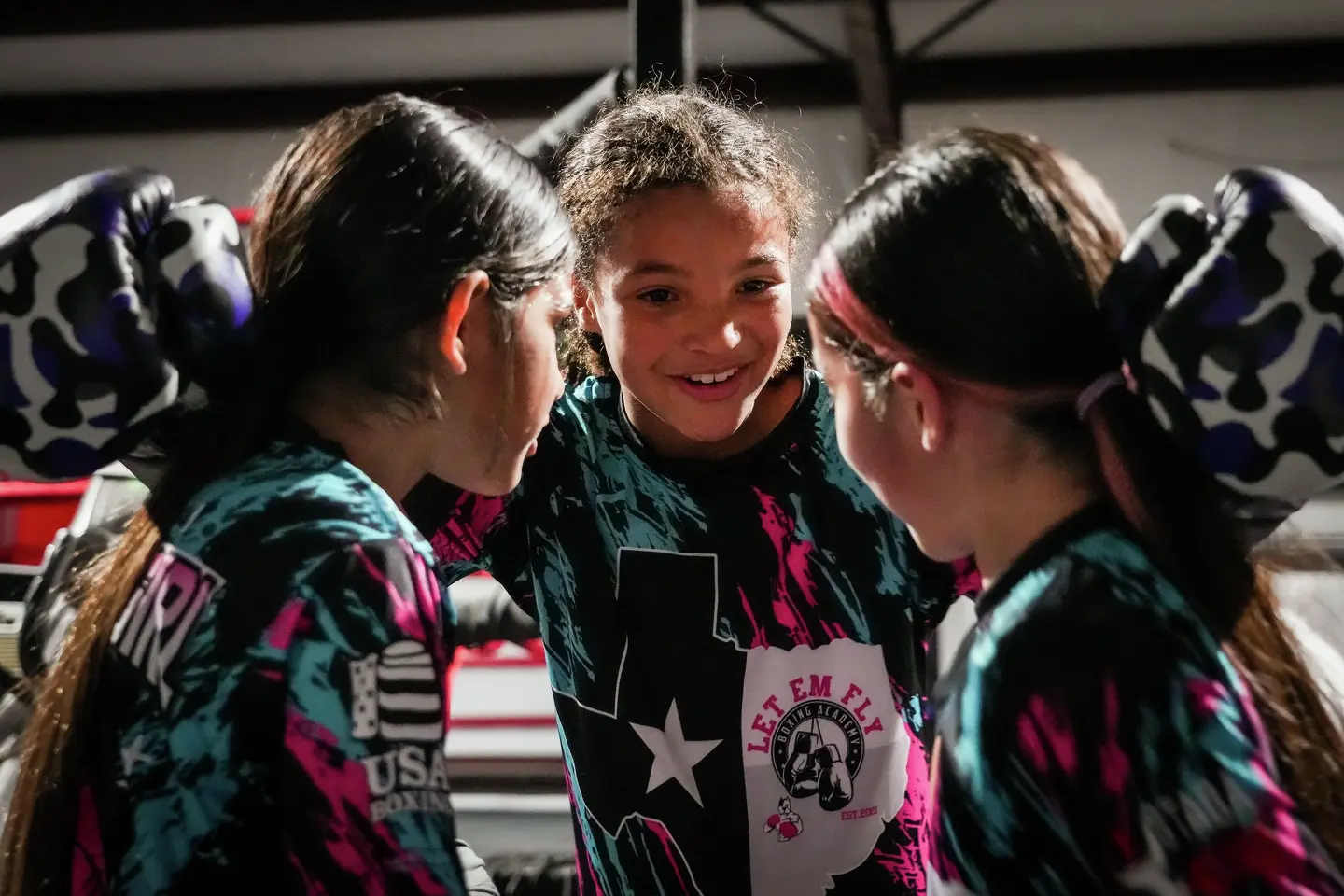
Those father-and-son sessions quickly grew to include Fabian Hernandez’s best friend’s son, Osiris Rangel, 12, then the boys’ younger sisters, and eventually dozens of other kids. Early this year, Fabian Hernandez moved the operation, which he named Let Em Fly Boxing Academy, into a warehouse. Participation has continued to grow.
Article continues below this ad
So, too, has the gym’s reputation, built on Jayden’s high placements at national tournaments and national title wins by Osiris and three female youth boxers — including the boys’ sisters Lily Hernandez, 11, and Emoni Rangel, 10.
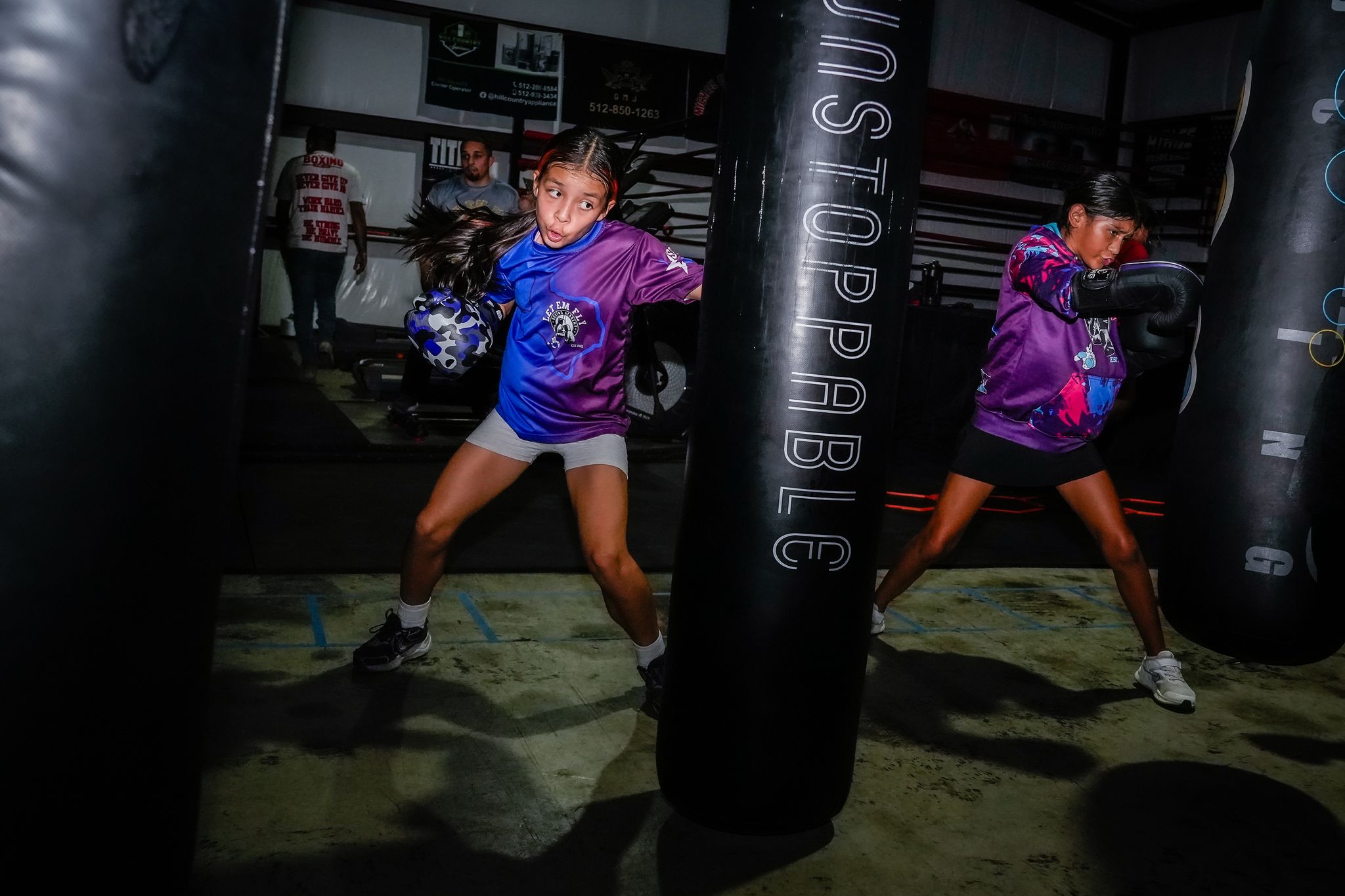
Lily Hernandez, 11, helps Emoni Rangel, 10, with her head gear during a sparring night at Let ‘Em Fly Boxing in Kyle, Texas, Nov. 13, 2025. Both girls are national-caliber boxers, using the sparring session to get sharp before the USA Boxing National Championships.
Sara Diggins/Austin American-Statesman
Training is tough and ramps up in the weeks before a national tournament. There are distance runs and sprints, long circuits of sit-ups, tire throws, box jumps, ladders and bag work, followed by sparring several nights a week with kids whose parents drive them in from Killeen, San Antonio, Uvalde or Laredo. During peak periods, some train six days a week.
“At no time can you take a break from this sport. It’s a livelihood,” Fabian Hernandez is known to tell his athletes.
Article continues below this ad
Hernandez has his children write out where they want to be in five and 10 years. The most common answer among kids in his competitive team: They want to be champions. They want to go pro.
“I don’t just want to be good, or great,” Jayden said during one training session. “I don’t just want to go pro and be a stepping stone for someone else. I want to be a world champion. I want to be known.”
Coach Fabian Hernandez at his gym in Kyle.
Sara Diggins / Austin American-Statesman
Coach Fabian Hernandez, left, at his gym in Kyle.
Sara Diggins / Austin American-Statesman
The boxer of today
Manuel Sepeda was 13 when he gave boxing a second chance in 1985. A troublemaker raised by his mom and aunt, he began to make the five-block daily walk from East Austin’s Santa Rita Courts public housing project to the Pan-American Recreation Center to train. Sepeda went in search of discipline and purpose: boxing’s mythic whisper. Other East Austin Chicanos, from the projects and nearby homes, went too. The gambit paid off for some, including Sepeda, who later carved out a modest professional career in his 20s.
Article continues below this ad
Twenty-five years ago, when Zach Martinez started coaching youths, that grit still defined the sport’s storyline. Many of the kids who showed up at Pan-Am or Montopolis recreation centers were often getting into trouble. Some were shot dead on days off from the gym. Poverty — the harsh backdrop boxing has long claimed — was ever-present.
Today, though that storyline is still told, it is less common in Austin, said Martinez, who currently trains youth boxers out of the Montopolis recreation center.
That doesn’t mean boxing has stopped being a blue-collar sport. Far from it. But, “there are a lot more fathers in corners,” said Sepeda, now 53, who served time in federal prison before becoming a car salesman and boxing trainer. “That’s a good thing.”
Athletes box during a sparring night at Let ‘Em Fly Boxing in Kyle, Texas, Nov. 13, 2025. The gym invites other gyms from around Central Texas to spar, letting the athletes get in practice bouts before real competitions.
Sara Diggins/Austin American-Statesman
Fabian Hernandez, who grew up boxing while his own father sat behind bars, agrees. Boxing is a trade he is teaching his son. Being in his corner matters.
Article continues below this ad
The father in the corner has become more important in part because of the rising cost of participation. Spending has increased in youth sports, especially since the turn of the century, as private facilities and travel-based circuits have become increasingly prevalent, said Jon Solomon, community impact director of the Aspen Institute’s Sports and Society Program. (Montopolis and Pan-Am recreation centers now have much smaller programs than the private gyms in Austin suburbs.)
But boxing carries additional burdens: Limited participation by age and weight class makes national tournaments essential, and the sport lacks an offseason, pressing parents to travel out of state — and pay for it — several times a year.
Campbell, the USA Boxing operations manager, estimates the average fighter or family spent about $1,200 to participate in December’s national championships in Lubbock, covering transportation, lodging, food and registration. Hernandez estimates that he spent about $2,000 this year to take his two kids to tournaments in Lubbock, Las Vegas and Tulsa this year, but only because his gym’s aggressive fundraising covered roughly three times that amount.
Of course, the father in the corner is much more than a wallet. He wraps wrists, waves mitts and makes weight decisions. He raises his voice for the judges to hear, or to admonish after a loss. He lowers his voice to comfort.
Article continues below this ad
Coach Fabian Hernandez, founder of Let ‘Em Fly Boxing, watches his athletes hit the bag during practice ahead of the annual holiday party at Let ‘Em Fly Boxing in Kyle, Texas, Dec. 19, 2025. Hernandez founded the gym after training his own kids, both national-caliber youth boxers out of his garage.
Sara Diggins/Austin American-Statesman
‘Among the best’
As Jayden skipped around the ring dressed in blue, his opponent edging toward him, the first round of his third-round matchup appeared to go to plan. The opponent, broader-shouldered and aggressive, rushed in. Jayden pivoted out. Some punches landed; others missed. Jayden countered with quick strikes to the head.
Fabian Hernandez swayed at ringside. When the counters landed, he smiled, proudly. “Beautiful,” he told his son between rounds.
Article continues below this ad
But the pace proved hard to sustain. In the second and third rounds, the opponent worked Jayden onto the ropes and kept him there. Jayden’s pivots slowed, and the fight became a brawl — blow traded for blow — as Jayden tried to escape one corner and then another, tripping at times and taking repeated punches to the face.
After the unanimous decision against him, Jayden walked away from the rings toward a covered corner of the auditorium, out of view of the mezzanine stands filled with fans. He stared at the wall, turning from his father, who listed frustrations about his son’s drop in form. After a few minutes, he stopped.
“You’ve proven you’re among the best,” he told Jayden.
Jayden Hernandez, 15, helps a younger athlete train on the mitts during practice ahead of the annual holiday party at Let ‘Em Fly Boxing in Kyle, Texas, Dec. 19, 2025. Jayden’s father, coach and gym founder Fabian Hernandez is proud of his son stepping up to help coach and lead the younger athletes, but still encourages him to put his own training and childhood first.
Sara Diggins/Austin American-Statesman
The delicate sport
From the crowded stands of the Lubbock Civic Center, four rings come into view below. In a tangle of red and blue, fleeting contests are decided in 90-, 120- or 180-second rounds. Talent collides with chance, bravery with apprehension, expectation with delusion — meanings that settle only later, when the adrenaline has faded.
Article continues below this ad
Boxing may be the most delicate of games because of the unavoidable risk of grave injury. It is also delicate because triumph and defeat are decided by judges who can each see only a partial angle of the fight from their bench. In Lubbock, any loss ended a boxer’s tournament, leaving fighters with days’ worth of empty hotel reservations. The thin line between excellence and obscurity became unmistakable.
Let ‘Em Fly Boxing in Kyle, Texas.
Sara Diggins / Austin American-Statesman
Let ‘Em Fly Boxing in Kyle, Texas.
Sara Diggins / Austin American-Statesman
The fragility is visible, until it isn’t. An older Chicano man, gaunt and bald, with a cryptic neck tattoo peeking from a black hoodie, shrieks when a referee issues an “eight count,” an eight-second stoppage intended to protect a fighter’s brain.
“That’s bullshit. He hit him with a jab,” the man yells, as he swallows bright yellow popcorn and the kids around him giggle. “He didn’t even fall. Got to let them fight.”
Article continues below this ad
Safety remains a roundabout conversation in youth boxing. USA Boxing enforces medical screenings and morning health checks designed to prevent fighters from entering the ring with existing head injuries — a proven way to reduce the risk of seizures or strokes, said ringside physician Leah Geodecke, a volunteer at nationals. But among coaches and fighters, risks are often framed as inevitable — concerns to be reckoned with only if they arrive. At the end of the day, Hernandez said, “It’s a combat sport.”
And though the rewards of the adherent come from sticking with the sport, boxing is hard to remain in. At the end of the road for many, Sepeda reflected, comes the day “you can’t get past a kid no matter what you do.”
“I don’t think people [who box] are quitters,” Sepeda said. “But boxing is a sacrificial sport, and it’s a very lonely sport.”
Aniyah Edwards, left, and Lily Hernandez, center brush the Emoni Rangel’s hair after her bout during a sparring night at Let ‘Em Fly Boxing in Kyle, Texas, Nov. 13, 2025. The three girls are preparing to compete at the USA Boxing National Championships in a few weeks.
Sara Diggins/Austin American-Statesman
Walking into the lobby after his loss, a red rash glowing on his right cheek, Jayden accepted hugs from his sister, teammates and fathers. He said he would replay his mistakes that night in bed, as he felt the soreness of his arms, legs and face. He would think about them over the next few days while sparring with other fighters who had been surprised with early exits, and over the coming weeks back at the gym in Kyle.
Article continues below this ad
Those details, or at least that feeling, will be there “forever,” he said. “It’ll be there when you want to quit.”
See more scenes from Let ‘Em Fly boxing:
Aniyah Edwards, center, talks to her teammates, Lily Hernandez, left and Emoni Rangel as they huddle ahead of their bouts during a sparring night at Let ‘Em Fly Boxing in Kyle, Texas, Nov. 13, 2025. The three girls are preparing to compete at the USA Boxing National Championships in a few weeks.
Sara Diggins/Austin American-Statesman
Emoni Rangel sends a punch at her opponent during a sparring night at Let ‘Em Fly Boxing in Kyle, Texas, Nov. 13, 2025. Rangel is preparing to compete at the USA Boxing National Championships.
Sara Diggins/Austin American-Statesman
Aniyah Edwards, 11 smears frosting on the nose of Lily Hernandez, 11, during their ginger bread house contest at Let ‘Em Fly Boxing’s annual holiday party in Kyle, Texas, Dec. 19, 2025. Spending long hours in the gym training, often six days a week, has brought the group of elite youth boxers close.
Sara Diggins/Austin American-Statesman
Lily Hernandez, 11, sits ringside wearing her gloves as she gets ready to spar at Let ‘Em Fly Boxing in Kyle, Texas, Nov. 13, 2025. Hernandez, a nationally ranked athlete, is ramping up to compete at the USA Boxing National Championships.
Sara Diggins/Austin American-Statesman
Lily Hernandez, 11, shadow boxes as another athlete uses the ropes during their final conditioning session ahead of the USA Boxing National Championships at Let ‘Em Fly Boxing in Kyle, Texas, Nov. 19, 2025.
Sara Diggins/Austin American-Statesman
Emoni Rangel, 10, hits a water bag during her final conditioning session ahead of the USA Boxing National Championships at Let ‘Em Fly Boxing in Kyle, Texas, Nov. 19, 2025.
Sara Diggins/Austin American-Statesman
Lily Hernandez, 11, sends a punch at her opponent during a sparring night at Let ‘Em Fly Boxing in Kyle, Texas, Nov. 13, 2025.
Sara Diggins/Austin American-Statesman
Lily Hernandez, 11, warms up for practice and conditional ahead of the annual holiday party at Let ‘Em Fly Boxing in Kyle, Texas, Dec. 19, 2025.
Sara Diggins/Austin American-Statesman
Osiris Rangel, 12, center, does footwork during his final conditioning session ahead of the USA Boxing National Championships at Let ‘Em Fly Boxing in Kyle, Texas, Nov. 19, 2025.
Sara Diggins/Austin American-Statesman
Aniyah Edwards warms up to spar with Coach Fabian Hernandez doing the mitts during a sparring night at Let ‘Em Fly Boxing in Kyle, Texas, Nov. 13, 2025. Edwards is one of three national-caliber female youth boxers training under Hernandez at the gym.
Sara Diggins/Austin American-Statesman
Athletes condition with a core workout during practice ahead of the annual holiday party at Let ‘Em Fly Boxing in Kyle, Texas, Dec. 19, 2025.
Sara Diggins/Austin American-Statesman
Athletes are reflected in a screen at the gym as they do footwork during practice ahead of the annual holiday party at Let ‘Em Fly Boxing in Kyle, Texas, Dec. 19, 2025.
Sara Diggins/Austin American-Statesman
Lily Hernandez, 11, warms up for practice at Let ‘Em Fly Boxing in Kyle, Texas, Dec. 19, 2025 as an Outstanding Club trophy from the junior olympics is displayed ahead of the gym’s holiday party. Lily, the daughter of gym founder and coach Fabian Hernandez, is a nationally-ranked athlete and a huge part of the gym’s growing competitive success, along with her older brother, Jayden, 15.
Sara Diggins/Austin American-Statesman
Jayden Hernandez, 15, passes the team trophies from the year down to Coach Fabian Hernandez, who in turn passes them to Lily Hernandez, 11, as the family prepare for the gym’s annual holiday party at Let ‘Em Fly Boxing in Kyle, Texas, Dec. 19, 2025. The trophies, from the 2024 and 2025 Edinburgh Junior Olympics are team awards for the Outstanding Club. They represent the gym’s growing success, with more and more athletes able to compete at a high level.
Sara Diggins/Austin American-Statesman
Jayden Hernandez, 15, wraps his hands ahead of practice at Let ‘Em Fly Boxing in Kyle, Texas, Dec. 19, 2025. Jayden and his younger sister, Lily, 11, come straight to the gym after school most days, eating a snack in the bag of Coach and father Fabian Hernandez’ truck.
Sara Diggins/Austin American-Statesman
Coach Fabian Hernandez, tidies up the gym ahead of practice at Let ‘Em Fly Boxing in Kyle, Texas, Dec. 19, 2025. Hernandez founded the gym after training his own kids, both national-caliber youth boxers out of his garage.
Sara Diggins/Austin American-Statesman
Jayden, left, and Lily Hernandez get in their father’s truck to head to practice at Let ‘Em Fly Boxing in Kyle, Texas, Dec. 19, 2025. Coach Fabian Hernandez picks his kids up from school and takes them straight to the gym most days. They eat a snack in the car or sometimes stop for food.
Sara Diggins/Austin American-Statesman
Jayden Hernandez, 15, hits the bag during their final conditioning session ahead of the USA Boxing National Championships at Let ‘Em Fly Boxing in Kyle, Texas, Nov. 19, 2025.
Sara Diggins/Austin American-Statesman
Coach Fabian Hernandez watches his athletes run sprints during their final conditioning session ahead of the USA Boxing National Championships at Let ‘Em Fly Boxing in Kyle, Texas, Nov. 19, 2025. Physical fitness is a critical part of boxing, which combines both skill and endurance.
Sara Diggins/Austin American-Statesman
Osiris Rangel, 12, hits the bag during his final conditioning session ahead of the USA Boxing National Championships at Let ‘Em Fly Boxing in Kyle, Texas, Nov. 19, 2025.
Sara Diggins/Austin American-Statesman
Lily Hernandez breaks a sweat while hitting the bag during a final conditioning before the USA Boxing National Championships while practicing with the team at Let ‘Em Fly Boxing in Kyle, Texas, Nov. 19, 2025.
Sara Diggins/Austin American-Statesman
Coach Fabian Hernandez laces up athlete Osiris Rangel’s, 12, gloves during his final conditioning session ahead of the USA Boxing National Championships at Let ‘Em Fly Boxing in Kyle, Texas, Nov. 19, 2025.
Sara Diggins/Austin American-Statesman
Coach Fabian Hernandez and his athletes watch a bout during a sparring night at Let ‘Em Fly Boxing in Kyle, Texas, Nov. 13, 2025. Hernandez founded the gym after training his son, Jayden, 15, and daughter, Lily, 11, out of his garage.
Sara Diggins/Austin American-Statesman
Lily Hernandez, 11, laces up her shoes as she gets ready to spar against another gym at Let ‘Em Fly Boxing in Kyle, Texas, Nov. 13, 2025. The sparring night was set up with another Central Texas gym to help athletes get sharp ahead of the USA Boxing National Championships.
Sara Diggins/Austin American-Statesman
Jayden Hernandez, 15, prepares to fight during a sparring night at Let ‘Em Fly Boxing in Kyle, Texas, Nov. 13, 2025. Hernandez began training at age seven with his father, Fabian Hernandez as a coach. The father-son sessions grew to include other national-caliber athletes, including Jayden’s sister, Lily, 11, and soon led to Fabian Hernandez opening the boxing gym.