Youth Sports Umpire Assaulted By Parent In Parking Lot originally appeared on The Spun.
A youth sports umpire was assaulted by an angry parent in the parking lot following a game over the weekend.
In upstate New York, an umpire calling a girls softball game was assaulted by a spectator who was upset with some of his calls. The youth umpire was calling a travel softball game. The umpire was followed into the parking lot by the angry parent.
Advertisement
Carlos Chaluisant, 68, said he’s dealt with his fair share of complaints over the years. But he’s never been attacked like he was on Sunday.
“He approached me, I then tried to defend myself and he kicked me off my feet. I fell on the floor, and he swiped me with his hand on my face,” he told 12 News.
Umpire assaulted.12 News.
The youth umpire had to go to the emergency room after experiencing head pain. Thankfully, the scans came back clear and he didn’t face any serious injuries.
He’s scared moving forward, though.
“It’s scary. It really is scary, because right now this happened to me on Sunday, and I’m still having a little bit of emotion on it because what did I do wrong? I was just doing a game,” he told 12 News.
Advertisement
It’s a growing issue across the country, as parents become more obsessed over their kids and their sporting events, even though 99.9 percent of youth athletes aren’t going to make a career – or even play in college – when it comes to sports.
“We were concerned for several years that something like this would end up happening at some point,” President of the Binghamton Umpires’ Association, Ryan Hastings, said. “We’ve seen videos all over online that this happens across the country on unfortunately a routine basis.”
Meanwhile, the youth umpire has made a decision on his future, following the attack.
“It doesn’t change, I still love the game. I played the game as a child, and now I’m 68 but 26 years [umpiring] and I still love the game. And I will love it until the moment I die.”
Youth Sports Umpire Assaulted By Parent In Parking Lot first appeared on The Spun on Jul 9, 2025
This story was originally reported by The Spun on Jul 9, 2025, where it first appeared.
Major League Baseball brothers Zack and Jake Gelof held their third annual Youth Sports Camp at Cape Henlopen High School Nov. 26, when 85 athletes ages 8 to 13 enjoyed a full day of baseball, soccer, basketball and more. Tickets sold out in just 23 minutes.
The mission of the Gelof Brothers Foundation is to provide resources and assistance to support the overall development of youth.
Joining the Gelofs were 2025 World Series standout and Cape graduate Mason Fluharty, along with newly drafted players Luke Johnson of the Washington Nationals and Jase Mitchell of the Houston Astros.
Delaware hasn’t traditionally produced a large pool of Major League Baseball draft picks, but all five emerged from the Cape community. Each returned to help run the camp and inspire the next wave of young athletes.
“I’m blessed to have the opportunity to come out here, see the guys and help out,” said Fluharty. “It’s really fulfilling after the year I had. I get to see all my boys and family, and help with this really awesome event. It’s super fulfilling to come back to my hometown that’s been behind me and supported me all the way.”
“This means so much to come back, see old friends and bring them together for this event,” said Jake Gelof. “It’s great to see the younger generation interested in baseball, and to let them know that their dream of playing at a higher level is achievable.”
“It means a lot to come back and give back to the youth of our community,” said Johnson. “Hopefully they set goals to become better players, and who knows, they might get drafted.”
The staff’s résumés were impressive, featuring conference champions, state champions, collegiate national champions and pro scouts. Coaches volunteering at the clinic included Adam Gelof, Alia Marshall, Annie Judge, Ava Calciano, Ben Ashby, Ben Evick, Brian Fleming, Chris Calciano, Dynell Toppin, Ellis Gaulden, DJ Toppin, Josh Reinhold, Kannex Camarco, Lindsay Monigle, Mike Fleming, Rick Townsend, Trey Hitchcock, Zach Dale and Zach Savage.
“It’s awesome to be around these guys and see all the talent that’s come out of Cape,” said Mitchell. “Coach Evick has done such a great job developing these players. I’m blessed to come out of such a great program. It’s really nostalgic as I was in these youngsters’ shoes just a few years ago, so it’s wonderful helping out.”
“I love the camp,” said 9-year-old Nolan Clark. “I’m a really big baseball fan, and to possibly face Blue Jays pitcher Mason Fluharty in the knuckleball catch challenge is great. I don’t know if I’ll catch it, but I’m going to try.”
“It’s cool being here at the camp,” said 8-year-old Layton Greer. “The hitting station was my favorite.”
“It’s always fun to be part of this event each year,” said Evick. “Seeing these guys give back to their community shows the pride they carry with them. Having all five pros here this year was great, and I hope we can continue that. The kids have such a good time and leave so happy, and that’s what it’s all about.”
“Today was a great day for the community,” said Zack Gelof. “The kids, volunteers and everyone involved made this possible. Jake and I hope to keep this going every year. This camp is another reminder of how many great role models we have in this community, and hopefully that inspires kids to become the best version of themselves.”

Boise fitness coach Justin Levine completed his 25th marathon of the year at a local elementary school, raising funds to help kids afford youth sports programs.
BOISE, Idaho — It wasn’t a typical Friday at Cynthia Mann Elementary School. While students tackled math problems inside, one determined father was solving his own equation outside: 130 laps around the school equals one marathon.
Justin Levine, a local youth fitness coach, completed his 25th and final marathon of 2025 on Friday, capping off a year-long fundraising challenge for his nonprofit, Inspire Kidz.
“Today is the culmination of a year -ong journey that I set out at the beginning of the year to run 25 marathons to inspire kids,” Levine said before starting the race at 8:45 a.m.
Levine created Inspire Kidz at the beginning of the year to raise funds for children who can’t afford to participate in sports.
“The number one barrier for kids to play sports is cost,” Levine said. “We know the hardship that it can be for other families, and so we want to just bridge that gap. That’s what this is for.”
According to the Centers for Disease Control and Prevention (CDC), only about 25% of children nationally get the recommended 60 minutes of physical activity per day.
Over the past year, Levine ran his other 24 marathons across the Treasure Valley.
“I would step out of my doorstep early in the morning, everyone’s asleep still, and say, I’ll be back around 10 and make them pancakes when I get home,” he said.
But Friday’s race brought the challenge home, literally. Levine and his family live down the street and chose his children’s school for the final marathon.
His GoFundMe has raised over $7,000, and Levine said he’s received other donations, putting them at about $12,000 total this year. Levine has helped hundreds of kids by paying for uniforms, scholarships and event registration fees.
“I don’t want a cost to be the reason why they don’t play a sport or get involved in a fitness activity or go run the Harrison classic, and because it may change their life, one event, one season of sports, could change their life,” he said.
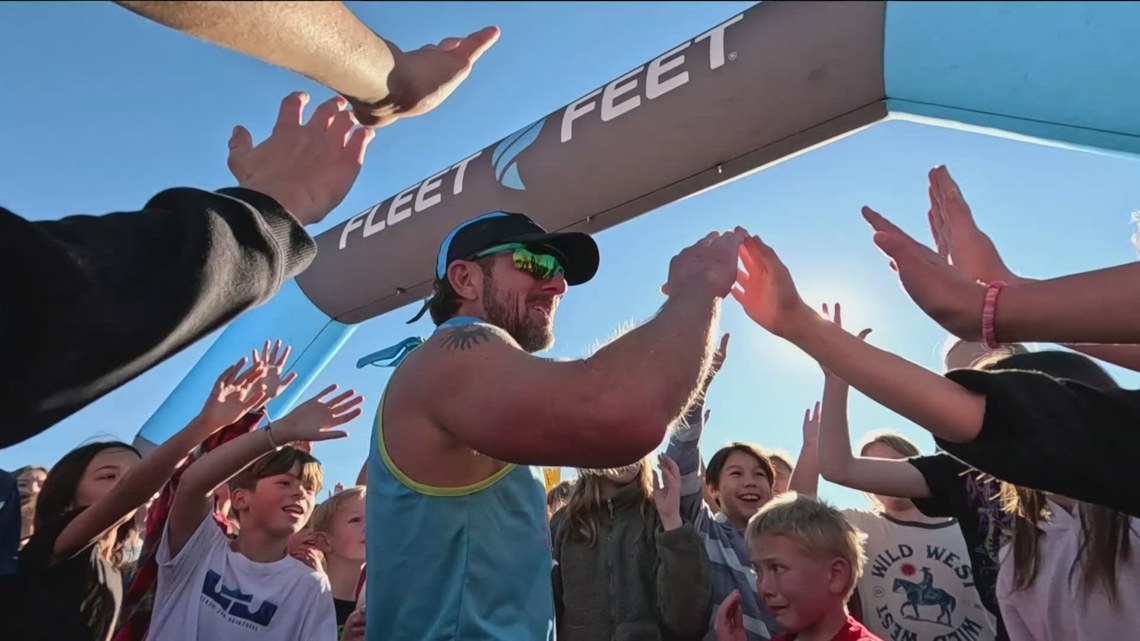
During Friday’s recess periods, students at Cynthia Mann joined Levine on his route, running lap after lap alongside their neighbor and coach.
“They get to see this, and I think it’s going to open their eyes to what’s possible,” Levine said.
Among those students was 9-year-old Si Johnson, who plays football under Levine’s coaching.
“I consider him more than a coach,” Johnson said. “He really helps people.”
Johnson said Levine offers encouragement even on difficult days, like when the young quarterback struggles on the field.
“He tells me, ‘Si, be positive about yourself.’ And even though I threw, like, three interceptions, he’s like, ‘Si, it’s okay,”‘ Johnson said.
Parent Jackie Forrey also ran laps on Friday to support the mission. She said the cost of youth sports has become prohibitive for many families.
“Even a middle-class family, it’s expensive to do almost all the sports,” Forrey said. “There’s families here at our school that can’t even afford all the food.”
Levine finished the marathon in just under four hours, surrounded by the students he ran for. An emotional crowd cheered as he crossed the finish line.
“It was a very emotional ending,” Levine said afterward. “When you run for something bigger than yourself, it’s that is accentuated.”
Though the 25 marathons are complete, Levine said Friday’s finish line marks just the beginning for Inspire Kidz.
“I think we opened up some eyes today,” he said. “These kids are unbelievable, like it’s just so cool to see and to give them some hope and inspiration in a tough world that we’re living in right now.”
Levine said he hopes the nonprofit will continue serving Treasure Valley youth year-round, personally connecting with each child who receives assistance.
For more information about Inspire Kidz or to donate, visit the organization’s website. Or their Instagram page.
International exchange students in the area and their host families gathered Sunday at the Rapid River Falls Park Lodge, often called Dutch Mill, to celebrate an International American Christmas. From left are Benedetta Curcio from Germany, who brought tiramisu; Laura Zoli from Italy, who presented carbonara; Marleen Giese from Germany, providing schnitzel; Marie Lou Koziol from Germany, who brought Kartoffelsalat; Kristina Plsekova from Slovakia, who shared zemiakove placky; Alba Muniz from Spain, who brought fritos de jamon y queso; and Helena Rabasco from Spain, who brought tortilla de patatas, fondue and panettone. Santa Claus brought candy canes, presumably from the North Pole. (Contributed photo)
RAPID RIVER — International exchange students and host families gathered Sunday at Rapid River Lodge, also known as the Dutch Mill, to celebrate a beautiful International American Christmas.
The table had dishes from around the world that the students brought, as well as tastes from each American host family. A gathering of cultures and hearts embraced the holiday spirit in bliss. A welcomed surprise visit from Santa Claus highlighted the afternoon.
A memorable day, embracing peace and understanding, was enjoyed by all.
Anyone interested in hosting an exchange student for the next school year can contact Melissa Carpenter, regional representative for International Culture Exchange Services, at mcarpenter@icesusa.org.
The lights are back on at the Watertown Middle School Gymnasium and the 2025-26 Basketball Season is underway. While Boys Hoops travelled to Belmont to open their campaign, the Girls opened at home to begin the the third and final interim season of hoops at the Middle School before beginning play at the new High School Gym in December of 2026. Coach Mike Tempesta, in his third year at the helm, and his young and small (as in only ten dressed) squad got off to a good start with a 63-54 win over the cross-town rival Marauders.
The Raiders graduated four seniors, all starters, so change was in the air, but at the same time, not so much. The starting five on this night included senior captain Sophia Setouhi, who played a significant role on last year’s team. It also included returning junior Aisling Brennock, fresh off an excellent Field Hockey campaign and ready to play a more significant role on this year’s team. Brooke Lambo, the third Lambo girl on the way to being a hoops star in Watertown and beyond, returns after a fine Freshman season. And rounding out the starting five were two fabulous freshman, Natalie Haley and Natalia Keuchkarian, who contributed significantly to last year’s 14-8 team as eighth graders, and already seemed ready to take on starring roles.
Tonight’s game did not play out like a first game of the season, full of nerves and turnovers and lack of a shooting eye. Well, don’t get me wrong, all those things were in play, but up and down competitive basketball was just as much the theme. Neither team ever led by double digits, and lead changes were as frequent as honking horns at the Common Street rotary. Sophomore Guard Sarah Geller had 7 first quarter points for Belmont on the way to a 16-12 lead after one quarter. But Watertown picked up its defense in the second, especially after going to a 2-3 zone, although they didn’t have an answer for forward Sophia McClendon, who had 8 in the quarter. And offensively, Natalie Haley made her first two 3-pointers of the season on the way to a 12 first half points. At the half, the Raiders led 29-26.
On this night, Coach Tempesta went only six deep, with Freshman Diana Martin the only other player to see the floor on this night. Diana is another who made the squad last year as an eighth grader and started to see more minutes the second half of the season. The third quarter was a back-and-forth affair, with both teams finding some range from beyond the arc, including two from Brennock and one from Keuchkarian, one of her two on the night. After three quarters, it was Watertown 43 and Belmont 39.
The fourth quarter saw both teams get a bit tight, with turnovers picking up. A promising sign though, and an improvement on a real achilles heal for last year’s team, was free throw shooting. Late in the fourth, and with Belmont playing catch-up and in need of stopping the clock, Haley, Lambo and Keuchkarian all went to the line four times and they combined to make 11 of 12 attempts. That and two more three’s from Haley and the night ended in joy, a third straight win over Belmont to start the season, this time 63-54.
So, on a night when captain Setouhi, a growing offensive star last season, went scoreless, youth was served. Certainly there will be ups and down this season. Watertown isn’t overly tall or physical, and on this night the remaining bench — seniors Moya Flanagan, Lori Kouyoumjian and Morgan Macomber, as well as freshman Mackenzie Highland — were not called upon to contribute. Not every game will go that way, and Coach Tempesta will learn more about his team when the time comes. What he knows now is that Haley and Keuchkarian, 24 and 19 points respectively, are ready to shine most nights, even though they are young and physically still maturing. But, they will learn how to match physical play with physical play of their own, and best of all, they are both natural scorers. And Brooke Lambo’s (11 points) upside is huge, especially as she refines her inside game and bag full of moves which are already so good.
So enjoy the future, now, because it’s here and fun and will only get better as the season progresses. Next week, the Raiders travel to Woburn on Tuesday Night Dec. 16, and are home Friday at 5:30 p.m. as apart of a Girls/Boys doubleheader versus Wilmington.
At your local Brooklyn Y kids can learn to play a sport, develop their skills, make new friends, and become empowered in youth sports, dance & swim programs. We have activities that cater to every interest and age group. Every class at the Y is a new opportunity to challenge boundaries, surpass goals, and cultivate well-being. Learn from the best instructors and choose from a diverse class catalog. Find a class that’s right for your children and family.
2026 Winter Programs Session Dates: January 2 – February 22. Find out more here.
The University of Utah made history this week by becoming the first major college athletic program to partner with a private equity firm. The unanimous vote by the school’s board of trustees on December 10, 2025, approved a groundbreaking agreement with New York-based Otro Capital that could generate up to $500 million in capital.
The deal represents a significant evolution in college sports financing, one that will be closely watched across the industry. For the millions of families investing in youth sports as a pathway to college scholarships, understanding this shift matters. The model Utah is testing could reshape how college athletics programs are funded and operated nationwide.
The Deal Structure
The University of Utah will create a new for-profit entity called Utah Brands & Entertainment LLC to manage the commercial side of its athletic department. This includes ticket sales, corporate sponsorships, media rights, licensing, hospitality and other revenue-generating operations.
Otro Capital will take a minority ownership stake in exchange for a significant capital infusion, with the university maintaining majority control through its Growth Capital Partners Foundation. Athletic Director Mark Harlan will chair the board of the new entity, which will be led by an external president overseeing day-to-day operations.
The university retains control over athletic decisions including coaching hires, scheduling and student-athlete welfare. The deal includes an exit strategy allowing Utah to repurchase Otro’s stake after five to seven years.
Otro Capital was founded in 2023 by former RedBird Capital Partners executives, including Alec Scheiner, who previously served as president of the Cleveland Browns and senior vice president of the Dallas Cowboys. The firm was also instrumental in creating Legends Hospitality, a major player in stadium operations and sports venue management.
Why This Happened Now
The timing of this deal reflects the financial pressure facing college athletic departments nationwide. The House v. NCAA settlement now allows schools to pay student-athletes up to $20.5 million annually, with that figure increasing 4% each year over the next decade.
Utah athletics reported a $17 million deficit in fiscal year 2024, spending $126.8 million against $109.8 million in revenue. While the football program generated a $26.8 million profit and men’s basketball added $2.6 million, the remaining 17 sports programs lost $21.2 million combined.
Similar deficits exist across college sports. Ohio State, despite generating $254.9 million in revenue, ran a $37.7 million deficit. Colorado projected a $27 million shortfall. The traditional funding model of donor contributions and ticket sales is no longer sufficient to cover rising costs.
The Olympic Sports Question
The relationship between college athletics and Olympic sports development presents both opportunity and uncertainty under this new model. Olympic sports programs including swimming, diving, gymnastics, wrestling, track and field, and others represent the primary development pathway for American Olympic athletes.
Data from the U.S. Olympic and Paralympic Committee shows that 88% of American summer Olympians at the 2016 Rio Games competed in college. Over 70% of U.S. Olympic swimmers since 2000 came through collegiate programs. For winter sports at the 2018 PyeongChang Olympics, one-third of Team USA members were former college athletes.
Private equity firms typically focus on profitability and return on investment. The business-oriented decision making this brings could take several directions. Operational efficiencies and revenue optimization might generate resources to support a broader range of sports. Alternatively, pressure to maximize returns could lead to resource reallocation away from non-revenue programs.
The University of Utah has explicitly committed to maintaining its Olympic sports programs. President Taylor Randall stated the deal will help grow women’s and Olympic sports. The structure keeps athletic decisions including program offerings under university control rather than investor authority.
The question for youth sports stakeholders is whether improved revenue generation can sustain more comprehensive athletic programs, or whether profit pressure will eventually impact program offerings despite current commitments.
The Youth Sports Pipeline Connection
Changes to college Olympic sports programs would directly impact youth sports participation and development. College scholarships serve as a significant motivator for families investing time and money into youth sports training.
Research from the Aspen Institute shows that roughly 20% of youth sports parents believe their child has the ability to play Division I college sports. This belief influences enrollment decisions in travel programs, specialized training and development academies.
The impact on youth sports could unfold in several ways:
If college programs expand or improve through better revenue generation, more scholarship opportunities could increase youth participation in Olympic sports. Enhanced facilities and resources at the college level might strengthen the entire development pipeline.
Conversely, if college opportunities diminish, youth participation could be affected as families reassess their investments. Swimming, wrestling and gymnastics programs at the youth level rely heavily on the college pathway as a development goal.
Greg Earhart of the College Swimming and Diving Coaches Association noted in Sports Illustrated that changes to college programs create downstream effects. When parents make decisions about youth sports enrollment, news about college program changes factors into their calculus.
COVID demonstrated the interdependence between college and youth sports. When NCAA facilities closed to youth programs, junior diving programs that had been developing future Olympians lost access to facilities. Some coaches transitioned to college positions for stability. Four years later, some markets still face gaps in availability and coaching capacity.
Private Equity Already in Youth Sports
The entry of private equity into college sports parallels a trend already underway in youth sports. Over the past three years, Apollo Global Management co-founder Josh Harris and Blackstone executive David Blitzer have used their family foundations to acquire youth sports properties through a company called Unrivaled Sports.
Private equity involvement in youth sports brings both professional management and business pressure. Improved facilities, better marketing and operational efficiency can enhance the participant experience. The capital these firms provide enables facility upgrades and expansion that individual operators might not afford.
The concern among some advocates centers on accessibility. Higher facility fees, tournament costs and program expenses could accelerate economic stratification in youth sports. The counterargument is that professional management and economies of scale might actually improve efficiency and cost structure over time.
What Makes Utah Different
Several factors enabled Utah to move forward where other schools and conferences have stalled. The Big Ten explored a $2.4 billion private investment proposal with UC Investments last month, but the deal faced opposition from Michigan and USC. The complexity of getting 18 member schools to agree proved challenging.
Utah’s board of trustees has only 10 members, streamlining the negotiation and approval process. The school also took a more transparent approach, with President Randall and AD Harlan publishing an 800-word letter explaining their rationale on the same day as the board vote.
The university structured the deal to maintain control over athletic operations while partnering with Otro on the commercial revenue side. This separation allowed Utah to access private capital and operational expertise without ceding decision-making authority over sports programs.
Legislative Response and Legal Questions
The deal generated immediate response from lawmakers at both state and federal levels. Representative Michael Baumgartner of Washington posted on social media that Congress would examine the tax-exempt status of universities entering private equity deals. Earlier this year, he introduced the PROTECT Act, legislation aimed at blocking private equity deals with athletic departments or conferences.
Utah state senators Daniel McCay and Nate Blouin expressed concerns publicly. Representatives Brendan Boyle and Lori Trahan also questioned the approach on social media.
Legal experts have varied perspectives on the implications. David Gringer, a partner at WilmerHale specializing in antitrust issues in higher education, told Front Office Sports that treating private equity as a “boogeyman” is misguided. He noted that LLC structures have been used by other schools like Kentucky, Michigan State and Clemson, albeit without private equity involvement, and provide clear benefits including dedicated funding sources and operational flexibility.
Frank Azzopardi, a partner at Davis Polk, expressed surprise at Utah creating a for-profit entity during the SBJ Intercollegiate Athletics Forum, citing potential implications for the university’s 501(c)(3) tax status.
Gringer countered that threats to strip tax-exempt status are unnecessarily inflammatory, calling it “absurd” to penalize a school’s overall tax status based on a standalone entity with private equity investment.
The legal and regulatory framework for these partnerships remains unsettled, creating uncertainty for other institutions considering similar approaches.
What Youth Sports Leaders Should Watch
For those operating youth sports organizations, several aspects of the Utah deal offer learning opportunities:
Program Sustainability: Track whether Utah maintains or expands funding and roster sizes for Olympic sports programs. Positive outcomes would validate the model, while program reductions would signal potential risks across college athletics.
Operational Excellence: Otro brings expertise in ticketing, sponsorships, licensing and hospitality that college programs have traditionally handled internally. Youth sports organizations may identify similar opportunities to professionalize revenue operations and improve business performance.
Donor Equity Participation: Utah offered major donors the opportunity to purchase stakes in the new entity. This model combines traditional philanthropy with investment returns, potentially providing a blueprint for youth sports organizations seeking capital while maintaining operational control.
Revenue-Generating Innovation: The partnership aims to identify new revenue streams through professional sports expertise. Successful innovations at the college level could be adapted for youth sports contexts.
Five to Seven Year Timeline: The deal includes an exit strategy after five to seven years. This timeframe will reveal whether private equity partnership can genuinely improve financial sustainability or if it merely delays difficult decisions. The performance metrics and outcomes over this period will be instructive.
The Broader Trend
Utah’s deal is positioned as a first mover rather than an outlier. Industry executives told Front Office Sports they expect more deals to be announced over the next 12 to 24 months, though likely at a measured pace rather than rapid adoption.
Ben Fund, a partner at Carlyle Group, noted that private equity firms are actively interested in college sports opportunities. Chuck Baker, co-chair of Sidley Austin’s entertainment, sports and media practice, said the main question among both private equity and university clients is whether this will accelerate similar deals elsewhere.
Several schools including Kentucky, Michigan State and Clemson have created similar for-profit entities for revenue generation, though none have partnered directly with private equity firms. These structures provide existing models for separating commercial operations while maintaining university control over athletic decisions.
The difference with Utah is the capital partner. Otro brings both immediate funding and operational expertise from professional sports. Whether this combination delivers better outcomes than university-managed entities will influence how other schools approach their financial challenges.
The Youth Sports Impact
The impact on youth sports depends on how private equity-backed college programs balance financial performance with program breadth. Several scenarios are possible:
Enhanced revenue generation could strengthen college programs across all sports, improving scholarship opportunities and facility quality. Better business operations might create efficiencies that support rather than threaten Olympic sports.
Alternatively, sustained pressure for returns could lead to difficult decisions about program offerings despite current commitments. The five to seven year timeline before exit strategies take effect will be telling.
The Los Angeles 2028 Olympic Games adds relevance to this question. With international competition on American soil, the strength of college programs producing Olympic athletes will be on display.
For youth sports families making long-term investment decisions about their children’s athletic futures, the Utah deal represents a model worth understanding. The answers emerging over the next several years will inform whether similar structures spread across college athletics.
The deal closes in 2026, when Utah Brands & Entertainment begins operations. Whether private equity partnership proves to be an effective solution for college sports sustainability, and what that means for youth sports pathways, will become clearer as results emerge.
The seal has been broken. Private equity has officially entered college sports. How this influences youth sports development will be determined by the execution of this first major partnership.
Legal Disclaimer: YSBR provides this content on an “as is” basis without any warranties, express or implied. We do not assume responsibility for the accuracy, completeness, legality, reliability, or use of the information, including any images, videos, or licenses associated with this article. For any concerns, including copyright issues or complaints, please contact YSBR directly.
Sources
Photo: UtahUtes.com
Primary Reporting:
Dellenger, Ross. “Sources: University of Utah nearing landmark private equity deal expected to generate $500 million.” Yahoo Sports, December 9, 2025.
Horney, Ben. “The Private Equity ‘Boogeyman’ Shows Up at Utah.” Front Office Sports, December 12, 2025.
Axios. “Private equity makes its first college sports play.” December 10, 2025.
University of Utah Coverage:
The Salt Lake Tribune. “University of Utah nears private equity deal to fund athletics department with Otro Capital.” December 9, 2025.
The Salt Lake Tribune. “How might private equity’s deal with the University of Utah turn gold? How might it turn sour?” December 10, 2025.
Deseret News. “University of Utah proposes private equity deal to fund athletics.” December 9, 2025.
KSL Sports. “University of Utah Announces Landmark Private Equity Deal.” December 9, 2025.
Financial and Industry Analysis:
Bloomberg. “Private Equity Firm Otro Wins College Sports Deal With University of Utah.” December 10, 2025.
Wetzel, Dan. “Beware, college sports, private equity has arrived.” ESPN, December 2025.
Business of College Sports. “Is Private Investment on the Way Into College Sports or Getting Banned?” 2025.
AInvest. “The Shifting Financial Dynamics of College Sports and Its Impact on U.S. Olympic Dominance.” 2025.
Private Equity in Youth Sports:
The New York Times. “Youth Sports Are a $40 Billion Business. Private Equity Is Taking Notice.” 2025.
NPR. “When private equity invests in youth sports facilities.” November 25, 2025.
Vice. “Is This the End of Youth Sports?” 2025.
Additional Context:
Sports Business Journal. “The NCAA settlement puts Olympic and non-revenue sports on the brink.” June 30, 2025.
El-Balad.com. “Otro Capital to back University of Utah in college sports’ first private-equity partnership, aiming to raise $500 million.” December 9, 2025.
About Youth Sports Business Report
Youth Sports Business Report is the largest and most trusted source for youth sports industry news, insights, and analysis covering the $54 billion youth sports market. Trusted by over 50,000 followers including industry executives, investors, youth sports parents and sports business professionals, we are the premier destination for comprehensive youth sports business intelligence.
Our core mission: Make Youth Sports Better. As the leading authority in youth sports business reporting, we deliver unparalleled coverage of sports business trends, youth athletics, and emerging opportunities across the youth sports ecosystem.
Our expert editorial team provides authoritative, in-depth reporting on key youth sports industry verticals including:
Sports sponsorship and institutional capital (Private Equity, Venture Capital)
Youth Sports events and tournament management
NIL (Name, Image, Likeness) developments and compliance
Youth sports coaching and sports recruitment strategies
Sports technology and data analytics innovation
Youth sports facilities development and management
Sports content creation and digital media monetization
Whether you’re a sports industry executive, institutional investor, youth sports parent, coach, or sports business enthusiast, Youth Sports Business Report is your most reliable source for the actionable sports business insights you need to stay ahead of youth athletics trends and make informed decisions in the rapidly evolving youth sports landscape.
Join our growing community of 50,000+ industry leaders who depend on our trusted youth sports business analysis to drive success in the youth sports industry.
Stay connected with the pulse of the youth sports business – where industry expertise meets actionable intelligence.
Sign up for the biggest newsletter in Youth Sports – Youth Sports HQ – The best youth sports newsletter in the industry
Follow us on LinkedIn
Follow Youth Sports Business Report Founder Cameron Korab on LinkedIn
Are you a brand looking to tap into the world’s most passionate fanbase… youth sports?
Introducing Play Up Partners, a leading youth sports marketing agency connecting brands with the power of youth sports. We specialize in youth sports sponsorships, partnerships, and activations that drive measurable results.
About Play Up Partners
Play Up Partners is a leading youth sports marketing agency connecting brands with the power of youth sports. We specialize in youth sports sponsorships, partnerships, and activations that drive measurable results.
Why Sponsor Youth Sports?
Youth sports represents one of the most engaged and passionate audiences in sports marketing. With over 70 million young athletes and their families participating annually, the youth sports industry offers brands unparalleled access to motivated communities with strong purchasing power and loyalty.
What Does Play Up Partners Do?
We’ve done the heavy lifting to untangle the complex youth sports landscape so our brand partners can engage with clarity, confidence, and impact. Our vetted network of accredited youth sports organizations (from local leagues to national tournaments and operators) allows us to create flexible, scalable programs that evolve with the market.
Our Approach
Every partnership we build is rooted in authenticity and value creation. We don’t just broker deals. We craft youth sports marketing strategies that:
Deliver measurable ROI for brand partners
Create meaningful experiences for athletes and families
Elevate the youth sports ecosystem
Our Vision
We’re positioning youth sports as the most desirable and effective platform in sports marketing. Our mission is simple: MAKE YOUTH SPORTS BETTER for athletes, families, organizations, and brand partners.
Common Questions About Youth Sports Marketing
Where can I sponsor youth sports?How do I activate in youth sports?What is the ROI of youth sports marketing?How much does youth sports sponsorship cost?
We have answers. Reach out to info@playuppartners.com to learn how Play Up Partners can help your brand navigate the youth sports landscape.
Youth sports organizations: Interested in partnership opportunities? Reach out to learn about our accreditation process.