
NIL
2025 Sun Belt Conference college football projections, preview

-

Bill Connelly
James Madison has won 28 games in three seasons, while South Alabama has won 24. Louisiana has four 10-win seasons in the past six years, Troy has five in the past nine, and Appalachian State has five in the past 10. Hell, even with a recent stumble, Coastal Carolina has two in the past five.
Texas State is coming off its two best FBS seasons. Georgia Southern is coming off its best season in four years, Arkansas State and Louisiana-Monroe their best in five and Marshall its best in nine. Even Georgia State has five winning seasons in the past eight years.
Nearly everyone in the Sun Belt has reached solid to great heights of late. Considering the immutable fact that someone has to lose every football game, that’s an awfully impressive sign of parity and general conference health.
At the moment, though, there’s a bit of a leadership void: Troy lost its head coach after winning the 2022 and 2023 Sun Belt titles and fell off last fall, and damned if Marshall doesn’t look primed to do exactly the same after last season’s title run. Does that mean it’s James Madison’s turn? The Dukes dropped the baton in 2024, falling out of contention thanks to a pair of maddening two-point losses. If they stumble again, will that leave the door open for Louisiana? Texas State? South Alabama? Another team?
Someone has to come out on top. Let’s preview the Sun Belt!
Every week through the summer, Bill Connelly will preview another FBS conference, ultimately including all 136 FBS teams. The previews will include 2024 breakdowns, 2025 previews and team-by-team capsules.
Earlier previews: MAC | Conference USA | Mountain West

2024 recap
Last season, the best teams on paper weren’t the best in close games, and that made the Sun Belt race an awfully surprising one. James Madison and Texas State both finished in the SP+ top 50, but they each went 1-2 in one-score Sun Belt finishes, and late defensive stumbles left them on the outside of the conference race. South Alabama hinted at major upside but couldn’t close games out either.
Louisiana was next up on the SP+ hierarchy and used a six-game winning streak to earn a spot in the Sun Belt championship game, but a pair of late-season QB injuries rendered its offense incompetent in the title game. And while everyone else was stumbling late, Marshall peaked: The Thundering Herd ranked 82nd in SP+ with just a 5-3 record heading into Week 11 but won their last five games by an average of 35-19 and grabbed the title, all while an evidently contentious school/coach relationship was pushing Charles Huff out the door. (He landed at Southern Miss.)
It was an odd season, in other words. And if I have any say in the matter, 2025 will be just as odd.
Continuity table
The continuity table looks at each team’s returning production levels (offense, defense and overall), the number of 2024 FBS starts from both returning and incoming players, and the approximate number of redshirt freshmen on the roster heading into 2025. (Why “approximate”? Because schools sometimes make it very difficult to ascertain who redshirted and who didn’t.) Continuity is an increasingly difficult art in roster management, but some teams pull it off better than others.
We’re quickly growing accustomed to a new head coach bringing some of his old players with him. But we’ve got an extreme example of that going on at Southern Miss in 2025: When USM hired Huff the day after Marshall’s Sun Belt championship win, so many Marshall players entered the transfer portal that the school had to opt out of its Independence Bowl berth.
When the dust settled, 50 Marshall players had entered the portal in the winter and spring windows, and 21 of them had landed at Southern Miss. About one-fourth of the Golden Eagles’ roster played in Huntington last year. And despite new Herd head coach Tony Gibson bringing in 55 transfers of his own, Marshall heads toward the 2025 season with the lowest returning production averages in the country. The Herd officially return three starters from last year’s champ, while Southern Miss, which went 1-11 last season, returns five. Mind-blowing stuff.
Other interesting continuity notes: Despite losing star running back Ahmad Hardy to Missouri, ULM’s production numbers are good after a refreshing 5-7 campaign in Bryant Vincent’s first season at the helm; Georgia Southern hit the 60% mark as well; and at the other end, App State is starting over: After suffering their first losing season at the FBS level, the Mountaineers will have a new head coach (Dowell Loggains) and approximately 17 new starters.
2025 projections
SP+ basically declares JMU the favorite, then shrugs. The Dukes were frustrating but frequently awesome in 2024, and they return exciting dual-threat quarterback Alonza Barnett III — assuming full health after a late-season injury, anyway — plus a loaded running back room and, despite losing star defensive end Eric O’Neill to Rutgers, maybe the conference’s most proven set of defensive personnel. They deserve the top spot, and if they stumble again, I have absolutely no idea who should be next on the list.
Meanwhile, the projections for Marshall and Southern Miss serve as a reminder that, despite making lots of adjustments to how I go about creating SP+ projections, it’s really hard to get a statistical read on what either the Herd or Golden Eagles might be capable of in 2025. I would expect Southern Miss to be a prime overachievement candidate, while Marshall really might struggle to even rank 87th.
East divisionTEAMCONF. WCONF. TITLE %11+ WINS %6+ WINS %James Madison6.020.8%7.0%98.6%Ga. Southern5.010.6%1.1%88.3%Coastal Caro.4.17.0%0.1%62.6%App. St.4.06.4%0.2%67.4%Marshall3.45.6%0.0%54.0%Old Dominion3.65.1%0.0%32.2%Georgia St.2.42.8%0.0%10.2%West divisionTEAMCONF. WCONF. TITLE %11+ WINS %6+ WINS %S. Alabama5.210.0%1.1%87.0%Louisiana4.99.3%1.3%91.0%Troy4.87.9%0.2%76.1%Texas St.4.16.1%0.1%64.8%Arkansas St.3.64.4%0.0%43.6%UL-Monroe2.82.5%0.0%23.2%So. Miss2.11.5%0.0%8.8%Indeed, after JMU up top, SP+ gives nine teams between a 5% and 11% chance of winning the conference title. As with last year, whoever wins its close games and peaks in November will have an excellent chance.Five best games of 2025Here’s where I typically share the five conference games that feature (a) the highest combined SP+ ratings for both teams and (b) a projected scoring margin under 10 points. But since all the top games (and the top nonconference game) feature James Madison — the Dukes have quite the road slate ahead — I tweaked the approach a bit. Here are five big games, if not the five best as defined above.James Madison at Liberty (Sept. 20). For all we know, this one might have College Football Playoff implications. JMU and Liberty have been two of the more steadily strong Group of 5 programs over the last two or three years, and both stumbled at inopportune times in 2024.Editor’s Picks2 RelatedJMU’s schedule is a road-heavy delight, from top to bottom. The Dukes visit Louisville and Liberty in September, then visit Texas State, Marshall and Coastal Carolina over the back half of the season. Throw in home games against Georgia Southern and Louisiana and a late November visit from Washington State, and you’ve got one unique slate.Georgia Southern at James Madison (Sept. 27). SP+ is optimistic about Georgia Southern’s chances of becoming a contender in 2025, and this game will be a pretty solid prove-it opportunity in that regard.South Alabama at Troy (Oct. 4). South Alabama might have lost more talent than anyone else in FBS in the spring portal window, but the Jaguars still return quite a bit, and Troy’s continuity levels are solid after a setback season. Depending on how well Texas State handles roster turnover, the winner of this one could become Louisiana’s biggest competitor in the West Division. (That’s right: The Sun Belt still has divisions! And makes actual geographic sense!)Louisiana at James Madison (Oct. 11) and Louisiana at South Alabama (Nov. 1). Like JMU, Michael Desormeaux’s Ragin’ Cajuns will need to be road warriors to fulfill their potential.Conference title (and, therefore, CFP) contenders Head coach: Bob Chesney (second year, 9-4 overall)2025 projection: 49th in SP+, 8.5 average wins (6.0 in the Sun Belt)Georgia Southern, Appalachian State, Coastal Carolina, Liberty, Jacksonville State, Sam Houston … we’ve seen plenty of excellent FCS-to-FBS transitions through the years. But JMU might turn out to be the gold standard in this regard. The Dukes began FBS life with five straight wins and an AP poll appearance, and it was a genuine surprise that they didn’t play for the Sun Belt title in their first season eligible last year. The next time they finish outside of the SP+ top 50 will be the first, and they aren’t projected to do so in 2025.
With George Pettaway leading the way, James Madison has one of the best running back groups in the country. AP Photo/Lynne SladkyIt would be even brighter, potentially, if we knew Alonza Barnett III would be 100%. The junior QB combined 2,598 passing yards (and a 26-to-4 TD-to-INT ratio) with 669 non-sack rushing yards last year before injuring his leg against Marshall. He was cleared only for non-contact drills this spring, and his status remains unclear. Heading into his second season after succeeding Curt Cignetti, Chesney took no chances, bringing in two QB transfers: Richmond’s Camden Coleman and Matthew Sluka;. Sluka is known primarily for his NIL-related opt-out at UNLV last season, but before that he was a star for Chesney at Holy Cross, leaving as the Crusaders’ No. 2 career rusher and No. 5 career passer and a two-time Walter Payton Award finalist (top player in FCS). Chesney and offensive coordinator Dean Kennedy love a nice, durable dual-threat QB, and both Sluka and Coleman (to a degree) qualify if Barnett isn’t ready.
The RB corps might be one of the best in the FBS. George Pettaway and backups Wayne Knight and Jobi Malary combined to average 22 carries per game and 6.0 yards per carry, and Ayo Adeyi, injured for most of 2024, was a 1,000-yard rusher at North Texas in 2023. The line in front of them does have to replace three starters, but right tackle Pat McMurtrie is the only returning player on the first-team All-Sun Belt list, three other returning veterans have starting experience, and Chesney brought in former North Carolina center Zach Greenberg and all-Patriot League selection Cam McNair (Holy Cross), among four transfers. He also dipped heavily into the portal to find pass catchers: Sure-handed slot man Yamir Knight will be joined by both former power conference reserves in Braeden Wisloski (Maryland) and 6-foot-4 Isaiah Alston (Iowa State) and FCS starters Landon Ellis (Richmond), Nick DeGennaro (Richmond) and Jaylan Sanchez (Villanova).
Chesney also was pretty aggressive on defense, adding 13 transfers to a lineup that boasts some proven pieces — 315-pound tackle Immanuel Bush, linebacker Trent Hendrick, safety Jacob Thomas, nickel DJ Barksdale — but returns only seven of the 19 players who saw at least 200 snaps in 2024. Again, he dipped heavily into the FCS ranks, bringing in stars such as defensive end Xavier Holmes (12.5 TFLs at Maine), tackle Andrew Taddeo (7.5 TFLs at Colgate), linebacker JT Kouame-Yao (11.5 TFLs at Shepherd), safety Curtis Harris-Lopez (9.5 TFLs and nine passes defended at Holy Cross) and corner TJ McGill (six passes defended as a freshman at William & Mary), plus former blue-chip defensive end Aiden Gobaira (Notre Dame).
There are enough new pieces here that success isn’t guaranteed, but the combination of proven talent and proven smaller-school playmakers — especially at a school that has more than proven that FCS stars can become FBS stalwarts — makes JMU the preseason conference favorite. It’s up to the Dukes to close the deal this time.

Head coach: Major Applewhite (second year, 7-6 overall)
2025 projection: 76th in SP+, 7.3 average wins (5.2 in the Sun Belt)
As a redshirt freshman, Gio Lopez ranked seventh among G5 quarterbacks in Total QBR. He’s a North Carolina Tar Heel now. As a true freshman, Fluff Bothwell was a bolt of lightning, gaining 924 yards in just 124 combined rushes and receptions and scoring 13 times. He’s now a Mississippi State Bulldog. Right tackle Malachi Carney (Georgia Tech) … edge rusher Aakil Washington (SMU) … cornerbacks Lardarius Webb Jr. (Wake Forest) and Amarion Fortenberry (Kansas State) … injured cornerback Ricky Fletcher (Ole Miss) … nickel back Jordan Scruggs (West Virginia) … even kicker Laith Marjan (Kansas). A whole bunch of South Alabama players flashed major potential, then got plucked away in the transfer portal. Offensive coordinator Rob Izell (Wake Forest) basically did too.
Players moving up and down the ladder with lightning speed is a symptom of the portal era, and few schools had more players move up than Major Applewhite’s USA. If you look solely at who they don’t have, in fact, it’s hard to envision the Jags playing a major role in the Sun Belt race in 2025.
If you look at who they do have, however, they might still have a chance:
• Quarterbacks Bishop Davenport and Zach Pyron (Georgia Tech) both have starting experience and have flashed dual-threat capabilities.
• Veteran running back Kentrel Bullock had 984 rushing and receiving yards (5.9 per touch) despite sharing touches with Bothwell.
• Left tackle Jordan Davis is an all-conference contender and one of three returning starters up front. Applewhite managed to hold on to most of last year’s two-deep, in fact, and added six O-line transfers.
• Defensive tackle Ed Smith IV made 7.0 tackles at or behind the line last year and has strong pass rushing chops for his size, and 334-pound Stephen Johnson (McNeese State) is one of four defensive line transfers.
• Linebacker Blayne Myrick is among the most proven run stoppers in the league.
Few of Applewhite’s defensive transfers have a disruptive track record like JMU’s — defensive end IBK Mafe (St. Thomas) and corner Jayvon Henderson (East Tennessee State) are the most promising in that regard — but most of them are higher-upside youngsters who might develop into solid pieces. (Of course, that also might mean they get plucked away.) If either Davenport or Pyron are ready to shine and an unproven receiving corps provides some semblance of value, it sure seems like there’s enough talent here to at least continue a three-year run of bowl eligibility. Sun Belt contention will require quite a few newcomers and youngsters to break through. Considering how many did last year, there’s a chance.

Head coach: Clay Helton (fourth year, 20-19 overall)
2025 projection: 78th in SP+, 7.3 average wins (5.0 in the Sun Belt)
Clay Helton served as an early model of how portal life can work when he arrived at Georgia Southern in 2022, immediately reset the Eagles’ entire identity with a batch of key transfers and still managed to upset Nebraska and double their win total. I don’t want to overstate his success — he’s basically .500 through three years — but in an increasingly volatile G5 environment, he’s produced stable results. And despite offensive inconsistency, last year was his best yet: Georgia Southern inched up to 76th in SP+ and won eight games.
In 2025, Helton and the Eagles boast a promising combination of proven pieces and intriguing new ones. Quarterback JC French threw too many interceptions last year (11) and must improve in that regard, but in slot receivers Dalen Cobb and Josh Dallas (combined: 1,213 yards and 10 TDs), tight end River Helms (Western Kentucky) and returning third-down back OJ Arnold, the Eagles have the components of an efficient attack. That’s doubly true when you see that they have the most proven interior line in the league: Both guards, Pichon Wimbley and Caleb Cook, are all-conference contenders. A little big-play boost would be great — Dallas did average 13.4 yards per catch, and incoming transfer Dylan Gary (West Georgia) averaged 16.9 in FCS — but there are proven commodities here for coordinator Ryan Aplin.
The defense was too bend-don’t-break for my taste, but it was also the most competent defense yet for Helton and coordinator Brandon Bailey: The Eagles’ No. 91 defensive SP+ ranking was their best since 2020. Helton was evidently confident enough in what he’s returning that he mostly aimed young in the portal, bringing in five redshirt freshmen or sophomores (all former high-three or four-star recruits) among eight transfers. Senior linebacker Brendan Harrington (Appalachian State) should provide stability, but this year’s success will be driven primarily by returnees like 340-pounder Latrell Bullard up front and nickel Ayden Jackson and corners Tracy Hill Jr. and Chance Gamble in the back.
The upside here isn’t enormous, but big-play prevention and an efficient offense should drive another bowl season at worst. And if JMU indeed falters again, the Eagles’ high floor and solid veterans might make them the most likely team to take advantage in the East division. We’ll know what we need to know pretty early on: Their rough nonconference schedule (at Fresno State, at USC, Jacksonville State) will either beat them down or properly prepare them for a Sun Belt slate that begins with a trip to JMU.

Head coach: Michael Desormeaux (fourth year, 23-18 overall)
2025 projection: 74th in SP+, 7.5 average wins (4.9 in the Sun Belt)
After going 34-5 with three consecutive SP+ top-50 finishes from 2019 to 2021, Louisiana took a brief step backward in transitioning from Florida-bound Billy Napier to Michael Desormeaux. But after back-to-back six-win seasons, Desormeaux’s Ragin’ Cajuns were ready to roll again last fall. At least, they were until QB injuries wrecked their plans. They survived one injury (to Ben Wooldridge) while starting 10-2 and rising as high as 34th in SP+, but a second one (to Chandler Fields) spelled doom; in their last two games, the Ragin’ Cajuns were outscored by a combined 65-6 against Marshall and TCU.
It was a sign of confidence from Desormeaux that he didn’t load up on transfers despite losing about eight offensive and seven defensive starters. In that regard, a lot of Louisiana’s fate will be determined by players who were also in a Louisiana uniform last season. Running backs Bill Davis and Zylan Perry (combined: 1,491 rushing yards and 13 TDs), right guard Jax Harrington (6-foot-4, 327 pounds), disruptive defensive lineman Jordan Lawson (5.5 sacks at 293 pounds) and edge rusher Cameron Whitfield (11.5 TFLs) are all all-Sun Belt contenders. But the Cajuns are mostly starting over in both the receiving corps (which lost six of last year’s top seven) and the secondary (which lost last year’s top four). Sophomore safety Kody Jackson seems like a keeper, but transfers might tell the tale in both the passing game and pass defense.
Among the seven transfers Desormeaux brought in are three former blue-chippers in quarterback Walker Howard (Ole Miss), receiver Shelton Sampson Jr. (LSU) and cornerback Curley Reed III (Washington). Howard was a top-50 prospect in the 2022 class, Sampson was top-75 in 2023, and both looked good in the spring. If they’re difference-makers, and both Reed and Richmond transfer Trae Tomlinson are solid at corner, Louisiana immediately becomes the West division favorite again. But if they aren’t, I’m not sure they have what they need.
Then again, maybe that’s just me overreacting to last year’s late offensive collapse. Like Napier, Desormeaux has proven himself in the recruiting department, and the Cajuns are all but guaranteed to have some of the highest levels of athleticism and physicality in the conference. The offense has ranked 50th or better in offensive SP+ five times in six years, and while the defense has slipped recently, it still has three top-50 finishes in five seasons. The bar here is high, and the combination of depth and blue-chip additions might give them a chance to clear it.
A couple of breaks away from a run

Head coach: Gerad Parker (second year, 4-8 overall)
2025 projection: 86th in SP+, 6.6 average wins (4.8 in the Sun Belt)
With a combination of deep and experienced line play and big-play potential, Troy won back-to-back Sun Belt titles in 2022 and 2023; the Trojans ranked in the defensive SP+ top 30 in both seasons and rose to 26th overall in 2023. In two seasons, Jon Sumrall proved that, with the right set of hands in charge, this chip-on-shoulder program can absolutely shine.
Gerad Parker could still prove himself, but he had very little chance in 2024. Virtually every proven playmaker was gone, as were most of both lines. The offense remained efficient thanks primarily to quarterback Matthew Caldwell, receiver Devonte Ross and running back Damien Taylor, but the Trojans stopped making big plays and started allowing a ton of them, and almost nothing worked during a 1-7 start.
The offense clicked late as Troy won three of its last four, but Caldwell (Texas), Ross (Penn State) and Taylor (Ole Miss) all departed for big-time schools. The Trojans have solid experience and excellent size in the trenches: Left guard Eli Russ (6-foot-4, 313 pounds) will anchor the offensive line, tackle Julian Peterson (eight TFLs at 310 pounds) leads the defensive front, and Parker added five power-conference transfers on the two lines. They will look the part physically, and veteran quarterback Goose Crowder, who began 2024 as the starter, should be decent. But the skill corps is drastically unproven. Three receiver transfers — Rara Thomas (Georgia), Tray Taylor (Coastal Carolina) and Kristian Tate (Delta State) — will need to click, and former blue-chipper (and 2024 transfer) Mojo Dortch will need to provide more than the two catches and minus-2 yards he managed last season. The running back corps, meanwhile, is almost completely devoid of known quantities.
Between Peterson, linebacker Jordan Stringer and safety Justin Powe, the spine of the defense should be solid, and the run defense should be disruptive. But even with Powe and a delightful nickel in Devin Lafayette, Troy ranked just 112th in yards allowed per dropback and 126th in completion rate allowed last season. As with the receiving corps, transfers — corners Kaleno Levine (Missouri State) and Jaquez White (Washburn), safeties Steven Sannieniola (Vanderbilt) and David Daniel-Sisavanh (Georgia) — will play a big role in propping up the pass defense and telling Troy’s tale in 2025.

Head coach: G.J. Kinne (third year, 16-10 overall)
2025 projection: 93rd in SP+, 6.1 average wins (4.1 in the Sun Belt)
It’s weird that we’ve gotten this far and haven’t yet brought up the team that finished 48th in SP+ and nearly beat CFP-bound Arizona State last year, right? That probably tells you how much of last year’s Texas State team is no longer in San Marcos. G.J. Kinne both inherited and defied perennially low expectations at TXST in each of the last two years, and he’ll have a chance to do so again after losing his offensive coordinator (Mack Leftwich), starting quarterback (Jordan McCloud), leading rusher (Ismail Mahdi), top three receivers, three offensive line starters and 14 of the 18 defenders with at least 250 snaps last season.
Kinne is a fearless transfer portal aficionado. He brought in another 36 transfers this season, including three quarterbacks (Pitt’s Nate Yarnell, SMU’s Keldric Luster and former Auburn blue-chipper Holden Geriner), eight skill corps guys and 19 defenders. This year’s transfer haul is a mix of semi-proven G5 or smaller-school guys — running back Greg Burrell (UNLV), slot receiver Tiaquelin Mims (Southern Miss), linebackers Ayden Jones (Prairie View A&M) and Cole Nilles (Bryant), corners Jaden Rios (East Texas A&M) and Malik Willis (Campbell), safety Javis Mynatt (Wofford) — and young and unproven power-conference transfers. There are some former blue-chippers like Geriner, receiver Mavin Anderson (Cal), defensive tackle Bryce Carter (Virginia) and linebacker Terrence Cooks (TCU) in the mix as well.
Kinne has quickly grown accustomed to asking members of a transient roster for immediate contributions, but when it came time to replace the Texas Tech-bound Leftwich, he went with a familiar face: Landon Keopple is a former small-school coordinator who joined up with Kinne about five years ago and understands Kinne’s modern spread as well as anyone.
A Kinne team is going to score points, but defensive improvement was a key piece of last year’s first-ever top-50 finish. Coordinator Dexter McCoil returns star end Kalil Alexander (11 run stops, 6.5 sacks), and corner Trez Moore and safeties Ryan Nolan and Darius Jackson were decent rotation pieces last year, but most of the 2025 lineup will be new. That’s an opportunity for improvement or regression. My guess is that the Bobcats defy projections once again, but if the defense falls off, that will be difficult.

Head coach: Tim Beck (third year, 14-12 overall)
2025 projection: 95th in SP+, 6.0 average wins (4.1 in the Sun Belt)
The Coastal Carolina of the last couple of years — with Tim Beck replacing Liberty-bound Jamey Chadwell in 2023 — has reminded me a lot of the first couple of Louisiana teams after Billy Napier: fine but distinctly underwhelming. After slipping to 74th in SP+ in Chadwell’s final season, the Chanticleers held steady at 68th in 2023 but last season slipped to an injury-plagued 99th, with both the offense and defense regressing. Lineup stability was a huge impediment: Only four players started all 13 games.

With iconic stories, hit Originals and live sports, there’s something for everyone on Disney+, Hulu and ESPN+. Get all three for a price you’ll love.
Nothing feels definitively wrong with the Chants, but you could see the talent coming together at Louisiana, and the Cajuns’ offense was consistently solid even during the two-year lull. Things appear a little less proven at Coastal: Neither unit has been consistent, quarterback Ethan Vasko (Liberty) and running back Braydon Bennett (Virginia Tech) transferred, and of 24 defenders who started at least one game (again: serious lineup instability here) only six return.
But I love what Beck did in the portal this offseason, especially on defense. He landed five players who made at least five TFLs at their last school — ends Noah Arinze (New Mexico State) and Jordan Mack (Seton Hill), linebackers Luke Murphy (Eastern Michigan) and Dontae Lunan (Albany) and safety Jacob Robinson (Emory & Henry) — and added four former blue-chippers as well: end Darrion Henry-Young (Kentucky), safety DeAndre Boykins (North Carolina) and corners Ja’Marion Wayne (Missouri) and Robby Washington (Miami). Throw in decent holdovers in tackle Sawyer Goram-Welch, linebacker Shane Bruce and big safety Xamarion Gordon, and it feels like there’s a lot to work with here.
I’m less blown away by the additions on offense, though each of two quarterbacks, Emmett Brown (San Jose State) and MJ Morris (Maryland), seems to have decent potential. But quantity could create quality: Among three veteran wideouts (Jameson Tucker, Cameron Wright and Bryson Graves), Ball State transfer Malcolm Gillie and three FCS transfers who combined for 2,151 yards last year (Western Illinois’ Eli Aragon, West Georgia’s Karmello English and Furman’s Colton Hinton), a strong receiving corps should come together. And up front, some combination of six linemen with starting experience, four transfers and a JUCO should create a solid two-deep. Breakthrough coming? I can’t promise that, but it does feel like the ingredients have added up.

Head coach: Dowell Loggains (first year)
2025 projection: 98th in SP+, 6.2 average wins (4.0 in the Sun Belt)
Appalachian State doesn’t do “losing seasons.” Before 2024, the Mountaineers’ last sub-.500 season came in 2013, when they stumbled to 4-8 in their final FCS campaign and their first year after the legendary Jerry Moore’s retirement. The time before that? 1993! But things fell apart for Shawn Clark last fall, and App State looked like far more of an also-ran than we’re used to.
In an existential moment, schools often look within for the answer, asking someone with deep ties to rally the program and save the day. App State went in the other direction. Dowell Loggains spent the first 16 years of his coaching career in the NFL before moving to the college ranks in 2021. In 2023-24, he served as South Carolina’s offensive coordinator. In the year before his arrival, the Gamecocks ranked 25th in offensive SP+; in his two seasons there, they were 58th and 35th, respectively.
He can recruit, though. Loggains’ first App State roster lost more than 40 players to the transfer portal, but among the more than 30 incoming transfers are a number of former high-three or four-star recruits: quarterbacks AJ Swann (LSU) and JJ Kohl (Iowa State), running backs Rashod Dubinion (Arkansas) and Khalifa Keith (Tennessee), receiver Davion Dozier (Arkansas), tight end Izayah Cummings (Louisville), linebacker Brayshawn Littlejohn (Missouri), corner Emory Floyd (South Carolina), nickel Ja’Den McBurrows (Michigan) and others. Loggains also dipped into the FCS well to land a few transfers, including 1,000-yard receiver Jaden Barnes (Austin Peay) and defensive end Joseph Bakhole (East Tennessee).
Few on the roster have actually proven themselves at the FBS level. Offensive guards Jayden Ramsey and Griffin Scroggs and defensive ends Thomas Davis and Shawn Collins are good, and the secondary is experienced if nothing else. Swann, Kohl and freshman Noah Gillon evidently all had solid moments in spring practice — funny how everyone’s always good in spring ball, huh? — and no one’s going to doubt the athletic potential of this roster. The potential seems to give the Mountaineers a pretty high ceiling, and the drastically unproven roster gives them a scary-low floor. This school doesn’t know how to handle losing because it hasn’t had to; that makes this just about the most interesting team in the conference in 2025.

Head coach: Butch Jones (fifth year, 19-31 overall)
2025 projection: 100th in SP+, 5.3 average wins (3.6 in the Sun Belt)
There was a time when Arkansas State openly talked about becoming the Boise State of the South. Hell, back in 2012, as the Red Wolves were finishing up a second straight 10-win season, attendance was topping 31,000, nearly BSU-esque levels. The Red Wolves averaged 9.3 wins while hiring three straight single-year up-and-comers (Hugh Freeze, Gus Malzahn, Bryan Harsin), then settled into a 7.3-win average in seven seasons under Blake Anderson. When he stumbled, ASU chose someone on the other side of the age-and-ambition line: former Tennessee head coach Butch Jones, who has averaged 4.8 wins. Attendance has perked up as the win total has improved, but it was still 28% lower last year than it had been a decade earlier.
That makes capitalizing on last year’s eight-win campaign pretty important. Fans were treated to five home wins, all in dramatic fashion; it was the kind of season that can rekindle interest. It was also almost impossible to replicate. SP+ basically saw a four-win team that accidentally won eight games, and then that team lost about 17 starters. Jones has to stare up at a much higher bar while rebuilding his roster again.
ASU’s offense is generally perky under coordinator Keith Heckendorf, and that shouldn’t change with quarterback Jaylen Raynor, 1,000-yard receiver Corey Rucker and running back Ja’Quez Cross joined by fun newcomers like receiver Jaylen Bonelli (Wagner).
But the defense is completely starting over. Just one starter returns (plus another from 2023), and Jones had to find a lot of portal answers. I do think he found some good ones: End Demarcus Hendricks (Texas A&M-Kingsville) and tackle Cody Sigler (West Alabama) were double-digit TFL guys, and cornerback Joedrick Lewis (SE Missouri State) had a huge season in 2023. The two primary returning pieces — end Bryan Whitehead and linebacker Javante Mackey — are disruptive too, and players like tackle Gavin Ransaw (Coastal) and safety AG McGhee (Marshall) should be useful. ASU hasn’t ranked in the double digits in defensive SP+ since 2018, but there’s some talent here. Still, if last year’s good fortune turns, it’s going to be awfully hard for ASU to approach eight wins.

Head coach: Ricky Rahne (fifth year, 20-30 overall)
2025 projection: 103rd in SP+, 4.8 average wins (3.6 in the Sun Belt)
Be it Bobby Wilder (2014-19) or Ricky Rahne (2021-present) leading the way, Old Dominion seems to have found its level.
Wilder: 31-42 (.425 win percentage), 106.5 average SP+ ranking
Rahne: 20-30 (.400 win percentage), 103.5 average SP+ ranking
Rahne’s results have been more consistent, for better (no 1-11 seasons like Wilder) or worse (exactly seven losses in three of four years), but on average the product has remained the same.
If you squint just right, however, you might see hints of progress. ODU’s No. 95 SP+ ranking last year was its best since 2016, and six of seven losses were by a touchdown or less (including a season-opening 23-19 defeat to South Carolina). The Monarchs are in the top half of the conference in returning production too. The offense improved despite having to start three different quarterbacks, and redshirt freshman Colton Joseph looked promising there in eight starts. The offensive line is experienced and physical, and thanks to the return of all-world tackling machine Jason Henderson — see chart below — after a 2024 injury, the defensive front six returns four guys capable of double-digit TFLs: linebackers Henderson, Koa Naotala and Mario Thompson and defensive end Kris Trinidad.
TruMediaThe Monarchs have quite a few proven entities, but progress in 2025 will be determined by the success of two rebuilds: those of the skill corps and secondary.Last season, eight ODU RBs and WRs touched the ball at least 20 times; seven are gone. Running back Devin Roche is now the grizzly veteran of the skill corps despite a) being a sophomore and b) producing just 326 yards from scrimmage in 2024. Rahne brought in a pair of transfers (former Utah/Tulane WR Sidney Mbanasor and former Florida TE Dawson Johnson), but he’s hoping he struck gold in the overlooked JUCO ranks, where he grabbed one running back, four WRs and a tight end.
It’s a similar story in the secondary. Seven of last year’s top eight are gone, leaving part-time starting safety Mario Easterly and a pair of potentially promising former reserves in Jeremy Mack Jr. and Daevon Iles. Rahne again brought in a pair of four-year transfers and a big load of five JUCOs (including onetime TCU signee Kollin Collier).

Head coach: Tony Gibson (first year)
2025 projection: 99th in SP+, 5.7 average wins (3.4 in the Sun Belt)
The balance of power doesn’t usually change much in college football, but it can shift in a heartbeat in the Sun Belt. Both the 2021 (Louisiana) and 2023 champions (Troy) lost their head coaches and won seven fewer games as defending champs. And now the 2024 champion is starting over like almost no one ever has.
With Charles Huff’s departure and the player exodus that followed, Marshall is looking at the following:
• No passer on the roster threw for a yard last season.
• No returnee rushed for a yard.
• Two returnees caught passes.
• Those responsible for 49 of 65 O-line starts are gone.
• One of eight defensive linemen with at least 50 snaps returns.
• The total linebacker snaps returning is three.
• Two of 13 DBs with at least 30 snaps return.
This is mind-boggling turnover. In response, Marshall elected to lean heavily into its West Virginia roots. Glenville State graduate Tony Gibson, former defensive coordinator at NC State and West Virginia (and, back at the turn of the century, West Virginia Tech), leads the way. Glenville State grad Rod Smith, former protege of current and former WVU head coach Rich Rodriguez, is the offensive coordinator. Marshall graduate (and three-time former Marshall assistant) Shannon Morrison is the defensive coordinator. I guess if your roster has no roots whatsoever in the area, you should find coaches who do.
Gibson & Co. did their best to find experience where they could. In Zion Turner (UConn/Jacksonville State) and Carlos Del Rio-Wilson (Florida/Syracuse), they grabbed QBs with a combined 2,039 career passing yards. Running backs Jo’shon Barbie (McNeese State) and Tony Mathis Jr. (WVU/Houston) each have more than 1,000 career rushing yards. Among 10 receiver transfers, Adrian Norton (Akron) and Ben Turner (West Liberty) each had more than 800 yards last year. Three offensive linemen and nine defenders saw heavy smaller-school action, and a few — 6-foot-9 offensive lineman Tyler McDuffie (Hampton), 320-pound defensive tackle Naquan Crowder (California-PA), linebacker Jalen Marshall (Wofford), corners Boogie Trotter (Tennessee State) and Louikenzy Jules (Charleston), safety Cam Smith (Jackson State) — played at a particularly high level.
You can find talent on this roster, but almost none of it suited up in Kelly green and white last year. That makes the Thundering Herd almost impossible to project.
Just looking for a path to 6-6

Head coach: Bryant Vincent (second year, 5-7 overall)
2025 projection: 116th in SP+, 4.4 average wins (2.8 in the Sun Belt)
In the new House settlement, schools will be allowed to share up to $20.5 million in revenue with its athletes in a given year. Louisiana-Monroe reports total revenue of around $20 million in a given year. This school is wonderfully bull-headed in its insistence on playing FBS ball, which makes the rewards for doing so both rare and wonderful. The Warhawks’ 2012 season, in which they beat a top-10 Arkansas team on the way to eight wins, is one of my favorite underdog campaigns of the 21st century. They haven’t bowled since.
Going 5-7 last year was a genuine victory, though it came with the disappointment of a 5-1 start and an 0-6 finish. Bryant Vincent helped to resurrect the UAB program and brings serious underdog bona fides to the table; he found relative success with a combination of a run-heavy offense and the school’s best defense in six years.
The defense returns 11 of the 17 players with at least 200 snaps, including stars in end Kevontay Wells, OLB Billy Pullen and corner David Godsey Jr. Vincent added eight transfers and six JUCOs as well, so depth should be solid. On offense, sophomore quarterback Aidan Armenta returns, but that only means so much because ULM is going to run the ball as much as it’s allowed to.
Ahmad Hardy transferred after rushing for 1,351 yards as a freshman, but his success drew in four running back transfers — including Richmond 1,300-yard rusher Zach Palmer-Smith — and freshman D’Shaun Ford, one of the most highly touted recruits ULM has seen. Three of six regular linemen return, in addition to one transfer and three JUCOs. Last year’s rushing-and-D formula will be this year’s rushing-and-D formula.

Head coach: Dell McGee (second year, 3-9 overall)
2025 projection: 114th in SP+, 3.7 average wins (2.4 in the Sun Belt)
All things considered, Dell McGee did one hell of a job last season. Hired after spring practice had already begun in February 2024, he navigated through massive post-spring turnover, then crafted a team capable of upsetting Vanderbilt in September and Texas State in November. His Panthers weren’t good — between those upsets were seven straight losses — but they were occasionally spicy, and things ended up merely bad, not apocalyptic.
McGee is still searching for stability in Year 2. He needed two tries to land a defensive coordinator — he went with Travis Pearson when Deron Wilson left for Florida after two weeks — and he lost nearly 40 more transfers. Depth could be an issue, but there’s upside. Quarterback Christian Veilleux and explosive receiver Ted Hurst both return, and McGee added a stable of exciting RB transfers, led by Jordon Simmons (6.0 yards per carry at Akron) and former blue-chippers Branson Robinson (Georgia) and Djay Braswell (South Carolina). The offensive line returns only one starter but welcomes six transfers and two JUCOs.
Thanks to Hurst and a solid secondary, GSU created bigger big plays than its opponents. But safety D-Icey Hopkins is the only regular defensive back returning, and McGee signed an almost conservative three transfers and two JUCOs. There’s experience in the front six, but last year’s best unit is starting over.
McGee had to know what he was getting himself into when taking the job, and while he’s still navigating through bumpy waters, his team should flash some upside if it can survive a rough early stretch — among their first five games are trips to Ole Miss and Vandy and visits from Memphis and JMU — with morale intact.

Head coach: Charles Huff (first year)
2025 projection: 128th in SP+, 3.4 average wins (2.1 in the Sun Belt)
What happens when you graft one-quarter of last year’s Sun Belt championship roster onto the worst roster in the conference? We’re going to find out! Two years after a semi-promising 7-6 campaign, everything fell apart for Will Hall at Southern Miss last season as the Golden Eagles plummeted to 1-11 and 133rd in SP+. That Charles Huff so quickly fled Marshall for USM might speak to the strange relationship he had with his former employer, but that’s Southern Miss’ gain. After signing more than 50 transfers in addition to the normal freshman/JUCO signing class, Huff has almost completely flipped the roster in six months. The only returning starters: receiver Davis Dalton, right tackle Greg Nunnery and defensive tackle Brodarius Lewis. Hell, they’re almost the only returnees from the two-deep.
Former Marshall players — especially quarterback Braylon Braxton, receivers Chuck Montgomery and Carl Chester and defensive backs Josh Moten, Ahmere Foster and Ian Foster — will be key to early success, such as it exists. Offensive coordinator Blake Anderson brought some players from his recent Utah State head coaching stint, too, most notably receiver Grant Page and guard Aloali’i Maui. SP+ is setting the bar low because things like “recent history” still tend to matter more often than not. But as with Marshall, this is a total, unprojectable roster reset.
After winning between six and nine games every year from 1994 to 2010, Southern Miss has been dramatically unstable for nearly 15 years. Even if Huff steadies the ship, it’s probably going to take him a bit. But if nothing else, the Eagles should enjoy a bit more upside in 2025.

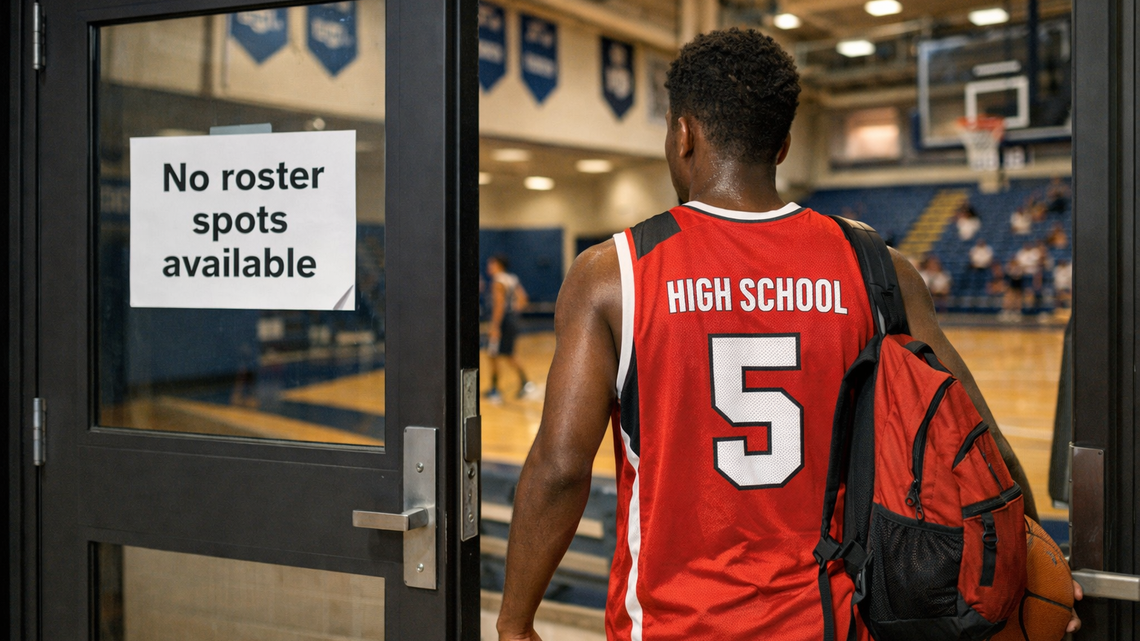
If the road to college basketball scholarships was not already difficult for high school players, the NCAA’s decision to allow NBA G League athletes to enter or re-enter college basketball has created another obstacle. One of the most impactful rulings of 2025, the policy arrives at a moment when NIL and the transfer portal have already reduced access to scholarships and roster spots. By granting G League players immediate eligibility, the NCAA further dilutes opportunities for first-time college athletes.
G League to College: The Precedent Is Already Set
The first notable example of this shift was Thierry Darlan. Darlan spent two seasons in the G League, appearing in 58 games. He suited up for Ignite during the 2023–2024 season and later joined the Delaware Blue Coats in 2024–2025. He was not on the fringe of the league. Instead, he emerged as a legitimate contributor and started roughly half of his games.
Despite that professional experience, Santa Clara granted Darlan eligibility for the West Coast Conference. Because Santa Clara carries a limited national profile, his return to college basketball drew little attention.
That changed when the NCAA restored eligibility for London Johnson at a true “blue blood,” the University of Louisville. Johnson’s case sparked national outrage and forced the college basketball world to confront a new reality. Players could now return to NCAA competition after playing in the NBA G League. The trend continued in November when BYU signed Abdullah Ahmed, a former player for the G League’s Westchester Knicks.
James Nnaji Pushes the Boundary Even Further
Baylor’s signing of James Nnaji brought the issue into sharper focus. Nnaji was selected 31st overall in the 2023 NBA Draft and later became part of an NBA trade in 2025. His move back to college basketball showed just how far the boundaries had shifted.
NCAA Responds as Backlash Grows
As concerns mounted, NCAA President Charlie Baker addressed the issue publicly.
“The NCAA has not and will not grant eligibility to any prospective or returning student-athletes who have signed an NBA contract,” Baker said. “As schools increasingly recruit individuals with international league experience, the NCAA is exercising discretion in applying the actual and necessary expenses bylaw. This ensures that prospective student-athletes with experience in American basketball leagues are not at a disadvantage compared to their international counterparts. Rules have long permitted schools to enroll and play individuals with no prior collegiate experience midyear.”
High School Players Were Already Losing Ground
Even before these rulings, opportunities for high school athletes were shrinking. The transfer portal now functions like free agency. As a result, Division I coaches-including those at HBCUs-often prioritize experienced transfers over developing high school talent. A brief review of HBCU Division I rosters highlights the impact.
Transfer Numbers Tell the Story
According to Real GM, a basketball tracking service, 99 MEAC players transferred from other institutions. In the SWAC, that number rises to 161. Together, those 260 roster spots no longer exist for high school athletes. Football numbers paint an even starker picture.
NIL Is the Driving Force
So what draws these players back to college? NIL.
The financial landscape has changed dramatically. In many cases, college athletes now earn more through NIL than NBA G League players earn through salaries. High-profile exceptions exist, such as Bronny James, whose endorsement portfolio-often linked to his father, NBA legend LeBron James-sets him apart.
BYU star AJ Dybantsa reportedly earns $4 million this season. Texas Tech’s JT Toppin is also positioned for a $4 million payday. When combined with what Duke’s Cooper Flagg earned last season, NIL compensation now exceeds typical NBA rookie salaries and far surpasses G League pay.
The Illusion of a Safety Net
NIL rumors have also fueled speculation about college athletics as a financial safety net. One widely circulated but unconfirmed report suggested Ohio State supporters planned to offer wide receiver Marvin Harrison Jr. more money than he would earn as a first-year NFL player. The goal was to keep him in school.
Harrison ultimately declared for the 2023 NFL Draft and was selected fourth overall by the Arizona Cardinals in 2024.
HBCUs Feel the Same Pressure
HBCUs face the same challenges and must “keep up with the Joneses.” The first nationally televised SWAC matchup of the season illustrated that reality. Bethune-Cookman defeated Florida A&M 87–83 in a high-level contest loaded with transfers.
Bethune-Cookman’s Arterio Morris, a transfer from Texas, scored 20 points. Florida A&M’s Jaquan Sanders, a transfer from Hofstra, led all scorers with 22. Most key contributors in the game came from the transfer portal.
Of the 28 total players on both rosters, only eight came directly from high school. That number even includes prep school players, who are not always truly straight out of high school. Florida A&M’s roster consists of roughly one-third high school players. Bethune-Cookman’s roster sits closer to one-quarter.
A Broader Concern Across College Sports
Across all sports, coaches increasingly worry that athletes prioritize NIL opportunities over skill development. Many cite this shift as a factor in the retirement of one of college football’s greatest coaches, Nick Saban.
After a historic run at Alabama, Saban stepped away from the program. During a roundtable discussion in Washington, D.C., led by U.S. Senator Ted Cruz, Saban explained his frustration.
“All the things that I believed in for all these years, 50 years of coaching, no longer exist in college athletics,” Saban said. “It was always about developing players. It was always about helping people be more successful in life.”
What Comes Next?
Baker closed by emphasizing that while the NCAA has lost control in several legal battles, it does not plan to concede this one.
“I will be working with DI leaders in the weeks ahead to protect college basketball from these misguided attempts to destroy this American institution.”
So what’s next? Perhaps LeBron James-who never played college basketball-and Bronny James-who left early and spent time in the G League-will enroll at the University of Arizona to play alongside Bryce.
At this point, what would stop them?
The post The NCAA further fails high schoolers with G League Rulings appeared first on HBCU Gameday.
HBCU Gameday
This story was originally published January 4, 2026 at 2:08 PM.

Half the fun of the transfer portal is the endless evaluation. Considering a player in one system and projecting him into possible landing spots can make everything different. It’s why a Division II QB and a mildly above average ACC QB can morph into two of the best passers in the nation a season later.
ESPN’s Tom Luginbill has scouted QBs for over 20 years at ESPN. Luginbill was once a QB himself and where he once might have spent much of his energy scouting college QBs for the NFL Draft, he’s now contemplating the portal college football market increasingly.
Luginbill saw a standout QB he is impressed with in Cincinnati transfer Brendan Sorsby. Luginbill praised Sorsby’s “excellent size, arm strength, and mobility.” Sorsby also caught Luginbill’s attention as a “powerful runner” who “anticipates extremely well and helps players get open with his throws.” ESPN ranks Sorsby as the top prospect in the portal and Luginbill terms him “an instinctive player… with elite processing and navigation skills when pressured.”
On3 wasn’t quite as impressed with Sorsby. While the site’s NIL valuation estimator gives Sorsby a hefty $3.3 million valuation, he is ranked No. 15 nationally in the site’s transfer portal rankings. That’s behind other QBs like Sam Leavitt, Byrum Brown, and Dylan Raiola. 247sports ranks Sorsby second behind only Leavitt.
Of course, the bigger question than whether Sorsby is the best or second-best or even sixth-best portal prospect is where the passer will spend the remainder of his career. Unsurprisingly, that’s not very clear either. On3’s picks favor Texas Tech while 247’s picks favor LSU.
Among the other schools mentioned as possibilities for Sorsby have been LSU and Miami from one expert. Other rumors have circulated that Sorsby will command a payment of over $5 million for his final portal destination.
Sorsby started his collegiate career at Indiana, where he sat in 2022 and split time in 2023 ahead of the hiring of Curt Cignetti. Sorsby passed for 1,587 yards and 15 touchdowns in 2023. He continued to blossom at Cincinnati, throwing for over 5,600 yards and rushing for another 1,000 yards across the 2024 and 2025 seasons.
In his total college career, Sorsby has thrown for 7,208 yards and 60 touchdowns against 18 interceptions. He’s rushed for another 1,295 yards and 22 touchdowns. In 2025, Sorsby led the Big 12 in total touchdowns created (36) and yards per passing attempt (9.3).
He’s one of the most experienced and talented players in the portal and the evidence of Luginbill’s testimony certainly is unlikely to hurt his seven-figure NIL offers. Sorsby may end up pacing the NIL market in 2026.

The NCAA transfer portal officially opened for all college football players looking to compete for different programs on Friday. The transfer portal will remain open until Jan. 16.
A myriad of players from all different levels decided to enter the portal in the weeks after the end of the 2025 regular season. Power Four quarterback transfers have been a major talking point, but plenty of other coveted offensive skill players are entering the portal.
One skill player that is sought after by multiple major college football programs is former Auburn wide receiver Cam Coleman. He will have two seasons of eligibility remaining at his second school.
The 6-foot-3, 201-pounder arrived at Auburn as a freshman in 2024. He appeared in 10 of 12 games for the Tigers in his freshman season, catching 37 passes for 598 yards and eight touchdowns. He was named to the SEC All-Freshman Team for the strong start to his college career.
Coleman was Auburn’s most productive wide receiver in 2025. He grabbed 56 receptions for a team-high 708 yards and five touchdowns in his final season at Auburn. Head coach Hugh Freeze was fired following Auburn’s loss to Kentucky, and Coleman officially decided to transfer on Dec. 29, 2025.
Every recruiting service ranks Coleman as the No. 1 overall prospect in the transfer portal, something that will have some of the top programs in the country interested in him. Pete Nakos of On3 reported that four different schools are jockeying for Coleman in the portal.
USC
The Trojans have positioned themselves well enough to receive a visit from Coleman on Thursday. Quarterback play was an inhibitor for Coleman’s production at Auburn the last two seasons, but that would not figure to be an issue with Jayden Maiava set to return for USC next year.
2025 Trojans wide receivers Makai Lemon and Ja’Kobi Lane have both declared for the 2026 NFL draft, so Coleman could slide in to fill a need for USC. CeeDee Lamb, Hollywood Brown and Jordan Addison are among the wide receivers to play for Lincoln Riley and find success in the NFL.
Texas A&M

Coleman has a visit to Texas A&M scheduled for Sunday. The Aggies had Coleman committed to their 2024 signing class for four months before he flipped to the Tigers on Early Signing Day.
Texas A&M will return starting quarterback Marcel Reed for at least one more season. Reed has experience working with transfer wide receivers in KC Concepcion and Mario Craver, the former of which has declared for the 2026 NFL draft.
Texas
Steve Sarkisian has helped multiple high profile wide receiver prospects make their way to the NFL as an offensive play caller. 2020 Heisman Trophy winner DeVonta Smith, Xavier Worthy and Matthew Golden are among the wide receivers taken in the first round of the NFL draft and play for Sarkisian.
The return of an improving quarterback in Arch Manning figures to be a draw for high-profile portal receivers to Texas. Ryan Wingo will return for the Longhorns in 2026, but the second and third most productive receivers, DeAndre Moore Jr. and Parker Livingstone, are both heading for the transfer portal.
Livingstone issued a statement that said “some things are out of my control,” potentially implying he was asked to leave in favor of a transfer.
Alabama

If proximity to home matters, and Auburn was not going to be a good fit with Alex Golesh, Alabama is the only other option for Coleman in his home state. Of course, Coleman transferring to Alabama would add an extra level of intrigue to the 2026 Iron Bowl.
The quarterback situation in Tuscaloosa is less certain than the prior three schools competing for Coleman, as it is unclear what Ty Simpson will do in 2026. The Crimson Tide will lose its lead receiver from 2025 in Germie Bernard, but neither Ryan Williams nor Isaiah Horton appears to be going anywhere.

The top-ranked overall player in the college football transfer portal cycle is predictably getting some serious interest from major players at the top level, and it appears the star quarterback will have five schools to pick from ahead of the 2026 season.
Former Arizona State quarterback Sam Leavitt has visited with one SEC school this week and is preparing to meet with a College Football Playoff team out of the Big 12 today, with three other schools also involved, according to On3 Sports.
Where Leavitt has been
Kentucky is the SEC program that most recently hosted Leavitt on a transfer visit as the school underwent a change at head coach and also at the quarterback position.
Cutter Boley elected to transfer away from the Wildcats after the departure of head coach Mark Stoops and the hiring of Will Stein.
That leaves the school in the market for a proven commodity at the quarterback position to lead an offense that has recycled several signal callers in recent seasons and still struggled.
Where he’s going
One of the most-improved programs in college football this season is also scouting a new quarterback, as Texas Tech is said to be hosting Leavitt on an official visit over the weekend, according to the On3 report.
The offense had its ups and downs with Behren Morton in command at quarterback, but now with the veteran starter preparing to enter the NFL Draft, the Red Raiders are poised to be in the market for a proven replacement.
Leavitt certainly fits the bill, and Texas Tech has shown it’s willing to put serious money into its roster, as evidenced by last offseason’s spending spree that revamped their defense and helped put them in the College Football Playoff in 2025.
Who else is in play?
Three other notable programs all in need of something at quarterback are said to be in the mix for Leavitt, one in the Big Ten, another in the SEC, and a third from the ACC.
Oregon could potentially lose starter Dante Moore to the draft after the end of the school’s College Football Playoff run, and installing a player of Leavitt’s experience would be an instant answer at the most important position.
Although, that may not be the case, as ESPN college football insider Pete Thamel recently suggested that Moore could decide to return to the Ducks in 2026, and cited a feeling from inside the program that he might stay rather than enter the draft.
Lane Kiffin is also interested in the quarterback as he installs his first roster at LSU, and the school is reportedly preparing to make a serious investment in the transfer portal after marshaling their donors to the cause to inject big money into the project.
Quarterback and wide receiver are said to be primary objectives for Kiffin and his staff heading into 2026, and the coach has demonstrated his inclination to use the portal as much as needed.
Lastly, expect Miami to once again be in the market for a veteran quarterback as current starter Carson Beck prepares to enter the NFL Draft.
Mario Cristobal and the Hurricanes have profited from the portal at the quarterback position recently, bringing on Cam Ward a year ago before scoring Beck as a transfer.
Leavitt could get serious money
Not long after it was reported that Leavitt intended to enter his name into the college football transfer portal, insiders speculated that he could have a windfall as a result.
Experienced quarterbacks are among the most coveted prizes in any transfer portal cycle, and one of Leavitt’s caliber could be in the market for some serious NIL cash.
“Sam Leavitt on the open market is going to command a significant amount of money,” 247Sports analyst Chris Hummer said of the quarterback’s market.
“We’re talking $3 million-plus, most likely. Although, in all fairness, I think teams really do have questions about Sam Leavitt’s injury and what that means moving forward. It’s kind of like the Carson Beck situation a year ago.”
Leavitt currently ranks No. 5 nationally with a $3.1 million valuation, according to the On3 Sports national player estimates, and is second among quarterbacks behind Arch Manning ($5.3 million).
What Sam Leavitt has done on the field
Leavitt initially began his college football career at Michigan State back in 2023, appearing in four games with 2 touchdowns and 2 interceptions before making the move that would put him on the national stage.
The quarterback made a bombshell transfer to Arizona State in the 2024 offseason, a decision that propelled himself and the program to a historic effort that year.
Leavitt helped lead the Sun Devils to a 10-2 regular season campaign and beat Iowa State by a 45-19 count to win the Big 12 championship and put the school into the College Football Playoff for the first time ever.
That season, Leavitt was responsible for 2,885 yards passing with 24 touchdowns against 6 interceptions, rushing for another 443 yards and 5 additional scores.
Leavitt won the Big 12 Offensive Freshman of the Year honor and was named Second Team All-Big 12 for his efforts after posting the most passing yardage for a freshman quarterback in Arizona State football history.
But his 2025 season was ultimately cut short by a Lisfranc injury after the Sun Devils’ game against Houston.
Leavitt passed for 1,628 yards with 10 touchdowns and 3 interceptions, rushing for 306 yards and another 5 scores in seven appearances this fall.
(On3)
Read more from College Football HQ

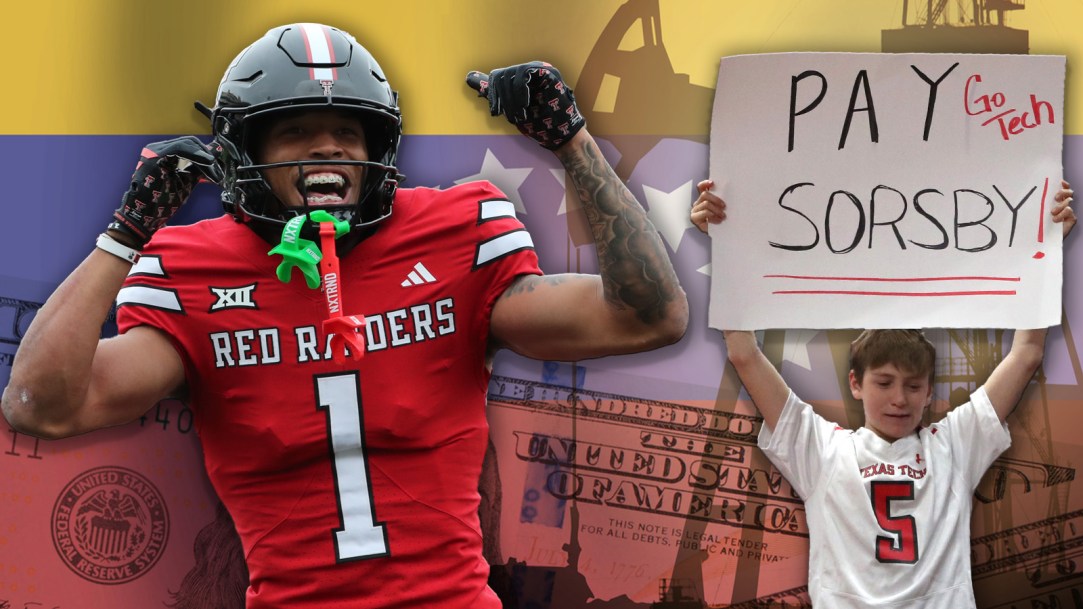
Texas Tech spent approximately $30 million on its roster for college football this season. However, the uncertainty with Venezuela after the capture of (former) President Maduro is now a cause for concern for the Red Raiders.
Especially after Brendan Sorsby decided to visit Baton Rouge…
Depending how things shake out in South America over the next few days, weeks and months, the oil money could run dry for college football boosters in Lubbock. Don’t just take it from me!
The Red Raiders have won 10 or more games only seven times in program history and only twice since 1977. Mike Leach took them to the Cotton Bowl at 11-1 in 2008. Joey McGuire led them to the College Football Playoff as the four-seed at 12-1 in 2025. That’s it.
Texas Tech had not won more than eight games since 2009 before this year’s impressive run to the Big 12 title. The blowout loss to Oregon on New Year’s Day was unfortunate but it was a historic season.
McGuire absolutely deserves credit for how his team played. The boosters deserve just as much credit for helping to assemble his roster.
According to multiple reports, the Red Raiders spent at least $28 million on this year’s players. At least. Billionaire booster Cody Campbell led the charge through the Matador Club. All of the oil tycoons in the Lone Star State opened up their checkbooks.
A massive influx of “NIL” dollars allowed McGuire to bring in 21 high-profile transfers during the offseason and Texas Tech had its best season in school history. That is not a coincidence.
Money (with the right coaching staff) can buy a Big 12 Championship and Playoff roster.
Venezuela creates oil money concerns.
The price of crude oil has already dropped by roughly $20 per barrel since the start of the 2025 college football season on Aug. 23, 2025. That’s approximately 25%. U.S. oil recently dropped below $55 per barrel, which is the lowest level since early 2021.
It could keep going lower after the capture of former Venezuelan “president” Nicolás Maduro.
United States president Donald Trump made it abundantly clear that he wants domestic oil companies to invest in the shattered petroleum industry of Venezuela. Should that happen, and the removal of Maduro leads to political stability, an increased amount of crude oil would flow into global markets.
That would, in turn, increase supply and put a downward pressure on prices. If the price of oil keeps dropping, the boosters in Lubbock will feel the impact.
Could it then have an impact on the Red Raiders? Fans are starting to panic.
To make matters worse, Texas Tech fans guaranteed that former Cincinnati quarterback Brendan Sorsby would not go through with his visit to Baton Rouge because he was going to sign with the Red Raiders while on campus— especially with his girlfriend set to play volleyball there. And then he got on the private jet to visit LSU less than 12 hours later.
Uh oh!
Maybe this is the first sign of financial unpredictability within the oil industry? This is a pretty galaxy-brained line of thinking but it is one that currently exists. The capture of Maduro in Venezuela could mark the end of Texas Tech’s instant relevance in college football. It is the greatest sport.

Fox Sports’ Joel Klatt called out ESPN for its College Football Playoff broadcast quality and relationship with one conference. Klatt said the networks should be evenly distributed throughout the postseason and not just dominated by ESPN.
As it stands for the CFP, every game is presented by ESPN, with licensing distributed to TNT for two of the first round games. Other networks that routinely broadcast college football, such as FOX and CBS, do not have any playoff games.
“They chose the wrong path when it comes to the presentation of this playoff,” Klatt said on his podcast. “There is no playoff that should be a single television partner. It just shouldn’t. Because the presentation is important, in particular, when you’re down to this point in the sport where you’re trying to showcase games …
“Let’s face it, it’d be better if every network was giving an A-level broadcast versus a single presenter, in particular when that single presenter has a deep relationship with just one conference within college football … That’s how you know this isn’t a Fox-ESPN thing for me, because I don’t think it would be great if we at Fox solely had the College Football Playoff. That wouldn’t be good for the sport, and it’s not good the way that it is right now. It just isn’t.”
If you look at the NFL, the games are distributed between FOX and CBS, with NBC, ESPN and Amazon Prime getting playoff games as well. Then, the Super Bowl is rotated between FOX, CBS and NBC with ESPN/ABC getting back into the rotation starting next year.
With Klatt, who broadcasts on FOX Sports and does the Big Noon game every Saturday with Gus Johnson, his point is that the CFP should have some variety. His argument is ESPN broadcasts primarily SEC games, sprinkled in with some other conferences such as the ACC.
But the Big Ten, which is the other “Big Two” of the Power Four, is done by FOX, CBS and NBC. Regardless if you think there is network bias towards a conference or vice versa, Klatt wants that perception eliminated.
But until the College Football Playoff itself, which has a weekly rankings reveal show on ESPN, distributes its content to other major player networks, the broadcast rights will remain with the four-letter-network. Other major spots split up the networks when it comes to their postseason, but the CFP has yet to get to that point.

The NCAA further fails high schoolers with G League Rulings

Young athletes compete in Northwest Ohio Elks Hoop Shoot | Allen County

Jake Kielb Hockey foundation launches effort to expand youth sports access in Las Vegas

NBC5 In Depth: Nordic skiing gaining traction

Burbank Boys Basketball Wallops Upland 73-33

College football scout hypes up $3.3 million QB amid interest from major programs

JAN. 4: MINNESOTA AT MONTRÉAL PRE-GAME PRIMER | PWHL

STM’s Eleanor Guidry named All-Metro Volleyball MVP | High Schools

Taylor, Horvath named Dixie Turman State Farm Agency Student-Athletes of the Week

Abbeville girls volleyball makes history with first state title | Sports

Global Youth Multicultural Forum Highlights Xizang Culture in Singapore and Malaysia |

No. 1 transfer portal player linked to four major college football programs

Braxon Vasconcellos Captures His First Career Golden Driller With K&B Motorsports Restricted – Speedway Digest

Auto Racing News – The Mountain Eagle

Hawaii men’s volleyball overwhelms NJIT in season opener

SoundGear Named Entitlement Sponsor of Spears CARS Tour Southwest Opener

Donny Schatz finds new home for 2026, inks full-time deal with CJB Motorsports – InForum

David Blitzer, Harris Blitzer Sports & Entertainment

DeSantis Talks College Football, Calls for Reforms to NIL and Transfer Portal · The Floridian
Elliot and Thuotte Highlight Men’s Indoor Track and Field Season Opener

#11 Volleyball Practices, Then Meets Media Prior to #2 Kentucky Match

JR Motorsports Confirms Death Of NASCAR Veteran Michael Annett At Age 39

Rick Ware Racing switching to Chevrolet for 2026

Colleges ponying up in support of football coaches, programs
West Fargo volleyball coach Kelsey Titus resigns after four seasons – InForum

Maine wraps up Fall Semester with a win in Black Bear Invitational

Temple Begins Indoor Track & Field Season at UPenn This Weekend

Ross Brawn to receive Autosport Gold Medal Award at 2026 Autosport Awards, Honouring a Lifetime Shaping Modern F1

Nascar legal saga ends as 23XI, Front Row secure settlement

Sunoco to sponsor No. 8 Ganassi Honda IndyCar in multi-year deal





-
 Motorsports3 weeks ago
Ross Brawn to receive Autosport Gold Medal Award at 2026 Autosport Awards, Honouring a Lifetime Shaping Modern F1
-

 Rec Sports3 weeks ago
Stempien to seek opening for Branch County Circuit Court Judge | WTVB | 1590 AM · 95.5 FM
-

 Rec Sports2 weeks ago
Princeton Area Community Foundation awards more than $1.3 million to 40 local nonprofits ⋆ Princeton, NJ local news %
-
 NIL3 weeks ago
Downtown Athletic Club of Hawaiʻi gives $300K to Boost the ’Bows NIL fund
-
 NIL3 weeks ago
Kentucky AD explains NIL, JMI partnership and cap rules
-
 Sports3 weeks ago
Three Clarkson Volleyball Players Named to CSC Academic All-District List
-

 Sports3 weeks ago
Central’s Meyer earns weekly USTFCCCA national honor
-

 Sports3 weeks ago
Young People Are Driving a Surge in Triathlon Sign-Ups
-

 Sports2 weeks ago
Beach Volleyball Unveils 2026 Spring Schedule – University of South Carolina Athletics
-
 NIL3 weeks ago
Why the NIL era will continue to force more QB transfers