
NIL
Rules Resulting from House Settlement Finalized and Enforced by College Sports Commission

WASHINGTON DC, October 30, 2025 – In the months since the House v. NCAA (“House”) settlement was approved by the U.S. District Court for the Northern District of California on June 6, 2025, the NCAA Division I Board of Directors has adopted multiple sets of new and revised NCAA bylaws resulting from that agreement.
Among these changes are new NCAA bylaws requiring high school and junior college prospective student-athletes and prospective transfer student-athletes to comply with the rules around disclosure of third-party Name, Image, and Likeness (NIL) deals, including being prepared to disclose all NIL deals worth $600 or more to the College Sports Commission (CSC) upon enrollment at a Division I institution.
These rules are enforced by the College Sports Commission, and participating institutions and student-athletes are required to comply with all settlement-related rules or face penalties, including eligibility consequences for student-athletes.
A high-level summary of many of the rules can be found below, and more information is available on the College Sports Commission website, the NCAA Division I Manual and in the NCAA’s Legislative Services Database. The CSC has also developed comprehensive resources on NIL rules and reporting requirements specifically for high school and junior college prospective student-athletes and prospective transfer student-athletes. These materials are accessible through the CSC website, the NCAA Eligibility Center, and have been distributed to campuses nationwide.
Third-Party Name, Image and Likeness (NIL) Deals
1. Student-Athletes & Third Parties
a. Noninstitutional NIL activities: A student-athlete may permit the use of the student-athlete’s NIL in noninstitutional NIL activities and receive compensation for such activities subject to Bylaw 21.1.3. [NCAA Bylaw 22.1.2]
b. Associated entities: An entity or individual associated with a student-athlete’s institution (“Associated Entity or Individual”, as defined in the House settlement), shall not enter into an agreement with or provide payment to a prospective student-athlete or student-athlete unless the agreement or payment terms are for a valid business purpose and do not exceed a reasonable range of compensation, as determined by the CSC in connection with the NIL Go platform. [NCAA Bylaws 22.02.1, 22.02.2 and 22.1.3]
c. Defining “Valid Business Purpose” and “Range of Compensation”: NIL payments from an Associated Entity or Individual must serve a valid business purpose related to the promotion or endorsement of goods or services provided to the general public for profit, with compensation at rates and terms commensurate with compensation paid to similarly situated individuals. [NCAA Bylaws 22.1.3 and 22.2.4]
d. Documentation requirements: The CSC may require student-athletes and entities to provide information and documentation to establish compliance with the valid business purpose rule. [NCAA Bylaw 22.1.3.1]
e. Pay-for-play is not a Valid Business Purpose: Raising money to induce student-athletes to attend or participate in intercollegiate athletics at an institution does not satisfy the valid business purpose requirement. [NCAA Bylaw 22.1.3]
f. NIL activation required under Valid Business Purpose: An NIL agreement or payment with an Associated Entity or Individual, must include direct activation of the student-athlete’s NIL rights. In other words, the acquisition of such rights without reasonable specificity of the NIL activation (e.g., description of the specific group licensing categories, the student-athlete’s obligations related to the activation, timing and ultimate use of the student-athlete’s NIL) may not satisfy the requirements for payments by Associated Entities or Individuals. [NCAA Bylaw 22.1.3.3]
g. Nonprofit standards: NIL deals involving a noninstitutional nonprofit or charitable organization may be considered to have a valid business purpose only if the contract or payment terms:
i. Originate with funding from the nonprofit or charitable organization; and
ii. Involve the student-athlete participating in an activity for which the primary purpose is to raise funds to support the organization’s bona fide charitable mission. [NCAA Bylaw 22.1.3.2]
h. Agents permitted: Student-athletes may use agent representation for NIL activities. [NCAA Bylaw 12.02.8]
i. Assistance by professional service providers: A professional service provider (e.g., agent, multimedia rights holder acting as a marketing agent, marketing agency) may assist in facilitating payments for NIL contracts or payment terms to a student-athlete, provided the entity that will use the student-athlete’s NIL is the originating source of the compensation and not the professional service provider. [NCAA Bylaw 22.3.2]
2. Reporting Requirements
a. NIL clearinghouse: Establishes a clearinghouse called NIL Go to evaluate noninstitutional NIL agreements to determine rules compliance. [NCAA Bylaw 22.2.2]
b. NIL reporting: All NCAA Division I student-athletes are required to report all noninstitutional NIL contracts or payment terms, including those involving Associated Entities or Individuals, as defined in the House settlement, with a total value of $600 in the aggregate or more to the designated name, image and likeness clearinghouse (NIL Go) for review. [NCAA Bylaw 22.2.2]
c. Reporting timeline: Student-athletes must submit written documentation of deal terms to NIL Go within five business days of execution or agreement to payment terms. The penalty for failure to report an NIL deal is ineligibility for the student-athlete. [NCAA Bylaw 22.2.2.2]
d. High school prospective student-athletes: Prospective student-athletes enrolling at Division I institutions must report all third-party NIL deals worth $600 or more that were executed, agreed upon, or that include payments made any time after July 1, 2025, or a prospect’s first day of junior year in high school, whichever occurs later. [NCAA Bylaw 22.2.2.5.1]
i. These deals must be reported within 14 days after initial enrollment at a Division I institution or before their first game as a Division I student-athlete—whichever comes first. [NCAA Bylaw 22.2.2.5.3]
e. Junior college prospective student-athletes: Prospective student-athletes enrolling at Division I institutions must report all third-party NIL deals worth $600 or more that were executed, agreed upon, or that include payments made any time after July 1, 2025, or starting from a prospect’s initial enrollment at a two-year college, whichever occurs later. [NCAA Bylaw 22.2.2.5.1]
i. These deals must be reported within 14 days after initial enrollment at a Division I institution, or before their first game as a Division I student-athlete—whichever comes first. [NCAA Bylaw 22.2.2.5.3]
f. Prospective transfer student-athletes: Student-athletes transferring from Division II or Division III to a Division I institution must report all third-party NIL worth $600 or more that were executed, agreed upon, or that include payments made from the date their name is officially entered into the NCAA Transfer Portal. [NCAA Bylaw 22.2.2.5.2]
i. NIL deals involving student-athletes transferring from one Division I institution to another will be evaluated based on the company’s or individual’s association with the student-athlete’s new school from the time their name is officially entered into the NCAA Transfer Portal. [NCAA Bylaw 22.2.2.5.2]
Institutional Revenue Sharing & NIL Agreements
1. Institution revenue sharing and NIL: Institutions may provide additional payments, benefits and expenses to their student-athletes subject to the House settlement-related rules. [NCAA Bylaw 16.13.1]
2. Benefits cap: The amount of revenue share and benefits any institution can provide is capped by the House settlement. The cap amount is 22% of the average total revenue in certain categories as set forth in the House settlement. The value of these additional payments and/or benefits provided by the institution or on the institution’s behalf cannot exceed the cap amount during an academic year. The benefits cap amount for the 2025-26 academic year is $20.5 million. [NCAA Bylaw 16.02.2]
3. Eligibility for institutional benefits: An institution may not enter into an NIL agreement with a student-athlete that extends beyond the student-athlete’s period of eligibility to participate in intercollegiate athletics. [NCAA Bylaw 16.13.1.1]
4. Institutional NIL: Institutions may enter into exclusive/nonexclusive licenses with student-athletes for NIL use. [NCAA Bylaw 22.1.1]
5. Reporting requirements: All additional payments and/or benefits provided by an institution or on an institution’s behalf to a student-athlete shall be specified in writing in signed agreements between the institution and the student-athlete. Such agreements shall be entered and uploaded into CAPS within five business days from final signatures. [NCAA Bylaw 16.13.2]
6. No guaranteed third-party NIL: As of July 1, 2025, schools can not promise or guarantee a student-athlete – either verbally or in writing – a third-party NIL contract or payment. Deals guaranteed before July 1 for the 2025-26 academic year are allowed and count toward the school’s benefits cap, unless the student-athlete receives payments from a third party up to that amount. [NCAA Bylaw 22.1.1.1]
7. Institutions as marketing agents: Institutions may serve as marketing agents for student-athletes in third-party NIL agreements. [NCAA Bylaw 22.1.1]
8. Excess benefits rollover: In addition to any penalties that may be assessed by the CSC, if an institution exceeds the value of an applicable period’s benefits cap, the excess amount shall be counted against the institution’s benefits cap in the immediately following annual period. [NCAA Bylaw 16.13.1.8]
9. Benefits Cap Attestation: Institutions must attest on a yearly basis that all information in CAPS is complete, accurate and compliant with the benefits cap rules and polices, that all countable benefits provided to student-athletes were uploaded into CAPS, and student-athletes were not guaranteed payments or benefits not in a written agreement entered into CAPS. [NCAA Bylaw 16.13.3]
Roster Limits
1. Roster limits: Scholarship limits are eliminated and sport-specific roster limits for institutions providing settlement-related benefits are established. [NCAA Bylaws 17.2 and 16.13.1.5]
2. Roster submission deadlines: Rosters must be submitted by the day before the first contest of the season or December 1, whichever is earlier. [NCAA Bylaw 17.2.1]
3. Roster additions: Institutions may add student-athletes only if roster limits haven’t been reached, with changes required to be reported before the next contest. [NCAA Bylaw 17.2.1.1]
4. Mandatory roster inclusion: With limited exceptions, an institution must include any student-athlete who receives athletically related financial aid or settlement-related payments on a sport’s submitted roster during the academic year in which they receive such payments. [NCAA Bylaw 17.2.2]
5. Designated student-athlete rule: Institutions must have reported “designated student-athletes” who would have been removed due to roster limit implementation by July 6, 2025. Upon being designated, such a student-athlete may continue to participate in practice and competition without counting towards the institution’s roster limit. [NCAA Bylaw 17.02.8 and 17.2.2]
Enforcement
1. College Sports Commission (CSC): The CSC is designated as the enforcement entity responsible for enforcement of NCAA bylaws adopted based on the House settlement, including investigating alleged violations, assessing penalties for violation determinations, and serving as the party seeking enforcement of any penalties contested through neutral arbitration. [NCAA Bylaw 23.02.1]
2. Investigations: Participating institutions agree that the CSC has the authority to investigate an alleged violation of an NCAA bylaw developed as a part of the House settlement. [NCAA Bylaw 23.01.1]
3. Penalties: If the CSC concludes that a violation of settlement-related rules occurred, the CEO of the CSC has sole authority to prescribe penalties for those violations. [NCAA Bylaw 23.2.1]
4. Arbitration: Student-athletes have access to a neutral arbitration process to contest any decision made by the CSC. A neutral arbitrator shall reach a final written decision within 45 days from commencement of the proceedings and the written decision shall be considered final and binding. [NCAA Bylaw 23.3]
a. During the pendency of arbitration, any prescribed penalties are stayed. The presiding arbitrator, if good cause is shown, may lift a stay. [NCAA Bylaw 23.3.1.1]
b. A student-athlete who elects to use the neural arbitration process has the right to be represented by counsel of the student-athlete’s choice. [NCAA Bylaw 23.3.1.2]
About the College Sports Commission
The College Sports Commission (CSC) is an independent body established in 2025 to oversee and enforce compliance with rules governing student-athlete compensation in college sports, including institutional revenue sharing and third-party Name, Image, and Likeness (NIL) agreements. Dedicated to the principles of fairness, integrity and opportunity, the College Sports Commission provides structure and accountability to ensure that student-athletes and institutions benefit from a transparent and equitable collegiate athletics system.
Media Contact
collegesportscommission@fgsglobal.com


The college football transfer portal is only ten days away from officially opening for business. That hasn’t stopped players around the country from getting a head start on the action, as nearly 1,100 names are expected to transfer.
That number will continue to rise over the next few weeks. The movement could be unprecedented this offseason, as the spring window has been eliminated, meaning there will be only 15 days for players to appear in the portal.
The quarterback market is packed. Though the group might not be as top-heavy as the last few seasons, there will still be plenty of talented signal-callers available.
Former Freshman Of The Year Transferring From Arkansas State
On Tuesday evening, Arkansas State junior quarterback Jaylen Raynor revealed his intentions to transfer, per 247Sports’ Matt Zenitz.
Raynor spent the last three seasons as the starter for the Red Wolves. In 2025, he completed 333/501 passes for 3,361 yards with 19 touchdowns to 11 interceptions. He added 154 rushes for 423 yards and 7 more scores.
Raynor led the Sun Belt Conference in completions, attempts, yards, and interceptions.
Arkansas State finished 7-6, defeating Missouri State, 34-28, in the Xbox Bowl.
Raynor signed with the Red Wolves as a two-star prospect in the 2023 class. He leaped into the starting role early in his true freshman season, taking the reins for the final 10 games of the year.
Raynor was named the Sun Belt’s Freshman of the Year after completing 166/285 passes for 2,550 yards with 17 touchdowns to 7 interceptions. He rushed for 5 more scores.
The North Carolina native tied Arkansas State’s program record with six touchdown passes against UMass on September 30, 2023.
Raynor continued to lead the Red Wolves as a sophomore. In 2024, Arkansas State went 8-5 and defeated Bowling Green in the 68 Ventures Bowl.
Overall, Raynor is 20-16 as a starting quarterback and he’s 2-1 in bowl games.
During his college career, he’s completed 758 of 1,206 passes for 8,694 yards with 52 touchdowns and 28 interceptions. Raynor has rushed 414 times for 1,183 yards and 15 more scores.
The 6-foot-0, 202-pound quarterback has two years to play one at the college level.
Out of high school, Raynor held offers from programs such as UMass, Miami (OH), Army, Air Force, and Navy.
Read more on College Football HQ
• $45 million college football head coach reportedly offers Lane Kiffin unexpected role
• Paul Finebaum believes one SEC school is sticking by an ‘average’ head coach
• SEC football coach predicts major change after missing College Football Playoff
• Predicting landing spots for the Top 5 college football transfers (Dec. 17)
1. The latest actual numbers I can find…per 247 sports, U of L was 20th in NIL monies in college sports at about 450 million. Now we are approaching 2026 and things obviously have changed, but we were at least trying to play the NIL game.
2. Jeff did not leave Purdue the first time because the timing wasn’t right or he still had a job to do with the Boilermakers. I respected Jeff for that and quite frankly made me feel more proud of who he was as a person .
I could be naive and stupid but:
A. This crazy money by rich people to pay athletes is just that, crazy and not sustainable long term.
B. U of L is probably doing the best it can but can not compete against oil monies etc.
C. Love him or not, (I love Jeff as our coach) he is the best we could have and feel safe he wants to stay. (Is this a dumb statement given the leaving fears?)
D. Let’s keep winning at Jeff’s level or better
Updated Dec. 24, 2025, 2:51 p.m. CT

Four Missouri football staff members, including the lead executive of the Tigers’ NIL agency, are leaving MU to follow former offensive coordinator Kirby Moore to Washington State.
Brad Larrondo, who was the CEO and general manager of Every True Tiger Brands, is moving to take a role at WSU. He is a Boise State grad and still has significant connections to the region.
The Tigers also are set to lose tight ends coach Derham Cato to the same role with the Cougars, and Mizzou assistant offensive line coach Jack Abercrombie is set to become Moore’s lead O-line coach. Those staff changes were first reported by Matt Zenitz at CBS Sports.
Finally, Mizzou assistant director of football athletic performance Malcolm Hardmon will become Washington State’s strength and conditioning coach, per Bruce Feldman at The Athletic.
The most significant loss of the group, arguably, is Larrondo, who has been instrumental in the name, image and likeness space for Missouri.
Mizzou coach Eli Drinkwitz originally hired Larrondo, who like the MU coach had spent time working at Auburn and Boise State, to oversee recruiting and external relations. Larrondo ultimately became the lead executive at Every True Tiger, where he helped establish the core of Mizzou’s current NIL structure.
Every True Tiger and Larrondo are influential in negotiating both revenue-sharing and third-party NIL deals for Missouri athletes, as well as distributing money to athletes and making sure the football program remains within its spending cap. The agency also is a marketing arm and has helped facilitate deals for Mizzou student-athletes.
The college football transfer portal is approaching, which brings significant challenges for both roster retention and recruitment for teams — something Larrondo would have been closely involved with.
The portal officially opens Jan. 2 and remains open for new entries through Jan. 16.

Missouri football has not hired a general manager partly because, with Drinkwitz at the forefront, it has recreated that role in the aggregate through Larrondo and other staffers.
Drinkwitz responded to reports of Larrondo’s exit via his personal X/Twitter account.
“Good luck to Brad and thank you for all he did, but MIZZOU NIL was started way before Brad, and is a STRONG POSITION! Carry on!” Drinkwitz wrote Wednesday, Dec. 24.
Beyond Larrondo, the staff shakeup was seemingly expected. Drinkwitz indicated Dec. 16 that some assistants could end up following Moore to Pullman, Washington.
“Could lose a couple more people off of our staff from analyst roles as coach Moore finalizes and puts his staff together,” Drinkwitz said Dec. 16. “It shouldn’t change the dynamic of what we do at all.”
Missouri is only actively looking to replace one primary assistant on its staff in Cato, who had been with the team for three seasons. The Tigers will need a new tight ends coach.
As part of Drinkwitz’s recent contract extension, he was given an additional $4 million to spend on his assistant and staff salary pool.
Mizzou has recently made two notable hires.
Michigan’s Chip Lindsey was tabbed as the Tigers’ new offensive coordinator, and Jack Breske has joined the team from Tennessee as MU’s president of player personnel and recruiting.
NIL
Matt Patricia’s first season at Ohio State exceeds expectations going into College Football Playoff :: WRALSportsFan.com
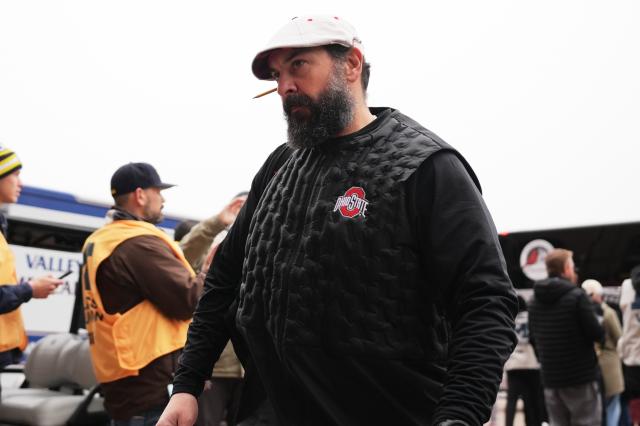
Matt Patricia is used to postseason runs from his days as the defensive coordinator of the New England Patriots.
However, Patricia acknowledges that the preparation for the College Football Playoff is different than the NFL. Patricia is in his first season as Ohio State’s defensive coordinator as the second-seeded Buckeyes (12-1) get ready to face 10th-seeded Miami (11-2) in a CFP quarterfinal at the Cotton Bowl on Dec. 31.
“It’s a learning (process) for me. We’d have bye-week kind of moments in the NFL, but this is a really long layover and break,” Patricia said. “Right now, I’m trying to trust the expertise in the building. Some of the things we did transfer, you know, because we have some different kind of scheduling and when everybody is in school and that stuff.”
Ohio State was off for two weeks after its 13-10 loss to Indiana in the Big Ten championship game on Dec. 6. Players were mostly occupied with final exams while waiting to see who they would face in the Cotton Bowl.
With the Buckeyes going for consecutive national championships for the first time in school history, Patricia’s first season in Columbus has exceeded expectations. He was hired after Jim Knowles left for Penn State, tasked with leading a unit that returned only three starters, none on the defensive line.
Patricia and Ohio State made an emphatic opening statement in their Aug. 30 14-7 victory over Texas and continued the momentum throughout the season.
The Buckeyes are ranked either first or second nationally in nine different categories. They lead the nation in scoring defense (8.2 points per game), passing yards (129.1), red zone scores (66.7%) and fewest plays of 10 or more yards (90).
Ohio State had three AP All-America first-team selections on the defense — defensive tackle Kayden McDonald, linebacker Arvell Reese and safety Caleb Downs. All three plus linebacker Sonny Styles are projected to be first-round picks in April’s NFL draft.
Patricia, who returned to coaching in college for the first time since 2002, is a finalist for the Broyles Award, which is given to the top assistant coach in college football.
“The players have done an unbelievable job. Again, give them all the credit. I think they’ve played so hard and aggressive and flying around on the field. And it is a lot of fun. I tell them all the time, it’s such a privilege to be up there in front of the group and talk to the group,” Patricia said. “And just for me, personally, it has been so much fun to come back to college and have that little bit of a youthful energy with the players that we have here and their excitement to go out and play.”
When Patricia was hired, many lauded his ability to adjust his personnel by running multiple fronts and coverages. He also has shown the ability to relate to players.
“When he first stepped on campus here, it was like a long-lost family member that just came back from whatever he came from, but he came back home,” defensive end Kenyatta Jackson said. “And I mean, all the guys love him. Even offensive guys. He don’t just talk to the starters or whatever the case may be, but he talks to everybody. And I think that’s why everybody loves him.”
One person who hasn’t been surprised with Patricia’s success is the guy who hired him.
“His background speaks for itself and putting guys into a situation to be successful. And every player just wants someone that’s going to be there to get them better but also wants someone to care about them. He’s done both of those things,” coach Ryan Day said. “It’s great to have somebody in the building who has been through some of the games he’s been through, the Super Bowls and a lot of playoff games, so there’s a confidence level the guys have in him. So, I think all of that adds up to what you’re seeing.”
___
Get poll alerts and updates on the AP Top 25 throughout the season. Sign up here and here (AP News mobile app). AP college football: https://apnews.com/hub/ap-top-25-college-football-poll and https://apnews.com/hub/college-football

If I were given $25 million to build the 105-man Arkansas football roster, how would I do it? All schools on the Power Four level have $22.5 million allotted for revenue sharing across all sports. SEC programs have pledged to donate $2.5 million of that to scholarships. For most schools, football is expected to receive approximately 75% of the remaining balance.
That comes out to $13.5 million in revenue sharing for football. That means we need to raise an additional $11.5 million in NIL to get to $25 million, which is probably the amount of money a program would need to be considered to be in the upper-half of NIL among SEC programs. And that’s an educated guess. Arkansas is likely working somewhere between $20 million and $25 million, I would assume.
That’s probably what it takes to bump someone out among programs like Georgia, Alabama, Texas, Texas A&M, Florida, Tennessee, Oklahoma, Auburn and Ole Miss. Let’s suppose the breakdown below is for Arkansas. It has always been said Arkansas must do more with less. I’ve got a formula that should stretch that $25 million in Monopoly Money I’m playing with today…

Welcome to the Morning Commute
Today we are talking about Mizzou Football!
In case you missed it, Mizzou defensive end Damon Wilson II got sued by Georgia in regards to breached agreement by transferring and owes $390,000, the unpaid portion of the deal, under a liquidated damages clause.
The Missouri defensive end challenges whether or not that agreement was ever legally binding.
Wilson is suing for defamation after spokesman Steven Drummond told ESPN that Georgia “expects student athletes to honor commitments.” The complaint alleges the comment damaged Wilson’s character by falsely implying he breached a contract.
This is definitely an ongoing subject so the best way to stay updated is the Rock M+ forums!
Yesterday at Rock M and Rock M+
Let’s shift our focus to Mizzou Football as Missouri plays in the TaxSlayer Gator Bowl vs Virginia on Saturday night. For the final time this season, it’s game week.
Hey… Missouri Football is playing! Should be an exciting matchup to wrap up Christmas festivities!
MU has seen its three-point field goal percentage drop from 45 percent to 31 percent since Stone, who shot 41.7 percent from beyond the arc in his six games this season, left the rotation. Gates used the analogy of his team as a puzzle in the postgame press conference, pointing to Pierce and Stone as key (missing) pieces.
Key players missing leads to major impact. Mizzou needs to get healthy if it wants a chance to compete in the SEC.
From Rock M Radio: Dive Cuts
In this episode, what turned into a slaughter fest of the Braggin’ Rights matchup is previewed. More to come soon on Rock M Radio!
If you like Rock M Radio drop us a Review and be sure to subscribe on your preferred podcasting platform. Follow @RockMRadio on Twitter and if you haven’t already head over to our YouTube channel and click that subscribe button!
(** RockMNation has affiliate partnerships. These do not influence editorial content, though RockMNation may earn commissions for products purchased via affiliate links.**)

K1 Speed champions get new route into Porsche series

Coveted dual-threat quarterback entering college football transfer portal

BYU women’s volleyball has a new head coach — and a key return from portal

FDU deputy AD says new UND coach David Nguyen is ‘an incredible volleyball mind’ – Grand Forks Herald

Two things about NIL and Brohm
2025 StarNews All Area Volleyball teams

IMSA team unveils Greg Biffle tribute following death – Motorsport – Sports

Coming home: Neilson tabbed as new BYU women’s volleyball coach | News, Sports, Jobs

Slidell’s Danny Tullis is headed to Mandeville | St. Tammany community news

The Games of the Future Abu Dhabi 2025 Closes Landmark Edition, Setting New Benchmark for Phygital Sports

Bulldog Explorers Program brings global learning to Starkville youth
4 Missouri football staffers, including lead NIL exec, follow Moore to WSU

Season in Review: Culture Leads to Special Season for Volleyball

From Repair to Prevention: The Emerging Role of Preventive Orthopedics

Meet the Rapid City Journal’s 2025 Best of the Black Hills volleyball team

Fargo girl, 13, dies after collapsing during school basketball game – Grand Forks Herald

CPG Brands Like Allegra Are Betting on F1 for the First Time

Sycamores unveil 2026 track and field schedule

Two Pro Volleyball Leagues Serve Up Plans for Minnesota Teams

Utah State Announces 2025-26 Indoor Track & Field Schedule

SoundGear Named Entitlement Sponsor of Spears CARS Tour Southwest Opener

Jo Shimoda Undergoes Back Surgery

Redemption Means First Pro Stock World Championship for Dallas Glenn

Black Bear Revises Recording Policies After Rulebook Language Surfaces via Lever

Texas volleyball vs Kentucky game score: Live SEC tournament updates

Bowl Projections: ESPN predicts 12-team College Football Playoff bracket, full bowl slate after Week 14

Robert “Bobby” Lewis Hardin, 56

How this startup (and a KC sports icon) turned young players into card-carrying legends overnight

Donny Schatz finds new home for 2026, inks full-time deal with CJB Motorsports – InForum

Indiana’s rapid ascent and its impact across college football





-
 Motorsports2 weeks ago
SoundGear Named Entitlement Sponsor of Spears CARS Tour Southwest Opener
-
 Motorsports2 weeks ago
Donny Schatz finds new home for 2026, inks full-time deal with CJB Motorsports – InForum
-

 Rec Sports3 weeks ago
How Donald Trump became FIFA’s ‘soccer president’ long before World Cup draw
-
 Rec Sports2 weeks ago
David Blitzer, Harris Blitzer Sports & Entertainment
-

 Motorsports3 weeks ago
JR Motorsports Confirms Death Of NASCAR Veteran Michael Annett At Age 39
-
Sports2 weeks ago
Elliot and Thuotte Highlight Men’s Indoor Track and Field Season Opener
-
 Motorsports2 weeks ago
Rick Ware Racing switching to Chevrolet for 2026
-
Sports2 weeks ago
West Fargo volleyball coach Kelsey Titus resigns after four seasons – InForum
-
 Sports2 weeks ago
#11 Volleyball Practices, Then Meets Media Prior to #2 Kentucky Match
-
 Sports3 weeks ago
Temple Begins Indoor Track & Field Season at UPenn This Weekend