The policy documents for this study were collected from official sources, including the Ministry of Education’s website and authoritative legal and policy platforms such as the Peking University Law Database. Given the large number of policy texts related to campus football, three screening criteria were applied: (1) issued by authoritative institutions such as the Ministry of Education and the General Administration of Sport; (2) representative of China’s campus football policies; and (3) containing substantive content suitable for policy coding. Based on these criteria, 71 valid policy documents were selected as the data foundation for this study’s analysis of campus football policies (Bowen, 2009; Qin et al., 2020) (See Table 1).
Table 1 List of campus football policy documents (Partial).
Three-dimensional analysis framework
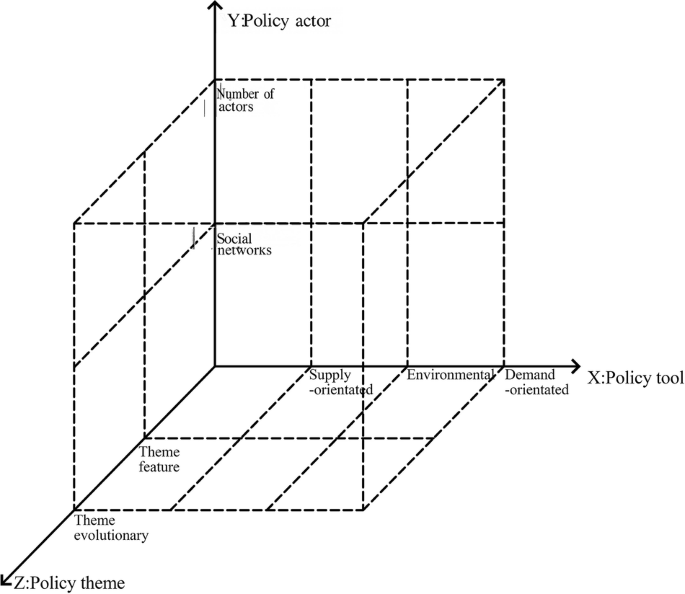
This study proposes a three-dimensional analytical framework encompassing policy tools, policy actors, and policy themes to comprehensively examine the evolutionary characteristics of China’s campus football policy (see Fig. 1). It employs content analysis, SNA, and the LDA2Vec topic modeling technique to quantitatively analyze these dimensions, with the results subsequently visualized using curve charts, river diagrams, Gephi software, and the pyLDAvis visualization toolkit.
Fig. 1
The three-dimensional analysis framework.
X dimension: policy tools
Drawing on policy tools theory, this study adopts the tripartite classification of policy tools proposed by Rothwell and Zegveld and incorporates findings from existing Chinese research, categorizing policy tools into supply-oriented, environmental, and demand-oriented types (Rothwell, 1985). The details are as follows (See Table 2). In addition, given the large volume of policy documents involved in this study, the analysis of extensive textual content renders traditional analytical methods insufficient (Liu et al., 2024). However, content analysis is a systematic, objective, and quantitative method for describing text content, and it is widely used in policy text analysis (Downe-Wamboldt, 1992). This approach relies on clearly defined coding rules to reduce large volumes of textual information into smaller, more meaningful content categories (Weber, 1990). It enables a more accurate and comprehensive interpretation of textual data (Wei and Li, 2024).
Table 2 Classification and definition of campus football policy tools.
This study employed two independent coders to perform content coding using NVivo 14.0 software. The selected policy documents were coded and categorized using a hierarchical structure denoted as “policy number–clause number–policy tool sequence number” (e.g., “7-1-7” indicates the seventh policy tool in the first clause of policy document number 7). After node coding was completed, the two datasets were imported into the NVivo system, and the built-in Kappa coefficient function was used to calculate intercoder reliability. A Kappa value above 0.81 indicates an optimal level of consistency between coders (Song et al., 2021). After multiple tests, all Kappa coefficients across the nodes were found to exceed 0.81. Finally, any coding discrepancies were resolved through expert consultation to determine the appropriate classification, thereby finalizing the coding table for the content analysis of campus football policy documents (See Table 3).
Table 3 Table of campus football policy text coding (Partial).
Y dimension: policy actors
Grounded in governance theory, this dimension examines the interactions and influences of policy actors in the implementation of campus football policies. Policy actor refers to an entity involved in the formulation, implementation, evaluation, and monitoring of policies. It is responsible for designing policy themes, selecting appropriate policy tools, and coordinating the resources and actions of various stakeholders to achieve the intended policy objectives (Wang and Minawar, 2024). Accordingly, in the context of campus football, central government agencies, football associations, and related organizations are identified as policy actors. This study employs statistical bubble charts to visualize the frequency of policy actors’ involvement in campus football policy documents. Furthermore, by integrating SNA with Gephi visualization, the study constructs a policy actor network. Mapping nodes (e.g., organizations such as GASC and CFA) and edges (e.g., relationships or interactions) reveals interaction patterns, thereby enabling the assessment of coordination levels among policy actors in campus football governance(Otte and Rousseau, 2002; Springer and De Steiguer, 2011).
Z dimension: policy themes
This dimension, underpinned by policy process theory, analyzes the thematic evolution of campus football policies. As core elements of the policy system, policy themes reflect the problems addressed and objectives pursued by policies. Their dynamic adjustments across different stages of campus football development further reveal shifts in policy priorities and goal orientations (Hua et al., 2022). To capture these evolutionary trajectories, this study employs the LDA2vec thematic model—an extension of the LDA model. While traditional LDA (a three-layer Bayesian probabilistic network comprising vocabulary, themes, and documents) demonstrates efficiency and scalability in identifying policy themes (Blei et al., 2003; Chauhan and Shah, 2021; Alkan et al., 2023), its reliance on one-hot encoding overlooks semantic relationships. LDA2vec enhances clustering accuracy and thematic identification by integrating Word2Vec technology to optimize word, topic, and document vector representations (Li et al., 2018). This study combines LDA2vec with the confusion coefficient and the pyLDAvis visualization tool to identify the number of themes and associated keywords across different policy phases. In addition, a Sankey diagram is constructed to visualize the evolution of policy themes in campus football, allowing for a deeper analysis of thematic characteristics and their evolutionary trajectories, with the aim of revealing the shifting policy focus and goal orientation throughout the development process.
This study utilizes the Jieba Chinese text segmentation tool in Python to tokenize 71 campus school policy documents. To improve segmentation accuracy, domain-specific terms in the field of campus football—such as “campus football” and “Mantianxing Training Camp”—are incorporated into a customized dictionary. The text data were further cleaned using Chinese stop word lists, including the HITU Deactivation Thesaurus. After preprocessing, the LDA2vec model is trained iteratively to extract topics and associated keywords for each stage of campus football development. The optimal number of topics for each stage is determined based on the Perplexity and pyLDAvis visualization tool, with manual intervention used to eliminate semantically incoherent topics (Omar et al., 2015; Farea et al., 2024). The final topic modeling results are presented in Table 4.
Table 4 Results of topic extraction from campus school policy documents.
Stages of campus football development
This study categorizes the development of campus football into four major phases, primarily based on the time point of significant policy enactments.
Start-up development stage (2009–2014)
In 1992, the Chinese Football Association (CFA) convened a working meeting in Hongshankou, a western suburb of Beijing, to set the direction for the professionalization of Chinese football (Fang and Yang, 2024). At that time, professional football clubs and football schools became the main pathways for cultivating reserve talent. However, this model emphasized competition while neglecting academic education, forcing young players to choose between professional training and general education. As a result, the number of football schools—once exceeding 4000—dropped sharply due to declining enrollment (Li et al., 2022). In 2009, to enhance the role of schools in developing youth talent, promote broader youth participation in football, and address the shortage of reserve talents, the GASC and the MOE jointly issued the Notice on the Development of National Youth Campus Football Activities. This policy called for the widespread implementation of campus football programs in regular primary and secondary schools, the establishment and refinement of a four-tier league system (covering primary schools, junior high schools, senior high schools, and colleges), and the systematic development of youth football reserve talent. This initiative marked the official launch of China’s campus football. According to statistics, from 2009 to 2014, over 100,000 school football matches were held annually, involving 5161 participating schools and resulting in the training of 2608 competitive football reserve talents (Qiu and Qin, 2021).
Development of the incremental stage (2015–2019)
In November 2014, the State Council convened a national video and teleconference on youth campus football, during which Vice Premier Liu Yandong emphasized that the development of campus football was a major and urgent strategic task (China Government Website, 2014). Subsequently, in March 2015, the Overall Program of Chinese Football Reform and Development, issued by the General Office of the State Council, elevated campus football to the level of national strategy. The plan proposed promoting the widespread adoption of campus football and set targets of establishing 20,000 campus football-specialized schools by 2020 and 50,000 by 2025. In the same year, the MOE issued the Implementation Opinions on Accelerating the Development of Youth Campus Football, outlining the primary objectives and future development trajectory of campus football (Ministry of Education, 2015). According to statistics, from 2015 to 2019, the number of campus football-specialized schools grew from just over 5000 to 27,059, surpassing the target of 20,000 schools set for 2020 ahead of schedule (Miao et al., 2020). During the same period, the four-tier league system (covering primary schools, junior high schools, senior high schools, and colleges) attracted approximately 12.55 million participants, trained approximately 350,000 teachers, and constructed or renovated 32,432 campus football fields (Ministry of Education, 2019).
Development deepening stage (2020–2023)
In December 2019, the MOE held a press conference, where the then Director of the Department of Physical Education, Health, and Arts Education proposed the development of an “upgraded version” of campus football (Ministry of Education, 2019). This initiative aimed to optimize the existing development system and further accelerate the advancement of campus football. Subsequently, in September 2020, the MOE issued the Action Plan for the Construction of the Eight Major Systems of National Youth Campus Football, which emphasized deepening the implementation of both the Overall Program of Chinese Football Reform and Development and the Implementation Opinions on Accelerating the Development of Youth Campus Football(Ministry of Education, 2020). The plan focused on optimizing and enhancing systems related to popularization and promotion, teaching and training, competitions and leagues, teacher development, and publicity and guidance. According to statistics, from 2020 to 2023, 5701 new schools with campus football-specialized were added, bringing the total to 32,760, which has played an important role in supporting the comprehensive development of campus football in China (Ministry of Education, 2024b).
Efficiency and quality improvement stage (2024–present)
Currently, the MOE has selected and recognized 37,261 schools with campus football-specialized, falling short of the 50,000 target set by the Overall Program of Chinese Football Reform and Development (Ministry of Education, 2025). Meanwhile, after nearly 15 years of large-scale and wide-ranging experimental work in campus football, signs of fatigue—both material and psychological—have inevitably emerged. Compared to the initial stage of its implementation, the nationwide enthusiasm for campus football has evidently declined (Mao, 2024). In response, in February 2024, the MOE issued the Implementation Opinions on Strengthening and Improving Youth School Football in the New Era, aiming to address the prominent issues facing the reform and development of campus football. Meanwhile, the document seeks to promote the healthy, sustainable, and high-quality development of campus football, and it also calls on campus football practitioners to commit to sustained efforts, remain grounded in present realities, and work steadily to elevate the development of campus football to a new level (Ministry of Education, 2024a).
Although we are only at the halfway point of the campaign, Real Madrid have already started planning for the season ahead.
It is widely considered that Nico Paz will be the club’s first signing of the summer, with Los Blancos set to activate the buyback clause embedded in the Argentine’s contract at Como.
Advertisement
Paz will not just rejoin Real Madrid to fill up the squad numbers. He will be a critical player in the first team, having made a stellar impact in Serie A under Cesc Fabregas.
Paz’s return to the Santiago Bernabeu, however, may have major ramifications in the Real Madrid setup, potentially impacting the roles of existing stars.
Real Madrid set to axe Ceballos
A recent report from Defensa Central has offered key insight into Real Madrid’s plans to accommodate Nico Paz next season.
Dani Ceballos will be axed by Real Madrid next summer. (Photo by Juan Manuel Serrano Arce/Getty Images)
With the Argentine set to compete for the first team, it could come at the expense of Dani Ceballos, the report adds.
Advertisement
It appears Florentino Perez has identified Ceballos as the man to be axed in the wake of Paz’s arrival.
The former Arsenal midfielder has struggled to convince coach Xabi Alonso this season and has fallen behind other midfielders in the pecking order.
Real Madrid, therefore, are ready to sacrifice Ceballos, who has been linked with a move away from Santiago Bernabeu for a while. His current contract at the club expires in 2027.
Recent reports suggest Ceballos himself is contemplating his future after failing to prove himself at Real Madrid. With his contract running in 2027, a move away from the Bernabeu next summer could make sense for all parties involved.
Paz, on the other hand, continues to prove his credentials in Serie A. As a result, Real Madrid have completely ruled out the possibility of selling him permanently.
There aren’t many more indelible memories for members of a small-town championship team than a firetruck ride through the streets of their hometown.
Lights flashing.
Sirens blaring.
Smiles everywhere.
Residents wondering what’s going on.
Just an impromptu heroes’ celebration.
For them.
Like the ones they had in Weatherly in mid-July.
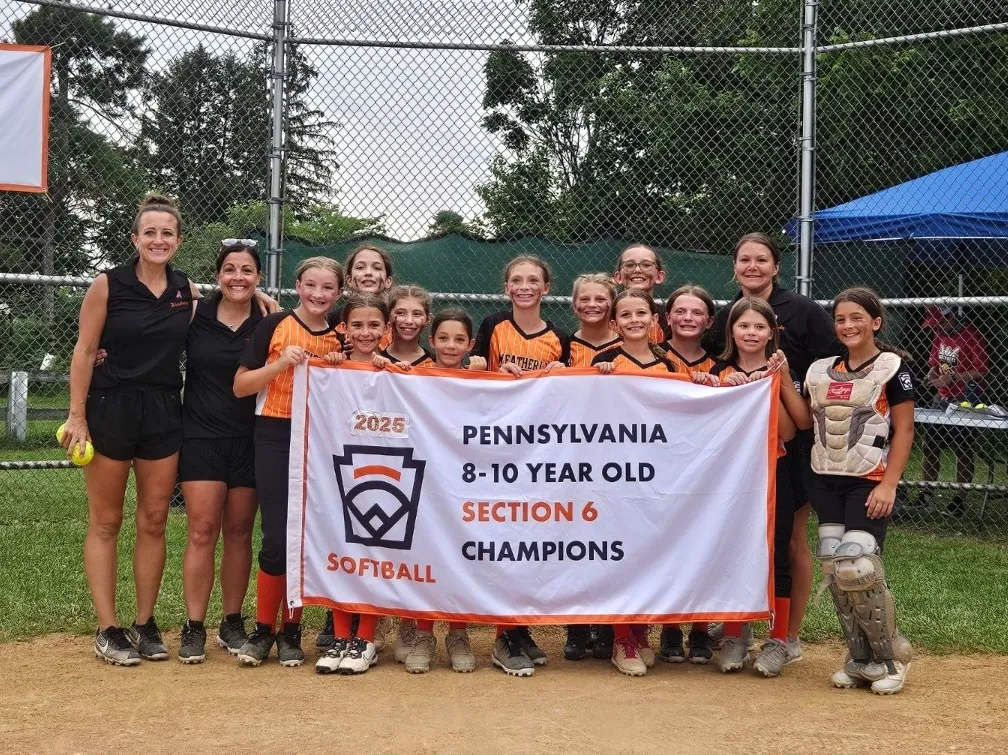
Reya Gregory doubled home the tying and eventual winning runs in the bottom of the fourth inning as Weatherly’s 8-10-year-old softball team edged Northwest, 5-4, in the Section 6 Little League Tournament title game at the West End Fairgrounds complex in Gilbert.
Briella Vanblargan starred in the pitching circle for Weatherly, scattering five base hits, striking out 12 batters and walking only two six innings as her team avenged a loss to Northwest from the night before to punch its ticket to the state tournament in Drexel Hill.
Northwest grabbed a 2-0 lead in the rematch on an RBI groundout in the top of the first and a run-scoring single to right in the third.
Back came Weatherly in the bottom of the third as two base runners stole home and a bases-loaded walk to Audrey Wagner forced home another run and gave the District 18 champions their first lead at 3-2.
After Northwest reclaimed the advantage with two runs in the top of the fourth, Weatherly went back on top on Gregory’s clutch two-run double in the bottom half.
Neither team scored again as Weatherly claimed the first sectional title for a local softball team.
Jenna Jones went 2-for-2 with two singles to pace the locals at the plate. Gregory contributed her double and two RBI and Vanblargan and Myah Makowiec chipped in a single apiece. Kenzie Clabia, Aubrey Clabia, Jones and Makowiec each stole multiple bases for the Lady Wreckers, who swiped a total of 14 as a team in the game.
Vanblargan, Jones, Makowiec, Mia Durham and Audrey Clabia scored a run apiece in the win.
Little League team makes run
A few weeks earlier, Weatherly’s 11-12-year-old Little League League all-stars enjoyed their own memoriable run.
They won their first two District 18 tournament games and led defending district champion-Franklin Township, 8-6, late in the district winners’ bracket final before an overflow crowd at their home field on a steamy summer evening. They were oh so close to hosting another game — for the district title.
However, Franklin Township rallied for two runs in the top of the sixth inning, scored more five in the seventh and held off Weatherly’s own comeback bid in the bottom half for a wild 13-10 victory in one of the most entertaining games at any level of the past year.
“We had our chance there at the end,” Weatherly manager Jeremy Witner said. “It just didn’t happen.”
It did happen for Weatherly earlier in the tournament and earlier in the game against Franklin Township.
Showing a ton of heart and guts, the locals twice overcame deficits to put them in position to play for the district championship. They scored five runs in the bottom of the fifth to erase a 6-3 deficit and get within three outs of advancing to the title game. Silas Zink blooped a two-run single to highlight the rally. Other runs came in on a baes-loaded walk and two wild pitches.
“They answered the bell every time,” Witner said. “They kept getting off the mat and coming for more.”
Weatherly’s dream of a Cinderella district crown died after Franklin Township made its own comeback and Tamaqua avenged an earlier tournament loss a few nights later, eliminating Weatherly.
“We’ve been trying to put Weatherly on the map for a while,” Witner said. “It’s always a couple teams we have to get through. … We’ll get there.”
In 2025, Witner and his team were at least pointed in the right direction.
Families seeking winter break activities can attend a free diving event Dec. 30 at the Goodyear YMCA, where a dive show and youth clinic will be offered at no cost.
The event is scheduled to begin at 3 p.m. with a dive show featuring junior-level divers. The show is open to the public, and spectators may attend without participating in the clinic.
After the performance, a youth dive clinic will run until 5 p.m. The clinic is open to children ages 7 to 17 and is intended to introduce participants to the sport of diving. Instruction will include basic techniques and supervised practice on 1-meter and 3-meter springboards, as well as a diving trampoline, according to organizers.
The clinic will be hosted by the YMCA Silver Fins Dive Team and sponsored by USA Diving. Organizers said the sponsorship allows the clinic, which is typically offered for a fee, to be provided free of charge.
The clinic will be held at is 2919 N Litchfield Rd, in Goodyear. All community members are invited to attend.
Central Valley Empowerment Alliance founder and co-executive director Arturo Rodriguez said the fact the state of California has reinvested in what they’re doing when it comes to preventing youth substance abuse by renewing their grant shows the stewardship his organization has provided for its program.
The Poplar-based CVEA was among 57 community-based and tribal organizations to be awarded $47 million in grants to prevent youth substance abuse through leadership engagement programs. The grants were awarded as part of Governor Gavin Newsom’s Path & Purpose initiative. The program also has a strong emphasis on reaching struggling young men and boys.
“It speaks more volumes than anything that anybody can say,” said Rodriguez about CVEA’s $900,000 grant being renewed in the program. CVEA will be reimbursed $300,000 a year over the next three years, 2026-2027-2028, for its costs in implementing the program.
The state said the $900,000 CVEA grant is “To engage Asian and Latinx youth in Kern and Tulare counties through culturally relevant mentorship, civic engagement, and peer-led storytelling to foster resilience, prevent substance use and improve health outcomes.”
Two other organizations received $1 million grants to serve Tulare County. The California Health Collaborative received a grant to serve Two-Spirit Indigenous/LGBTQIA+ youth of color in the county “through healing-centered activities, peer-led talking circles, and youth advocacy to strengthen cultural protective factors, reduce stigma surrounding substance use disorder prevention and improve health.”
In addition the Latino Commission on Alcohol and Drug Abuse Services has received a grant “to empower Latinx youth in Tulare County through peer-led support, leadership development, and family engagement to strengthen protective factors against substance use and improve health.”
The program is designed to build leadership and community-building skills among youth and Rodriguez said that’s what their program is all about. He said it’s about more than just substance abuse.
He noted the development of Nagi Daifallah Park has led to a number of youth sports teams being formed in Poplar. As a result parents are taking more responsibility, serving as coaches and traveling with their youth to games.
Rodriguez noted as part of the program youth have been able to travel to Sacramento and have even met the Governor.
He said he and CVEA’s other co-founder and executive director Mari Perez-Ruiz are dedicated to serving the community.
“We pay ourselves just above minimum wage,” he said. “We make sure to put as much as we can back into the community and our young people.”
About the state renewing the grant Rodriguez said, “They’re really excited about what we’ve managed to do for young people. It speaks volumes to the work that we do and the trust that we have.”
Programs funded by the grants are designed to deal with isolation, trauma, and lack of access to supportive services which can be especially challenging for young men and boys. The funding is designed to help youth foster mentorship, leadership, and civic engagement skills.
“As a parent, I am committed to investing in healing and empowering our youth to be changemakers within their communities. These investments focus on mentorship, connection, and purpose — especially for young men and boys who are too often struggling in silence,” Newsom said.
The funding is being provided through the California Department of Health Care Services to strengthen the state’s substance use disorder prevention programs. The grants are awarded through Elevate Youth California, EYC, a statewide program that prioritizes youth leadership.
The state provides funding to youth-serving organizations that demonstrate community-driven approaches to support young people. “Programs funded are healing-centered, trauma-informed, and culturally and linguistically responsive, while prioritizing harm reduction and public health strategies that build resilience and prevent substance abuse,” the state said.
“This funding empowers youth to lead change in their communities,”said DHCS Director Michelle Baass. “By supporting culturally responsive, peer-led programs, we’re investing in the resilience and long-term wellness of California’s young people.”
The state added the investment builds on Newsom’s executive orderto improve mental health and wellness among young men and boys, and empower them through service and leadership.
Recently, California launched the Men’s Service Challengewhich calls upon 10,000 young men to step up as mentors, coaches and tutors to address the mental health crisis facing young men and invest in communities across the state.
Since this program launched in 2019, DHCS has awarded more than $370 million through 517 grants. EYC is funded by Proposition 64, passed by voters in November 2016, which legalized adult non-medical marijuana use in California. The program uses taxes from cannabis sales.
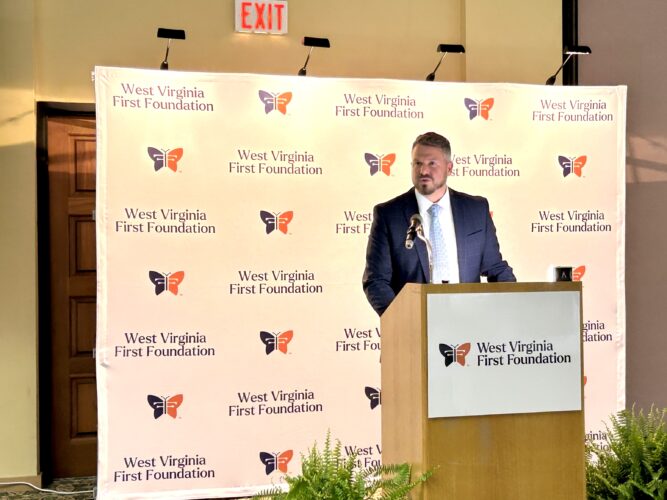
West Virginia First Foundation Executive Director Jonathan Board announces grant recipients in May. The foundation recently awarded another round of grants from the state’s pool of funding from settlements with opioid makers. (File Photo)
CHARLESTON — The West Virginia First Foundation has announced the latest recipients of funding through its Momentum Initiative Grant program, awarding nearly $18 million to support programs aimed at addressing substance use disorder, prevention, recovery and related workforce programs in the state.
“The Momentum Initiative Grant reflects a new way of responding to the substance use crisis; one grounded in evidence, shaped by local expertise and guided by accountability,” said Jonathan Board, WVFF executive director. “We traveled the state, listened to those holding the line in their communities, and answered the call to honor the lives lost by putting these resources into the hands of those ready to create real, lasting impact for West Virginia.”
Funding for 76 projects was approved by the West Virginia First Foundation board of directors earlier this month, with an eye toward supporting programs which include foster care, non-parental caregiver initiatives, youth prevention, recovery housing, behavioral health and workforce development and re-entry and diversion programs.
Eight grants were awarded to programs in Region 1, which includes Hancock, Brooke, Ohio, Marshall and Wetzel counties.
Those grants include $125,000 to Youth Services System for its Afterschool Youth Prevention Program; $249,397 to West Liberty University for its Hilltopper Pathways: Out-of-School Re-entry and Support Program; $216,065 to Northwood Health Systems for its Workforce for Wellness program; $125,000 for HoH-Share Inc. for the Mother Jones Center for Resilient Community Youth Prevention Program; and $250,000 to the Greater Wheeling Coalition for the Homeless for its Recovery First Re-entry Initiative Program.
The Young Women’s Christian Association of Wheeling received three grants, including $124,744 for YWCA Wheeling — Youth Prevention; $380,000 for YWCA Wheeling — Cathy’s Haven; and $186,450 for its Women Inspired in New Directions program.
“We were intentional in building a structure that reflects both feedback and best practices,” said Greg Duckworth, WVFF board chairman. “What emerged is a landmark opioid abatement model, distinct from any other foundation of its kind, made possible by volunteer Board Members and Expert Panelists dedicated to serving West Virginia.”
Statewide awards include $954,469.45 for National Youth Advocate Program for its Foster RISE project; $974,751 to Pressley Ridge for its Pressley Ridge Treatment Kinship Care Statewide Services; $975,000 to West Virginia CASA Association Inc. for its Continuum of Care for Children and Families Impacted by the Opioid Crisis; and $947,916 to West Virginia Wesleyan College for its WVWC and WV CASA Capacity Building Initiative.
With the start of 2026 comes New Year’s resolutions, and for many, that means looking for a new gym or personal trainer. At Better Bodies Inc., new members can get personal training, state-of-the-art exercise equipment, and a personalized plan to help them meet their goals.
“As far as the fountain of youth, this is the closest you’re going to come,” says owner and physical therapist Mitch Schroder.
Better Bodies Inc. offers a wide variety of memberships and programs to suit each client’s individual needs, from golf enhancement programs in the offseason to personal training for longevity or specialized coaching for youth sports. One of the staff members is a former special forces officer who will soon be teaching self-defense classes.
The gym has recently gone through renovations and major enhancements, including upgrading to shock-absorbent biometric floors and adding more Keiser equipment.
“You can adjust it by a fraction of a pound to get the right resistance for a client. I don’t know of any other place in Indy that has it,” Schroder says. “We’ve put a half-million-dollar investment into this place.”
He’s been in the business for more than three decades, and his passion for it has only increased with time.
“I wake up at four in the morning and can’t wait to get to work,” he says. “There’s a positive energy here, and we love being together.”
Schroder is proud of the staff he’s assembled and says it’s the most cohesive team he’s had in 30 years.
“I have really good people,” he adds. “They’ve taken ownership. I’m comfortable taking trips and traveling all over the world because I have people here who do a fantastic job, so I’m not worried when I leave that we’re going to lose clients. They’re asking themselves, ‘How do we get better every day?’ and we do get better every day.”
It’s important to him that his team is educated and stays up to date on their certifications so they can offer the best training and support to clients and remain well-informed.
“We do assessments and reassessments,” he says. “We get a baseline for our clients. It’s not safe if you don’t know their medical history. You can injure someone with an inept trainer. With the tools we have, we can show how people have improved in strength, muscular endurance, body fat and flexibility. We can rate them compared to others of the same age and sex. We’ve had people go from the 5th percentile to the 99th percentile with objective measurements.”
Better Bodies Inc. uses a holistic approach, monitoring clients’ nutrition, exercise, sleep and water intake.
“If they do the things we ask, we have a 100% success rate. Some people want to just say they have a personal trainer. This isn’t the place for someone who doesn’t want to change their life,” Schroder says.
Better Bodies Inc. has membership plans for individuals, couples, families and college students, as well as corporate-level options.
“Businesses benefit from corporate training and membership. It’s the very best benefit you can give your employees, and it’s very affordable,” Schroder says. “It causes them to be three times more efficient: they’re sick less, they’re more motivated, they notice it directly and appreciate that benefit. There have been studies showing whatever you invest in health and wellness for your employees, you get a three-dollar return. As people are healthier, their risk for heart attack goes down, and that’s the whole reason I started this.”
For Schroder, helping people improve their health is a personal mission and one close to his heart.
“I was going to go to medical school. I didn’t know much about physical therapy before, but then my grandfather had a stroke,” he says. “I saw what they did to give him back his quality of life, and I thought there’s got to be nothing better on this Earth than being able to do that.
“But at some point, I had an epiphany. I asked myself, if we’re trying to help people, why do we let them have heart attacks? I kept seeing the same group of people, men and women who worked their entire lives, get to their 50s and 60s, then have a stroke and are limited for the rest of their lives.”
That’s how Schroder got the idea for Better Bodies 30 years ago, and it’s still what drives him and his business today.
“This is preventative, and it’s about quality of life,” he says. “What you can do is determined by how well you take care of yourself.”
Better Bodies Inc. is located at 12775 Horseferry Road in Carmle. They are open 24 hours a day. To find out more, email betrbodiz@aol.com, visit betterbodiesinc.com or call 317-508-0839.









 “
“ “
“